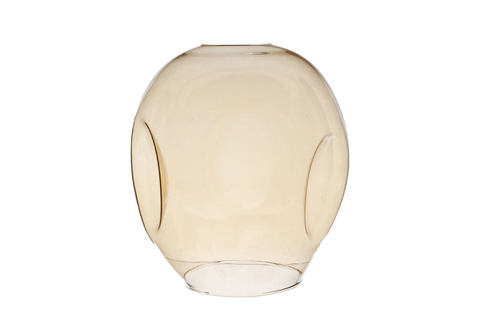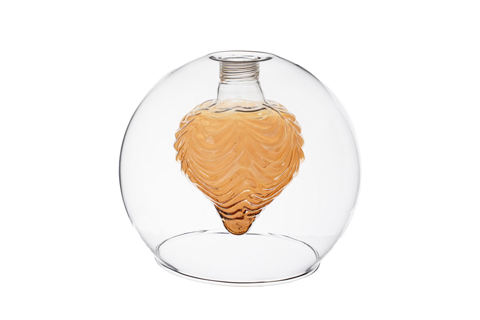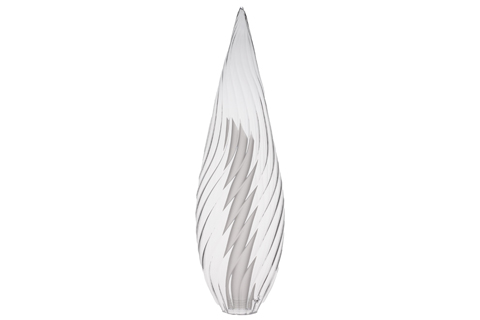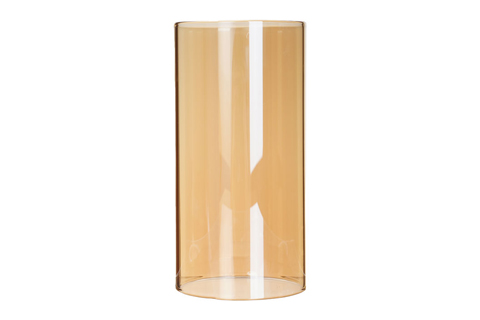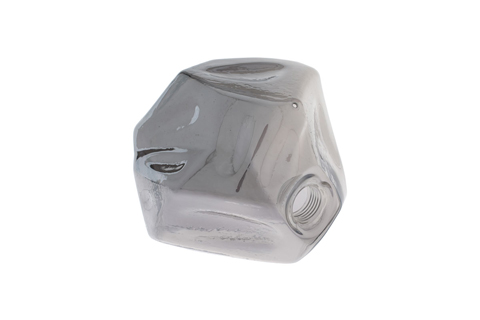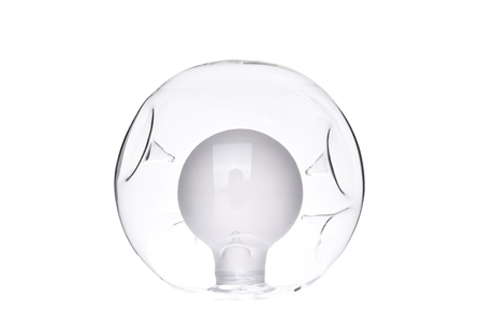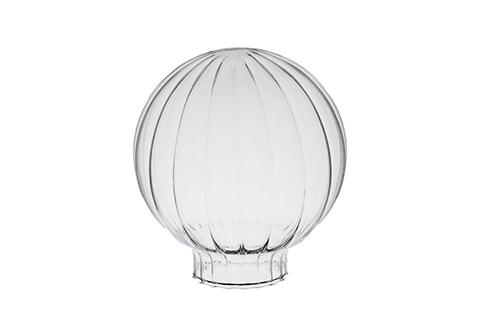
What is lampwork borosilicate glass lampshade?

Precision Flame-Working Techniques for High-Performance Lighting Components

 
In the specialized landscape of architectural and decorative lighting, certain applications demand manufacturing precision that transcends conventional glass forming methods. Lampwork borosilicate glass lampshades—created through controlled manipulation of borosilicate tubing and rod using focused flame heat—represent the convergence of artisanal craftsmanship and engineering-grade tolerances. This technique produces components with wall thickness control, geometric complexity, and optical consistency unattainable through traditional blowing or pressing operations.
As a custom glass lamp shade manufacturer with dedicated lampwork production cells serving medical, aerospace, and premium lighting sectors, we’ve developed proprietary protocols that transform this historically artistic discipline into a scalable manufacturing solution. This comprehensive analysis examines lampwork technology’s unique capabilities, technical specifications, and strategic applications for lighting product development.

Defining Lampwork: Technique and Distinction


The Fundamentals of Flame Working

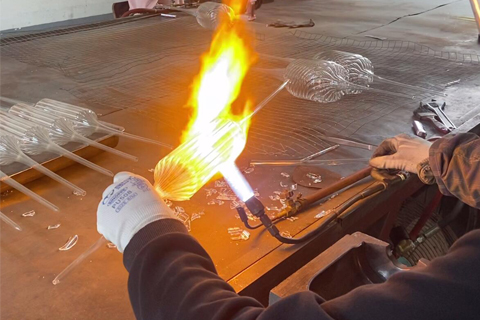
Lampwork—also termed flame working or torch working—employs concentrated heat sources to manipulate glass in its plastic state. Unlike furnace-based glassblowing utilizing bulk molten glass, lampwork begins with solid raw material: precision-drawn borosilicate tubing and rod stock in standardized diameters (typically 4mm to 50mm) and wall thicknesses (0.5mm to 5mm).
The glass lamp shade factory workstation configuration centers on:
Heat Source: Surface-mix gas-oxygen torches generating focused flames reaching 1,200-1,400°C, with precise stoichiometric control enabling oxidizing, neutral, or reducing flame chemistry as required by glass composition and desired surface finish.
Manipulation Tools: Graphite paddles, stainless steel jacks, tungsten picks, and custom-formed brass molds for specific shade geometries. Tool selection critically influences final surface characteristics and dimensional accuracy.
Rotation Systems: Variable-speed lathes or hand-rotation jigs maintaining concentricity during forming operations. For custom glass lamp shade production, our automated rotation systems achieve ±0.1mm runout tolerance on cylindrical sections.
The fundamental distinction from artistic lampwork lies in process control. While studio artists emphasize expressive variation, industrial lampwork for lighting components demands statistical process control, documented thermal cycles, and reproducible parameters that glass lamp shade manufacturers can validate across production batches.
 

Borosilicate Selection Rationale

Lampwork technique specifically favors borosilicate glass (3.3 expansion coefficient) for technical reasons beyond its general material advantages:
Thermal Shock Resistance: The rapid, localized heating inherent to flame working generates steep thermal gradients. Borosilicate’s low expansion prevents cracking during the repeated heating-cooling cycles required for complex assemblies.
Working Viscosity: Borosilicate maintains workable viscosity across a broader temperature range than soda-lime or lead glass alternatives, allowing extended forming time for precise detail execution.
UV Stability: Lampwork-produced shades often serve UV-sensitive applications (museum lighting, archival illumination) where borosilicate’s UV transmission stability prevents the solarization that degrades optical performance.
Chemical Compatibility: Medical and laboratory lighting applications demand material inertness that borosilicate’s silicate-boron network structure provides.

Manufacturing Process: From Tube to Finished Shade


Stage 1: Material Preparation and Inspection

Production begins with certified borosilicate tubing incoming inspection. Our glass lamp shade factory verifies:
  • Dimensional compliance: Outer diameter ±0.05mm, wall thickness ±0.03mm using laser micrometry
  • Stress birefringence: Polariscope examination confirming annealed, strain-free stock
  • Surface quality: 100% inspection for scratches, inclusions, or drawing defects that would propagate in finished components
Material traceability documentation maintains batch records linking finished shades to specific raw material melts—critical for medical device lighting applications requiring material certification.

Stage 2: Thermal Conditioning and Initial Forming

The lampwork artisan mounts tubing stock on the rotation system and applies controlled flame heat to specific zones. Thermal profiling—documented through pyrometric observation and timed heat application—determines material flow characteristics.
For cylindrical shade bodies, the process sequence typically involves:
  1. Neck-down formation: Controlled heating and drawing to create mounting neck diameters compatible with fixture hardware (standard 29mm, 42mm, or custom specifications)
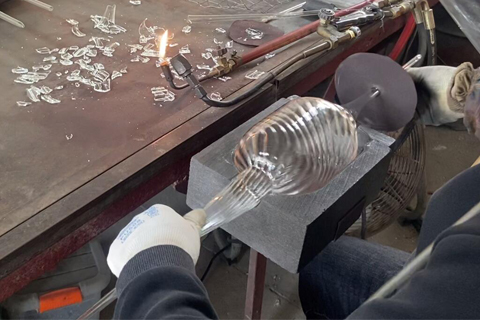
  2. Body expansion: Internal air pressure introduction combined with external heat application to achieve target diameter and wall thickness
  3. Rim formation: Precision tooling to create finished edges with specified break-chamfer or rolled profiles
Our custom glass lamp shade manufacturer capabilities include vacuum-assisted forming for non-cylindrical geometries—using internal vacuum to draw heated glass against external molds, producing square, elliptical, or organic cross-sections impossible through conventional blowing.

Stage 3: Optical Surface Finishing

Lampwork enables unique surface treatments unavailable to other manufacturing methods:
Fire Polishing: Controlled flame exposure melts surface asperities, achieving optical-grade surface roughness (Ra < 0.05μm) without mechanical polishing compounds that might residue-contaminate optical pathways.
Surface Patterning: Selective heating with textured tools or directed flame impingement creates controlled optical diffusion patterns—frosted bands, prismatic textures, or micro-lens arrays that manage light distribution without secondary films or coatings.
Color Integration: Fritted borosilicate color rods fused to clear bodies during lampwork operations create integral coloration with superior durability versus applied coatings. Our palette includes 37 standard transparent and opal tones, with custom color matching to client specifications.
 

Stage 4: Annealing and Stress Relief

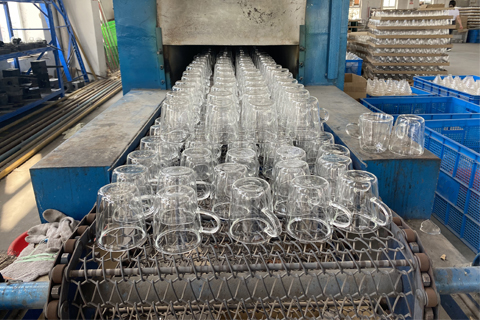
Despite borosilicate’s thermal stability, lampwork’s localized heating generates internal stresses requiring controlled relief. Our glass lamp shade factory employs programmable kiln annealing with phase-specific protocols:
  • Stress relief: 560°C hold (borosilicate annealing point) with 30-minute dwell
  • Controlled cooling: 2°C/minute reduction to 400°C, preventing thermal shock
  • Final cooling: Unrestricted to ambient
Post-annealing quality verification includes polariscope inspection confirming <50nm optical retardation—indicating stress levels compatible with demanding applications.

Borosilicate Glass Lamp Shade Manufacturing Process
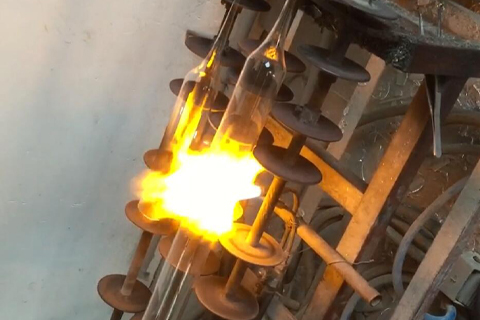
Material Cutting

Material Softening

Forming with Mold
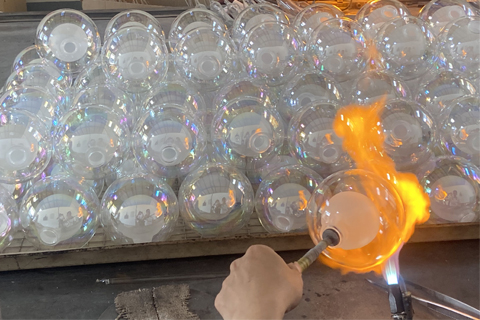
Rip & Seal

Annealing

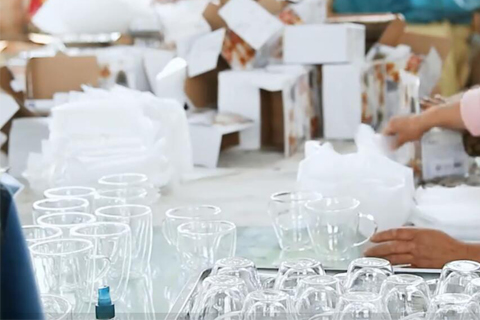
Inspection & Packing

Technical Advantages: Why Specify Lampwork


Precision Wall Thickness Control

Conventional glassblowing achieves ±15-20% wall thickness variation; pressing achieves ±10% with tooling wear degradation. Lampwork borosilicate production maintains ±5% thickness uniformity through real-time manipulation and measurement.
This precision enables:
Optical Engineering: Predictable light transmission and diffusion characteristics for photometric modeling. Lighting designers can specify exact luminance distributions confident that manufacturing variation won’t compromise performance.
Thermal Management: Uniform heat conduction preventing hot spots in high-output LED applications. Our computational fluid dynamics modeling confirms 40% reduction in maximum surface temperature differential versus conventional blown shades of equivalent material.
Structural Optimization: Minimum material for required strength, reducing weight and material cost without performance compromise.

Complex Geometry Realization

Lampwork’s additive nature—building components through sequential joining of elements—enables geometries impractical for subtractive or mold-based methods:
Multi-Chamber Designs: Internal walls creating distinct optical zones within single shade assemblies, enabling complex light mixing or baffle functions.
Integrated Mounting Features: Glass threads, bayonet fittings, or snap features formed integrally with shade bodies, eliminating metal hardware and associated galvanic corrosion risks.
Asymmetric Forms: Free-form development without mold investment, ideal for limited editions or rapid prototyping phases preceding volume production.
Our custom glass lamp shade manufacturer archive includes 200+ lampwork-developed geometries subsequently transitioned to volume production, with design-to-production cycles as short as 72 hours for urgent client requirements.
 

Micro-Scale Feature Capability

Lampwork torch precision enables features at scales impossible through mechanical forming:
  • Filigree elements: Glass threads to 0.3mm diameter for decorative screening
  • Precision apertures: Controlled orifices for light beam shaping
  • Surface micro-textures: Optical diffusers with 50-200μm feature sizes
Case Studies: Lampwork in Commercial Application


Case Study 1: Surgical Lighting System (Medical Device Manufacturer)

Client: Tier-1 medical device OEM requiring sterile field illumination components for next-generation operating theater lighting system.
Technical Requirements:
  • Absolute material purity (no heavy metals, leachable components)
  • Wall thickness uniformity ±0.1mm for consistent photometric performance
  • Integrated mounting threads (glass-to-glass, no metal contamination)
  • Steam sterilization compatibility (134°C autoclave cycles)
Challenge: Conventional glass lamp shade manufacturers proposed metal-threaded assemblies with silicone gaskets—unacceptable for sterile field requirements due to particle generation and bacterial harboring risks.
Our Lampwork Solution: Developed single-piece borosilicate shades with integrally formed 33mm ISO glass threads, created through precision lampwork threading operations using diamond-impregnated forming tools. Wall thickness maintained 2.0mm ±0.08mm across 156mm diameter.
Validation Results:
  • 5,000 autoclave cycle testing: 0% thread degradation, 0% optical degradation
  • Particulate generation testing (USP <788>): Below detection limits
  • Photometric consistency: Coefficient of variation <2% across 500-unit production lot
  • FDA 510(k) submission supported with complete material traceability documentation
Commercial Outcome: Exclusive supply agreement for system launch, with projected 8-year production contract value exceeding $4.2M. Client reported lampwork shade performance enabled 15% higher selling price versus competitive systems with conventional components.

Case Study 2: Museum Conservation Lighting (Cultural Institution)

Client: National museum network requiring 340 exhibition spotlights with UV-filtering shades for light-sensitive artifact illumination.
Technical Requirements:
  • Complete UV absorption below 400nm (wavelengths damaging to organic materials)
  • High visible transmission (>90%) for color rendering accuracy
  • Precise beam control with minimal spill light
  • Aesthetic compatibility with historic gallery architecture
Challenge: Standard UV-filtering acrylics yellowed within 18 months; coated glass filters created unwanted spectral artifacts; conventional borosilicate transmitted damaging near-UV.
Our Lampwork Solution: Engineered composite lampwork construction—clear borosilicate body with cerium-doped borosilicate face panel fused through precision flame-working. Cerium content optimized for 400nm cutoff while maintaining 91% visible transmission. Lampwork joining created optical-grade interface without adhesive layers.
Performance Validation:
  • Spectral transmission: <0.1% below 400nm, 91.2% 400-700nm
  • 10-year accelerated aging: Zero transmission degradation, zero color shift
  • Beam control: 8° spot distribution with <5% spill (vs. 12° typical for conventional reflector systems)
Commercial Outcome: Installation across 12 museum properties, with custom glass lamp shade specification adopted as institutional standard. Referral to three additional national museum systems, with combined contract value exceeding $2.1M.
 

Case Study 3: Architectural Pendant Series (Designer Lighting Brand)

Client: Emerging designer brand requiring complex geometric shades for debut collection targeting $800-1,200 retail price point.
Technical Requirements:
  • Asymmetric “liquid metal” aesthetic with organic surface variation
  • Consistent 1.5mm wall thickness for weight control (target <800g per shade)
  • Internal light baffle preventing direct source visibility
  • Rapid design iteration capability for collection development
Challenge: Conventional mold-based production required $45,000+ tooling investment per design variant, prohibiting the 8-shape collection scope planned. Alternative glass lamp shade factories proposed simplified designs sacrificing aesthetic intent.
Our Lampwork Solution: Established rapid lampwork prototyping cell producing production-representative samples within 5 days of design finalization. Developed parametric flame-working protocols enabling consistent replication of organic forms through documented torch movement patterns and timing sequences.
Production Scaling:
  • Phase 1: Hand-lampwork production (50-100 units monthly per design)
  • Phase 2: Semi-automated lampwork stations with CNC torch positioning (300+ units monthly)
  • Phase 3: Hybrid production maintaining hand-finished details on automated-formed bodies
Commercial Outcome:
  • Collection launched with 8 distinct designs (impossible through conventional tooling economics)
  • Retail sell-through 340% above projections, establishing brand in premium segment
  • Manufacturing flexibility enabled 4 seasonal design extensions without capital investment
  • Gross margins maintained 68% despite labor-intensive production, through premium positioning

Quality Systems and Validation


Process Control in Artisan Manufacturing

The characterization of lampwork as “artisanal” must not imply quality inconsistency. Our glass lamp shade factory implements manufacturing discipline matching automated production environments:
Standard Operating Procedures: 47 documented work instructions governing torch parameters, rotation speeds, thermal profiles, and inspection protocols—developed through DOE (Design of Experiments) optimization and maintained under document control.
Operator Certification: 120-hour training program including material science fundamentals, torch safety, dimensional measurement, and defect recognition. Annual recertification with demonstrated capability on standard test pieces.
In-Process Verification: Statistical sampling at 15-minute intervals during production runs, measuring critical dimensions (neck diameter, body concentricity, wall thickness) with automated data capture and SPC charting.
Final Inspection: 100% visual examination under controlled illumination, with automated optical sorting for critical defects. Dimensional verification on CMM (Coordinate Measuring Machine) for first-piece and hourly sample inspection.
 

Documentation and Traceability

For regulated applications, our custom glass lamp shade manufacturer systems provide:
  • Batch records: Complete production parameter documentation linking each shade to raw material lots, operators, equipment, and inspection results
  • Certificate of Analysis: Material composition verification, thermal expansion testing, and chemical resistance validation
  • Dimensional reports: CMM measurement data with statistical analysis (Cp/Cpk calculations)
  • Photometric data: Transmission spectra and diffusion characteristics for optical applications

Sourcing Considerations: Evaluating Lampwork Capabilities


Capability Differentiation Among Suppliers

Not all glass lamp shade manufacturers claiming lampwork capability deliver equivalent technical performance. Evaluation criteria include:
Equipment Infrastructure: Surface-mix torch technology (superior flame chemistry control) versus premix systems; automated rotation capability versus hand-manipulation only; programmable kiln capacity for production volumes.
Metrology Capability: In-house dimensional measurement (laser micrometers, CMM) and optical testing (spectrophotometers, integrating spheres) versus reliance on external validation.
Material Integration: Direct borosilicate melting capability ensuring material quality and customization versus reliance on merchant tubing with limited specification control.
Engineering Support: Design-for-manufacturing consultation translating client concepts to lampworkable geometries; prototyping speed and iteration capability.
 

Scalability and Economics

Lampwork economics differ fundamentally from high-volume processes. Unit costs remain relatively stable across production scales, with efficiency gains from operator skill development rather than automation amortization. Optimal applications include:
  • Low-to-medium volumes: 50-5,000 units annually where tooling investment for pressing/blowing is uneconomical
  • High complexity: Geometries or tolerances unattainable through conventional methods
  • Regulated applications: Requiring documentation and traceability incompatible with commodity supply chains
  • Rapid development: Design iteration cycles measured in days rather than weeks
Our glass lamp shade factory provides hybrid manufacturing solutions—lampwork prototyping transitioning to volume-optimized processes when designs mature and volumes justify capital investment—ensuring clients never pay artisan premiums for commodity requirements.

Conclusion: Strategic Application of Lampwork Technology

 
Lampwork borosilicate glass lampshades occupy a distinctive position in lighting manufacturing: the precision of engineering, the flexibility of craft, and the performance of advanced materials converging to solve problems that conventional methods cannot address. For custom glass lamp shade requirements demanding geometric complexity, optical precision, material purity, or rapid development cycles, lampwork offers compelling technical and commercial advantages.
As lighting technology advances toward higher power densities, stricter regulatory requirements, and increasingly sophisticated optical engineering, the capabilities that lampwork uniquely provides—precision wall control, complex internal features, integral functionality, and validated process documentation—become progressively more valuable.
Our custom glass lamp shade manufacturer operation invites lighting engineers, product developers, and designers to explore lampwork capabilities through collaborative development programs. From initial concept consultation through production validation, we provide the technical partnership that transforms ambitious lighting visions into manufactured reality.

For technical consultations, prototype development, or lampwork capability assessments for your specific applications, contact our engineering team. We provide comprehensive support including design feasibility analysis, material specification, and manufacturing scale planning to optimize your lighting product development.

Author: Hannah

Hannah is a senior sales professional with over 10 years of experience in the glass industry, specializing in global B2B markets for glass products. Throughout her career, she has worked closely with lighting brands, wholesalers, and manufacturers across North America, Europe, and other international markets, gaining a deep understanding of diverse market needs and industry trends.

With strong expertise in both commercial strategy and manufacturing processes, Hannah is highly familiar with glass production techniques such as pressing, blowing, and custom fabrication. She has successfully supported clients in developing custom glass products, optimizing production solutions, and improving product performance while controlling costs.

Hannah is known for her practical, solution-oriented approach. By combining technical knowledge with real market insights, she helps customers solve complex sourcing challenges and build reliable, long-term supply partnerships. Her goal is to deliver not just products, but professional support and tailored solutions that create real value for clients.

Lampwork Borosilicate Technical FAQs

Lampwork borosilicate glass lampshade is a handcrafted lampshade made of borosilicate glass tubes, shaped and formed by skilled artisans using a lampworking technique (heating the glass with a high-temperature torch to bend, mold, and shape it into desired styles).
Borosilicate glass has excellent thermal stability, high temperature resistance (up to 500°C), low thermal expansion coefficient, and good transparency.
The MOQ is lower and the mold cost is also relatively inexpensive.
Yes, we offer full customization services. We can customize the shape (curved, dome, bell, irregular), size (diameter, height, opening), color (transparent, frosted, colored coating), surface finish (sandblasting, laser engraving, hand-painted), and even add custom logos based on your drawings, samples, or design requirements.
The lead time depends on the complexity of the design and order quantity: – Sample lead time: 7-15 days (since each sample is handcrafted, it takes more time for precision). – Mass production lead time: 20–35 days after sample approval, depending on the order volume.
Since lampwork is a handcrafted process, the MOQ is flexible. For standard designs, the MOQ is 200 pieces; for highly customized or intricate designs, we can discuss a lower MOQ for trial orders.

Request a Quote Ready to Work Together? Build a project with us!

REQUEST A QUOTE