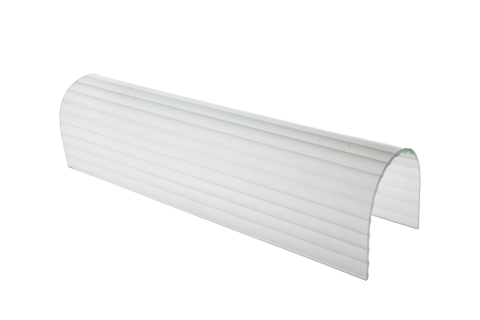
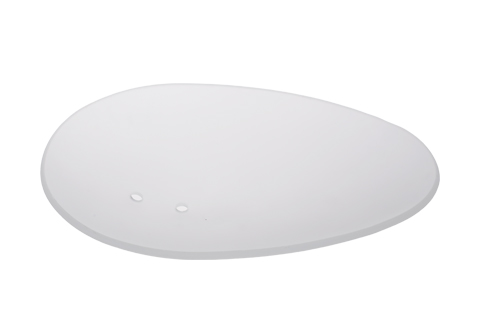
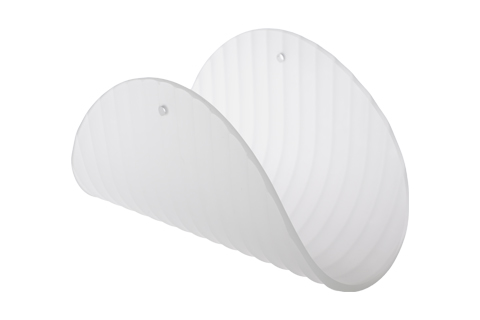
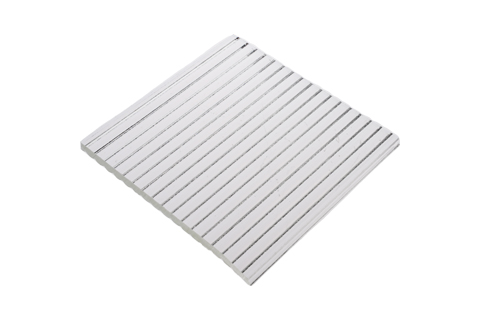
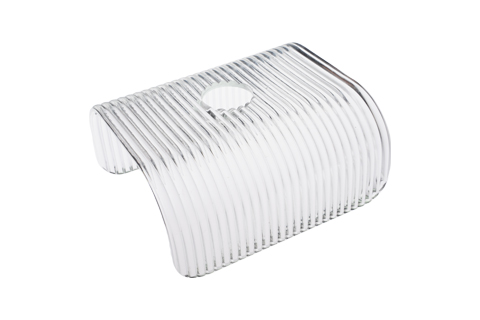
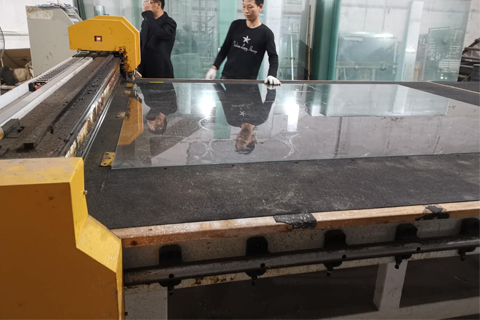
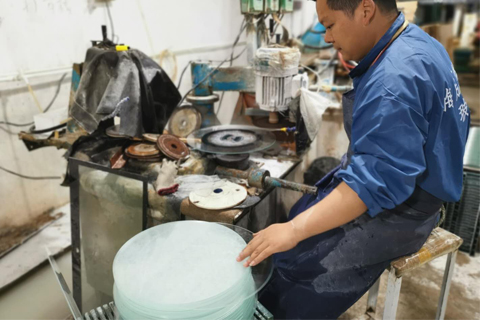
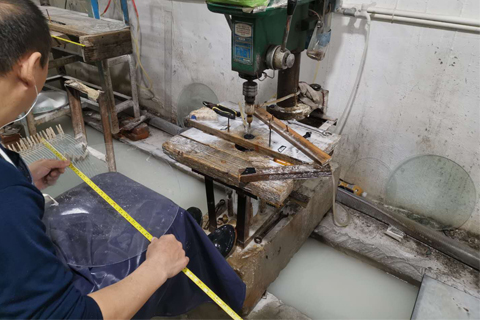
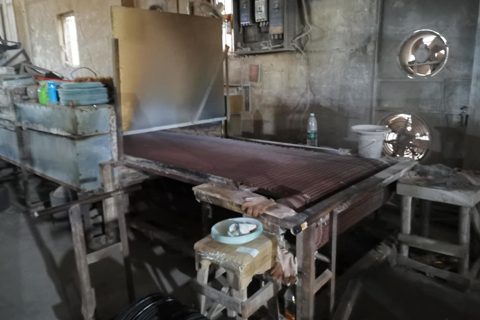
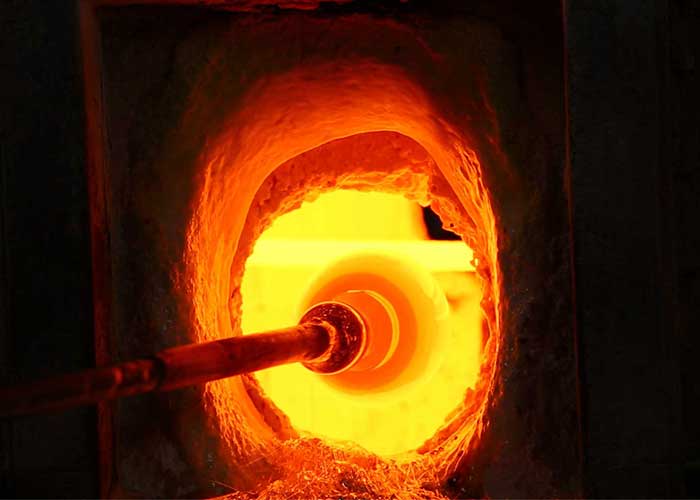
Heat-bent curved glass is produced by heating flat glass sheets to approximately 600-720C and forming them over refractory molds using gravity slumping, vacuum assist, or pressure-forming techniques. At forming temperature the glass softens enough to flow into the mold shape under controlled stress without losing its essential dimensional stability or optical properties. After forming, the curved glass passes through an annealing cycle to slowly cool from 540C to room temperature over 60-120 minutes, relieving internal stress that would otherwise cause cracking. Heat-bending is the preferred technique for producing precise curved lampshade geometries including half-cylinders, quarter-spheres, compound saddle curves, and architectural wave forms. The technique produces excellent dimensional accuracy (+/-0.5mm typical), uniform wall thickness preservation, and clean polished surfaces. Heat-bent glass shades are used extensively in modern wall sconces, architectural pendant lights, and designer lighting brands requiring sculptural curved forms.
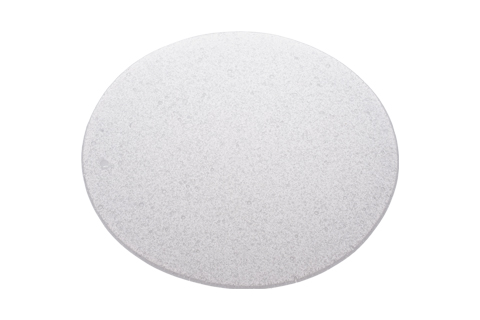
Curved glass lamp shades accept the same surface treatments as flat glass, including frosting, acid etching, sandblasting, screen printing, ceramic enamel coating, and digital inkjet printing. Frosting through acid etching produces uniform diffused finishes that hide bulb filaments while transmitting 70-85% of light – the most common treatment for modern interior lighting applications. Sandblasting creates similar diffused effects with optional pattern masking for decorative designs, logos, or branded markings. Ceramic enamel firing produces permanent colored or opaque white coatings with light transmittance ranging from 0% (full opaque) to 75% (translucent decorative). Digital ceramic inkjet printing enables full-color photographic imagery on curved surfaces for architectural feature lighting and branded retail fixtures. Each treatment must be applied after the curve forming process since heat-bending temperatures exceed the firing range for most surface coatings. Multi-treatment combinations (frosted plus printed logo, for example) require careful sequencing to preserve each layer’s adhesion.
Heat-bent lamp shades are typically produced from three glass material choices selected based on application requirements: standard soda-lime float glass (most common, used for general decorative lighting), low-iron extra-clear float glass (preferred when premium optical clarity is required, with 90-92% light transmittance vs 85-88% for standard soda-lime), and borosilicate 3.3 sheet glass (specified for high-temperature applications, outdoor fixtures, or where thermal shock resistance is critical). Standard thickness ranges from 3mm for small decorative wall sconces up to 8mm for large architectural curved pendants, with 4-5mm being the most common production thickness. Each material has different optimal forming temperatures – soda-lime bends well at 620-680C, low-iron at 640-700C, and borosilicate requires 700-780C due to its higher softening point. The material choice affects per-piece cost (low-iron costs 25-40% more than standard, borosilicate 60-100% more) but also long-term performance and appearance.
Yes, curved glass lampshades can be tempered after the heat-bending and annealing cycle, providing 4-5x impact strength improvement over annealed curved glass. The tempering process involves reheating the curved shade to 620-650C and then rapidly cooling the surface using controlled air jets, creating compressive surface stress. Tempering of curved glass is more complex than flat glass because uniform air-jet cooling around curved geometries requires custom-positioned blowing nozzles – this limits the technique to curves with radii above approximately 150mm. Tighter radii below 100mm cannot be conventionally tempered and instead use chemical strengthening (potassium ion exchange) which provides 2-3x strength improvement without geometric limitations. Tempered curved shades are required for vandal-resistant outdoor sconces, school and hospital lighting, and any code-regulated overhead glass fixture. Tempered glass cannot be modified after the tempering process, so all drilling and finishing must be completed before tempering.
Curved glass lampshades are most commonly specified for five design application categories: modern wall sconces with half-cylinder or quarter-sphere light shields, architectural pendant lights with compound saddle curves directing light in specific patterns, designer chandelier components combining multiple curved elements, bathroom vanity strips with downward-throwing curved diffusers, and retail accent lighting using small curved shades for product display illumination. In hospitality settings, curved glass dominates hotel corridor sconces, restaurant booth lighting, and reception area pendants where soft directional light supports specific ambient design intent. Residential applications include entryway ceiling fixtures, bedside reading sconces, kitchen island pendants, and home office task lighting. Designer brands frequently use curved glass for signature collection pieces because the sculptural curves create distinctive silhouettes that distinguish their products visually in lighting showrooms and online retail listings. Curve geometry directly influences light distribution patterns, allowing designers to specify both aesthetic and functional outcomes.
Custom curved glass shade orders have MOQ ranging from 300 pieces per design for simple single-axis curves up to 1,the quoted quantity per design for complex compound curves with multiple-part molds. Custom mold development cost ranges from $1,200 for simple slumped curves up to $5,500 for sophisticated compound geometries with multiple draft angles or split-mold tooling. Sample development typically requires 3-5 physical prototypes over a 25-40 day approval period before mass production begins. Per-piece pricing depends on size, glass material, surface treatment, and curve complexity – a typical 200mm wide half-cylinder curved shade in clear soda-lime glass with frosted finish wholesales at $4-$8 FOB Shanghai for orders of the quoted quantity. Borosilicate, low-iron glass, tempering, or complex compound curves can increase pricing by 50-150% depending on combination. We sign mutual NDAs for designer brand proprietary curve geometries and retain custom molds exclusively for the originating customer.
Curved glass lampshades modify the light distribution pattern from a bulb significantly compared to flat or cylindrical alternatives, acting as a lens that focuses, spreads, or redirects the bulb output based on the specific curve geometry. Concave curves (bowl shapes, dome shades) focus light toward a central point below the fixture, producing intense narrow beam angles of 30-60 degrees suitable for task lighting over kitchen islands, work desks, or retail display tables. Convex curves (outward-bulging dome shades) spread light in wide patterns of 90-160 degrees, producing ambient room illumination ideal for entryways, hallway sconces, and general living area lighting. Compound curves combining concave and convex sections can produce specialized beam patterns for architectural lighting effects. For lighting designers requiring precise photometric prediction, we provide IES file photometric data measured in our integrating sphere with reference 800-lumen LED bulbs.
Heat-bent curved glass shades can achieve curve radii from a minimum of approximately 60mm (tight half-cylinder bends) up to several meters (gentle architectural curves), with the practical sweet spot for lampshade applications between 80mm and 400mm radius. The minimum achievable radius depends on glass thickness: 2mm glass can bend to 60mm radius reliably, 4mm glass requires minimum 100mm radius, and 6mm glass needs at least 180mm radius without quality compromise. Tighter radii than these minimums risk surface wrinkling, optical distortion visible in light transmission, and concentration of internal stress that may cause delayed cracking weeks after production. For radii below the recommended minimum for a given thickness, alternative forming techniques (mouth-blowing into curved molds or press-forming) should be specified instead of slumping. Complex compound curves requiring bending in two axes simultaneously demand custom multi-part molds and add 25-40 days to standard development timelines.
Yes, curved glass lampshades are available in colored or tinted glass through two main approaches: starting with pre-colored sheet glass before heat-bending, or applying ceramic enamel coatings after forming. Pre-colored sheet glass (manufactured with in-the-mass metal-oxide pigments) preserves the color permanence and depth of full-thickness tinting through the bending process, producing rich uniform colors that cannot fade or peel. Available colors in pre-tinted sheet form include amber, gray smoke, bronze, blue, green, and select Pantone matches for orders above 5,000 square meters per color. Post-forming ceramic enamel coating offers wider color flexibility (any custom color including multi-color gradients and patterns) but is a surface treatment that adds 30-50 microns to the glass thickness on the coated side. Coating durability is excellent when properly fired at 600C, with documented retention exceeding 20 years in normal indoor lighting environments without fading, peeling, or chemical degradation.
Curved glass production quality and consistency are maintained through a six-step quality control system. Each incoming flat glass sheet is dimensionally inspected for thickness, surface defects, and optical clarity before forming. Mold temperature is monitored continuously during the heating cycle with thermocouples placed at multiple points to ensure uniform forming temperature within +/-15C. Curved samples are scanned with a 3D digital scanner comparing against the original CAD model, with typical accepted tolerance of +/-0.5mm for designer applications. Surface quality is verified under D65 daylight using polariscope inspection to detect any residual internal stress that could indicate inadequate annealing. Dimensional sampling at 5 pieces per 100-unit batch records key dimensions in batch quality logs retained for 5 years. Final visual inspection under standardized lighting confirms each piece meets the buyer’s approved master sample. For matched-pair applications such as bookend wall sconces, we apply matched-pair production protocols ensuring left/right pieces are visually identical.