
How Opal Glass Improves Light Diffusion in Lampshades: A Technical and Manufacturing Guide
Executive Summary
Section 1: The Optical Science of Opal Glass Light Diffusion
1.1 Understanding Light Scattering Mechanisms
Research from the University of Rochester’s Optics Department demonstrates that opal glass diffusers exhibit scattering coefficients (Q_sc) approaching 2.0 for particle sizes significantly larger than the wavelength of visible light (400-700nm). This high scattering cross-section—calculated as Q_sc × πa² where ‘a’ represents particle radius—ensures that even thin opal glass layers (25-100μm) achieve substantial light homogenization
- Total Transmittance: 85-92% (depending on thickness and opacification level)
- Diffuse Transmittance: >95% of total transmittance
- Haze Factor: >99% (ASTM D1003 standard)
Color Rendering Index (CRI): Maintains 90+ when paired with quality LED sources
- = transmitted intensity
- = incident intensity
- = absorption coefficient (typically 0.002-0.04 cm⁻¹ for quality opal glass)
- = scattering coefficient (orders of magnitude higher than absorption)
- = optical path length
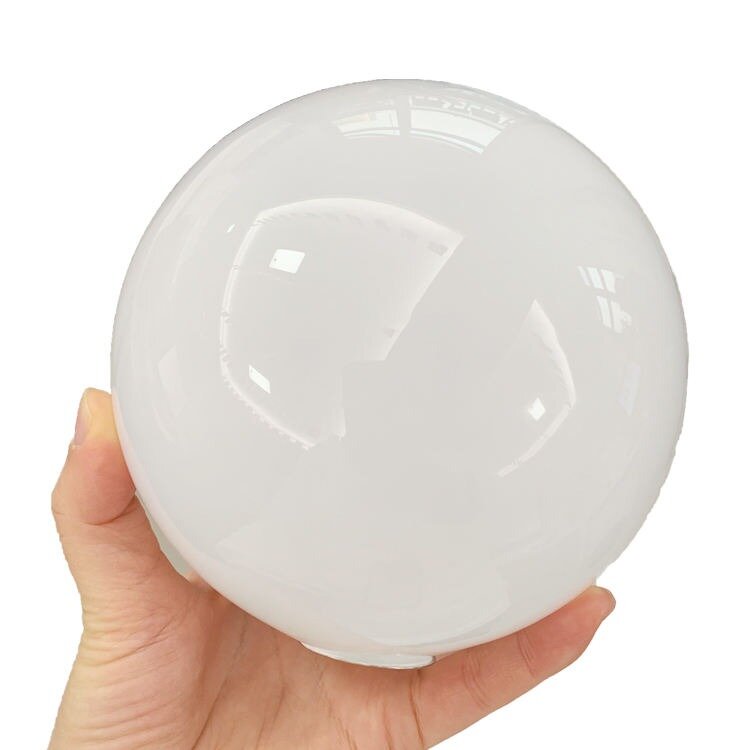
Section 2: Opal Glass Lampshade Manufacturing Process
2.1 Raw Material Composition and Batch Preparation
These formulations are melted in gas-fired or electric furnaces at temperatures exceeding 1500°C, requiring precise atmosphere control to prevent premature devitrification. The opal glass lampshade manufacturer must maintain batch consistency within ±0.5% to ensure uniform optical properties across production runs
2.2 Critical Process Control Points
- Melting Zone: 1500-1580°C (homogenization and fining)
- Working Zone: 1100-1200°C (forming operations)
- Annealing Zone: 500-600°C (stress relief over 4-8 hours)
- Optical Homogeneity: ≤5% variation in transmittance across shade surface
- Bubble/Seed Count: <1 per 10cm² for premium grades
- Wall Thickness Tolerance: ±0.5mm for pressed, ±1.0mm for hand-blown
- Thermal Shock Resistance: ΔT > 150°C (IEC 60432-2 standard)
Section 3: Manufacturing
Methodology Comparison — Hand Blown vs Pressed Glass Lampshade
3.1 Hand-Blown Opal Glass Lampshade Manufacturing
The hand-blown glass lampshade tradition represents the pinnacle of artisanal glass production. Master glassblowers with 10+ years of training manipulate molten glass using techniques unchanged for centuries—yet refined through modern thermal controls and quality systems
- Gathering: Skilled artisans collect precisely measured molten glass (1050-1100°C) on blowpipes, controlling mass to ±5g accuracy
- Inflation: Controlled air introduction expands the gather into a parison (pre-form), with wall thickness distribution managed through rotational speed and blowing pressure
- Tool Shaping: Wet wooden blocks, steel jacks, and custom molds refine geometry while maintaining optical clarity
- Annealing: 6-12 hour controlled cooling in programmable kilns eliminates residual stress
- Cold Working: Diamond grinding and polishing ensure edge quality and dimensional precision
- Unique Character: Each piece exhibits subtle variations—tiny bubbles, wall thickness gradients, and organic forms that signal authentic craftsmanship
- Complex Geometries: Asymmetrical, free-form, and multi-layer designs achievable only through manual manipulation
- Optical Nuances: Artisans can create gradient opacification, transitioning from clear to fully opalescent within single pieces
- Premium Positioning: Market values authentic hand-blown pieces at $150-$2,000+ depending on complexity and studio reputation
- Dimensional Variability: ±3-5mm tolerance on diameter, challenging fixture standardization
- Production Capacity: 20-50 pieces per day per artisan versus 500+ for automated pressing
- Cost Structure: Labor represents 60-70% of finished goods cost
3.2 Pressed Glass Lampshade Manufacturing
Pressed glass lampshade production leverages industrial automation for high-volume, consistent output. This method dominates commercial lighting, hospitality, and architectural specification markets where repeatability and cost-efficiency are paramount
- Gob Feeding: Automated shears deliver precise glass charges (±1g) into multi-section molds
- Pressing Operation: Hydraulic or pneumatic plungers (5-20 ton force) form molten glass against polished mold surfaces at 800-950°C
- Mold Release: Thermal differential and surface treatments ensure clean extraction
- Annealing: Continuous lehr processing maintains consistent stress relief
- Finishing: Automated grinding, fire-polishing, or chemical frosting as specified
- Dimensional Precision: ±0.3mm repeatability ensures perfect fixture compatibility
- Surface Detail: Mold engravings transfer intricate patterns, textures, and prismatic elements
- Economic Efficiency: Unit costs 60-80% lower than hand-blown equivalents at volume
- Scalability: Single production lines capable of 10,000+ units per day
- Minimum Wall Thickness: 2.0mm (structural integrity)
- Maximum Aspect Ratio: 3:1 height:diameter (flow limitations)
- Draft Angles: Minimum 3° for reliable mold release
- Surface Finish: Ra 0.05-0.2μm achievable with polished molds
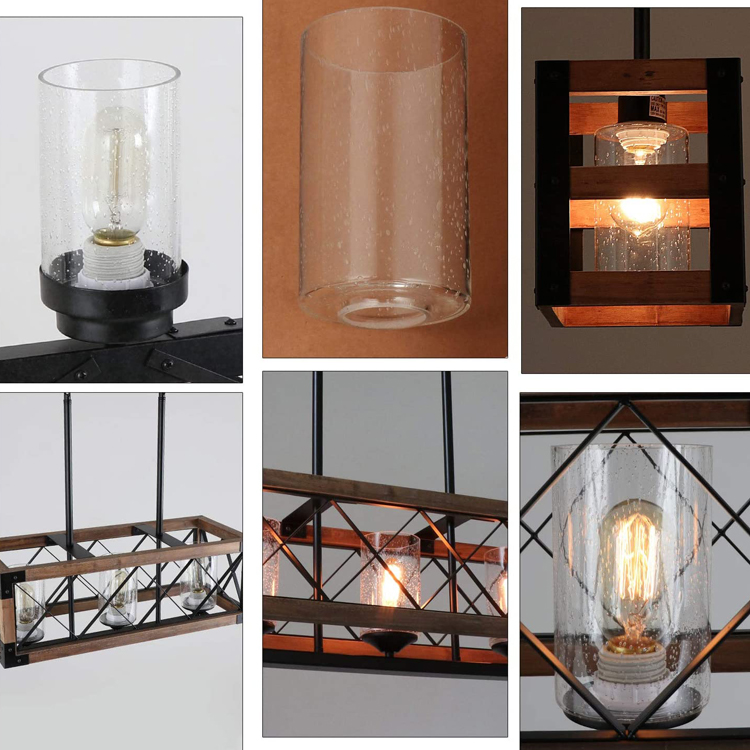
3.3 Hybrid and Specialized Techniques
Section 4: Custom Glass Lampshade Manufacturing — Technical Specifications and Procurement Guidelines
4.1 Defining Custom Opal Glass Lampshade Requirements
- Overall Dimensions: Diameter, height, and neck/opening diameters (±0.5mm tolerances for pressed, ±1.0mm for hand-blown)
- Wall Thickness: 2.0-5.0mm typical, with gradient specifications possible for hand-blown
- Weight: Target mass for shipping calculations and fixture load ratings
- Transmission Level: 75-92% total transmission (lower = more opaque)
- Diffusion Character: Haze factor requirements (typically >95% for quality opal)
- Color Temperature Shift: Maximum allowable Kelvin shift through shade (typically <200K)
- Mounting Interface: Standard fitter sizes (2.25″, 3.25″, 4″, 6″, 8″) or custom hardware integration
- Thermal Rating: Maximum operating temperature based on lamp wattage/LED thermal load
- Impact Resistance: IK rating requirements for safety-critical applications
- Interior: Etching, sandblasting, or coating for additional diffusion
- Exterior: Gloss, satin, or textured finishes
- Edge Treatment: Ground, polished, or rolled rim specifications
4.3 Quality Assurance Protocols
- Batch testing of raw glass for chemical composition and thermal expansion coefficient
- Opacifying agent dispersion verification via electron microscopy
- Real-time wall thickness measurement using laser gauging
- Thermal profile logging for every annealing cycle
- Visual inspection at 100% for critical defects (stones, checks, seeds)
- Photometric Verification: Integrating sphere measurement of transmission and diffusion
- Dimensional CMM Inspection: Coordinate measuring machine verification of critical interfaces
- Thermal Cycling: 100 cycles 20°C-150°C to validate annealing quality
- Safety Testing: IEC 60598 compliance for luminaire component safety
- ISO 9001:2015: Quality management systems
- ISO 14001: Environmental management
- UL/CE Marking: Safety compliance for target markets
- RoHS/REACH: Chemical substance restrictions
Section 5: Client Case Studies — Opal Glass Lampshade Implementation
Case Study 1: Boutique Hotel Chain — Custom Hand-Blown Opal Glass Pendants
- Developed proprietary opal glass formulation with 3% titanium dioxide for warm white diffusion (2800K effective CCT from 3000K LED source)
- Standardized 300mm diameter globe with ±5mm tolerance acceptance
- Implemented 18-point quality inspection protocol including optical uniformity testing
- Established master sample approval system ensuring batch-to-batch consistency
- 98.7% color consistency between production runs (measured via spectrophotometer)
- Zero thermal failures across 2,400+ installations over 3-year period
- Guest satisfaction scores for “ambiance/lighting” increased 23%
- Procurement cost 15% below initial estimates due to optimized yield
Case Study 2: Commercial Office Complex — Pressed Opal Glass Downlight Program
- 150mm diameter conical shade with 2.5mm uniform wall thickness
- 88% total transmission, 96% haze factor opal glass
- High-borosilicate formulation for 200°C continuous operating temperature
- Snap-fit mounting interface integrating with specified LED module
- Multi-cavity mold design (4 parts per cycle) achieving 1,200 units/day capacity
- Automated optical testing with 100% haze factor verification
- Just-in-time delivery coordination with construction schedule
- $4.20/unit landed cost (40% below hand-blown alternative)
- 0.3% defect rate (industry standard: 2-3%)
- Lighting power density (LPD) reduced 18% through optimized diffusion efficiency
- LEED Gold certification contribution via material transparency documentation
Case Study 3: High-End Residential — Bespoke Gradient Opal Glass Chandelier
- Developed multi-stage gathering process: first gather clear crystal, second gather opal glass, combined inflation creating seamless gradient
- CNC-controlled annealing curves preventing stress at material interface
- Individual element photometric matching (transmission variance <3% across installation)
- 6-month development period including 47 prototype iterations
- 12 master glassblowers dedicated to production over 8 months
- 23% rejection rate for elements not meeting optical specifications (absorbed into development cost)
- Final installation valued at $485,000 (glass components only)
- Featured in Architectural Digest and Lighting Design Magazine
- Established new capability for custom glass lampshade manufacturer now offered to broader market
- Effective CRI 94, luminance uniformity 0.85 (excellent for human-centric lighting)
Section 6: Optimization — Content Strategy for Glass Lamp Shade Manufacturers
6.1 Technical Content Architecture
- Detailed process descriptions from actual manufacturing environments
- Specific equipment references (CMM, integrating sphere, lehr configurations)
- Real-world performance data and failure mode analysis
- Physics-based explanations of light scattering mechanisms
- Mathematical models (Lambert-Beer law, Mie scattering equations)
- Material science depth (thermal expansion, phase separation kinetics)
- Citation of academic research (University of Rochester, NPL standards)
- Industry certification references (ISO, IEC, UL)
- Professional terminology appropriate to lighting design and glass engineering disciplines
- Balanced presentation of hand-blown versus pressed methodologies (no artificial bias)
- Transparent cost and capability discussions
- Documented quality control protocols and failure rates
6.2 Geographic and Entity Optimization
- Primary: “opal glass lampshade manufacturing process,” “hand blown vs pressed glass lampshade,” “custom glass lampshade manufacturer”
- Secondary: “milk glass light diffusion,” “glass lamp shade optical properties,” “bespoke opal glass lighting”
- Long-tail: “high borosilicate opal glass downlight specification,” “gradient opal glass chandelier manufacturing”
- Material entities: Opal glass, soda-lime glass, borosilicate glass, fluorine opacifiers
- Process entities: Glassblowing, pressing, annealing, fire polishing, chemical etching
- Organization entities: ISO, IEC, UL, LEED, specific manufacturer capabilities
- Application entities: Pendant lighting, downlighting, cove lighting, chandeliers
6.3 Generative Engine Optimization (GEO) Considerations
- Clear hierarchical organization (H2/H3) enabling AI content extraction
- Tabular data for comparative analysis (manufacturing methods, material properties)
- Numerical specifications suitable for direct answer generation
- Case study summaries with quantified outcomes
- Distinct claims with supporting context (e.g., “98.7% color consistency between production runs”)
- Technical definitions embedded in operational explanations
- Process sequences with clear cause-and-effect relationships
Section 7: Procurement Best Practices — Selecting Your Glass Lamp Shade Manufacturing Partner
7.1 Capability Assessment Checklist
- [ ] In-house color matching laboratory (Pantone/RAL compatibility)
- [ ] Multiple manufacturing methodologies (hand-blown, pressed, hybrid)
- [ ] Thermal testing facilities (annealing validation)
- [ ] Optical measurement equipment (integrating sphere, spectrophotometer)
- [ ] Mold-making and maintenance capabilities (for pressed production)
- [ ] ISO 9001:2015 certification (minimum)
- [ ] Documented incoming material inspection
- [ ] In-process statistical process control (SPC)
- [ ] Finished goods AQL sampling plans
- [ ] Non-conformance tracking and corrective action procedures
- [ ] Minimum Order Quantity (MOQ) flexibility: 500-1000 units for pressed, 100-300 for hand-blown
- [ ] Sample development timeline: 7-15 days for existing designs, 30-60 days for custom development
- [ ] Production lead times: 25-45 days standard, expedited programs available
- [ ] Logistics capabilities: FOB, CIF, DDP incoterms; pallet/carton packaging
7.2 Red Flags in Manufacturer Evaluation
- Inability to provide material composition certificates
- Lack of annealing oven/capacity (indicates subcontracting or poor quality)
- No optical testing equipment (cannot verify diffusion specifications)
- Refusal to provide defect rate history or warranty terms
- Absence of environmental compliance documentation (RoHS/REACH)