
The Industrial Nature of the Pressed Machine Lampshade
Author: Rae Liu
Understanding Machine-Pressed Glass Lampshade Manufacturing for Commercial Lighting Applications
The lighting industry has undergone significant transformation over the past two decades, yet one manufacturing process remains fundamental to high-volume, precision glass lampshade production: machine pressing. For lighting designers, procurement specialists, and commercial fixture manufacturers seeking consistent quality at scale, understanding the industrial nature of press machine lampshade manufacturing is essential for making informed sourcing decisions.
What Is Machine-Pressed Glass Lampshade Manufacturing?
Machine pressing represents the most efficient method for producing uniform glass lampshades in medium to high volumes. Unlike hand-blown techniques that rely on individual artisan skill, press machine manufacturing utilizes automated or semi-automated systems to shape molten glass within precision-engineered molds.
Dimensional Consistency: Machine pressing eliminates the variability inherent in hand-blown production, ensuring each lampshade meets exact specifications. For lighting manufacturers assembling fixtures in volume, this consistency reduces fitting issues and simplifies inventory management.
Production Efficiency: A single press machine can produce hundreds of units per shift, depending on shade size and complexity. This throughput makes the process economically viable for large-scale lighting projects where component costs must remain competitive.
Design Repeatability: Once a mold is engineered and validated, every subsequent part matches the original design intent. This reliability proves particularly valuable for lighting brands maintaining consistent product lines across multiple production runs.
The Technical Process: From Raw Material to Finished Glass Lampshade
Raw Material Selection and Batch Preparation
- Soda-Lime Glass: The most widely utilized material due to its favorable balance of workability, clarity, and cost. Suitable for general interior lighting where moderate heat resistance suffices.
Borosilicate Glass: Engineered for applications requiring superior thermal shock resistance. With a linear thermal expansion coefficient of 3.3×10⁻⁶K⁻¹ conforming to ISO 3585 standards, borosilicate glass withstands temperature differentials up to 300°C without failure. This makes it ideal for high-heat fixtures, including halogen and high-output LED applications.
Opal Glass: Characterized by milky white appearance and controlled light diffusion (typically 30-70% transmittance), opal glass creates soft, glare-free illumination preferred in residential and hospitality settings .
Melting and Conditioning
Mold Design and Preparation
- Textured patterns that transfer to the glass surface
- Precision mounting features for fixture assembly
- Draft angles facilitating clean part release
- Venting channels allowing air escape during pressing
Mold maintenance directly impacts production consistency. Experienced manufacturers implement regular inspection protocols and refurbishment schedules to prevent dimensional drift over production runs.
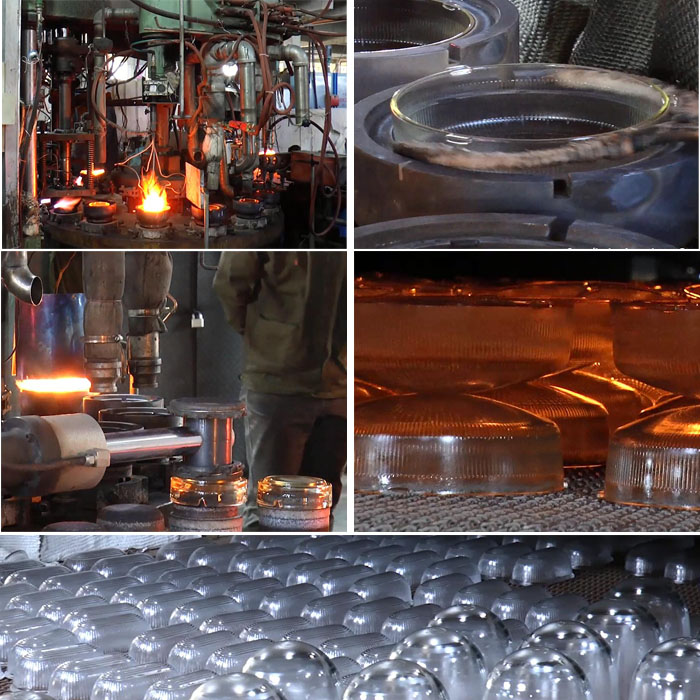
The Pressing Operation
Material Acquisition: A preheated blowpipe or automated gathering mechanism extracts a precisely measured gob of molten glass from the furnace.
Transfer and Positioning: The glass gob moves into the mold cavity, positioned to ensure uniform distribution during pressing.
- Mechanical Forming: A plunger applies controlled pressure, forcing the molten glass to conform to the mold interior. The pressure, timing, and temperature must be precisely calibrated—too rapid, and stress fractures may develop; too slow, and the glass may cool prematurely, capturing surface imperfections.
- Initial Cooling: Immediately after forming, the part undergoes controlled cooling to stabilize its shape before removal from the mold.
- Rough grinding with coarse abrasive wheels removes major irregularities
- Fine grinding progressively smooths the edge profile
- Polishing (where specified) achieves high-gloss finish quality
This finishing stage contributes significantly to production costs due to material loss and processing time, but remains essential for professional-grade products.Raw-pressed glass features rough edges that require refinement. Edge grinding removes excess material and creates smooth, safe handling surfaces. The process typically employs sequential grinding operations:
Edge Treatment and Finishing
- Rough grinding with coarse abrasive wheels removes major irregularities
- Fine grinding progressively smooths the edge profile
- Polishing (where specified) achieves high-gloss finish quality
Annealing for Thermal Stability
Annealing represents perhaps the most critical quality-determining step in glass lampshade manufacturing. Glass cannot cool naturally because differential contraction between surface and interior creates internal stresses that lead to spontaneous failure. During annealing, formed shades enter a temperature-controlled kiln maintained just below the glass softening point. Over an extended period—potentially hours depending on wall thickness—the temperature decreases gradually, allowing uniform contraction and stress relief. Properly annealed glass demonstrates significantly improved mechanical strength and thermal shock resistance.
For borosilicate glass products, annealing parameters must account for the material’s unique thermal properties. Wall thickness directly correlates with thermal shock resistance—a 3mm borosilicate wall withstands approximately 175°C differential, while 6mm thickness accommodates roughly 124°C.
Surface Treatment and Decoration
Spray Coating: Specialized glass paints applied via spray gun and cured at 80-120°C enable custom colors and decorative effects.
Electroplating: Metallic deposition (chrome, nickel, or other finishes) enhances reflectivity and corrosion resistance. The process requires thorough surface preparation to ensure adhesion
Vacuum Coating: Thin-film deposition techniques create mirror finishes, dichroic effects, or selective light filtering.
Material Specifications and Performance Standards
Borosilicate Glass Standards
Borosilicate glass 3.3, designated by its linear expansion coefficient of 3.3×10⁻⁶K⁻¹, conforms to ISO 3585 specifications for laboratory and industrial glassware. For lighting applications, this material offers:
- Thermal Shock Resistance: Withstands rapid temperature changes that would fracture conventional soda-lime glass
- Chemical Durability: Resists degradation from atmospheric pollutants and cleaning agents
- Optical Clarity: High light transmission with minimal color shift
- Mechanical Strength: Allowable tensile stress of 3.5 MPa and compressive stress tolerance up to 100 MPa
Tempered Glass Specifications
For applications requiring enhanced mechanical safety, physically tempered glass provides superior impact resistance. Tempering involves heating formed glass to approximately 620°C followed by rapid air quenching, creating compressive surface stresses that strengthen the material against mechanical shock.
Tempered glass lampshades must meet relevant safety glazing standards, though specific requirements vary by application and jurisdiction. Typical specifications include:
- Minimum thickness: 4mm for standard applications, 5-10mm for high-impact environments
- Dimensional tolerance: ±1mm for precision applications
- Edge finishing: Flat, pencil, or beveled profiles with polished or matte finish
Quality Assurance Protocols
Design Development Services
Mold Engineering: In-house mold design and fabrication, typically requiring 2-3 weeks for new designs
Sample Production: Pre-production samples for approval before mass manufacturing commitment
Technical Customization Options
Production Scalability
Minimum Order Quantities: Typically 500-1000 pieces per design for machine-pressed products, though some suppliers accommodate lower volumes for established relationships
- Production Lead Times: 3-4 weeks standard, with mold development adding 2-3 weeks for new designs
- Capacity Allocation: Multi-line facilities capable of parallel production for large orders or multiple SKUs
- Quality Consistency: Single-furnace batch allocation for orders under 10,000 pieces; inline spectrophotometer monitoring with automatic chemistry adjustment; sample retention comparison for multi-batch large orders
Applications and Industry Verticals
Hospitality and Commercial Interiors
Industrial and Explosion-Proof Lighting
Residential and Decorative Markets
Medical and Laboratory Equipment
Automotive and Transportation
Sourcing Considerations: Evaluating Glass Lampshade Manufacturers
Technical Capabilities
- Equipment Portfolio: Press machine capacity, mold fabrication capabilities, and finishing line diversity
- Material Expertise: Experience with specified glass compositions and relevant quality standards
- Engineering Support: In-house design assistance and technical consultation availability
- Quality Systems: ISO 9001 certification, documented inspection protocols, and testing capabilities.
Production Reliability
- Facility Scale: Adequate capacity for projected volume requirements with expansion capability
- Process Control: Statistical process control implementation and continuous monitoring systems
- Supply Chain Management: Raw material sourcing stability and inventory management practices
- Lead Time Performance: Historical delivery performance and contingency planning
Commercial Factors
- Export Experience: Familiarity with destination market requirements, documentation, and logistics
- Communication Effectiveness: Technical English proficiency and responsive project management
- Financial Stability: Creditworthiness and long-term viability indicators
- Reference Verification: Client testimonials and active project references
Quality Assurance Protocols
Factory Audit: On-site or virtual assessment of production facilities, equipment condition, and operational practices. Third-party verification through SGS, TÜV, or Bureau Veritas provides additional confidence.
- Sample Evaluation: Comprehensive testing of production samples including dimensional verification, visual inspection, light transmission measurement, and thermal performance testing where applicable.
- Documentation Review: Technical specification sheets, material certifications, quality control procedures, and previous project references.
- Pilot Production: Limited initial order validating production consistency before large-scale commitment.
Packaging and Logistics for Glass Lampshades
Future Trends in Glass Lampshade Manufacturing
Sustainability Initiatives
Advanced Surface Treatments
- Self-cleaning Coatings: Hydrophobic surface treatments reducing maintenance requirements
- Smart Glass Integration: Electrochromic or thermochromic properties enabling dynamic light control
- 3D-Printed Components: Hybrid manufacturing combining pressed glass bases with printed structural elements
Digital Integration
- Automated Inspection: Machine vision systems detecting defects with greater consistency than human inspection
- Process Monitoring: Real-time data collection enabling predictive maintenance and quality optimization
- Digital Twin Technology: Virtual modeling of production processes for optimization before physical implementation
A: Mold fabrication typically requires 2-3 weeks from approved design to production-ready status. This timeline includes design finalization, material procurement, machining, and initial testing. Complex geometries or specialized surface textures may extend this timeframe. Total lead time from design initiation to first production samples generally spans 4-6 weeks.
A: For fixtures generating significant heat—halogen lamps, high-output LEDs, or industrial lighting—borosilicate glass is strongly recommended. Its thermal expansion coefficient of 3.3×10⁻⁶K⁻¹ provides superior thermal shock resistance compared to soda-lime glass. Borosilicate withstands temperature differentials up to 300°C and continuous service temperatures approaching 500°F (260°C). For extreme conditions, consider tempered borosilicate combining thermal resistance with enhanced mechanical strength.
A: Essential qualifications include ISO 9001 quality management certification and relevant product safety standards for your target markets (CE marking for Europe, UL recognition for North America, etc.). For specialized applications, additional certifications may apply—ISO 3585 for borosilicate glass laboratory equipment, explosion-proof certifications for hazardous location fixtures, or industry-specific requirements. Implement incoming inspection protocols including dimensional verification, visual defect inspection, and functional testing appropriate to your application.
Q: How do I ensure color consistency across large production runs?
A: Reputable manufacturers employ several control mechanisms: single-furnace batch allocation for orders under 10,000 pieces, inline spectrophotometer monitoring with automatic furnace chemistry adjustment, and sample retention comparison for multi-batch large orders. Specify color tolerance requirements in your technical documentation, referencing standard systems (Pantone, RAL) or providing physical samples for matching .
A: Comprehensive technical documentation minimizes miscommunication and enables accurate quoting. Include: detailed dimensional drawings (3D CAD preferred), material specifications, tolerance requirements, surface finish descriptions, color references, functional requirements (heat resistance, light transmission), estimated annual volume, and any relevant standards or certifications required. Physical samples of existing products or reference materials often prove invaluable for communicating quality expectations.
Q: How can I verify a manufacturer’s claimed capabilities before placing orders?
Conclusion
nMachine-pressed glass lampshade manufacturing represents a mature industrial process combining centuries-old glassworking principles with modern automation and quality control. For lighting industry professionals, understanding this manufacturing method’s capabilities, limitations, and quality determinants enables more effective supplier selection and product specification.
nCommon Questions
Yancheng Jingxin Glassware Co., Ltd. is a professional glass manufacturer established in 1999. We operate our own production base and office area of more than 48,430 sq ft (approximately 4,500 m²), integrating design, manufacturing, quality control, and export services.
We manufacture a wide range of custom glass lamp shade including blown glass lamp shade , machine pressed glass lamp shade , borosilicate glass lamp shade , centrifugal glass lamp shade ect. Our capabilities cover OEM and ODM production for various applications and industries.
Yes, we provide full OEM and ODM customization services including:
- Custom product design and engineering
- In-house mold development
- Logo printing and branding
- Surface treatments and finishes
- Customized packaging solutions
Yes, our design team can develop custom glassware from your concept. We provide professional design services based on your ideas, reference samples, or functional requirements—no technical drawings needed to start.
Our process ensures quality before mass production
Design confirmation with customer
In-house mold development at our facility
Sample production for approval
Customer testing and feedback
Mass production only after final sample approval
We offer comprehensive custom packaging for safe international shipping:
- Protective inner packaging materials
- Export-grade cardboard cartons
- Custom color boxes and retail packaging
- Label printing and branding
- Packaging designed to international shipping standards
- Inspection at every production stage
- Scientific quality control procedures
- Pre-shipment inspection of every batch
- Compliance with international export standards
- Certified quality management systems
We operate multiple production lines with experienced workers, enabling stable mass production for orders of all sizes. Our facility ensures consistent quality and reliable on-time delivery for both small batches and large-volume orders.
Lead times vary by complexity and quantity:
- Catalog/light customization: 25–30 days for orders up to 1,000 pieces
- Orders of 1,000–5,000 pieces: 35–45 days
- Full custom OEM with new molds: 45–65 days; final timing is confirmed by project
Current market coverage is confirmed during supplier review., including:
- North America (USA, Canada)
- Europe (UK, Germany, France, etc.)
- Asia-Pacific markets
- Middle East
- Africa
- Oceania (Australia, New Zealand)
We maintain a comprehensive global distribution network.