
How to Choose the Right Glass for Lampshades: Opal, Clear, Seeded, Cracked and Solid Color Glass
Author: Hannah, 10+ years Senior Manager
Why Glass Type Matters More Than Shape
- Optical control: Directing, diffusing, or refracting light from the source to the target surface
- Thermal management: Withstanding heat from incandescent, halogen, or high-output LED modules without thermal shock failure
- Aesthetic expression: Contributing texture, color, and visual weight to the overall fixture design
- Durability: Resisting impact, chemical cleaning agents, and UV degradation over years of service
Opal Glass: The Diffusion Standard
What It Is and How It Works
Manufacturing Methods: Hand-Blown vs. Pressed
When working with a custom glass lamp shade manufacturer, you’ll typically encounter two production methodologies for opal glass.
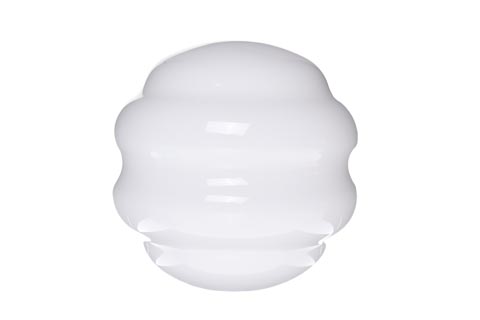
Hand-blown opal glass represents the pinnacle of artisanal production. Master glassblowers with a decade or more of training gather molten glass at 1050–1100°C, inflate it into a parison, and shape it using wet wooden blocks and custom molds. The process yields subtle variations—tiny bubbles, gentle wall thickness gradients, and organic forms that signal authentic craftsmanship .
The advantages are clear for boutique and luxury projects: unique character, complex asymmetrical geometries, and gradient opacification effects that transition from clear to fully opalescent within a single piece. The trade-offs are dimensional variability (±3–5mm tolerance), limited production capacity (20–50 pieces per artisan per day), and higher unit costs driven by labor representing 60–70% of finished goods cost .
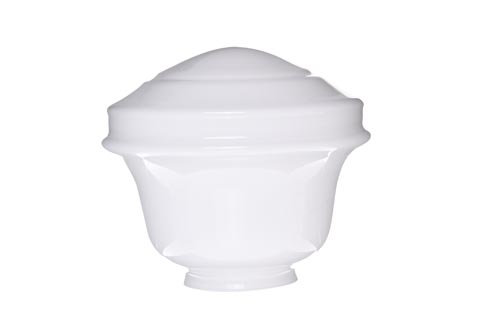
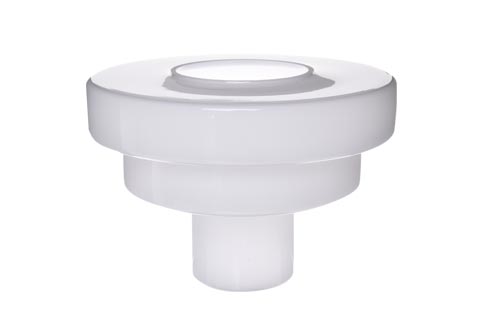
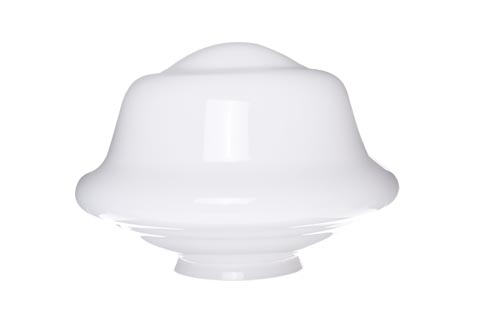
Pressed opal glass dominates commercial, architectural, and hospitality markets where repeatability and cost efficiency matter. Automated gob feeders deliver precise glass charges into multi-section molds, where hydraulic plungers form the shade against polished surfaces at 800–950°C. The result is dimensional precision within ±0.3mm, ensuring perfect compatibility with standardized fitters and LED modules .
For a recent commercial office project requiring 15,000 downlight shades, pressed opal glass delivered an 88% total transmission rate with 96% haze factor at a landed cost of $4.20 per unit—roughly 40% below hand-blown alternatives. The defect rate held at 0.3%, compared to an industry standard of 2–3% for complex glass components .
When to Specify Opal Glass
- Hotel guest rooms and corridors where glare control directly impacts guest satisfaction
- Restaurant dining areas requiring intimate, flattering light
- Residential living spaces where fixtures are viewed directly at eye level
- Healthcare and wellness environments where visual comfort supports circadian lighting protocols
Clear Glass: Maximum Transmission, Maximum Responsibility
The Physics of Transparency
Clear glass lampshades are exactly what they appear to be: optically transparent enclosures that allow light to pass with minimal interference. High-quality clear soda-lime glass achieves approximately 90% light transmission across the visible spectrum, making it the most efficient option in pure lumen-delivery terms .
However, that efficiency comes with optical responsibilities. Clear lenses deliver concentrated, directional illumination with defined beam edges. In accent lighting, merchandise display, or high-bay applications, this focused output is precisely what you want. The sharp light pattern can illuminate target surfaces with intensity and precision .
The challenge arises when clear glass is used in ambient or low-mounting applications. Without diffusion, the light source remains visible, creating intense brightness that causes visual discomfort and potential eye fatigue. In office environments or dining rooms where people spend extended time, direct glare from clear glass shades can degrade the experience significantly .
Frosted Clear Glass: A Middle Path
Many lighting designers specify clear glass with secondary surface treatments—acid etching, sandblasting, or ceramic frit coatings—to achieve controlled diffusion without sacrificing the crystalline aesthetic of transparent glass. Frosting works by roughening the surface so incoming light scatters instead of passing straight through, converting specular transmission into diffuse transmission .
The trade-off is modest: frosted lenses typically reduce total light output by approximately 3–5% through diffusion coating absorption, while clear lenses deliver roughly 3–5% higher lumen output due to minimal light absorption . For most applications, this efficiency difference is negligible compared to the visual comfort gained.
From a manufacturing perspective, surface frosting can be applied post-production to pressed or hand-blown clear glass shades. This offers flexibility for custom glass lamp shade orders where you want to maintain a single base material across a product line while offering multiple diffusion levels.
Thermal Considerations
Clear glass shades, particularly in enclosed fixtures, must account for heat buildup. Standard soda-lime clear glass has a thermal expansion coefficient of approximately 8.8 µm/m·K and a maximum service temperature around 300°C . For most residential LED applications, this is sufficient. However, in enclosed fixtures using high-wattage incandescent or halogen sources, borosilicate clear glass may be necessary.
Borosilicate glass, with its significantly lower thermal expansion coefficient (3.3–5.1 µm/m·K) and higher thermal shock resistance, can withstand temperature differentials exceeding 150°C without failure . A competent glass lamp shade manufacturer will ask about your light source and enclosure geometry before recommending a glass composition.
When to Specify Clear Glass
- You’re designing accent or display lighting where directional intensity matters
- The mounting height is 20 feet or more, minimizing direct glare concerns
- You want to showcase decorative filament bulbs or intricate LED arrays as part of the visual design
- The fixture design includes internal diffusers or reflectors that handle optical control upstream of the shade
Seeded Glass: Controlled Imperfection
The Aesthetic of Entrapped Air
Seeded glass—also called bubble glass—derives its character from thousands of tiny air bubbles trapped within the glass matrix during formation. These bubbles create a textured, organic visual effect that catches and refracts light in unpredictable ways, adding depth and movement that perfectly smooth glass cannot replicate.
In hand-blown production, bubbles form naturally as the glassblower introduces air through the blowpipe. Master artisans learn to control bubble density and distribution through breath pressure, rotational speed, and the temperature of the gather. However, for commercial consistency, a specialized glass lamp shade factory will often introduce controlled air injection or chemical agents that generate uniform bubble patterns across production batches .
Production Consistency Challenges
- Calibrated wall thickness control: Maintaining 3mm ±1mm tolerance ensures consistent optical behavior and structural integrity
- Controlled bubble density categories: Rather than leaving bubble formation to chance, factories define Light (sparse, elegant), Medium (balanced visibility), and Heavy (rustic, vintage appearance) density standards, creating reference samples for client approval before bulk production.
- Three-stage quality inspection: Hot shop visual checks immediately after forming, annealing verification after controlled kiln cooling, and final dimensional and surface defect inspection
For a hospitality client running 28 boutique properties, we once specified custom seeded glass pendants with medium bubble density. The custom glass lamp shade manufacturer developed master samples that were photographed and spectroscopically measured, then used automated optical scanning during production to reject shades falling outside the approved bubble density range. The result was 98.7% visual consistency across 2,400 installations—critical for brand coherence.
Light Behavior and Applications
Seeded glass scatters light more aggressively than clear glass but less uniformly than opal. The bubbles create localized bright points and soft shadows, producing a “living” light effect that shifts as viewers move around the fixture. This makes seeded glass particularly effective for:
- Coastal and farmhouse aesthetic collections where organic texture reinforces the design narrative
- Restaurant bar areas and social spaces where visual interest at close range enhances atmosphere
- Entryway and foyer fixtures where guests encounter lighting at conversational distances
- Vintage and industrial restoration projects where authentic material character matters
Crackle Glass: Thermal Shock as Design Language
From Accidental Defect to Intentional Texture
nCrackle glass—sometimes called ice crack or craquelé glass—features a network of fine surface fissures that catch light dramatically while the underlying structure remains fully intact. The effect originated in Song Dynasty China (960–1279 CE) as an accidental glaze phenomenon on porcelain, but artisans quickly recognized its aesthetic potential and developed controlled methods to reproduce it .
nIn modern glass lamp shade manufacturing, crackle effects are achieved through deliberate thermal shock. The process follows a precise sequence: the hot-blown glass form is briefly immersed in cold water, causing rapid surface contraction and microscopic cracking. The piece is then reheated to a lower temperature to seal the cracks without collapsing the structure, leaving a permanent fissured texture beneath a glossy, stable surface .
nThe technical elegance of this method lies in its contradiction: the glass is visibly fractured yet structurally sound. Each piece carries unique crack patterns that never duplicate, functioning almost like a material fingerprint .
nStructural Integrity Considerations
n- n
- nWall thickness minimum: Crackle glass should maintain at least 3mm wall thickness to ensure adequate structural marginn n
- nAnnealing protocol: Extended annealing (6–12 hours in programmable kilns) is critical to relieve stresses introduced by the thermal shock processn n
- nEdge treatment: Ground and polished edges prevent stress concentration at rim locations where handling occursn n
- nThermal rating: Crackle glass manufactured from soda-lime compositions should be rated for continuous operating temperatures appropriate to the light source; borosilicate crackle glass offers additional thermal shock margin for demanding applicationsn n
Light Interaction and Visual Effect
n- n
- nStatement pendants in dining rooms and atriums where the fixture itself is a focal pointn n
- nWall sconces where grazing light across the crackle surface maximizes texture visibilityn n
- nLuxury residential and boutique hospitality projects seeking distinctive, artisanal charactern n
- nFixtures with exposed filament bulbs where the crackle pattern fragments the filament image into decorative constellationsn n
Solid Color Glass: Pigmentation and Performance
How Color Is Introduced
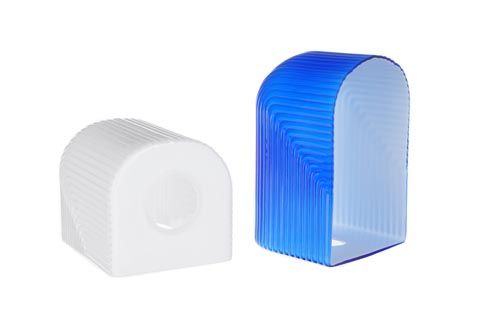
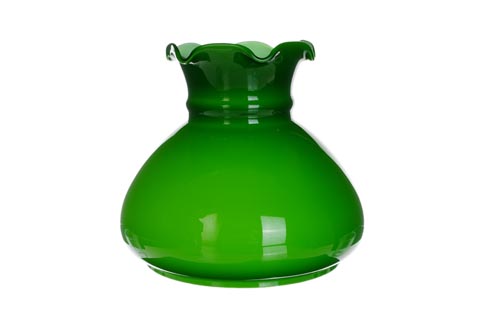
Solid color glass lampshades obtain their hue through three primary methods, each with distinct optical and durability implications:
- Bulk Coloration (Through-Body Color)
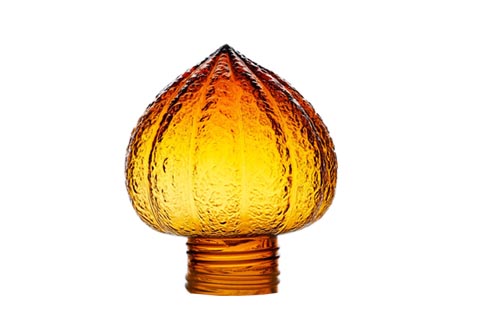
In this method, metal oxide colorants are added directly to the molten glass batch before forming. Cobalt oxide produces deep blues, selenium compounds create reds and pinks, and iron-chromium combinations yield greens and ambers. The color is integral to the material, meaning chips or wear won’t reveal a different substrate.
Bulk coloration offers the highest durability and UV stability because the pigment is locked within the glass network. However, it requires precise batch control—leading glass lamp shade manufacturers maintain color consistency within ±0.5% batch formulation tolerance to ensure uniformity across production runs .
- Ceramic Frit Coating
Ceramic frit involves applying a glass-based paint containing mineral pigments to the surface, then firing at high temperature to fuse the coating into the substrate. This method allows broader color ranges, including opaque whites and bright primaries that are difficult to achieve through bulk coloration alone.
The fired ceramic layer becomes chemically bonded to the base glass, offering excellent scratch resistance and thermal stability. However, the interface between frit and base glass introduces a potential failure point under extreme thermal cycling if the thermal expansion coefficients aren’t precisely matched.
- Organic Spray Coatings
Spray-applied organic paints cured at lower temperatures (80–120°C) offer the widest color palette, including metallics and pearlescents impossible with mineral pigments . The trade-off is reduced durability: organic coatings can degrade under prolonged UV exposure or high operating temperatures, and they may show wear at handling points over time.
For commercial lighting applications, I generally recommend avoiding organic coatings on exterior shade surfaces unless the fixture is purely decorative and receives minimal handling.
Optical Behavior of Colored Glass
- Lumen budgeting: Dark colored shades require higher-output light sources to achieve target illuminance levels
- Color temperature shift: Amber and warm-toned glasses shift perceived color temperature downward, potentially clashing with cool-white LED sources
- CRI impact: Strong coloration reduces the Color Rendering Index of transmitted light, making accurate color perception difficult beneath deeply colored shades
Applications and Trends
- Gradient color effects: Shades transitioning from clear to deep color, achieved through layered gathers in hand-blown production or controlled spray gradients in pressed manufacturing
- Smoked and tinted grays: Offering partial transparency with reduced glare, popular in contemporary and minimalist interiors
- Brand-specific colors: Hospitality chains using custom-matched Pantone or RAL colors to reinforce brand identity across properties
Material Selection: Soda-Lime vs. Borosilicate
Regardless of glass type—opal, clear, seeded, crackle, or solid color—the base glass composition fundamentally determines thermal performance, durability, and cost. Understanding the distinction between soda-lime and borosilicate glass helps you specify appropriately for your application.
Soda-Lime Glass
Comprising approximately 70–75% SiO₂, 13–17% Na₂O, and 5–10% CaO, soda-lime glass is the most common commercial glass type . It offers excellent optical clarity, easy workability, and low material cost. For standard residential and commercial lighting applications with moderate thermal loads, soda-lime glass is entirely appropriate.
Key properties:
- Thermal expansion coefficient: ~8.8–9.0 µm/m·K
- Maximum service temperature: ~300°C
- Light transmission: ~90% for clear formulations
- Cost: Lowest among technical glass types
Borosilicate Glass
By replacing some silica with boric oxide (B₂O₃), borosilicate glass achieves dramatically improved thermal properties. Its thermal expansion coefficient drops to 3.3–5.1 µm/m·K—less than half that of soda-lime—providing exceptional resistance to thermal shock and thermal gradients .
Key properties:
- Thermal expansion coefficient: 3.3–5.1 µm/m·K
- Maximum service temperature: ~360°C (higher for specialized formulations)
- Thermal shock resistance: 50–91 points vs. 4.7–20 for soda-lime
- Chemical durability: Significantly higher hydrolytic resistance than soda-lime
- Cost: 30–50% premium over soda-lime
When to Specify Borosilicate
The additional cost of borosilicate is justified when:
- Fixtures operate in enclosed environments with limited heat dissipation
- Light sources generate high thermal loads (high-wattage halogen, HID retrofit)
- Outdoor or landscape lighting faces temperature extremes and weather exposure
- Fixtures require frequent cleaning with chemical agents that might attack soda-lime surfaces
- Safety-critical applications where thermal shock failure would create liability exposure
A quality glass lamp shade factory will maintain both soda-lime and borosilicate production capabilities, allowing material selection based on application rather than manufacturing convenience.
Sourcing from a Glass Lamp Shade Manufacturer: What to Verify
When evaluating a custom glass lamp shade manufacturer or glass lamp shade factory for your project, technical capability matters as much as pricing. Here are the verification points that separate capable suppliers from commodity brokers:
Production Methodology Breadth
Can the factory produce both hand-blown and pressed glass? Do they offer hybrid techniques like semi-automated blowing or centrifugal casting? A manufacturer with limited methodology options will push you toward whatever they can produce, not necessarily what’s optimal for your project .
Optical Testing Capability
Request documentation of photometric testing equipment. Integrating spheres for transmission and haze measurement, spectrophotometers for color consistency verification, and CMM (Coordinate Measuring Machine) inspection for dimensional accuracy indicate serious quality investment .
Thermal Testing Protocols
Verify that the factory conducts thermal cycling tests—typically 100 cycles between 20°C and 150°C—to validate annealing quality and thermal shock resistance . This is especially critical for crackle glass and thick-walled opal shades where internal stress can lead to delayed failure.
Certification Portfolio
Minimum certifications should include:
- ISO 9001:2015 for quality management
- CE marking for European market access
- UL recognition for North American safety compliance
- RoHS/REACH compliance for chemical substance restrictions
For specialized applications, ask about IEC 60598 luminaire component safety certification .
Sample Development Process
A professional glass lamp shade manufacturer should offer 3D visualization before physical prototyping, followed by sample production within 5–10 days for standard shapes or 10–14 days for custom molds . Be wary of factories that cannot produce physical samples before committing to bulk tooling.
Transparency in Lead Times and Pricing
Standard lead times in the industry run 25–45 days after sample approval, with peak season (August through October, ahead of holiday retail) extending toward 60 days . Pricing should be tiered by volume, with clear documentation of mold costs, sample charges, and shipping terms (typically FOB major port or DDP for turnkey delivery).
Frequently Asked Questions
What is the minimum order quantity for custom glass lamp shades?
MOQ varies significantly by manufacturer and production method. For standard pressed glass shades using existing molds, MOQs typically start at 300–500 pieces per design . Hand-blown custom shapes may require 100–300 pieces, while fully custom mold development often demands 500+ pieces to justify tooling costs. Some factories offer sample orders of 1–5 pieces for quality evaluation before bulk commitment .
How do I choose between hand-blown and pressed glass for my project?
Choose hand-blown when uniqueness, artisanal character, or complex asymmetrical geometry is paramount—luxury hospitality, high-end residential, or statement fixtures. Choose pressed glass when consistency, dimensional precision, and cost efficiency matter—commercial rollouts, architectural specifications, or retail product lines requiring thousands of identical units .
Can a glass lamp shade manufacturer match my exact color requirements?
Yes. Leading custom glass lamp shade manufacturers maintain color development laboratories capable of matching Pantone, RAL, or proprietary color codes. Bulk coloration achieves the best durability; ceramic frit offers broader color range with good durability; organic spray coatings provide the widest palette but lower longevity. Expect 98.7% color consistency between production runs from quality suppliers .
What glass type works best with LED light sources?
Opal glass is generally optimal for LED ambient lighting because it eliminates the multi-point glare from LED arrays while maintaining high transmission efficiency. Clear glass works well for LED accent lighting where directional output is desired. For high-output LED modules in enclosed fixtures, specify borosilicate glass to manage thermal loads safely .
How long does custom glass lamp shade production take?
Sample development typically requires 5–14 days depending on complexity. Bulk production runs 25–45 days after sample approval, though peak season (pre-holiday months) can extend this. Rush production may be available for standard styles from some factories .
Is crackle glass structurally safe for permanent installation?
When manufactured correctly by an experienced glass lamp shade factory, yes. The crackle effect is a surface phenomenon sealed beneath stable glass. Proper annealing (6–12 hours controlled cooling) relieves thermal stresses introduced during the shock process. Specify minimum 3mm wall thickness and request thermal cycling test documentation for safety-critical applications .
What’s the difference between seeded glass and bubble glass?
They are essentially the same—both refer to glass with intentionally trapped air bubbles. “Seeded glass” is the more common industrial term, while “bubble glass” is often used in retail and design contexts. The key specification is bubble density: light, medium, or heavy, which determines the visual texture and light scattering intensity .
Can I get glass shades with multiple colors or gradient effects?
Yes. Gradient effects (transitioning from clear to opal, or one color to another) are achievable through multi-stage hand-blown gathering processes or controlled spray applications on pressed glass. These require custom development and typically carry longer lead times and higher costs, but create distinctive visual signatures impossible with single-material shades .
How do I verify a glass lamp shade manufacturer’s quality before placing a large order?
Request physical samples of your exact specification, not just catalog items. Conduct your own evaluation: check wall thickness consistency, hold the shade against a bright light to inspect for stress patterns (rainbow birefringence indicates poor annealing), verify fitter dimensions with calipers, and request photometric data if optical performance is critical. If possible, visit the factory or arrange a third-party inspection .
What certifications should a glass lamp shade factory have?
At minimum: ISO 9001:2015 (quality management), CE marking (European safety), UL recognition (North American safety), and RoHS/REACH (chemical compliance). For food-service or healthcare applications, additional sanitation and material safety certifications may be required .
Conclusion: Matching Glass to Intent
Choosing the right glass for lampshades is ultimately an exercise in matching material properties to design intent. Opal glass transforms harsh sources into ambient glow. Clear glass delivers raw, directional efficiency. Seeded glass adds organic texture and visual movement. Crackle glass creates prismatic spectacle. Solid color glass expresses brand identity and mood.
The best outcomes emerge from early collaboration with a capable custom glass lamp shade manufacturer—one who understands not just how to blow or press glass, but how your fixture will live in its intended environment. Bring them your photometric requirements, your thermal constraints, your aesthetic references, and your volume projections. A factory that asks the right technical questions before quoting is the factory worth building a supply relationship with.
As LED technology continues evolving and human-centric lighting principles gain regulatory traction through standards like the WELL Building Standard, the demand for sophisticated optical diffusion solutions will only accelerate. Glass lampshades—whether opal, clear, seeded, crackle, or solid color—remain the most elegant, durable, and optically refined solution for transforming electrical energy into human experience.
If you’re ready to specify custom glass lamp shades for your next lighting project, begin by defining your optical priorities. Everything else—material selection, manufacturing method, and supplier partnership—flows from that clarity.
Common Questions
Yancheng Jingxin Glassware Co., Ltd. is a professional glass manufacturer established in 1999. We operate our own production base and office area of more than 48,430 sq ft (approximately 4,500 m²), integrating design, manufacturing, quality control, and export services.
We manufacture a wide range of custom glass lamp shade including blown glass lamp shade , machine pressed glass lamp shade , borosilicate glass lamp shade , centrifugal glass lamp shade ect. Our capabilities cover OEM and ODM production for various applications and industries.
Yes, we provide full OEM and ODM customization services including:
- Custom product design and engineering
- In-house mold development
- Logo printing and branding
- Surface treatments and finishes
- Customized packaging solutions
Yes, our design team can develop custom glassware from your concept. We provide professional design services based on your ideas, reference samples, or functional requirements—no technical drawings needed to start.
Our process ensures quality before mass production
Design confirmation with customer
In-house mold development at our facility
Sample production for approval
Customer testing and feedback
Mass production only after final sample approval
We offer comprehensive custom packaging for safe international shipping:
- Protective inner packaging materials
- Export-grade cardboard cartons
- Custom color boxes and retail packaging
- Label printing and branding
- Packaging designed to international shipping standards
- Inspection at every production stage
- Scientific quality control procedures
- Pre-shipment inspection of every batch
- Compliance with international export standards
- Certified quality management systems
We operate multiple production lines with experienced workers, enabling stable mass production for orders of all sizes. Our facility ensures consistent quality and reliable on-time delivery for both small batches and large-volume orders.
Lead times vary by complexity and quantity:
- Catalog/light customization: 25–30 days for orders up to 1,000 pieces
- Orders of 1,000–5,000 pieces: 35–45 days
- Full custom OEM with new molds: 45–65 days; final timing is confirmed by project
Current market coverage is confirmed during supplier review., including:
- North America (USA, Canada)
- Europe (UK, Germany, France, etc.)
- Asia-Pacific markets
- Middle East
- Africa
- Oceania (Australia, New Zealand)
We maintain a comprehensive global distribution network.