
How to Choose the Right Glass Material for Lamp Shades: Tempered vs Borosilicate vs Soda-Lime
Choosing the right glass material for lamp shades is one of the most critical decisions in lighting product design and manufacturing. The glass you select directly affects heat resistance, safety, light diffusion, durability, compliance, cost, and long-term performance.
For lighting manufacturers, interior designers, architects, and hospitality project buyers, understanding the differences between tempered glass, borosilicate glass, and soda-lime glass is essential to avoid cracking, quality failures, and costly project delays.
In this guide, we break down each material from both a technical and commercial perspective, helping you make the right choice based on application, environment, and production scale—while avoiding common mistakes that B2B buyers often encounter.
Why Glass Material Matters in Lamp Shade Manufacturing
Lamp shades are not purely decorative components. In real-world use, they must withstand:
Continuous heat exposure from bulbs or LED modules
Thermal shock from switching lights on and off
Mechanical stress during installation and transportation
Long-term exposure to UV light and ambient temperature changes
Selecting the wrong glass material can result in:
Cracking or shattering during use
Uneven light diffusion and glare
High breakage rates during shipping
Non-compliance with safety or project standards
That is why professional lighting manufacturers evaluate glass materials not only by appearance, but by thermal performance, mechanical strength, and consistency in mass production.
Overview: The Three Most Common Glass Materials for Lamp Shades
Before diving into details, here is a quick comparison:
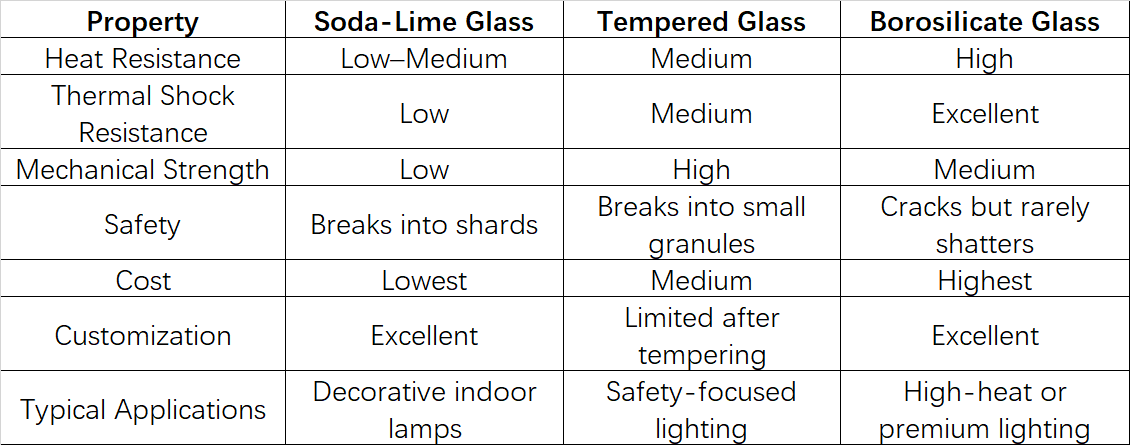
Each material serves a different purpose, and there is no “one-size-fits-all” solution.
Soda-Lime Glass: Cost-Effective and Widely Used
What Is Soda-Lime Glass?
Soda-lime glass is the most common type of glass used worldwide. It is composed mainly of silica (SiO₂), sodium oxide, and calcium oxide. Because it is easy to melt and shape, it is widely used in household glassware, decorative products, and standard lamp shades.
Key Characteristics of Soda-Lime Glass
Maximum working temperature: ~150–200°C
Low resistance to thermal shock
High clarity and smooth surface finish
Easy to cut, drill, frost, or decorate
Lowest raw material and production cost
Advantages for Lamp Shades
Soda-lime glass is ideal for:
Decorative table lamps and wall sconces
Low-heat LED lighting fixtures
Indoor residential lighting
Projects with strict cost targets
Its excellent workability allows for:
Complex shapes
Thin or thick wall designs
Frosted, etched, painted, or sprayed finishes
This makes it a popular choice for custom decorative lamp shades where aesthetics matter more than extreme performance.
Limitations and Risks
The biggest drawback of soda-lime glass is its poor thermal shock resistance. Rapid temperature changes—such as turning a lamp on after it has cooled—can cause cracking.
It is not recommended for:
High-wattage bulbs
Enclosed fixtures with poor ventilation
Outdoor or commercial environments
Tempered Glass: Strength and Safety First
What Is Tempered Glass?
Tempered glass is soda-lime glass that has undergone a controlled heat-treatment process. This process increases surface compression, making the glass significantly stronger than untreated soda-lime glass.
Key Characteristics of Tempered Glass
3–5 times stronger than regular glass
Better resistance to mechanical impact
Breaks into small, blunt granules (safety glass)
Moderate heat resistance
Advantages for Lamp Shades
Tempered glass is commonly used when safety and durability are top priorities.
Typical applications include:
Commercial lighting fixtures
Hospitality and public spaces
Pendant lights in high-traffic areas
Fixtures requiring compliance with safety regulations
Because of its strength, tempered glass reduces:
Breakage during installation
Damage during shipping
Safety risks in public environments
Important Design Constraints
One key limitation of tempered glass is post-processing restriction.
Once glass is tempered:
It cannot be cut or drilled
Shape and holes must be finalized before tempering
This means:
Design changes after sampling are costly
Complex customization requires careful upfront engineering
For B2B buyers, this makes supplier engineering support especially important.
Borosilicate Glass: High-Performance and Heat Resistant
What Is Borosilicate Glass?
Borosilicate glass contains boron oxide, which significantly improves thermal and chemical resistance. It is commonly used in laboratory glassware, cookware, and high-performance lighting applications.
Key Characteristics of Borosilicate Glass
Maximum working temperature: 300–500°C
Excellent thermal shock resistance
Low thermal expansion coefficient
High chemical stability
Advantages for Lamp Shades
Borosilicate glass is the preferred choice for:
High-temperature lighting fixtures
Enclosed lamp designs
Industrial or architectural lighting
Premium or long-life products
It performs exceptionally well in environments where:
Lamps are frequently switched on/off
Heat buildup is unavoidable
Long-term stability is required
From a brand perspective, using borosilicate glass can significantly reduce:
Warranty claims
Cracking complaints
Project replacement costs
Cost and Production Considerations
Borosilicate glass is more expensive due to:
Higher raw material costs
Higher melting temperature
More demanding production control
However, for professional lighting projects, total lifecycle cost is often lower due to reduced failure rates.
Light Diffusion and Optical Performance
Glass material also influences how light behaves.
Clear soda-lime glass offers high transparency but can create glare
Frosted or opal soda-lime glass provides softer diffusion
Borosilicate glass maintains stable optical performance even at high temperatures
Tempered glass maintains clarity but limits post-processing finishes
For lighting designers, the ideal solution often combines:
Correct material selection
Surface treatment (frosted, sandblasted, opal)
Proper wall thickness
A professional manufacturer should be able to recommend the optimal combination based on light source and application.
Safety, Compliance, and International Standards
For B2B buyers, compliance is often non-negotiable.
Different markets may require:
Safety glass for public spaces
Heat resistance documentation
Material composition reports
Tempered glass is often specified for:
Commercial projects
Hospitality and public buildings
Borosilicate glass is favored where:
High-temperature safety is critical
Long-term reliability is required
Choosing the right supplier means ensuring they can provide:
Material test reports
Batch consistency documentation
Compliance support for different markets
Cost vs Performance: Making the Right Trade-Off
A common mistake in lamp shade sourcing is focusing only on unit price.
A better approach is to evaluate:
Failure risk
Replacement cost
Brand reputation impact
Long-term maintenance

How a Professional Glass Manufacturer Adds Value
Choosing the right material is only part of the equation. A reliable glass lamp shade manufacturer should also provide:
Engineering consultation during design
Material comparison and testing support
Prototyping and sampling
Quality control and batch consistency
Secure packaging and export logistics
For B2B buyers, this technical support often makes the difference between a smooth project and a costly failure.
Frequently Asked Questions
Yes, for low-heat LED applications, soda-lime glass is commonly used.
Not necessarily. It is better for heat resistance, but may be unnecessary for decorative or low-temperature applications.
No. Tempered glass is stronger mechanically, but borosilicate glass has superior thermal resistance.
Soda-lime and borosilicate glass offer the greatest customization flexibility.
Our process ensures quality before mass production
Design confirmation with customer
In-house mold development at our facility
Sample production for approval
Customer testing and feedback
Mass production only after final sample approval
We offer comprehensive custom packaging for safe international shipping:
- Protective inner packaging materials
- Export-grade cardboard cartons
- Custom color boxes and retail packaging
- Label printing and branding
- Packaging designed to international shipping standards
- Inspection at every production stage
- Scientific quality control procedures
- Pre-shipment inspection of every batch
- Compliance with international export standards
- Certified quality management systems
We operate multiple production lines with experienced workers, enabling stable mass production for orders of all sizes. Our facility ensures consistent quality and reliable on-time delivery for both small batches and large-volume orders.
Lead times vary by complexity and quantity:
- Sample production: typically 2-4 weeks
- Mass production: scheduled after sample approval
- Exact timelines provided based on specific order requirements
We export to over 150 countries and regions worldwide, including:
- North America (USA, Canada)
- Europe (UK, Germany, France, etc.)
- Asia-Pacific markets
- Middle East
- Africa
- Oceania (Australia, New Zealand)
We maintain a comprehensive global distribution network.