Quais São os Diferentes Tipos de Abajures de Vidro para Iluminação Comercial?

Autor: Hannah, Gerente Sênior com mais de 10 anos
The glass lamp shade specification decision fundamentally determines fixture performance, aesthetic character, and commercial viability. For lighting manufacturers and specifiers navigating commercial projects—from hospitality rollouts to corporate campuses, healthcare facilities to retail environments—understanding the technical distinctions between glass types, forming methods, and finishing options separates successful product development from costly field failures.
Como um fabricante personalizado de cúpulas de vidro para luminárias operating integrated production across borosilicate, soda-lime, and lead crystal specialties, we’ve supplied over 3.2 million commercial-grade shades to fixture brands in 52 countries. This comprehensive analysis examines the seven primary glass lamp shade categories dominating commercial lighting specification, their manufacturing processes, performance characteristics, and optimal application contexts.

Category 1: Pressed Borosilicate Glass Shades


Technical Foundation and Manufacturing Process

Pressed borosilicate represents the engineering-grade standard for high-performance commercial lighting. The manufacturing process begins with electrically heated furnaces melting raw batch—silica sand (SiO₂), boron oxide (B₂O₃), alumina, and fluxing agents—at 1,250°C to 1,300°C. This composition yields the distinctive 3.3 × 10⁻⁶/K thermal expansion coefficient that defines borosilicate’s superior thermal shock resistance.
In de abajur de vidro production, molten glass flows from the furnace forehearth into precision steel or cast iron molds mounted on automated pressing machines. A plunger mechanism applies 50-200 bar pressure, forcing glass into mold cavities with dimensional tolerances achieving ±0.5mm on critical features. The pressed parison transfers to annealing kilns for controlled cooling over 18-24 hours, eliminating internal stresses that would otherwise cause spontaneous fracture.
 

Commercial Applications

High-Output Downlights: Thermal management in 15W+ LED COB fixtures demands borosilicate’s heat resistance. Standard soda-lime shades experience thermal stress failures at junction temperatures exceeding 120°C, while borosilicate maintains integrity beyond 200°C surface temperatures.
Outdoor Architectural Lighting: Freeze-thaw cycling, solar loading, and precipitation exposure destroy conventional glass within 3-5 years. Borosilicate installations demonstrate 15+ year service life with minimal optical degradation.
Food Service and Healthcare: Steam cleaning, autoclave sterilization, and aggressive disinfectant exposure mandate borosilicate’s chemical inertness and thermal shock resistance.
Custom Glass Lamp Shade Considerations: Pressed borosilicate requires dedicated tooling investment ($4,000-$12,000 for production molds) and minimum order quantities typically 500-1,000 units. However, the material enables precision features—internal threads, mounting bays, optical prisms—impossible through alternative forming methods.

Category 2: Blown Soda-Lime Glass Shades


Artisan and Semi-Automated Production

Vidro de soda-lima, comprising approximately 72% SiO₂, 14% Na₂O, 10% CaO, and 4% MgO/Al₂O₃, dominates decorative lighting through its optical clarity, color compatibility, and forming versatility. Two distinct production methodologies serve commercial markets:
Machine Blowing: Automated IS (Individual Section) machines gather molten glass gobs, transfer to blow molds, and apply compressed air forming. Production rates reach 30-60 pieces per minute for standard shapes, with wall thickness control of ±15% and dimensional tolerances ±2mm.

Hand Blowing: Master glassblowers gather molten glass on blowpipes, manipulate with hand tools, and inflate to final dimensions. Production rates of 10-30 pieces per hour yield organic variation and complex geometries impossible through automation.

Optical and Economic Characteristics

Soda-lime’s 1.518 refractive index produces brilliant light transmission and sparkle valued in decorative applications. However, the 9.1 × 10⁻⁶/K thermal expansion coefficient restricts applications involving steep thermal gradients. The material’s lower raw material cost—approximately 40% below borosilicate—enables competitive pricing for temperature-moderate environments.
 

Commercial Deployment

Hospitality Decorative Pendants: Restaurants, hotels, and residential lobbies prioritize aesthetic warmth over thermal extremes. Hand-blown soda-lime shades provide the “touch of the maker” differentiation commanding $800-$2,400 fixture price points.
Retail Ambient Lighting: Moderate-output LED installations (under 10W) where thermal management is engineered into fixture housing rather than shade material.
Cost-Optimized Commercial Rollouts: Large-scale office or educational installations where specification-grade performance is sacrificed for budget compliance.
Glass Lamp Shade Manufacturer Sourcing: Soda-lime production concentrates in traditional glassmaking regions—Murano, Bohemia, Foshan—where generational craft skills coexist with modern factory automation. Vertical integration from batch melting through finishing provides quality control and supply security unavailable from merchant glass processors.

Category 3: Opal and Diffused Glass Shades


Light Engineering Through Material Modification

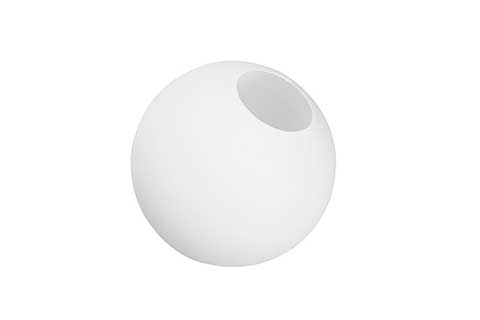
Opal glass achieves diffuse light transmission through controlled phase separation or fluoride opacification, creating thousands of microscopic glass-glass interfaces that scatter light without absorption. Two technical approaches dominate fábrica de abajures de vidro personalizados production:
Fluoride Opal: Addition of fluorides (NaF, CaF₂, AlF₃) to glass batch creates fluoride crystallites 50-200nm in size. This “superwhite” opal achieves 60-75% diffuse transmission with excellent color rendering (CRI maintenance >95).
Phosphate Opal: Phosphate additions produce larger scattering centers and warmer tone, preferred for residential and hospitality applications seeking reduced glare intensity.
 

Commercial Specification Drivers

Controle de Ofuscamento: UGR (Unified Glare Rating) compliance in office environments often mandates opal diffusion. Direct-view LED sources require 60%+ diffusion to achieve UGR <19 for open-plan workspaces.
Beam Shaping: Opal shades with engineered thickness variation create asymmetric distribution patterns, directing light toward work surfaces while maintaining ambient uniformity.
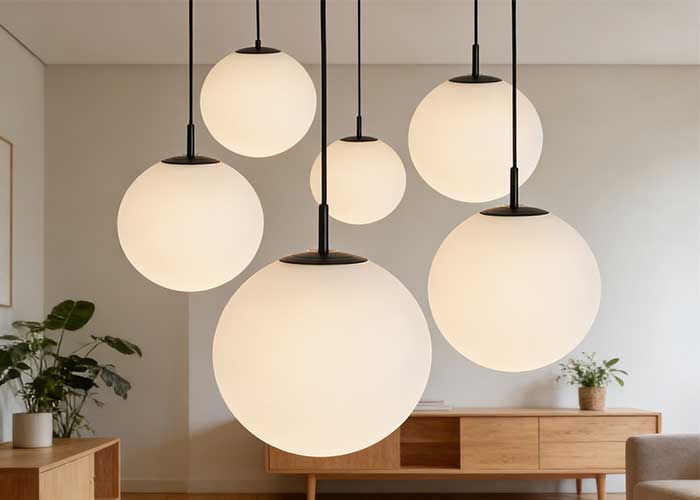
Aesthetic Softness: The “glowing volume” effect of opal glass transforms point sources into luminous architectural elements, valued in boutique hospitality and high-end residential specification.
Manufacturing Complexity: Opal glass requires precise batch chemistry and controlled melting atmospheres. Inconsistent fluorine volatilization produces “streaking” or color variation that rejects entire production lots. Experienced fabricantes de abajures de vidro maintain dedicated opal furnaces with 72-hour color transition protocols to ensure batch-to-batch consistency.

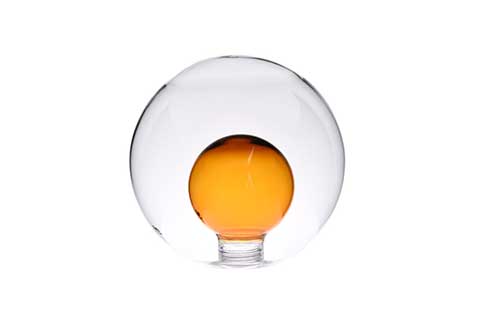
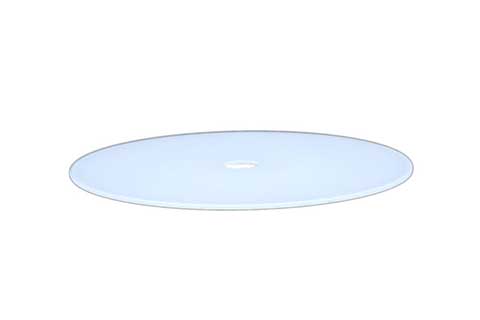
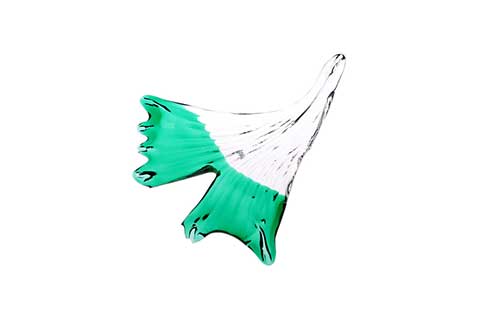
Abajur de Vidro Soprado à Mão

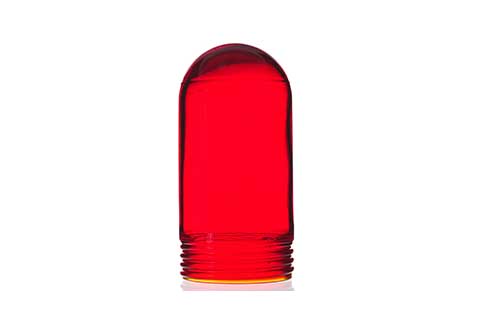
Abajur de Vidro Borossilicato

Abajur de Vidro Moldado por Máquina

Abajur de Vidro Centrífugo

Abajur de Vidro Curvado

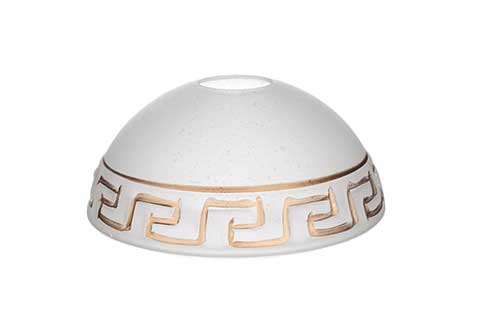
Abajur de Vidro Feito à Mão

Category 4: Crystal and Lead Glass Shades


Density, Brilliance, and Heritage Craft

Cristal de chumbo—containing 24-30% lead oxide (PbO)—replaces calcium with lead in the glass network, increasing density to 3.0-3.2 g/cm³ and refractive index to 1.545-1.560. The resulting optical properties—exceptional brilliance, spectral fire, and weight—define luxury lighting segments.

Manufacturing Distinctions

Lead glass’s lower working viscosity and extended plastic range favor hand-working techniques:
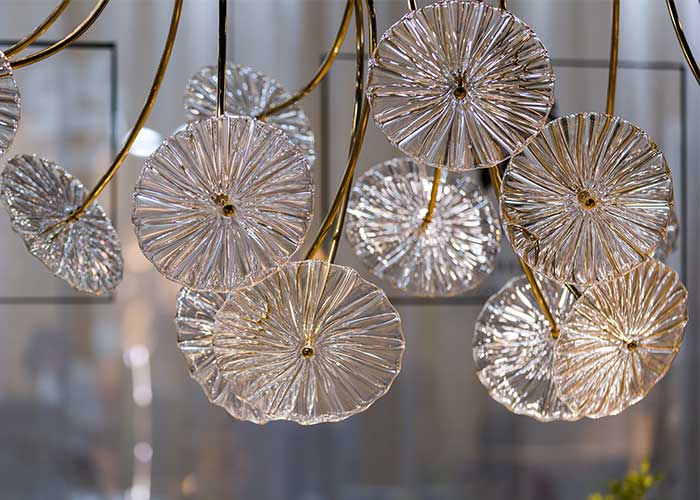
  • Cut crystal: Diamond wheel cutting and polishing creates prismatic facets that refract light into spectral components
  • Mold-blown crystal: Patterned molds impart surface texture without secondary cutting
  • Pressed crystal: High-lead compositions pressed into detailed molds for mass-produced decorative elements

Regulatory and Market Evolution

Environmental regulations—EU REACH restrictions, California Proposition 65—have pressured lead content reduction. Modern fabricantes de cúpulas de lâmpadas de vidro sob medida offer “lead-free crystal” formulations using barium, zinc, or titanium oxide substitutions achieving 90-95% of lead crystal optical performance without regulatory liability.
 

Commercial Positioning

Heritage and Traditional Fixtures: Restoration projects, classical architectural contexts, and luxury residential where material authenticity justifies regulatory compliance costs.
Statement Lighting: Chandeliers, pendants, and sconces where shade material itself constitutes the design focal point rather than functional light distribution.
Gift and Decorative Markets: Limited-edition pieces where material preciousness supports premium pricing.

Category 5: Tempered and Heat-Strengthened Glass Shades


Safety Engineering Through Thermal Treatment

Tempered glass—produced by heating annealed glass to 620-650°C then rapid air quenching—creates surface compression (80-150 MPa) balanced by interior tension. This stress state fundamentally alters failure mechanics: tempered glass shatters into small granular fragments rather than sharp shards, satisfying safety glazing requirements.
Heat-strengthened glass undergoes similar but less aggressive treatment, achieving 40-70 MPa surface compression. It retains annealed glass fracture patterns (large shards) but offers 2× mechanical strength and improved thermal resistance.
 

Commercial Lighting Applications

Public and High-Traffic Spaces: Building codes often mandate tempered glass for fixtures below 2.5m mounting height or in vulnerable locations.
Food Service and Preparation: NSF and health department regulations frequently require tempered glass in kitchen and dining areas.
Outdoor and Vandal-Prone Installations: Mechanical strength resists impact damage; when failure occurs, granular fragments reduce liability exposure.
Technical Constraints: Tempering distorts optical precision—flatness deviations of 0.3-0.5% are typical. Post-tempering cutting or drilling is impossible; all fabrication must precede thermal treatment. These restrictions limit tempered glass applicability in precision optical applications.

Category 6: Specialty Coated and Surface-Modified Glass Shades


Functional Surface Engineering

Beyond bulk glass composition, surface treatments extend abajur de vidro functionality:
Vacuum Metallizing: Aluminum or silver deposition in vacuum chambers creates reflective surfaces with 90-95% reflectance. Interior metallization of pendant shades directs light downward while maintaining exterior aesthetic. Exterior metallization produces mirror or semi-reflective decorative effects.
Dichroic Coatings: Thin-film interference coatings deposited via physical vapor deposition (PVD) transmit selected wavelengths while reflecting others. The “color-shift” effect—transmission color differing from reflected color—creates dynamic lighting effects valued in entertainment and architectural accent applications.
Anti-Reflective (AR) Coatings: Magnesium fluoride or multi-layer dielectric coatings reduce surface reflectance from 8% to <1% per surface, maximizing light transmission for museum, photographic, and scientific lighting.
Hydrophobic/Oleophobic Coatings: Fluoropolymer treatments reduce surface energy, preventing water spotting and fingerprint adhesion in outdoor or high-touch applications.
 

Manufacturing Integration

Surface coating requires specialized de abajur de vidro infrastructure: vacuum chambers (10⁻⁵ mbar), PVD sputtering systems, and cleanroom environments. Batch processing economics favor minimum quantities of 500-2,000 pieces depending on coating complexity. In-line coating for high volumes (10,000+ units) enables cost reduction but requires dedicated production lines.

Category 7: Recycled and Sustainable Glass Shades


Environmental Performance as Specification Criteria

Post-consumer recycled glass (PCR) incorporation—30-100% cullet content—reduces virgin material demand and melting energy consumption (approximately 25% energy reduction per 10% cullet increase). However, optical consistency challenges limit commercial lighting applications:
  • Color variation: Recycled glass introduces iron and chromium contaminants producing greenish tint
  • Seed and bubble: Re-melting history increases gaseous inclusions
  • Chemical inconsistency: Mixed source cullet creates unpredictable working properties
Carbon-Neutral Production: Some fabricantes de abajures de vidro achieve net-zero emissions through renewable energy (solar, wind), electric melting (replacing fossil fuel combustion), and verified carbon offset purchases. Premium pricing of 10-25% reflects these investments but enables client ESG compliance and green building certification (LEED, BREEAM).
 

Market Positioning

Corporate Sustainability Mandates: Fortune 500 headquarters, government facilities, and institutional clients with carbon reduction commitments increasingly require documented sustainable sourcing.
Consumer Brand Differentiation: Residential lighting brands targeting environmentally conscious demographics leverage recycled content as marketing differentiation.
Technical Limitations: High-optical-performance applications (museum, medical, precision architectural) generally require virgin material consistency unavailable from current recycled glass processing.

Aplicações Personalizadas de Abajures de Vidro

Para Decoração Residencial

Em residências, proporcionam iluminação suave e confortável, aprimorando salas de estar, quartos e áreas de jantar com design elegante e distribuição de luz equilibrada.

Para Cafés & Restaurantes

Em cafés e restaurantes, nossas luminárias de vidro ajudam a criar uma atmosfera acolhedora e convidativa, apoiando estilos de interior modernos e clássicos, além de melhorar a experiência geral do cliente.

Para Hotéis

Para hotéis e projetos de hospitalidade, nossos produtos oferecem qualidade consistente, aparência refinada e desempenho confiável, atendendo aos altos padrões necessários para quartos, saguões, corredores e espaços públicos.
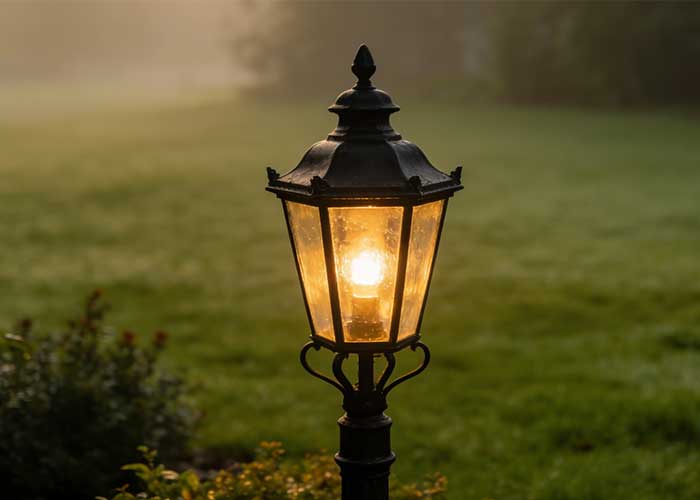
Para Luzes de Gramado

Para luzes de gramado, elas possuem um visual moderno e elegante, combinando perfeitamente com jardins, pátios e espaços externos.

Para Pátio Externo

Lâmpadas de vidro para exteriores são resistentes, à prova de intempéries e fáceis de limpar. Elas resistem ao desbotamento, chuva e altas temperaturas, oferecem iluminação suave e uniforme, além de uma longa vida útil.

Para Engenharia

Para projetos de engenharia, nossos produtos possuem alta resistência, resistência ao calor e excelente durabilidade em condições climáticas adversas. Transmissão de luz estável, seguros e duráveis, ideais para aplicações de engenharia e externas.

Quality Verification and Supplier Qualification


Assessing Glass Lamp Shade Manufacturer Capabilities

Technical specification achieves value only through manufacturing execution. Qualification criteria for abajur de vidro personalizado suppliers include:
Material Certification: Request batch-specific chemical analysis confirming composition. Borosilicate should demonstrate B₂O₃ content 12-13%, expansion coefficient 3.3 ± 0.2 × 10⁻⁶/K.
Process Control Documentation: For critical applications, audit furnace control charts, annealing kiln temperature profiles, and statistical process control data.
Testing Capabilities: In-house thermal shock testing (20°C to 300°C cycling), photometric measurement (integrating spheres, goniophotometers), and mechanical testing (impact, pressure) indicate sophisticated quality infrastructure versus subcontracted validation.
Vertical Integration: Facilities melting raw batch provide material traceability and customization impossible from merchant glass processors. However, specialized de cúpulas de vidro sourcing certified tubing may offer superior forming expertise for specific applications.

Perguntas Frequentes


What glass type offers the best value for commercial LED downlights?

Pressed borosilicate 3.3 provides optimal total cost of ownership for high-output LED applications. While unit material cost exceeds soda-lime by 60-80%, elimination of thermal failure warranty claims (typically 2-5% of revenue with inferior materials) and 15+ year service life justify investment. For outputs below 10W with engineered thermal management, soda-lime opal offers acceptable performance at reduced cost.

How do hand-blown and machine-made glass shades differ in commercial specification?

Hand-blown shades provide organic variation and complex geometries valued in decorative segments, with individual piece times of 10-30 minutes. Machine-made shades achieve ±2mm dimensional consistency and 30-60 pieces per minute production rates, essential for large-scale commercial rollouts requiring uniformity. Specification decisions hinge on aesthetic priorities versus volume requirements and budget constraints.

Can a single de abajur de vidro produce multiple glass types?

Integrated facilities typically specialize. Borosilicate and soda-lime require dedicated furnaces—cross-contamination of even trace boron destroys soda-lime working properties, while sodium contamination compromises borosilicate thermal resistance. Large fabricantes de cúpulas de lâmpadas de vidro sob medida operate separate production lines; smaller facilities focus on single material families. Verify material-specific expertise rather than assuming universal capability.

What lead times should lighting brands expect for custom glass production?

Standard catalog items from stock: 2-4 weeks. Custom tooled production: 12-16 weeks initial order (including 4-6 week mold fabrication), reducing to 6-8 weeks for repeat orders. Hand-blown artisan pieces: 8-12 weeks depending on complexity and artisan availability. Ocean freight from Asian manufacturing adds 4-6 weeks; air freight reduces to 1 week at 300-500% cost premium.

How do surface treatments affect glass shade durability?

Acid etching and sandblasting reduce surface integrity, potentially decreasing mechanical strength by 20-40%. However, for thermal shock performance, these treatments often prove beneficial—surface compression from differential cooling during etching can improve thermal resistance. Vacuum-metallized coatings require protective overcoats (silica or polymer) to prevent oxidation and abrasion in high-touch applications.

What testing validates glass shade compliance with commercial building codes?

ASTM C1048 (heat-treated flat glass), ASTM C1279 (non-destructive stress evaluation), and ANSI Z97.1 (safety glazing) provide standardized validation. For international projects, EN 12150 (thermally toughened soda-lime silicate safety glass) and EN 14179 (heat-soaked thermally toughened soda-lime silicate safety glass) apply. Fabricantes de cúpulas de vidro para lâmpadas should provide test reports from accredited laboratories (SGS, Intertek, Bureau Veritas).

How does recycled glass content affect optical performance?

Post-consumer recycled glass introduces iron and chromium contaminants producing greenish tint and reduced transmission (typically 5-15% below virgin material). For applications where color accuracy and maximum output are critical, virgin material is recommended. For ambient and decorative applications where slight color variation is acceptable, 30-50% recycled content achieves sustainability objectives without significant performance compromise.

What distinguishes pharmaceutical-grade from standard commercial glass shades?

Pharmaceutical and medical lighting requires: (1) USP Type I or EP Type I borosilicate glass certification confirming hydrolytic resistance; (2) validated cleaning and sterilization protocols (autoclave, gamma irradiation, hydrogen peroxide vapor compatibility); (3) particulate and extractable testing per USP <788> and <1661>; (4) complete batch traceability from raw material through finished device. Standard commercial de cúpulas de vidro lack these validation systems; medical-grade suppliers maintain dedicated cleanroom production and quality systems.

Can glass shades be repaired or refinished in the field?

Glass is fundamentally unrepairable—thermal or mechanical damage requires replacement. Some surface degradation (mineral deposits, organic residue) can be addressed through appropriate cleaning protocols. Never attempt field cutting, drilling, or grinding—uncontrolled stress introduction guarantees subsequent failure. Specify replacement stock for critical installations, or partner with fabricantes de cúpulas de lâmpadas de vidro sob medida offering rapid-turnaround replacement programs.
 

How do lighting brands protect intellectual property for custom glass designs?

Three mechanisms: (1) Design patents protect ornamental appearance for 15 years (US) or 25 years (EU); (2) Utility patents cover functional innovations (mounting systems, optical features); (3) Contractual exclusivity agreements with fabricantes de abajures de vidro prevent design replication for competing clients. Mold ownership clauses and non-disclosure agreements provide additional protection. Note that pure geometric forms and functional shapes may not qualify for design patent protection.

Conclusion: Strategic Glass Specification

 
The diversity of abajur de vidro types available to commercial lighting specifiers reflects centuries of materials science development and manufacturing refinement. No single glass type dominates all applications; optimal specification requires matching material properties—thermal, optical, mechanical, chemical—to specific installation demands, budget parameters, and design intentions.
Successful lighting brands develop deep partnerships with fabricantes de cúpulas de lâmpadas de vidro sob medida whose technical capabilities span multiple material families and forming methodologies. This integration enables responsive product development, consistent quality execution, and supply security essential for commercial market success.
The technical distinctions outlined in this analysis provide foundation for informed specification. However, final material and process selection benefits from direct consultation with manufacturing engineers who can evaluate specific design geometries, performance requirements, and volume projections against production capabilities and economic constraints.

Perguntas Frequentes

Yancheng Jingxin Glassware Co., Ltd. é um fabricante de vidro profissional fundado em 1999. Operamos nossa própria instalação de produção de 6.000m² que integra design, fabricação, controle de qualidade e serviços de exportação — não uma empresa comercial.

Nós fabricamos uma ampla variedade de abajur de vidro personalizado  incluindo abajur de vidro soprado, abajur de vidro prensado, abajur de vidro de borossilicato, abajur de vidro centrífugo, etc. Nossas capacidades abrangem produção OEM e ODM para várias aplicações e indústrias.

Sim, fornecemos serviços completos de personalização OEM e ODM incluindo:

  • Design e engenharia de produto personalizado
  • Desenvolvimento de moldes interno
  • Impressão de logotipo e branding
  • Tratamentos de superfície e acabamentos
  • Soluções de embalagem personalizadas

Sim, nossa equipe de design pode desenvolver utensílios de vidro personalizados a partir do seu conceito. Fornecemos serviços de design profissionais com base nas suas ideias, amostras de referência ou requisitos funcionais—sem necessidade de desenhos técnicos para começar.

Nosso processo garante qualidade antes da produção em massa

Confirmação do design com o cliente

Desenvolvimento interno do molde em nossa instalação

Produção de amostras para aprovação

Testes e feedback do cliente

Produção em massa somente após a aprovação da amostra final

Oferecemos embalagem personalizada completa para envio internacional seguro:

  • Materiais de embalagem interna protetora
  • Caixas de papelão de grau de exportação
  • Caixas de cores personalizadas e embalagens para varejo
  • Impressão de etiquetas e branding
  • Embalagem projetada de acordo com os padrões de envio internacional
  • Inspeção em todas as etapas de produção
  • Procedimentos científicos de controle de qualidade
  • Inspeção pré-embarque de cada lote
  • Conformidade com padrões internacionais de exportação
  • Sistemas de gestão de qualidade certificados

Operamos múltiplas linhas de produção com trabalhadores experientes, permitindo uma produção em massa estável para pedidos de todos os tamanhos. Nossa instalação garante qualidade consistente e entrega pontual confiável tanto para pequenos lotes quanto para pedidos de grande volume.

Os prazos variam de acordo com a complexidade e quantidade:

  • Produção de amostras: geralmente de 2 a 4 semanas
  • Produção em massa: agendada após aprovação da amostra
  • Prazos exatos fornecidos com base nos requisitos específicos do pedido

Exportamos para mais de 150 países e regiões em todo o mundo, incluindo:

  • América do Norte (Brasil, Canadá)
  • Europa (Reino Unido, Alemanha, França, etc.)
  • Mercados da Ásia-Pacífico
  • Oriente Médio
  • África
  • Oceania (Austrália, Nova Zelândia)

Mantemos uma rede de distribuição global abrangente.

Solicitar Orçamento Pronto para Trabalhar Juntos? Construa um projeto conosco!

SOLICITAR ORÇAMENTO
Rolar para cima