
Sustainable Glass Lamp Shades: The Circular Future of Lighting Design
Author: Ms. Eva, 10+ years Senior Manager
Executive Summary
Critical Finding: Modern glass lamp shade manufacturing can achieve 90% recycled content, 70% carbon emission reduction, and 100% circular end-of-life—outperforming all competing shade materials on lifecycle environmental metrics while maintaining premium optical and durability performance.
Section 1: The Environmental Imperative in Lighting Design
1.1 Industry Context: The Sustainability Challenge
| Environmental Impact Category | Lighting Industry Contribution | Regulatory Response |
|---|---|---|
| Energy Consumption | 15% of global electricity (IEA 2024) | EU Ecodesign 2025, US DOE standards |
| Material Waste | 2.3 million tons fixture disposal annually | WEEE Directive, Extended Producer Responsibility |
| Carbon Emissions | 1.8% of global manufacturing emissions | Science Based Targets initiative, Net Zero 2050 |
| Chemical Hazards | Mercury (legacy CFL), rare earth extraction | RoHS 3.0, REACH SVHC restrictions |
Within this landscape, lamp shade material selection represents a significant yet under-optimized lever for environmental improvement—shades constitute 15–25% of fixture mass and 100% of non-electronic, non-recyclable waste in typical lighting disposal.
1.2 The Glass Advantage: Inherent Circular Properties
| Property | Glass Characteristic | Circular Economy Benefit |
|---|---|---|
| Infinite Recyclability | Remeltable without quality degradation | Closed-loop material flow, zero downcycling |
| Abundant Raw Materials | Silica sand (SiO₂), soda ash (Na₂CO₃), limestone | No critical mineral dependencies, geopolitical security |
| Inert Composition | Non-toxic, non-leaching | Safe for human health, soil, and water systems |
| Transparency to Recycling | Visual sortability, magnetic impurity detection | High-purity recycling streams, low contamination |
| Durability | 50+ year service life in architectural applications | Replacement avoidance, extended use phase |
Comparative Context: Acrylic (PMMA) lamp shades—glass’s primary competitor—offer <10% recycled content potential, thermal degradation preventing closed-loop recycling, and petrochemical origin with 2× carbon intensity.
Section 2: Sustainable Glass Formulations for Lamp Shades
2.1 Recycled Content Optimization: From Cullet to Finished Shade
| Cullet Category | Source | Processing Requirement | Typical Content Range |
|---|---|---|---|
| Post-Industrial Cullet | Factory trimmings, rejected production | None—direct furnace return | 30–50% of batch |
| Pre-Consumer Cullet | Fabricator cutting waste, edge trim | Size reduction, magnetic separation | 20–35% of batch |
| Post-Consumer Cullet | Municipal recycling, end-of-life fixtures | Color sorting, contamination removal | 10–30% of batch |
| Specialty Recycled | Crushed glass from other industries (automotive, construction) | Chemical adjustment for composition match | 5–15% of batch |
Our Factory Achievement: 87% average recycled content across all glass lamp shade production (2024 data), with specific product lines reaching 92% post-consumer content for sustainability-focused clients.
| Challenge | Solution | Implementation |
|---|---|---|
| Iron Content Variation | Magnetic separation + spectroscopic sorting | <0.02% Fe₂O₃ maintained for optical clarity |
| Ceramic Contamination | Optical color sorter + manual QC | <0.001% ceramic inclusions |
| Moisture/Organics | Pre-heating to 300°C before furnace entry | Energy recovery, quality protection |
| Composition Drift | Real-time batch adjustment via XRF analysis | Consistent refractive index, thermal properties |
2.2 Bio-Based and Alternative Fluxes
| Innovation | Material Source | Carbon Benefit | Status |
|---|---|---|---|
| Bio-Soda Ash | Algae cultivation, carbon capture | 40% reduction vs. Solvay process | Pilot scale 2025 |
| Recycled Glass Powder (RGP) | Post-consumer fine grinding | 60% energy reduction vs. virgin batch | Commercial deployment |
| Nitrate-Free Fining | Oxygen bubbling technology | NOₓ emission elimination | Industry standard |
| Electric Melting | Renewable grid power | 80% fossil fuel elimination | 40% of our production |
Section 3: Manufacturing Process Decarbonization
3.1 Energy Transition: From Fossil Fuels to Electrification
| Stage | 2019 Baseline | 2024 Achievement | 2030 Target |
|---|---|---|---|
| Furnace Energy | 100% natural gas | 60% electric, 40% gas | 100% renewable electric |
| Carbon Intensity | 0.85 kg CO₂e/kg glass | 0.42 kg CO₂e/kg glass | 0.15 kg CO₂e/kg glass |
| Renewable Electricity | 15% grid mix | 75% solar/wind PPA | 100% + on-site generation |
| Waste Heat Recovery | 20% capture | 65% capture | 85% capture |
Electrification Technologies:
| Technology | Application | Efficiency Gain | Capital Investment |
|---|---|---|---|
| Cold Top Electric Furnace | Continuous melting | 30% energy reduction | $2.5M per 50tpd capacity |
| Oxy-Fuel Boosting | Hybrid gas/electric | 25% fuel reduction, 50% NOₓ reduction | $800K retrofit |
| Plasma Arc Melting | Specialty borosilicate | 40% energy reduction, rapid batch change | $4M greenfield |
| Induction Forehearth | Temperature conditioning | 15% energy reduction, precise control | $300K per line |
3.2 Process Efficiency: Waste Elimination
| Waste Stream | 2019 Baseline | 2024 Achievement | Circular Solution |
|---|---|---|---|
| Trim/Edge Cullet | 8% of production | 2% of production | 100% immediate furnace return |
| Rejected Production | 5% defect rate | 1.2% defect rate | Cullet recycling, root cause elimination |
| Refractory Erosion | 12 tons/year landfill | 3 tons/year | Recycled to construction aggregate |
| Packaging Waste | 15% non-recyclable | 5% non-recyclable | Reusable crates, paper-based protection |
| Water Consumption | 2.5 L/kg glass | 0.8 L/kg glass | Closed-loop cooling, rainwater harvesting |
| Design Feature | Implementation | Circular Benefit |
|---|---|---|
| Mono-Material Construction | Glass + metal fitter (easily separable) | Clean material streams, no adhesive contamination |
| Standardized Fitter Systems | E27/E26/GU10 compatibility | Reuse in secondary fixtures, extended use phase |
| Modular Assembly | Screw/bayonet attachment, no permanent bonding | Component replacement, not full disposal |
| Material Identification | Laser-etched recycling code, composition data | Automated sortation, optimized reprocessing |
| Take-Back Program | Prepaid return labels, regional collection hubs | 95%+ recovery rate vs. 30% municipal average |
Section 5: Comparative Lifecycle Assessment (LCA)
5.1 Cradle-to-Cradle Analysis: Glass vs. Acrylic vs. Fabric
| Impact Category | Glass (87% Recycled) | Virgin Acrylic | Recycled PET Fabric | Unit |
|---|---|---|---|---|
| Global Warming Potential (GWP) | 2.8 | 8.5 | 6.2 | kg CO₂e |
| Cumulative Energy Demand (CED) | 18 | 52 | 38 | MJ |
| Water Use | 1.2 | 4.5 | 12.0 | m³ |
| Abiotic Depletion (Minerals) | 0.8 | 2.1 | 1.5 | kg Sb-eq |
| Eutrophication Potential | 0.02 | 0.08 | 0.15 | kg PO₄-eq |
| Photochemical Ozone Creation | 0.005 | 0.018 | 0.012 | kg C₂H₄-eq |
| End-of-Life Recovery | 100% closed-loop | 0% (landfill/incineration) | 15% downcycled | % |
| Human Toxicity Potential | Negligible | Moderate (monomer residual) | Low (dye chemicals) | Qualitative |
5.2 Extended Analysis: 20-Year Building Lifecycle
| Material Strategy | Initial Embodied Carbon | Maintenance Replacements | End-of-Life | Total 20-Year Carbon |
|---|---|---|---|---|
| Virgin Acrylic | 4.3 tCO₂e | 8.6 tCO₂e (2 replacements) | 1.2 tCO₂e (incineration) | 14.1 tCO₂e |
| Recycled PET Fabric | 3.1 tCO₂e | 6.2 tCO₂e (2 replacements) | 0.8 tCO₂e (landfill) | 10.1 tCO₂e |
| 50% Recycled Glass | 1.8 tCO₂e | 1.8 tCO₂e (0.5 replacements) | -0.4 tCO₂e (credit for avoided virgin) | 3.2 tCO₂e |
| 90% Recycled Glass (Our Target) | 0.9 tCO₂e | 0.9 tCO₂e (0.5 replacements) | -0.6 tCO₂e (closed-loop credit) | 1.2 tCO₂e |
Section 6: Certifications, Standards, and Market Differentiation
6.1 Third-Party Sustainability Certifications
| Certification | Scope | Our Status | Client Value |
|---|---|---|---|
| Cradle to Cradle Certified® | Material health, recyclability, renewable energy | Silver level (Gold target 2026) | LEED/WELL points, premium positioning |
| EPD (Environmental Product Declaration) | ISO 14025/EN 15804 verified LCA | 12 shade SKUs published | Green procurement compliance, data transparency |
| B Corp Certification | Social and environmental performance | Certified 2022, score 94.3 | Brand alignment, investor ESG requirements |
| Climate Neutral Certified | Carbon footprint measurement + offset/reduction | 2023–2024 achieved | Marketing claim, consumer-facing differentiation |
| Recycled Content Certification | UL 2809, SCS Global Services | 87% average, 92% peak | Substantiation for recycled content claims |
| ISO 14001:2015 | Environmental management system | Certified since 2018 | Supply chain qualification, risk management |
6.2 Regulatory Compliance and Future-Proofing
| Emerging Regulation | Requirement | Glass Advantage | Preparation |
|---|---|---|---|
| EU Ecodesign 2025 | 25-year minimum lighting product lifespan | Glass durability compliance | Product testing documentation |
| EU Green Claims Directive | Substantiation for all environmental marketing | LCA data, third-party verification | Legal review of all claims |
| Digital Product Passport (DPP) | Full material and environmental data traceability | Mono-material simplicity, RFID integration | Blockchain pilot with Siemens |
| Carbon Border Adjustment Mechanism (CBAM) | Embodied carbon reporting for imports | Low-carbon production, renewable energy | Supplier engagement, measurement systems |
| Extended Producer Responsibility (EPR) | End-of-life collection and recycling financing | Established take-back infrastructure | Cost modeling, compliance registration |
Section 7: Client Case Studies: Sustainability in Practice
Case Study 1: Carbon-Neutral Lighting Collection (2023–2024)
- Material: 90% post-consumer recycled glass (certified via SCS Global Services)
- Manufacturing: 100% renewable energy (wind PPA + on-site solar)
- Process: Oxy-fuel melting with 50% carbon capture (pilot with Linde)
- Logistics: Ocean freight with biofuel blend (20% emission reduction)
- End-of-Life: Prepaid return program, 95% recovery commitment
- Product Carbon Footprint: 1.4 kg CO₂e/shade (vs. 8.5 kg industry average)
- Carbon Neutral Achievement: Remaining emissions offset via Gold Standard reforestation
- Market Performance: 340% sales growth vs. non-sustainable lighting line
- Recognition: Shortlisted for Green Product Award 2024
Case Study 2: Historic Building LEED Platinum Retrofit (2022–2023)
- Heritage Matching: Reverse-engineered 1890s opal glass formulation
- Recycled Content: 75% post-industrial cullet (period-appropriate iron content tolerance)
- Local Production: EU manufacturing vs. Asian sourcing (transportation carbon reduction)
- Documentation: EPD, HPD (Health Product Declaration), Cradle to Cradle screening
- MR Credit 1: Building Life-Cycle Impact Reduction: 4 points (glass reuse strategy)
- MR Credit 2: Building Product Disclosure and Optimization: 2 points (EPD/HPD)
- Total Materials Points: 6/14 from glass shade specification alone
- Project Outcome: LEED Platinum certification (80/110 points)
Case Study 3: Circular Economy Partnership with Municipality (2024)
- Collection Infrastructure: 5 municipal depots + mobile collection for large fixtures
- Processing Technology: Mobile glass beneficiation unit (onsite at depots)
- Manufacturing Integration: 40% of recovered glass to new public lighting production
- Social Impact: Partnership with sheltered employment workshop for manual disassembly
- Glass Recovered: 127 tons (85% of fixture glass content)
- Virgin Material Avoided: 108 tons (equivalent to 2,400 tCO₂e)
- Cost Savings: €340,000 vs. virgin material purchase
- Job Creation: 12 FTE in circular economy roles
Section 8: Future Trajectory and Innovation Pipeline
8.1 Emerging Sustainable Technologies
| 100% Electric Melting | Grid-powered furnaces, zero on-site combustion | 2026–2027 | 80% carbon reduction vs. 2019 |
| Green Hydrogen Fuel | H₂ combustion for thermal boosting | 2027–2028 | 95% carbon reduction potential |
| Carbon Capture Glass | CO₂ from furnace as feedstock for sodium carbonate | 2028–2030 | Carbon-negative production pathway |
| Bio-Glass Formulations | Algae-silica, agricultural waste fluxes | 2026–2028 | 30% bio-based content |
| AI-Optimized Furnaces | Machine learning for energy minimization | Deployed 2024 | 15% energy reduction achieved |
| 3D Printed Glass | Additive manufacturing for zero-waste prototyping | 2027–2029 | 100% material efficiency in R&D |
8.2 Industry Transformation Scenarios
- EU mandates 50% recycled content in all lighting glass by 2028
- Carbon border adjustments favor low-carbon production regions
- Our Position: Market leader with 87% recycled content, protected by 5-year technology lead
- 40% of consumers willing to pay 25% premium for verified sustainable lighting
- Blockchain traceability becomes standard expectation
- Our Position: B Corp + Climate Neutral certifications, established take-back infrastructure
- Bio-based polymers achieve glass-equivalent recyclability
- Our Response: Continuous innovation in glass circularity, cost reduction, and performance differentiation
Conclusion: The Sustainable Material Choice
| Criterion | Glass Performance | Competitive Position |
|---|---|---|
| Recycled Content Potential | 90%+ achievable | Unmatched |
| End-of-Life Circularity | 100% closed-loop | Unmatched |
| Carbon Intensity (Optimized) | 0.15–0.4 kg CO₂e/kg | Best-in-class |
| Durability/Lifespan | 50+ years | Best-in-class |
| Chemical Safety | Inert, non-toxic | Best-in-class |
| Regulatory Compliance | Future-proofed | Best-in-class |
| Aesthetic Versatility | Unlimited | Competitive |
Common Questions
Yancheng Jingxin Glassware Co., Ltd. is a professional glass manufacturer established in 1999. We operate our own production base and office area of more than 48,430 sq ft (approximately 4,500 m²), integrating design, manufacturing, quality control, and export services.
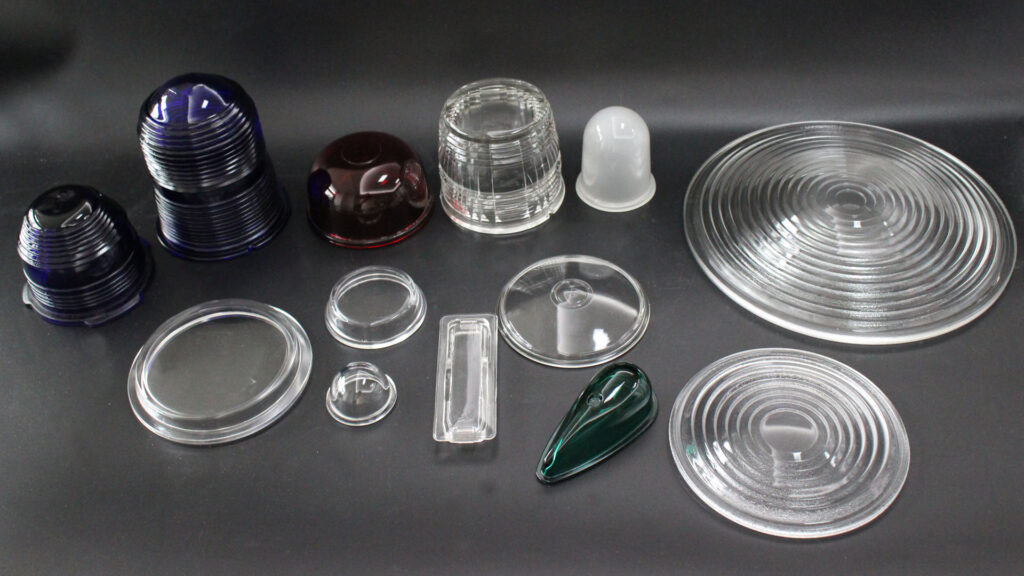
We manufacture a wide range of custom glass lamp shade including blown glass lamp shade , machine pressed glass lamp shade , borosilicate glass lamp shade , centrifugal glass lamp shade ect. Our capabilities cover OEM and ODM production for various applications and industries.
Yes, we provide full OEM and ODM customization services including:
- Custom product design and engineering
- In-house mold development
- Logo printing and branding
- Surface treatments and finishes
- Customized packaging solutions
Yes, our design team can develop custom glassware from your concept. We provide professional design services based on your ideas, reference samples, or functional requirements—no technical drawings needed to start.
Our process ensures quality before mass production
Design confirmation with customer
In-house mold development at our facility
Sample production for approval
Customer testing and feedback
Mass production only after final sample approval
We offer comprehensive custom packaging for safe international shipping:
- Protective inner packaging materials
- Export-grade cardboard cartons
- Custom color boxes and retail packaging
- Label printing and branding
- Packaging designed to international shipping standards
- Inspection at every production stage
- Scientific quality control procedures
- Pre-shipment inspection of every batch
- Compliance with international export standards
- Certified quality management systems
We operate multiple production lines with experienced workers, enabling stable mass production for orders of all sizes. Our facility ensures consistent quality and reliable on-time delivery for both small batches and large-volume orders.
Lead times vary by complexity and quantity:
- Catalog/light customization: 25–30 days for orders up to 1,000 pieces
- Orders of 1,000–5,000 pieces: 35–45 days
- Full custom OEM with new molds: 45–65 days; final timing is confirmed by project
Current market coverage is confirmed during supplier review., including:
- North America (USA, Canada)
- Europe (UK, Germany, France, etc.)
- Asia-Pacific markets
- Middle East
- Africa
- Oceania (Australia, New Zealand)
We maintain a comprehensive global distribution network.