
Introduction: The Renaissance of Artisanal Lighting
As a custom glass lamp shade manufacturer with deep expertise in artisanal production methods, we recognize that understanding both the benefits and limitations of mouth-blown glass is essential for lighting brands, interior designers, architects, and procurement specialists. This comprehensive analysis explores the technical specifications, practical applications, economic considerations, and quality standards associated with mouth glass lampshade production, supported by real-world client cases and manufacturing insights.
Understanding the Mouth-Blown Glass Manufacturing Process
nThe glass lamp shade factory process includes several critical stages: initial gathering and inflation, precision shaping through mold or hand-manipulation, controlled cooling (annealing) in kilns to relieve internal stresses, and final finishing including edge grinding, polishing, and fitting preparatio. Each stage requires years of training and decades to master, making experienced craftspeople invaluable assets to any glass lamp shade manufacturer .
nWhat distinguishes truly artisanal mouth-blown glass is the intentional embrace of natural variations. As noted by premium lighting manufacturer Louis Poulsen, “Creating mouth-blown lampshades in glass is an art… Even if the colour mixtures match precisely, the varying glass thickness subtly influences the hue. Additionally, different patterns of tiny bubbles trapped in the glass can slightly alter the appearance from shade to shade”. These factors contribute to what we term “imperfect beauty”—the hallmark of authentic craftsmanship.
n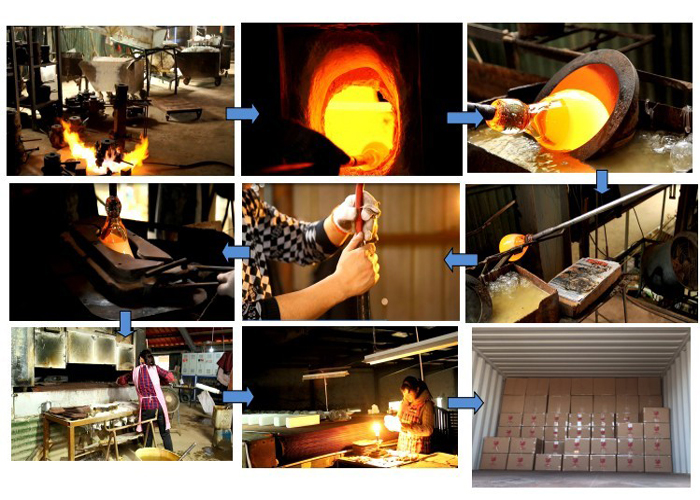
The Advantages of Mouth-Blown Glass Lampshades
1. Unparalleled Aesthetic Individuality and Design Versatility
- Colorful and Patterned Shades: Featuring swirling cords, ribbed textures, geometric layouts, and floral motifs that transform illumination into dynamic visual experiences
- Floral and Natural Motifs: Etched or molded botanical elements evoking serenity and warmth, particularly suited for Cottagecore and Bohemian interiors
- Industrial and Rustic Designs: Textured finishes with bubbles, ripples, and uneven edges emphasizing artisanal authenticity
- Geometric and Minimalist Patterns: Angular prisms and faceted surfaces requiring expert control during the blowing process
- Artistic and Sculptural Designs: Abstract forms including undulating waves, floating orbs, and twisted spirals created through advanced techniques like glass fuming and marbling
2. Superior Light Quality and Diffusion Properties
3. Environmental Sustainability and Minimal Waste
4. Premium Market Positioning and Brand Differentiation
This premium positioning enables stronger brand differentiation in crowded markets. A glass lamp shade manufacturer specializing in mouth-blown techniques can offer SKUs with “strong aesthetic value and brand differentiation” that machine-production facilities cannot match. The narrative of artisanal craftsmanship—emphasizing years of training, decades of mastery, and individual attention—resonates powerfully with contemporary consumers seeking authenticity and provenance.
5. Compatibility with Modern Lighting Technology
Modern mouth-blown custom glass lamp shade designs demonstrate excellent compatibility with LED bulbs, smart lighting systems, and dimmers . This convergence of traditional craftsmanship and contemporary technology allows lighting designers to specify artisanal pieces without sacrificing energy efficiency or advanced functionality. The thermal properties of properly annealed glass also ensure durability when paired with LED sources, which emit significantly less heat than traditional incandescent bulbs—a critical consideration for preserving delicate glasswork.
The Disadvantages of Mouth-Blown Glass Lampshades
1. Production Cost and Economic Accessibility
The most significant disadvantage of mouth-blown glass lampshades is their substantial cost premium compared to machine-manufactured alternatives. This cost differential stems from multiple factors: the extensive training required for skilled artisans (often 10+ years of experience), the labor-intensive nature of individual piece production, higher defect rates inherent to handmade processes, and the inability to achieve economies of scale.
For budget-conscious projects or applications requiring multiple identical fixtures—such as hospitality chains or large commercial installations—mouth-blown glass may prove economically prohibitive. Industry guidance suggests these pieces are “less ideal for… budget-conscious shoppers, or those needing multiple identical fixtures”.
2. Inconsistency and Quality Control Challenges
3. Extended Lead Times and Scalability Limitations
The artisanal nature of mouth-blown glass imposes inherent production speed limitations. Where machine-pressed custom glass lamp shade production can generate thousands of identical units daily, skilled artisans may require several hours to complete a single complex piece. This constraint becomes particularly problematic for large-scale projects or brands experiencing rapid growth.
4. Fragility and Handling Requirements
5. Risk of Counterfeiting and Authenticity Verification
Client Case Study: Successful Implementation for US Lighting Brand
To illustrate practical application of these advantages and disadvantages, consider the experience of a mid-sized lighting brand based in the United States. This company sought to develop a new collection of modern wall sconces featuring custom glass lamp shade components with distinctive torch shapes, high transparency, consistent thickness, and compatibility with standard fittings.
Initial Challenges with Domestic Sourcing
Transition to Specialized Glass Lamp Shade Manufacturer
- Rapid Prototyping: New mold development based on brand specifications with sample production completed within weeks
- Design Optimization: Collaborative adjustments to improve light diffusion properties and structural integrity
- Packaging Innovation: Redesigned protective packaging that reduced shipping damage incidents
Cost Efficiency: Production costs reduced by over 30% compared to domestic sourcing while maintaining artisanal quality standards
Technical Specifications and Quality Standards
Material Composition and Thermal Properties
Premium mouth-blown glass for lighting applications typically utilizes silica-based mixtures with soda and limestone, with ratios varying based on desired optical and physical properties. Coloration is achieved through precise addition of metal oxides during the smelting process, which occurs over 14 hours at approximately 1,450°C in traditional furnace operations.
Annealing—the controlled cooling process—is critical for durability. Improperly annealed glass retains internal stresses that can lead to spontaneous breakage. Professional glass lamp shade manufacturers conduct annealing over extended periods, with specific temperature curves determined by glass thickness and composition.
Safety and Compliance Certifications
- UL Certification: Required for US market entry, covering electrical safety and fire resistance
- CE Marking: Mandatory for European Economic Area distribution
- CCC Certification: Chinese Compulsory Product Certification for domestic market and certain export categories
- Surface Finish: Absence of scratches, chips, or unacceptable inclusions
- Dimensional Accuracy: Compliance with design tolerances (typically ±2-3mm for artisanal pieces
- Structural Integrity: Absence of cracks, stress patterns, or weak pointsROHS Compliance: Restriction of Hazardous Substances for environmental safety
- FCC Certification: For products incorporating radio-frequency or electromagnetic component
Surface Finish and Optical Quality Standards
- Transparency: Measured light transmission rates against specifications
- Surface Finish: Absence of scratches, chips, or unacceptable inclusions
- Dimensional Accuracy: Compliance with design tolerances (typically ±2-3mm for artisanal pieces)
- Structural Integrity: Absence of cracks, stress patterns, or weak points
- Color Consistency: Evaluation within acceptable variation ranges for artisanal products
Strategic Recommendations for Lighting Professionals
When to Specify Mouth-Blown Glass Lampshades
- Luxury residential projects where uniqueness and artisanal provenance justify premium pricing
- Boutique hospitality environments (high-end restaurants, boutique hotels) seeking distinctive atmospheric lighting
- Statement pieces in commercial lobbies, galleries, or executive spaces
- Heritage restoration projects requiring traditional craftsmanship techniques
- Limited edition or collector’s item lighting collections
When to Consider Alternative Manufacturing Methods
- Large-scale commercial rollouts requiring hundreds of identical units
- Budget-constrained projects where cost efficiency outweighs artisanal value
- Applications demanding precise dimensional consistency across multiple fixtures
- High-traffic public spaces where durability concerns outweigh aesthetic considerations
- Rapid market expansion requiring scalable supply chains
Sourcing Best Practices
- Verify production capabilities through facility visits or third-party audits
- Request comprehensive sample evaluation including stress testing and optical assessment
- Establish clear quality tolerance parameters acknowledging artisanal variation while defining unacceptable deviations
- Develop specialized packaging protocols addressing fragility concerns
- Negotiate flexible production scheduling accommodating artisanal lead times
- Implement authentication measures protecting against counterfeit products
Conclusion: Balancing Artistry and Practicality
The disadvantages—cost premiums, production limitations, quality variability, and handling requirements—are substantial but manageable through informed sourcing decisions and strategic partnerships with experienced glass lamp shade factory operations. As demonstrated by successful client implementations, collaboration with specialized glass lamp shade manufacturers can mitigate traditional artisanal production challenges while preserving the aesthetic and narrative advantages that distinguish mouth-blown glass in contemporary markets.
Common Questions
Yancheng Jingxin Glassware Co., Ltd. is a professional glass manufacturer established in 1999. We operate our own production base and office area of more than 48,430 sq ft (approximately 4,500 m²), integrating design, manufacturing, quality control, and export services.
We manufacture a wide range of custom glass lamp shade including blown glass lamp shade , machine pressed glass lamp shade , borosilicate glass lamp shade , centrifugal glass lamp shade ect. Our capabilities cover OEM and ODM production for various applications and industries.
Yes, we provide full OEM and ODM customization services including:
- Custom product design and engineering
- In-house mold development
- Logo printing and branding
- Surface treatments and finishes
- Customized packaging solutions
Yes, our design team can develop custom glassware from your concept. We provide professional design services based on your ideas, reference samples, or functional requirements—no technical drawings needed to start.
Our process ensures quality before mass production
Design confirmation with customer
In-house mold development at our facility
Sample production for approval
Customer testing and feedback
Mass production only after final sample approval
We offer comprehensive custom packaging for safe international shipping:
- Protective inner packaging materials
- Export-grade cardboard cartons
- Custom color boxes and retail packaging
- Label printing and branding
- Packaging designed to international shipping standards
- Inspection at every production stage
- Scientific quality control procedures
- Pre-shipment inspection of every batch
- Compliance with international export standards
- Certified quality management systems
We operate multiple production lines with experienced workers, enabling stable mass production for orders of all sizes. Our facility ensures consistent quality and reliable on-time delivery for both small batches and large-volume orders.
Lead times vary by complexity and quantity:
- Catalog/light customization: 25–30 days for orders up to 1,000 pieces
- Orders of 1,000–5,000 pieces: 35–45 days
- Full custom OEM with new molds: 45–65 days; final timing is confirmed by project
Current market coverage is confirmed during supplier review., including:
- North America (USA, Canada)
- Europe (UK, Germany, France, etc.)
- Asia-Pacific markets
- Middle East
- Africa
- Oceania (Australia, New Zealand)
We maintain a comprehensive global distribution network.