
Cómo Elegir el Material de Vidrio Adecuado para Pantallas de Lámpara: Templado vs Borosilicato vs Sodocálcico
Elegir el material de vidrio adecuado para las pantallas de lámparas es una de las decisiones más críticas en el diseño y fabricación de productos de iluminación. El vidrio que selecciones afecta directamente la resistencia al calor, la seguridad, la difusión de la luz, la durabilidad, el cumplimiento, el costo y el rendimiento a largo plazo.
Para los fabricantes de iluminación, diseñadores de interiores, arquitectos y compradores de proyectos de hostelería, entender las diferencias entre vidrio templado, vidrio borosilicato y vidrio de soda-lima es esencial para evitar grietas, fallos de calidad y costosos retrasos en los proyectos.
En esta guía, desglosamos cada material desde una perspectiva técnica y comercial, ayudándote a tomar la decisión correcta basada en la aplicación, el entorno y la escala de producción, mientras evitas errores comunes que los compradores B2B suelen encontrar.
Por qué el material de vidrio es importante en la fabricación de pantallas de lámparas
Las pantallas de lámparas no son componentes puramente decorativos. En el uso real, deben soportar:
Exposición continua al calor de bombillas o módulos LED
Choque térmico al encender y apagar las luces
Estrés mecánico durante la instalación y el transporte
Exposición a largo plazo a la luz UV y cambios de temperatura ambiente
Seleccionar el material de vidrio incorrecto puede resultar en:
Grietas o roturas durante el uso
Difusión de luz desigual y deslumbramiento
Altas tasas de rotura durante el envío
No cumplimiento con las normas de seguridad o del proyecto
Por eso, los fabricantes de iluminación profesionales evalúan los materiales de vidrio no solo por su apariencia, sino por rendimiento térmico, resistencia mecánica y consistencia en la producción en masa.
Descripción general: Los tres materiales de vidrio más comunes para pantallas de lámparas
Antes de profundizar en los detalles, aquí hay una comparación rápida:
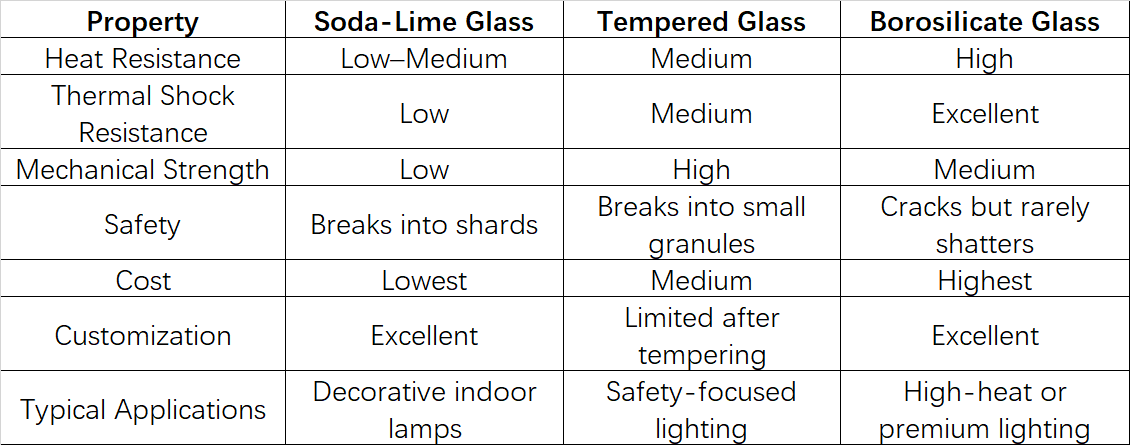
Cada material tiene un propósito diferente y no hay una solución única para todos.
Vidrio de soda y cal: Económico y ampliamente utilizado
¿Qué es el vidrio de soda y cal?
El vidrio de soda y cal es el tipo de vidrio más comúnmente utilizado en todo el mundo. Está compuesto principalmente de sílice (SiO₂), óxido de sodio y óxido de calcio. Debido a que es fácil de fundir y moldear, se utiliza ampliamente en utensilios de vidrio para el hogar, productos decorativos y pantallas de lámparas estándar.
Características clave del vidrio de soda y cal
Temperatura máxima de trabajo: ~150–200°C
Baja resistencia al choque térmico
Alta claridad y acabado superficial liso
Fácil de cortar, perforar, esmerilar o decorar
Costo más bajo de materia prima y producción
Ventajas para pantallas de lámparas
El vidrio de soda y cal es ideal para:
Lámparas de mesa decorativas y apliques de pared
Lámparas LED de bajo calor
Iluminación residencial interior
Proyectos con objetivos de costo estrictos
Su excelente trabajabilidad permite:
Formas complejas
Diseños de paredes delgadas o gruesas
Acabados esmerilados, grabados, pintados o rociados
Esto lo convierte en una opción popular para pantallas de lámparas decorativas personalizadas donde la estética importa más que el rendimiento extremo.
Limitaciones y Riesgos
El mayor inconveniente del vidrio de soda y cal es su pobre resistencia al choque térmico. Los cambios rápidos de temperatura, como encender una lámpara después de que se ha enfriado, pueden causar grietas.
No se recomienda para:
Bombillas de alta potencia
Aparatos cerrados con mala ventilación
Entornos exteriores o comerciales
Vidrio templado: Fuerza y seguridad primero
¿Qué es el vidrio templado?
El vidrio templado es vidrio de soda y cal que ha pasado por un proceso de tratamiento térmico controlado. Este proceso aumenta la compresión superficial, haciendo que el vidrio sea significativamente más fuerte que el vidrio de soda y cal sin tratar.
Características clave del vidrio templado
3 a 5 veces más fuerte que el vidrio normal
Mejor resistencia al impacto mecánico
Se rompe en pequeños gránulos romos (vidrio de seguridad)
Resistencia moderada al calor
Ventajas para pantallas de lámparas
El vidrio templado se utiliza comúnmente cuando la seguridad y la durabilidad son las principales prioridades.
Las aplicaciones típicas incluyen:
Lámparas de iluminación comercial
Hospitalidad y espacios públicos
Lámparas colgantes en áreas de alto tráfico
Instalaciones que requieren cumplimiento con regulaciones de seguridad
Debido a su resistencia, el vidrio templado reduce:
Rupturas durante la instalación
Daños durante el envío
Riesgos de seguridad en entornos públicos
Restricciones importantes de diseño
Una limitación clave del vidrio templado es la restricción de post-procesamiento.
Una vez que el vidrio está templado:
No se puede cortar ni perforar
La forma y los agujeros deben estar finalizados antes del templado
Esto significa:
Los cambios de diseño después de la muestra son costosos
La personalización compleja requiere una ingeniería cuidadosa desde el principio
Para los compradores B2B, esto hace que el soporte de ingeniería del proveedor sea especialmente importante.
Vidrio borosilicatado: alto rendimiento y resistente al calor
¿Qué es el vidrio borosilicatado?
El vidrio borosilicatado contiene óxido de boro, que mejora significativamente la resistencia térmica y química. Se utiliza comúnmente en utensilios de laboratorio, utensilios de cocina y aplicaciones de iluminación de alto rendimiento.
Características clave del vidrio borosilicatado
Temperatura máxima de trabajo: 300–500°C
Excelente resistencia al choque térmico
Bajo coeficiente de expansión térmica
Alta estabilidad química
Ventajas para pantallas de lámparas
El vidrio borosilicatado es la opción preferida para:
Lámparas de iluminación de alta temperatura
Diseños de lámparas cerradas
Iluminación industrial o arquitectónica
Productos premium o de larga duración
Rinde excepcionalmente bien en entornos donde:
Las lámparas se encienden y apagan con frecuencia
La acumulación de calor es inevitable
Se requiere estabilidad a largo plazo
Desde la perspectiva de una marca, usar vidrio borosilicatado puede reducir significativamente:
Reclamaciones de garantía
Quejas por agrietamiento
Costos de reemplazo del proyecto
Consideraciones de costo y producción
El vidrio borosilicatado es más caro debido a:
Costos más altos de materias primas
Mayor temperatura de fusión
Control de producción más exigente
Sin embargo, para proyectos de iluminación profesional, el costo total del ciclo de vida a menudo es más bajo debido a las tasas de fallo reducidas.
Difusión de luz y rendimiento óptico
El material del vidrio también influye en cómo se comporta la luz.
Vidrio claro de soda y cal ofrece alta transparencia pero puede crear deslumbramiento
Vidrio de soda y cal esmerilado u opalino proporciona una difusión más suave
Vidrio de borosilicato mantiene un rendimiento óptico estable incluso a altas temperaturas
Vidrio templado mantiene la claridad pero limita los acabados de post-procesado
Para los diseñadores de iluminación, la solución ideal a menudo combina:
Selección correcta de materiales
Tratamiento de superficie (esmerilado, arenado, opalino)
Espesor de pared adecuado
Un fabricante profesional debería ser capaz de recomendar la combinación óptima según la fuente de luz y la aplicación.
Seguridad, Cumplimiento y Normas Internacionales
Para los compradores B2B, el cumplimiento a menudo es innegociable.
Diferentes mercados pueden requerir:
Vidrio de seguridad para espacios públicos
Documentación de resistencia al calor
Informes de composición de materiales
El vidrio templado a menudo se especifica para:
Proyectos comerciales
Hospitalidad y edificios públicos
El vidrio borosilicatado es preferido donde:
La seguridad a altas temperaturas es crítica
Se requiere fiabilidad a largo plazo
Elegir el proveedor adecuado significa asegurar que pueden proporcionar:
Informes de pruebas de materiales
Documentación de consistencia de lotes
Soporte de cumplimiento para diferentes mercados
Costo vs Rendimiento: Haciendo el Compromiso Correcto
Un error común en la búsqueda de pantallas de lámparas es centrarse solo en el precio unitario.
Un enfoque mejor es evaluar:
Riesgo de fallo
Costo de reemplazo
Impacto en la reputación de la marca
Mantenimiento a largo plazo

Cómo un fabricante de vidrio profesional añade valor
Elegir el material adecuado es solo parte de la ecuación. Un fabricante de pantallas de lámparas de vidrio confiable también debería proporcionar:
Consulta de ingeniería durante el diseño
Comparación de materiales y apoyo en pruebas
Prototipado y muestreo
Control de calidad y consistencia en lotes
Embalaje seguro y logística de exportación
Para los compradores B2B, este apoyo técnico a menudo marca la diferencia entre un proyecto fluido y un fallo costoso.
Preguntas frecuentes
Sí, para aplicaciones LED de baja temperatura, el vidrio de sodalima se utiliza comúnmente.
No necesariamente. Es mejor para la resistencia al calor, pero puede ser innecesario para aplicaciones decorativas o de baja temperatura.
No. El vidrio templado es mecánicamente más fuerte, pero el vidrio borosilicato tiene una resistencia térmica superior.
El vidrio de sodalima y el vidrio borosilicato ofrecen la mayor flexibilidad de personalización.
Nuestro proceso garantiza calidad antes de la producción en masa
Confirmación del diseño con el cliente
Desarrollo interno del molde en nuestras instalaciones
Producción de muestras para aprobación
Pruebas y comentarios del cliente
Producción en masa solo después de la aprobación de la muestra final
Ofrecemos embalaje personalizado integral para un envío internacional seguro:
- Materiales de embalaje interior protectores
- Cajas de cartón de grado exportación
- Cajas de colores personalizadas y embalaje minorista
- Impresión de etiquetas y branding
- Embalaje diseñado para cumplir con los estándares de envío internacional
- Inspección en cada etapa de producción
- Procedimientos científicos de control de calidad
- Inspección previa al envío de cada lote
- Cumplimiento con las normas internacionales de exportación
- Sistemas certificados de gestión de calidad
Operamos múltiples líneas de producción con trabajadores experimentados, lo que permite una producción en masa estable para pedidos de todos los tamaños. Nuestra instalación garantiza una calidad constante y una entrega puntual confiable tanto para pequeños lotes como para pedidos de gran volumen.
Los tiempos de entrega varían según la complejidad y la cantidad:
- Artículos de catálogo/personalización ligera: 25–30 días para pedidos de hasta 1.000 unidades
- Pedidos de 1.000–5.000 unidades: 35–45 días
- OEM totalmente personalizado con moldes nuevos: 45–65 días; el plazo final se confirma según el proyecto
La cobertura actual del mercado se confirma durante la revisión del proveedor., incluyendo:
- América del Norte (Estados Unidos y Canadá)
- Europa (Reino Unido, Alemania, Francia, etc.)
- Mercados de Asia-Pacífico
- Medio Oriente
- Africa
- Oceanía (Australia, Nueva Zelanda)
Mantenemos una red de distribución global integral.