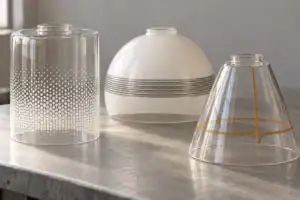
Glass lamp shades for hotel rooms are glass diffusers — frosted, opal, clear, or ribbed — specified by room position: opal drum or globe shades for bedsides, empire glass for desks, opal globes for bathroom vanities, and handblown or ribbed glass for suite and corridor feature lighting.
Hotel room lighting fails in a specific, repeatable way. Bedside lamps that produce a hard glare point when the guest glances up from the pillow. Bathroom vanity lights that cast directional shadow across the face at mirror height. Desk lamps that illuminate the wall behind the laptop rather than the work surface. In every case, the wrong glass shade — or the wrong shape of glass shade in the wrong room position — is the actual problem. Not the bulb type. Not the wattage. The shade.
This guide works through each position in a hotel room where glass lamp shades are specified and explains exactly which glass type, shape, and finish resolves the specific lighting problem that position creates. Bedside, desk, bathroom, suite, corridor — each has its own glass shade logic, and getting each one right is what separates a room that photographs well and feels comfortable from one that simply looks like it has lamps.
Why Glass Shades Define the Lighting Character of a Hotel Room
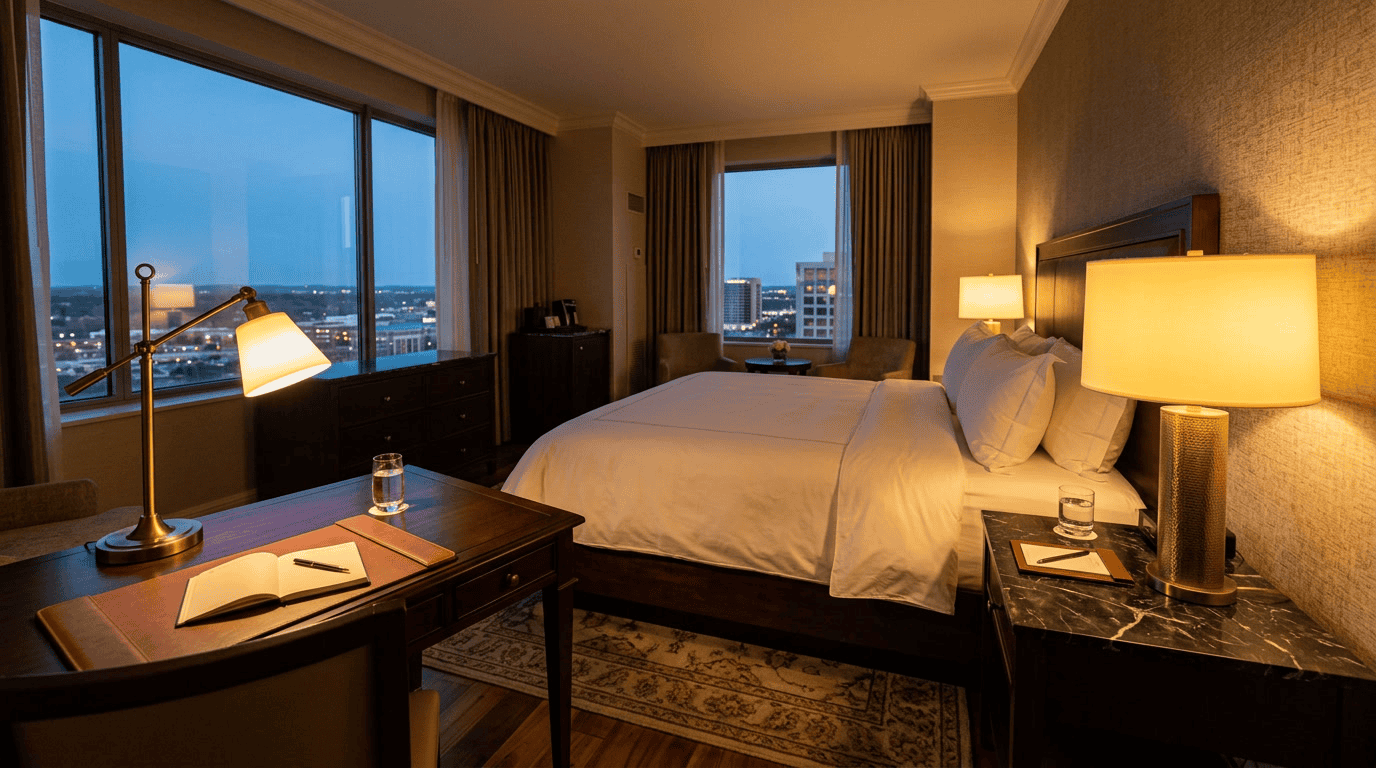
The glass finish on a hotel room lamp shade determines whether the room produces ambient light, task light, or glare — and this distinction plays out differently depending on where in the room the lamp sits, how far it is from the guest’s eye level, and what the guest is doing when the lamp is on.
This is the foundational insight behind specifying glass lamp shades for hotel rooms by position rather than by appearance. A frosted drum shade that works perfectly as a corridor sconce produces an uncomfortable glare point if placed on a nightstand at pillow height. The shade geometry and glass finish are the same. The room position is different. The guest experience is completely different.
As the Illuminating Engineering Society’s recommendations for hospitality environments note, hotel lighting design requires distinguishing between ambient illumination (diffuse, room-filling), task illumination (focused, directed), and accent illumination (decorative, feature-defining) — and specifying fixtures accordingly. Glass shades are the primary tool that determines which category any given lamp falls into.
How Glass Finish Determines Ambient vs. Task Light
Opal glass produces ambient light. Frosted glass produces soft ambient-to-task light. Clear glass produces visible-filament feature light. Empire and cone shapes redirect any of these toward task. The interplay of finish and shape is what puts the right lamp in the right position.
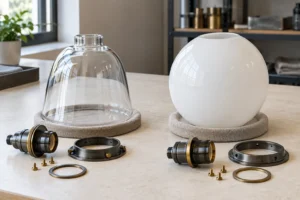
Opal glass — manufactured with mineral additives that create opacity throughout the material — emits from its surface rather than transmitting light through it. The shade becomes a light source itself. The result is soft, enveloping ambient light with no visible hot spot or filament. In a hotel guestroom where the guest will be lying down, reading, sleeping, or simply relaxing, opal glass hotel room lamp shades create the warm cocoon atmosphere that defines the experience of a premium room.
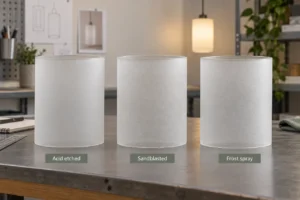
Frosted glass, by contrast, acid-etched or sandblasted to scatter light while transmitting 50–70% of the bulb output, sits between full diffusion and task light. It hides the filament and softens the glow, but produces slightly more directed, slightly brighter light than opal. Frosted is appropriate where a guest needs to actually see clearly — corridor reading, desk work, bathroom tasks — while still maintaining a warm aesthetic. In clear glass, light transmission reaches 88–93%, and the visible filament becomes an intentional design element rather than a functional diffuser.
The Glare Equation — Why Shade Shape Changes the Guest Experience
Glare in hotel rooms is a sightline problem. A lamp shade that produces glare is almost always a shade whose open bottom — the direction from which direct light exits — falls within the guest’s natural visual field at the position and posture where they use the lamp.
At a hotel nightstand, the guest’s eye level when lying on the pillow is approximately 50–65 cm above the mattress surface. A bedside lamp with its shade bottom at 70–80 cm above the floor puts the direct-exit light from an empire or open-bottom shade almost exactly at lying eye level. The guest turns to reach for the water glass and looks directly into the light source. This is why drum and globe shades — which diffuse light through their sides rather than directing it downward from an open base — are the correct glass shade type for hotel nightstand positions, regardless of what looks most symmetrical on the spec sheet.
At desk height, the calculation inverts. A guest sitting at a hotel room desk has eyes at approximately 110–120 cm above the floor. The lamp needs to direct light downward onto the work surface. An empire or bell glass shade — which concentrates light downward — serves this position correctly. A drum shade at desk height sends half its light upward at the seated guest’s eye level, which creates the glare problem in the opposite direction.
| Glass finish | Light transmission | Character | Best room position |
|---|---|---|---|
| Opal | 35–55% | Enveloping ambient, no hot spot | Bedside, suite feature lamps |
| Frosted | 50–70% | Soft ambient, slight directionality | Corridors, sconces, desk (drum shape) |
| Clear | 88–93% | Visible filament, high output | Bar areas, lobby feature pendants |
| Ribbed | 45–75% (varies) | Prismatic, decorative | Corridor sconces, reception, F&B |
| Borosilicate | Varies by base | Thermally resistant | Outdoor terraces, spa-adjacent, high-wattage |
Bedside and Nightstand Glass Lamp Shades — the Critical Position
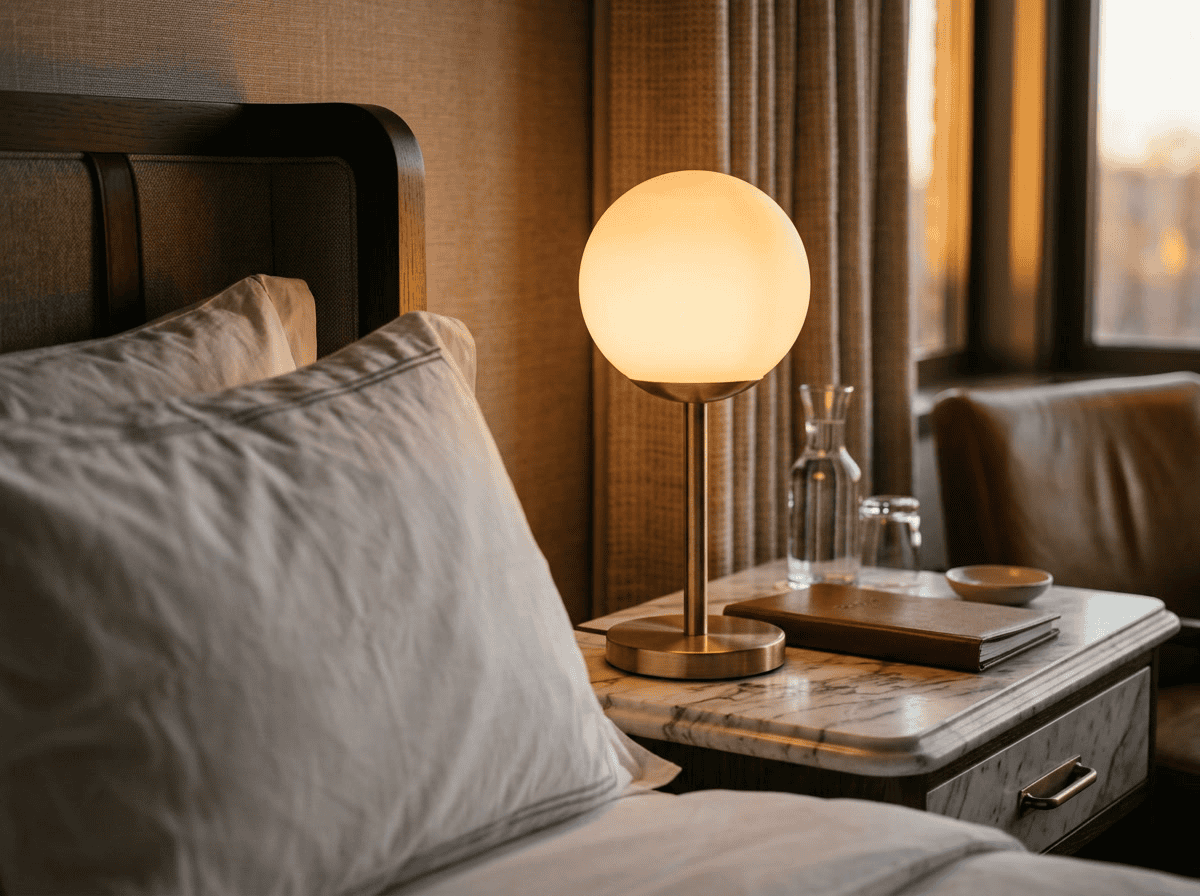
The bedside lamp is the most-used, most-criticized lamp in any hotel room — and opal drum or opal globe glass shades, mounted at the correct height above nightstand level, consistently outperform every alternative for this position.
Most hotel guests turn on the bedside lamp more than any other fixture in the room. They use it to read in bed, to reach for a phone charger at 2 a.m., to check the time, to find the bathroom in a darkened room. The shade must diffuse light widely enough to illuminate the immediate area without producing a glare point when the guest is reclined. It must look premium when the guest first enters the room with overhead lights on. And it must last through thousands of daily cleaning cycles without degrading.
Opal glass hotel room lamp shades at the bedside satisfy all three requirements. That glass shades specifically dominate the bedside specification at four- and five-star properties is not aesthetic preference — it is the material science of durability plus the physics of how opal glass handles a lying guest’s sightline.
The Reclined Guest Sightline — Why Most Hotels Get This Wrong
The standard hotel nightstand lamp places the shade bottom at approximately 65–75 cm above the floor, depending on nightstand height and lamp base dimensions. A guest lying on a standard hotel bed has eyes at 50–65 cm above the mattress — which places the mattress surface approximately 50–60 cm above the floor (standard hotel bed height including frame and mattress). So the lying guest’s eye level is approximately 100–125 cm above the floor.
At that sightline angle, an empire shade open at the bottom directs light outward and slightly upward from the nightstand, which falls directly in the guest’s peripheral and forward visual field when they turn toward the lamp. A drum shade with vertical sides diffuses light through the side walls instead of directing it from an open base. The guest’s sightline intersects the diffusing surface of the drum rather than looking into the direct-exit aperture. The experienced light quality is completely different.
In practice, the worst bedside specification we encounter repeatedly is a small empire shade in a light fabric or clear glass on a low nightstand lamp — the three-way combination of open bottom, transparent material, and low placement puts the bare bulb close to lying eye level with no diffusion between guest and source. An opal drum or globe glass shade on the same lamp base, mounted at the same height, eliminates all three problems simultaneously.
Opal Globe and Drum Shades — the Correct Specification
For hotel room bedside positions, specify opal glass in either drum or globe form. The choice between them is design-language driven, not functionally driven — both produce appropriate light quality for the position.
Opal glass drum shades (equal top and bottom diameter, straight sides) read as contemporary. They suit modern hotel design directions, minimalist guestroom aesthetics, and urban business hotels where the design brief avoids traditional or residential references. A frosted glass drum is acceptable at the three-star tier where cost pressure is real, but the opal version produces the superior guest experience.
Opal glass globe shades (spherical or near-spherical) read as slightly warmer and more residential. They are the signature bedside shade specification at boutique hotels and luxury independent properties. The globe at nightstand height glows as a warm orb in a darkened room — a visual quality that photographs well in OTA listings and that guests consistently describe as feeling “like a real hotel” rather than a budget stay.
Size guideline: for a standard hotel nightstand table lamp, specify an opal drum or globe with 28–35 cm diameter. This range balances visual weight proportional to the lamp base with sufficient shade area to diffuse 8–10W LED output across the nightstand and immediate bed area without hot spots.
Size, Height, and Placement That Actually Work
Beyond the shade itself, the lamp’s total installed height determines the sightline outcome. For bedside table lamps on a standard 55–65 cm nightstand, the shade bottom should clear 75–85 cm above the floor. This places the diffusing surface above the lying guest’s horizontal sightline while keeping the lamp proportional to the room.
Where nightstand height is non-standard (low platform beds, integrated headboard nightstand shelves), recalculate from the mattress surface up: shade bottom should be 30–40 cm above the mattress, which places it slightly below the reading-in-bed line of sight — high enough to avoid direct-aperture glare but low enough to cast light on the book or tablet in the guest’s hands.
Desk and Work Lamp Glass Shades for Hotel Rooms
Hotel room desk lamp shades must direct light downward onto the work surface — which makes empire and bell glass shades in frosted or opal the correct specification for this position, not the drum or globe shades appropriate for bedside.
The desk lamp is the most technically demanding shade position in a hotel room because it must serve two modes simultaneously: task lighting for laptop work and document reading, and ambient fill when the guest uses the desk casually or for phone calls. Getting this right with glass lamp shades for hotel rooms requires understanding that no single shade type serves both modes with equal excellence — the specification involves a prioritization call.
Task vs. Ambient — Two Different Glass Shade Specifications
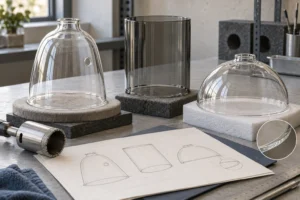
A dedicated task desk lamp in a business hotel room should specify a small empire frosted glass shade — approximately 25–30 cm base diameter, height 18–22 cm, in frosted glass that transmits 55–65% of the LED output downward onto the desk surface. The empire geometry concentrates light where the work is. The frosted finish softens the pool edge, reducing the harsh contrast between the bright desk surface and the darker room surroundings.
An ambient desk lamp intended to fill the corner of a room while the guest uses the bed or sofa area can use a frosted drum shade — the equal upward and downward distribution fills the room corner effectively and the lamp reads as a decorative object from across the room rather than a functional task tool.
In practice, most hotel rooms have a single desk lamp serving both functions. The correct compromise specification for that single-lamp position: a medium frosted glass drum shade (30–35 cm diameter) at the back of the desk surface, with the lamp base positioned so the shade bottom is at approximately 45–50 cm above the desk surface. This height distributes light broadly across the desk while keeping the horizontal light output below the seated guest’s direct eye line.
Empire and Cylinder Glass Shades for Focused Work Light
Where hotel design allows for a dedicated task lamp separate from an ambient desk lamp — an increasingly common specification in business-oriented four-star properties — the frosted glass cylinder shade deserves consideration alongside the empire. Taller than it is wide, the cylinder concentrates light in a narrow downward column rather than spreading it wide. The effect is highly focused task illumination: the desk surface is well-lit, the walls to either side remain darker, and the guest can work without the eye fatigue that comes from a uniformly bright environment.
Frosted cylinder glass shades at desk height also read as intentionally architectural — they signal “this is a workspace” in a way that a round opal globe clearly does not. For hotel rooms marketed to business travelers, this functional signaling matters as much as the actual light output.
Modern Business Travel Requirements
Research on hotel guest satisfaction in business travel contexts consistently identifies task lighting at the desk as one of the lowest-rated elements of hotel room lighting across property classes. The consistent failure mode: desk lamps specified for aesthetics — usually a fabric drum shade or decorative base — that produce inadequate light output for the screen-and-document work that business guests actually need. Frosted and opal glass hotel room lamp shades consistently outperform fabric at the desk because glass transmits more light at equivalent wattage (no absorbed output through fabric weave) and because the glass finish diffuses the pool edge in a way that works with, rather than against, a laptop screen’s ambient light requirements.
LED bulb compatibility is the specification detail that most desk lamp glass shade installations fail on in early 2026: many desk lamp shades designed for incandescent bulbs have internal clearances that conflict with the wider body of modern LED filament bulbs. Before specifying any glass shade for hotel room desk positions, confirm that the lamp’s neck opening clears the specific LED module by at least 5mm on all sides.
Bathroom Vanity Glass Lamp Shades
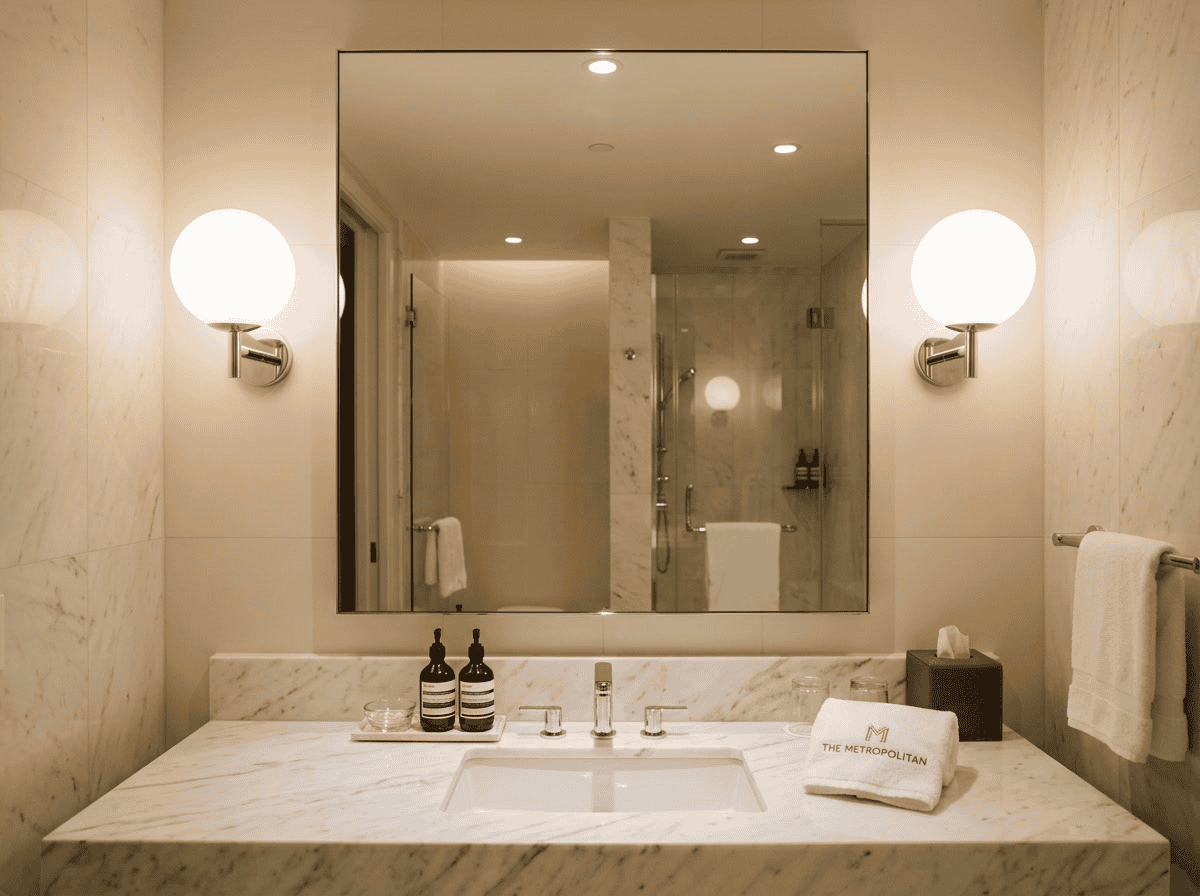
Opal glass globe shades are the universal standard for hotel bathroom vanity lighting — the spherical form distributes light omnidirectionally to eliminate mirror-height facial shadows, and the sealed globe resists humidity, cleaning chemicals, and condensation in a way open-bottom shades cannot.
The bathroom is the one room position where the glass shade specification is least contested. Hotel interior designers, lighting specifiers, and hospitality procurement professionals essentially universally agree: opal globe for the hotel bathroom vanity. The rationale is functional, not aesthetic.
Why Globe Shades Are the Universal Hotel Bathroom Standard
At mirror height (typically 160–190 cm above the floor for the center of a vanity mirror in a standard hotel bathroom), a guest applying makeup, shaving, or examining their appearance needs light that comes from the front — not from above, not from below, but from the same horizontal plane as the face. This is the fundamental photographic lighting principle applied to human-face illumination: frontal light eliminates shadows, directional overhead light creates unflattering under-eye and nose shadows.
An empire or drum shade on a bathroom vanity sconce directs light either downward (empire) or up-and-down equally (drum). Neither hits the guest’s face at horizontal mirror height with the kind of even, shadow-free frontal light that a globe produces. The globe’s omnidirectional distribution sends light to the face from above the globe, below it, and from both sides simultaneously — the closest thing to a ring light that a standard hotel bathroom sconce can produce.
In opal glass, the globe also eliminates the visible-filament glare that a clear glass globe would introduce at a distance of 50–70 cm from the guest’s eyes (standard mirror-to-sconce distance in hotel bathrooms). The opal surface glows evenly; the guest sees light, not a burning filament.
Opal Glass for Mirror-Height Facial Lighting
The color temperature specification matters as much as the shade specification at the hotel bathroom vanity. Opal glass hotel room lamp shades at 2700K (warm white) produce flattering facial light — guests look as they expect to look in warm interior lighting. At 3000K or above, the same opal globe shade produces a cooler, more clinical light that guests find less flattering and that becomes associated with budget accommodation.
Specify warm-white LED bulbs (2700K) with opal globe glass shades at hotel bathroom vanities as a standard combination. The opal glass tempers the LED output from its native color point slightly toward warmth; the combination reads as higher-end than the component specifications would suggest.
Humidity, Cleaning, and Sealed Globe Specifications
Hotel bathroom environments expose lamp shades to condensation from showers, cleaning chemical spray during housekeeping, and temperature swings from hot water use. These conditions eliminate fabric shades from consideration and also create problems for open-bottom glass shades: steam ingress through the open bottom can fog glass interiors and corrode lamp socket hardware.
The correct glass shade specification for hotel bathrooms uses sealed or near-sealed globe designs — threaded neck fitters or tight clip-on fitters that minimize the opening between shade and fixture. This prevents moisture infiltration into the lamp socket while keeping the glass shade surface accessible for wiping from outside.
Wall-mount bathroom globe sconces with threaded neck fitters are the standard hotel bathroom glass shade configuration precisely because the threaded connection seals the interior of the fixture against the bathroom environment. The glass itself — whether opal or clear — is non-porous and unaffected by moisture. The fitter connection is the vulnerability, and the threaded neck addresses it.
Suite, Lobby Lounge, and Corridor Glass Lamp Shades
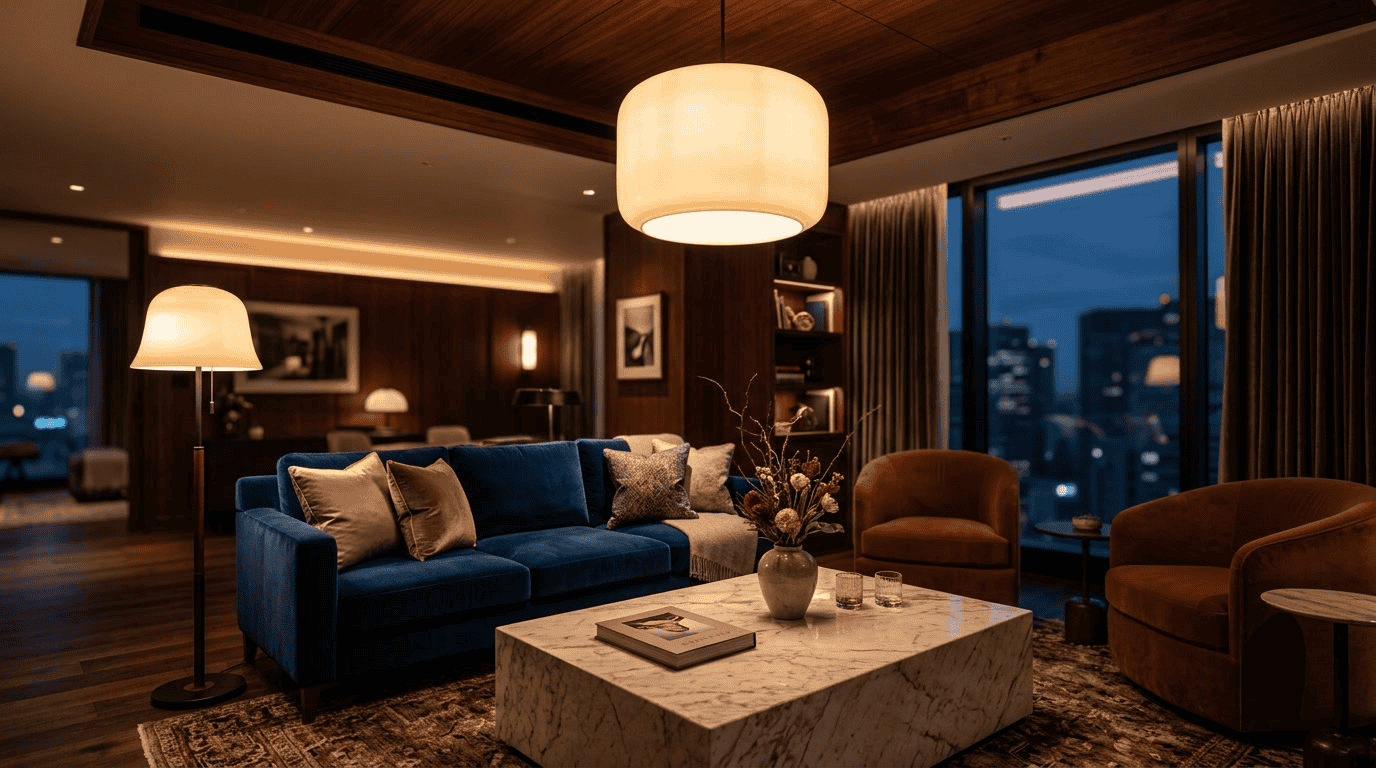
Beyond the standard guestroom positions, suites and public hotel areas use glass lamp shades as design statements — handblown artisan glass, large ribbed glass pendants, and coordinated drum sconce systems that reinforce a property’s visual identity at a scale standard guestroom shades cannot.
The hotel areas beyond the standard guestroom represent the widest range of glass shade specifications. Corridors require consistency at scale. Suites demand elevated materials and proportions. Lobby lounges use glass shades as architecture. Each context has distinct requirements that standard guestroom glass lamp shade specifications do not address.
Suites — When to Move Beyond Standard Guestroom Specifications
A hotel suite’s bedside glass lamp shade can be the same opal drum as the standard guestroom — or it can be the element that signals to a guest spending significantly more per night that this room is different. The principle behind premium hospitality design is that every material touch point in a premium space should either match or exceed the quality associated with the price tier, and bedside lamp shades are a touchable, visible, constantly used element.
Practical suite glass shade upgrades that deliver felt value without disproportionate cost:
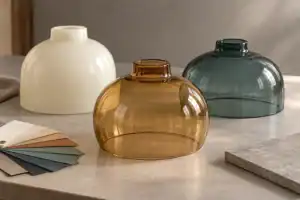
- Handblown opal glass drum shades with slight surface irregularities and warm mineral tint, 32–38 cm diameter at suite nightstands — the slight imperfections signal craft rather than mass production
- Large bell-shaped opal glass shades (35–42 cm base diameter) on floor lamps at suite seating areas, where the proportionally larger shade suits the architectural scale of a suite living space
- Ribbed clear or amber-tinted glass pendants over a suite dining table or bar area — a design element absent from standard guestrooms that visually defines the suite as a different category of space
The suite upgrade does not require a different glass finish type — it requires a different scale, proportion, and production quality of glass shade within the same material family as the standard guestroom.
Corridor Wall Sconces — Drum and Globe Glass Shades at Scale
Hotel corridors present a glass shade specification challenge that no individual guestroom does: consistency across 30, 60, or 120 identical positions, with every shade visible simultaneously in perspective down the corridor length.
Corridor wall sconce glass shades must be identical — same glass finish, same diameter tolerance (typically ± 2mm), same etch depth for frosted versions — because perspective compression makes any variation between adjacent shades immediately visible. A 5% diameter variation between two frosted drum shades looks minor in isolation; in a hotel corridor where the two shades are side-by-side under matching sconces, the difference reads as a quality defect.
This is the procurement argument for OEM factory-direct glass shade sourcing for corridor applications over wholesale stock. Factory-direct orders from a single production batch deliver the dimensional and finish consistency that corridor installation demands. As documented in commercial glass manufacturing standards, controlled production runs with documented quality tolerances are the mechanism that achieves this level of consistency — not simply ordering from a catalogue.
Standard corridor wall sconce glass shade specifications:
- Frosted or opal drum, 20–28 cm diameter (smaller than guestroom bedside shades, scaled to sconce proportions)
- Spider or uno fitter matching existing sconce hardware
- Wall thickness 2.5–3mm for adequate diffusion and mechanical durability at sconce height
- ΔE ≤ 2.5 color tolerance against master sample for full corridor batch
Lobby Seating Areas — Statement Glass as Design Language
Hotel lobby lounges use glass lamp shades differently from guestrooms. The lobby is a public-facing, high-visibility space where the design intent reads before any guest opens a room door. Glass shades in lobby seating areas function as architectural elements as much as lighting tools.
Large opal glass drum pendant shades (45–60 cm diameter) hung at 200–220 cm above floor level in lobby seating clusters produce pools of warm ambient light that define seating zones within a large lobby space. Clear glass globe pendants over a lobby bar create an entirely different atmosphere — visible filament, higher light output, visual energy rather than relaxation. The glass shade choice in the lobby communicates the property’s emotional register to a guest the moment they enter.
The specification principle for lobby glass shades: scale up from guestroom proportions. A 30 cm drum shade that works perfectly on a nightstand reads as miniature in a lobby with 4-meter ceiling height. Lobby glass shade specifications typically start at 40 cm and go up to 60+ cm for large pendant clusters.
Sourcing and Specifying Glass Lamp Shades Across a Hotel Room Portfolio
Maintaining visual consistency in glass lamp shades across a hotel property requires treating the specification as a portfolio — identifying all shade positions, grouping them by specification type, and sourcing each group in a single production batch rather than purchasing by room as renovations progress.
The most common glass shade consistency failure in hotel renovation projects comes from phased procurement: corridor glass shades ordered in Phase 1, guestroom glass shades ordered six months later in Phase 2, suite glass shades ordered as custom items. Even with identical specifications, time-separated batches from the same manufacturer may show visible color drift — the ΔE between Phase 1 and Phase 2 shades can exceed 3.0, which is visible to the unaided eye in side-by-side comparison.
The solution is documented specification and master sample retention. Order all glass lamp shades for hotel rooms in the largest viable batches. Keep four to six master samples from each batch in sealed storage. When reordering replacement shades or ordering Phase 2 quantities, send the stored master samples to the manufacturer and specify against them with a ΔE ≤ 2.5 tolerance requirement.
Maintaining Visual Consistency Room to Room
Corridor-to-guestroom glass shade consistency matters more than most hotel operators realize until they see the comparison. A guest walking from a corridor with warm opal sconce shades into a guestroom with noticeably cooler frosted drum shades experiences a lighting temperature discontinuity that subconsciously signals inconsistency — even if they cannot articulate what changed.
The practical specification approach: use the same glass composition and the same production batch for all frosted or opal glass shades across guestrooms and corridors. The diameter and shape can differ (smaller drums for corridor sconces, larger drums for nightstands) while the glass finish and color temperature remain constant. This produces the visual continuity that signals a properly designed property.
MOQ, Lead Times, and Replacement Strategy
For a 100-room hotel with two bedside shades and one desk shade per room, plus corridor sconces and bathroom vanity globes, a complete glass lamp shade specification runs 700–1,200 individual pieces depending on suite count and bathroom count. This volume comfortably exceeds the 500-piece minimum order quantity for factory-direct glass shade production and justifies the 25–35 day production lead time.
Maintain 8–10% buffer stock (56–120 pieces) on-property for same-day replacement of broken or damaged shades. Buffer stock should be from the same production batch as the installed shades, or from a subsequent batch with documented ΔE compliance.
| Room position | Recommended glass shade | Finish | Standard diameter | Fitter type |
|---|---|---|---|---|
| Bedside nightstand | Drum or globe | Opal | 28–35 cm | Spider or uno |
| Desk lamp (task) | Empire | Frosted | 25–30 cm base | Spider or uno |
| Desk lamp (ambient) | Drum | Frosted | 30–35 cm | Spider or uno |
| Bathroom vanity sconce | Globe | Opal | 14–20 cm | Threaded neck |
| Corridor wall sconce | Drum | Frosted or opal | 20–28 cm | Spider or uno |
| Suite bedside (premium) | Drum or globe (handblown) | Opal | 32–38 cm | Spider or uno |
| Suite floor lamp | Bell | Opal | 38–45 cm base | Spider |
| Lobby pendant | Drum or globe | Opal or clear | 40–60 cm | Pendant canopy |
The most reliable solution to cross-phase batch consistency is specifying through a dedicated glass lampshade manufacturer for hospitality projects that archives production molds and colorimetric batch records — this allows Phase 2 and Phase 3 reorders to match Phase 1 glass even two or three years later.
Trends Shaping Hotel Room Glass Lamp Shade Design (2026+)
Three overlapping trends are reshaping glass lamp shade specification for hotel rooms in 2026: the circadian lighting movement, the rise of artisan glass as a premium differentiator, and the integration of glass shade design with smart room control systems.
Warm Color Temperature and Circadian Lighting Integration
The hotel industry’s awareness of color temperature’s effect on sleep quality and circadian rhythm has moved from wellness-brand talking point to mainstream specification requirement at branded four-star-and-above properties. Opal and frosted glass hotel room lamp shades are at the center of this shift because the glass finish modulates color temperature output in addition to diffusing the light.
An opal glass shade on a 2700K LED bulb produces a final delivered color temperature of approximately 2600–2750K — the glass absorbs the blue-spectrum component slightly more than the warm spectrum, nudging the output fractionally warmer than the bulb specification. A clear glass shade on the same bulb passes the full 2700K without modification. For hotel rooms specifying warm, sleep-compatible bedside lighting, the opal glass shade amplifies the warm color temperature effect without requiring a custom or specialty LED.
Properties investing in circadian-aligned in-room lighting — dimming bedside lamps to 2400K warm at 9 p.m. via smart room controls — are specifying opal glass exclusively for all guestroom positions because the finish’s natural warm-spectrum bias compounds the dimming-to-warm effect.
Artisan Glass as a Boutique Hotel Differentiator
The boutique hotel sector’s movement toward handmade and locally sourced materials is reaching glass lamp shade specification with increasing frequency in 2026. Handblown glass shades — with their characteristic surface irregularities, subtle color variations, and visible maker’s marks — read as luxury to a guest who has stayed in enough standardized properties to know the difference.
For properties where every room is slightly different by design, the slight variation between handblown glass shades in adjacent rooms is not a quality defect — it is evidence of craft. This framing is gaining commercial traction with the boutique hotel segment.
| Trend | Adoption tier | Direction | Shade specification implication |
|---|---|---|---|
| Circadian lighting (warm 2700K) | 4–5 star branded chains | Mainstream requirement | Opal glass exclusively for bedside positions |
| Artisan handblown glass | Boutique, luxury independent | Growing rapidly | Accept surface variation; source from specialist studios |
| Smart room dimming integration | All tiers | Becoming standard | Confirm shade finish compatible with target dimming range aesthetic |
| Sustainability / recycled glass | Branded chains with ESG mandates | Emerging | Request ISO 14021 recycled content certification |
| Custom shaped glass for brand identity | Hotel chains and groups | Established | MOQ 500+ per shape, coordinate across all guestroom positions |
Frequently Asked Questions
What glass shade type is best for hotel room bedside lamps? Opal glass drum or globe shades are the correct specification for hotel room bedside lamps. Opal glass transmits 35–55% of the bulb’s light as a uniform surface glow with no visible filament hot spot — which means a reclined guest looking toward the nightstand sees a softly glowing shape rather than a point of direct-exit light. Frosted glass is acceptable at budget tier; empire and bell shapes should not be used at nightstand height because their open base directs light toward a lying guest’s eye level.
Why are globe glass shades used in hotel bathrooms? Globe glass shades distribute light omnidirectionally, including forward from the face of the shade at mirror height — which eliminates the directional shadows that empire or drum shades create on a guest’s face at a bathroom vanity. Opal globe glass shades in hotel bathrooms also resist humidity and cleaning chemicals through their sealed or near-sealed fitter connections, outlasting open-bottom fabric shades significantly.
What size glass shade fits a standard hotel nightstand lamp? For a standard hotel nightstand table lamp, an opal drum or globe shade of 28–35 cm diameter balances visual proportion with the lamp base while covering sufficient area to diffuse 8–10W LED output. The shade bottom should clear 75–85 cm above the floor when installed on a standard 55–65 cm nightstand, placing the diffusing surface above the lying guest’s sightline. Always measure the existing lamp base fitter opening before ordering.
Can glass lamp shades be used with dimmable LED bulbs in hotel rooms? Yes — opal and frosted glass hotel room lamp shades are fully compatible with dimmable LED bulbs. Glass does not absorb or lose light at reduced dimming levels the way fabric can look uneven at low settings. At low dimming levels (10–20%), opal glass shades continue to glow uniformly as the LED output reduces. Clear glass shades show the visible filament dimming effect — appropriate in bar and feature contexts but not ideal for bedside applications where guests dim for sleep.
What is the difference between frosted and opal glass shades for hotel rooms? Frosted glass is acid-etched or sandblasted clear glass — it scatters light through a surface treatment while the glass body remains clear. Opal glass is manufactured with mineral additives throughout the material, making the glass body itself opaque white. In hotel rooms, the practical difference is that opal glass shades produce a more even, glowing light with no visible hot spot at any angle, while frosted glass shades may show a slightly brighter area at the bulb position viewed at certain angles. Opal is the premium standard for bedside and bathroom; frosted is appropriate for desk and corridor positions.
How many glass lamp shades does a standard 100-room hotel need? A 100-room hotel with two bedside shades, one desk shade, and two bathroom vanity globes per room requires approximately 500 guestroom glass shades. Adding corridor sconces (typically one per 3–4 meters of corridor), suite positions, and public area shades typically brings the total to 700–1,200 pieces depending on property size and suite count. This volume justifies factory-direct OEM procurement rather than wholesale, which typically reduces per-unit cost by 30–45%.
How should hotel room glass lamp shades be cleaned? Opal and frosted glass hotel room lamp shades clean with a damp microfiber cloth and any standard hotel disinfectant at normal dilution. No specialist protocol is needed. Clear glass shades clean with any streak-free glass cleaner. Ribbed glass shades benefit from a soft dry brush to clear dust from ridges before wiping. Do not use abrasive pads on frosted glass — abrasion changes the etch surface and alters the shade’s light-diffusion character over time.
What fitter type is standard for hotel room glass lamp shades? Spider fitters (USA and Canada standard) and uno fitters (UK and Europe standard) cover the majority of hotel room table lamp positions. Bathroom vanity globe shades typically use threaded neck fitters that seal against moisture ingress. Always measure the existing fitter opening with a caliper — nominal fitter sizes are not consistently standardized between lamp base manufacturers, and a 3mm fitter mismatch creates a glass shade replacement problem that is expensive to resolve after delivery.
Conclusion
Glass lamp shades for hotel rooms are not a one-size-fits-all specification. Each position in the room — bedside, desk, bathroom, corridor, suite — creates a different lighting problem that requires a different glass shade solution. Opal glass drum at the bedside eliminates glare for the reclined guest. Frosted empire at the desk directs task light without ceiling-level waste. Opal globe in the bathroom produces shadow-free facial illumination at mirror height. Scaled-up versions of the same glass family deliver premium feel in suites and visual consistency in corridors.
The property that gets all five positions right produces a room that guests describe as well-lit — which is the lowest-friction path to positive lighting reviews, return visits, and OTA scores that compound over time. The work is upfront: specifying by position, sourcing at sufficient scale for batch consistency, and retaining master samples for replacement continuity. Done once, correctly, it runs for a decade.