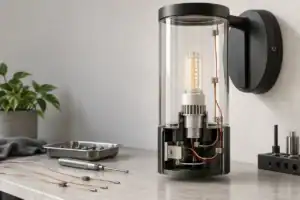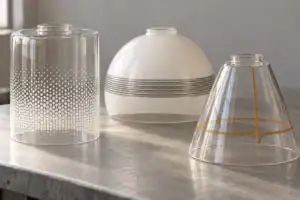
Hotel lamp shade replacement involves identifying a damaged or degraded shade, measuring fitter type and diameter from the existing unit, sourcing a color-matched replacement from stock or OEM production, and maintaining buffer stock on-property to enable same-day swaps without visible mismatches across a room or corridor.
A cracked glass shade on a nightstand lamp gets reported at Tuesday morning housekeeping inspection. Check-in is at 3 p.m. That room needs to look right. The replacement shade is either sitting on a shelf — matching the room’s other three lamps exactly — or the room goes out of service, or a stand-in shade that doesn’t quite match gets installed and a guest who paid for consistency receives something less.
Hotel lamp shade replacement is an operations problem disguised as a purchasing problem. The purchasing decision was made at installation. The operations problem surfaces every time a shade breaks, yellows, or gets discontinued. This guide covers both: how to identify which shades need replacing and when, how to measure and match correctly, how to source either urgently or at scale, and how to build a replacement program that removes the scramble from the process entirely.
When Hotel Lamp Shades Actually Need Replacing
Hotel lamp shades require replacement when they show physical damage, material degradation beyond cosmetic tolerance, or when they create visible inconsistency within a room or corridor that affects guest perception. The urgency of replacement depends on which category applies.
Not every imperfect shade requires immediate replacement, and not every visible problem warrants the full OEM procurement process. Understanding the difference between urgent replacement, planned replacement, and cosmetic tolerance saves both time and budget.
Visible Damage — Cracks, Chips, and Structural Failure
Cracked or chipped glass lamp shades require immediate replacement. There is no safe repair approach for a cracked glass hotel lamp shade — structural cracks propagate under thermal cycling (the heating and cooling cycle of lamp use), and a shade that is cracked but intact on Monday morning can shatter by Wednesday. Beyond safety, a visibly cracked shade is an immediate quality signal that reads as property neglect to any guest who notices it.
Chip damage to the rim of a glass shade — common from housekeeping cart contact or mattress-pad laundering equipment near the lamp — is slightly more nuanced. A chip on the underside rim, invisible unless the shade is lifted, can be tolerated until the next scheduled replacement cycle. A chip on the visible upper or side surface of the shade requires replacement before the room returns to inventory.
Structural failure of the fitter hardware — a cracked spider arm, a stripped uno thread, a broken clip-on spring — requires immediate replacement of the shade and inspection of the lamp base socket. Fitter failures are often caused by over-tightening during prior shade installation; the lamp socket hardware should be checked before installing the replacement shade to avoid repeating the failure.
Material Degradation — Yellowing, Fading, and Surface Wear
Fabric hotel lamp shades degrade on a predictable timeline under daily hotel use. Hardback fabric shades in guestroom positions show visible yellowing and surface dullness within 2–4 years of installation under standard hotel cleaning protocols. The degradation is driven by cleaning chemical absorption into the fabric backing, UV exposure from the lamp itself, and airborne cooking and HVAC particulate accumulation.
The hospitality industry’s shift toward glass hotel lamp shades — as covered extensively in commercial lighting design literature — is driven largely by this degradation problem. Glass shades do not yellow. A frosted or opal glass shade cleaned daily for eight years looks the same as it did at installation. The hotel lamp shade replacement frequency for glass is driven by breakage, not material degradation, which reduces the operational complexity of the replacement program significantly.
For properties still running fabric shades: schedule replacement inspection at 18-month intervals for guestroom bedside and desk positions. By month 24–30, most hardback fabric shades in high-cleaning-frequency environments will show visible degradation that guests can perceive. Do not wait for complete visual failure before ordering replacements — by the time degradation is extreme, you are replacing shades that have been reducing room quality for months.
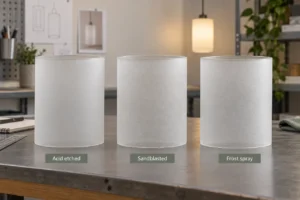
Frosted glass shade surface wear — visible as subtle changes in the light diffusion character — is caused by abrasive cleaning and typically develops over 5–8 years in standard housekeeping use. This is usually the trigger for a full replacement cycle rather than emergency single-unit replacement, since all shades from the same installation batch will show similar wear timing.
Design Obsolescence — When Replacement Is a Renovation Decision
Design obsolescence occurs when a shade style is discontinued, when a property rebrands or renovates, or when guest expectations in the property’s tier shift beyond what the current shade specification delivers. This category of hotel lamp shade replacement is a capital decision, not a maintenance decision.
Discontinued shade styles present the hardest sourcing challenge in the replacement program. A shade specified in a 2018 hotel renovation may no longer be manufactured in the original specification by 2026 — particularly if it was a bespoke or semi-custom fabric style. The response options are:
- Full property replacement with a new shade specification that can be sourced reliably going forward
- OEM reproduction — commissioning a factory to reproduce the original style from a master sample, viable for glass shades and for fabric shades where the original construction can be reverse-engineered
- Managed mismatch — accepting that replacement shades will not perfectly match originals and managing the visible inconsistency by replacing entire rooms at a time rather than individual shades
The managed mismatch approach works only if the replacement is done room-by-room (all four shades in a room replaced simultaneously) rather than shade-by-shade. A room where three shades are from the 2018 batch and one is from a 2026 approximate-match batch will have visible inconsistency in corridor-facing and same-room comparison.
| Damage / degradation type | Urgency | Replacement approach | Can it wait? |
|---|---|---|---|
| Cracked glass shade | Immediate — same day | Buffer stock replacement | No |
| Chipped rim (visible surface) | Within 48 hours | Buffer stock replacement | One shift maximum |
| Chipped rim (underside, invisible) | Next planned cycle | Batch replacement | Yes — flag for scheduling |
| Fabric yellowing / discoloration | Within 30 days | Planned batch replacement | Yes — affects quality score |
| Frosted glass surface wear | Next planned cycle | Full batch replacement | Yes |
| Fitter hardware failure | Immediate | Buffer stock replacement | No |
| Discontinued style | Capital planning timeline | OEM reproduction or full spec change | Yes — plan within 90 days |
Measuring for a Replacement Hotel Lamp Shade
Accurate measurement is the step most hotel lamp shade replacement orders fail on. A replacement shade ordered from nominal size descriptions rather than direct measurement arrives with fitter clearance problems, diameter mismatches, or finish inconsistencies that require a second order and delay the repair.
The correct process is to measure directly from the existing shade — either from an undamaged shade in the same room or from the damaged shade itself — before placing any order.
The Four Dimensions That Must Match
Every hotel lamp shade replacement order requires four confirmed measurements:
- Top diameter — the width of the shade opening at the top, measured across the center with a flexible tape measure or rigid ruler. For drum shades, this equals the bottom diameter. For empire, bell, and cone shades, the top opening is significantly smaller than the base.
- Bottom diameter — the width of the shade opening at the base. This is the most visible shade dimension and the one that most affects the shade’s proportional relationship to the lamp base. A 2 cm error in bottom diameter is immediately visible on a bedside table lamp.
- Height (slant or vertical) — for drum and cylinder shades, height is vertical (straight down). For empire, bell, and cone shades, specifiers sometimes use slant height (the diagonal measurement from top rim to bottom rim across the shade surface) and sometimes vertical height. Confirm which measurement system the manufacturer uses before ordering.
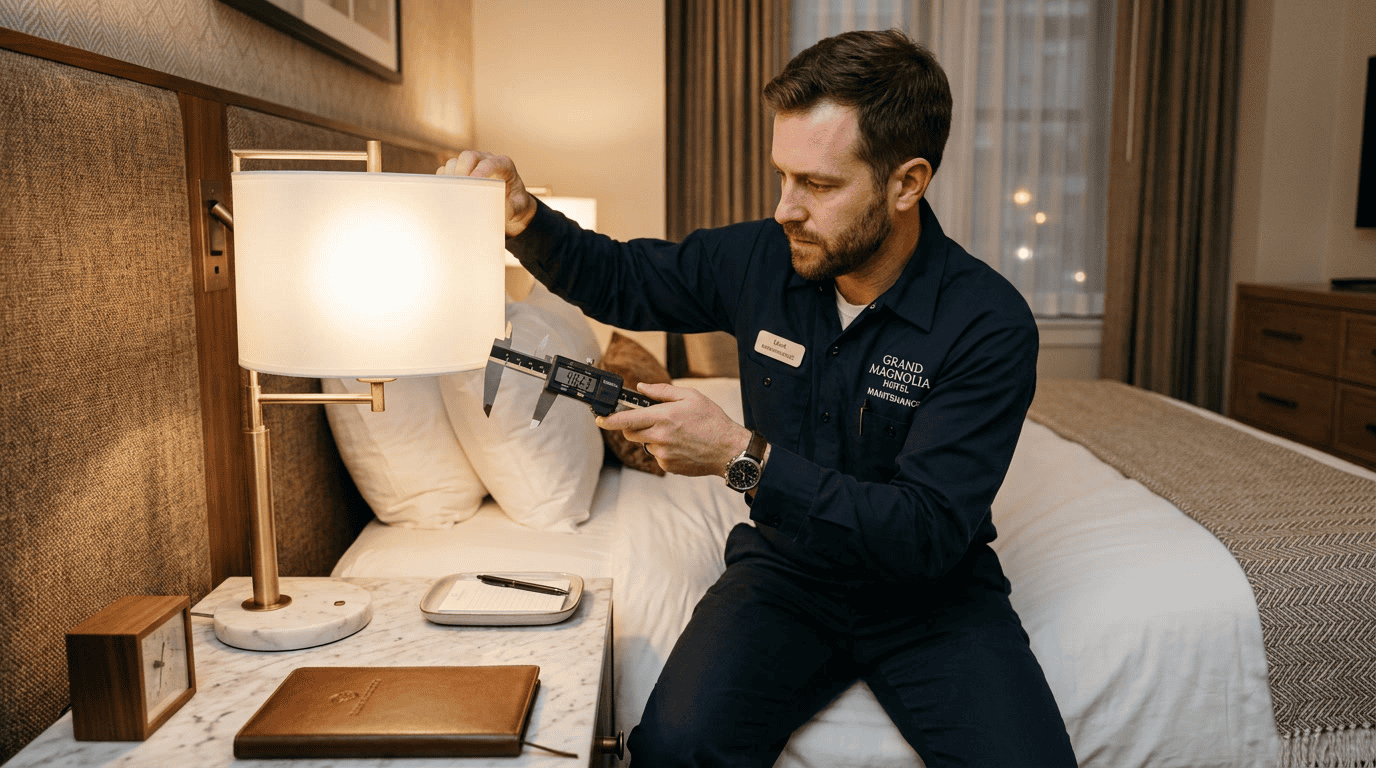
- Fitter opening — measured with a caliper at the shade’s top or neck opening where it attaches to the lamp hardware. This is the measurement most commonly omitted and most commonly responsible for fit failures. A 3 mm fitter diameter error makes the shade incompatible with the lamp base even if every other dimension is correct.
Caliper rule: Always measure fitter openings with a digital caliper to the nearest 0.1 mm. Tape measures and visual estimation introduce errors at this scale that cause procurement failures. A USD 15 digital caliper prevents a USD 200 reorder.
Fitter Type Identification — Spider, Uno, Clip-on, Threaded Neck
Fitter type is determined by the lamp base hardware, not by the shade shape. The four types common in hotel lamp shade applications:
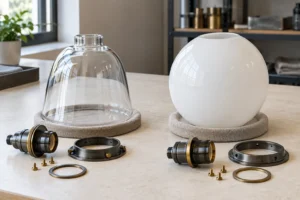
- Spider fitter: A central washer ring with radiating arms (typically 3 or 4) that rest on a lamp harp. The shade is secured by a harp finial that threads through the center of the spider ring. Common on North American hotel table lamps. Replacement shade must have a spider fitter with a center hole diameter compatible with the existing harp finial thread.
- Uno fitter: A single threaded ring that screws directly onto the lamp socket. No harp required. The uno thread diameter is standardized at approximately 38 mm (1.5 inches) for most European and some Asian lamp hardware, but variances exist — measure the socket thread with calipers before ordering.
- Clip-on fitter: A spring clip that snaps over the light bulb directly. Used on small decorative shades, candelabra sconces, and accent lamps. Weight limit is critical: clip-on fitters safely support glass shades up to approximately 180–220 g. Heavier glass replacement shades require a fitter type change.
- Threaded neck fitter: The shade has an integral glass neck with external thread that screws into the fixture housing. Standard on bathroom vanity globes and pendant fixtures. Neck thread diameter must match the fixture’s internal thread exactly — measure with calipers from the existing shade neck.
As the foundational literature on lampshade design and construction notes, fitter standardization across manufacturers is imperfect even within nominally compatible systems — always verify with a physical measurement rather than relying on nominal size designations from different manufacturers.
Glass Finish and Color Matching — Why ΔE Matters
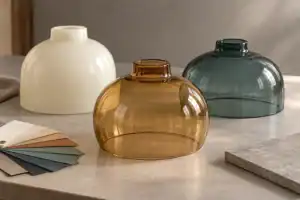
Color matching for glass hotel lamp shade replacement is quantifiable. The standard measurement is ΔE (Delta E), the numerical difference between two colors in a perceptually uniform color space. A ΔE value of 0 means identical color. A ΔE of 1.0 is imperceptible to most human observers. A ΔE of 3.0 is visible in side-by-side comparison under identical lighting.
For hotel lamp shade replacement, the acceptable ΔE tolerance depends on the context:
- Same-room replacement (one shade replaced among three or four in the same room): ΔE ≤ 2.0. Anything above 2.0 will be visible when the lamps are lit simultaneously.
- Corridor replacement (one sconce shade among twenty in a corridor): ΔE ≤ 1.5. The perspective alignment of corridor sconces makes color variation between adjacent units especially visible.
- Different-room replacement (replacing all shades in a single room as a batch): ΔE ≤ 3.0 is acceptable because there is no same-installation-batch reference in the room itself.
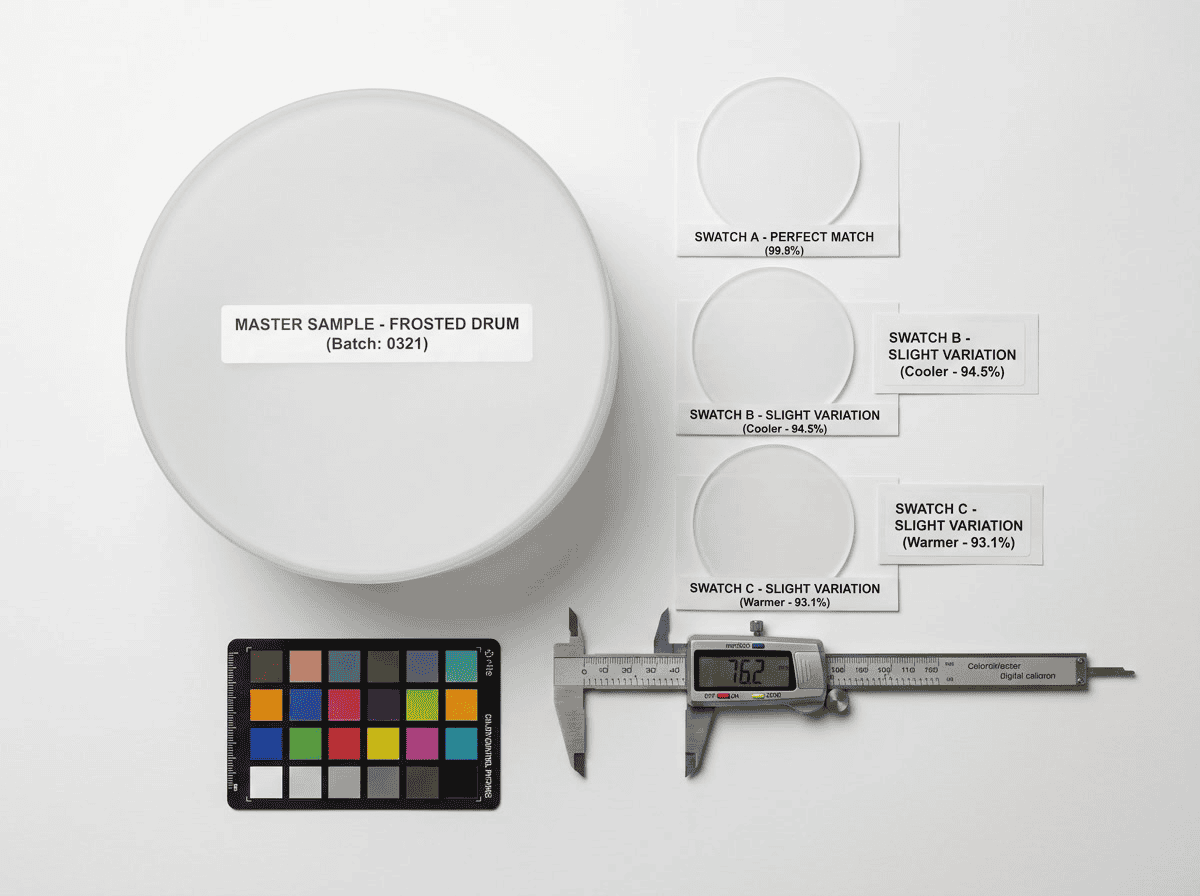
To specify ΔE tolerance to a manufacturer: provide a master sample from the original installation batch (ideally a shade from a stored buffer stock) and state the target ΔE tolerance in writing. The manufacturer measures the sample with a spectrophotometer and produces the replacement batch against the documented baseline. Glass’s compositional manufacturing consistency — the fact that the same raw material ratios produce the same optical output — makes ΔE-documented glass shade replacement reliably achievable; fabric shade color matching to the same tolerance is significantly harder.
Sourcing a Matching Hotel Lamp Shade Replacement
The sourcing channel for hotel lamp shade replacement depends on two variables: how many shades you need, and whether your shade is still manufactured in the original specification. The combination of these two factors determines whether you buy from stock, order OEM, or pursue reproduction.
Using the Original Shade as a Master Sample
The most reliable hotel lamp shade replacement process begins with a master sample from the original batch. If your property maintained buffer stock from the original installation order — even a single undamaged shade stored in a maintenance room — that sample is worth its weight in procurement efficiency.
The process with a master sample:
- Send the sample to the target manufacturer (or to a glass specialist supplier who can characterize and reproduce it).
- Request spectrophotometric measurement of the sample’s glass finish against the target ΔE tolerance.
- Request a pre-production sample — a single shade from the new batch — before committing to the full replacement quantity.
- Compare the pre-production sample to the original master under the same lighting conditions as the hotel room environment (warm LED at 2700K, not fluorescent overhead comparison lighting, which will misrepresent the color relationship).
- Approve and order the full quantity only after the pre-production sample passes visual and ΔE verification.
This process adds 7–14 days to the timeline compared to buying from stock, but it eliminates the visible-mismatch problem that makes rushed hotel lamp shade replacement worse than waiting.
For properties without stored master samples: pull a shade from a guestroom that has had minimal use (a room that was recently out of service for renovation, a suite with low occupancy, a storage room), and use that as the sample. Even an in-use shade from the original batch is a far better matching baseline than a verbal or photographic description.
Wholesale Stock vs. OEM Reproduction — When Each Makes Sense
Wholesale stock replacement is correct when your shade specification matches a standard catalogue item currently in production. This applies to:
- Common drum shade diameters (25, 28, 30, 35 cm) in frosted or opal glass
- Standard globe shades in common bathroom vanity dimensions (14, 16, 18 cm)
- Empire shades in standard hospitality proportions
Wholesale replacement is the right channel for single-unit emergency replacement, for small properties with quantities below 100 units, and for situations where exact color matching is less critical than speed (full room replacement where no original-batch reference remains in the room).
OEM reproduction is correct when:
- The shade is no longer in standard catalogue production
- The required quantity exceeds 300–500 units (the OEM minimum that justifies factory-direct pricing)
- The shade has custom dimensions, a custom finish specification, or a proprietary shape that no stock item matches
- Exact ΔE color matching against a master sample is required
OEM lead times for hotel lamp shade replacement from glass manufacturers: 25–35 days production plus 15–20 days sea freight from Asia. Plan accordingly — emergency OEM orders do not exist. OEM is a planned procurement channel.
Handling Discontinued or Heritage Shade Styles
Discontinued shade replacement is the hardest hotel lamp shade replacement scenario. The shade is no longer manufactured, original specifications may not exist, and visual matching from a degraded original sample introduces compounding error.
The practical approach for discontinued glass shade replacement:
- Reverse-engineer the specification from one or more original shades. Measure all four dimensions with calipers. Document the glass composition by working with a glass specialist supplier who can identify soda-lime vs. borosilicate construction. Borosilicate glass is identifiable by its thermal behavior and its slightly blue-tinted hue in bulk; soda-lime glass is more neutral. Identify the surface finish process (acid etching vs. sandblasting for frosted; mineral additive type for opal).
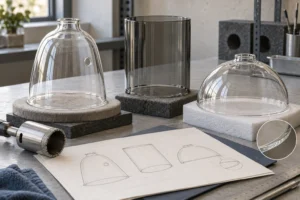
- Commission a glass mold if the shade shape is non-standard. Custom glass mold development for hotel lamp shade reproduction typically costs USD 800–2,000 and requires 20–30 days for mold fabrication and first-article approval. The mold cost amortizes over subsequent reorder runs, which use the existing mold with no additional development charge.
- Order a pre-production sample before committing to full quantity. This is non-negotiable for discontinued shade reproduction — there is no manufacturer catalogue to revert to if the production run misses the specification.
- Document the reproduction specification in writing and store it with the property’s maintenance records. This documentation makes the next replacement cycle straightforward, even if the current manufacturer is no longer available.
For glass shade replacements specifically, a supplier that holds mold archives and production records — such as a dedicated OEM glass lampshade supplier for hotel replacement orders — can reproduce a discontinued specification from a single master sample, making glass the most reliable material for long-term hotel replacement programs.
Emergency vs. Planned Hotel Lamp Shade Replacement
Hotel lamp shade replacement falls into two operationally distinct categories with different protocols, sourcing channels, cost structures, and acceptable quality thresholds. Conflating the two leads to either over-spending on emergency procurement that could have been planned, or under-delivering on quality by using emergency protocols for situations that warranted a more careful match.
Emergency Replacement — Same-Day Protocol
Emergency hotel lamp shade replacement — a shade broken or damaged within hours of a room’s check-in time — requires on-property buffer stock. There is no alternative that maintains both room quality and room availability simultaneously.
The same-day protocol:
- Housekeeping reports the damage to the facilities desk, specifying the lamp position and room number.
- Facilities pulls a buffer stock shade from the on-property store room — pre-identified, pre-labelled by shade type (bedroom A-type, bathroom globe B-type, etc.).
- Technician installs the replacement shade and confirms fitter engagement before the room is re-serviced.
- Inventory is noted — the buffer stock count decrements by one. A replacement order is triggered if buffer stock falls below the minimum threshold.
The acceptable quality threshold for emergency replacement: exact match from the same production batch (if buffer stock is from the original installation), or same-nominal-specification from wholesale stock if buffer stock is unavailable. A same-nominal-specification emergency replacement that introduces a slight color difference is acceptable for same-day service recovery; it is not acceptable as a permanent installation. Flag the shade for replacement at the next batch cycle.
Planned Replacement — Batch Scheduling and Cost Efficiency
Planned hotel lamp shade replacement — addressing degradation, planned renovation, or style update — should be scheduled as a batch cycle, not room-by-room as individual shades fail.
Batch replacement economics are significantly better than unit-by-unit replacement:
- OEM factory-direct pricing starts at 300–500 units, typically 30–45% below wholesale per-unit price
- Shipping cost amortizes across the full order quantity
- Color consistency is guaranteed within a single production batch — shades from the same batch will have ΔE < 0.5 between units, far better than the ΔE variation between shades from different stock purchases
The optimal batch cycle trigger: when degradation inspection reveals that more than 15–20% of a shade specification are showing replacement-worthy deterioration. At this proportion, the remaining 80–85% will reach the same condition within 12–18 months. Replacing all units simultaneously at the 15–20% threshold — rather than waiting for 80% failure — reduces total long-run replacement cost because it eliminates multiple procurement cycles and maintains visual consistency across the property throughout.
Partial vs. Full Property Replacement
When budget constraints require phased hotel lamp shade replacement rather than a full property batch, phase by wing, floor, or corridor — never by individual room.
Phasing by floor or wing ensures that all shades visible in a single guest’s sightline — their guestroom, the corridor to breakfast, the lift lobby — are from the same replacement batch. A guest who sees five different shade generations in one corridor walk experiences the property as poorly maintained, regardless of the quality level of any individual shade.
Phasing by individual room (replacing only the rooms with the worst shade condition) creates the visible patchwork problem. Two rooms in the same corridor with clearly different shade vintages signal that the property makes its maintenance decisions reactively rather than proactively — which is a confidence signal guests use to calibrate their expectations for other maintenance standards throughout their stay.
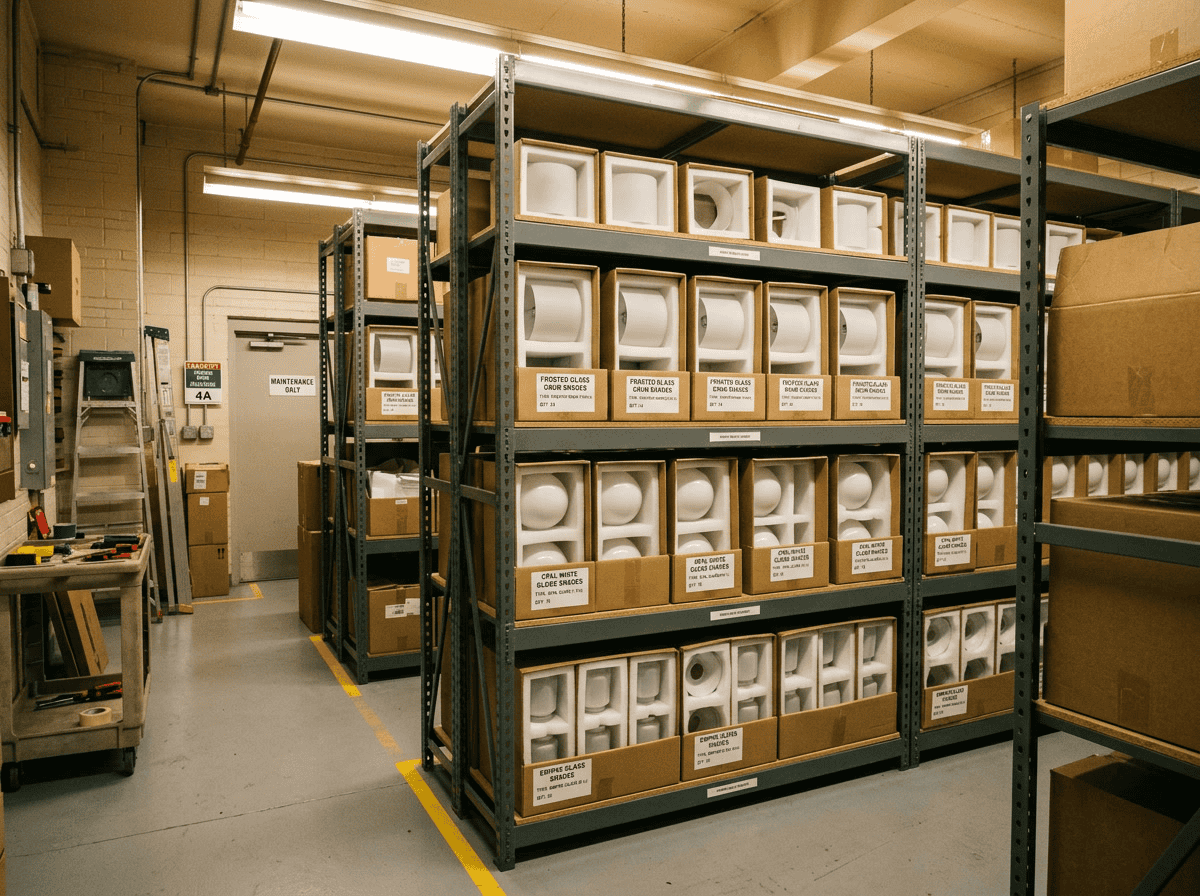
Building a Hotel Lamp Shade Replacement Program
A hotel lamp shade replacement program is a documented system for buffer stock sizing, specification record-keeping, scheduled inspection, and procurement planning — not an ad-hoc response to individual breakage events.
Properties that build this system once, correctly, run for years without emergency procurement scrambles. Properties that operate reactively pay a premium on every replacement: higher per-unit costs from urgent wholesale orders, visible mismatches from imperfect emergency sourcing, and lost room revenue when the buffer stock is empty and a damaged room can’t turn.
Buffer Stock Sizing — How Much to Keep On-Property
Buffer stock is the insurance policy of hotel lamp shade replacement. The correct buffer stock size depends on the property’s room count, the breakage rate for glass shades in its specific housekeeping environment, and the lead time for restocking from the primary supplier.
The industry baseline breakage rate for glass hotel lamp shades in standard guestroom use is 3–7% per year — driven primarily by housekeeping incidents (cart contact, vacuum cleaner proximity, linen snap-back during bed-making). For a 200-room hotel with two bedside glass shades and one bathroom globe per room (600 shades total), the expected annual breakage is 18–42 shades.
The correct buffer stock formula: (Annual breakage rate × Supplier lead time in weeks / 52) + Safety stock.
For the example above:
- Annual breakage: 30 shades (midpoint estimate)
- Supplier lead time: 3 weeks (from wholesale stock)
- Lead time consumption: 30 × (3/52) = 1.7 shades
- Safety stock (2× lead time consumption for variability): 3.5 shades per shade type
- Minimum buffer stock: 4–5 shades per specification, rounded up to the nearest pack size
In practice, most properties find 8–10% of total shade count as a workable buffer stock level — rounding the example to 50–60 shades across all specifications. This covers worst-case breakage periods (high-occupancy seasons, intensive housekeeping rotations) without requiring excessive storage space.
Documentation and Specification Records
Specification records are what prevent the hotel lamp shade replacement program from failing at year three. Without documentation, each replacement cycle starts from scratch — measuring shades that may have degraded, contacting suppliers who may no longer carry the original style, and hoping the replacement matches well enough.
The minimum required documentation for each shade specification:
- Shade type identifier (e.g., “BR-A” for Bedroom Type A, “BT-G” for Bathroom Globe)
- Dimensions: top diameter, bottom diameter, height, fitter opening diameter (all in mm from caliper measurement)
- Fitter type: spider / uno / clip-on / threaded neck, with thread size if applicable
- Glass specification: soda-lime or borosilicate, frosted / opal / clear / ribbed, etch depth or opacity level
- Color reference: ΔE baseline from master sample (or spectrophotometric measurement if no master sample exists)
- Original supplier and order reference number
- Installation date and expected replacement cycle date
- Master sample storage location: which shelf, which room number
Store this documentation in the property management system and as a physical laminated card on the buffer stock storage shelf. The physical card is the fail-safe — when the facilities manager who built the system leaves, the physical card outlasts their memory.
Replacement Cost Planning by Property Size
Hotel lamp shade replacement costs vary significantly by property size, shade type, and sourcing channel. The ranges below use wholesale pricing for single-unit replacement and OEM pricing for batch replacement at scale.
As hospitality procurement best practices indicate, lifecycle cost rather than unit cost is the correct framework for hotel lamp shade replacement budgeting. A glass shade that costs 2.5× a fabric shade at purchase but lasts 4× as long has a lower lifecycle cost even before accounting for the reduced operational complexity of lower replacement frequency.
| Property size | Total shades (est.) | Annual breakage (5%) | Buffer stock cost (glass, wholesale) | Batch replacement cycle | Batch replacement cost (OEM) |
|---|---|---|---|---|---|
| 50-room boutique | 250 | 12–13 shades | USD 150–300 | Every 8–10 years | USD 6,000–12,000 |
| 150-room mid-scale | 750 | 37–38 shades | USD 450–900 | Every 8–10 years | USD 18,000–35,000 |
| 300-room full-service | 1,500 | 75 shades | USD 900–1,800 | Every 8–10 years | USD 36,000–70,000 |
| 500-room large hotel | 2,500 | 125 shades | USD 1,500–3,000 | Every 8–10 years | USD 60,000–115,000 |
Note: OEM batch replacement costs assume glass shades; fabric shade batch costs run 40–60% of glass equivalent per unit but require replacement every 3–4 years rather than 8–10, making total lifecycle cost comparable or higher.
Hotel Lamp Shade Replacement Trends (2026+)
Two overlapping trends are reshaping how hotels approach lamp shade replacement in 2026: the systematic shift from fabric to glass to reduce replacement frequency, and the adoption of standardized shade specifications as a deliberate property management strategy.
Moving from Fabric to Glass to Cut Replacement Frequency
The operational case for glass hotel lamp shades over fabric is now predominantly a maintenance argument rather than an aesthetic one. Fabric shade replacement at the 2–4 year cycle creates a recurring operational load — procurement cycles, installation labor, temporary room outages — that glass’s 8–12 year cycle eliminates for the property’s operational decade.
Properties converting from fabric to glass during renovation or partial replacement programs typically recover the higher per-unit glass cost within the first replacement cycle. A fabric shade requiring replacement at year three, at a wholesale unit cost, costs approximately the same or more per room-decade as a glass shade requiring replacement at year nine at OEM pricing. The maintenance labor saving is additional: fewer procurement events, fewer installation hours, fewer temporary room outages for shade swap operations.
For properties mid-lifecycle on a fabric shade specification, the conversion decision point is the first batch replacement cycle — when degradation triggers a full replacement, specify glass for the replacement batch rather than continuing the fabric specification.
Standardization as a Replacement Strategy
Specification standardization — selecting a small number of shade types (ideally 3–5 across the full property) and sourcing all of them from a single manufacturer relationship — is the most effective long-term hotel lamp shade replacement strategy available to multi-property operators or large single properties.
Standardization allows:
- A single supplier relationship with documented specification records for all shade types
- Pre-negotiated replacement pricing locked over a multi-year contract
- Pre-positioned buffer stock at the manufacturer level — the manufacturer maintains 30-day buffer stock of your specification, reducing lead time from 35 days to 3–5 days for restocking
The trade-off is design flexibility. Standardized shade specifications limit the property’s ability to refresh the guestroom aesthetic without a full specification change. Most properties operating at scale find this trade-off favorable — design consistency and operational efficiency outweigh the value of shade variety for the vast majority of their guestroom inventory.
| Trend | Adoption status in 2026 | Replacement program implication |
|---|---|---|
| Fabric-to-glass conversion | Mainstream at 4-star-and-above | Eliminates 2–4 year replacement cycle; extends to 8–12 years |
| Specification standardization | Established practice at chain properties | Single supplier relationship; pre-negotiated pricing; 3–5 day restocking |
| OEM factory-direct procurement | Growing at 100+ room properties | 30–45% cost reduction vs. wholesale for batch quantities |
| Pre-positioned buffer stock (manufacturer-held) | Emerging at multi-property operators | Reduces effective lead time from 35 days to 3–5 days |
| Digital specification records in PMS | Growing adoption | Eliminates re-measurement at each replacement cycle |
Frequently Asked Questions
How do I find a replacement lamp shade for a discontinued hotel model? Start with a physical sample — pull an undamaged shade from a low-use room and use it as a master sample. Send the sample to a glass lampshade specialist supplier with a request for spectrophotometric measurement and an OEM reproduction quote. For glass shades, full dimensional measurement plus glass composition identification enables accurate reproduction even when the original manufacturer no longer produces the style. Custom glass mold development for non-standard shapes adds 20–30 days to the first order but enables indefinite future reordering.
What is ΔE and why does it matter for hotel lamp shade replacement? ΔE (Delta E) is the numerical measurement of color difference between two objects. A ΔE of 0 means identical; a ΔE of 3.0 is visible in side-by-side comparison under matching light. For hotel lamp shade replacement in the same room or corridor, specify ΔE ≤ 2.0 against a master sample from the original batch. Request spectrophotometric certification from the manufacturer confirming that the replacement batch meets the specified tolerance before approving the full order.
How much buffer stock of replacement lamp shades should a hotel keep? A practical rule is 8–10% of total installed shade count per shade specification type, stored on-property. For a 200-room hotel with 600 total glass shades across three types, this means approximately 16–20 shades per type in buffer stock. This level covers worst-case seasonal breakage rates and provides time to reorder from wholesale (3-week lead time) without running out. Adjust upward if the property’s housekeeping environment produces above-average breakage rates.
How long does a hotel lamp shade replacement order take? From wholesale stock: 3–7 business days for standard specifications. From OEM factory-direct production: 25–35 days production plus 15–20 days sea freight from Asia. Custom or discontinued shade reproduction: add 20–30 days for mold development and pre-production sample approval on the first order. Plan all OEM and reproduction replacement orders at least 60 days before the shades are needed on-property.
Can I replace a fabric hotel lamp shade with glass? Yes — glass shade replacement for a fabric original is operationally straightforward provided the fitter type is compatible. The fitter opening dimensions must match. The glass shade’s weight must be within the fitter’s rated capacity (clip-on fitters have the tightest weight limits — typically 180–220g). If the lamp harp length does not position the glass shade at the correct height, the harp can be swapped independently of the shade replacement. The result is a glass shade with longer service life and simpler cleaning protocol.
How do I tell a spider fitter from a uno fitter on my existing hotel lamp shades? Remove the shade from the lamp. A spider fitter has visible radiating arms (usually 3 or 4) connecting to a central ring — the shade rests on a harp and is held by a finial. A uno fitter has a single ring with a threaded interior that screws directly onto the lamp socket — there is no harp or finial. A clip-on fitter has spring clips that grip the bulb directly. A threaded neck fitter has an integral glass or metal neck with external thread on the shade itself. Identifying fitter type correctly before ordering is the single most important step in preventing hotel lamp shade replacement fit failures.
What causes hotel lamp shades to yellow and how can I slow the process? Yellowing is primarily a fabric shade degradation phenomenon. It is caused by chemical absorption from cleaning agents (particularly bleach and quaternary ammonium compounds) into the shade’s styrene backing, combined with UV emission from the lamp source and airborne particulate accumulation. Slowing yellowing: use pH-neutral cleaning solutions rather than bleach-based products near fabric shades, ensure adequate airflow through HVAC to reduce airborne particulate deposition, and use LED sources (which emit minimal UV) rather than halogen or incandescent sources. Switching to glass hotel lamp shades eliminates the yellowing problem entirely — glass does not absorb cleaning chemicals or undergo UV-driven color shift.
Is it cheaper to repair or replace a damaged hotel lamp shade? For glass hotel lamp shades: replace. Glass repair is not a viable hospitality option — adhesives used in glass repair do not withstand the temperature cycling of lamp use, the repair is always visible under lamp light, and the structural integrity of a repaired shade is unreliable. The unit cost of a replacement glass shade is low enough relative to the repair labor cost and quality risk that replacement is always the economically correct decision. For fabric shades: same conclusion. Fabric shade repair (re-covering, re-backing) costs more per unit than replacement and the result is rarely visually indistinguishable from the original under close inspection.

Conclusion
Hotel lamp shade replacement is not a transaction — it is a system. The transaction is buying a shade. The system is knowing in advance which shade to buy, having it on-hand when the need arises, and maintaining the documentation that makes the next replacement cycle no harder than the current one.
The properties that manage this well share a few characteristics: they stock buffer inventory from the original installation batch rather than ordering reactively, they document their specifications while the original shades are still in good condition, and they treat the first degradation sign as the trigger for batch procurement rather than waiting for visible failure. The result is not just operational efficiency — it is a guest experience that stays consistent from year one to year ten, because the shade in room 214 still matches the shade in room 215.