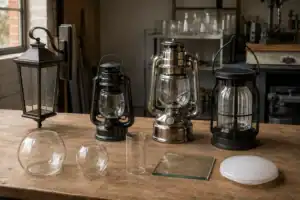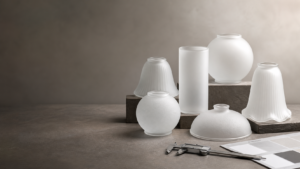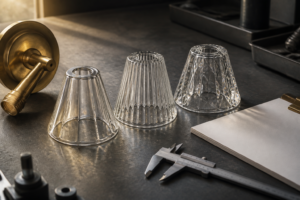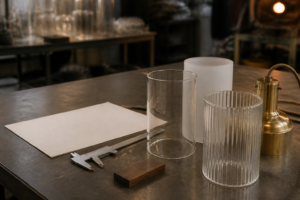
Hotel glass lamp shades are glass-bodied lighting diffusers — in frosted, opal, clear, or ribbed finishes — used across hotel guestrooms, lobbies, bathrooms, and F&B areas for their durability, cleanability, and consistent batch color across long-running hospitality projects.
A procurement manager for a 280-room hotel signs off on lamp shades once every eight years — or she does it every two, if she chose fabric. That gap is not marketing language; it is what happens when you compare the chemical resistance of frosted glass against the dye stability of a hardback linen shade under daily hotel cleaning protocols. The glass wins. Every time.
What no supplier’s product page explains is the layered decision behind the choice: which glass finish survives the disinfectant wipe-downs, which fitter type matches the lamp base hardware already installed in the property, how to specify a replacement batch that actually matches the originals three years on, and where to source at the quantities a hotel project demands without paying retail margins. This guide covers all of it — from first-principle material properties to factory-direct procurement.
Why Hotels Specify Glass Lamp Shades
Glass is the professional-tier default for hotel lamp shades because it outlasts fabric by a factor of three-to-one in daily hospitality use, holds its color indefinitely across replacement batches, and cleans safely with standard hotel disinfectants — none of which fabric shades can claim.
The hospitality procurement decision between glass and fabric is rarely a close call at the four- and five-star level. As the Illuminating Engineering Society’s commercial lighting guidelines note, cleaning frequency and material durability are the primary specification criteria in hotel environments — not secondary considerations after aesthetics. A guestroom lamp shade will be wiped, dusted, and sprayed with disinfectant hundreds of times over its service life. What it’s made of determines whether that service life is measured in years or decades.
Durability and Cleaning Resistance — the Core Case
Hotel glass lamp shades withstand daily cleaning without surface degradation. The mechanism is simple: glass is non-porous. Disinfectant solutions, which break down fabric dyes and soften the styrene backing on hardback shades, find no chemical pathway into glass. A frosted glass shade wiped with a quaternary ammonium solution every morning for eight years looks identical to how it looked on installation day. A hardback fabric shade under the same protocol begins showing discoloration and surface softening within eighteen months.
The numbers bear this out. In practice, standard hardback fabric hotel lamp shades require replacement every 2–4 years in a guestroom environment. Glass hotel lamp shades in the same application typically last 8–12 years before replacement is driven by physical damage rather than material degradation. Across a 200-room property with two lamps per room, the difference in replacement cost over a ten-year lifecycle is substantial enough that the higher unit price of glass pays back completely within the first replacement cycle.
In practice, we’ve found that the cleaning chemical most likely to damage fabric shades in hotel environments is not the disinfectant itself but the frequency — shades cleaned once a week versus once a day show dramatically different degradation timelines. Glass eliminates this variable entirely.
Batch Color Consistency — the Replacement Problem Fabric Can’t Solve
Glass hotel lamp shades can be reproduced to a documented color tolerance — typically ΔE ≤ 2.5 against a master sample — across production runs separated by years. Fabric shades cannot.
This matters intensely in hotel procurement. A hotel that installs 400 frosted glass drum shades across 200 guestrooms will need replacement shades at various points over the next decade as individual units break. If the glass specification is documented — glass composition, etching process, and color tolerance — the manufacturer can produce matching shades in year three or year six that are visually indistinguishable from the originals to a guest or housekeeper standing in the corridor.
The scientific basis for this consistency lies in glass’s compositional manufacturing: the same raw material inputs (silica, sodium carbonate, lime) produce the same optical output every time, unlike dye baths for fabric which vary by batch. Frosted finishes achieved by hydrofluoric acid etching are particularly reproducible — the etch depth and surface texture correlate directly to the acid concentration and duration, both of which can be held constant.
Fabric dye batches drift. The manufacturer may no longer stock the specific fabric. The shade structure may have been discontinued. Hotels that specify fabric shades typically find themselves making wholesale replacements rather than partial batching because matching is impractical. Hotels that specify glass can replace individual broken shades for years.
| Specification criterion | Glass (frosted/opal) | Hardback fabric | Hand-sewn fabric |
|---|---|---|---|
| Service life (hotel guestroom) | 8–12 years | 2–4 years | 3–5 years |
| Daily disinfectant cleaning | Safe — wipe with any cleaner | Degrades backing and dye | Requires specialist protocol |
| Batch color consistency | Excellent (ΔE ≤ 2.5 achievable) | Poor — dye drift between batches | Very poor |
| Partial replacement feasibility | High — single-unit replaceable | Low — match rarely possible | Very low |
| Initial unit cost (relative) | Higher | Lower | Highest |
| 10-year total cost | Lower | Higher | Highest |
The 5 Glass Finishes Used in Hotel Glass Lamp Shades
The five glass finishes used in hotel glass lamp shades are frosted, opal, clear, ribbed, and borosilicate — each producing different light transmission, visual character, and thermal performance properties that suit specific hotel areas and design objectives.
Finish selection is the most consequential specification decision in procuring hotel glass lamp shades. Two shades with the same shape and fitter but different finishes will produce entirely different visual environments. A frosted drum shade creates soft, diffused ambient light; a clear glass globe creates a visible-filament feature effect. Knowing what each finish does — and where it belongs — separates specification from guessing.
Frosted and Opal — the Hospitality Workhorses
Frosted glass is produced by acid etching or sandblasting clear glass, creating a microscopically rough surface that scatters light rather than transmitting it directly. The finish hides the bulb filament, eliminating glare from visible light sources — critical for hotel guestrooms where guests lie reclined in bed and look upward toward lamps. Frosted glass hotel lamp shades transmit approximately 50–70% of the light produced by the bulb, depending on etch depth.
Frosted glass is the most widely specified finish at the three- and four-star tier. It is mid-range in cost, highly reproducible, and compatible with standard cleaning protocols. The primary failure mode is fingerprint visibility — the matte surface shows oil smudges more clearly than opal glass — but a damp cloth eliminates this in seconds.
Opal glass (milk glass) is fundamentally different from frosted glass, though it looks superficially similar. Where frosted glass is clear glass with a surface treatment, opal glass is manufactured with mineral additions — typically calcium fluoride or sodium fluoride — that create opacity throughout the material, not just at the surface. The result is a glass that glows rather than transmits: the shade surface itself becomes luminous rather than being a container through which light shines.
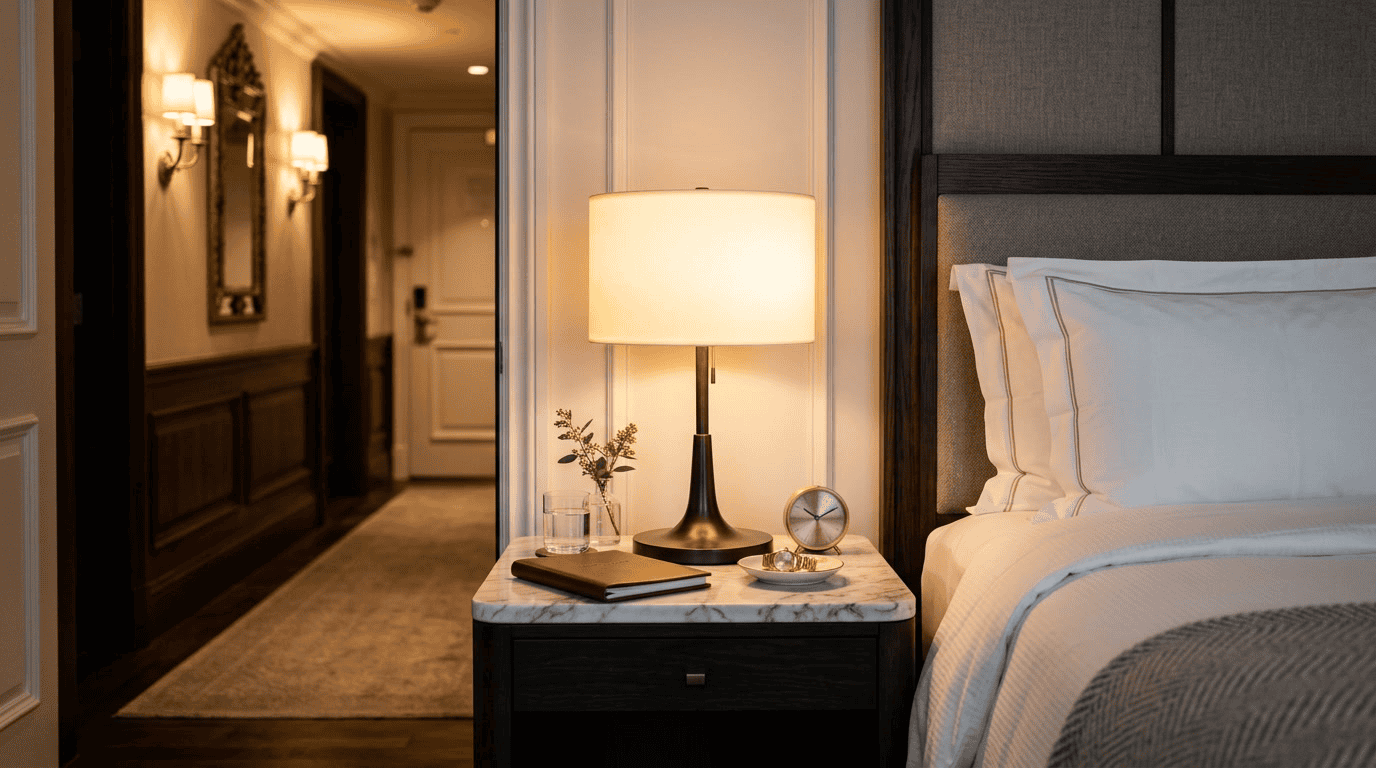
Opal glass hotel lamp shades transmit 35–55% of the light, less than frosted, but the uniformity of the glow is significantly superior. There are no hot spots, no visible filament position regardless of bulb placement, and the shade reads as a light source rather than a lamp fixture. Five-star and boutique properties overwhelmingly prefer opal glass for guestroom bedside lamps precisely because of this premium visual quality.
Specify opal glass when the lamp shade will be visible from bed height and the presence of a visible filament point would feel incongruous with the room’s design level.
Clear and Ribbed — the Design-Statement Options
Clear glass hotel lamp shades are deliberately transparent — they are not attempting to hide the bulb but to present it. In modern hotel design contexts, a clear glass globe or cylinder containing a visible Edison-style filament bulb is a deliberate aesthetic choice: the bulb and shade are experienced together as a single object. This approach appears in hotel bars, lobby feature lamps, boutique hotel corridors, and F&B environments where an industrial or artisanal design language is established.
Clear glass transmits 88–93% of the light — the highest of any glass finish — and requires the designer to specify the bulb type carefully, since the filament shape is visible. Clear glass hotel lamp shades are also the most straightforward to clean (any streak-free glass cleaner) and the least likely to show watermarks after drying.
Ribbed glass applies a structural texture — parallel vertical ridges, diamond patterns, or custom geometries — to either clear or frosted base glass. The texture refracts light as it passes through, creating a prismatic effect visible on surrounding surfaces when the lamp is lit. Ribbed glass hotel lamp shades are primarily used as visual interest pieces in lobbies, reception desks, and F&B environments where a plain smooth shade would read as too minimal.
The ribbing also reduces the visual weight of large shades — a ribbed 45 cm drum shade appears lighter and more intricate than a smooth equivalent of the same dimensions.
Borosilicate — When Thermal Resistance Matters
Borosilicate glass, composed of silica and borosilicate oxide, withstands thermal expansion and contraction that would crack standard soda-lime glass. Its coefficient of thermal expansion is approximately one-third that of standard glass — 3.3 × 10⁻⁶/°C versus 9 × 10⁻⁶/°C for soda-lime.
In hotel applications, borosilicate becomes relevant in three specific contexts:
- Outdoor and terrace fixtures where glass heats in direct sun and cools rapidly overnight
- Spa and sauna-adjacent areas where ambient temperatures fluctuate significantly
- High-wattage vintage-style applications where the bulb wattage produces significant radiant heat
Standard soda-lime frosted and opal glass handles up to 70–80°C without issue — more than adequate for modern LED hotel lamps, which produce minimal heat. Borosilicate is the correct specification only where temperature cycling or high-wattage heat exposure is a genuine factor.
| Glass finish | Light transmission | Best hotel area | Design character | Cleaning ease | Cost tier |
|---|---|---|---|---|---|
| Frosted | 50–70% | Guestrooms, corridors, sconces | Soft, modern, neutral | Easy — damp cloth | Mid |
| Opal | 35–55% | Guestrooms (bedside), lobbies | Premium, luminous, glowing | Easy — no hot spots visible | Mid-high |
| Clear | 88–93% | Bars, feature lamps, F&B | Industrial, artisanal, transparent | Easy — streak-free glass cleaner | Mid |
| Ribbed | 45–75% (varies) | Lobby, reception, F&B | Decorative, prismatic, textured | Moderate — ridges trap dust | Mid-high |
| Borosilicate | Varies by base | Outdoor, terrace, high-wattage | Functional first, aesthetic second | Easy | High |
Glass Shade Shapes for Hotel Applications
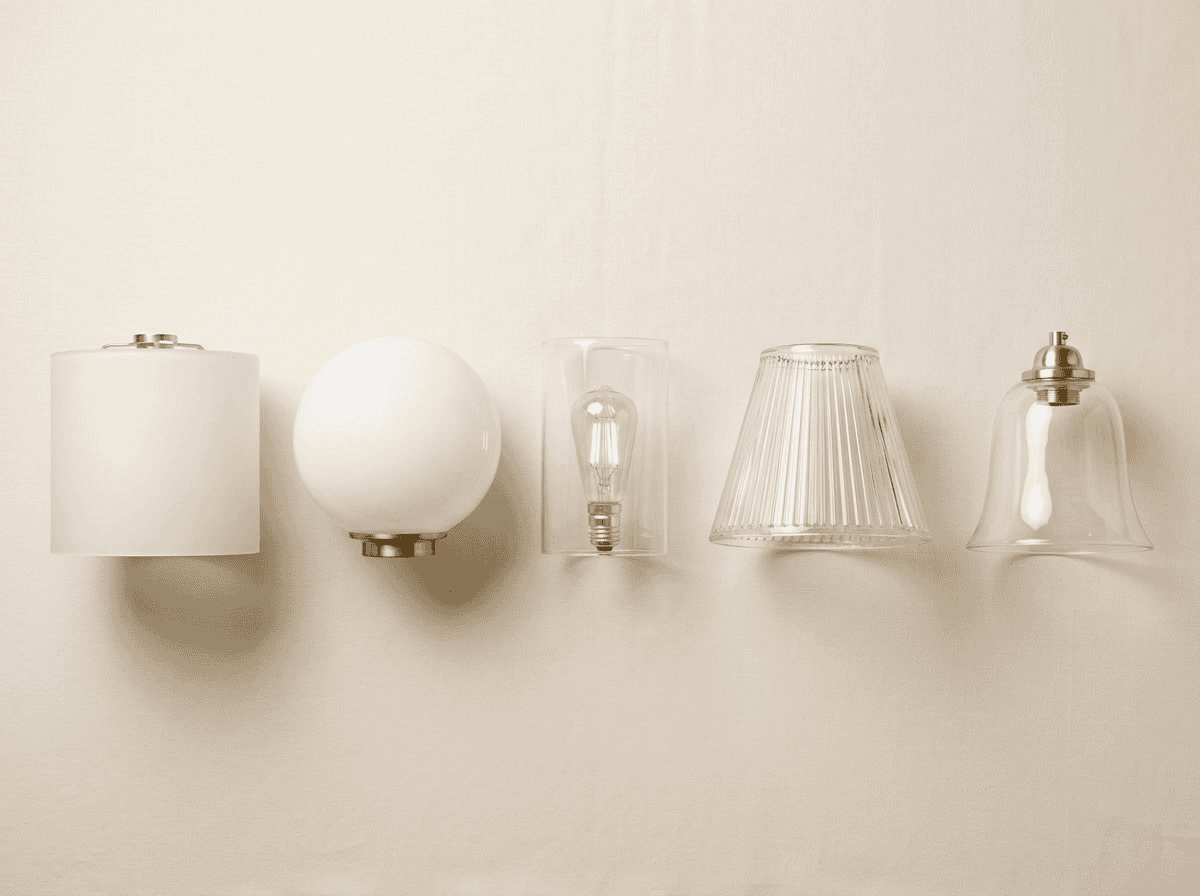
The dominant glass shade shapes in hotel procurement are drum and globe for ambient and feature lighting, with empire, bell, and cylinder used in directional and specialty applications — shape selection driven by light distribution need and the fixture’s position relative to the guest’s eye level.
Shape determines how light leaves the shade and whether the glass itself becomes a visual object or a utilitarian diffuser. For hotel glass lamp shades specifically, three shapes account for the majority of procurement volume.
Drum and Globe — the Dominant Hotel Forms
Drum shades in glass are the single most-specified shape across mid-range and upscale hotel guestrooms. The equal-diameter top and bottom produce even upward and downward light distribution, which suits wall sconces in corridors (ceiling and floor both benefit) and table lamps in guestrooms where the shade sits above the guest’s normal eye line. A frosted or opal glass drum shade reads as clean and contemporary — minimal visual noise, no strong design statement, blends with any guestroom decor scheme.
In glass, drum shades most often appear in frosted or opal white finishes because the shape’s straight walls would reveal a visible hot spot at the filament position if made in clear glass without a designer intent behind it.
Globe shades in glass dominate hotel bathroom vanity applications worldwide. The spherical or near-spherical shape distributes light evenly in all directions, which eliminates directional shadow at mirror height — the primary functional requirement for hotel bathroom lighting. A guest applying makeup or shaving needs shadow-free facial illumination, which globe shades deliver and directional shades (empire, cone) do not.
Beyond bathrooms, globe glass hotel lamp shades appear in hotel bar pendant clusters, lobby seating area feature lamps, and exterior courtyard wall sconces. In opal glass, a globe glows as a soft orb at night — a visual quality that hotel designers use deliberately in otherwise large, architecturally austere spaces.
Empire, Bell, and Cylinder — Directional and Specialty
Empire shades taper from a smaller top to a larger bottom with straight sides. This geometry directs light downward — exactly the function a hotel bedside reading lamp requires. The shade walls prevent direct sightline to the bulb from a reclined position. Empire glass shades, most commonly in frosted or opal finishes, are the standard specification for hotel guestroom table lamps at properties where a more classic silhouette is part of the design direction.
Bell shades follow the same directional logic as empire but with a curved, softer taper. The visual difference is significant: bell shapes read as warmer and more residential, while empire reads as more formal and structured. Boutique hotels and luxury properties with a curated residential aesthetic frequently choose bell-shaped opal glass shades for guestroom lamps over empire.
Cylinder shades — taller than drum, proportionally narrower — appear on floor lamps, tall table lamps in hotel lobby seating, and wall sconces where a vertical profile suits the architecture. In clear glass, a cylinder shade can be used with a visible-filament bulb as a deliberately architectural fixture element in contemporary hotel lobbies.
| Shape | Primary hotel application | Glass finish typically paired | Light distribution |
|---|---|---|---|
| Drum | Guestroom table lamps, corridor sconces | Frosted, opal | Even — up and down |
| Globe | Bathroom vanity, bar pendants, courtyards | Opal, clear | Omnidirectional |
| Empire | Bedside reading lamps, desk lamps | Frosted, opal | Directional — downward |
| Bell | Boutique guestroom table lamps, lounges | Opal, ribbed | Soft directional — downward |
| Cylinder | Floor lamps, tall lobby table lamps | Clear, frosted | Even — narrow column |
Specifying Hotel Glass Lamp Shades — Size and Fitter Guide
Correct size and fitter specification is the single most common source of procurement errors on hotel glass lamp shade projects — a shade ordered in the wrong diameter or with the wrong fitter type creates a retrofit problem that adds cost and delay to the entire installation.
The specification process has three components: shade dimensions, fitter type, and glass thickness. Each must be confirmed before any purchase order is placed.
Standard Hotel Lamp Shade Sizes by Area
Hotel lamp shade dimensions are driven by the fixture base diameter and the intended light spread — the shade diameter should be approximately 1.5–2× the lamp base diameter for visual balance. In practice, hotel procurement uses area-specific standard ranges:
- Guestroom bedside table lamps: shade diameter 25–35 cm, height 18–25 cm. This range suits standard hotel bedside lamp bases (typically 10–15 cm base diameter) and keeps the shade below a reclined guest’s direct sightline.
- Guestroom desk lamps: shade diameter 30–40 cm, height 22–30 cm. Slightly larger to provide broader task illumination over the desk surface.
- Hotel lobby floor lamps: shade diameter 40–55 cm, height 30–40 cm. Larger proportion needed for the architectural scale of lobby spaces.
- Bathroom vanity globes: diameter 12–20 cm. Smaller globes are standard; larger opal globes appear in premium spa-adjacent bathrooms.
- Pendant shades (bar and F&B): diameter 25–50 cm depending on ceiling height and designer intent. Bar pendant clusters typically use 20–30 cm globes or drums; feature pendants over dining tables run 35–50 cm.
Always confirm dimensions with a caliper from the existing shade or lamp base specification sheet — nominal size designations vary between manufacturers and are not internationally standardized.
Fitter Types — Spider, Uno, Clip-on, and Threaded Neck
Fitter type is determined by the lamp base hardware — not by the shade shape or size. The four fitter types common in hotel glass lamp shades are:
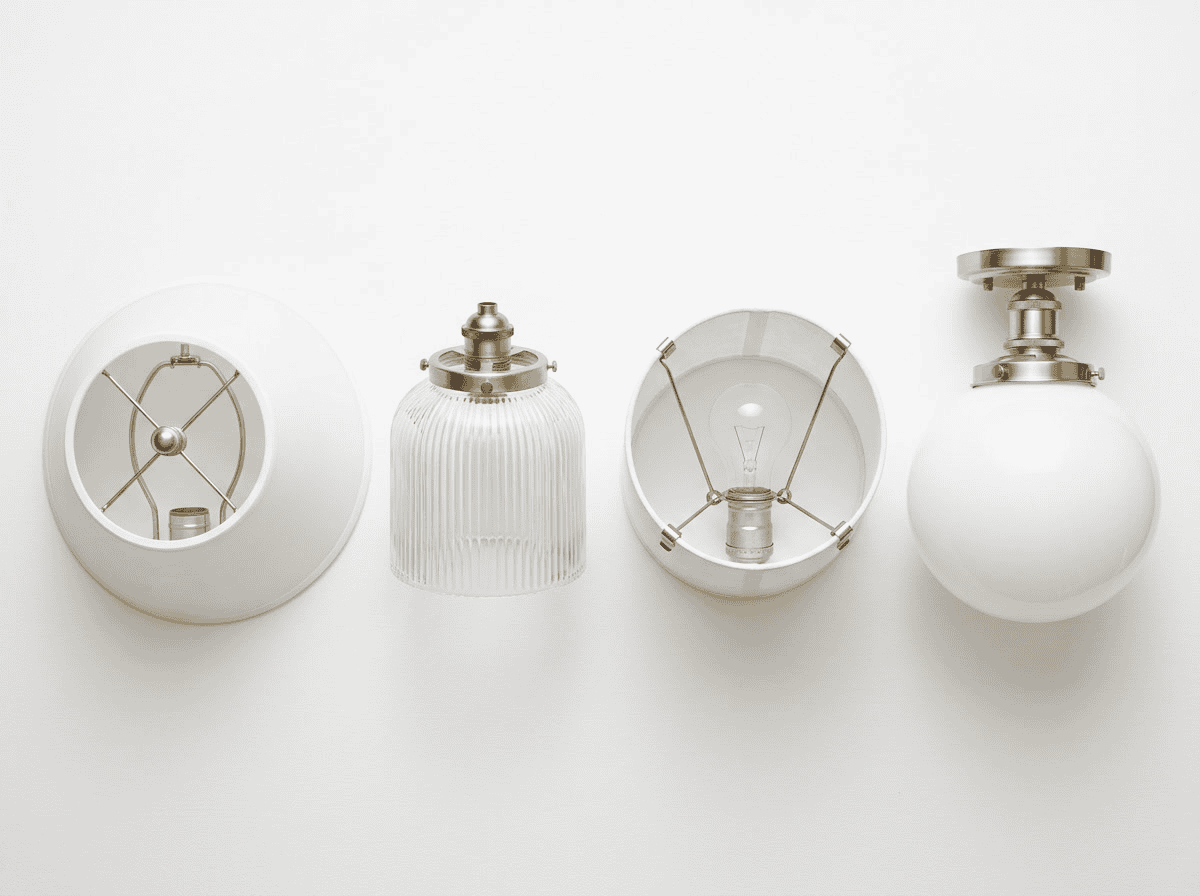
- Spider fitter (USA and Canada standard): A central mounting ring with radiating arms that sit on a lamp harp. The shade screws onto the harp finial. This is the most common configuration on hotel table lamps in North American properties.
- Uno fitter (UK and European standard): A single threaded ring that screws directly onto the lamp socket. The shade mounts directly to the bulb socket, with no harp required. Common on European-specification hotel lamps.
- Clip-on fitter: A spring-loaded clip that snaps directly over the bulb. Used on candelabra-style wall sconces, accent lamps, and small decorative fixtures. The glass must be light enough (typically under 200g) for the clip to hold securely.
- Threaded neck fitter: A glass shade with an integral threaded neck that screws directly into a fixture housing. Common on bathroom vanity globes and pendant fixtures with purpose-built housings. This is the most secure fitter type and is standard on any glass shade used in a high-humidity environment.
Always measure the existing fitter opening with a caliper before specifying replacement hotel glass lamp shades. Nominal fitter sizes (e.g., “55mm uno”) are not always consistent between lamp manufacturers.
Thickness and Weight Considerations
Glass shade thickness affects both fragility and visual quality. Standard hospitality-grade glass hotel lamp shades use 2–3mm wall thickness for drum, empire, and bell shapes. Globe shades in bathroom configurations typically run 3–4mm for thermal and impact resistance. Handblown glass shades for boutique hotel applications may reach 5–6mm in varying thickness — this is intentional; the thickness variation creates the characteristic uneven glow of artisan glass.
Weight matters for clip-on and spider fitter applications where the shade is not positively restrained. A standard 30cm frosted drum shade in 2.5mm glass weighs approximately 300–450g — within safe limits for both fitter types. A 45cm globe in 3.5mm glass can reach 800–1000g and requires a threaded neck or positive fastening approach.
Sourcing Hotel Glass Lamp Shades — Wholesale, OEM, and Replacement
Hotel glass lamp shades are sourced through three channels: wholesale distributors (standard stock, no MOQ, premium price), OEM factory-direct programs (custom specification, MOQ typically 500–1000 pieces, 30–40% cost reduction), and specialist hospitality suppliers (curated stock, mid-range price, reorder continuity programs). Each channel suits a different procurement scenario.
The channel choice depends on two variables: how many shades you need and whether standard stock shapes and finishes match your specification. As covered in the foundational design literature on hospitality interiors, procurement scale and lead time are the defining constraints on hotel FF&E purchasing — not just per-unit cost.
Wholesale vs. OEM Factory Direct — What the MOQ Numbers Mean
Wholesale hospitality suppliers carry standard stock in the most common configurations — frosted and opal drum shades in 25cm, 30cm, and 35cm, globe bathroom shades in 15cm and 20cm opal, and empire shades in the standard hotel range. The advantages are immediate availability, no minimum order quantity, and known quality. The disadvantages are premium pricing and the impossibility of exact specification matching for non-standard properties.
OEM factory-direct sourcing from glass lampshade manufacturers covers custom specification: your exact dimensions, your exact glass composition, your exact finish. Standard OEM programs for hotel glass lamp shades begin at 500 pieces per specification (some manufacturers accept 300-piece minimums for simple shapes with existing molds). Custom mold development for proprietary shapes adds 3–6 weeks to the first-order timeline but not to subsequent reorders.
The cost reduction at OEM scale compared to wholesale retail is typically 30–45% per unit. For a 300-room hotel specifying 600 identical frosted drum shades, that price differential is significant enough to warrant the OEM lead time and minimum quantity commitment.
The critical documentation required for an OEM glass shade order:
- Shape drawing with dimensions (top diameter, bottom diameter, height, wall angle, neck/fitter type)
- Glass composition specification (soda-lime or borosilicate, clear or opal base material)
- Surface finish specification (etch depth for frosted, mineral density for opal, rib profile for ribbed)
- Color tolerance requirement (ΔE value against master sample — specify ≤ 2.5 for guestroom applications where shades are compared side-by-side in corridors)
- Fitter specification (spider, uno, clip-on, or threaded neck dimensions in mm)
- Delivery schedule (phased delivery to match FF&E installation phases)
Matching Replacement Shades to Existing Installations
Replacement sourcing for hotel glass lamp shades — replacing broken or damaged shades within an existing installation — has different requirements from new-project procurement. The challenge is matching, not quantity.
The process that works in practice:
- Pull a master sample — ideally two or three from the original batch that are undamaged and have been out of direct light (stored backup units are ideal).
- Send the sample to the manufacturer or to a specialist glass supplier with the instruction to match to a documented ΔE tolerance.
- Request a pre-production sample from the new batch before committing to full quantity. This is non-negotiable for visual-match purposes.
- Measure with a caliper, not by eye — fitter dimensions are the most common source of replacement misfits in hotel glass lamp shade procurement.
- Specify in writing: glass type, finish, nominal dimensions, fitter type, and wall thickness. Email confirmation of these parameters from the manufacturer is your quality assurance document.
For properties without stored master samples, an original specification drawing from the original FF&E contractor is the next best option. Without either, a glass artisan can measure and characterize an existing shade to derive a reproduction specification — but this adds cost and timeline.
Lead Times and Logistics for Large Hotel Projects
Standard lead times for hotel glass lamp shades at OEM scale from China-based glass manufacturers:
- Standard shapes with existing molds: 25–35 days production, 15–20 days sea freight
- Custom shapes requiring new molds: add 20–30 days for mold production and approval
- Pre-production sample approval: allow 7–10 days round-trip once the sample is shipped
For hotel openings or renovations with fixed handover dates, phase the shade order to arrive 30 days before installation begins — the shipping buffer accounts for customs clearance delays and the approval window gives time to address production issues without path-critical delay.
Packaging for glass hotel lamp shades in transit typically uses individual polyfoam inserts within sectioned master cartons. Request foam density specification from the manufacturer — inadequate foam is the primary cause of in-transit breakage on glass shade orders. Industry standard for hospitality-grade packaging is 20–25 kg/m³ polyethylene foam per shade.
Hotel Glass Lamp Shade Maintenance and Service Life
Glass hotel lamp shades require minimal routine maintenance — wipe with a damp cloth or glass-compatible disinfectant, dry immediately, and inspect for chips or cracks at each deep-clean cycle. No specialist protocols, no chemical restrictions, no separate housekeeping procedure.
As architectural glass maintenance guidelines note, glass surfaces are among the most forgiving in hospitality environments precisely because the non-porous surface prevents staining and holds no bacteria in the way porous fabric and wicker do.
Cleaning Protocols by Glass Finish
Frosted and opal glass: A damp microfiber cloth removes fingerprints, dust, and most housekeeping chemicals. Quaternary ammonium disinfectants (the standard hotel room disinfectant) are safe at standard dilutions. Do not use abrasive pads — they will scratch the etch surface of frosted glass, changing its light-diffusion character over time.
Clear glass: Any streak-free glass cleaner. Dry immediately after cleaning to prevent watermarks, which show more clearly on clear glass than on frosted or opal finishes.
Ribbed glass: A soft brush (a dry pastry brush or a soft-bristle detail brush) dislodges dust from the ridges before the damp wipe. Skipping this step builds up dust lines in the ribs over time.
Borosilicate glass: Standard protocols as for frosted or clear, depending on the base glass character. No special chemical requirements.
When to Replace — and How to Plan the Cycle
Hotel glass lamp shades should be replaced when chipped, cracked, or when the etch surface shows mechanical abrasion that alters the light quality. In practice, in a well-maintained hotel guestroom, physical breakage — not material degradation — is the dominant replacement trigger.
Expected breakage rates in hotel guestroom glass lamp shade applications: 3–7% per year from housekeeping incidents, guest contact, and maintenance activities. For a 200-room hotel with 400 guestroom bedside shades, this means 12–28 shade replacements per year. Maintain a 10% buffer stock (40 units) stored on-property to enable same-day replacement without visible mismatches.
At 8–10 years, schedule a full property review. By that point, surface scratches on frosted shades, UV-related color drift in room lighting design, and accumulated minor chipping typically make full batch replacement the economically correct decision even if most individual shades remain structurally intact.
Trends in Hotel Glass Lamp Shades (2026+)
Three trends are reshaping how hotel glass lamp shades are specified in 2026: the rise of handblown and artisan glass at the luxury tier, the integration of glass shade design with smart lighting systems, and the growing demand for recycled-content glass in hospitality FF&E procurement.
Handblown and Artisan Glass — the Boutique and Luxury Tier
At four- and five-star properties positioning around craft and provenance, handblown glass hotel lamp shades are moving from rare statement pieces to standard specification. Handblown glass has distinctive characteristics no machine-pressed glass replicates: slight surface irregularities, varying wall thickness, and a visual warmth from the bubble inclusions and thickness variation that machine glass cannot produce.
The procurement trade-off is real: handblown glass shades have longer lead times (custom European or American studios work to 8–14-week lead times), higher unit costs (2–4× machine-pressed), and lower consistency between individual pieces — which some designers embrace as intentional variation and others manage by specifying tight tolerances that constrain the artisan.
For boutique properties where no two rooms are identical, slight handblown variation reads as luxury. For 300-room properties where corridor consistency is a quality signal, machine-pressed opal and frosted glass remains the correct specification.
Smart Integration and Retrofit Compatibility
LED retrofit compatibility has become a glass shade specification variable in 2026. Standard hotel glass lamp shades designed for incandescent or halogen sources had generous fitter-to-glass clearances because those bulb types were small. LED modules with integral heat sinks or decorative form factors (Edison filament LEDs, globe LEDs, candelabra LEDs) have different physical footprints that can conflict with shade neck opening dimensions or fitter clearances.
When specifying hotel glass lamp shades alongside an LED retrofit, confirm:
- Neck opening diameter clears the LED module without contact
- Shade interior height accommodates any upward-extending LED heat sink
- Glass composition is thermally appropriate for the specific LED’s rated operating temperature (most LEDs run cool enough for standard soda-lime glass; high-output modules may require borosilicate in close-clearance applications)
Smart hotel room systems that dim lamps to preset scenes are also reshaping glass shade specification. A frosted or opal glass shade looks excellent at 100% and at 20% dimming — the filament is never visible, so the shade appearance is consistent across the dimming range. Clear glass shades with visible-filament bulbs show a dramatic visual change between full brightness and low dimming — which is either a desired design effect (warm, intimate, candle-like) or an unwanted inconsistency, depending on the property’s intent.
Recycled Glass and Sustainability Requirements
Hotel brands operating under corporate sustainability mandates are increasingly requiring documentation of recycled content in glass specifications. Standard soda-lime glass for lampshade production already incorporates 20–30% cullet (recycled glass) in most factory programs. For hotels requiring certified higher recycled content, select manufacturers offer specifications with 50–70% cullet — at a marginal cost premium of 8–15%.
Third-party certification for recycled glass content (ISO 14021-compliant declarations) is the standard documentation form. When sustainability specification is a procurement requirement, request this certificate from the manufacturer before order placement — not as an afterthought after delivery.
| Trend | Adoption tier | 2026 status | Procurement implication |
|---|---|---|---|
| Handblown artisan glass | 5-star, boutique | Mainstream at luxury tier | Longer lead time, higher MOQ flexibility |
| LED retrofit compatibility checks | All tiers | Standard requirement | Add neck and clearance spec to orders |
| Smart dimming compatibility | 4–5 star | Growing rapidly | Specify finish for target dimming range |
| Recycled glass certification | Branded chains | Emerging requirement | Request ISO 14021 cert from manufacturer |
| Custom mold for brand identity | Hotel chains, large groups | Established practice | MOQ 500+ per shape, 4–6 week mold lead time |
Frequently Asked Questions
What is the difference between frosted and opal hotel glass lamp shades? Frosted glass is clear glass with an acid-etched or sandblasted surface that scatters light; opal glass is manufactured with mineral additives throughout the material that create a glowing, uniform luminescence. Opal glass hotel lamp shades transmit less light (35–55% vs. 50–70% for frosted) but produce a more premium, evenly glowing appearance with no visible filament hot spot. The practical bottom line: specify opal for guestroom bedside lamps at four-star-and-above properties; frosted for corridors, sconces, and cost-sensitive applications.
What MOQ is standard for OEM hotel glass lamp shades? Standard OEM minimum order quantities for hotel glass lamp shades from specialty manufacturers are 500 pieces per specification for standard shapes with existing molds, and 300–500 pieces for custom shapes with new mold development. Lead times from China-based factories are 25–35 days production plus sea freight. For quantities below 500 pieces, wholesale hospitality distributors carrying stock product are the more practical channel.
Which glass finish lasts longest in a hotel guestroom? All glass finishes — frosted, opal, clear, ribbed — outlast fabric shades significantly, with service lives of 8–12 years in standard hotel guestroom use. Among glass finishes, clear glass has no surface treatment to abrade, so it is theoretically the most durable to mechanical wear. In practice, frosted and opal glass shades are replaced at the same rate as clear glass — physical breakage, not surface wear, is the dominant failure mode in all glass hotel lamp shade applications.
What fitter type is standard on hotel table lamps? Spider fitters (USA/Canada standard) and uno fitters (UK/Europe standard) are the two dominant configurations on hotel table lamps. Spider fitters use a lamp harp and finial; uno fitters thread directly onto the lamp socket. Always measure the existing fitter opening with a caliper before ordering replacement hotel glass lamp shades — nominal size descriptions between manufacturers are inconsistent.
Can hotel glass lamp shades be used with LED bulbs? Yes — standard soda-lime glass hotel lamp shades are thermally compatible with LED bulbs, which run significantly cooler than the incandescent and halogen bulbs they replace. The specification check required is dimensional: confirm that the LED module’s physical form factor (particularly upward-extending heat sinks on some LED types) clears the shade’s interior neck opening without contact. Borosilicate glass is required only for high-output LED modules in close-clearance fittings, or for outdoor applications with significant temperature cycling.
How do I source matching replacement hotel glass lamp shades? The matching process requires: (1) a master sample from the original batch, (2) a manufacturer who can measure the sample’s dimensions, glass composition, and surface finish character, (3) a pre-production sample approval step before the full replacement quantity is produced, (4) a documented ΔE color tolerance of ≤ 2.5 to ensure visual consistency against the originals. Without a master sample, a reproduction specification can be derived from the original FF&E documentation — but this adds time and cost.
What is the standard size for hotel bathroom globe glass shades? Hotel bathroom vanity globe glass shades are most commonly 12–20 cm in diameter. The smaller end (12–15 cm) suits single-bulb vanity sconces; 18–20 cm globes appear above wider mirror spans with multiple-point light sources. Opal glass is the standard finish for hotel bathroom globes — the omnidirectional light distribution eliminates facial shadows, and the sealed globe form resists humidity and cleaning chemical exposure.
Are custom hotel glass lamp shades available in non-standard shapes? Yes — custom glass hotel lamp shades in any shape, finish, or dimension are available from OEM glass lampshade manufacturers at hospitality-scale quantities. Custom mold development for proprietary shapes typically takes 3–6 weeks and is a one-time cost that applies only to the first production run. Subsequent reorders use the existing mold with no additional development cost or delay. Minimum quantity for custom shapes is typically 500 pieces per specification.

Conclusion
Hotel glass lamp shades are not a commodity line item — they are one of the few procurement decisions in hotel FF&E that compound over time. The unit cost difference between glass and fabric closes within the first replacement cycle. The batch color consistency that glass provides becomes indispensable by year three when individual replacements start. The maintenance simplicity accumulates as a housekeeping efficiency across every cleaning day of the shade’s 8–12-year life.
The specification path is straightforward when the variables are understood: finish choice driven by the guest’s sightline and the room’s design tier, fitter type confirmed by caliper measurement rather than nominal description, size derived from lamp base proportion, and sourcing channel matched to quantity. For hotel projects of 100 rooms or more, OEM factory-direct procurement with documented color tolerance and a pre-production sample approval step is the correct approach. For smaller properties or partial replacements, wholesale distributors with reorder continuity programs provide the supply-chain reliability that glass’s long service life demands.