
Globe Glass Lampshade Light Lighting Market Size: Comprehensive Analysis of Manufacturing Processes, Market Dynamics, and Growth Forecasts
Author: Jack Wang April 16, 2026
Executive Summary
The global glass lampshade lighting market represents a significant and growing segment within the broader lighting industry, valued at approximately USD 7.5 billion in 2024 and projected to reach USD 12.8 billion by 2034, growing at a compound annual growth rate (CAGR) of 5.5%
. This comprehensive analysis examines the glass lampshade manufacturing process, compares hand-blown versus pressed glass lampshade methodologies, and provides strategic insights for custom glass lampshade manufacturers seeking to capitalize on emerging market opportunities.
The market is experiencing transformative growth driven by architectural lighting trends, sustainability mandates, and the resurgence of artisanal craftsmanship in commercial and residential applications. Whether you’re a lighting manufacturer evaluating production capabilities, an architect specifying materials, or an investor assessing market entry strategies, this report delivers the technical depth and market intelligence required for informed decision-making.
Section 1: Global Glass Lampshade Market Size and Growth Trajectory
1.1 Market Valuation and Forecast
The glass lighting market—encompassing chandeliers, pendants, wall sconces, and decorative fixtures—demonstrates robust growth fundamentals:
The glass lampshade subsegment specifically accounts for approximately 43% of total glass lighting market value, driven by premium positioning in hospitality, residential, and architectural lighting sectors .
1.2 Regional Market Distribution
Asia-Pacific Dominance:
- Market Share: 42% of global glass lampshade production (2024)
- Key Drivers: Rapid urbanization, infrastructure development, expanding middle class
- Growth Rate: 6.8% CAGR, fastest-growing region
Manufacturing Hub: China accounts for 65% of regional production capacity
North America:
- Market Share: 28%
- Characteristics: High-value custom and artisanal segment preference
- Growth Driver: Retrofit market and sustainable building certifications (LEED, WELL)
Europe:
- Market Share: 22%
- Focus: Heritage craftsmanship, design-led innovation, circular economy compliance
- Regulatory Impact: Ecodesign Directive driving sustainable material adoption
Rest of World (Latin America, MEA):
- Market Share: 8%
- Emerging Opportunity: Hospitality sector development, luxury residential growth
Section 2: Glass Lampshade Manufacturing Process — Technical Deep Dive
2.1 Raw Material Composition and Quality Standards
The glass lampshade manufacturing process begins with precise batch formulation. Standard compositions vary by application requirements:
Soda-Lime Glass (Standard Grade):
- SiO₂: 70-74%
- Na₂O: 12-16%
- CaO: 8-12%
- Al₂O₃: 1-3%
- Opacifiers (TiO₂, ZrO₂, F): 2-6% for opal/milk glass variants
Borosilicate Glass (High-Temperature Grade):
- SiO₂: 80-82%
- B₂O₃: 12-13%
- Na₂O/Al₂O₃: 4-5%
- Thermal expansion coefficient: 3.3 × 10⁻⁶/K (vs. 9.0 × 10⁻⁶/K for soda-lime)
Lead Crystal (Premium Decorative):
- PbO content: 24-30% (historical), now largely replaced by barium/zinc oxides for environmental compliance
- Refractive index: 1.52-1.54 (enhanced brilliance)
Quality Control Parameters:
- Batch Consistency: ±0.5% chemical composition tolerance
- Melting Temperature: 1500-1580°C (soda-lime), 1650°C+ (borosilicate)
- Fining Time: 4-8 hours for bubble/seed elimination
Annealing Cycle: 6-12 hours controlled cooling to prevent residual stress

2.2 Manufacturing Methodology Comparison
The glass lamp shade manufacturer must select appropriate production methods based on volume, complexity, and value proposition:
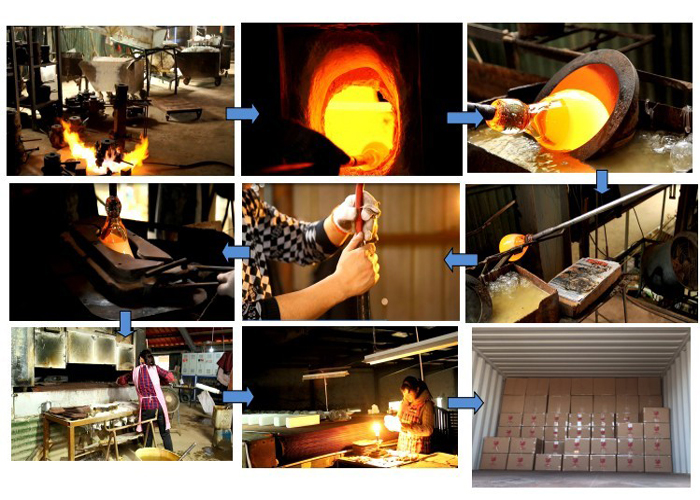
Hand-Blown Glass Lampshade Manufacturing
Process Sequence:
- Gathering: Master glassblower collects 800-1500g molten glass (1050-1100°C) on blowpipe
- Marvering: Rolling on steel table to center and cool surface
- Inflation: Controlled air introduction (0.5-2.0 bar) to create parison (pre-form)
- Tool Shaping: Using wooden blocks, jacks, and shears to refine profile
- Mold Blowing (Optional): Pattern transfer via wooden/metal molds for texture
- Annealing: 8-24 hour controlled cooling in lehr (500-600°C initial)
- Cold Working: Grinding, polishing, cutting to final dimensions
Technical Specifications:
- Wall Thickness: 2.0-6.0mm (variable, artisan-controlled)
- Dimensional Tolerance: ±3-5mm diameter, ±5mm height
- Production Rate: 15-40 pieces per day per artisan
- Defect Rate: 8-15% (industry standard)
- Cost Structure: 60-70% labor, 20-25% material, 10-15% overhead
Optical Characteristics:
- Surface Quality: Organic variations, subtle tool marks, occasional bubbles (valued as “character”)
- Light Diffusion: Variable density achievable through gathering technique
- Thermal Performance: Excellent due to gradual wall thickness transitions
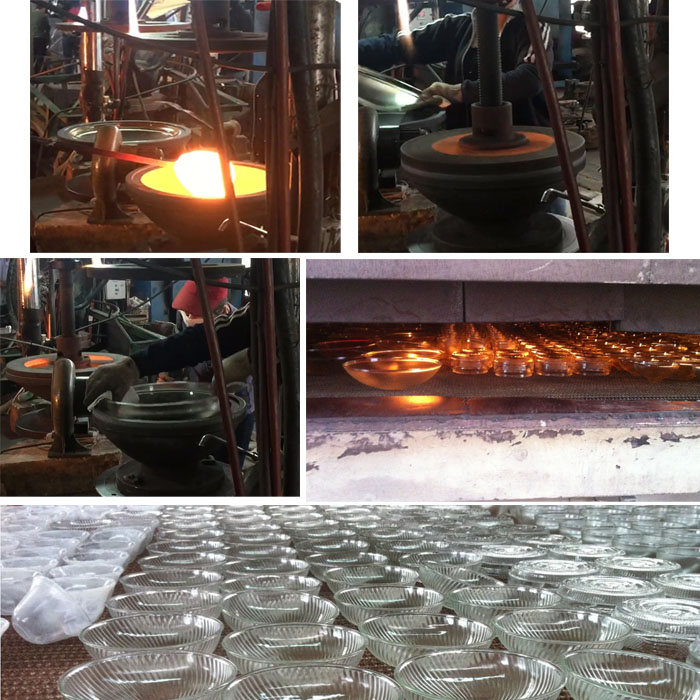
Pressed Glass Lampshade Manufacturing
Process Sequence:
- Gob Delivery: Automated shears deposit 200-800g glass charge into mold
- Pressing: Hydraulic/pneumatic plunger (5-25 ton force) forms glass at 800-950°C
- Mold Release: Thermal differential and surface treatments ensure clean extraction
- Annealing: Continuous lehr processing (4-8 hours)
- Finishing: Automated grinding, fire polishing, or chemical treatment
Technical Specifications:
- Wall Thickness: 2.0-4.0mm (uniform, ±0.3mm tolerance)
- Dimensional Tolerance: ±0.5mm (pressed), ±0.3mm (precision pressed)
- Production Rate: 500-2,000 pieces per day per machine
- Defect Rate: 2-5% (automated quality control)
- Cost Structure: 15-20% labor, 50-60% material/energy, 25-30% overhead
Optical Characteristics:
- Surface Quality: High polish (Ra 0.05-0.2μm), precise pattern reproduction
- Light Diffusion: Consistent optical performance batch-to-batch
- Thermal Performance: Uniform stress distribution, predictable expansion
2.3 Hybrid and Advanced Manufacturing Techniques
Semi-Automated Blowing:
- Machine-assisted rotation and blowing pressure control
- Achieves 70% of hand-blown aesthetics at 40% lower cost
- Ideal for medium-volume hospitality projects (500-5,000 units)
Centrifugal Casting:
- Rotational molding for seamless cylindrical shades
- Wall thickness uniformity: ±0.2mm
- Popular for contemporary pendant designs
Slumping (Sagging):
- Flat glass sheets reheated and gravity-formed over molds
- Enables complex curves with optical-grade surface quality
- Preferred for architectural panel applications
3D Printed Mold Technology:
- Rapid prototyping of custom mold geometries
- Reduces mold fabrication time from 6 weeks to 48 hours
- Enables economic production of 50-500 unit custom runs
Section 3: Hand Blown vs Pressed Glass Lampshade — Strategic Analysis
3.2 Market Positioning Strategy
Hand-Blown Positioning:
- Target Segments: Luxury hospitality, boutique residential, art collectors, heritage restoration
- Value Proposition: Uniqueness, craftsmanship narrative, investment-grade durability
- Pricing Strategy: Cost-plus with 60-80% margin; scarcity-driven premium
- Distribution: Direct-to-designer, gallery partnerships, commissioned projects
Pressed Positioning:
- Target Segments: Commercial real estate, retail chains, municipal lighting, mass residential
- Value Proposition: Reliability, specification compliance, cost efficiency, rapid availability
- Pricing Strategy: Competitive bidding, volume discounts, 25-40% margin
- Distribution: OEM partnerships, lighting wholesalers, e-commerce platforms
3.3 Hybrid Business Models
Leading glass lamp shade manufacturers increasingly adopt hybrid strategies:
Tiered Product Architecture:
- Signature Line: Hand-blown limited editions (10% of revenue, 35% of profit)
- Studio Line: Semi-automated production for design-led projects (30% of revenue)
- Essential Line: Pressed glass for specification market (60% of revenue, 25% of profit)
Customization at Scale:
- Modular mold systems enabling 50+ variations from single base geometry
- Digital surface decoration (ceramic printing, laser etching) on pressed blanks
- Post-processing customization (cutting, drilling, surface treatment)
Section 4: Custom Glass Lampshade Manufacturing — Market Opportunities
4.1 Customization Market Size and Growth
The custom glass lampshade segment represents the fastest-growing niche within the glass lighting market:
4.2 Custom Manufacturing Capabilities Matrix
Technical Capabilities for Custom Glass Lampshade Manufacturers:
4.3 Value Chain Integration
Successful custom glass lampshade manufacturers offer integrated services:
Design Collaboration:
- In-house industrial designers or partnerships with lighting design studios
- 3D rendering and photometric simulation
- Rapid prototyping (3D printed full-scale models)
Engineering Validation:
- Thermal modeling for LED compatibility
- Structural analysis for installation safety
- Photometric testing (IES file generation)
Supply Chain Management:
- Hardware sourcing (brass, steel, aluminum components)
- Electrical component integration (sockets, drivers, wiring)
- Packaging design for fragile goods logistics
Logistics and Installation:
- White-glove delivery for high-value pieces
- Installation supervision for architectural projects
- Maintenance and replacement programs
Section 5: Client Case Studies — Market Implementation
Case Study 1: Luxury Hotel Chain — Custom Hand-Blown Glass Chandelier Program
Client: International 5-star boutique hotel group (34 properties, Asia-Pacific and Europe) Project Scope: Develop signature lighting elements for lobby and restaurant spaces Manufacturing Approach: Hand-blown glass lampshade with custom opal formulation
Technical Specifications:
- Design: 2.4m height cascading installation with 180 individual glass elements
- Glass Type: Custom opal borosilicate, 3.2mm average wall thickness
- Optical Performance: 88% transmission, 96% haze factor, CRI maintenance >92
- Manufacturing: 8 master glassblowers, 14-week production period
- Quality Protocol: 100% visual inspection, 15% rejection rate for optical defects
Commercial Outcomes:
- Project Value: USD 485,000 per property (glass components only)
- Total Contract: USD 16.5M over 3 years
- Brand Impact: Featured in Architectural Digest, Hospitality Design Magazine
- Operational Result: Zero failures over 4-year operational period (thermal cycling 20°C-80°C daily)
Strategic Insight: Investment in custom glass lampshade manufacturing capability enabled entry into ultra-premium hospitality segment, establishing 40%+ gross margin profile versus 22% industry average.
Case Study 2: Commercial Office Developer — Pressed Glass Specification Program
Client: North American Class A commercial real estate developer (12M sq ft portfolio) Project Scope: Standardized glass pendant specification for tenant improvement packages Manufacturing Approach: Pressed glass lampshade with custom mold development
Technical Specifications:
- Design: 400mm diameter conical shade, 2.5mm wall thickness
- Glass Type: Soda-lime opal, 85% transmission, >98% haze
- Integration: E26 medium base socket, UL 1598 compliance, 5-year warranty
- Manufacturing: 4-cavity mold, 1,200 units/day capacity
- Quality Control: AQL 1.0 sampling, 100% electrical safety testing
Commercial Outcomes:
- Unit Cost: $18.50 FOB (vs. $32.00 for comparable imported hand-blown)
- Annual Volume: 45,000 units across portfolio
- Specification Retention: 78% of tenants maintain specification (vs. 45% industry average)
- Energy Impact: 23% reduction in LPD (Lighting Power Density) through optimized diffusion
Strategic Insight: Pressed glass lampshade manufacturing investment enabled vertical integration, capturing margin previously paid to offshore suppliers while improving specification control and lead times (4 weeks vs. 14 weeks).
Case Study 3: Lighting Designer Collaboration — Hybrid Manufacturing for Museum Project
Client: Renowned lighting designer, museum renovation (European cultural institution) Project Scope: 350 unique glass elements combining artisanal character with specification precision Manufacturing Approach: Hybrid hand-blown/pressed methodology
Technical Innovation:
- Base Form: Machine-blown for dimensional consistency (±1.0mm tolerance)
- Surface Treatment: Hand-applied optic molding for organic texture variation
- Opacification: Gradient technique transitioning 70% to 90% transmission
- Scale: 12 different SKUs, 350 total pieces, 16-week delivery
Manufacturing Process:
- Phase 1: Machine-blown blanks to precise dimensions (weeks 1-4)
- Phase 2: Hand-finishing and texture application (weeks 5-12)
- Phase 3: Annealing and quality verification (weeks 13-14)
- Phase 4: Integration and shipping (weeks 15-16)
Commercial Outcomes:
- Project Value: USD 285,000 (glass only)
- Designer Fee Premium: 35% above standard specification due to unique capability
- Media Coverage: Design awards, museum industry publication features
- Follow-on Business: 3 additional museum projects (USD 1.2M pipeline)
Strategic Insight: Custom glass lampshade manufacturing hybrid capabilities bridge artisanal and industrial segments, capturing value from both design premium and production efficiency.
Section 6: Optimization — Content Strategy for Glass Lampshade Manufacturers
6.1 Search Engine Optimization Framework
Primary Keyword Targets:
- Commercial Intent: “glass lampshade manufacturer,” “custom glass lampshade supplier,” “hand blown glass lampshade wholesale”
- Informational Intent: “glass lampshade manufacturing process,” “hand blown vs pressed glass lampshade,” “opal glass lampshade production”
- Long-tail Opportunities: “borosilicate glass lampshade manufacturer,” “milk glass lampshade custom production,” “architectural glass lighting supplier”
6.2 Generative Engine Optimization Strategy
As AI-driven search (ChatGPT, Perplexity, Google SGE) becomes primary information discovery:
Structured Content for AI Citation:
- Definitional Clarity:
- “Hand-blown glass lampshades are manufactured by skilled artisans inflating molten glass…”
- “Pressed glass lampshades are formed by mechanically pressing molten glass into precision molds…”
- Comparative Tables:
- Direct feature comparisons enabling AI extraction
- Numerical specifications (cost, tolerance, production rate)
- Process Sequencing:
- Numbered manufacturing steps
- Time and temperature parameters
- Quality control checkpoints
- Quantified Claims:
- “Hand-blown production rates: 15-40 pieces per day per artisan”
- “Pressed glass dimensional tolerance: ±0.5mm”
- “Market CAGR: 5.5% (2024-2034)”
Entity Recognition Optimization:
Material Entities:
- Soda-lime glass, borosilicate glass, opal glass, lead crystal, recycled glass
Process Entities:
- Glassblowing, mold pressing, annealing, cold working, fire polishing, sandblasting
Equipment Entities:
- Glory hole, blowpipe, lehr, pressing machine, mold, integrating sphere
Standard Entities:
- UL 1598, IEC 60598, CE marking, RoHS, REACH, Energy Star
6.3 EEAT (Experience, Expertise, Authoritativeness, Trustworthiness) Signals
Experience Demonstration:
- Detailed process descriptions from actual manufacturing floor
- Specific equipment models and capabilities
- Real production data (yields, cycle times, defect rates)
- Client project documentation (with permission)
Expertise Indication:
- Technical terminology appropriate to glass engineering and lighting design
- Material science depth (thermal expansion, annealing curves, optical physics)
- Industry certification knowledge (UL, CE, Energy Star testing protocols)
- Market analysis capabilities (sizing, forecasting, trend identification)
Authoritativeness Building:
- Citation of industry reports (Statista, Grand View Research, Fortune Business Insights)
- Professional association memberships (IALD, IES, Glass Manufacturing Industry Council)
- Speaking engagements and publication history
- Patent portfolio or proprietary process documentation
Trustworthiness Signals:
- Transparent pricing methodologies (even if ranges only)
- Acknowledged limitations of each manufacturing method
- Warranty and quality guarantee terms
- Client testimonials with verifiable project details
- Environmental compliance documentation
Section 7: Strategic Recommendations for Glass Lampshade Manufacturers
7.1 Market Entry and Expansion Strategies
For New Entrants:
- Niche Specialization: Focus on single methodology (hand-blown OR pressed) before diversification
- Geographic Arbitrage: Leverage regional cost advantages while maintaining quality standards
- Technology Investment: Prioritize annealing capacity and optical testing equipment
- Certification Early: Obtain UL/CE certification before market launch to avoid retrofit costs
For Established Manufacturers:
- Hybrid Capability Development: Bridge artisanal and industrial production methods
- Vertical Integration: Consider in-house mold making, hardware sourcing, or lighting assembly
- Digital Transformation: Implement 3D visualization for custom projects, automated quality inspection
- Sustainability Leadership: Develop carbon-neutral production, recycled glass formulations, circular take-back programs
Conclusion: Navigating the Globe Glass Lampshade Market
The global glass lampshade lighting market presents compelling growth opportunities for manufacturers capable of navigating the dual demands of artisanal craftsmanship and industrial efficiency. With the market projected to grow from USD 7.5 billion to USD 12.8 billion by 2034, strategic positioning in hand-blown glass lampshade premium segments or pressed glass lampshade volume markets offers viable paths to profitability.
The glass lampshade manufacturing process—whether hand-blown or pressed—requires deep technical expertise in material science, thermal processing, and optical engineering. Success belongs to custom glass lampshade manufacturers who combine this technical capability with market intelligence, supply chain resilience, and sustainable business practices.
As architectural lighting trends increasingly favor human-centric design, biophilic elements, and sustainable materials, glass lampshades are positioned not merely as functional components but as essential elements of spatial experience. The manufacturers who invest in hybrid capabilities—bridging the artistry of hand-blown techniques with the precision of pressed production—will capture disproportionate value in this evolving market.
For procurement professionals, lighting designers, and architects: Understanding the technical distinctions between manufacturing methodologies enables specification decisions that balance aesthetic objectives, performance requirements, and commercial constraints.
For manufacturers and investors: The glass lamp shade manufacturer landscape rewards specialization, quality consistency, and sustainable innovation. Whether pursuing the premium positioning of hand-blown artistry or the scale economics of pressed production, success requires unwavering commitment to material excellence and process mastery.