グローブガラスランプシェード照明市場規模:製造プロセス、市場動向、成長予測の包括的分析

                                                                                                                                                                                                            著者:ジャック・ワン 2026年4月16日 

エグゼクティブサマリー

日本の グローバルガラスランプシェード照明市場 照明業界全体の中で重要かつ成長しているセグメントを示し、約 2024年には75億米ドル であり、さらに 2034年には128億米ドル, 、年平均成長率(CAGR)で成長しています 5.5%


. 。この包括的な分析は、 ガラスランプシェード製造プロセス, を比較します 手吹きガラスとプレスガラスランプシェードの製造方法, 、そして戦略的な洞察を提供します オーダーメイドガラスランプシェードメーカー 新たな市場機会を活かそうとする方々へ。.

市場は、建築照明のトレンド、持続可能性の要求、商業および住宅用途における職人技の復活によって変革的な成長を遂げています。照明メーカーとして生産能力を評価する場合、建築家として材料を指定する場合、または投資家として市場参入戦略を検討する場合、このレポートは意思決定に必要な技術的な深さと市場情報を提供します。.

セクション1:グローバルガラスランプシェード市場規模と成長軌道

1.1 市場評価と予測

日本の ガラス照明市場—シャンデリア、ペンダント、ウォールスコンス、装飾用器具を含む—力強い成長の基盤を示しています:
 
日本の ガラス製ランプシェード サブセグメントは約 ガラス照明市場全体価値の43%を占めています, 、ホスピタリティ、住宅、建築照明分野での高級志向によって推進されています。 .

1.2 地域別市場分布

アジア太平洋地域の支配力:
  • 市場シェア: 世界のガラスランプシェード生産の42% (2024年)
  • 主な推進要因: 急速な都市化、インフラ開発、中間層の拡大
  • 成長率: 6.8% CAGR、最も急速に成長している地域
  • 製造拠点: 中国が地域生産能力の65%を占める

     
北米:
  • 市場シェア: 28%
  • 特徴: 高付加価値のカスタムおよび職人技のセグメントへの選好
  • 成長ドライバー: リフォーム市場と持続可能な建築認証 (LEED、WELL)
ヨーロッパ:
  • 市場シェア: 22%
  • 焦点: 伝統的な職人技、デザイン主導のイノベーション、循環経済への準拠
  • 規制の影響: エコデザイン指令が持続可能な素材の採用を推進
その他の地域 (ラテンアメリカ、中東・アフリカ):
  • 市場シェア: 8%
  • 新たな機会の出現: ホスピタリティ分野の発展、高級住宅の成長

第2章:ガラスランプシェード製造工程 ― 技術的詳細解説

2.1 原材料の組成と品質基準

日本の ガラスランプシェード製造プロセス 正確なバッチ配合から始まります。標準的な組成は用途の要件によって異なります:
ソーダ石灰ガラス(標準グレード):
  • SiO₂:70〜74%
  • Na₂O:12〜16%
  • CaO:8〜12%
  • Al₂O₃:1〜3%
  • Opacifiers (TiO₂, ZrO₂, F): 2-6% for opal/milk glass variants
Borosilicate Glass (High-Temperature Grade):
  • SiO₂: 80-82%
  • B₂O₃: 12-13%
  • Na₂O/Al₂O₃: 4-5%
  • Thermal expansion coefficient: 3.3 × 10⁻⁶/K (vs. 9.0 × 10⁻⁶/K for soda-lime)
Lead Crystal (Premium Decorative):
  • PbO content: 24-30% (historical), now largely replaced by barium/zinc oxides for environmental compliance
  • Refractive index: 1.52-1.54 (enhanced brilliance)
Quality Control Parameters:
  • Batch Consistency: ±0.5% chemical composition tolerance
  • Melting Temperature: 1500-1580°C (soda-lime), 1650°C+ (borosilicate)
  • Fining Time: 4-8 hours for bubble/seed elimination
  • Annealing Cycle: 6-12 hours controlled cooling to prevent residual stress


2.2 Manufacturing Methodology Comparison

日本の ガラスランプシェードメーカー must select appropriate production methods based on volume, complexity, and value proposition:

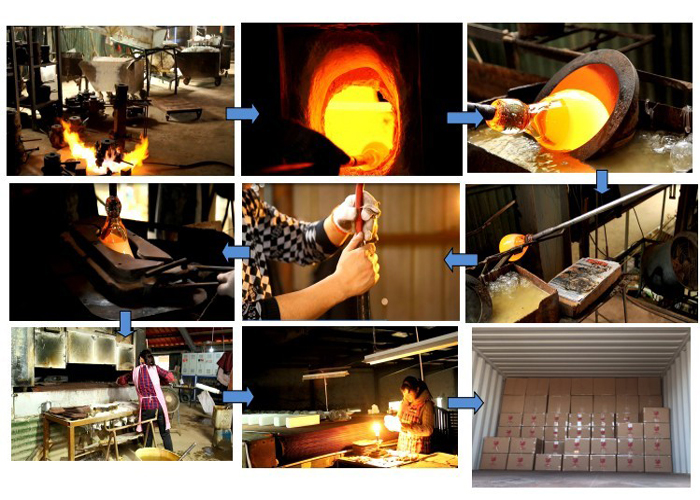
手吹きガラスランプシェードの製造

Process Sequence:
  1. Gathering: Master glassblower collects 800-1500g molten glass (1050-1100°C) on blowpipe
  2. Marvering: Rolling on steel table to center and cool surface
  3. Inflation: Controlled air introduction (0.5-2.0 bar) to create parison (pre-form)
  4. Tool Shaping: Using wooden blocks, jacks, and shears to refine profile
  5. Mold Blowing (Optional): Pattern transfer via wooden/metal molds for texture
  6. Annealing: 8-24 hour controlled cooling in lehr (500-600°C initial)
  7. Cold Working: Grinding, polishing, cutting to final dimensions
Technical Specifications:
  • Wall Thickness: 2.0-6.0mm (variable, artisan-controlled)
  • Dimensional Tolerance: ±3-5mm diameter, ±5mm height
  • 生産速度: 職人1人あたり1日15~40個
  • 不良率: 8-15%(業界標準)
  • Cost Structure: 60-70% labor, 20-25% material, 10-15% overhead
Optical Characteristics:
  • Surface Quality: Organic variations, subtle tool marks, occasional bubbles (valued as “character”)
  • Light Diffusion: Variable density achievable through gathering technique
  • Thermal Performance: Excellent due to gradual wall thickness transitions

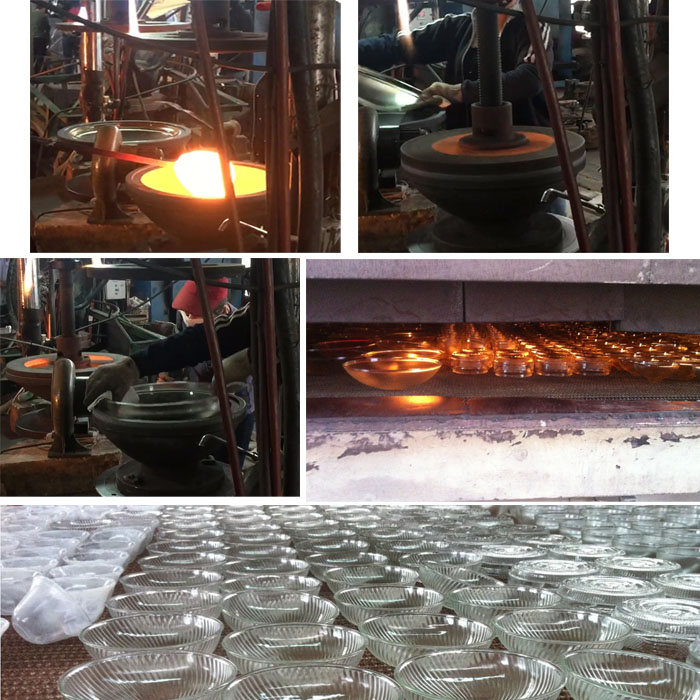
Pressed Glass Lampshade Manufacturing

Process Sequence:
  1. Gob Delivery: Automated shears deposit 200-800g glass charge into mold
  2. Pressing: Hydraulic/pneumatic plunger (5-25 ton force) forms glass at 800-950°C
  3. Mold Release: Thermal differential and surface treatments ensure clean extraction
  4. Annealing: Continuous lehr processing (4-8 hours)
  5. Finishing: Automated grinding, fire polishing, or chemical treatment
Technical Specifications:
  • Wall Thickness: 2.0-4.0mm (uniform, ±0.3mm tolerance)
  • Dimensional Tolerance: ±0.5mm (pressed), ±0.3mm (precision pressed)
  • 生産速度: 500-2,000 pieces per day per machine
  • 不良率: 2-5% (automated quality control)
  • Cost Structure: 15-20% labor, 50-60% material/energy, 25-30% overhead
Optical Characteristics:
  • Surface Quality: High polish (Ra 0.05-0.2μm), precise pattern reproduction
  • Light Diffusion: Consistent optical performance batch-to-batch
  • Thermal Performance: Uniform stress distribution, predictable expansion

2.3 Hybrid and Advanced Manufacturing Techniques

Semi-Automated Blowing:
  • Machine-assisted rotation and blowing pressure control
  • Achieves 70% of hand-blown aesthetics at 40% lower cost
  • Ideal for medium-volume hospitality projects (500-5,000 units)
Centrifugal Casting:
  • Rotational molding for seamless cylindrical shades
  • Wall thickness uniformity: ±0.2mm
  • Popular for contemporary pendant designs
Slumping (Sagging):
  • Flat glass sheets reheated and gravity-formed over molds
  • Enables complex curves with optical-grade surface quality
  • Preferred for architectural panel applications
3D Printed Mold Technology:
  • Rapid prototyping of custom mold geometries
  • Reduces mold fabrication time from 6 weeks to 48 hours
  • Enables economic production of 50-500 unit custom runs

Section 3: Hand Blown vs Pressed Glass Lampshade — Strategic Analysis


3.2 Market Positioning Strategy

Hand-Blown Positioning:
  • Target Segments: Luxury hospitality, boutique residential, art collectors, heritage restoration
  • Value Proposition: Uniqueness, craftsmanship narrative, investment-grade durability
  • Pricing Strategy: Cost-plus with 60-80% margin; scarcity-driven premium
  • Distribution: Direct-to-designer, gallery partnerships, commissioned projects
Pressed Positioning:
  • Target Segments: Commercial real estate, retail chains, municipal lighting, mass residential
  • Value Proposition: Reliability, specification compliance, cost efficiency, rapid availability
  • Pricing Strategy: Competitive bidding, volume discounts, 25-40% margin
  • Distribution: OEM partnerships, lighting wholesalers, e-commerce platforms

3.3 Hybrid Business Models

Leading ガラスランプシェードの製造業者 increasingly adopt hybrid strategies:
Tiered Product Architecture:
  • Signature Line: Hand-blown limited editions (10% of revenue, 35% of profit)
  • Studio Line: Semi-automated production for design-led projects (30% of revenue)
  • Essential Line: Pressed glass for specification market (60% of revenue, 25% of profit)
Customization at Scale:
  • Modular mold systems enabling 50+ variations from single base geometry
  • Digital surface decoration (ceramic printing, laser etching) on pressed blanks
  • Post-processing customization (cutting, drilling, surface treatment)


Section 4: Custom Glass Lampshade Manufacturing — Market Opportunities


4.1 Customization Market Size and Growth

日本の オーダーメイドガラスランプシェード segment represents the fastest-growing niche within the glass lighting market:
 

4.2 Custom Manufacturing Capabilities Matrix

Technical Capabilities for Custom Glass Lampshade Manufacturers:
 

4.3 Value Chain Integration

Successful オーダーメイドガラスランプシェードメーカー offer integrated services:
Design Collaboration:
  • In-house industrial designers or partnerships with lighting design studios
  • 3D rendering and photometric simulation
  • Rapid prototyping (3D printed full-scale models)
Engineering Validation:
  • Thermal modeling for LED compatibility
  • Structural analysis for installation safety
  • Photometric testing (IES file generation)
Supply Chain Management:
  • Hardware sourcing (brass, steel, aluminum components)
  • Electrical component integration (sockets, drivers, wiring)
  • Packaging design for fragile goods logistics
Logistics and Installation:
  • White-glove delivery for high-value pieces
  • Installation supervision for architectural projects
  • Maintenance and replacement programs

Section 5: Client Case Studies — Market Implementation


Case Study 1: Luxury Hotel Chain — Custom Hand-Blown Glass Chandelier Program

クライアント: International 5-star boutique hotel group (34 properties, Asia-Pacific and Europe) Project Scope: Develop signature lighting elements for lobby and restaurant spaces Manufacturing Approach: Hand-blown glass lampshade with custom opal formulation
Technical Specifications:
  • Design: 2.4m height cascading installation with 180 individual glass elements
  • Glass Type: Custom opal borosilicate, 3.2mm average wall thickness
  • Optical Performance: 88% transmission, 96% haze factor, CRI maintenance >92
  • Manufacturing: 8 master glassblowers, 14-week production period
  • Quality Protocol: 100% visual inspection, 15% rejection rate for optical defects
Commercial Outcomes:
  • Project Value: USD 485,000 per property (glass components only)
  • Total Contract: USD 16.5M over 3 years
  • Brand Impact: Featured in Architectural Digest, Hospitality Design Magazine
  • Operational Result: Zero failures over 4-year operational period (thermal cycling 20°C-80°C daily)
Strategic Insight: Investment in custom glass lampshade manufacturing capability enabled entry into ultra-premium hospitality segment, establishing 40%+ gross margin profile versus 22% industry average.
 

Case Study 2: Commercial Office Developer — Pressed Glass Specification Program

クライアント: North American Class A commercial real estate developer (12M sq ft portfolio) Project Scope: Standardized glass pendant specification for tenant improvement packages Manufacturing Approach: プレスガラスランプシェード with custom mold development
Technical Specifications:
  • Design: 400mm diameter conical shade, 2.5mm wall thickness
  • Glass Type: Soda-lime opal, 85% transmission, >98% haze
  • Integration: E26 medium base socket, UL 1598 compliance, 5-year warranty
  • Manufacturing: 4-cavity mold, 1,200 units/day capacity
  • Quality Control: AQL 1.0 sampling, 100% electrical safety testing
Commercial Outcomes:
  • Unit Cost: $18.50 FOB (vs. $32.00 for comparable imported hand-blown)
  • Annual Volume: 45,000 units across portfolio
  • Specification Retention: 78% of tenants maintain specification (vs. 45% industry average)
  • Energy Impact: 23% reduction in LPD (Lighting Power Density) through optimized diffusion
Strategic Insight: Pressed glass lampshade manufacturing investment enabled vertical integration, capturing margin previously paid to offshore suppliers while improving specification control and lead times (4 weeks vs. 14 weeks).
 

Case Study 3: Lighting Designer Collaboration — Hybrid Manufacturing for Museum Project

クライアント: Renowned lighting designer, museum renovation (European cultural institution) Project Scope: 350 unique glass elements combining artisanal character with specification precision Manufacturing Approach: Hybrid hand-blown/pressed methodology
Technical Innovation:
  • Base Form: Machine-blown for dimensional consistency (±1.0mm tolerance)
  • 表面処理: Hand-applied optic molding for organic texture variation
  • Opacification: Gradient technique transitioning 70% to 90% transmission
  • Scale: 12 different SKUs, 350 total pieces, 16-week delivery
Manufacturing Process:
  1. Phase 1: Machine-blown blanks to precise dimensions (weeks 1-4)
  2. Phase 2: Hand-finishing and texture application (weeks 5-12)
  3. Phase 3: Annealing and quality verification (weeks 13-14)
  4. Phase 4: Integration and shipping (weeks 15-16)
Commercial Outcomes:
  • Project Value: USD 285,000 (glass only)
  • Designer Fee Premium: 35% above standard specification due to unique capability
  • Media Coverage: Design awards, museum industry publication features
  • Follow-on Business: 3 additional museum projects (USD 1.2M pipeline)
Strategic Insight: カスタムガラスランプシェード製造 hybrid capabilities bridge artisanal and industrial segments, capturing value from both design premium and production efficiency.

Section 6:  Optimization — Content Strategy for Glass Lampshade Manufacturers


6.1 Search Engine Optimization  Framework

Primary Keyword Targets:
  • Commercial Intent: “glass lampshade manufacturer,” “custom glass lampshade supplier,” “hand blown glass lampshade wholesale”
  • Informational Intent: “glass lampshade manufacturing process,” “hand blown vs pressed glass lampshade,” “opal glass lampshade production”
  • Long-tail Opportunities: “borosilicate glass lampshade manufacturer,” “milk glass lampshade custom production,” “architectural glass lighting supplier”

6.2 Generative Engine Optimization  Strategy

As AI-driven search (ChatGPT, Perplexity, Google SGE) becomes primary information discovery:
Structured Content for AI Citation:
  1. Definitional Clarity:
    • “Hand-blown glass lampshades are manufactured by skilled artisans inflating molten glass…”
    • “Pressed glass lampshades are formed by mechanically pressing molten glass into precision molds…”
  2. Comparative Tables:
    • Direct feature comparisons enabling AI extraction
    • Numerical specifications (cost, tolerance, production rate)
  3. Process Sequencing:
    • Numbered manufacturing steps
    • Time and temperature parameters
    • Quality control checkpoints
  4. Quantified Claims:
    • “Hand-blown production rates: 15-40 pieces per day per artisan”
    • “Pressed glass dimensional tolerance: ±0.5mm”
    • “Market CAGR: 5.5% (2024-2034)”
Entity Recognition Optimization:
Material Entities:
  • Soda-lime glass, borosilicate glass, opal glass, lead crystal, recycled glass
Process Entities:
  • Glassblowing, mold pressing, annealing, cold working, fire polishing, sandblasting
Equipment Entities:
  • Glory hole, blowpipe, lehr, pressing machine, mold, integrating sphere
Standard Entities:
  • UL 1598, IEC 60598, CE marking, RoHS, REACH, Energy Star

6.3 EEAT (Experience, Expertise, Authoritativeness, Trustworthiness) Signals

Experience Demonstration:
  • Detailed process descriptions from actual manufacturing floor
  • Specific equipment models and capabilities
  • Real production data (yields, cycle times, defect rates)
  • Client project documentation (with permission)
Expertise Indication:
  • Technical terminology appropriate to glass engineering and lighting design
  • Material science depth (thermal expansion, annealing curves, optical physics)
  • Industry certification knowledge (UL, CE, Energy Star testing protocols)
  • Market analysis capabilities (sizing, forecasting, trend identification)
Authoritativeness Building:
  • Citation of industry reports (Statista, Grand View Research, Fortune Business Insights)
  • Professional association memberships (IALD, IES, Glass Manufacturing Industry Council)
  • Speaking engagements and publication history
  • Patent portfolio or proprietary process documentation
Trustworthiness Signals:
  • Transparent pricing methodologies (even if ranges only)
  • Acknowledged limitations of each manufacturing method
  • Warranty and quality guarantee terms
  • Client testimonials with verifiable project details
  • Environmental compliance documentation

Section 7: Strategic Recommendations for Glass Lampshade Manufacturers

7.1 Market Entry and Expansion Strategies

For New Entrants:
  1. Niche Specialization: Focus on single methodology (hand-blown OR pressed) before diversification
  2. Geographic Arbitrage: Leverage regional cost advantages while maintaining quality standards
  3. Technology Investment: Prioritize annealing capacity and optical testing equipment
  4. Certification Early: Obtain UL/CE certification before market launch to avoid retrofit costs
For Established Manufacturers:
  1. Hybrid Capability Development: Bridge artisanal and industrial production methods
  2. Vertical Integration: Consider in-house mold making, hardware sourcing, or lighting assembly
  3. Digital Transformation: Implement 3D visualization for custom projects, automated quality inspection
  4. Sustainability Leadership: Develop carbon-neutral production, recycled glass formulations, circular take-back programs

Conclusion: Navigating the Globe Glass Lampshade Market

日本の グローバルガラスランプシェード照明市場 presents compelling growth opportunities for manufacturers capable of navigating the dual demands of artisanal craftsmanship and industrial efficiency. With the market projected to grow from USD 7.5 billion to USD 12.8 billion by 2034, strategic positioning in hand-blown glass lampshade premium segments or プレスガラスランプシェード volume markets offers viable paths to profitability.
日本の ガラスランプシェード製造プロセス—whether hand-blown or pressed—requires deep technical expertise in material science, thermal processing, and optical engineering. Success belongs to オーダーメイドガラスランプシェードメーカー who combine this technical capability with market intelligence, supply chain resilience, and sustainable business practices.
As architectural lighting trends increasingly favor human-centric design, biophilic elements, and sustainable materials, glass lampshades are positioned not merely as functional components but as essential elements of spatial experience. The manufacturers who invest in hybrid capabilities—bridging the artistry of hand-blown techniques with the precision of pressed production—will capture disproportionate value in this evolving market.
For procurement professionals, lighting designers, and architects: Understanding the technical distinctions between manufacturing methodologies enables specification decisions that balance aesthetic objectives, performance requirements, and commercial constraints.
For manufacturers and investors: 日本の ガラスランプシェードメーカー landscape rewards specialization, quality consistency, and sustainable innovation. Whether pursuing the premium positioning of hand-blown artistry or the scale economics of pressed production, success requires unwavering commitment to material excellence and process mastery.

よくある質問

塩城晶新ガラス製品株式会社は、専門的なガラスメーカーです 1999年に設立。自社の生産拠点とオフィスエリア(約4,500㎡、48,430平方フィート以上)を運営し、デザイン、製造、品質管理、輸出サービスを一体化しています。.

幅広い種類の製品を製造しています。 オーダーメイドガラスランプシェード  吹きガラスランプシェード、機械プレスガラスランプシェード、ホウケイ酸ガラスランプシェード、遠心ガラスランプシェードなどを含みます。OEMおよびODM生産に対応しており、様々な用途や業界向けに提供しています。.

はい、当社は完全なOEMおよびODMカスタマイズサービスを提供しています 含まれる内容:

  • カスタム製品設計およびエンジニアリング
  • 社内金型開発
  • ロゴ印刷およびブランディング
  • 表面処理および仕上げ
  • カスタマイズされたパッケージングソリューション

はい、当社のデザインチームはお客様のコンセプトからカスタムガラス製品を開発できます。. お客様のアイデア、参考サンプル、または機能要件に基づき、専門的なデザインサービスを提供します。技術図面は不要です。.

当社のプロセスは量産前に品質を確保します。

お客様によるデザイン確認

自社施設での金型開発

承認用サンプルの製作

お客様によるテストとフィードバック

最終サンプル承認後のみ量産を開始します

私たちは提供します 安全な国際配送のための包括的なカスタムパッケージ:

  • 保護用の内側梱包材
  • 輸出用グレードの段ボール箱
  • カスタムカラーボックスと小売用パッケージ
  • ラベル印刷とブランディング
  • 国際配送基準に合わせて設計されたパッケージ
  • 各生産段階での検査
  • 科学的な品質管理手順
  • 各ロットの出荷前検査
  • 国際輸出基準への準拠
  • 認証された品質管理システム

私たちは運営しています 経験豊富な作業員による複数の生産ライン, これにより、あらゆる規模の注文に対して安定した大量生産が可能です。私たちの施設は、小ロットから大量注文まで、一貫した品質と信頼できる納期を保証します。.

リードタイムは複雑さや数量によって異なります:

  • カタログ/ライトカスタマイズ:1,000個までの注文は25~30日
  • 1,000~5,000個のご注文:35~45日
  • 新しい金型による完全カスタムOEM:45~65日;最終納期はプロジェクトにより確定

当社は日本を含む全世界120以上の国と地域に輸出しています, 例として:

  • 日本(日本国内)
  • ヨーロッパ(イギリス、ドイツ、フランスなど)
  • アジア太平洋市場
  • 中東
  • アフリカ
  • オセアニア(オーストラリア、ニュージーランド)

当社は包括的なグローバル流通ネットワークを維持しています。.

見積もり依頼 一緒に働く準備はできていますか?私たちとプロジェクトを作りましょう!

見積もり依頼
トップへスクロール
見積もり依頼