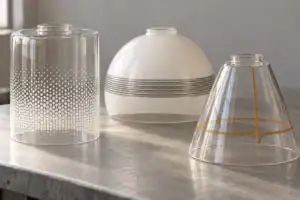
To measure a replacement glass shade for a lawn light, take three dimensions using digital calipers: fitter inner diameter (the collar opening that seats on the holder ring), maximum globe width, and shade height. Fitter diameter is the only measurement that determines whether the shade physically fits the fixture.
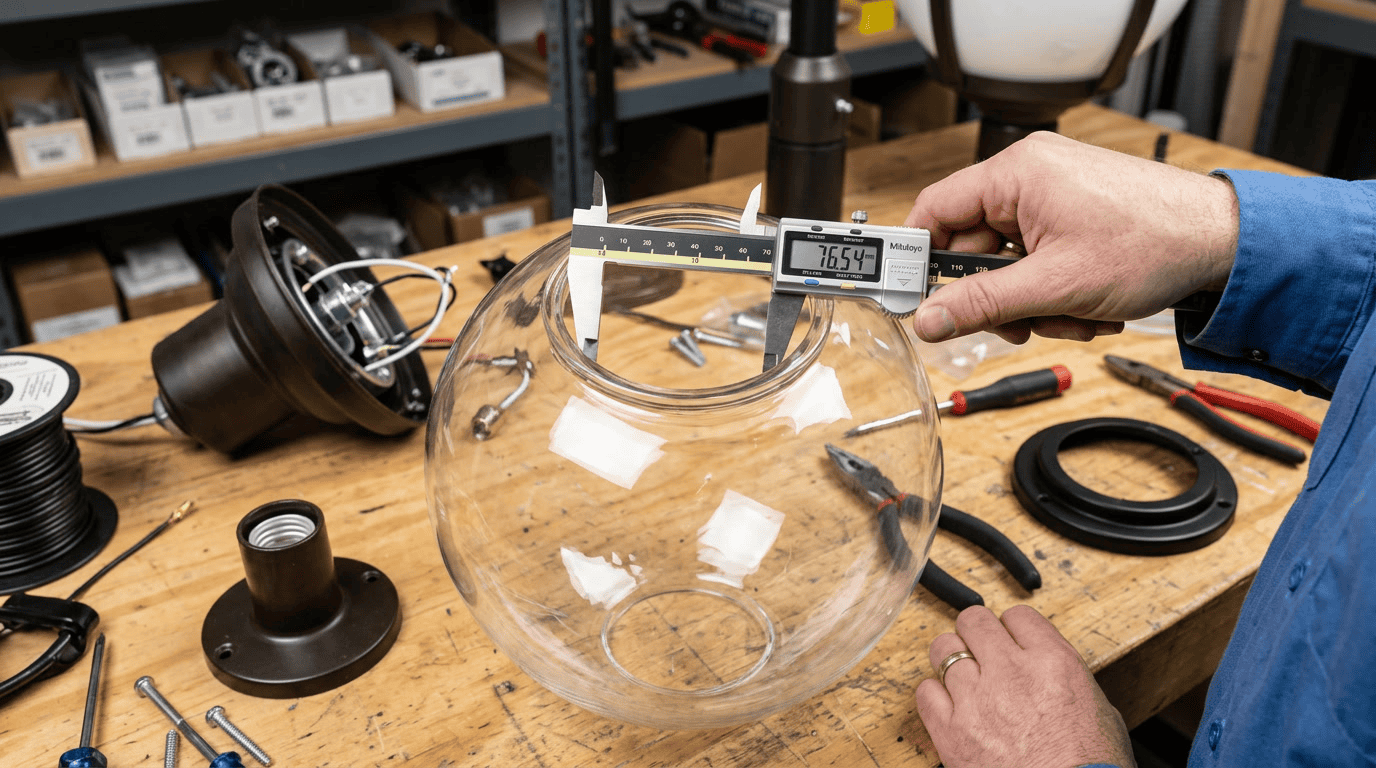
The wrong measurement is the most common reason a replacement glass shade for a lawn light fails to fit. Not the wrong style, not the wrong color — the wrong measurement. Usually, the buyer measured the outside of the broken shade’s collar rather than the inside. Or used a flexible tape measure that curved slightly across the opening and gave a chord reading instead of the true diameter. Either error produces a shade that won’t seat on the holder ring.
Measuring correctly for a replacement glass shade for a lawn light requires three specific dimensions, each measured with the right tool at the right reference point. This guide covers all three, plus how to measure when the original shade is already gone, which is the situation that catches most buyers off guard.
Why Lawn Light Glass Shade Measurement Is Different
Post-top lawn light fixtures have tighter fitter tolerances than many indoor or porch fixtures. The holder ring on a post-top fixture is designed to grip the glass collar firmly enough that the shade doesn’t rattle in wind or vibrate when a vehicle passes nearby — typical conditions that porch and wall fixtures don’t encounter. That grip depends on a precise fitter match.
A shade that is 2–3 mm undersized in fitter diameter will pass through the holder ring instead of seating on it. A shade that is 2–3 mm oversized will not seat at all. The tolerance window for a functional fit on a post-top holder ring is typically ±1.5 mm from the standard fitter size. Flexible tape measurements and eyeball estimates are not accurate enough to work reliably within that window.
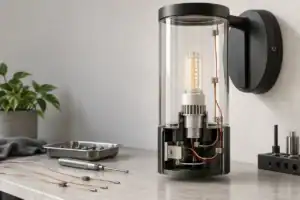
Additionally, lawn light post-top fixtures often have enclosed housings where the shade must also fit within the housing geometry — creating height constraints that open-frame porch fixtures don’t have.
The Three Measurements You Need
Measurement 1: Fitter Inner Diameter (Critical)
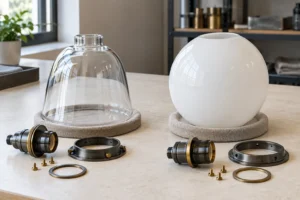
The fitter is the glass collar at the top of the shade — the circular opening that contacts the fixture’s holder ring. Fitter inner diameter is measured across the inside of this opening: from the inner edge of the glass on one side to the inner edge directly opposite.
Why it’s critical: this is the only measurement that determines whether the shade seats on the fixture. Globe diameter and height affect visual proportion and enclosed-fixture clearance, but fitter diameter determines physical fit.
How to measure:
1. Hold the shade with the collar opening facing up
2. Open digital calipers and place the measuring faces inside the collar opening
3. Expand until each face contacts the inner glass wall on opposite sides
4. Read the measurement — this is your fitter inner diameter
Standard fitter sizes for residential lawn post-top lights:
– 2¼ inch (57 mm) — compact post fixtures, jelly jar pathway shades
– 4 inch (102 mm) — standard residential post globes (most common for 8–10 inch globes)
– 6 inch (152 mm) — large globe post lights, commercial pathway fixtures
If your measurement falls between two standard sizes, round to the closest standard. If it falls exactly at a standard size, that is your fitter size.
Never use a flexible tape measure for fitter diameter. A flexible tape bends slightly at the curve of the collar, measuring a chord rather than the true diameter — typically 2–5 mm shorter than the actual diameter depending on the collar diameter and how much the tape bends. A 2 mm error on a 4-inch fitter is enough to give you a shade that won’t seat.
Measurement 2: Globe Diameter (Maximum Width)
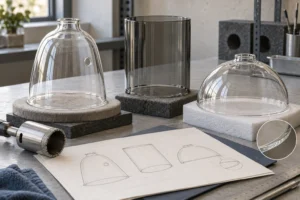
Globe diameter is the widest horizontal measurement across the shade body — not at the collar, but at the broadest point of the globe. On a true sphere, this is the equatorial diameter. On a lantern or non-spherical shade, it is the maximum width at any point.
Why it matters: Globe diameter does not affect whether the shade fits the fixture, but it determines visual proportion and — for enclosed post-top housings — whether the shade physically clears the housing interior walls.
How to measure:
1. Hold the shade at the widest point
2. Measure across the outside of the glass from one side to the other at the maximum width
3. Record this as the globe diameter (outer measurement is standard for this dimension)
For matching a replacement to an existing set: the globe diameter must match the survivors within ±5 mm to maintain consistent visual proportion in a row of post lights.
Measurement 3: Shade Height
Shade height is measured from the base of the fitter collar lip (the point where it contacts the holder ring) to the lowest point of the shade.
Why it matters: For enclosed post-top fixtures, height determines whether the shade fits within the housing. For open-frame fixtures, height is a proportion decision.
How to measure:
1. Stand the shade upright on a flat surface with the fitter collar at the top
2. Measure from the top of the shade body (just below the fitter collar lip) to the bottom of the globe
3. For enclosed fixtures: also measure the clearance inside the fixture housing before ordering
How to Measure When the Original Shade Is Missing
This is the scenario that causes the most ordering errors. The original shade broke and was discarded, leaving only the bare fixture. Three sources of measurement data are available:
Source 1: The Holder Ring (Most Reliable for Fitter Size)
The holder ring on the fixture is the best source for the critical fitter dimension. The inner diameter of the holder ring equals the fitter inner diameter of the correct replacement shade.
To measure:
1. Remove any set screws or clips that are part of the holder ring mechanism
2. With the ring in place on the fixture, or removed if easily detachable, measure the inner clear span of the ring using digital calipers
3. Compare to standard fitter sizes (2¼, 4, 6 inch)
This measurement is the fitter size you need. It is reliable because the holder ring was manufactured to accept a specific standard fitter size — there is no ambiguity from glass wall thickness or collar wear that can affect shade measurement.
Source 2: Fixture Documentation
Check whether the fixture has a model number stamped inside the housing or on a label at the base of the post. With the model number, search the manufacturer’s website or contact them directly — most residential fixture manufacturers document the replacement shade specification including fitter size and globe diameter.
This approach is particularly useful when the shade is enclosed within a housing where measuring the holder ring is difficult without partial disassembly.
Source 3: Visual Estimate from Surviving Fixtures
If multiple fixtures were installed as a set and some are intact, measure one of the surviving shades instead of trying to work from the bare fixture. Use the three-measurement method on an intact surviving shade to confirm the specification before ordering quantity replacements.
Common Measurement Mistakes for Lawn Light Glass Shades
Understanding the mistakes is as useful as knowing the correct method — because the mistakes are remarkably consistent.
Mistake 1: Measuring the Outside of the Fitter Collar
The outside diameter of the fitter collar is not the fitter size. The fitter size is measured inside the collar opening. The collar has a wall thickness of typically 5–8 mm, so measuring outside-to-outside gives a fitter reading that is 10–16 mm larger than the actual specification. This almost always results in ordering a shade that is too large.
Mistake 2: Using a Flexible Tape Measure
Already covered above, but worth emphasizing: a 2–5 mm error from tape measure flex is enough to order the wrong size. Digital calipers cost $10–15 at any hardware store and eliminate this error entirely. One correct measurement more than pays for the tool.
Mistake 3: Measuring the Maximum Collar Diameter (For Ribbed Collars)
Some glass shades have ribbed or flanged fitter collars where the outermost diameter of the collar is wider than the seating surface that contacts the holder ring. For these shades, measure the inside of the opening — not the outer flange. The flange is decorative trim that sits above the holder ring; it does not determine fit.
Mistake 4: Not Measuring Height for Enclosed Fixtures
Open-frame post-top fixtures are relatively forgiving on height — the shade simply extends below the fixture housing. Enclosed fixtures, where the shade is captive inside a housing, require a height measurement before ordering. A shade 15 mm too tall will prevent the housing from closing; a shade 20 mm too short will leave a visible gap.
Mistake 5: Assuming the Globe Diameter Equals the Fitter Size
A 10-inch globe shade and a 12-inch globe shade can both have a 4-inch fitter. Globe diameter and fitter diameter are independent measurements. Ordering by globe size and assuming the fitter size will match is the reason most “wrong size” returns happen on online glass shade orders.
Step-by-Step Measuring Guide for Lawn Post-Top Glass Shades
A complete measurement for a replacement lawn light glass shade in order:
Tools needed:
– Digital calipers (6-inch capacity sufficient for most standard sizes)
– Flexible ruler or tape measure (for globe diameter and height only — never for fitter diameter)
– Notepad
Step 1: Fitter inner diameter
Using digital calipers: measure inside the collar opening, across to the opposite inner wall. Record in mm and inches. Compare to 57 mm (2¼”), 102 mm (4″), 152 mm (6″). Note the closest standard.
Step 2: Collar lip depth (for gasketed fixtures)
Some enclosed post-top fixtures have a gasketed seat that requires the fitter collar to have a specific lip depth (the depth of the collar below the outer flange) to engage the seal. Measure the depth of the collar section that extends into the holder ring — typically 8–15 mm. Confirm with the replacement shade spec that the collar geometry matches.
Step 3: Globe maximum diameter
Using a ruler across the widest point of the globe: record the outer diameter. For spherical globes, this is straightforward. For lantern or oval shapes, take the measurement at the widest horizontal point.
Step 4: Shade height
Measure from the fitter collar lip base to the lowest point of the shade. For globes, this is typically the bottom of the sphere. For cylinder and jelly jar shapes, it is the flat or rounded base.
Step 5: Document and compare
Write down: fitter inner diameter, globe diameter, shade height. If you have a surviving shade from the same set, compare all three measurements. For replacement ordering, fitter inner diameter must match exactly; globe diameter and height should match within ±5–10 mm.
Per the Illuminating Engineering Society’s outdoor fixture maintenance standards, fixture globe replacement that maintains the original geometry (fitter size, globe diameter, height) preserves the photometric distribution of the original installation — important for pathway lighting that was designed to specific lux targets.
Lawn Light Fitter Size Quick Reference
The three standard fitter sizes cover nearly all residential and light-commercial post-top lawn lights:
| Fitter Size | Inner Diameter | Globe Range | Typical Post-Top Style |
|---|---|---|---|
| 2¼ inch | 57 mm | 5–7 inch globe | Compact vintage, jelly jar path lights |
| 4 inch | 102 mm | 8–12 inch globe | Standard residential post-top (most common) |
| 6 inch | 152 mm | 12–16 inch globe | Large commercial post-top, estate lighting |
If your caliper measurement falls between these standard sizes, the fixture uses a non-standard fitter. In this case, contact the fixture manufacturer with the caliper reading — some manufacturers use proprietary fitter sizes for specific fixture series.
According to the NEMA standards for outdoor luminaire hardware, post-top fixture holder rings in residential applications are manufactured to standard fitter tolerances of ±0.5 mm, which is why the measurement precision of digital calipers (±0.02 mm) is more than adequate for this application.
Measuring for a Matched Replacement in a Set
The measurement challenge is compounded when replacing one shade in a set of 4–8 identical lawn light fixtures. The goal is an exact visual match — same globe diameter, same glass opacity, same height, and same glass clarity characteristics. Measurement alone is not sufficient: you also need to confirm the glass type (borosilicate vs. soda-lime) and opacity (frosted, clear, seeded) match the surviving units.
Per the ASTM C1048 standard for heat-treated glass specification, glass products should be ordered by specifying both the glass type and the heat treatment classification — not just by size. When ordering a single replacement shade for a matched set, provide the manufacturer with the glass type of the original if known.
Checklist for matched replacement orders:
– Fitter inner diameter (from caliper measurement) ✓
– Globe outer diameter ✓
– Shade height ✓
– Glass type (borosilicate / heat-tempered / annealed) ✓
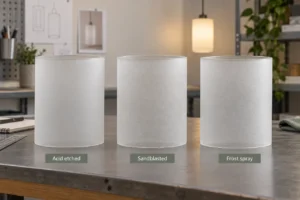
– Glass opacity (clear / frosted / seeded / amber) ✓
– Collar type (plain / ribbed / flanged) ✓
– Set screw count (confirms holder ring compatibility) — 2 or 3 screws typical
Frequently Asked Questions
How to measure replacement glass shade for a lawn light?
Measure three dimensions using digital calipers: (1) fitter inner diameter — inside the collar opening, across to the opposite wall; (2) globe maximum diameter — at the widest point; (3) shade height — from fitter collar lip base to lowest point of shade. Fitter inner diameter is the critical dimension that determines fit. Standard sizes are 2¼ inch, 4 inch, and 6 inch.
How to measure for a replacement lampshade?
For a lawn post-top replacement lampshade, measure inside the fitter collar opening for the fitter diameter (never outside). For the globe body, measure at the widest horizontal point. For height, measure from where the collar sits on the holder ring to the lowest point of the shade. Use digital calipers for fitter diameter — flexible tape measures give inaccurate results on curved collar openings.
How do you know what size light shade to buy?
Match the fitter inner diameter exactly to your existing shade or holder ring measurement. The fitter size (2¼, 4, or 6 inch standard) must match precisely for the shade to seat. Globe diameter and height are proportional preferences — match the original within ±5 mm for visual consistency. If you have no original shade, measure the inner diameter of the holder ring on the fixture.
Can I measure a glass shade with a ruler instead of calipers?
A rigid ruler can give an accurate fitter inner diameter measurement if held perfectly flat across the opening. The risk is maintaining perpendicular contact with both glass walls — any tilt produces a shorter chord measurement. Digital calipers are faster, more repeatable, and reliable to ±0.02 mm. For a $10–15 investment, calipers eliminate the most common source of wrong-size replacement orders.
What if the original shade is broken and I can’t measure it?
Measure the inner diameter of the holder ring on the fixture — this gives the fitter size directly. For globe diameter and height, check the fixture manufacturer’s documentation using the model number, or use the surviving shades in other fixtures of the same set as the measurement reference.
Does shade height matter for lawn light replacement?
Yes, particularly for enclosed post-top fixtures where the shade sits inside a housing that also contains the socket arm. Measure the internal clearance from the holder ring seat to the top of the lamp socket before ordering. For open-frame post lights, height is primarily a visual proportion decision — match the original within ±10 mm for best results.
What is the difference between fitter size and globe size?
Fitter size is the inner diameter of the glass collar — the measurement that determines whether the shade fits the fixture. Globe size is the maximum outer width of the shade body — a visual proportion measurement that does not affect fit. A 10-inch globe and a 12-inch globe can share the same 4-inch fitter size. Never assume globe size predicts fitter size.
Conclusion
Measuring a replacement glass shade for a lawn light correctly requires three dimensions taken at the right reference points with the right tools. Fitter inner diameter taken with digital calipers — not a flexible tape, not the outside of the collar — is the measurement that determines fit. Globe diameter and height confirm visual match and enclosed-fixture clearance.
When the original shade is missing, the holder ring inner diameter gives the critical fitter measurement directly. Everything else can be confirmed from fixture documentation or surviving units in the same set.
One accurate set of measurements before ordering avoids the return cycle that makes glass shade replacement feel more complicated than it is. For glass lampshade specifications, standard fitter sizing, and replacement globe sourcing for post-top and bollard lawn light applications, our product line at jxlampshade.com provides the full range of standard fitter sizes with documented glass construction.