
Da Areia ao Esplendor: A Jornada Completa da Fabricação Artesanal de Abajures de Vidro em 2026
Behind every exquisite glass lamp shade illuminating homes, hotels, and offices worldwide lies a fascinating journey of transformation—one that spans millennia of human innovation and cutting-edge 21st-century technology. The production of premium glass lighting elements involves over 47 distinct processes, each requiring precision, patience, and profound material understanding.
Chapter 1: Raw Materials – The Foundation of Brilliance
1.1 Sourcing High-Purity Silica Sand The journey begins in unexpected places: ancient riverbeds, quarried sandstone deposits, and even recycled glass cullet. Premium lamp shade manufacturing demands silica sand with 99.5%+ purity—free from iron oxides that would tint the glass green or brown unless specifically desired. Global Sourcing Networks: Ottawa, Illinois, USA: Renowned for exceptionally pure “Ottawa White” sand with minimal contaminants Sibelco Mines, Belgium: European standard for optical-grade glass sand Jiangsu Province, China: Emerging source for Asian manufacturing with rigorous quality control Recycled Glass Programs: Post-consumer cullet reducing virgin material requirements by up to 85% “The sand selection determines everything,” explains Dr. Hans Weber, Chief Materials Scientist at Bavarian Glass Works. “Iron content above 0.1% creates unacceptable coloration for clear shades. We test every batch with X-ray fluorescence spectroscopy before acceptance.”
1.2 Fluxes, Stabilizers, and Colorants Pure silica melts at 3,111°F—impractical for conventional furnaces. Ancient glassmakers discovered that adding fluxes dramatically reduces melting temperatures while improving workability。
1.3 Batch Preparation and Quality Control Raw materials are precisely weighed and mixed in computer-controlled batch plants: Automated Dosing: ±0.1% accuracy for 50+ component recipes Homogeneous Mixing: 30-minute intensive blending ensuring uniform distribution Moisture Control: Critical 4-6% water content for proper melting behavior Contamination Prevention: Dedicated silos and conveyors for each color family Batch Tracing: Blockchain-enabled tracking from mine to finished product “One contaminated batch can ruin a week’s production,” notes Maria Santos, Production Director at Lisbon Glass Collective. “Our spectroscopic analysis checks 47 parameters before any material enters the furnace.”
Chapter 2: The Melting Process – Where Science Meets Fire
2.1 Furnace Technology Evolution
The heart of any glass operation is the melting furnace—evolving from wood-fired medieval structures to today’s sophisticated systems:
Traditional Regenerative Furnaces:
Natural gas or fuel oil combustion
Heat recovery through checkerboard regenerators
50-100 ton daily capacity
10-15 year campaign life before rebuild
Electric Melting Systems:
100% renewable energy compatible
Zero direct emissions
Precise temperature control (±5°F)
Emerging as sustainability standard
Hybrid Oxy-Fuel Technology:
Oxygen-enriched combustion reducing fuel consumption 20%
Lower nitrogen oxide emissions
Enhanced glass quality through reduced bubbling
2.2 The Five Stages of Glass Melting
Stage 1: Silicate Formation (1,200-1,500°F)
Sand particles begin reacting with soda ash, forming initial glassy compounds. Batch transforms from granular to pasty consistency.
Stage 2: Glass Melting (1,500-2,200°F)
Complete dissolution of remaining sand particles. Vigorous bubbling as carbon dioxide and water vapor escape. Raw glass appears as thick, honey-like liquid.
Stage 3: Fining (2,200-2,600°F)
Extended high-temperature holding allowing trapped bubbles to rise and escape. Critical for optical clarity—remaining bubbles become defects in finished shades.
Stage 4: Homogenization
Mechanical stirring and thermal convection eliminating chemical striations. Ensures uniform refractive index throughout glass mass.
Stage 5: Conditioning (1,800-2,000°F) Controlled cooling to working temperature where glass becomes thick enough to gather and shape, yet fluid enough to manipulate.
2.3 Sustainability in Melting Environmental responsibility has transformed furnace operations: Carbon Capture Integration: Post-combustion CO2 capture systems Captured carbon utilized in
enhanced oil recovery or synthetic fuel production 40-60% emission reductions in pilot facilities Waste Heat Recovery: Exhaust gases preheating batch materials Furnace radiation captured
for facility heating Overall energy efficiency improvements of 25-35% Recycled Content Maximization: External cullet (post-consumer glass) reducing virgin material 60-85% Internal recycling of
trimmings and defects approaching 100% Some manufacturers achieving “zero waste to landfill” certification
Chapter 3: Forming Techniques – The Art of Shaping Light
Glass lamp shade production employs diverse forming methods, each suited to specific design requirements and production scales.
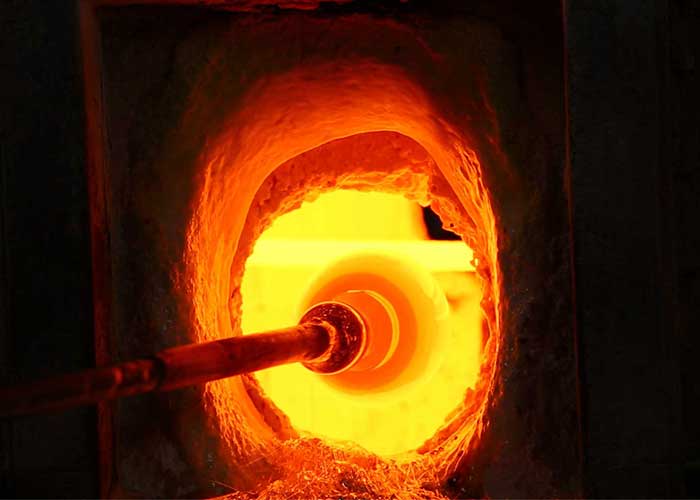
3.1 Hand-Blown Glass – The Ancient Art The most prestigious and technically demanding technique, practiced by master glassblowers with decades of training:
The Gathering Process:
Dipping: Craftsman dips blowpipe (hollow steel rod, 4-5 feet long) into molten glass furnace
1,Rolling: Gathered glass rolled on steel marver table to center and cool surface ,
2,Blowing: Initial air puff creates starter bubble
3,Reheating: Continuous furnace trips maintaining 1,800-2,000°F workability ,
4,Expansion: Controlled blowing and tool manipulation achieving desired diameter
5,Transfer: Pontil rod attached to base; blowpipe removed for opening ,
6,Finishing: Final shaping, rim creation, and annealing preparation
3.2 Pressed Glass – Industrial Precision
For consistent, repeatable production, pressed glass dominates mid-market segments:
The Pressing Process:
Gob Delivery: Precisely measured glass chunk (gob) dropped into mold Plunger
Descent: Metal ram forces glass into mold cavity
Pattern Transfer: Mold texture imprints onto glass surface
Cooling: Controlled temperature reduction preventing thermal shock
Ejection: Automated removal of formed shade
Trimming: Removal of excess flash material
Mold Technology:
Cast Iron: Traditional, durable, excellent pattern detail
Ductile Iron: Improved thermal conductivity, faster cycle times
Ceramic-Coated: Superior surface finish, reduced sticking
3D-Printed Sand: Rapid prototyping for custom designs
3.3 Heat-Slumped (Kiln-Formed)
Glass – Architectural Curves For curved, shield-like profiles impossible through blowing or pressing:
The Slumping Process:
Blank Preparation: Flat glass cut to oversized pattern
Mold Loading: Positioned over ceramic or stainless steel form
Kiln Firing: Gradual heating to 1,200-1,400°F softening point
Gravity Forming: Glass drapes over mold under own weight
Recozimento: Slow cooling preventing stress buildup
Finishing: Edge grinding and polishing
Advanced Techniques:
Drop-Out: Central hole creation through controlled
sagging Draping Over Positive Molds: Exterior texture transfer
Slumping Into Negative Molds: Interior detail precision
Multiple Firings: Complex forms requiring sequential shaping
The Slumping Process:
Blank Preparation: Flat glass cut to oversized pattern
Mold Loading: Positioned over ceramic or stainless steel form
Kiln Firing: Gradual heating to 1,200-1,400°F softening point
Gravity Forming: Glass drapes over mold under own weight
Recozimento: Slow cooling preventing stress buildup
Finishing: Edge grinding and polishing
Advanced Techniques:
Drop-Out: Central hole creation through controlled
sagging Draping Over Positive Molds: Exterior texture transfer
Slumping Into Negative Molds: Interior detail precision
Multiple Firings: Complex forms requiring sequential shaping
Chapter 4: Surface Treatment – Texture, Color, and Finish
4.1 Hot-End Decorating Applied while glass remains hot and malleable:
Frit Application: Crushed colored glass powder sprinkled on surface Fuses into permanent, durable coating Gradient and pattern effects possible
Threading and Trailing: Thin glass threads applied in decorative patterns Swirled, feathered, or geometric designs Requires exceptional hand coordination
Prismatic Pressing: Mold-integrated optical patterns Fresnel-inspired rings for light amplification Geometric facets for refraction effects
Conclusion: The Future of Glass Lamp Shade Manufacturing
The production of glass lamp shades represents humanity’s remarkable capacity to transform abundant natural materials into objects of enduring beauty and function. From the 3,000°F furnaces where sand becomes liquid light to the careful hands that coax it into form, every stage embodies both ancient wisdom and modern innovation. As we look toward the future, several trajectories emerge with clarity: Sustainability as Standard: The carbon-intensive reputation of glass manufacturing is being systematically dismantled through electrification, recycling, and circular design. Within this decade, carbon-neutral glass shades will transition from premium niche to market expectation. Technology as Enabler: Rather than replacing craftspeople, automation and AI are amplifying human capabilities—allowing masters to focus on creative decisions while machines handle repetition and precision. The result is higher quality, greater consistency, and preserved artisan employment. Transparency as Trust: Consumers increasingly demand visibility into production processes. Blockchain-tracked supply chains, live-streamed factory tours, and detailed environmental reporting will become competitive necessities rather than marketing differentiators. Customization as Norm: Economies of scale once demanded mass production of identical items. Flexible manufacturing now enables economically viable production of single pieces or small batches, democratizing custom lighting for broader markets.
Processo de Fabricação de Cúpulas de Vidro em Nossa Fábrica
Da seleção do vidro bruto ao acabamento de precisão, controlamos cada etapa para entregar cúpulas de vidro consistentes e de alta qualidade.
·Fabricante profissional de cúpulas de vidro com capacidade de produção completa
·Forno próprio, moldagem, recozimento e linhas de acabamento internas
·Adequado para soluções OEM, ODM e projetos personalizados de cúpulas de vidro
Nosso processo totalmente integrado de fabricação de cúpulas de vidro nos permite oferecer qualidade estável, personalização flexível e prazos de entrega confiáveis para clientes globais.
Perguntas Frequentes Técnicas sobre Abajur de Vidro Soprados à Boca
MOQ de vidro opalino/clear: 100~300 PCS. .
MOQ de vidro colorido: 500~1000 PCS
Um abajur de vidro soprado à boca é uma sombra de iluminação feita por artesãos usando técnicas tradicionais de sopro de vidro. Os artesãos moldam o vidro fundido soprando ar nele, criando formas únicas, texturas e variações sutis. Cada peça é feita à mão, tornando cada abajur único, combinando beleza artística e função prática de iluminação.
Abajures de vidro soprado à boca geralmente podem suportar lâmpadas padrão, mas não lâmpadas de alta potência. Recomendamos o uso de lâmpadas LED ou de baixo consumo dentro da potência segura para evitar superaquecimento e danos.
2-3 semanas após o recebimento do arquivo de desenho. .