
Identification and replacement guide
Queen Anne No. 2 Oil Lamp: Parts, Chimney Fit, and Replacement Guide
A Queen Anne No. 2 oil lamp is usually identified by its burner family, but the burner name alone does not prove that a replacement chimney or globe will fit. Check the collar, wick system, chimney fitter, gallery, outer shade holder, and the profile of the glass before ordering.
This guide separates the parts, explains what “No. 2” can and cannot tell you, and gives dealers, restorers, importers, and lighting brands a practical evidence pack for replacement or custom glass review.
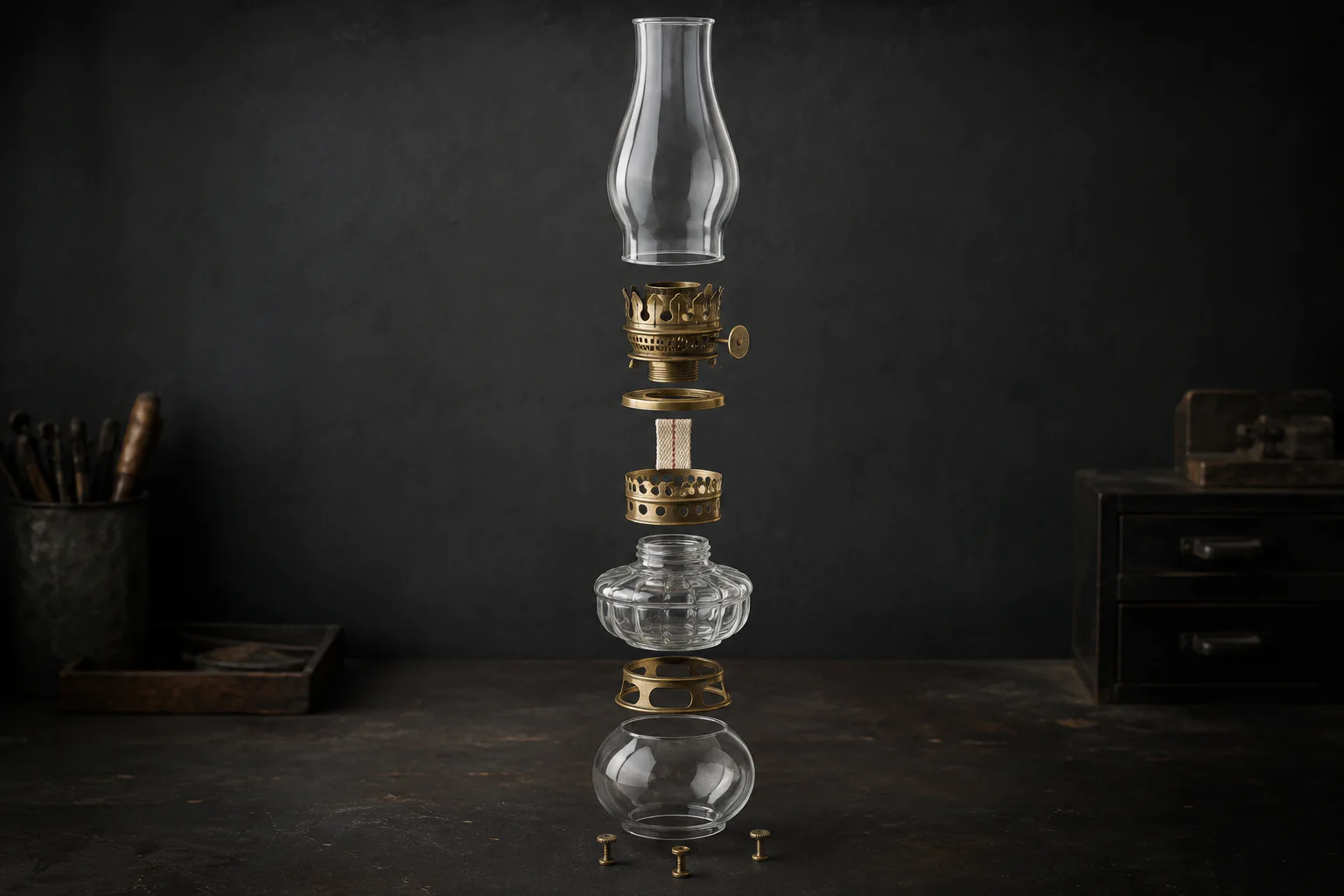
Direct component answer
Queen Anne No. 2 Oil Lamp at a Glance
The phrase is used in two related ways. A collector may use it to identify a style or burner family. A parts buyer may use it to look for a No. 2 burner, chimney, collar, wick, or glass globe. Those are different decisions.
Use the name to start the search, then match the actual interface. The short rule is: match the interface first, then match the profile and finish.
- Identify the burner and collar.
- Separate the chimney from the outer globe or shade.
- Measure the fitter, seat, height, bulge, and holder.
- Send photographs, a drawing, and a sample or fragment for repeat sourcing.
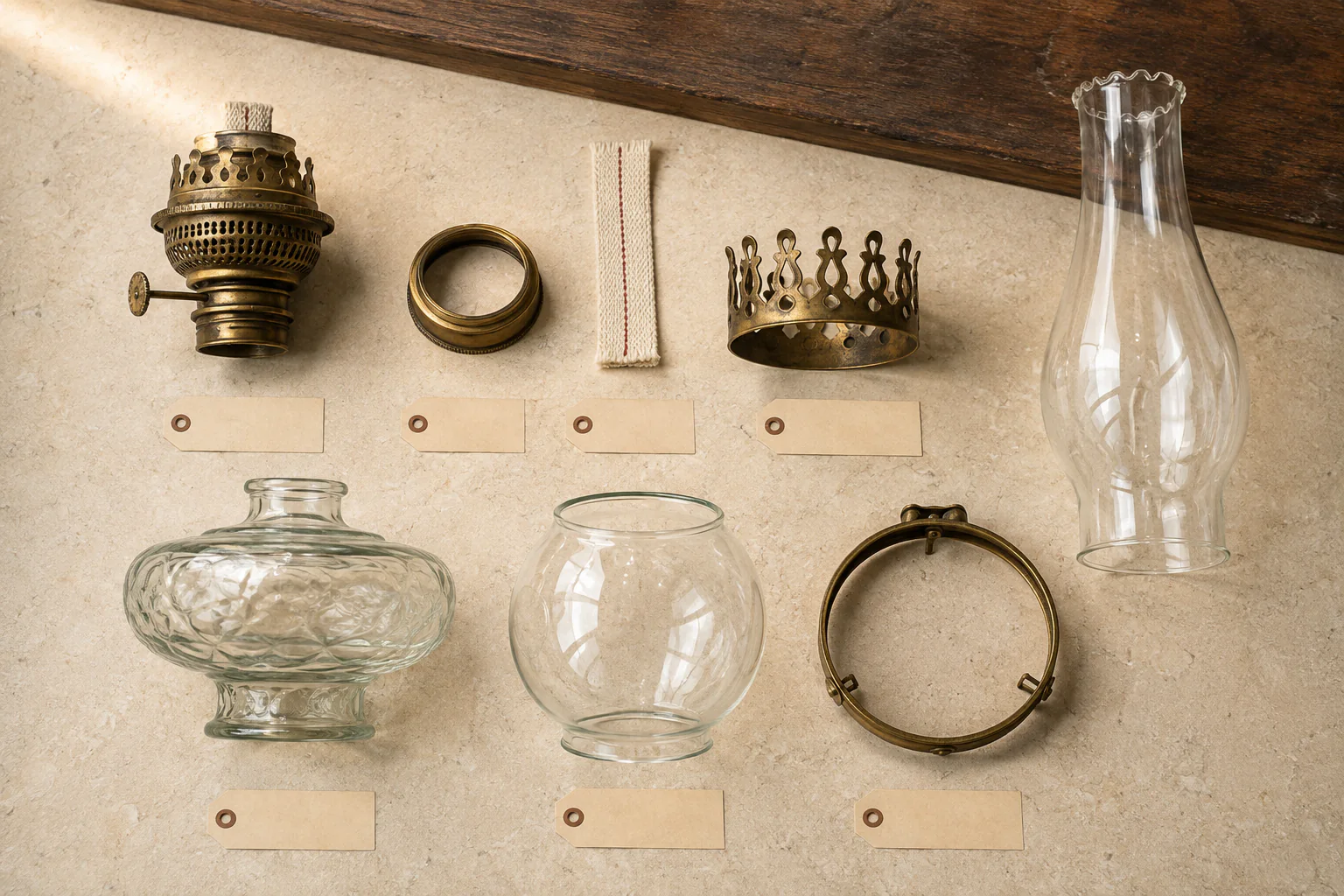
What the size label can tell you
What “No. 2” Means and What It Does Not
No. 2 is commonly treated as a burner size or family label. One restoration catalog, for example, lists a Queen Anne No. 2 burner with a 1-3/16-inch base for a No. 2 collar and a 3-inch base-diameter chimney. The same catalog lists a No. 2 collar with a 1-3/16-inch inside diameter at the top.
Those are useful reference values for that parts system, not a universal specification. Old lamps may contain a replacement burner, a later collar, a reproduction chimney, or an outer shade added after manufacture. A lamp marked Queen Anne No. 2 can therefore need a different measurement path from another lamp with the same listing name.
- No. 2 does not guarantee the thread used by every maker.
- No. 2 does not guarantee chimney height, bulge, or top rim.
- No. 2 does not prove that a modern burner fits an old collar.
- No. 2 does not establish the date, value, or maker of the complete lamp.
Treat the label as a search term. Treat the metal and glass interfaces as the specification.
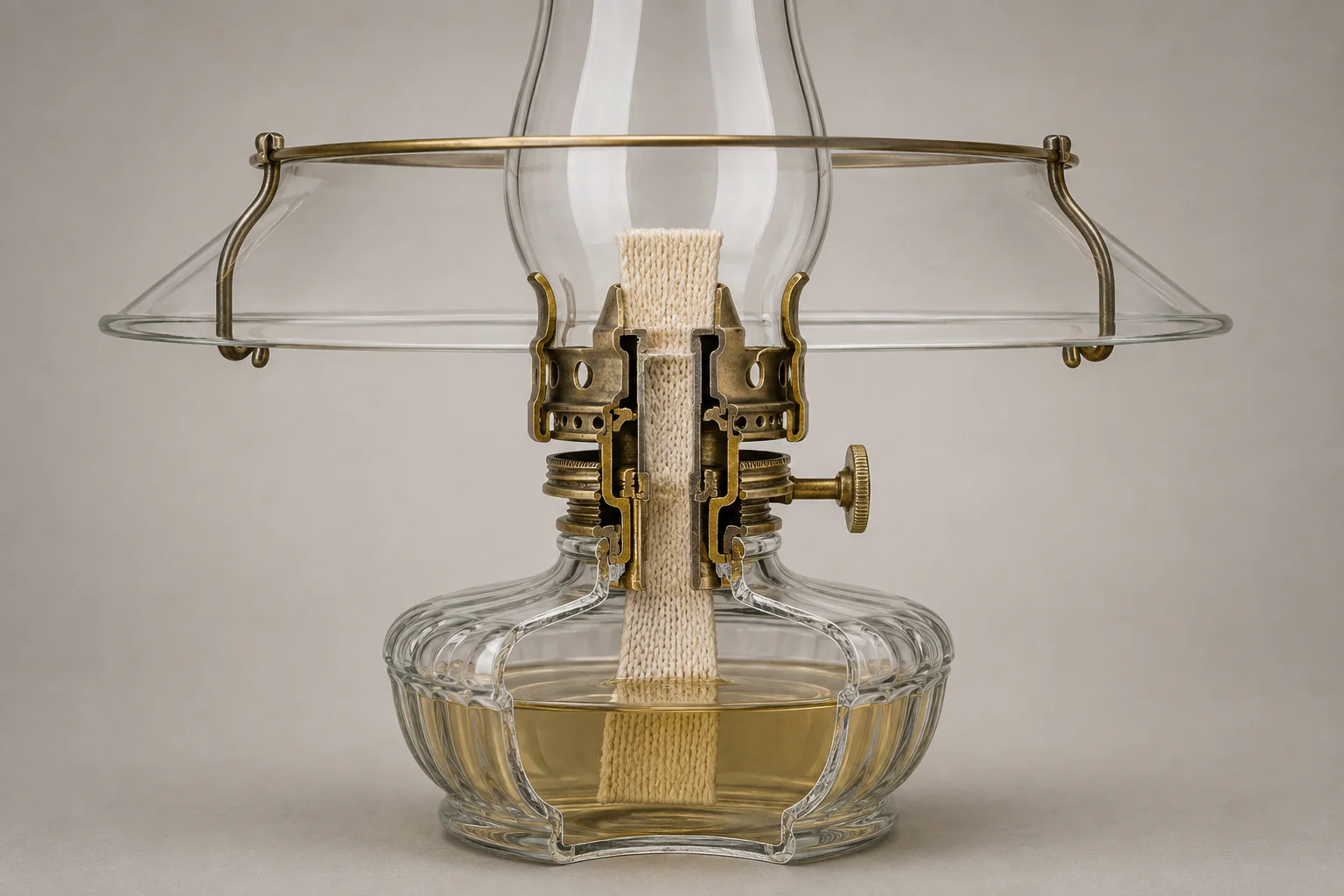
Fuel path and airflow
How the Burner, Wick, and Chimney Fit Together
The burner screws into or seats on the collar at the top of the font. The wick draws fuel from the font and presents it at the burner. The wick raiser changes the exposed wick height. Above the burner, a gallery, prongs, or formed seat supports the chimney. A wider outer shade may sit on a separate ring or holder.
The chimney is part of the operating geometry. It encloses the flame and guides draft around it. A replacement can have the right-looking base but still be too short, too tall, too narrow, or too close to the wick. That can change flame position, smoke behavior, or heat clearance.
The Smithsonian object record for one oil lamp documents a Queen Anne style metal burner with a wick raiser, a side peg, and remaining feet that could hold a chimney. The example shows why the support method deserves as much attention as the opening diameter.
In other words, the glass is not a decorative tube selected independently from the burner. Check the whole assembly before approving a part.
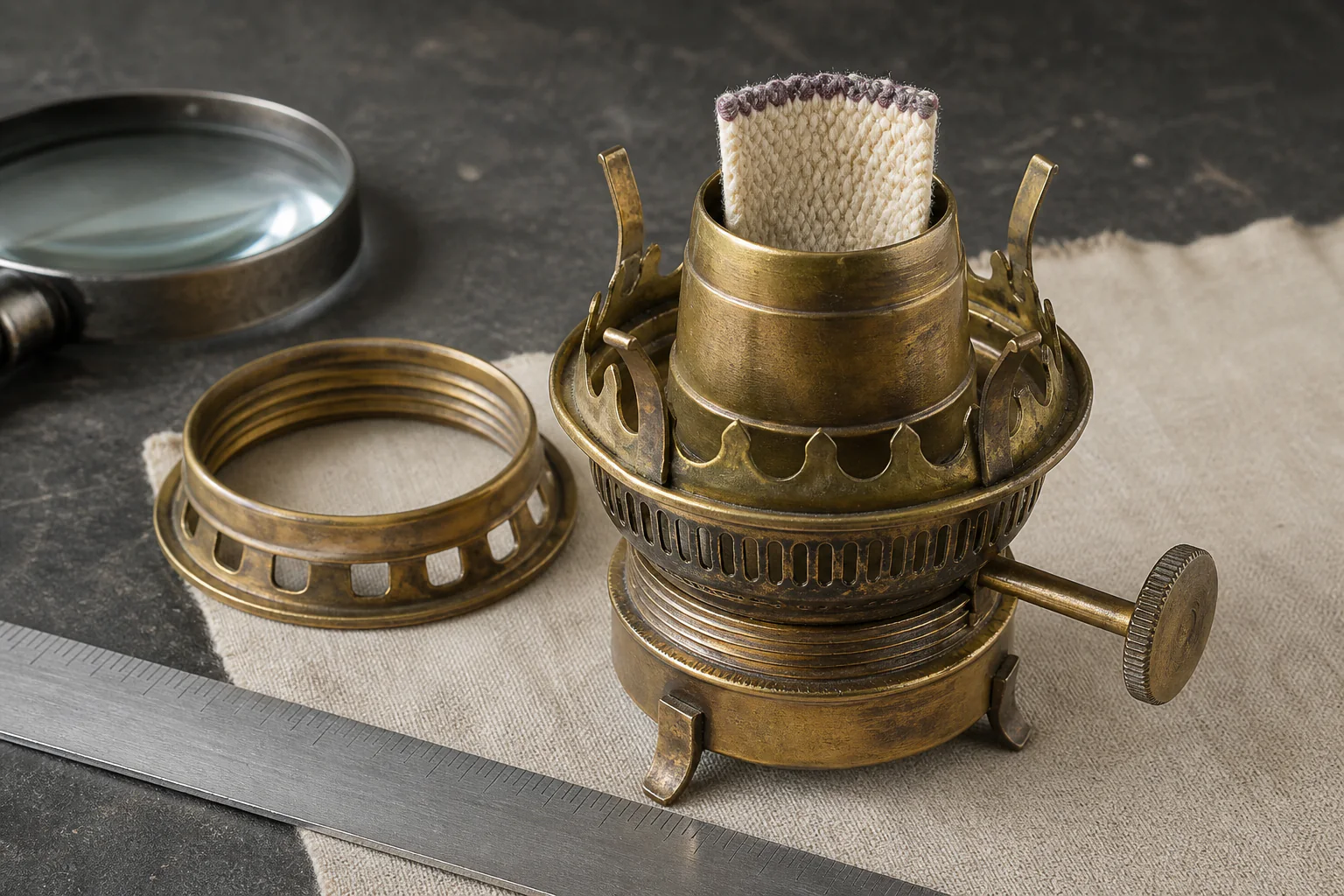
Metal interface checklist
Identify the Burner Before You Order Parts
Start at the top of the lamp and work downward. Photograph the burner from the side and above with the chimney removed. Look for a maker name, stamped mark, wick-raiser knob, threaded collar, gallery, or three or four support feet. Do not clean away a mark before photographing it.
- Record visible marks on the knob, burner, collar, font, base, or bracket.
- Note whether the wick is flat, round, or part of a center-draft system.
- Photograph how the chimney is retained: loose on a seat, held by prongs, or locked into a gallery.
- Measure the collar and burner separately. A diameter across the wrong shoulder can mislead.
- Keep the original burner, broken chimney, and loose fittings together while asking for help.
The word Queen Anne can describe a style family in a listing. It is not enough by itself to identify a specific manufacturer. If the burner starts onto the collar and then tilts or binds, stop. Partial thread engagement is not a fit confirmation.
Glass terminology buyers need
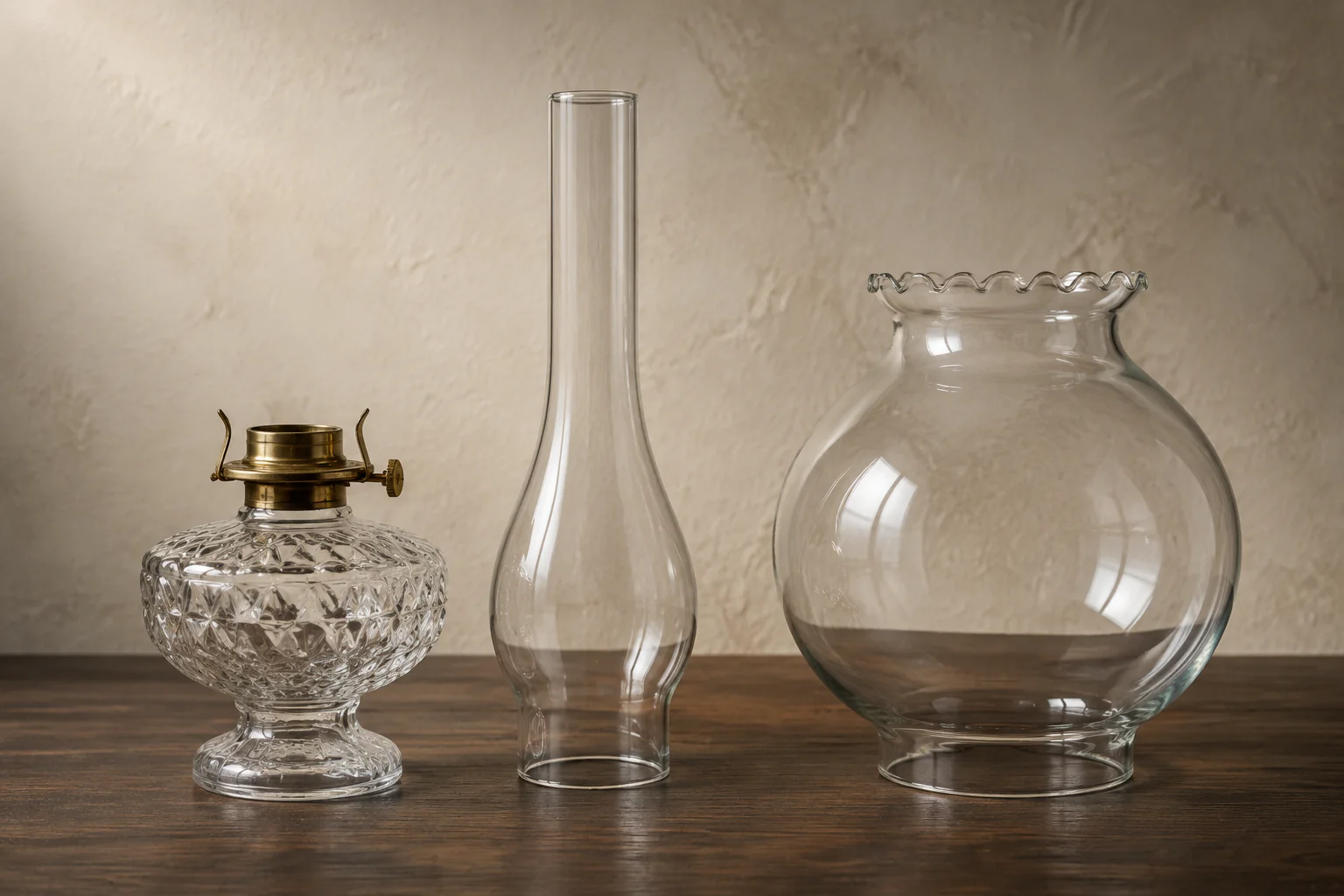
The Glass Parts Around a Queen Anne No. 2
A lamp can contain three different glass parts, and they are easy to call by the wrong name.
Font or fount
Function: Holds liquid fuel below the burner.
Check: Check the neck, collar, support, body shape, and cracks.
Chimney
Function: Surrounds the flame and participates in draft.
Check: Check the fitter, seat depth, height, bulge, shoulder, top rim, and clearance.
Outer globe or shade
Function: Diffuses light outside the chimney.
Check: Check the holder opening, ring, profile, weight, and distance from hot glass.
The narrow glass closest to the flame is normally the chimney. The wider piece outside it is usually an outer globe or shade. Sellers may use globe, chimney, hurricane, or shade differently, so the mounting point should control the request.
A missing font is a fuel-containment issue. A missing chimney is a burner and airflow issue. A missing outer shade is a holder, clearance, and visual-match issue.
The first measurement is the interface
Queen Anne No. 2 Chimney Dimensions: Start at the Fitter
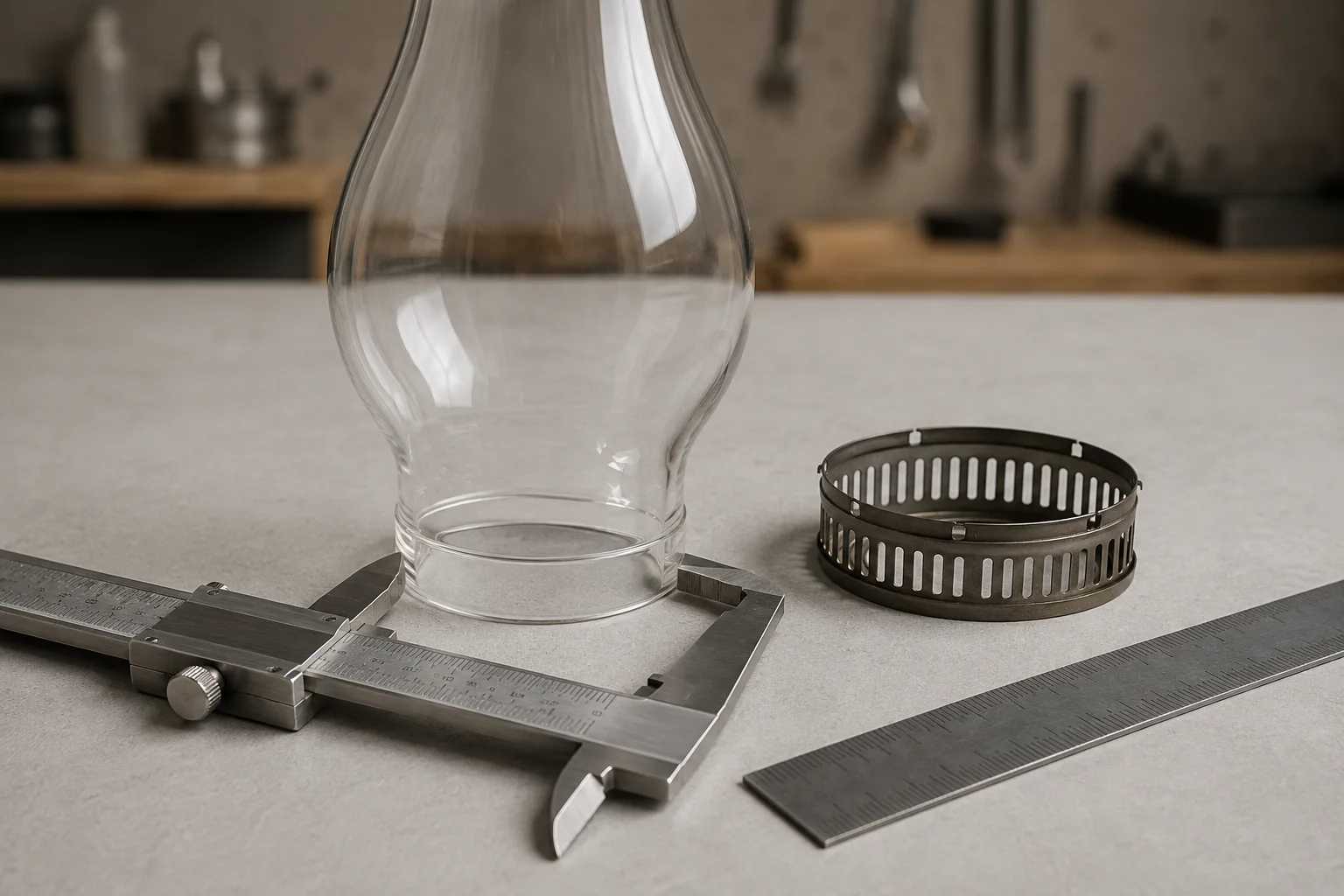
The lower fitter is the first measurement because it is the interface that sits on the burner or gallery. Record the bottom outside diameter or the dimension requested by the supplier, the seat depth, and the way the glass is retained.
Then record overall height, maximum bulge, top opening, shoulder location, and wall thickness if it can be measured safely. State whether each value is inside, outside, or centerline, and keep the unit consistent.
Published catalog examples show why the profile matters. Shenandoah Antique Restoration lists Queen Anne No. 2 examples around 10 inches high with a 3-inch base and different bulges. EAPC Glass documents a particular chimney with a 3-inch fitter, a 4.5-inch bulge, and an 8.75-inch height. These are reference shapes, not one universal pattern.
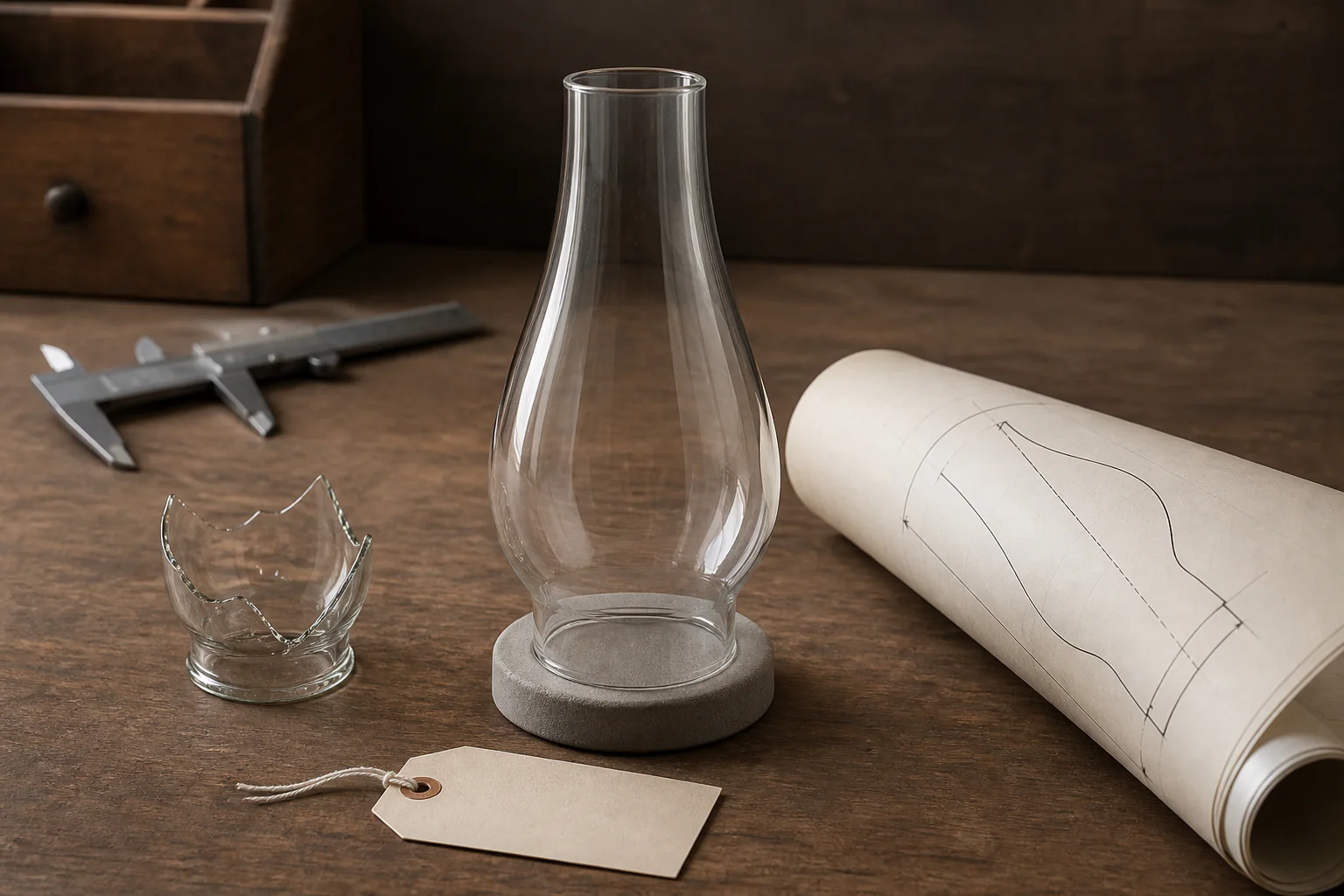
If the original is broken, save the base fragment. The fitter edge often carries the most important evidence.
Profile matching
Replacement Glass: Match the Profile, Not Just the Base
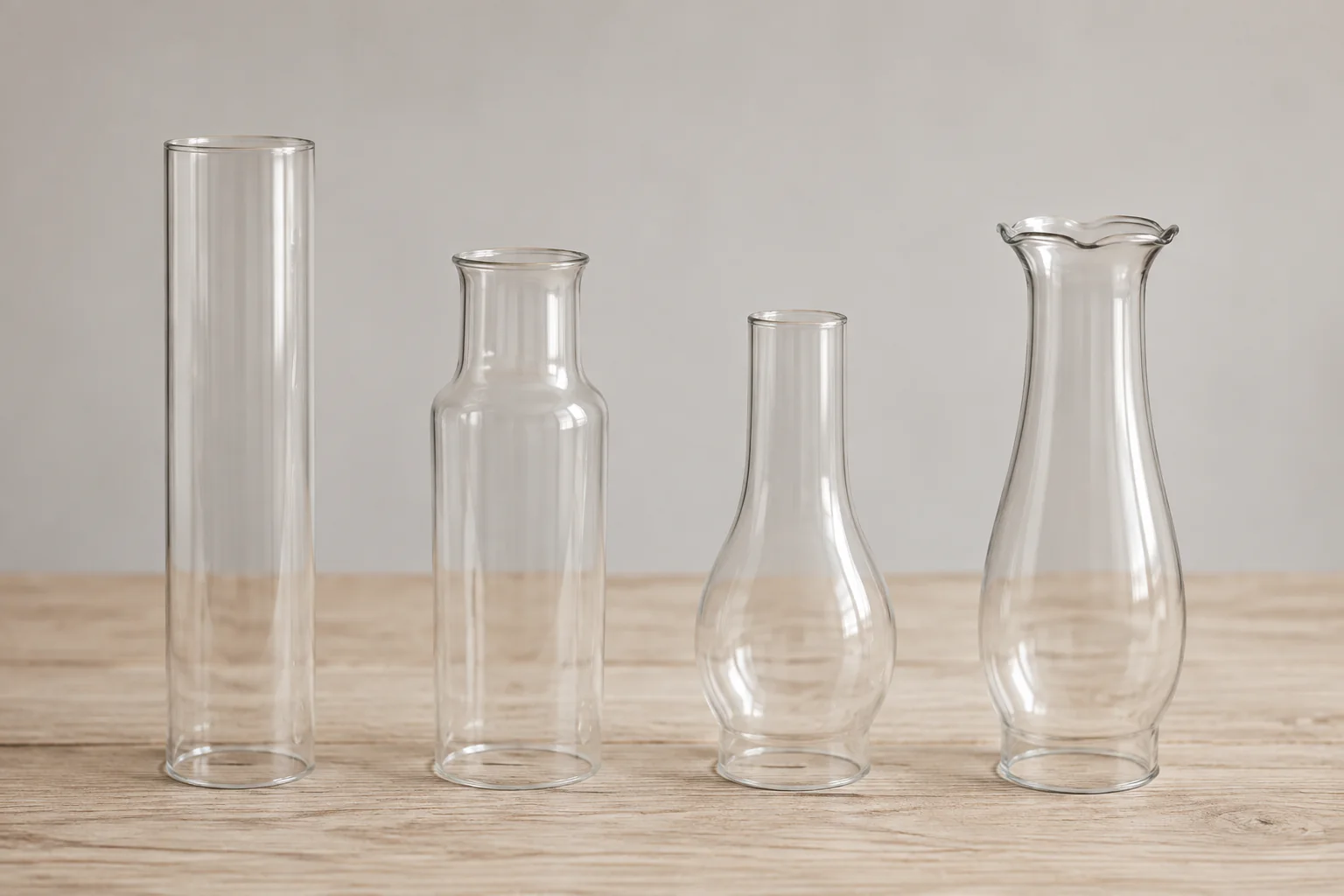
Two chimneys can share a 3-inch base and still look and perform differently. Compare overall height, maximum outside diameter and its vertical position, shoulder or flare transitions, top opening, rim treatment, finish, wall thickness, and clearance from the wick, gallery, outer shade, and nearby metal.
Use a side-profile sketch with a centerline. Mark the fitter at the bottom, the widest point, the top opening, and every change in direction. If the original shade has decoration, photograph it in soft side light. A drawing shows the silhouette, while a sample shows glass color and surface.
For a common retail repair, a documented standard reproduction may be a sensible starting point when the lamp is common and the buyer accepts a close match. For a restoration, display lamp, or repeat range, custom review is more appropriate when the original profile or finish matters.
Evidence before quotation
What to Photograph and Measure
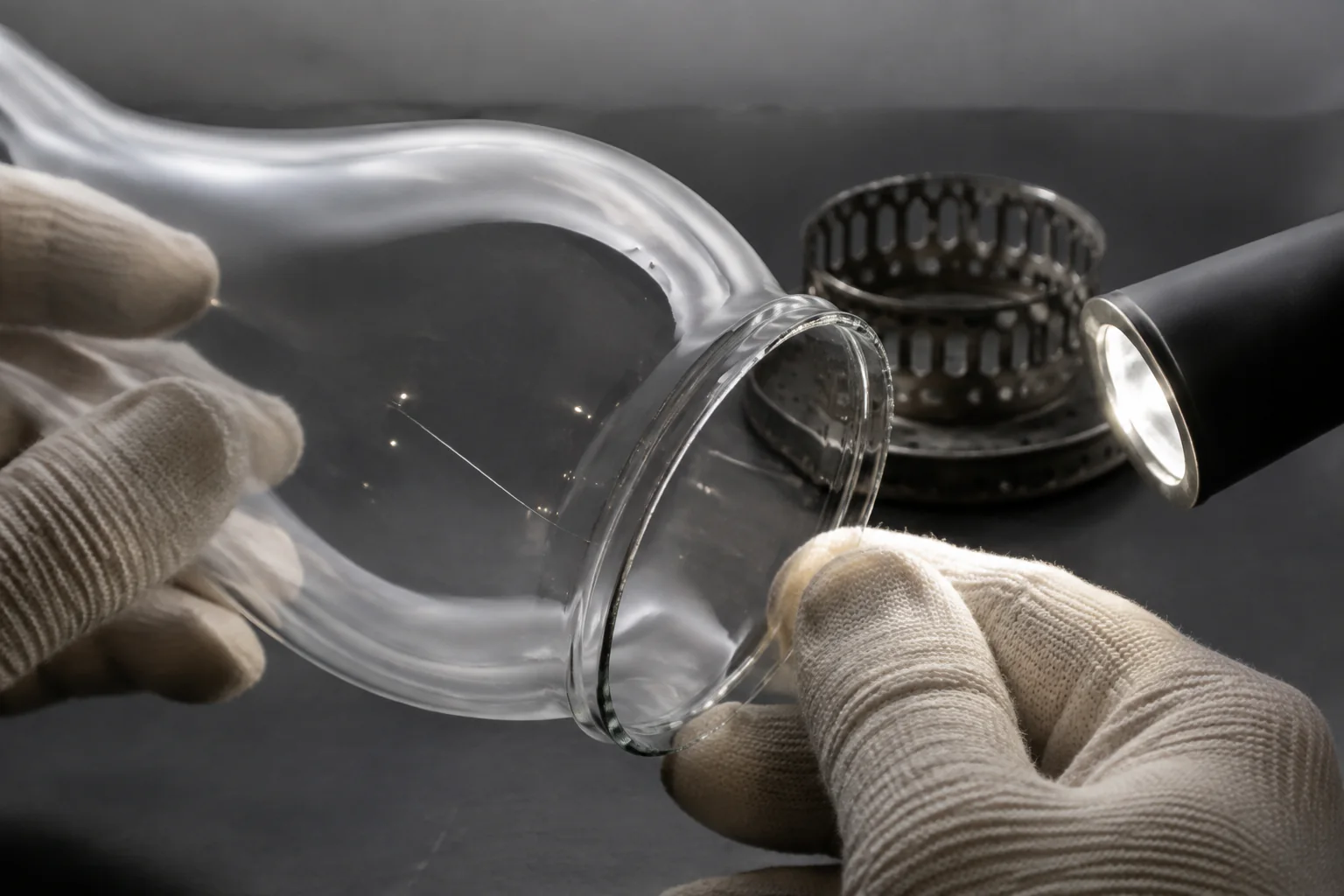
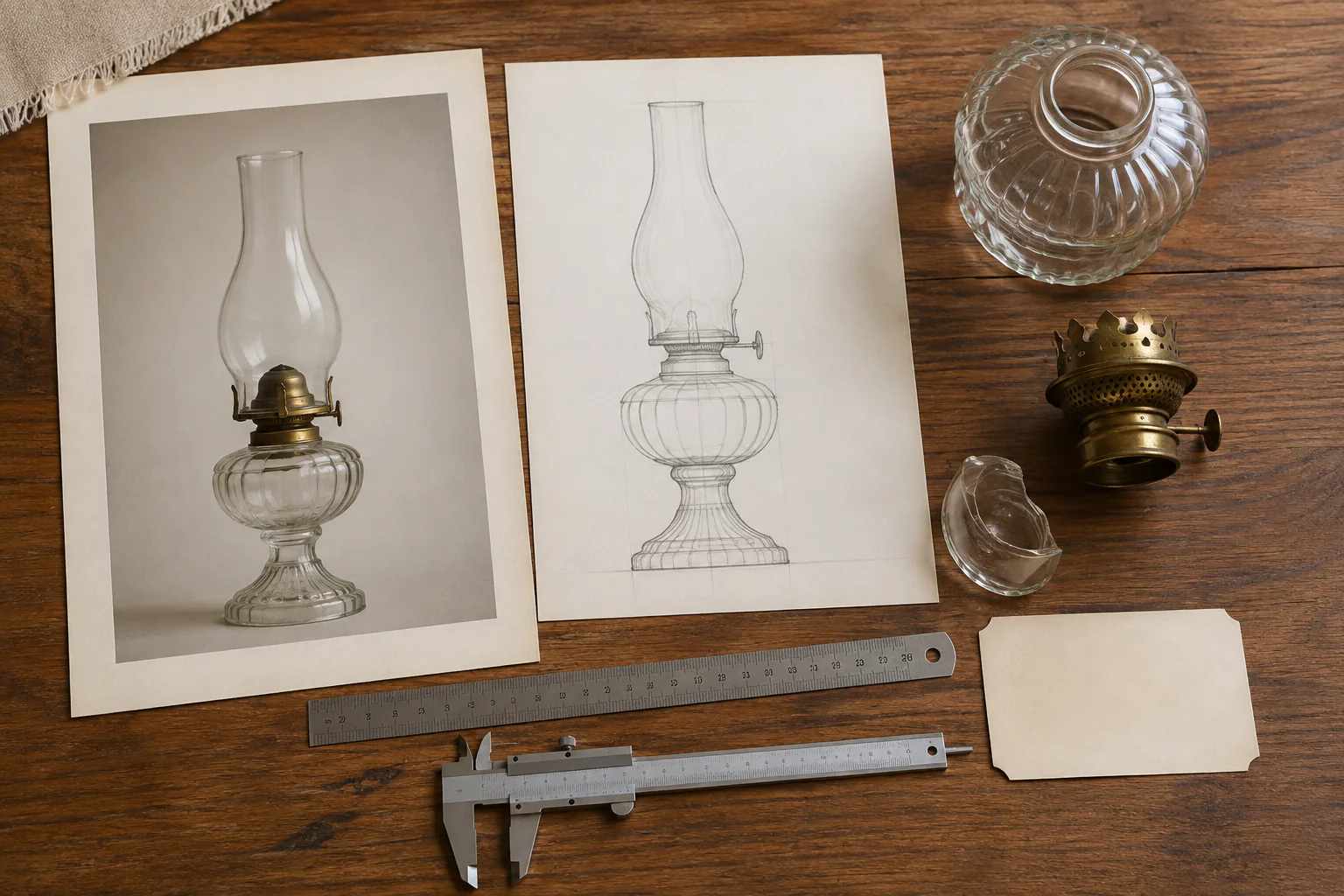
A useful replacement request can be assembled in one short session. Use a neutral background and place a ruler beside the part, not behind it. Photograph the complete lamp, then photograph the interfaces close up.
- Complete lamp from the front, standing straight.
- Top assembly with chimney and shade removed.
- Burner, collar, and gallery from the side.
- Chimney from the side and from below, including the fitter.
- Font neck, base, support ring, and any maker or model marks.
- Broken glass fragments laid in their original orientation when possible.
- Burner base and collar opening.
- Chimney fitter diameter, seat depth, and retaining method.
- Chimney height, bulge, top opening, and wall clearance.
- Outer shade opening, holder diameter, and total height.
- Quantity, repeat quantity, destination, packing needs, and inspection points.
A ruler in a photograph is a helpful scale, not a complete drawing. Perspective can make a circular opening appear oval. State the measurement method and identify the unit.
Troubleshooting by symptom
Common Queen Anne No. 2 Mismatch Symptoms
A mismatch can appear as a mechanical problem, a visual problem, or an operating problem. The symptom narrows the inspection; it does not prove which part is wrong.
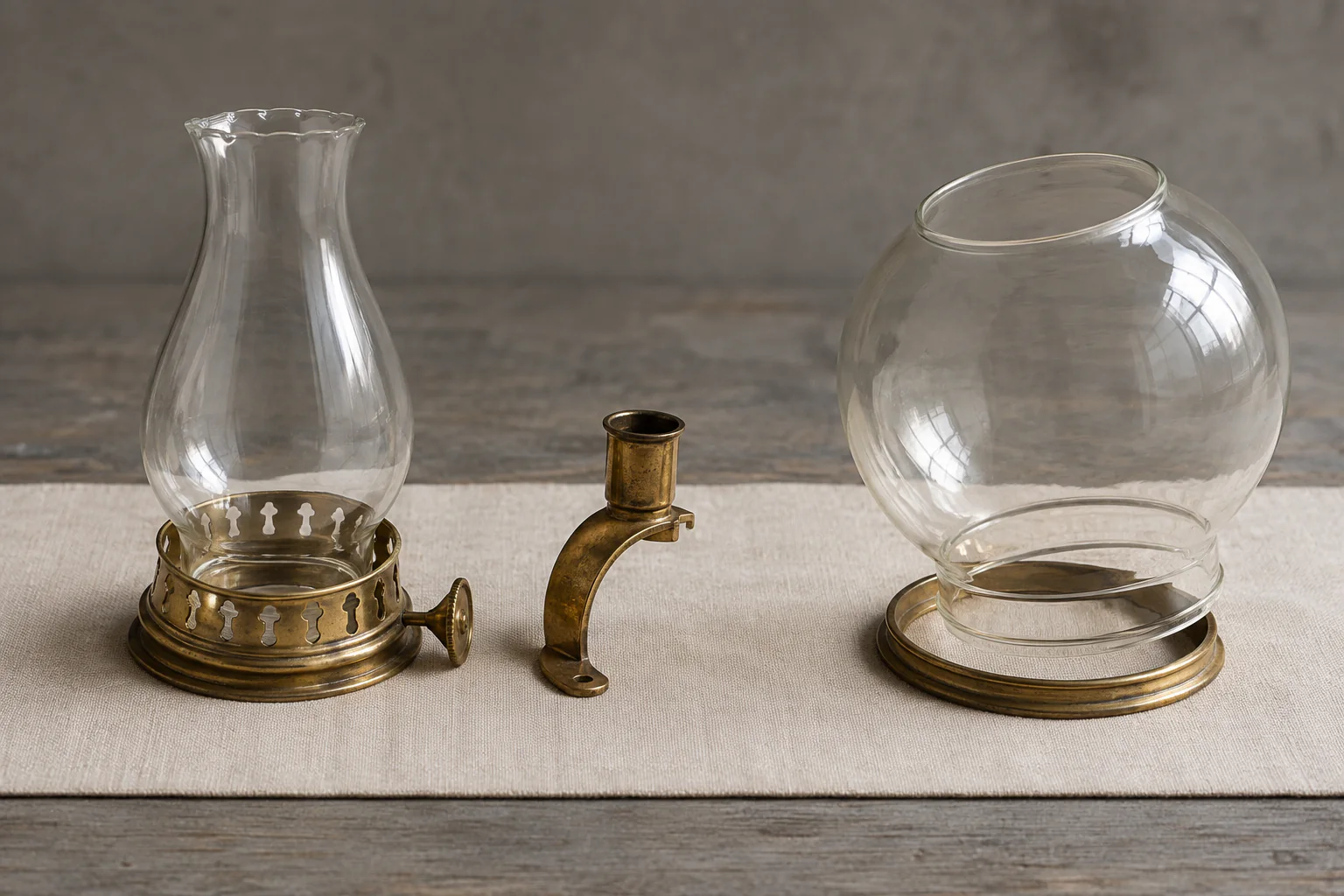
Chimney rocks on the burner
Check the fitter diameter, seat depth, chips on the lower edge, bent support feet, and residue on the gallery. A nominal diameter can still sit unevenly if the support is out of round.
The burner threads on but does not sit level
Stop and inspect the collar and burner threads. Compare the thread, shoulder, and seating surface. Do not tighten harder to force alignment.
The replacement chimney changes the flame
Check height, bulge, top opening, burner air openings, wick height, fuel, and the complete assembly. A base-only match does not prove the draft is unchanged.
The outer globe sits off-center
Measure the holder ring and inspect the opening, support arms, and center of gravity. The globe may be correct while the holder is bent.
The glass is chipped or cracked
Do not light the lamp to test questionable glass. Photograph the damage and review the original specification before choosing a replacement.
When flame position, overheating, smoke, fuel leakage, or structural stability is involved, stop use until the complete assembly is reviewed by a qualified person or the lamp maker.
Select the sourcing route
Original, Reproduction, or Custom Glass?
Choose the route based on the lamp, the evidence available, and the quantity required.
Original part. Best when historical authenticity, maker marks, or collector value are central. Condition can vary. Keep the original even if damaged because it may provide the only reliable profile and fitter evidence.
Reproduction part. Practical for common repair patterns when published dimensions, profile, and mounting system match the lamp. Treat listing dimensions as a starting point and confirm the actual part against the burner and gallery.
Custom glass. Suitable when the profile is unusual, the original is unavailable, the quantity is repeatable, or a lighting brand needs a controlled sample. A custom supplier needs the function, interface, drawing or sample, finish direction, quantity, packaging, and inspection plan.
JX Lampshade focuses on glass components such as chimneys, outer shades, globes, and selected glass font projects. The clear glass oil lamp chimney product page can be compared first for a catalog route. Catalog orders start from 500 pieces and full custom OEM starts from 1,000 pieces under the current public company-fact baseline. Final MOQ, material, process, sample plan, packing, and lead time are confirmed for the actual project.
Repeat-order control
A Sourcing Workflow for Dealers and Lighting Brands
Use the same sequence every time. It keeps a visually attractive but incompatible sample from moving into production.
1. Classify the lamp
Confirm flat-wick Queen Anne style rather than center-draft, mantle, pressure, or electric conversion hardware.
2. Find the model clues
Photograph marks, knob, burner, collar, font, base, and support feet.
3. Name the glass function
State chimney, outer globe, shade, or font. Do not combine separate parts under one line item.
4. Measure the interface
Record fitter, seat depth, collar opening, holder ring, and retaining method.
5. Draw the profile
Add height, bulge, shoulder, top opening, and finish direction.
6. Compare a standard option
Check the complete assembly, not a single diameter.
7. Request one sample
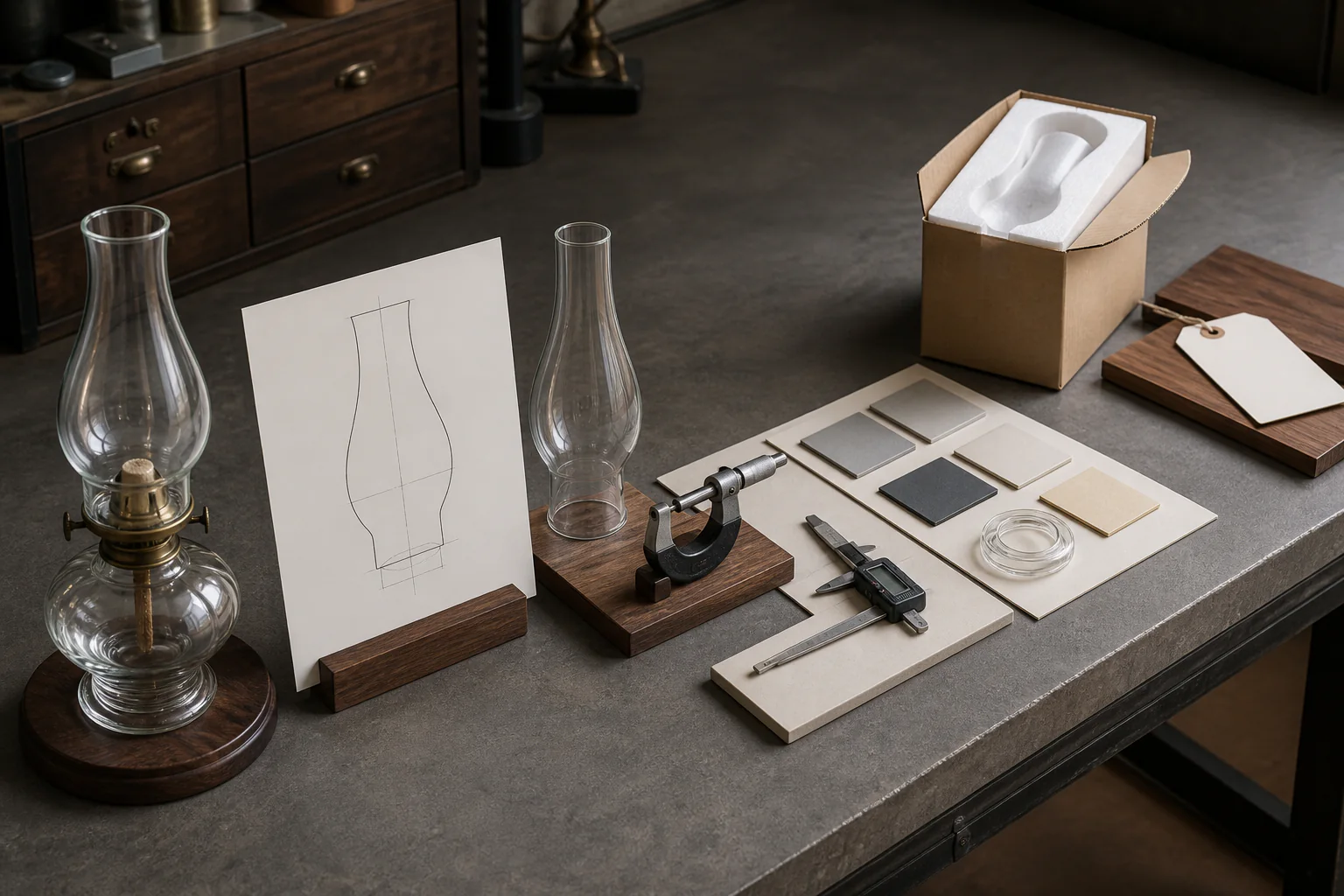
Review fit, centering, silhouette, glass appearance, and packaging before repeat ordering.
8. Freeze the inspection record
Keep the approved drawing, sample photos, measurement method, finish reference, and packing instructions together.
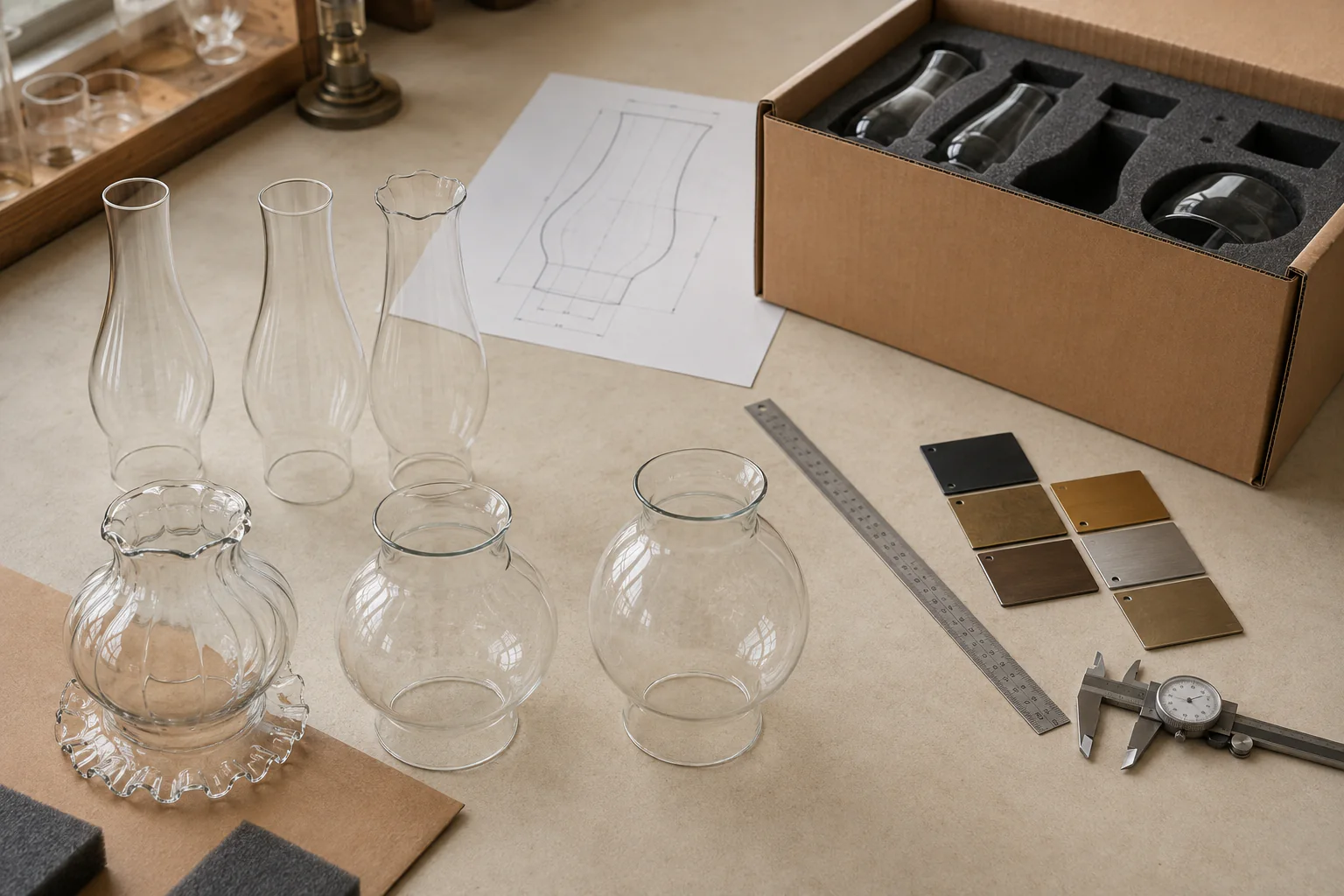
Supplier-ready request
How to Write a Procurement-Ready RFQ
The subject line can say “Queen Anne No. 2 oil lamp glass chimney,” but the body should carry the actual specification.
- Part function and lamp application.
- Complete-lamp photographs and close-ups of the burner and gallery.
- Maker, model, mark, or historical notes, with uncertainty stated plainly.
- Dimensioned side profile and fitter detail.
- Inside and outside dimensions at every interface.
- Glass color, transparency, finish, rim treatment, and decoration.
- Original sample, broken fragment, or approved reference.
- First-order quantity and expected repeat quantity.
- Destination, export packing, carton limits, labels, and inspection points.
- Whether the request is catalog matching, light customization, or a new mold.
Ask the supplier to confirm what is included. A chimney quotation may exclude the burner, collar, wick, shade holder, or outer globe. A glass quote also should not be read as approval to change the fuel, wick, or burner system.
Use the custom lampshade RFQ builder to organize photos, dimensions, finish, quantity, destination, packing, and inspection details before the request is sent.
Identification context
Historical Clues That Help With Identification
The Queen Anne name is more useful when combined with physical evidence. The Smithsonian object record cited above dates one oil lamp to 1860-1900 and describes its burner, wick raiser, peg, font, and chimney-support feet. It documents one object, not every lamp sold under the same style name.
A U.S. Department of Defense historical account about Fort McCoy describes fragile chimney glass recovered from a farmstead and connects Victor Blandford’s Queen Anne burner improvements with a manufacturing agreement involving Scovill Manufacturing Co. It also notes that maker marks on chimney glass can help researchers investigate where a piece was made and when.
Do not use a Queen Anne label to assign value. Condition, completeness, provenance, maker, decoration, and market demand all affect valuation. If the lamp may be historically or financially important, consult a restoration or appraisal specialist before polishing, drilling, electrifying, or discarding an original part.
Operating boundary
Safety Checks Before Reassembly
The glass fit is only one part of a safe operating review. Do not light an old or altered lamp while a chimney is unstable, cracked, chipped at a load point, or visibly too close to the flame. Let the lamp cool before handling or measuring a recently used assembly.
Lamp oil has its own boundary. The U.S. Consumer Product Safety Commission has warned about children drinking lamp oil and the danger of aspiration into the lungs. The National Capital Poison Center advises keeping lamp oil in its original container, out of reach, and away from children and pets.
Use the fuel, wick, burner, and lighting procedure specified for the lamp. A replacement glass part does not certify the whole system. If there is a fuel leak, smoke that does not clear with the maker’s approved adjustment, overheating, a loose chimney, or damaged support, stop and obtain qualified advice.
Concise answers for buyers and AI search
Queen Anne No. 2 Oil Lamp FAQ
What is a Queen Anne No. 2 oil lamp?
It is usually an oil lamp using a Queen Anne style No. 2 burner or an assembly described by that burner family. The label is a useful clue, but the collar, wick, gallery, chimney, font, and shade holder still need to be checked.
What size chimney fits a Queen Anne No. 2 burner?
Published restoration examples commonly associate a No. 2 burner with a 3-inch base fitter, and one catalog lists a 10-inch chimney with a 4-inch bulge. Those are reference examples, not a universal standard. Measure the actual burner or gallery, height, bulge, and top opening.
What does No. 2 mean on an oil lamp burner?
No. 2 generally identifies a burner size or family in parts listings. It does not by itself specify every thread, collar, chimney height, gallery, or wick. Use the marking to start the search, then verify the physical interfaces.
How do I identify a Queen Anne burner?
Photograph the burner, wick raiser, collar, gallery, support feet, and every mark. Note the wick shape and how the chimney is retained. Compare the complete assembly with a maker or parts reference instead of matching only the decorative appearance.
Is a Queen Anne No. 2 chimney the same as a globe?
Usually not. The chimney sits over the flame and participates in the airflow. A globe or outer shade is wider and normally sits on a separate holder outside the chimney. Listings sometimes use the words loosely, so specify the mounting point and function.
Can I order replacement glass from a photograph?
A photograph can identify the likely part, but it rarely proves compatibility. Add fitter and holder dimensions, the complete lamp, adjacent hardware, maker or model marks, a side profile, and an original or broken sample when available.
When should I choose custom glass instead of a standard reproduction?
Choose custom review when the original profile is unusual, a standard part does not match the holder, a finish or decoration must be repeated, or a dealer or lighting brand needs a controlled sample for repeat orders. Confirm the first sample against the actual lamp before production.
Can JX Lampshade supply the burner, wick, and fuel too?
JX Lampshade focuses on glass components such as chimneys, outer shades, globes, and selected glass font projects. Metal burners, wicks, fuel, and model-specific operating parts should be checked with the lamp maker or a specialist dealer. JX can review a glass requirement from photos, measurements, a drawing, or a sample.
Continue with the right topic owner
Related Queen Anne and Glass Replacement Resources
Oil Lamp Parts: Names, Diagram, and Replacement Checks
Name the font, burner, wick, chimney, holder, and shade before ordering a replacement.
How to Use an Oil Lamp Safely: Wick and Chimney Guide
Review wick adjustment, smoke checks, fuel boundaries, and complete-assembly safety.
Oil Lamp Glass Shades for Replacement and Custom Projects
Compare replacement and custom glass routes for project quantities and repeat orders.
Clear Glass Oil Lamp Chimney Product Reference
Use a catalog chimney as a comparison point before requesting a matched project review.
Glass Lamp Shades
Browse wider glass shade forms, materials, and project routes.
Custom Lampshade RFQ Builder
Organize photographs, dimensions, finish, quantity, packaging, and inspection needs.
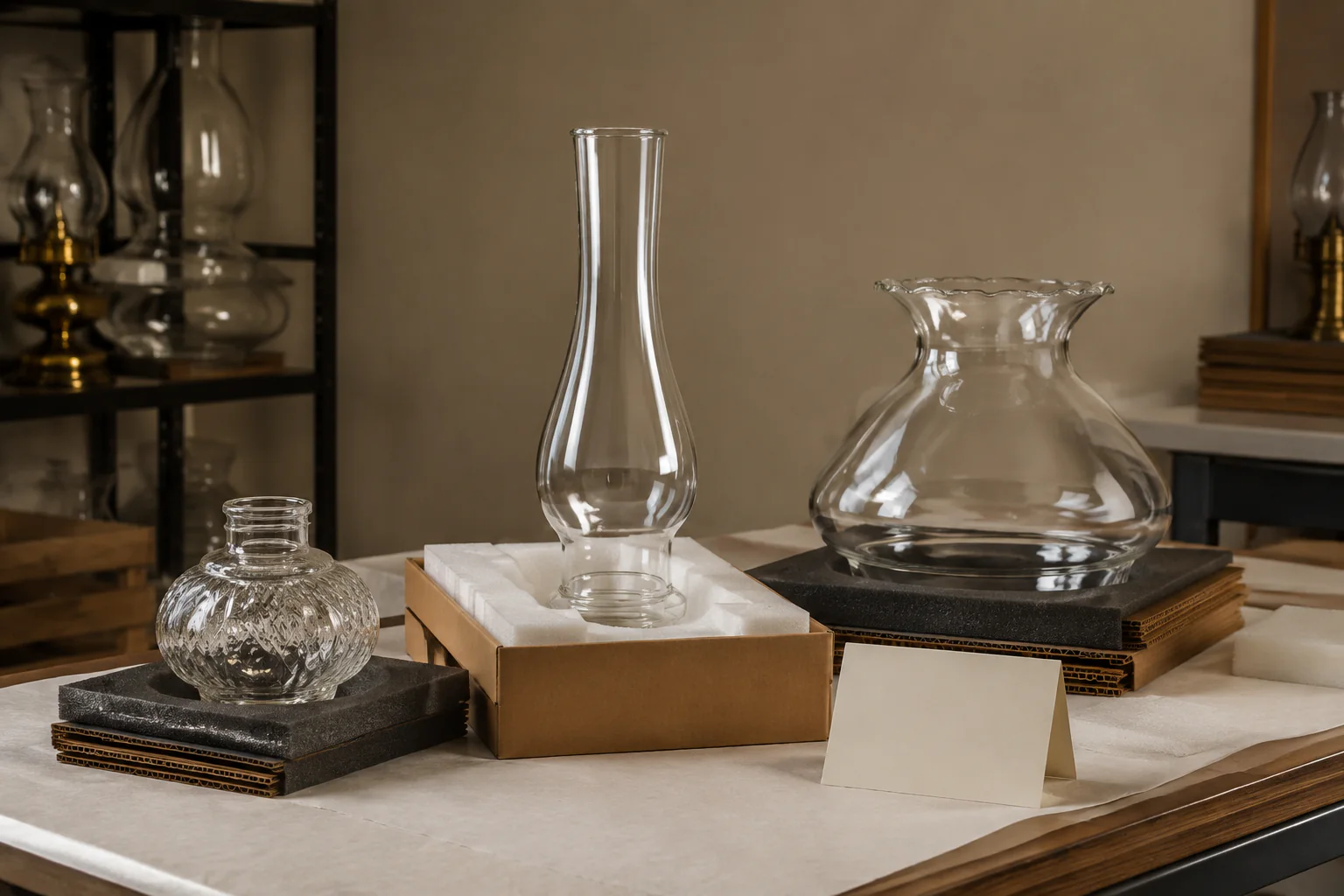
Send the Evidence With Your Part Request
For a repeat glass chimney, shade, globe, or font project, send complete-lamp photographs, an original sample or fragments, a dimensioned profile, interface details, finish target, quantity, destination, and packaging requirements.
JX can then review whether an existing catalog glass, a light customization, or a full custom OEM route is the better starting point.