Glassware Breakage: Causes, Types, and How to Prevent It
Glassware breakage occurs when physical or thermal stress exceeds the glass’s tensile strength — most commonly caused by thermal shock, mechanical impact, or pre-existing surface cracks that grow until the glass fails suddenly.
You install a beautiful glass lampshade, position it perfectly in the fixture — and three weeks later it cracks along the rim for no apparent reason. Or a set of drinking glasses survives years of daily use, then one shatters in the dishwasher on an ordinary Tuesday. If this sounds familiar, you are not alone. Glassware breakage is one of the most common and frustrating household and commercial problems, costing billions of dollars annually in replacement costs, safety incidents, and operational downtime. Understanding why glass breaks — and how to stop it — starts with understanding how glass actually fails at the physical level.
What Is Glassware Breakage?
Glassware breakage occurs when the mechanical or thermal stress applied to a glass object exceeds its tensile strength, causing the material to fracture. Unlike metals, glass does not bend or deform plastically before breaking — it fails suddenly and completely, a behavior called brittle fracture. This makes glass both elegant and unforgiving: there is no warning flex, no gradual yielding. It either holds or it doesn’t.
The Physics Behind Why Glass Breaks
At the molecular level, glass is an amorphous solid. Its atoms are arranged in a disordered network rather than the regular crystal lattice you find in metals or ceramics. This structure is what gives glass its transparency, its smooth surface, and its characteristic behavior — but it also means glass has essentially no mechanism to arrest crack propagation once a crack starts moving.
According to Penn State University’s research on glass fracture mechanics, most glass objects do not break because they encounter a force exceeding their theoretical strength. They break because of microscopic surface flaws — tiny scratches, chips, and micro-cracks invisible to the naked eye — that act as stress concentrators. Near a flaw, local stress can be 100 to 1,000 times higher than the average stress on the object. A force that would be completely safe on a pristine glass surface becomes catastrophic at a scratch tip.
This is why a glass that has been chipped along the rim is dramatically more likely to fail than an identical undamaged one. The flaw focuses all incoming energy into a tiny crack tip, where it drives the crack forward at speeds approaching the speed of sound in glass (approximately 1,500 m/s).
Glass Strength vs. Everyday Stress
Theoretically, glass is extraordinarily strong. Freshly drawn glass fibers in controlled laboratory conditions can withstand tensile stresses approaching 14,000 MPa — stronger than many steel alloys. In practice, surface damage from everyday handling reduces the effective strength of most household glassware to between 35 and 100 MPa. Every scratch, every contact with another hard surface, every dishwasher cycle erodes that margin further.
The practical consequence: glassware that has been in regular use for a year or two is meaningfully weaker than the same piece when it was new — not because the glass material changed, but because the surface damage accumulated.
| Stress Type | Common Cause | Relative Risk for Glassware |
|---|---|---|
| Thermal shock | Hot liquid in cold glass; cold water on hot glass; rapid oven transfer | Very High |
| Mechanical impact | Drop, bump against hard surface, collision during washing | High |
| Residual manufacturing stress | Poor annealing, uneven cooling during production | Medium-High |
| Slow crack growth | Repeated stress cycling below the failure threshold | Medium |
| Chemical attack | Dishwasher detergent, acidic beverages, prolonged moisture contact | Low-Medium |
Understanding which stress type dominates in your specific situation is the most direct path to preventing glassware breakage.
The 3 Main Types of Glass Fracture Patterns
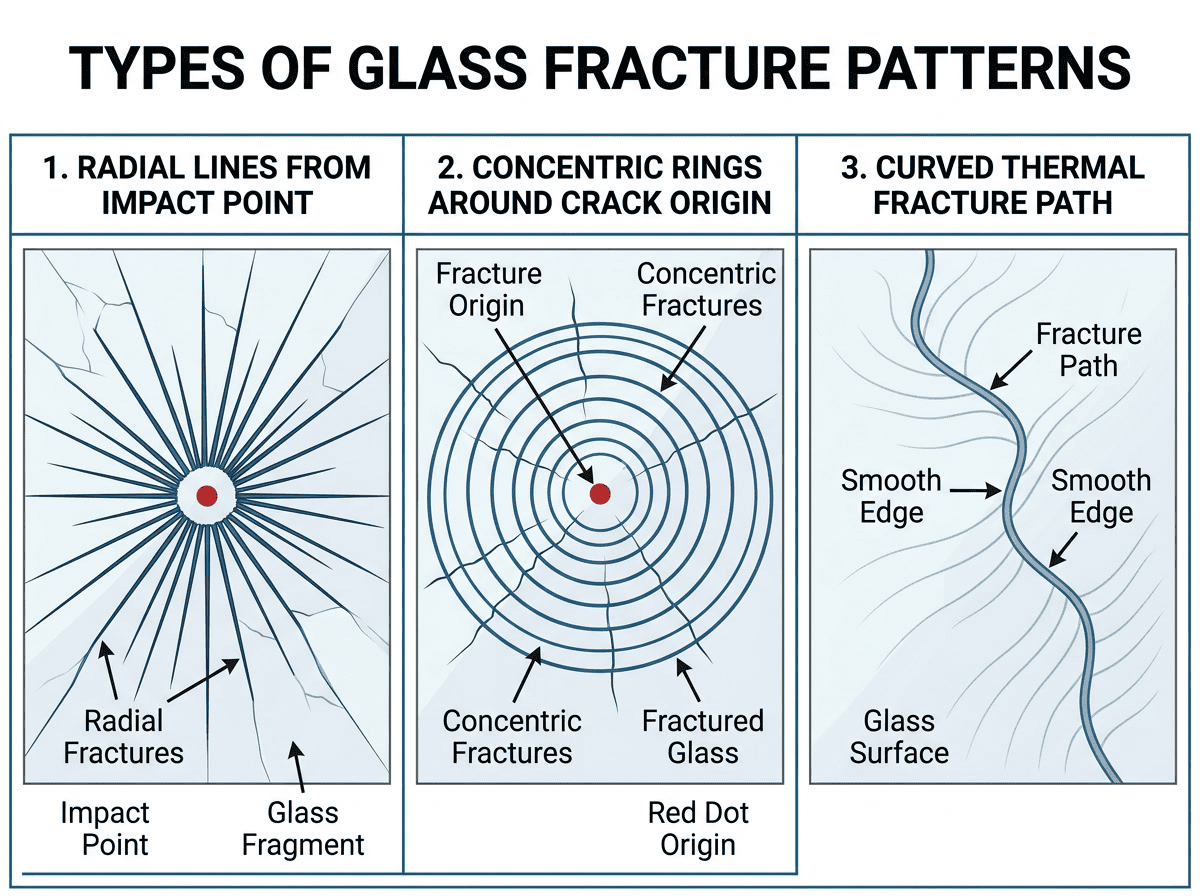
Not all glassware breakage looks the same. Forensic glass analysts — and anyone who takes a careful look at broken glass — recognize distinct fracture patterns that reveal the cause of failure. According to NIST’s reference guide on Fractography of Ceramics and Glasses, fracture patterns in glass are reproducible and diagnostic: the same cause consistently produces the same pattern. Reading the pattern tells you what went wrong.
Radial Fractures
Radial fractures radiate outward from a point of origin like spokes on a wheel. They are the classic mechanical impact signature — visible when a glass is dropped or struck sharply by a hard object. The point where the fracture lines converge (or nearly converge) marks where the break started. In glass lampshades, radial fractures often originate at mounting points or along the rim edge where the glass contacts a metal fitting — not always where you’d expect the break to initiate.
The key diagnostic feature of a radial fracture is directionality. Run your finger (carefully, on an undisturbed piece) along a fracture line from the origin: the fracture surface should feel slightly curved, bending away from the side the force came from — this is called the “hackle” pattern, and it points back to the impact site.
Concentric (Hertzian) Fractures
Concentric fractures form circles or arcs around the point of impact. Combined with radial fractures, they create the characteristic “bullseye” pattern familiar from vehicle windshields and cracked screens. The concentric rings form as stress waves reflect back through the glass after the initial impact, creating secondary tension zones at specific distances from the origin.
In thin household glassware — tumblers, wine glasses, lampshade glass — pure concentric fractures are less common because the glass is too thin to sustain the full Hertzian cone geometry. You’re more likely to see a partial bullseye combined with radial lines. True, well-developed concentric fractures appear most often in thicker decorative glass, plate glass, and architectural glazing.
Thermal Fractures
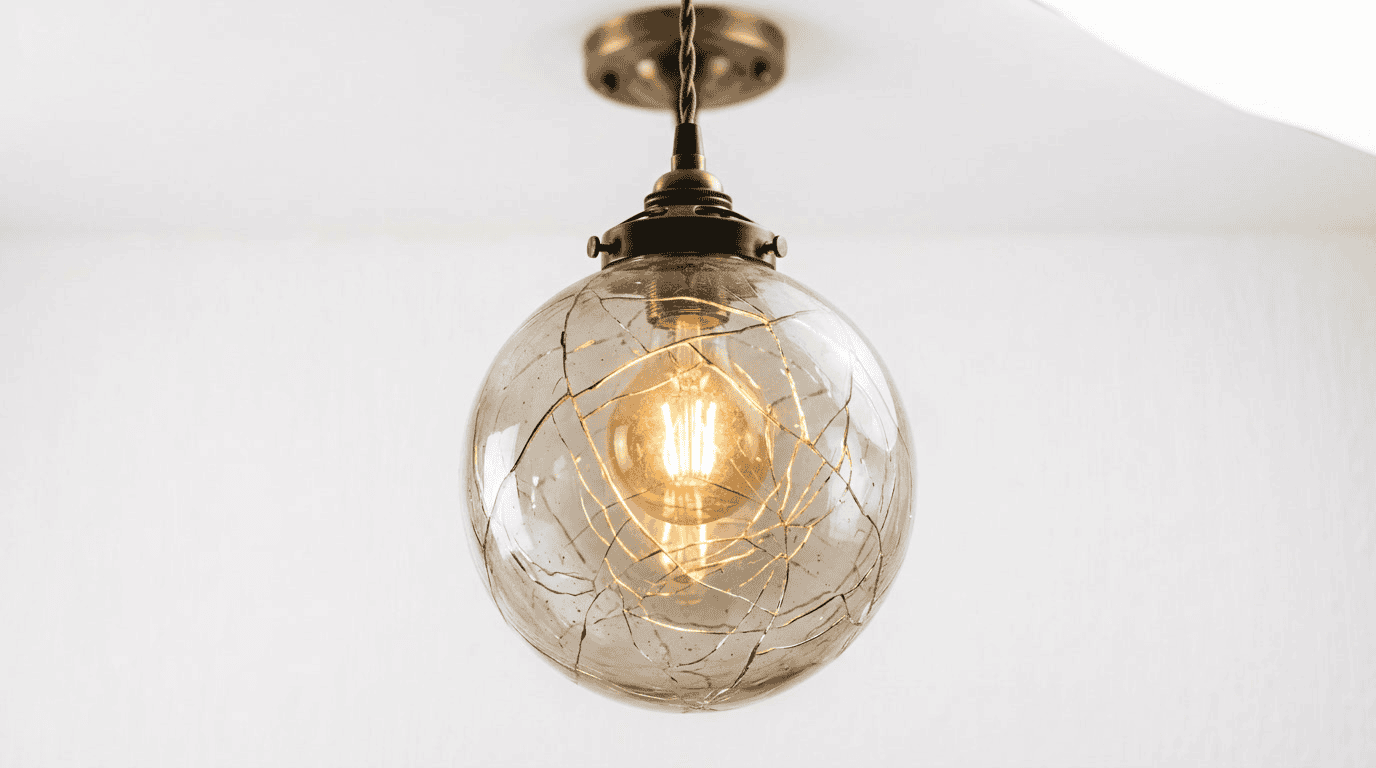
Thermal fractures are the most misunderstood type and arguably the most relevant to glass lampshade owners. They appear as smooth, curving cracks that wander across the glass surface with gentle curves and direction changes — sometimes described as “lazy” fractures because they lack the sharp directionality of impact fractures.
According to Wikipedia’s technical coverage of thermal fracturing in glass, the crack path in a thermal fracture follows the path of maximum tension created by the temperature gradient at the moment of failure. When one side of a glass object heats or cools faster than the other, the two sides want to change size at different rates. The resulting tension-compression mismatch fails at the point where tension is highest — and that point moves as the temperature gradient shifts, producing the wandering crack path.
One important characteristic of thermal fractures: the fracture surfaces are often smooth and flat, without the hackle marks typical of impact fractures. This makes them easier to distinguish from mechanical damage even after the fact.
| Fracture Type | Visual Pattern | Primary Cause | Most Common In |
|---|---|---|---|
| Radial | Lines radiating outward from a point | Impact, collision, drop | Tumblers, lampshades, windows |
| Concentric | Circular/arc rings around impact point | Hard blunt-force contact | Thick glass, auto glass, plate glass |
| Thermal | Smooth, curving, wandering crack | Rapid temperature differential | Lampshades, ovenware, cookware |
| Spontaneous | Random with no visible origin point | NiS inclusions in tempered glass | Tempered glass, architectural glass |
| Fatigue | Fine cracks at stress concentrators | Repeated sub-failure cycling | Frequently handled glassware |
Top Causes of Glassware Breakage
Understanding fracture types tells you how glass breaks. These four causes account for the overwhelming majority of glassware breakage incidents in homes, restaurants, and commercial settings.
Thermal Shock — The Number One Culprit
Thermal shock is the sudden, non-uniform temperature change that creates differential expansion within a single piece of glass. Glass expands when heated and contracts when cooled — but it does so at a fixed, predictable rate (the thermal expansion coefficient). If one part of a glass object changes temperature faster than another, one part tries to expand while the adjacent part resists. The resulting internal stress tears the glass apart.
Classic thermal shock scenarios that cause glassware breakage:
- Pouring boiling water into a glass that hasn’t been pre-warmed
- Running cold water over a hot glass fresh from the dishwasher
- Moving glassware from a refrigerator directly into a microwave
- Setting a hot glass down directly on a cold granite or metal countertop
- Switching on a lamp with a cold glass lampshade in a cold room (the lamp side heats instantly; the outer surface takes longer)
The critical variable is the temperature differential across the glass, not the absolute temperature. A glass sitting uniformly at 150°C is under no particular stress. Pour cold water on it and it can fail within seconds.
Most ordinary soda-lime glass — the type used in the majority of household drinking glasses, decorative vases, and lamp globes — has a thermal shock resistance of roughly 40–70°C differential. Borosilicate glass (recognized by brand names like Pyrex and Duran) withstands differentials above 150°C. The difference is the coefficient of thermal expansion: borosilicate expands approximately three times less than soda-lime glass for the same temperature change, so the differential stress is proportionally smaller.
Practical tip: If you must wash glassware in very hot water, allow it to cool gradually on a cloth rather than plunging it under cold running water. Pre-warming a glass with warm (not hot) water before adding a hot beverage takes 15 seconds and meaningfully reduces thermal shock risk.
Mechanical Impact and Drop Damage
Impact is the most intuitive cause of glassware breakage. What’s less intuitive is that glassware often does not fail at the moment of impact — it fails afterward, sometimes hours or days later, when invisible micro-cracks created by the impact slowly propagate under the ordinary stress of daily use.
This explains why a glass that apparently “survived” a drop sometimes breaks mysteriously later during normal handling. The impact created sub-critical cracks — too small to cause immediate failure but large enough to grow. Each use cycle puts a small amount of stress into those cracks until they reach the critical length at which they propagate catastrophically.
Drop height matters less than you might expect. Surface hardness at the point of impact matters far more. A glass dropped 30 cm onto a granite countertop is significantly more likely to break than the same glass dropped 60 cm onto a hardwood floor. The granite transfers impact energy efficiently into the glass; the wood absorbs and dissipates it.
Research from Cornell University’s materials science program on glass failure demonstrated that crack propagation speed in glass is bounded by the acoustic wave speed in the material — meaning that below a certain impact velocity, glass may actually create multiple small cracks rather than a single catastrophic fracture. This principle underlies laminated safety glass design, where multiple layers slow crack propagation and prevent complete disintegration on impact.
Manufacturing Defects and Hidden Cracks
Not all glassware starts at equal strength. Poor manufacturing practice introduces defects that dramatically reduce service life:
Improper annealing is perhaps the most common and consequential defect. After glass is formed — whether blown, pressed, or cast — it must be cooled slowly and uniformly through the annealing range (roughly 450–550°C for soda-lime glass). This allows internal stresses created during forming to relax. Rushed or uneven annealing locks residual stress into the glass. Poorly annealed glass can fail spontaneously under its own internal stress or fail at a fraction of its rated strength under external loads.
Inclusions — air bubbles, refractory particles, or foreign material trapped in the glass — create internal stress concentrators. In decorative glass and lampshade glass, bubbles are sometimes considered an aesthetic feature. They are not structurally neutral: each bubble is a stress concentrator and a site of reduced wall thickness.
Mold lines and seam marks — common in pressed glass lampshade globes — represent locations where the glass was joined during forming. At these seams, the glass microstructure is slightly different and residual stress is higher. Radial fractures in pressed-glass lampshades often originate at mold lines, not at impact sites.
Non-uniform wall thickness is a subtler defect. When the wall thickness varies across a lampshade or glass vessel, thinner sections heat and cool faster than thicker sections, creating thermal gradients even under mild temperature changes. This is why higher-quality glassware has more uniform wall thickness — it’s not just aesthetic.
Before installing a glass lampshade or purchasing decorative glassware, hold the piece up to a bright light source and inspect it: look for bubbles, visible seam lines, and thickness variation (which appears as lighter and darker bands). A piece with multiple visible defects has reduced service life before you install it.
Spontaneous Glassware Breakage Explained
Few things are more alarming than a glass object — a lampshade, a shower door, an oven panel — that shatters without being touched. This is called spontaneous breakage, and in thermally tempered glass, it has a specific, well-documented cause: nickel sulfide (NiS) inclusions.
During glass manufacturing, nickel from steel equipment components and sulfur from fuel sources can combine inside molten glass to form nickel sulfide particles. In un-tempered glass, these particles are mechanically harmless. But during the tempering process — where glass is heated to approximately 620°C and then rapidly air-quenched — NiS particles become “locked” in a high-energy metastable phase. Over months or years at room temperature, these particles slowly undergo a phase transformation and expand by approximately 4%. That expansion, occurring inside fully tempered glass under high compressive surface stress, eventually triggers the stored stress to release — catastrophically and suddenly, with the glass shattering into the small, dice-like fragments characteristic of tempered glass failure.
Spontaneous breakage from NiS inclusions can occur days to years after installation with no warning and no external trigger. It affects thermally tempered glass used in shower enclosures, glass doors, oven panels, and architectural glass. Heat-soak testing (holding tempered glass at approximately 290°C for two hours) can trigger most susceptible units in controlled conditions — but it is not universally applied in the industry, and it is not 100% effective.
For non-tempered decorative glassware and lampshades, apparent “spontaneous” breakage is almost always delayed mechanical failure — a sub-critical crack from an earlier impact that finally grew to the critical size.
Glassware Breakage in Glass Lampshades — What’s Different
Glass lampshades occupy a unique intersection of nearly all the failure mechanisms described above. They are decorative glass (which may have manufacturing variation and surface defects), they are exposed to sustained heat from the light source, they make contact with metal hardware that expands and contracts at different rates, and they are periodically cleaned and reinstalled in ways that can introduce thermal shock. Understanding lampshade-specific breakage risk is essential for anyone who owns, installs, or specifies glass lighting.
Why Lampshade Glass Is Particularly Vulnerable
Most glass lampshades use blown or pressed soda-lime glass. Blown glass tends to have more uniform thickness but hand-blown pieces often have slight wall thickness variation. Pressed glass (used widely in pendant globes, schoolhouse-style shades, and drum pendants) is more dimensionally consistent but may retain residual mold-line stress.
The wall thickness of typical lampshade glass runs 2–4 mm — thin enough to be lightweight and translucent, but also thin enough that temperature gradients across the wall are relatively small even with modest external temperature differentials. This means the margin between “safe operating temperature gradient” and “failure temperature gradient” is narrower than for thicker glass objects.
Heat Sources and Thermal Cycling Risk
The most significant risk factor for glass lampshade breakage is thermal cycling — the repeated heating and cooling that occurs every time the lamp is switched on and off. Each cycle stresses the glass slightly. Over thousands of cycles, micro-cracks grow. This is why a glass lampshade that performed flawlessly for two years might crack unexpectedly during what seems like a completely routine use day — the cumulative fatigue finally drove a pre-existing flaw to critical size.
The type of light source matters enormously. A traditional 60-watt incandescent bulb reaches 200°C or more at the glass surface. A 10-watt LED equivalent generating the same light output stays well below 50°C. The thermal cycling stress from an incandescent bulb is roughly 10–15 times greater per cycle than from a comparable LED. Switching to LED bulbs is among the most effective single steps you can take to extend glass lampshade life.
Equally important: lamp wattage relative to the shade’s rated maximum. Exceeding the rated wattage concentrates heat at the glass neck — the mounting point where the shade contacts the fixture hardware — exactly where contact stresses from the metal fitting are already highest. This combination of thermal and mechanical stress at the same location is a reliable recipe for premature breakage.
Common Installation Mistakes That Cause Glassware Breakage
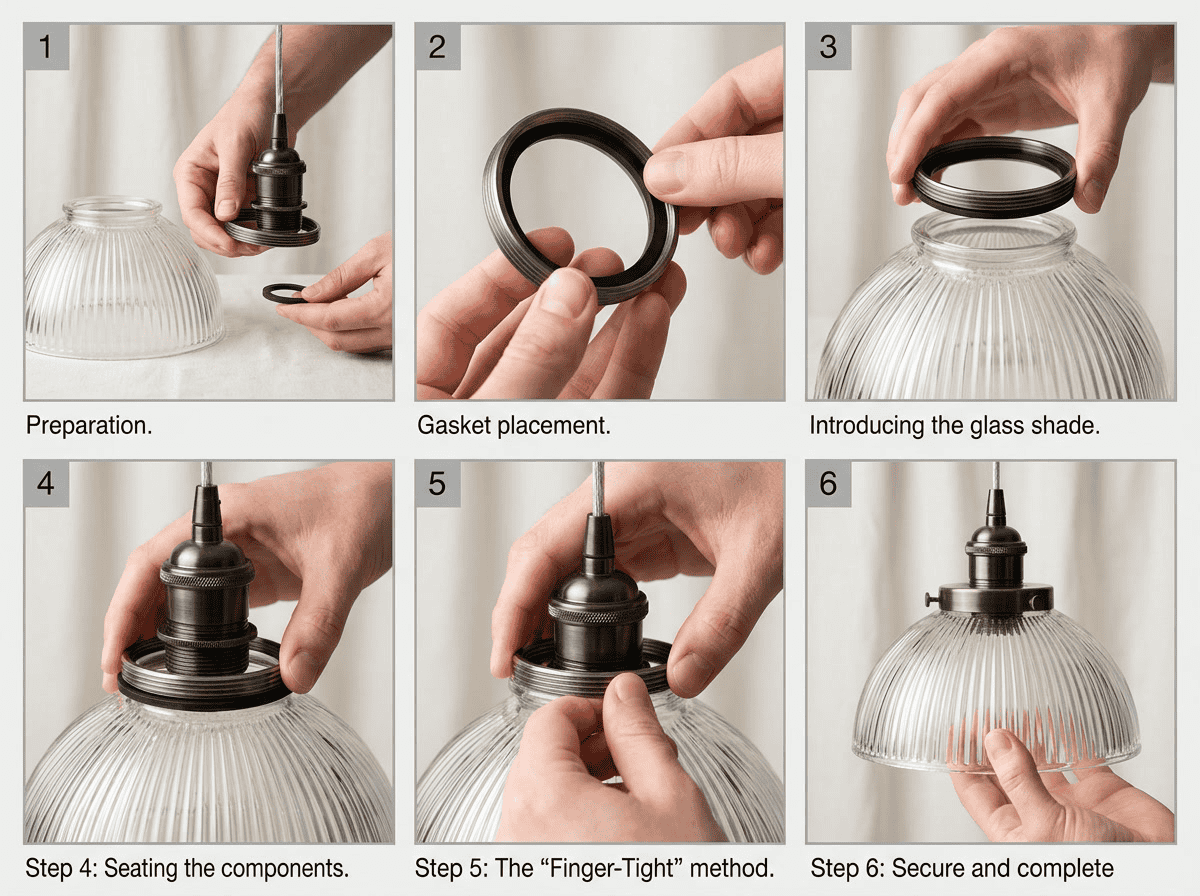
- Over-tightening the mounting ring. The metal ring compresses the glass at the contact point. When the lamp heats up, the metal expands outward while the glass wants to expand in all directions. If the ring is too tight, it restrains the glass’s natural expansion, creating localized stress at the contact rim. Over time, this produces radial fractures originating at the mounting contact.
- No gasket between glass and metal. Metal expands more than glass at equivalent temperatures (higher coefficient of thermal expansion). Without a rubber, silicone, or felt gasket between the metal fitting and the glass rim, repeated heating and cooling cycles force the glass to accommodate the metal’s movement — and the glass loses that negotiation.
- Installing cold glass on a warm fixture. Even room-temperature lamp fixtures can be 20–30°C warmer than glass brought in from an unheated garage or outdoor storage. Installing chilled glass directly onto a warm fitting creates an immediate thermal gradient at the contact point.
- Ignoring hairline cracks. A hairline crack in a glass lampshade is not a cosmetic defect — it is a structural failure in progress. Glass lampshades with hairline cracks should be replaced immediately, not used until “it actually breaks.”
How to Prevent Glassware Breakage
Thermal shock prevention, mechanical protection, and informed purchasing are the three pillars of glassware breakage prevention. None requires expensive equipment — just consistent habits and a basic understanding of the failure mechanisms above.
Storage and Handling Best Practices
For drinking glasses and decorative glassware:
- Store glasses upright, never nested rim-to-rim (rim stacking transfers point loads onto the most damage-prone edge)
- Leave at least 1 cm of clearance between stored glasses in cabinets — vibration and contact cause micro-damage that accumulates over time
- Use cabinet rack inserts or felt dividers in any storage environment with frequent vibration (near HVAC equipment, on floors above foot traffic areas)
- Inspect glassware every few months — hold each piece to a light source and look for chips, scratches, or hairline cracks along the rim and base
For glass lampshades specifically:
- Always use a rubber or silicone gasket between the glass and any metal mounting hardware — this single precaution prevents the most common lampshade breakage cause
- Tighten mounting rings to finger-tight, then no more than a quarter-turn — never wrench-tighten glass shade hardware
- Allow new lampshades to acclimate to room temperature (at least 30 minutes from cold storage or outdoor transit) before installing on a lit fixture
- When cleaning, avoid thermal extremes: room-temperature or lukewarm water only, supported from below rather than gripped at the rim
Temperature Management Tips
Most thermal-shock glassware breakage is preventable with straightforward temperature management:
- Pre-warm glasses before adding hot liquids — warm tap water run over the outside for 15–20 seconds reduces the thermal gradient when the hot liquid is poured in
- Let hot glassware cool on a folded cloth or silicone mat — not directly on cold stone, metal, or ceramic tile
- Use borosilicate glass for any regular high-temperature application — hot beverages, oven use, or high-wattage lamp fixtures. The thermal shock resistance advantage (150°C+ vs. 40–70°C for soda-lime) is real and significant
- Never microwave very cold glass — the heat concentrates inside the liquid while the glass wall stays cooler, creating an inside-out thermal shock
- Switch to LED bulbs in all glass lampshade fixtures — the temperature reduction is dramatic and directly extends lampshade service life
Choosing Breakage-Resistant Glass
The glass composition you choose at purchase time determines the ceiling on breakage resistance. No amount of careful handling fully compensates for glass with poor thermal properties in a demanding application.
| Glass Type | Thermal Shock Resistance | Impact Resistance | Best Application |
|---|---|---|---|
| Soda-lime glass | ~40–70°C differential | Moderate | Cold beverages, decorative objects, low-wattage lampshades |
| Borosilicate glass | ~150–200°C differential | Moderate | Hot beverages, oven use, higher-wattage lampshades |
| Tempered (toughened) glass | ~200°C+ differential | 4–5× stronger than annealed | Outdoor lampshades, architectural glass, high-traffic areas |
| Aluminosilicate glass | ~200°C+ differential | High | Specialty high-temperature applications, high-end cookware |
| Laminated glass | Moderate | Very high — retains fracture | Safety glazing, sloped glazing, glass floors |
For standard indoor glass lampshades used with LED bulbs, quality soda-lime glass is entirely appropriate — provided it is properly installed and maintained. For outdoor lampshades exposed to rain and temperature extremes, thermally tempered glass is the correct specification. For high-wattage halogen or specialty incandescent applications, borosilicate offers meaningful protection.
When evaluating a glass lampshade for purchase, look for:
- Uniform wall thickness — visible as even translucency when held to a light source
- Absence of bubbles or inclusions — visible as dark spots or distortions against a bright background
- Smooth, fire-polished edges on globes and pendant shades — machine-cut edges have micro-serrations that serve as crack initiation sites
- A stated wattage rating — any quality lampshade should carry a maximum wattage specification
Future Trends in Breakage-Resistant Glassware (2026+)
The glass industry is actively working on next-generation glassware that breaks less — driven by consumer safety demands, sustainability pressure to reduce glass waste, and the economic cost of breakage in commercial settings.
Next-Generation Glass Compositions and Surface Treatments
Ion exchange strengthening — already widely used in smartphone screens under brand names like Corning Gorilla Glass and AGC Dragontrail — is increasingly being adapted for tableware and decorative glass. The process immerses formed glass in a molten potassium salt bath, replacing smaller sodium ions at the glass surface with larger potassium ions. The size mismatch creates a compressive stress layer in the outer 40–80 microns of the glass, which must be overcome before any surface crack can propagate. The result is 3–5× improvement in drop and scratch resistance with no change in optical properties.
Early commercial products applying ion exchange treatment to tableware have appeared in the market, and the technology is migrating toward decorative glass and lampshade applications as manufacturing cost continues to fall.
Surface treatments using protective sol-gel coatings are another avenue. These thin coatings (typically under 1 micron thick) fill surface micro-scratches and reduce the stress concentration factor at existing flaws. They are already used on some laboratory glassware and are being evaluated for consumer applications.
As highlighted in Notre Dame’s research on shattering in glass cookware, failure in most glass objects occurs not because the material lacks theoretical strength but because surface damage accumulated over time enables low-stress crack propagation. This insight points directly toward surface treatment as the most practical near-term path to extending glassware service life.
Smart Monitoring and Predictive Breakage Detection
Acoustic emission monitoring — technology long used in industrial pipeline and pressure vessel inspection — is being miniaturized for building and consumer applications. These systems detect the acoustic signatures of sub-critical crack propagation in glass before the cracks reach failure length, providing warning before catastrophic failure.
For high-value architectural glass (glass bridges, glass floors, structural glass balustrades), such monitoring systems are already commercially available. For decorative glass and consumer lampshades, cost-effective deployment is likely 5–10 years away — but the trajectory is clear.
More near-term: machine-vision quality inspection systems used by glass manufacturers can now detect surface defects, inclusions, thickness variation, and annealing irregularities that escaped human quality control inspection. Glassware manufactured with these systems will have meaningfully lower defect rates — which translates directly to longer average service life before glassware breakage occurs.
| Development | Timeline | Expected Impact on Glassware Breakage |
|---|---|---|
| Ion exchange treatment for decorative glass | Now–2027 | 3–5× drop resistance improvement |
| Sol-gel protective surface coatings | Now–2026 | Extended scratch resistance, slower flaw growth |
| AI optical quality inspection at factory | Now (premium manufacturers) | Lower defect rates, fewer hidden flaws |
| Acoustic emission crack monitoring | 2028–2032 for consumer applications | Early warning before failure |
| Self-healing glass coatings | 2030+ | Potential to arrest surface crack growth |
FAQ: Glassware Breakage
How do I stop breaking glassware so frequently?
Start by auditing your temperature practices — the most common fix is eliminating thermal shock by pre-warming glasses before adding hot liquids and letting hot glass cool gradually before rinsing. Then check your storage: rim-to-rim stacking damages the most vulnerable edge on every use. If breakage continues after those changes, switch to a tougher glass type (borosilicate for hot-use applications) or inspect whether your dishwasher’s water temperature and cycle settings are too aggressive for your glassware.
Why do my drinking glasses keep breaking?
Repetitive breakage most commonly comes from dishwasher use, rim damage from stacking, or hidden impact damage accumulating over time. Dishwashers combine three glass stressors simultaneously: hot water, aggressive detergent chemistry, and rapid temperature changes at cycle end. Washing glassware by hand in lukewarm water significantly extends service life. Also examine whether glasses are chipping first at the rim — a chipped rim concentrates stress and accelerates failure.
At what weight does glass break?
Glass doesn’t fail at a weight threshold — it fails at a stress level, which depends on how load is distributed across the contact area. A very sharp, concentrated force (a knife edge, a stone point) can break glass at just a few newtons. The same glass may support hundreds of newtons from a wide, padded contact. Geometry of loading matters as much as load magnitude — which is why rubber gaskets on lampshade fittings dramatically reduce breakage risk even though they don’t reduce the clamping force.
Why does glass break spontaneously without being touched?
In thermally tempered glass, spontaneous breakage is caused by nickel sulfide inclusions that undergo slow phase transformation after tempering, expanding by approximately 4% and triggering the glass’s stored compressive stress to release suddenly. In non-tempered glass, apparent spontaneous breakage is almost always delayed failure from earlier impact damage — sub-critical cracks that grew to failure length over time without any additional external trigger.
Can I continue using a glass lampshade that has a hairline crack?
No. A hairline crack in a glass lampshade is active structural damage, not a cosmetic defect. The crack will grow under thermal cycling from the lamp. Failure will occur — the question is only when. Continued use with a cracked lampshade creates a risk of sudden glass failure and injury. Replace it promptly.
Is borosilicate glass worth the price premium for lampshades?
For lampshades used with incandescent or halogen bulbs at or near their rated wattage, yes — borosilicate’s substantially higher thermal shock resistance (150°C+ vs. 40–70°C for soda-lime) meaningfully reduces failure risk from heat cycling. For lampshades used with modern LED bulbs, which run far cooler, quality soda-lime glass is perfectly adequate when properly installed with correct gaskets and mounting torque.
How should I safely dispose of broken glassware?
Wrap broken glass in multiple layers of newspaper or place it in a rigid cardboard box before disposing. Never place loose broken glass directly in a plastic bag — it will puncture the bag and create a cut hazard for waste handlers. As documented in University of Iowa Environmental Health and Safety guidelines on sharps and broken glass disposal, glass placed in soft containers is one of the leading causes of cut injuries among waste management personnel.
What is the best way to clean glass lampshades without risking breakage?
Use lukewarm water — not hot, not cold. Support the shade from below rather than gripping the rim. Use a soft, lint-free cloth. Allow the shade to air-dry completely before reinstalling it on a warm fixture. Avoid harsh ammonia-based cleaners on borosilicate glass; ammonia at high concentrations can attack the glass surface over repeated exposure.

Conclusion
Glassware breakage is not random. Almost every broken piece has a traceable cause — thermal shock, accumulated micro-damage from handling and dishwasher use, a manufacturing defect that reduced strength before the glass ever reached your home, or installation stress that cycled the glass to failure. Understanding these mechanisms transforms breakage from an unavoidable frustration into a largely preventable problem.
For glass lampshades specifically, the combination of thermal cycling from the light source, differential expansion between glass and metal hardware, and decorative glass composition creates risks that straightforward precautions can substantially reduce: proper installation with rubber gaskets, matched bulb wattage, gradual temperature transitions during cleaning and installation, and regular inspection for early crack signs. Switching to LED bulbs alone reduces the thermal cycling stress on glass lampshade by an order of magnitude — it is the highest-leverage single change most users can make.
The next time you choose a glass lampshade or piece of decorative glassware, you’ll know what to look for — uniform wall thickness, clean bubble-free glass, smooth fire-polished edges, and a clearly stated wattage rating. That knowledge, applied consistently, is the most effective glassware breakage prevention tool available.