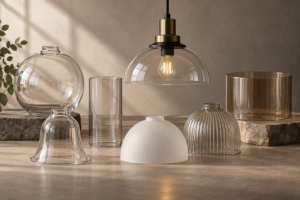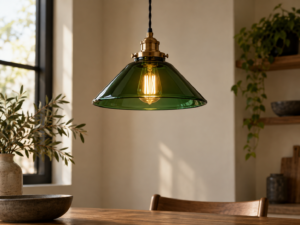
Glass light shades are the removable glass diffusers that mount onto ceiling, pendant, chandelier, and wall fixtures to soften light, control glare, and protect bulbs. Unlike fused fixtures, they’re designed to be swapped, replaced, or upgraded without disturbing the underlying housing.
Buyers searching “glass light shades” usually have one of three problems: a shade just broke and they need a replacement, they’re updating a fixture’s look without rewiring, or they’re specifying shades for a new build. Each problem has different answers, and most lighting category pages collapse them into one — which is why people end up ordering the wrong shade twice before getting it right.
We’ve manufactured glass light shades for residential retail, hotel FF&E, and restoration projects for over two decades. The questions that come up at the point of sale almost always trace back to three measurements and one decision about fitter type. This guide walks through what actually matters when you’re sourcing glass light shades that fit the first time.
What Are Glass Light Shades?
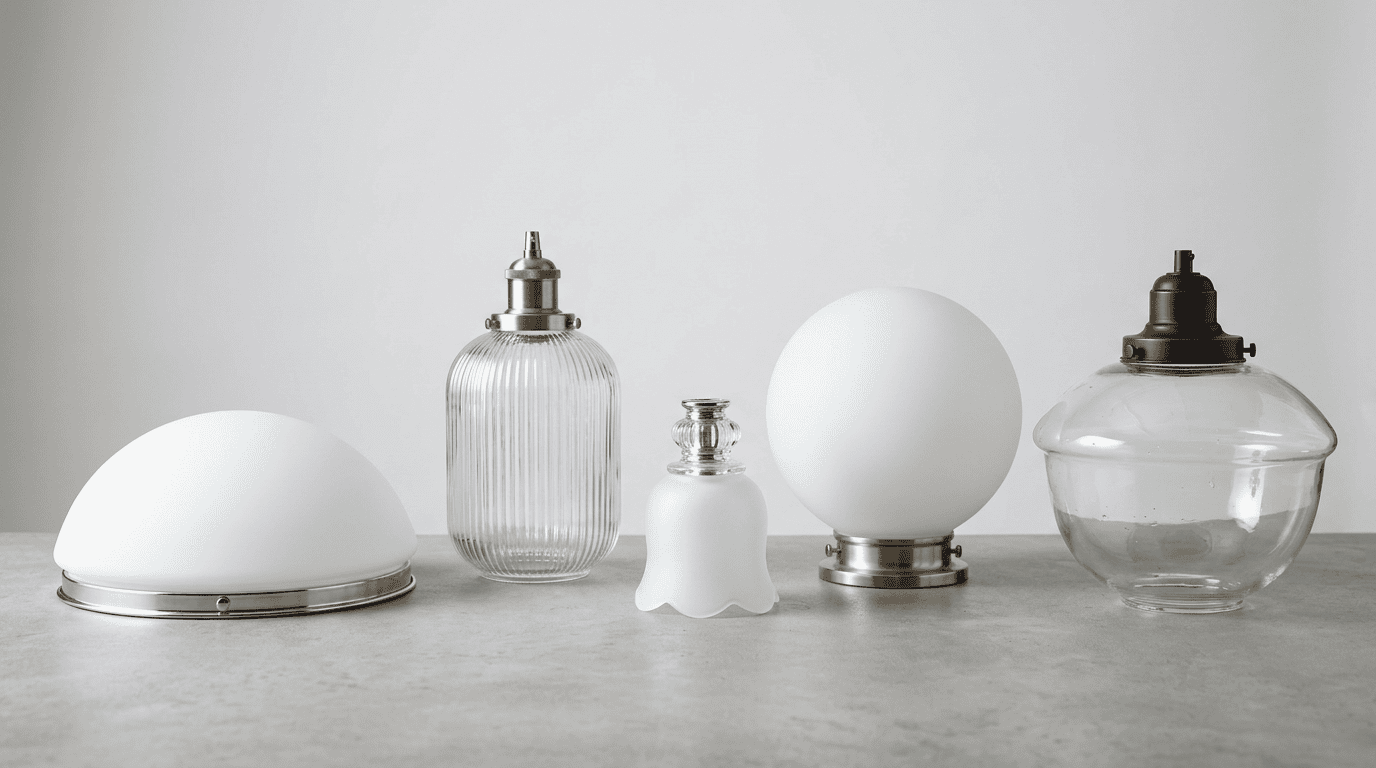
Glass light shades are detachable glass enclosures that mount onto a light fixture’s socket, holder, or arms to diffuse, direct, or color the light output. They’re a distinct product category from integrated glass fixtures, where the glass is permanently fused to the housing.
The key word is detachable. A glass light shade can be removed for cleaning, replaced when broken, or swapped for a different style without rewiring the fixture. That modularity is why a 1950s pendant fixture can still be revived today with a modern reproduction shade — and why specifiers for hospitality and contract projects prefer detachable glass shades over fused alternatives.
Glass light shades vs. glass lamp shades vs. ceiling diffusers
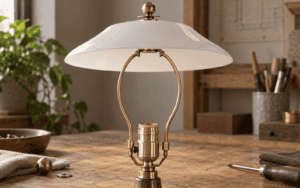
The terms overlap but aren’t identical. “Glass light shades” is the broadest category and covers any glass diffuser on any light fixture. “Glass lamp shades” usually refers specifically to shades on table or floor lamps with a fitter mount. “Ceiling diffusers” describes the flat or slightly domed glass panels on flush-mount ceiling fixtures. When ordering, use the most specific term that matches your fixture type — it cuts search noise and lands you on the right SKU faster.
Why glass keeps winning over plastic and acrylic
Acrylic and polycarbonate diffusers cost 60–80% less than glass and weigh a fraction. They also yellow within 5–8 years under hot bulbs, scratch when cleaned with anything coarser than a microfiber cloth, and develop visible crazing near LED hotspots. According to the U.S. Department of Energy’s lighting materials guidance, polymer diffusers in fixtures with poor heat management lose 15–25% of their light transmission within their first decade. Glass shades hold their transmission curve indefinitely — that’s why every premium hospitality and restoration project still specifies them.
Types of Glass Light Shades
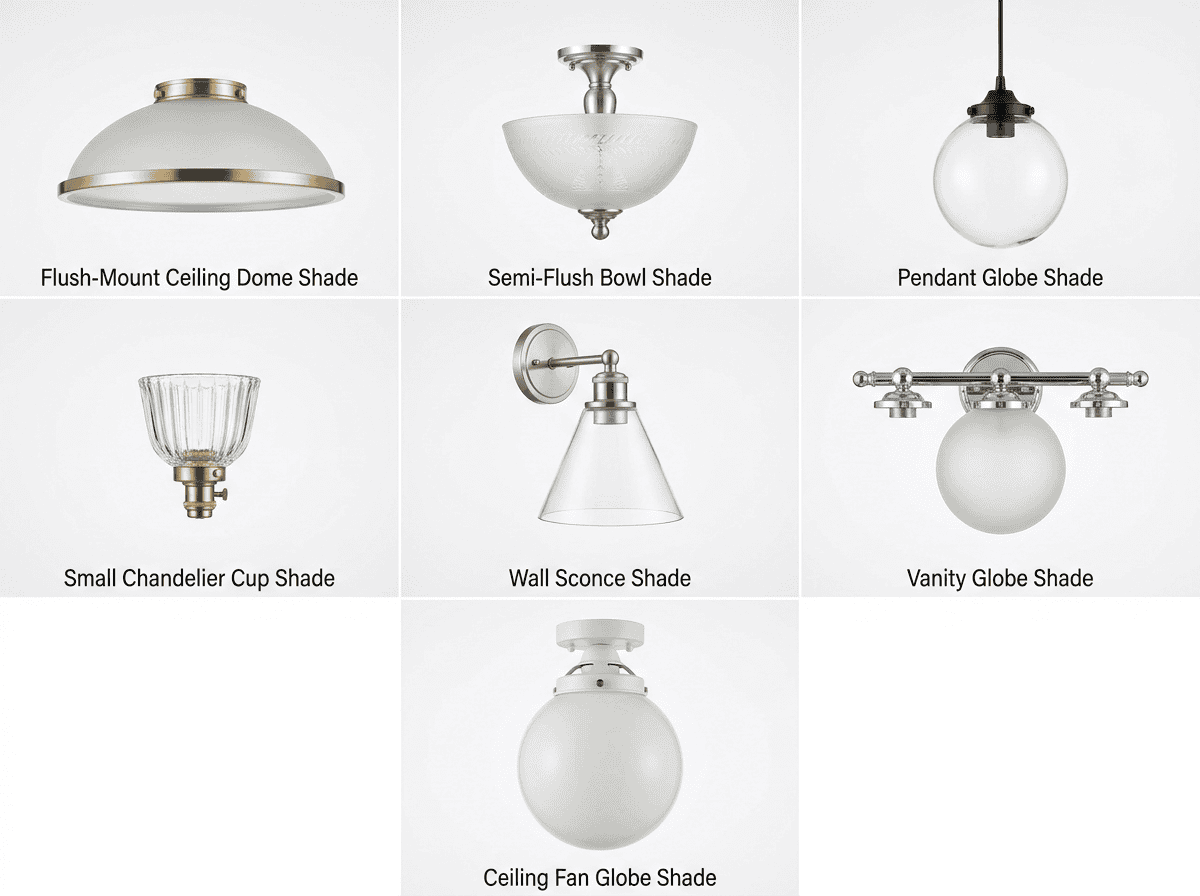
The category splits by fixture type and by glass style. By fixture, the seven mainstream categories are: flush-mount ceiling shades, semi-flush shades, pendant shades, chandelier bobeches and cups, wall sconce shades, vanity light shades, and replacement globes for ceiling fans. By glass style, the seven are clear, frosted, opal cased, seeded, ribbed, stained, and colored cased.
Both taxonomies matter when sourcing — fixture type dictates the mount, glass style dictates the look and light output. A pendant shade and a sconce shade in the same opal cased finish can come from the same factory run, but the mount is different.
Flush-mount ceiling shades
The dome or drum-shaped glass shade that sits flat against the ceiling, mounted via three or four small thumb-screws on the housing rim. Replacement size depends on rim diameter (typically 9″, 11″, 13″, 15″) and rim height (usually 1/2″ or 3/4″). Common failure: thumb-screws strip and the shade falls.
Semi-flush ceiling shades
Hung 4–10 inches below the ceiling on a short stem, with the shade attached via a threaded fitter at the bottom of the stem. Most use 3-1/4″ or 4″ threaded neck. Replacement shade depth and rim diameter both matter — measure both before ordering.
Pendant shades
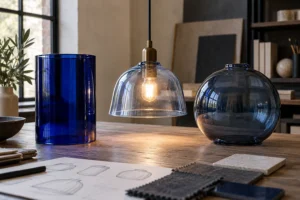
Suspended from a ceiling canopy via a stem, rod, or chain. Mount via 2-1/4″ or 3-1/4″ threaded neck for single pendants, or via a slip-on collar for cluster pendants. Pendant shades carry the widest stylistic range — schoolhouse globes, opal diner pendants, mid-century cones, industrial bell shapes, art deco fluted shades.
Chandelier shades (bobeches and cups)
Small shades (usually 3–5 inches tall) on the individual arms of a chandelier. Mount via 1-5/8″ fitter — the candle-clip standard. Replacement chandelier shades almost always need to match across multiple arms, which is the single biggest sourcing challenge in this category. Manufacturer batches matter.
Wall sconce shades
Mounted on a single arm or directly against a wall plate. Mount via 1-5/8″ fitter (most common), 2-1/4″ fitter (swing-arm sconces), or threaded collar (bath bar sconces). Bath sconces also need to handle higher humidity than living-room sconces — borosilicate is the safer spec.
Vanity light shades
The cluster of shades on a horizontal bar above a bathroom mirror. Typically 3-pack or 5-pack matched sets, mount via 1-5/8″ or 2-1/4″ fitter. Common style: opal globe, frosted bell, or clear ribbed cylinder. Match all shades from the same batch — bathroom lighting amplifies color mismatch.
Ceiling-fan replacement globes
Fan-light kits use small 4″ or 4-1/2″ fitter globes — a distinct standard from regular pendant shades. Replacement globes for ceiling fans are inexpensive ($8–$30) but easy to mismatch with regular fitter sizes. Always specify “4 inch ceiling fan globe” when ordering.
Quick fixture-type cheat sheet
| Fixture | Common mount | Typical shade size | Price range (replacement) |
|---|---|---|---|
| Flush-mount ceiling | Thumbscrews on rim | 9″–15″ rim diameter | $25–$140 |
| Semi-flush ceiling | 3-1/4″ or 4″ threaded neck | 8″–14″ diameter | $30–$180 |
| Pendant | 2-1/4″ or 3-1/4″ threaded neck | 6″–18″ diameter | $20–$320 |
| Chandelier arm | 1-5/8″ fitter | 3″–5″ tall | $8–$60 each |
| Wall sconce | 1-5/8″ or 2-1/4″ fitter | 5″–9″ tall | $15–$95 |
| Vanity bar | 1-5/8″ or 2-1/4″ fitter | 4″–7″ tall | $12–$75 each |
| Ceiling fan | 4″ or 4-1/2″ fitter | 4″–7″ diameter | $8–$30 |
Glass Styles for Light Shades
Beyond fixture type, the visual style of the glass shade is what most buyers think about first. Seven mainstream styles cover roughly 95% of catalog SKUs.
Clear pressed glass. Highest light transmission (88–92%), cheapest to produce. Pair with frosted bulbs or filament Edison bulbs where the filament is part of the look. Common in industrial pendants, schoolhouse fixtures, and laboratory-inspired designs.
Frosted (sandblasted or acid-etched). Light transmission 65–80%, fingerprints don’t show, glare disappears. The most-specified finish for residential and bathroom fixtures.
Opal cased white. Two-layer construction with a clear inner and white outer (or vice versa) gives an even glow with no visible filament hotspot. Light transmission 35–55% depending on opal thickness. Schoolhouse globes, diner pendants, mid-century reproductions.
Seeded/bubbled glass. Intentional small bubbles scatter light without dropping transmission much (78–85%). Farmhouse and coastal aesthetics. True mouth-blown seeded glass varies bubble-to-bubble; machine-pressed “seeded” looks mechanical.
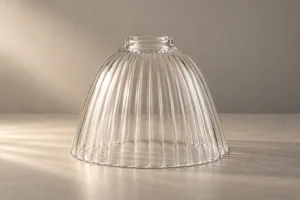
Ribbed/optic glass. Vertical or spiral pressed ribs create directional sparkle and prismatic shadows. Common in art deco and traditional library fixtures. Holophane prismatic shades — used in industrial and commercial settings since the 1890s — are a specialized ribbed sub-category. The Smithsonian’s documentation of Holophane prismatic glass covers the original optical engineering.
Stained leaded glass. Tiffany-style. Multiple colored pieces soldered into copper-foil or lead-came framework. Mass-produced reproductions run $80–$400; signed period Tiffany shades $3,000–$60,000+.
Colored cased glass. A clear or opal core with a fused colored outer layer — amber, ruby, cobalt, smoke, green. Cobalt transmits only 8–18% of light, making colored cased glass shades better suited for accent and mood lighting than primary task lighting.
How Glass Light Shades Are Made
Glass light shades use one of three glass families — soda-lime, borosilicate, or lead crystal — formed by one of four methods: pressing, machine blowing, mouth blowing, or casting. Each combination has a different cost profile, dimensional tolerance, and thermal-shock rating.
Soda-lime glass
The workhorse. Roughly 90% of mass-produced glass light shades use soda-lime. Melts at 1450°C, anneals cleanly, takes color pigments well. Thermal shock tolerance is moderate — a thin-walled soda-lime shade can crack from a 70°C sudden temperature change.
Borosilicate glass
Handles 820°C continuously and survives thermal swings up to 165°C. The right choice for outdoor fixtures, commercial kitchens, and fixtures with halogen capsules or high-wattage incandescent bulbs. Costs roughly 3× the raw materials of soda-lime.
Lead crystal
Decorative only. The lead content boosts refractive index but lowers thermal tolerance. Common in chandeliers and prismatic shades; not used in any commercial heat-exposed application.
Pressing vs. blowing
Pressed shades go through a steel mold and plunger; one cycle takes 8–14 seconds and produces shades with ±0.5 mm wall thickness variance. Mouth-blown shades take 4–9 minutes per piece, vary by ±1.5 mm, and carry visible irregularities. Pressed wins on cost and consistency; mouth-blown wins on character and authenticity for restoration work.
The annealing step
After forming, every glass light shade goes through a lehr — a temperature-controlled tunnel oven cooling the piece from ~550°C to room temperature over 30–120 minutes. Skipping or rushing this step locks internal stresses into the glass; the shade may crack spontaneously days or weeks later. Reputable manufacturers run polariscope checks on production samples to verify residual stress is below 5 MPa. Ask for the polariscope photos when auditing a new supplier.
How to Choose Glass Light Shades
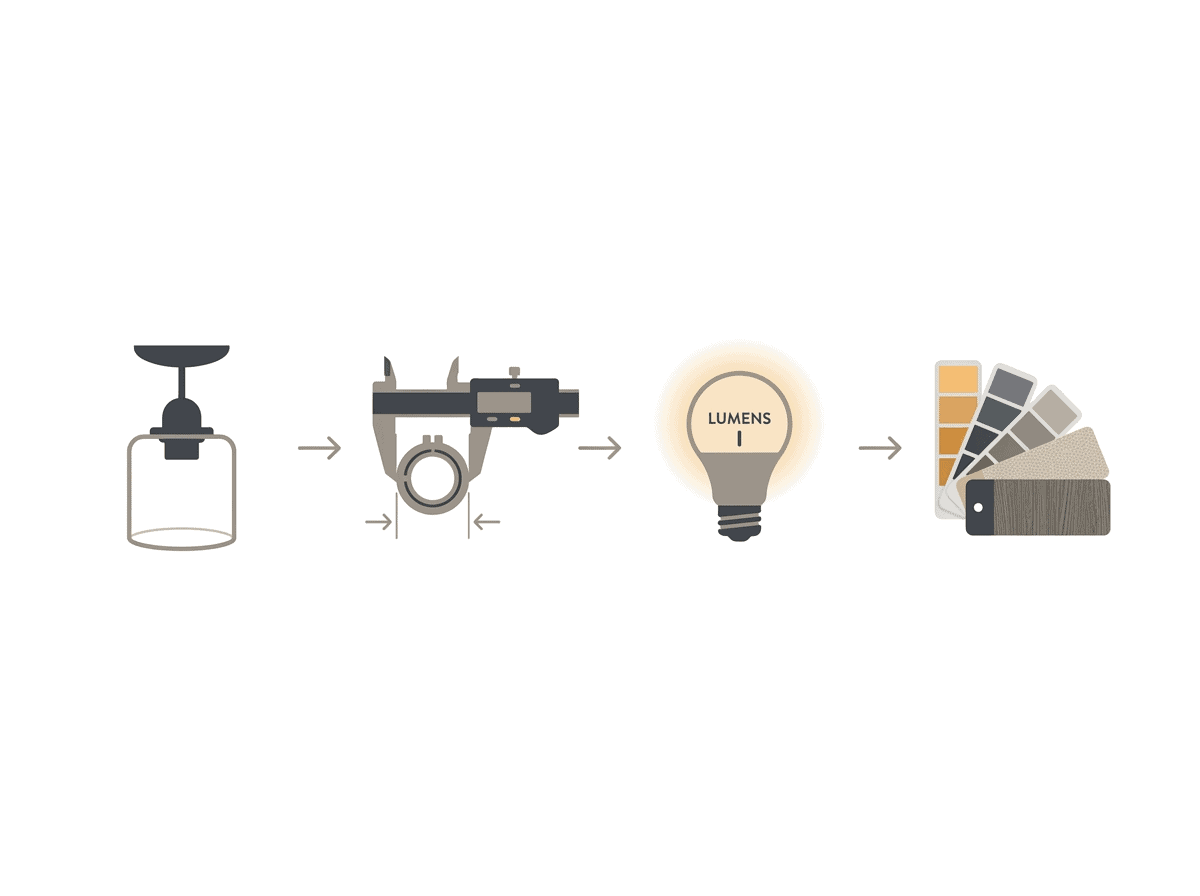
Match four things in this order: fixture type first, fitter or mount second, light transmission third, glass style and color fourth. Get the fixture type and mount wrong and nothing else matters because the shade won’t even attach.
Step 1: Identify the fixture type
Look at how the existing shade attaches. Thumbscrews on the rim? Flush-mount. Threaded collar at the top? Pendant or semi-flush. Three or four wire arms holding it like a bowl? Slip-shade. Small clip on the lamp arm? Chandelier or sconce. Knowing the mount type narrows the search by 80%.
Step 2: Measure the fitter or mount
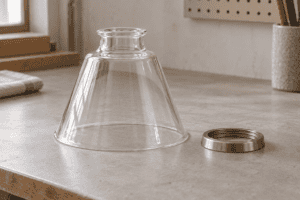
For threaded fitters, measure the inside diameter of the shade opening to ±0.5 mm. Common sizes: 1-5/8″ (41 mm), 2-1/4″ (57 mm), 3-1/4″ (82 mm), 4″ (101 mm). For flush-mount thumbscrew shades, measure the rim outside diameter and rim height. For chandelier and sconce fitters, the standard is 1-5/8″ with a small clip-on retainer.
Step 3: Pick a light transmission target
A 60W-equivalent LED bulb (~800 lumens) behind a clear glass light shade delivers ~720 lm to the room. Behind an opal cased shade at 45% transmission, that drops to ~360 lm. The Illuminating Engineering Society’s residential lighting handbook gives target foot-candle levels for each room type, which translates back into bulb wattage and shade transmission.
Step 4: Choose the style and color
Once mount and transmission are fixed, aesthetics is the last decision. Hold candidate shades next to the wall color and existing fixtures; opal looks warm against cream walls and cold against gray walls. For colored cased glass, view both lit and unlit before committing to a multi-shade order — many ambers look brown unlit and golden when lit.
Decision matrix
| If you need… | Choose | Avoid |
|---|---|---|
| Bright task light | Clear or frosted | Stained, dark cased |
| Glare-free reading | Opal cased, frosted | Clear with exposed filament |
| Bathroom vanity | Opal cased or frosted (borosilicate for high-humidity) | Polymer diffusers |
| Restoration of vintage fixture | Mouth-blown custom | Pressed substitute |
| Outdoor or covered patio | Borosilicate, IP-rated | Soda-lime thin-wall |
| Ceiling fan replacement | 4″ fitter globe | Regular pendant shade |
| Chandelier arm replacement | Same-batch fitter cups | Mix-batch ordering |
Industry Applications
Glass light shades flow through five major channels: residential retail, hospitality FF&E, contract office, restoration, and commercial/industrial. Each has different specs, volume profiles, and reorderability requirements.
Residential retail
The largest channel by unit volume. Department stores, lighting showrooms, and online marketplaces stock replacement glass light shades in standard fitter sizes. Buyer expectations: shade arrives unbroken, fits the published fitter size, color matches photos within reason. Returns rate runs 6–12% depending on packaging quality.
Hospitality FF&E
Hotels, restaurants, bars order glass light shades in lots of 20–2,000 per project. Specs are tight: matching color across the lot, ≥5-year supply commitment on replacements, packaged for staff to install without specialized tools. Hospitality FF&E orders prioritize reorderability over unit price — losing a discontinued shade mid-rollout costs 4–8× the original unit price to remediate.
Contract office and commercial
Corporate offices, executive suites, reception areas, retail interiors. Smaller volumes per project (10–80 shades) but higher per-unit price points ($35–$280). Specifiers reference CRI, CCT compatibility, and matching across multi-room projects.
Restoration
Specialty market for shades matching 1900–1970 vintage fixtures. Mouth-blown reproductions dominate; CNC-pressed alternatives are visibly wrong to collector eyes. Common buyer: antique dealer, homeowner with a documented fixture model, restoration contractor.
Commercial and industrial
Schoolhouse globes for institutional fixtures, prismatic Holophane-style shades for warehouses and gymnasiums, vapor-tight outdoor shades for industrial sites. Borosilicate dominates. According to Statista’s commercial lighting market data, commercial lighting accounts for roughly 38% of total lighting industry revenue, with glass shades a small but stable component of that mix.
Sourcing Glass Light Shades
Five channels with different MOQ, lead time, customization, and reorderability profiles.
Direct from manufacturer. Best for orders over 100 units of a single SKU. MOQ typically 100–500. Unit pricing 35–60% below retail. Lead times 30–90 days, longer for custom colors or sizes. Right channel for FF&E, contract, and private-label retail.
Lighting distributors. Curated catalogs at retail-plus pricing. Rejuvenation, Schoolhouse Electric, Visual Comfort, regional showrooms. Order 5–30 units per project with 2-week typical ship.
Big-box and online retail. Home Depot, Lowe’s, Lamps Plus, Wayfair, Amazon. Mass-market pricing, broad selection on standard fitter sizes, easy returns. SKU lifespans 18–36 months — poor reorderability for matched sets.
Specialty restoration suppliers. Antique Lamp Supply, Paxton Hardware, BP Lamp Supply. Period-correct glass light shades for 1900–1970 fixtures. Higher unit price but irreplaceable for restoration projects.
Online marketplaces. Etsy, eBay, Alibaba. Wide quality variance. Sample-before-order is essential. Best for orders of 500+ units when factory-direct retail relationships aren’t established.
Quality Inspection: What to Check Before Accepting Shipment
When a pallet of glass light shades arrives, the first 30 minutes of inspection determine whether the order succeeds or becomes a dispute. Pull a 5% random sample and check five things.
Dimensional accuracy. Caliper the fitter diameter on each sample shade. Reject if more than 5% fall outside the spec tolerance. Even 0.8 mm oversize on a 2-1/4″ fitter means shades won’t seat in their fittings.
Surface defects. Look for stones (unmelted batch material), unwanted seeds, cords (visible flow lines), and rim chips. The acceptable defect rate for AQL Level II inspection is typically 2.5% major defects for decorative glass light shades — write this tolerance into the PO.
Color consistency across the lot. Line up 10 shades against a white wall under a calibrated light source. Cased colors should match within Delta-E 2.0; clear and frosted shades should be visually indistinguishable. Batch-to-batch drift is common with colored glass — record the production batch number on each carton for traceability.
Annealing integrity. A field test: tap two shades gently together. Properly annealed glass rings clearly; poorly annealed glass sounds dull. For high-value orders request polariscope test reports rather than relying on field tests.
Packaging. Open one carton. The shade should sit in molded inserts or honeycomb dividers with at least 25 mm of dunnage on all sides. Loose-packed shades arrive broken — roughly 1 in 8 break in transit when packaging is undersized.
Document defects with photographs before filing claims. Most manufacturers will replace or credit out-of-spec shades within 30 days of delivery if defects are properly documented.
Common Mistakes When Buying Glass Light Shades
Ordering by “approximate” fitter size. A 2-1/4″ shade does not fit a 2-1/8″ fitter. The 1/8″ mismatch means the shade either won’t seat or will be too loose to hold. Measure to ±0.5 mm and order to that spec.
Assuming pendant and chandelier shades interchange. They don’t. Pendants use 2-1/4″ or 3-1/4″ threaded necks; chandeliers use 1-5/8″ clip-on fitters. The shade dimensions also differ — pendant shades are typically taller, chandelier shades are shorter and wider.
Buying single replacements for matched sets. Glass color and seediness vary batch-to-batch by Delta-E 1–3. A replacement shade for a 6-shade chandelier or 3-shade vanity bar will subtly mismatch the surviving shades if ordered from a different batch. Order spares at original purchase time.
Skipping the heat rating check. A 40W incandescent bulb runs the shade surface at 80–110°C. A 9W LED equivalent runs it at 35–50°C. Switching to LED retroactively is fine; switching back to incandescent on a shade rated for LED-only thermal loads can crack it.
Mixing pressed and mouth-blown in the same fixture. They have different wall thickness, different surface texture, and different light scattering. Even in the same nominal size and finish, they look different side-by-side. Stick to one method per fixture.
Ignoring rim quality. A poorly fire-polished rim is sharp enough to cut fingers during install. Quality manufacturers fire-glaze every shade rim; cost-cutting suppliers skip this step. Run a fingertip around the rim before signing off on a sample.
Care and Maintenance
Glass light shades need cleaning every 3–6 months to prevent dust accumulation that reduces light output by 8–15% over a year. Done right, the cleaning takes 5 minutes per shade.
Cleaning routine
Power off the fixture and let the bulb cool completely. Remove the shade (loosen thumbscrews, unscrew threaded collar, or unhook clip). Wash in warm — not hot — water with mild dish soap. Dry with a microfiber cloth. Reinstall with the thumbscrews snug but not over-torqued.
What not to do
Never spray glass cleaner directly onto a hot shade still mounted on the fixture; the thermal shock can crack it. Don’t use abrasive scrubbers on sandblasted or acid-etched finishes — they scratch the texture. Don’t soak shades in dishwashers; the high-temperature drying cycle stresses the glass.
Long-term storage
If a fixture is being moved or stored, remove the glass light shade and wrap separately in bubble wrap. Shades left mounted during a move vibrate against the fixture hardware and crack at the rim.
Future Trends 2026 and Beyond
Three trends are shaping glass light shades demand: smart-bulb compatibility, sustainability and recycled cullet, and reshoring of short-run custom production.
Smart-bulb compatibility
Color-tunable LED bulbs (2200K–6500K) interact unpredictably with cased colored glass light shades. An amber-cased shade tuned correctly at 2700K turns muddy at 4000K. Expect manufacturers to publish CCT-tested shade compatibility charts as a standard spec by 2027.
Recycled cullet and embodied carbon
Soda-lime glass light shades made with 30–50% recycled cullet cut embodied carbon by roughly 25% per unit without affecting optical quality. LEED-eligible glass shades are emerging as a category for hospitality and office projects pursuing certification.
Reshoring of short-run production
High-volume residential shade production stays in Asia, but restoration, custom, and design-led short-run work is partially reshoring to the U.S. and Europe. Lead times for short-run custom (under 200 units) are projected to halve by 2027 as more regional workshops come online.
Modular field-replaceable design
Right-to-repair regulations in the EU and California are pushing fixture manufacturers to publish parts catalogs with replacement-shade SKUs as a competitive differentiator. Expect this to become standard for premium residential and commercial fixtures by 2027.
What won’t change
The four standard fitter sizes (1-5/8″, 2-1/4″, 3-1/4″, 4″). The basic glass families (soda-lime, borosilicate, lead crystal). The visual taxonomy of clear / frosted / opal / seeded / ribbed / stained / colored. Sourcing playbooks built around these durable specs outlast any one supplier’s catalog.
FAQ
Can I replace glass light shades myself?
Yes — most glass light shades are designed for tool-free or simple-tool replacement. Power off the fixture at the breaker, let the bulb cool completely, loosen the thumbscrews or unscrew the threaded collar, lift off the old shade, install the new one, retighten. Total time per shade is usually 3–8 minutes. If the fixture is hardwired and the housing needs to come down, call an electrician — but the shade itself is a homeowner-level task.
How do I know what size replacement glass light shade I need?
Measure three dimensions: fitter inside diameter (±0.5 mm), shade overall height, and shade rim outside diameter. For flush-mount fixtures, also measure the rim height (1/2″ or 3/4″). Photograph the existing shade with a ruler in frame for scale. Send all four measurements plus the photo when ordering — suppliers can usually match a replacement from those four data points.
Are glass light shades better than plastic or acrylic?
Yes for any fixture you want to keep looking new for over a decade. Acrylic yellows under hot bulbs within 5–8 years, scratches easily during cleaning, and develops crazing near LED hotspots. Glass holds its light transmission and surface finish indefinitely. The trade-offs are weight (glass is 3–5× heavier) and impact fragility — for kid’s rooms or high-traffic areas, acrylic may still serve better despite the shorter lifespan.
Why do my glass light shades crack near the bulb?
Thermal shock from hot bulbs in cold environments, undersized shades for the bulb wattage, or poor annealing during manufacturing. Switch to LED bulbs (60% cooler than incandescent), verify the shade is rated for your bulb’s wattage, and if cracks appear within months of install, request a polariscope inspection report from the manufacturer — poorly annealed shades crack spontaneously regardless of use.
What’s the difference between a globe and a shade?
A globe is a specific sub-type of shade: round or oval, fully enclosed, used on pendants and schoolhouse fixtures. All globes are shades; not all shades are globes. Cone, drum, bell, and bowl-shaped shades are not globes. When ordering, use the more specific term that matches your fixture — “globe” narrows search results faster than “shade” if your fixture uses a round enclosure.
Can old glass light shades be repaired?
Hairline cracks can sometimes be stabilized with UV-cured optical adhesive; chips can be polished on the rim; missing pieces of stained-glass shades can be replicated by a specialist. Repair makes economic sense for signed period shades (Tiffany, Handel, Pairpoint, Quezal) worth $500+. For mass-produced shades under $100, replacement is usually cheaper than repair.
Do glass light shades require special bulbs?
Most glass light shades work with any standard bulb that fits the fixture’s socket and stays within the maximum wattage rating. LED bulbs run cooler and extend shade life. The exceptions: colored cased shades shift unpredictably under color-tunable LEDs (test before installing across a multi-room project), and frosted or opal shades may produce visible LED flicker under cheap dimmer-LED combinations (use flicker-free dimmable bulbs).
Conclusion
Sourcing glass light shades comes down to four ordered decisions: identify the fixture type, measure the fitter to half-millimeter precision, target the right light transmission for the room, then pick the glass style that fits the space. Skip the measurement step and you’ll send the shade back; skip the transmission step and you’ll fight the lighting forever; skip the style step and you’ll just live with a look you don’t love.
For matched-set fixtures — chandeliers, vanity bars, paired pendants — order from a single production batch and buy spares at the original purchase. Replacement orders from different batches will mismatch by Delta-E 1–3, and that’s the single most common post-sale complaint in the glass light shades category. We’ve shipped over 60,000 matched-set glass light shades against measurable specs since 2003, and the projects that ship to plan almost always start with a one-page spec sheet rather than a Pinterest board.