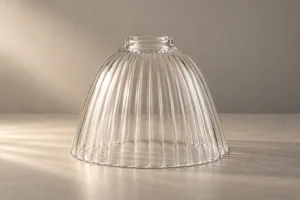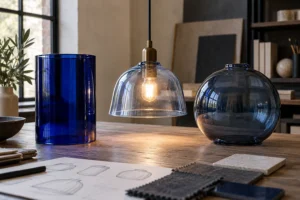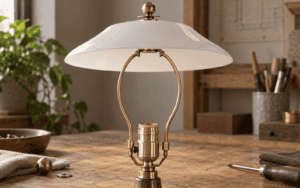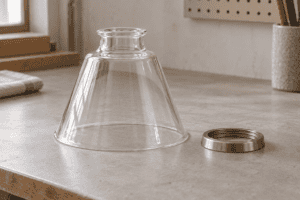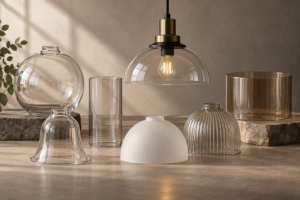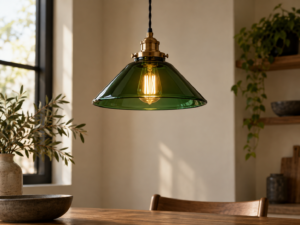
Glass bulb shades are small bulb-shaped or bulb-cover glass diffusers — typically 3 to 6 inches — that mount directly over a bare bulb to soften light, hide the filament, and add decorative form. They sit at the intersection of decorative shading and exposed-bulb styling, and they fit fixtures where a full-size lamp shade would overwhelm the design.
When buyers search “glass bulb shades,” they’re rarely looking for a 12-inch pendant globe. They want the small, bulb-scale glass cover that slips over an Edison bulb or an LED candle, the kind that turns a bare-socket sconce or chandelier into something finished. The category covers candelabra chimneys, mini schoolhouse globes, vanity mini-shades, and bulb-shaped decorative covers — and the sourcing rules are different from full-size shades.
We’ve manufactured glass bulb shades for chandeliers, sconces, and exposed-fixture pendant projects since 2003, mostly for hospitality and restoration clients. The recurring questions are the same: what size fitter, how does it interact with the bulb’s heat, and how do you match a replacement across a chandelier when one breaks. This guide covers what actually matters.
What Are Glass Bulb Shades?
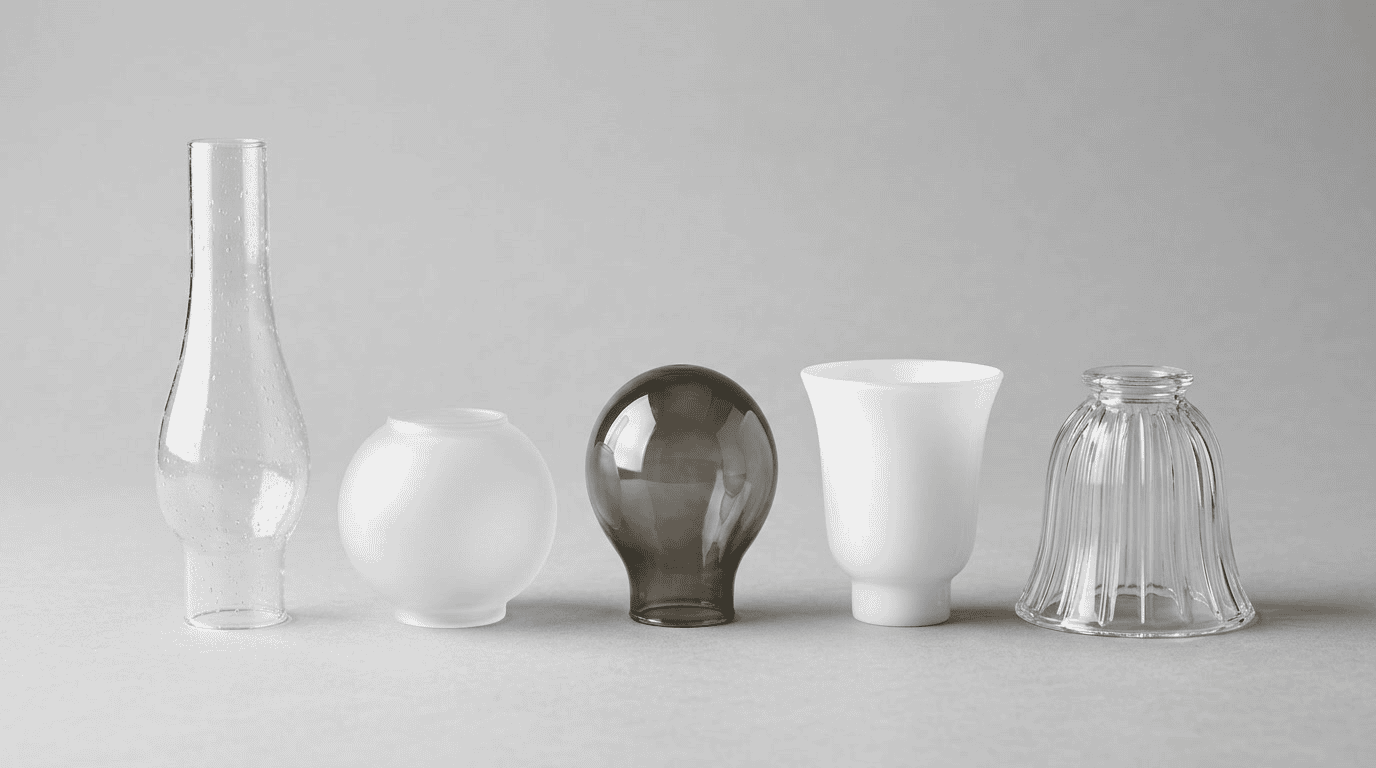
Glass bulb shades are bulb-scale glass diffusers — usually 3 to 6 inches tall, 2 to 4 inches in diameter — that attach directly to the bulb socket or to a small fitter ring designed for candelabra and mini-base fixtures. They differ from full-size lamp shades in three ways: smaller dimensions, smaller fitter standards (predominantly 1-5/8″), and tighter thermal margins because the glass sits closer to the bulb.
The category is dominated by chandelier arms, wall sconces, vanity bars, and exposed-bulb pendant fixtures. Anywhere a bare bulb would look too utilitarian and a full-size shade would look too heavy, a glass bulb shade fills the gap.
How they differ from regular lamp shades
A full-size lamp shade sits 4–8 inches above the bulb on a harp; the air gap between bulb and shade dissipates heat. A glass bulb shade sits 0.5–2 inches from the bulb, so the glass surface runs hotter — 80–130°C with a 40W incandescent. That’s why bulb shades almost always specify LED-compatible thermal ratings rather than vintage incandescent specs. The U.S. Department of Energy’s guidance on LED retrofits in enclosed fixtures covers the heat math in detail.
Why the category survives in the LED era
You’d think exposed-filament LED Edison bulbs would have killed the bulb-shade market. They haven’t. Buyers still want frosted, opal, and colored glass bulb shades for three reasons: glare control (a clear Edison bulb is uncomfortable to look at directly), color shift (amber-cased bulb shades give warmth that filament LEDs can’t), and aesthetic completion (a bare socket and bulb still reads as “unfinished” in most residential and hospitality contexts). The bulb-shade category has actually grown in the LED era because LED’s lower heat output opens up shade designs that couldn’t survive next to a 60W incandescent.
Types of Glass Bulb Shades
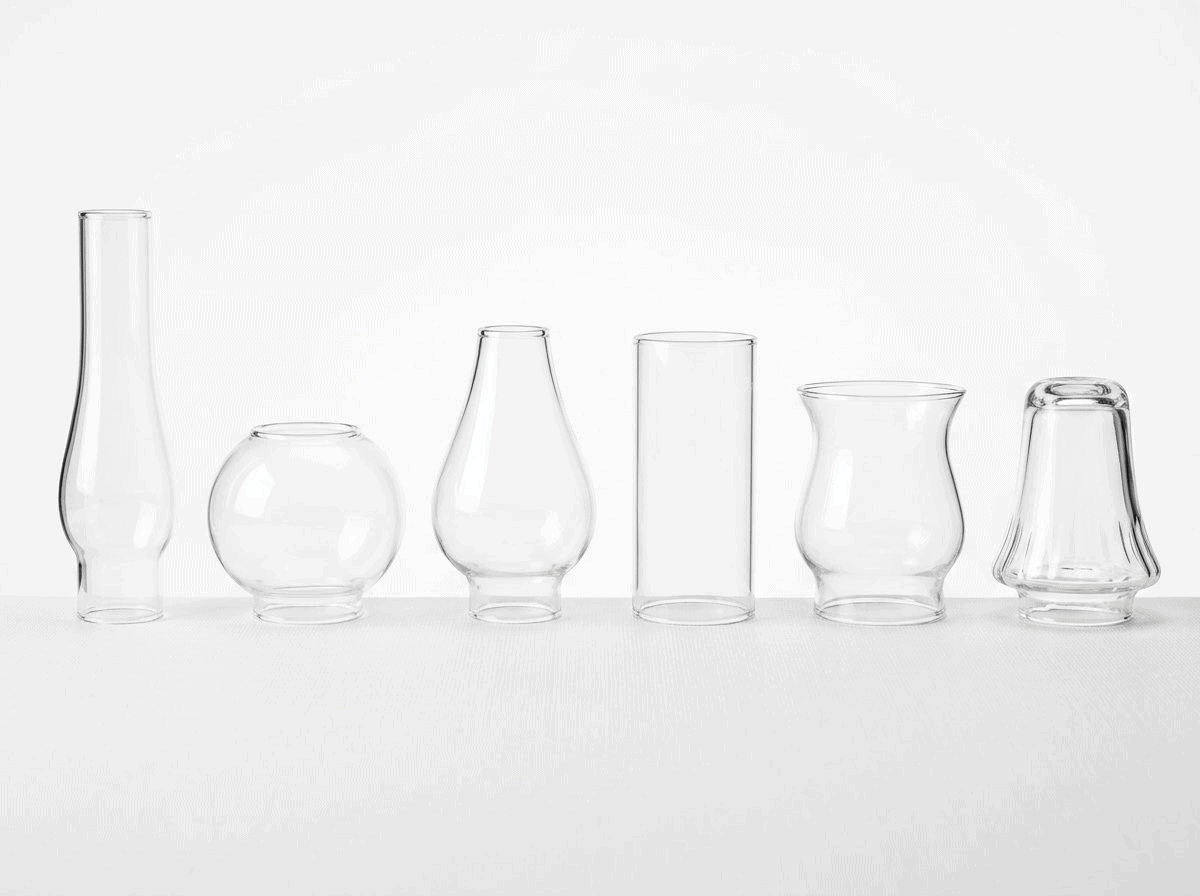
The category breaks into six mainstream types: candelabra chimneys, mini globes, bulb-shaped decorative covers, vanity mini-shades, chandelier hurricane cups, and salt-shaker (bell) shades. Each has a distinct fitter standard and a typical fixture application.
Candelabra chimneys
Tall slim glass cylinders (3–6 inches tall, 1.5–2 inches diameter) designed to mount over a candelabra-base (E12) bulb on a candle-style chandelier arm. They fit a 1-5/8″ fitter or a small candle clip. Common finishes: clear seeded, frosted ribbed, opal cased. The defining proportion: roughly 3× taller than wide.
Mini globes
Small spherical glass shades, typically 3–4 inches in diameter, used on chandelier arms, vanity bars, and mini pendants. Fitter sizes 1-5/8″ (most common) or 2-1/4″. The signature feature: a round shape that wraps the bulb without elongating it. Schoolhouse-style mini globes dominate this sub-category.
Bulb-shaped decorative covers
Glass shades formed to look like a stylized version of the bulb itself — usually a slightly oversized teardrop, pear, or A-shape silhouette. They sit close to the bulb (1/4 to 1/2 inch clearance), so the bulb shape is enhanced rather than hidden. Popular in mid-century reproduction and modern industrial fixtures.
Vanity mini-shades
Cylindrical or bell-shaped shades 4–7 inches tall, designed for bathroom vanity bars. Almost always sold as matched 3-packs or 5-packs because vanity bars carry multiple bulbs side-by-side. Fitter sizes 1-5/8″ or 2-1/4″. Frosted and opal cased dominate; clear is rare because bathroom vanity lighting needs glare control.
Chandelier hurricane cups
Short wide glass cups (2–4 inches tall, 3–5 inches diameter) that sit on a chandelier arm under a longer chimney or alone as a candle-cup shade. They reference the historical hurricane lamp form. Fitter is usually a 1-5/8″ arm clip.
Salt-shaker (bell) shades
Compact bell-shaped shades 4–6 inches tall with a flared rim. They were originally used to cover bare bulbs on industrial work lights in the 1910s–1930s. Modern reproductions use them on schoolhouse-style fixtures and barn-light reproductions. Fitter 1-5/8″ or 2-1/4″.
Quick type comparison
| Type | Typical size (H × D) | Common fitter | Typical fixture | Price range (single) |
|---|---|---|---|---|
| Candelabra chimney | 4–6″ × 1.5–2″ | 1-5/8″ / clip | Candle chandelier | $4–$28 |
| Mini globe | 3–4″ × 3–4″ | 1-5/8″ or 2-1/4″ | Chandelier, vanity, mini pendant | $6–$45 |
| Bulb-shaped cover | 4–6″ × 2.5–3.5″ | 1-5/8″ or socket-mount | Mid-century, industrial | $8–$60 |
| Vanity mini-shade | 4–7″ × 3–4″ | 1-5/8″ or 2-1/4″ | Bath vanity bar | $5–$35 each |
| Hurricane cup | 2–4″ × 3–5″ | 1-5/8″ arm clip | Chandelier | $5–$40 |
| Salt-shaker (bell) | 4–6″ × 3–4″ | 1-5/8″ or 2-1/4″ | Schoolhouse, barn-light | $7–$50 |
How Glass Bulb Shades Are Made
Glass bulb shades use the same three glass families as full-size shades — soda-lime, borosilicate, lead crystal — but forming methods skew more toward pressing because the smaller scale gives pressing a cost advantage. Mouth-blown bulb shades exist but represent under 10% of category volume.
Pressing dominates small-scale production
A pressed glass bulb shade goes from molten gob to finished blank in 6–10 seconds. The smaller mold cavity holds temperature better than full-size molds, so wall thickness consistency is excellent — typical variance ±0.3 mm versus ±0.5 mm on a 10-inch pendant shade. Annealing cycles are shorter (20–40 minutes versus 60–90 minutes for larger pieces), which is why pressed bulb shades make economic sense even in shorter production runs.
Mouth blowing for restoration and high-end design
A mouth-blown glass bulb shade takes 3–7 minutes per piece. The visible irregularities — slight asymmetry, varied bubble distribution, hand-finished rims — are exactly what restoration and high-end design buyers want. According to documentation from the Corning Museum of Glass on traditional glassblowing, the small-scale forming of bulb-size shades is one of the oldest production patterns in decorative glass and predates electric lighting by centuries.
The annealing question for thin-walled bulb shades
Bulb shades are usually thin-walled (1.5–2.5 mm) to keep weight down for the small fitters. Thin walls cool faster in the lehr, so annealing requires careful programming to avoid locking in residual stress. Reputable factories run polariscope checks on every production batch of bulb shades because the high surface-to-mass ratio makes stress defects more dangerous than in heavier pieces.
Surface treatments on bulb shades
Frosting (acid-etched or sandblasted), fired-on white enamel for opal effects, ceramic frit colors for cased looks, and copper-foiled stained-glass construction for Tiffany-style bulb covers. The same surface-treatment menu as full-size shades, scaled down. Avoid spray-on lacquer-painted bulb shades — the close proximity to the bulb means paint peels within 12–24 months in any commercial use.
How to Choose Glass Bulb Shades
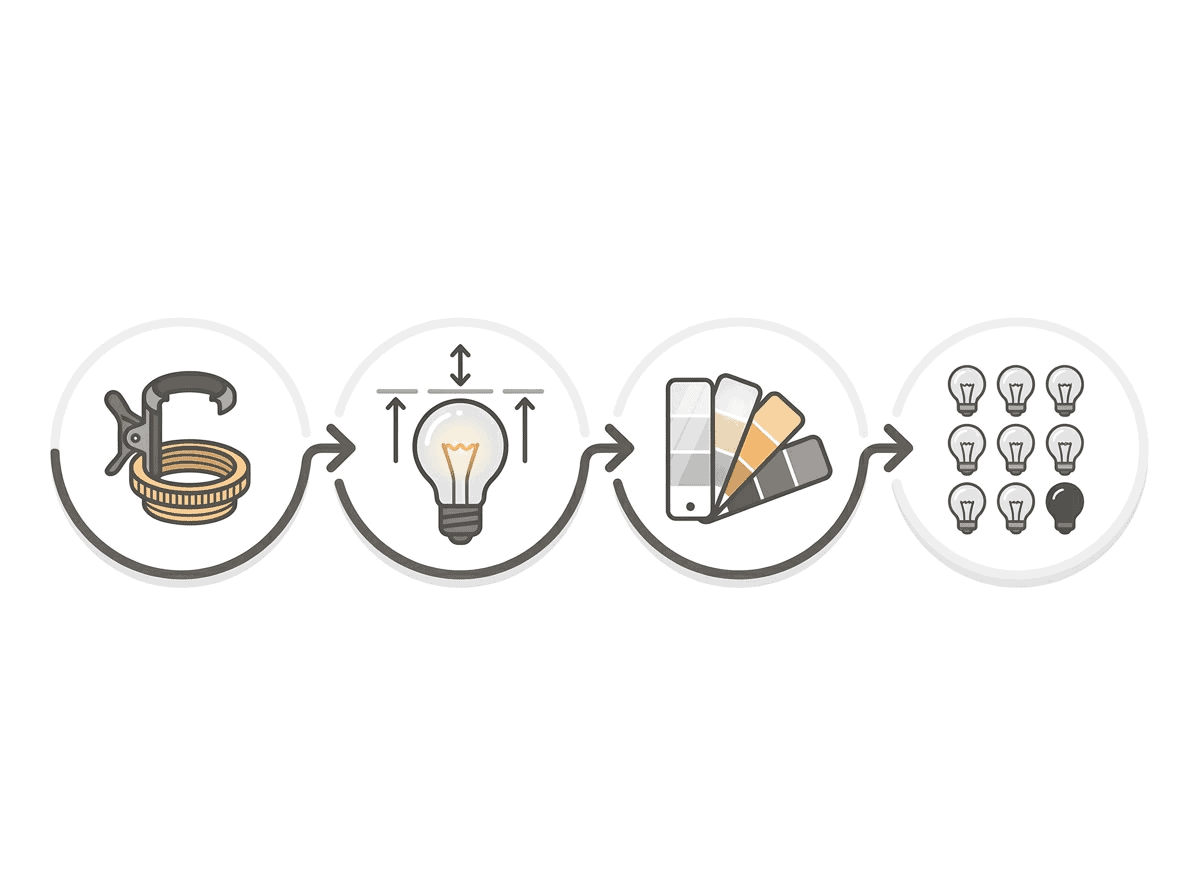
Match four things in this order: fitter standard first, bulb-to-shade clearance second, finish and color third, set-matching fourth. The order matters because the small scale of bulb shades makes mismatches more visible than on full-size shades.
Step 1: Confirm the fitter standard
The vast majority of glass bulb shades use a 1-5/8″ fitter (the candelabra-clip standard). A smaller subset uses 2-1/4″. A few unusual fixtures use a socket-mount where the shade screws directly onto the threaded portion of the socket. Look at how the existing shade attaches before ordering a replacement — measure the fitter inside diameter with calipers to ±0.5 mm.
Step 2: Verify bulb-to-shade clearance
A glass bulb shade should clear the bulb by at least 1/4 inch on all sides for an LED, 1/2 inch for incandescent, and 3/4 inch for halogen. Too-close clearances cause hotspot cracking on the shade and accelerate bulb failure from trapped heat. The Underwriters Laboratories standard UL 1598 for luminaires covers the minimum air gap requirements for enclosed bulb fixtures.
Step 3: Pick finish and color
Frosted bulb shades give the cleanest glare control. Opal cased gives the most even glow. Clear seeded or clear ribbed shades let the filament show through (good for Edison-bulb aesthetics). Colored cased (amber, smoke, cobalt) is accent only — light transmission drops to 8–25% in most colored cased glass.
Step 4: Match across the set
Chandeliers and vanity bars carry 3, 5, 6, or 8 bulb shades per fixture. Order all shades from the same production batch. Even within the “opal cased white” category, batch-to-batch color variance runs Delta-E 1–3, which is invisible on a single shade but obvious across a six-arm chandelier. Always order one or two spares at original purchase time — replacement orders 2 years later will subtly mismatch.
Decision matrix
| If you need… | Choose | Avoid |
|---|---|---|
| Candle chandelier replacement | Candelabra chimney, 1-5/8″ fitter | 2-1/4″ pendant shade |
| Bathroom vanity bar | Matched-batch frosted or opal mini-shades | Mixed-batch ordering |
| Edison-bulb feature pendant | Clear seeded or ribbed bulb shade | Opal cased (hides the filament) |
| Mid-century reproduction | Bulb-shaped clear or smoke cover | Stained-glass cup (wrong era) |
| Schoolhouse mini-pendant | Opal cased mini globe | Clear pressed (glare) |
| Outdoor or covered patio | Borosilicate, IP-rated bulb shade | Soda-lime thin-wall |
Industry Applications
Glass bulb shades flow through five major sectors: residential retail (chandeliers, vanity bars, sconces), hospitality FF&E (lobby chandeliers, restaurant pendants), restoration (period-correct chandelier cups and chimneys), commercial (bathroom and corridor fixtures), and the growing decorative-pendant exposed-bulb market.
Residential retail
The single largest channel for glass bulb shades by unit volume. Vanity bar replacements, chandelier cup replacements, sconce shade updates. Standard 1-5/8″ fitter dominates; 2-1/4″ is the secondary standard for swing-arm sconces. Retail packs usually come as 3-pack or 5-pack matched sets for vanity bars, or single units for chandelier and sconce replacements.
Hospitality FF&E
Lobby chandeliers, restaurant bar-top pendants, hotel bathroom vanity bars. Hospitality buyers we work with order 50–500 glass bulb shades per project, with tight color-matching specs and 5–10 year replacement supply commitments. Reorderability matters more than initial unit price — a chandelier with one broken shade and no matching replacement looks worse than the entire fixture being replaced.
Restoration
Period-correct chandelier chimneys and cups for 1900–1970 fixtures. The dominant request: mouth-blown clear seeded chimneys to match original arts-and-crafts or art-deco chandeliers. Modern pressed substitutes look mechanical to collector eyes. Specialty restoration suppliers (Antique Lamp Supply, Paxton Hardware) carry the legacy sizes and shapes.
Commercial
Bathroom and corridor fixtures in offices, schools, hospitals. Spec requirements: shatter-resistance ratings (tempered or laminated), cleanability under medical-grade disinfectants, matched-batch ordering for 6-shade or 8-shade vanity bars. Volume per project: 20–200 shades.
Decorative exposed-bulb pendants
The growth segment. Modern industrial-aesthetic restaurants, coffee shops, and design-led residential projects use bulb-shaped or oversized teardrop glass shades over filament LED bulbs as a feature lighting element. According to Statista’s lighting market data, decorative pendant lighting has grown at roughly 8% CAGR for the past five years, pulling glass bulb shade demand along with it.
Sourcing Glass Bulb Shades
Five channels with different MOQ, lead time, and customization profiles.
Direct from manufacturer. Best for orders over 200 units of a single SKU. MOQ typically 200–1,000 (lower per-unit cost means manufacturers want larger runs). Unit pricing 40–65% below retail. Lead times 30–60 days for standard finishes, 60–90 for custom colors. Right channel for hospitality FF&E and private-label retail.
Lighting distributors. Curated catalogs at retail-plus pricing. Smaller order quantities (5–50 units) with 2-week typical ship. Good for designers and contractors.
Big-box and online retail. Home Depot, Lowe’s, Lamps Plus, Wayfair, Amazon. Mass-market pricing on standard sizes (1-5/8″ and 2-1/4″ fitter, frosted or opal finishes). Easy returns. SKU lifespans 18–36 months — poor for matched-set replacement.
Specialty restoration. Antique Lamp Supply, Paxton Hardware, BP Lamp Supply. Period-correct candelabra chimneys, hurricane cups, and stained-glass chandelier shades. Higher unit prices but irreplaceable for restoration jobs.
Trade shows. Las Vegas Market, High Point Market, Hong Kong Lighting Fair. Right for multi-supplier sourcing programs and comparing 10–30 vendors of glass bulb shades in three days.
Common Mistakes When Buying Glass Bulb Shades
Mismatching fitter sizes across a chandelier set. A chandelier with 6 arms needs 6 shades with identical fitter dimensions. Mixed fitters mean some shades won’t seat. Measure all arms before ordering replacements — old chandeliers sometimes have non-uniform arms.
Buying single replacements without batch information. Glass color and seediness vary batch-to-batch by Delta-E 1–3. A single replacement shade for a 6-shade chandelier will subtly mismatch the surviving 5. Order from the same supplier and document the production batch.
Ignoring bulb wattage versus shade clearance. A 40W incandescent in a tight-clearance bulb shade hits 130°C surface temperature and cracks the shade. The same fixture with a 9W LED equivalent runs at 50°C and is safe. If you’re using vintage incandescent bulbs in modern bulb shades, downsize wattage by 50%.
Spray-painted “colored glass” bulb shades. Especially common on cheap imported chandeliers. Spray paint near a hot bulb peels within 12–24 months. Insist on ceramic-frit or fused colored cased glass for any commercial use.
Mixing pressed and mouth-blown in the same fixture. Even within the same nominal style, pressed and mouth-blown shades have different wall thickness and surface texture. Side-by-side on a chandelier they look noticeably different. Stick to one production method per fixture.
Skipping the rim inspection. A poorly fire-polished bulb shade rim is sharp enough to cut fingers during install. Quality manufacturers fire-glaze every rim; cost-cutting suppliers skip the step. Run a fingertip around the rim before signing off on a sample.
Care and Maintenance
Glass bulb shades collect more dust per unit area than full-size shades because they’re closer to the heat source and have higher surface-to-mass ratio. Clean every 2–4 months for residential, every 1–2 months for hospitality.
Cleaning routine
Power off the fixture and let the bulb cool completely. Remove the shade (release the clip, loosen thumbscrews, or unscrew the threaded ring). Wash in warm — not hot — water with mild dish soap. Dry with a microfiber cloth. Reinstall carefully — over-tightening clip fitters cracks the rim.
Inspecting for stress cracks
After cleaning, hold the shade up to a window and look for hairline cracks radiating from the rim or fitter contact point. These often appear before catastrophic failure and indicate either thermal stress (wattage too high) or mechanical stress (over-tightened fitter). Replace cracked shades immediately — they fall apart unpredictably.
Storing replacement spares
Glass bulb shades stored as spares need cushioned packaging or compartmented boxes. Loose storage in drawers leads to rim chipping that makes the spare unusable when finally needed. Mark the box with the original purchase batch and date for traceability.
Quality Inspection: What to Check on a Bulb-Shade Shipment
When a shipment of glass bulb shades arrives, run a 5% sample inspection in the first 30 minutes.
Dimensional accuracy. Caliper the fitter inside diameter on every sampled shade. The small scale of bulb shades means 0.3 mm of variance is the difference between a shade that seats properly and one that wobbles loose. Reject batches where more than 5% fall outside spec tolerance.
Color matching across the lot. Line up 10 shades against a calibrated light source. Cased colors should match within Delta-E 2.0. Variance over Delta-E 3 is visible to most people across a vanity bar or chandelier — reject batches with that level of drift.
Rim quality. Run a fingertip around each sampled rim. Quality bulb shades are fire-polished smooth; cost-cut versions have sharp edges that cut installers’ fingers and chip in transit. Reject batches with non-fire-polished rims.
Annealing integrity. Tap two shades together — properly annealed glass rings clearly; poorly annealed sounds dull. For high-value matched-set orders, request polariscope photos from the production batch. Bulb shades are especially vulnerable to annealing defects because thin walls cool faster.
Packaging. Individual cell dividers are mandatory. Loose-packed glass bulb shades in shared compartments arrive with rim chips on roughly 30% of pieces. Quality manufacturers ship in molded inserts with 15 mm of dunnage per shade — verify with one carton-open inspection.
Document defects with photographs before filing claims. Most manufacturers will replace or credit within 30 days of delivery with proper documentation.
Future Trends 2026 and Beyond
Three trends are reshaping glass bulb shades demand: filament-LED bulb aesthetics, smart-bulb color compatibility, and the broader move toward modular field-replaceable design in commercial lighting.
Filament-LED bulb aesthetics
The continued growth of clear seeded and clear ribbed glass bulb shades is tied directly to the popularity of decorative filament LED bulbs. The bulb itself has become the design feature, with the glass shade serving as a subtle frame rather than a primary visual element. Expect clear-glass bulb shade SKUs to continue growing at 10–15% annually through 2028.
Smart-bulb CCT testing
Color-tunable LED bulbs (2200K–6500K) interact unpredictably with cased colored glass bulb shades. An amber-cased chimney that looks correct at 2700K turns muddy at 4000K. Manufacturers will increasingly publish CCT-tested compatibility charts as a standard spec line by 2027.
Modular field-replaceable design
Right-to-repair regulations in the EU and California are pushing chandelier and sconce manufacturers to publish parts catalogs that include replacement glass bulb shade SKUs. Expect this to become standard for premium fixtures by 2027 — and a major sourcing relief for hospitality buyers who currently fight to find matching replacements 3 years post-install.
Recycled cullet
Soda-lime glass bulb shades made with 30–50% recycled cullet cut embodied carbon by roughly 25% per unit without affecting optical quality. LEED-eligible bulb shades are emerging as a sub-category for projects pursuing certification.
What won’t change
The 1-5/8″ candelabra fitter standard. The basic glass families. The visual taxonomy of clear seeded, frosted, opal cased, ribbed, stained, colored cased. Sourcing playbooks built around these durable specs outlast any one supplier’s catalog.
FAQ
What are the shades that cover a bulb called?
Small glass covers that mount over a bulb are called glass bulb shades, candelabra chimneys, mini globes, or hurricane cups depending on shape and fixture type. “Bulb shade” is the general term; “chimney” describes tall slim cylindrical versions for candle chandeliers; “mini globe” describes round shades 3–4 inches across; “hurricane cup” describes short wide cups on chandelier arms.
Can I put a glass bulb shade on any chandelier?
Only if the chandelier arms have a fitter that matches the shade’s fitter standard. Most candle-style chandeliers use a 1-5/8″ candelabra clip; the matching shade has a 1-5/8″ fitter. Pendant-style chandeliers may use 2-1/4″ fitter shades instead. Measure the existing fitter or photograph it with a ruler in frame before ordering replacements.
How do I replace a single glass bulb shade on a chandelier?
Power off the fixture at the breaker, let bulbs cool, remove the bulb, release the existing shade’s clip or unscrew the threaded ring, install the new shade, reinstall the bulb, restore power. Total time per shade is 4–6 minutes. Use a matched-batch replacement to avoid visible color mismatch with surviving shades — order from the original supplier if known, or source a full-set replacement if the original is discontinued.
Why do my glass bulb shades keep cracking?
Three common causes: bulb wattage too high for the shade’s clearance, switching from LED back to incandescent on a shade rated for LED-only thermal loads, or poor annealing during manufacturing. Verify the shade’s wattage rating, switch to LED bulbs (60% cooler than incandescent), and if cracks appear within months of install, request a polariscope inspection report from the manufacturer.
Are LED bulbs safe in glass bulb shades?
Yes — LEDs run roughly 60% cooler than incandescent equivalents and significantly extend bulb-shade life by reducing thermal cycling. The one caveat: dimmable LEDs can flicker visibly through clear or ribbed glass bulb shades when paired with cheap dimmers. Use flicker-free dimmable LEDs and verify the dimmer is rated for LED loads.
What’s the difference between a chimney and a globe bulb shade?
A chimney is tall and slim — typically 3× taller than wide — and references the historical kerosene-lamp chimney form. A globe is round, typically as tall as it is wide, fully enclosed at the top with a fitter ring at the bottom. Chimneys mount over candelabra-base bulbs on candle chandeliers; globes mount on mini pendants, vanity bars, and chandelier arms.
Can stained-glass bulb shades be used on modern LED bulbs?
Yes — stained-glass bulb shades with copper-foil or lead-came framework work fine with LED bulbs and are actually more compatible with LEDs than with incandescent. LED’s lower heat output reduces solder-joint fatigue in the leaded framework. Just verify the LED’s CCT (color temperature) is in the 2700K–3000K range, since stained-glass colors are tuned for warm-white light and shift unpredictably under cool-white or tunable LEDs.
Pricing Benchmarks for Glass Bulb Shades
Per-unit pricing for glass bulb shades runs $4–$60 retail depending on type, finish, and provenance, with manufacturer-direct pricing landing 35–60% below those numbers at quantity.
The cheapest end of the market — pressed clear or frosted candelabra chimneys in mass retail — runs $4–$10 per shade. These are functional replacements for chandelier arms where matching exactly isn’t critical. Mid-range pressed bulb shades in opal cased or colored cased glass run $15–$35 per unit at retail. Mouth-blown bulb shades for restoration projects start around $25 and climb to $60+ for specialty period reproductions.
Stained-glass bulb shades are their own pricing tier: $40–$300+ depending on complexity and provenance. Signed period Tiffany chandelier shades from the 1900–1920 era trade at auction in the $1,500–$8,000 range, but those are collector items rather than functional replacements.
For commercial-volume orders (200+ units), manufacturer-direct pricing on standard pressed bulb shades drops to $2.50–$15 per unit, with custom colors or etched logos adding $1–$3 per unit. Lead times for those orders run 30–60 days for standard items, 60–90 for custom work.
Conclusion
Sourcing glass bulb shades is a smaller-scale version of the full-size shade sourcing problem with three differences: the fitters are almost always 1-5/8″, batch matching matters more because chandeliers and vanity bars carry multiple shades in close proximity, and thermal margins are tighter because the glass sits closer to the bulb. Get those three things right and the rest of the sourcing decisions are aesthetic.
For matched-set fixtures — chandeliers, vanity bars, sconce pairs — always order spares at original purchase. Replacement orders from different batches will mismatch by Delta-E 1–3, and that’s the single most common post-sale complaint in the glass bulb shades category. We’ve shipped over 100,000 glass bulb shades against measurable specs since 2003, and the projects that ship to plan almost always start with a one-page spec sheet rather than a Pinterest board.