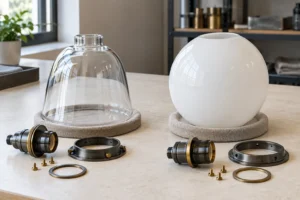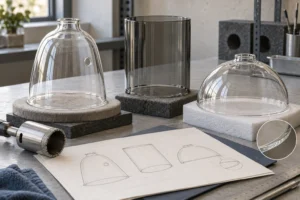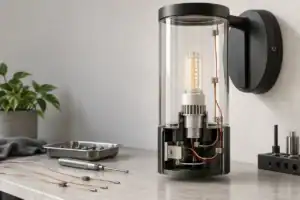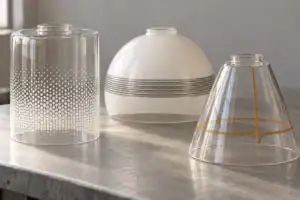
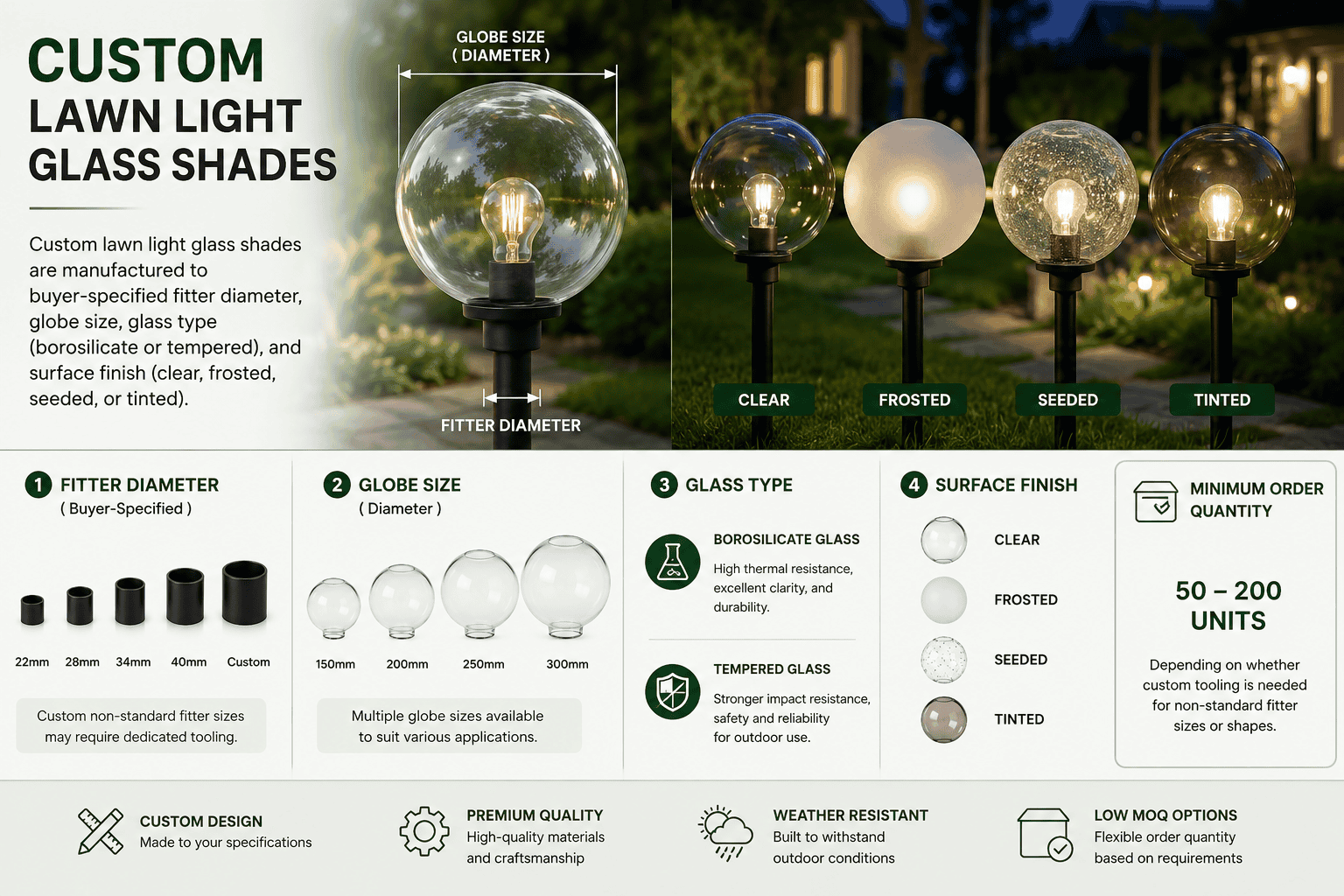
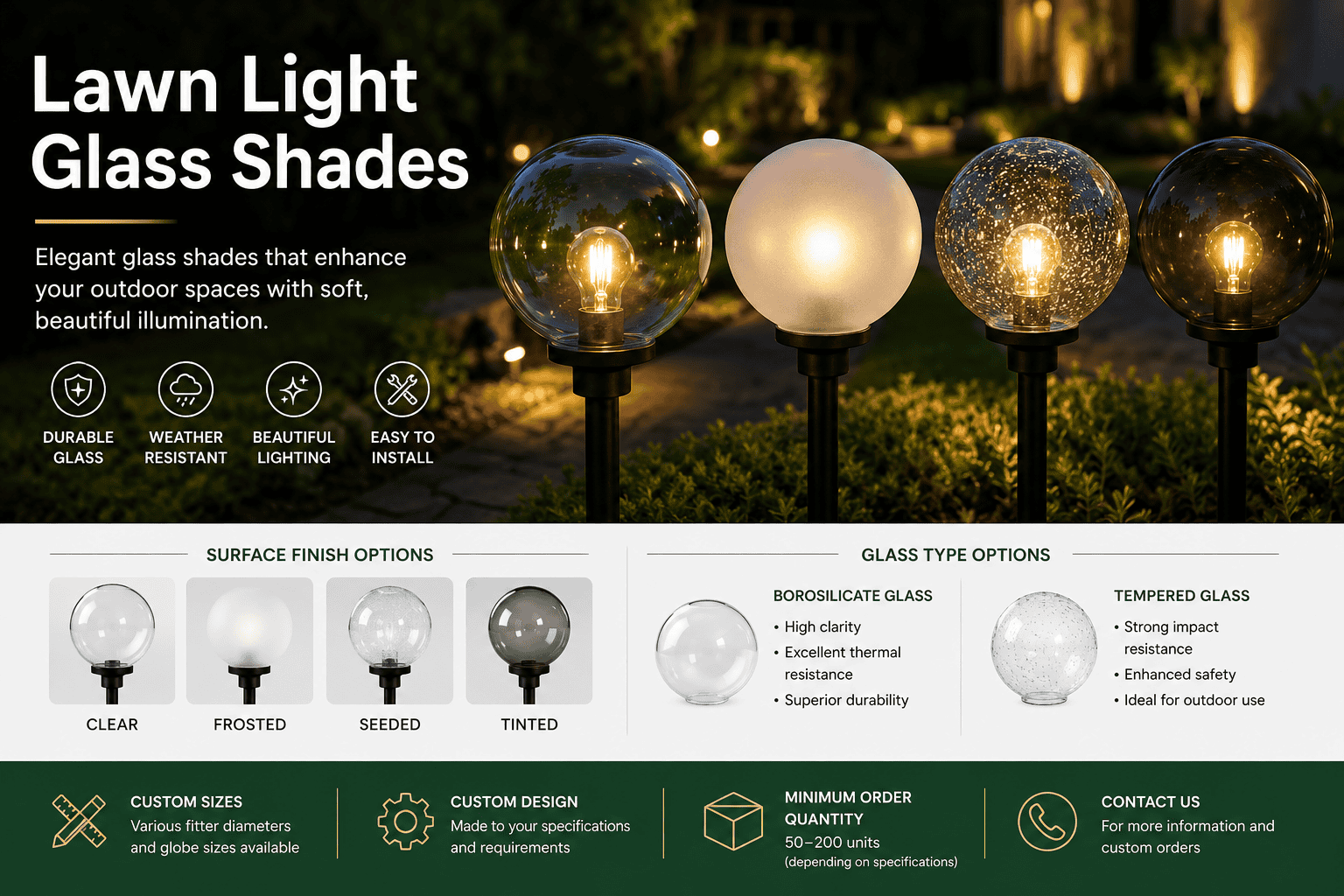
Custom lawn light glass shades are manufactured to buyer-specified fitter diameter, globe size, glass type (borosilicate or tempered), and surface finish (clear, frosted, seeded, or tinted). Minimum order quantities typically start at 50–200 units depending on whether custom tooling is needed for non-standard fitter sizes or shapes.
Standard replacement glass shades cover most residential repair and upgrade scenarios. But three situations consistently fall outside what off-the-shelf globes can solve: a discontinued fixture line where the original shade shape is no longer in production, a commercial or multi-family development project specifying custom globe dimensions to match a proprietary fixture design, and an OEM or landscape lighting brand sourcing a private-label globe for their product line.
Custom lawn light glass shades — made to specification rather than selected from catalog — are more accessible than most buyers expect. The MOQ thresholds, the customizable dimensions, the lead times, and the manufacturing methods all have clear parameters. This guide covers what can be customized, what cannot, how the process works from specification to delivery, and what to budget.
Who Orders Custom Lawn Light Glass Shades
Understanding the buyer categories clarifies the specification requirements that different buyers bring.
Landscape lighting designers and specifiers. A project requiring 60 matching post-top lights for a hotel entrance, a resort pathway, or a large-estate driveway frequently cannot source sufficient quantity of an identical globe from domestic retail channels. The designer specifies a custom globe that will be produced in the required quantity with guaranteed consistency across the batch.
HOA and multi-family property developers. A development of 150 homes, each with 4 post-top lawn lights, represents a total shade count of 600 units at initial installation plus ongoing replacement demand. Commissioning a custom globe provides supply chain control over the lifetime of the development and eliminates the “discontinued product” problem that plagues homeowners trying to match shades 8 years after initial installation.
Fixture manufacturers and OEM buyers. A fixture brand designing a new post-top lawn light line needs a glass globe manufactured to their exact form factor, fitter specification, and glass type. The globe is part of their product — not sourced from a shared catalog that their competitors also use.
Specialty retail and lighting showrooms. A retailer building a house brand in the landscape lighting category commissions custom globes that carry their branding, differ from commodity globes in glass specification, and give them a product story that justifies a premium price.
What Can Be Customized in a Lawn Light Glass Shade
Not every dimension is equally customizable, and the cost and MOQ implications vary significantly between customization types.
Fitter Diameter
Standard fitter sizes (2¼ inch, 4 inch, 6 inch) can be produced without custom tooling. Non-standard fitter diameters — say, 3½ inch or 5 inch for a proprietary fixture design — require custom molds or press tooling that adds to upfront cost.
Tooling for a non-standard fitter collar typically costs $800–2,500 USD depending on the manufacturing method, and the tooling is owned by the buyer for the life of the program. Once tooling exists, subsequent orders run at standard production pricing.
For standard fitter sizes, no tooling cost applies and MOQ is lower.
Globe Diameter and Height
Globe shape (diameter and height proportions) is the most commonly customized dimension. Standard globe diameters run from 5 inches through 16 inches in common sizes. Custom proportions between or outside these ranges are achievable with:
- Machine-pressed glass: uses matched metal dies to press heated glass into shape. Excellent for high-volume production (500+ units) with tight dimensional tolerance (±1 mm on globe diameter). Die cost: $1,500–4,000 per shape.
- Centrifugal casting: heated glass is spun in a rotating mold to create spherical and near-spherical globes. Good dimensional tolerance, moderate volume requirement (200+ units), lower tooling cost than full press dies.
- Mouth-blown glass: individual artisan production, no tooling cost, but dimensional variation of ±3–5 mm between units. Appropriate for low-volume specialty and artisan product lines; not suitable for applications requiring tight matched-set consistency.
Glass Type
The glass base material can be specified:
– Borosilicate — required for freeze-thaw climates and premium specifications
– Heat-tempered soda-lime — cost-effective for mild climates
– Standard annealed soda-lime — not recommended for outdoor post-top applications but available for indoor and mild-climate uses
Per the ASTM C1036 standard for flat glass and ASTM C1048 for heat-treated glass, glass construction should be documented with a material spec sheet that specifies the glass type and heat treatment classification. Reputable manufacturers provide this documentation with every custom order.
Surface Finish
Surface treatments are applied after forming and significantly affect optical character:
- Clear (fire-polished): no surface treatment; maximum transmittance (88–92%)
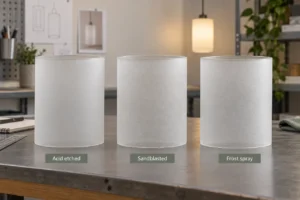
- Acid-etched frosted: chemical etching produces a uniform matte surface; transmittance 75–82%
- Sandblasted frosted: mechanical surface abrasion; slightly coarser texture than acid-etched; transmittance 70–80%
- Seeded / air-bubble: bubbles introduced during forming, not a surface treatment; available on mouth-blown and some centrifugal-cast globes
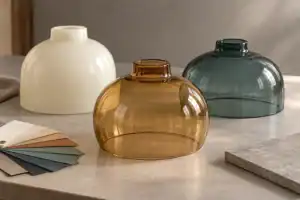
- Amber / tinted: colorant added to the glass batch; color is consistent throughout the glass thickness (not a coating that can scratch off)
- Custom color tinting: specialty colorants (green, blue, smoke, bronze) are available at additional batch cost; minimum batch size typically applies
OEM Marking
Custom laser etching or ceramic enamel printing can be applied to the glass collar area — typically a brand name, model number, or certification mark. Ceramic enamel printing (fired into the glass surface) is the most durable method and withstands outdoor weathering without fading.
Manufacturing Methods for Custom Lawn Light Glass Shades
Selecting the right manufacturing method depends on volume, dimensional tolerance requirements, budget, and the desired glass characteristics.
Machine-Pressed Glass
A heated glass gob is pressed between matched metal dies to form the globe shape. The result is dimensionally consistent (±1 mm), well-suited to high volume (500+ units per run), and can achieve a range of surface textures by incorporating texture into the die surface.
Machine pressing is the standard method for catalog-grade outdoor glass shades produced in volume. For custom projects with well-defined specifications and sufficient volume, machine pressing offers the best combination of cost and consistency.
According to production standards referenced by the Illuminating Engineering Society, luminaire glass components manufactured by machine pressing are expected to meet dimensional tolerances of ±1% of nominal diameter for outdoor fixture applications — achievable with well-maintained tooling.
Centrifugal Casting
Centrifugal casting introduces molten glass into a rotating mold, using centrifugal force to distribute the glass evenly into a spherical or near-spherical form. This method produces true sphere profiles that machine pressing can struggle to achieve for very round globes, and the wall thickness distribution is more uniform than pressed glass for sphere shapes.
Centrifugal casting is the preferred method for high-quality spherical post-top globes in the 8–14 inch diameter range. Wall thickness uniformity means more consistent optical properties across the batch.
Mouth-Blown Glass
Artisan glassblowers form each globe individually using traditional glassblowing techniques. The result has a handmade aesthetic character — very slight dimensional variation between units, occasional seeded or swirled visual effects from the blowing process, and wall thickness variations that create visual warmth different from machine-produced glass.
Mouth-blown glass is appropriate for artisan landscape lighting brands, boutique hospitality and retail projects, and any application where the handmade character is a selling point. It is not appropriate where matched-set dimensional consistency is required (variation of ±3–5 mm in globe diameter between units in the same batch).
The U.S. Department of Energy’s outdoor lighting procurement guidance notes that decorative luminaire glass components should be specified with their manufacturing method documented to support product consistency claims — relevant for custom OEM projects where the “handcrafted” designation needs to be accurate.
Lampwork Borosilicate Glass
Lampwork techniques use a torch to form borosilicate glass into precise shapes from glass tube and rod stock. This method is used for specialty post-top globes with complex geometries, decorative fused elements, or colors that cannot be achieved in batch production. Volume is inherently low (typically 10–100 units per run) and cost per unit is high, but the design freedom is unmatched for specialty applications.
Custom Order Process: From Specification to Delivery
A custom lawn light glass shade order typically follows a defined sequence:
Step 1: Specification package
Provide the manufacturer with:
– Fitter inner diameter (and whether standard or custom)
– Globe outer diameter and height (with dimensional tolerance requirement)
– Glass type (borosilicate / heat-tempered / annealed)
– Surface finish (clear / frosted / seeded / amber / custom color)
– Quantity required (initial order and expected annual volume)
– Any OEM marking requirements
Step 2: Quotation and tooling assessment
The manufacturer assesses whether existing tooling covers your specification or whether custom tooling is required. Tooling lead time is typically 3–6 weeks; production lead time after tooling is 4–8 weeks. Standard specifications without tooling requirements typically run 2–4 week production lead times.
Step 3: Sample approval
Before committing to full production quantity, request 2–5 physical samples for approval. Sample review should cover:
– Dimensional conformance (measure fitter inner diameter, globe diameter, height with calipers)
– Glass quality (check for bubbles, inclusions, surface defects)
– Optical character (compare transmittance against a known reference — frosted samples should match target transmittance within ±5%)
– Fitter seating (physically test in one of your fixture holder rings)
Step 4: Production and QC
Reputable manufacturers run dimensional QC checks on each production batch. For custom orders, request a QC report confirming the lot measurements fall within the agreed tolerance band.
Step 5: Packaging and shipping
Custom lawn light glass shades require individual protective packaging before export — EPE foam wrapping with a dedicated fitter collar ring, inner box per unit, and master export carton per ISTA Project 2A testing standards. Confirm packaging specifications are documented before the production run.
Pricing Framework for Custom Lawn Light Glass Shades
Custom glass shade pricing depends on glass type, size, manufacturing method, volume, and whether tooling is required. General framework:
| Specification | Price Range (per unit, ex-works) | MOQ |
|---|---|---|
| Standard fitter, soda-lime, frosted, machine-pressed | $3–8 | 100 units |
| Standard fitter, borosilicate, frosted, machine-pressed | $5–14 | 100 units |
| Custom fitter, borosilicate, any finish (+ tooling) | $8–20 + tooling | 200 units |
| Mouth-blown, borosilicate, any finish | $15–45 | 50 units |
| Lampwork borosilicate, specialty shapes | $40–120 | 10–50 units |
These are illustrative ranges — actual pricing depends significantly on globe size, wall thickness specification, and order volume. A 500-unit order of standard-fitter borosilicate frosted globes is typically 30–40% cheaper per unit than a 100-unit order of the same specification.
The NEMA outdoor luminaire hardware standards define performance requirements that custom glass shades must meet for use in listed outdoor fixtures — relevant for any OEM customer incorporating custom globes into a UL-listed fixture assembly.
Trends in Custom Lawn Light Glass Shade Sourcing for 2026
Sustainability documentation. Buyers increasingly require FSC-equivalent documentation for packaging and material sourcing declarations for the glass itself — specifically, the percentage of recycled cullet content in the glass batch and the carbon footprint per unit. Manufacturers who provide this documentation have a competitive advantage with procurement teams that have sustainability targets.
Dark-sky specification. Custom amber glass specifications are growing as municipalities expand dark-sky ordinances. Per the International Dark-Sky Association’s certification framework, shades that contribute to fixture spectral compliance need documented amber tint density (correlated to output color temperature below 3000K) — a documentation requirement that only custom or specialty-specification globes can reliably provide.
Digital customization for small quantities. Advances in glass surface printing (ceramic enamel digital printing) have reduced the minimum order for custom-branded glass shades from 500+ units to as few as 50 units in some manufacturing configurations, opening OEM branding to smaller landscape lighting brands and boutique fixture companies.
Frequently Asked Questions
What is the minimum order quantity for custom lawn light glass shades?
For standard fitter sizes with custom surface finish or glass type specifications, MOQ is typically 100–200 units. For non-standard fitter diameters or globe shapes requiring custom tooling, MOQ is typically 200–500 units depending on the tooling amortization required. Mouth-blown glass shades have lower MOQs (50+ units) due to the artisan production model, but at higher per-unit cost.
How long does a custom lawn light glass shade order take?
Lead time depends on whether tooling is required. Orders using existing tooling (standard fitter sizes) typically run 4–8 weeks from sample approval to production completion. Orders requiring new tooling add 3–6 weeks for tooling fabrication. Shipping time from China to North America adds 2–4 weeks by sea, 5–7 days by air.
Can I customize the borosilicate glass content of a lawn light shade?
Yes. Borosilicate glass is specified as the base material in the order — it is not a post-production treatment. A reputable manufacturer will provide a glass composition certificate with each production lot confirming the boron trioxide content and thermal expansion coefficient. Verify this documentation is part of the purchase agreement before placing the order.
What is the cost difference between borosilicate and soda-lime custom shades?
Borosilicate custom shades typically cost 25–40% more per unit than equivalent soda-lime glass shades of the same size and finish. For freeze-thaw climates and premium projects, the cost difference is justified by the extended replacement interval and absence of thermal shock failures. For mild-climate applications, heat-tempered soda-lime provides adequate performance at lower cost.
Can a custom lawn light glass shade be designed to pass ISTA 2A drop testing?
Yes, but the shade design itself is only part of the system — the packaging design must also pass ISTA 2A testing as an assembly. A qualified manufacturer will design the glass wall thickness and fitter collar geometry to survive the 60 cm multi-orientation drop sequence in the specified packaging. Request ISTA 2A test reports for the specific shade + packaging configuration before approving production.
How do I specify glass opacity for a custom order?
Specify the transmittance range (e.g., 75–82% for standard frosted) and the surface treatment method (acid-etched or sandblasted). A physical reference sample with confirmed transmittance provides the clearest specification when ordering from a new manufacturer — optical appearance described in words is too subjective for production matching.
Can custom lawn light glass shades be shipped pre-assembled into fixtures?
Some manufacturers offer sub-assembly services — inserting the glass globe into a fixture housing, attaching the holder ring and gasket, and shipping the assembly ready for post installation. This is more common for commercial projects than residential. Sub-assembly MOQs are typically higher (500+ units) and lead times are longer. For residential and small commercial projects, shipping globes separately and installing on-site is standard.
Conclusion
Custom lawn light glass shades are the correct solution when standard catalog options don’t match the fixture specification, when volume requirements justify supply chain control, or when OEM brand differentiation requires a glass globe that is exclusive to your product line. The customization matrix — fitter diameter, globe proportions, glass type, surface finish, OEM marking — covers virtually every design parameter that matters for outdoor post-top and bollard applications.
The process is straightforward: specification package → sample approval → production with QC documentation → ISTA-tested packaging. The challenge is not the manufacturing — it is preparing an accurate specification and selecting a manufacturer who can document borosilicate construction and dimensional tolerances.
For custom lawn light glass shade specifications, sample quotations, and OEM manufacturing programs in borosilicate and heat-tempered construction, jxlampshade.com provides the full custom manufacturing workflow from specification to export-ready delivery.