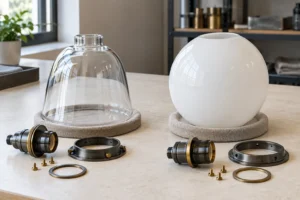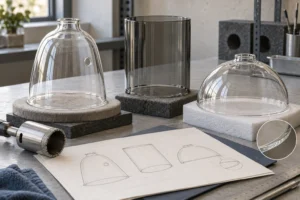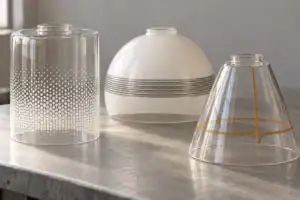
Lawn light glass shade packaging uses EPE foam-wrapped spherical globes with a dedicated fitter collar foam ring, placed in a double-wall corrugated inner box with a formed foam shell providing 50 mm minimum cushioning on all six sides — designed to pass ISTA 2A drop and vibration testing for post-top globe shapes.
Post-top globe glass shades break in shipping for a specific reason: they are spheres. Unlike flat-panel lantern glass or cylindrical wall sconce shades, a spherical globe concentrates all impact energy at the contact points — fitter collar rim, bottom tangent point, or equatorial contact on the foam sides — rather than distributing it across a flat surface. Standard foam-lined boxes designed for rectangular or cylindrical glass products fail spherical globes at the very points where stress concentrates.
Lawn light glass shade packaging has distinct requirements that differ meaningfully from general outdoor glass shade packaging. The globe shape creates specific packaging geometry challenges. The fitter collar is simultaneously the thinnest glass cross-section and the most stress-concentrated point in the assembly. And residential lawn light shades are typically shipped in sets of 4–8 — requiring both individual unit protection and master carton stacking performance across multiple units.
This guide covers the complete packaging specification: EPE foam selection and geometry for spherical globes, fitter collar protection, inner box specs, master carton ratings, and ISTA test compliance for post-top lawn light glass shade export.
Why Spherical Globe Packaging Requires Different Thinking
The breakage mechanics of a spherical glass globe differ from flat or cylindrical glass shapes in three important ways.
Point contact vs. surface contact. A flat glass panel distributes impact load across the foam pad area in contact with it. A sphere contacts flat foam at a single point tangent to the curve. At that tangent point, all of the impact energy transfers directly into the glass at a small area — creating peak stress concentrations that are far higher than what would occur with surface contact. Standard flat-bottom foam packaging underperforms for spherical globes specifically because it doesn’t address this point-contact geometry.
Fitter collar vulnerability. The fitter collar at the top of a post-top globe is the smallest glass cross-section in the assembly. Collar wall thickness is typically 5–8 mm — thinner than the globe body, which may be 8–12 mm. A corner drop that allows the fitter collar to impact the carton edge directly, with no foam between collar and wall, will almost always crack the collar before the globe body.
Rolling tendency. Unlike flat glass or cylinders oriented axially, spherical globes will roll inside their packaging if not positively constrained. A globe that rolls slightly during a vibration sequence positions itself at an off-nominal contact point where the foam is compressed unevenly — creating asymmetric stress under subsequent drops.
These three factors combine to make lawn light glass shade packaging more demanding per unit than packaging for most other outdoor glass shade shapes. The solution is a packaging system that addresses all three: formed foam shells that match the globe curve, dedicated fitter collar rings, and inner box geometry that prevents rolling movement.
EPE Foam Specification for Lawn Light Glass Shade Packaging
EPE (expanded polyethylene) foam is the standard cushioning material for glass lamp shades because it combines low density (reducing package weight), closed-cell structure (moisture resistance for outdoor products in transit), and adequate energy absorption across the density range used in glass packaging.
Foam Density and Thickness for Globe Shades
The two foam parameters that matter for glass globe cushioning are density (which determines energy absorption capacity) and thickness at the critical cushion points (which determines how much foam is available to compress before bottoming out).
For lawn light glass globe shades weighing 300 grams or above:
– Foam density: 18–22 kg/m³ EPE for globe body wrapping (standard foam wrap)
– Foam thickness at contact points: minimum 50 mm on all six faces of the inner box
– Fitter collar ring density: 22–25 kg/m³ (slightly denser to protect the thinnest glass section)
Per the International Safe Transit Association’s ISTA 2A protocols, the packaging system must maintain these foam dimensions under the atmospheric conditioning sequence (temperature and humidity cycling) that precedes drop testing — foam that loses compression set during conditioning and no longer delivers the specified cushion thickness is a test failure mode.
Formed vs. Flat Foam for Globe Shapes
This is the critical design decision. Two approaches are used:
Flat foam wrap + loose fill: Individual wrapping of the globe in flat EPE foam sheet (3–6 mm) with the cavity space inside the inner box filled with loose paper fill, bubble wrap, or additional flat foam pads. This is the most common approach for small-scale domestic shipping. It fails for export-volume lawn light globe packaging because:
– Loose fill settles and shifts during extended vibration sequences
– Point contact at the globe bottom tangent is not addressed by flat foam pads underneath the curved surface
– No dedicated fitter collar protection
Formed foam shell: A pre-formed EPE foam insert sized to the specific globe diameter, with a hemispherical cavity that makes surface-area contact with the globe curve rather than point contact. A matching top shell completes the enclosure. A separate fitter collar ring sits at the top of the globe, protecting the collar from rim impact.
Formed foam shells increase unit packaging cost by $0.30–0.80 per set (for a 200+ unit production run) but deliver a measurably lower breakage rate — typically 0.5–1.5% versus 6–12% for flat foam and loose fill on a standard 60 cm drop test sequence.
Fitter Collar Ring Specification
The fitter collar ring is a cylindrical EPE foam ring (inner diameter matching the fitter outer diameter, outer diameter extending to the inner box wall) that:
1. Supports the weight of the globe through the collar rather than through the globe bottom
2. Prevents the collar rim from contacting the inner box wall or carton flap on an edge drop
3. Prevents vertical movement of the shade within the inner box during vibration
For a standard 4-inch fitter glass globe, the collar ring dimensions:
– Inner diameter: approximately 115–120 mm (fitter outer diameter + 5–10 mm clearance)
– Outer diameter: equal to inner box inner width
– Height: 40–60 mm (enough to extend above and below the fitter collar)
– Density: 22–25 kg/m³
Inner Box Specification for Lawn Light Glass Shades
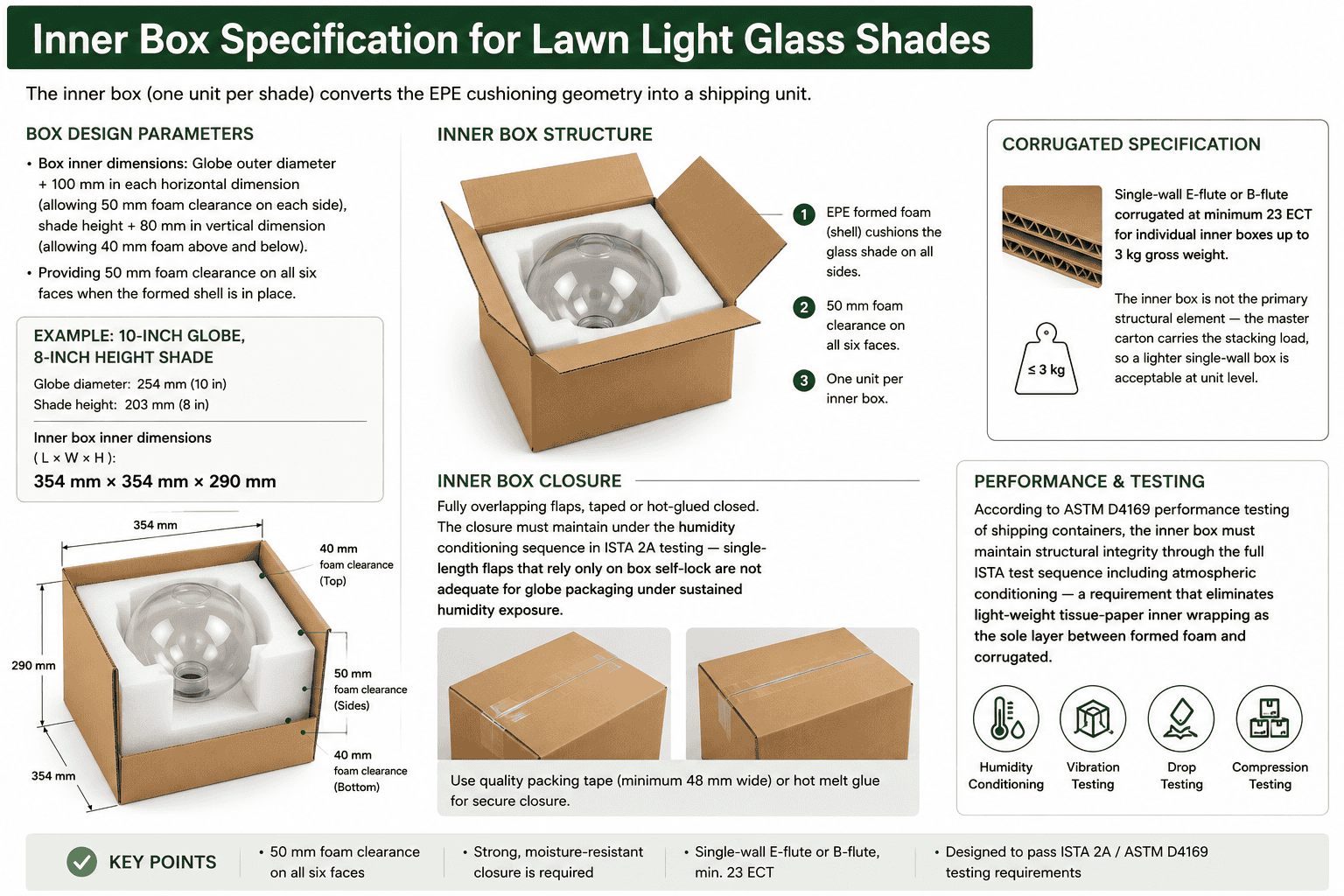
The inner box (one unit per shade) converts the EPE cushioning geometry into a shipping unit. Box design parameters:
Box inner dimensions: Globe outer diameter + 100 mm in each horizontal dimension (allowing 50 mm foam clearance on each side), shade height + 80 mm in vertical dimension (allowing 40 mm foam above and below).
For a standard 10-inch (254 mm) globe, 8-inch height shade:
– Inner box inner dimensions: approximately 354 mm × 354 mm × 290 mm
– Providing 50 mm foam clearance on all six faces when the formed shell is in place
Corrugated specification: Single-wall E-flute or B-flute corrugated at minimum 23 ECT for individual inner boxes up to 3 kg gross weight. The inner box is not the primary structural element — the master carton carries the stacking load — so a lighter single-wall box is acceptable at unit level.
Inner box closure: Fully overlapping flaps, taped or hot-glued closed. The closure must maintain under the humidity conditioning sequence in ISTA 2A testing — single-length flaps that rely only on box self-lock are not adequate for globe packaging under sustained humidity exposure.
According to ASTM D4169 performance testing of shipping containers, the inner box must maintain structural integrity through the full ISTA test sequence including atmospheric conditioning — a requirement that eliminates light-weight tissue-paper inner wrapping as the sole layer between formed foam and corrugated.
Master Carton Specification for Lawn Light Glass Shade Export
Multiple inner boxes (typically 2–6 units depending on globe size and carton weight limits) pack into a master export carton for container shipping.
Master Carton Corrugated Rating
The master carton carries the full stacking load in a shipping container — typically 3–4 cartons high in a pallet column. Box Compression Test (BCT) requirements at standard pallet heights:
| Gross Weight per Carton | Corrugated Rating | Minimum BCT |
|---|---|---|
| Up to 10 kg | Double-wall BC-flute, 32 ECT | 800 N |
| 10–20 kg | Double-wall BC-flute, 44 ECT | 1,200 N |
| Over 20 kg | Triple-wall, or 2 cartons at ≤20 kg | 1,600 N |
For residential lawn light glass globe shades (typically 300–700 g each), a master carton of 4 inner boxes (4 shades) has a gross weight of approximately 6–10 kg depending on globe size — typically placing it in the 32 ECT category.
Stacking Configuration and Interior Bracing
Post-top globe inner boxes are not easy to stack densely because the spherical globe inside makes the inner box top surface less rigid than a flat-product box. Place a corrugated divider pad between inner box layers in the master carton to distribute stacking load across the corrugated structure rather than concentrating it on the inner box flap area.
Carton Marking and Export Documentation
For export shipments, master carton marking must include:
– Product description (glass globe shade — fragile)
– Gross and net weight
– Carton dimensions
– Orientation arrows (keep upright — prevent inversion of the fitter collar ring)
– Fragile handling indicators per ISTA shipping mark standards
ISTA Testing for Lawn Light Glass Shade Packaging
The International Safe Transit Association’s ISTA Project 2A is the standard reference for verifying that post-top lawn light glass shade packaging is adequate for distribution.
ISTA 2A covers:
1. Atmospheric conditioning — 72-hour pre-conditioning at target temperature/humidity to simulate transit environment
2. Vibration testing — resonance dwell and random vibration simulating truck and rail transport
3. Drop testing — 18 drops at 60 cm height across multiple orientations (flat, edge, corner)
4. Compression testing — simulates carton stack in warehouse or container
For a single inner box with a 10-inch borosilicate globe, the critical drops in ISTA 2A are:
– Corner drops: the highest energy events; the formed foam shell must maintain 50 mm clearance at all corners after foam compression
– Flat bottom drop: tests fitter collar ring performance — the collar should not transmit impact force to the collar rim glass
– Edge drop on the fitter collar side: the highest-risk drop for collar fracture on lawn light globes specifically
Achieving sub-2% breakage rates on ISTA 2A testing requires the formed foam shell approach — not flat wrap with loose fill. The loose fill approach consistently produces 8–15% breakage on the corner drop sequence for spherical globes in the 200–700 g weight range.
Packaging should be validated by independent ISTA testing before approval for production, with test reports retained as part of the product quality file. The TAPPI corrugated packaging testing standards provide the box compression and humidity resistance test methods referenced in the ISTA protocol.
Retail vs. Export Packaging for Lawn Light Glass Shades
Different end markets require different packaging strategies.
Export bulk packaging (manufacturer → distributor → installer):
– Minimal outer decoration; functional marking only
– Maximum carton density within weight limits
– ISTA 2A test compliance required for container shipping
– Unit cost minimized
Retail single-unit packaging (distributor → retailer → homeowner):
– Color-printed outer box with product imagery and specifications
– Window panel or clear top showing the glass globe inside
– Installation instruction insert and gasket included
– Premium unboxing experience compatible with home delivery expectations
– Per-unit cost higher ($1.50–4.00 additional for retail packaging)
Direct-to-consumer e-commerce packaging (manufacturer → homeowner):
– Treat every unit as if it will be dropped once — because it likely will be
– Additional 15 mm foam on all six faces versus standard bulk packaging
– Double-tape all flaps
– “Fragile” exterior marking on 4+ faces
– Drop performance target: sub-2% breakage on ISTA 3H (parcel carrier simulation), which is more demanding than ISTA 2A
Frequently Asked Questions
How to pack a glass lamp shade?
For a spherical post-top lawn light glass globe, wrap individually in 3–6 mm EPE foam sheet, seat in a formed foam hemispherical shell with a dedicated fitter collar ring at the top, and place in a double-wall corrugated inner box sized to provide 50 mm foam clearance on all six faces. Seal with tape on all flaps. The formed foam shell — not flat foam + loose fill — is essential for spherical globes to prevent point-contact breakage at the globe bottom tangent.
How to package a lampshade for shipping?
For a post-top lawn light globe shipped as a single unit via parcel carrier (UPS, FedEx), use a formed EPE foam shell inside a double-wall corrugated box. 50 mm foam clearance on all six faces is the minimum for shades 300 g and above. Add “Fragile” marking on 4 faces and orient arrows on the fitter collar end. For shipping multiple units, use individual inner boxes inside a master carton with a corrugated divider pad between layers.
What foam thickness is needed for lawn light glass globe packaging?
Minimum 50 mm EPE foam clearance on all six sides for globes weighing 300 g or above. Lighter globes (under 200 g) can use 35–40 mm. The 50 mm figure represents the foam depth needed to reduce a 60 cm drop from approximately 50 G peak deceleration to the 15–25 G threshold where borosilicate and tempered glass breakage probability drops below 2%.
What corrugated carton grade is needed for lawn light glass shade export?
Master export cartons should use double-wall BC-flute corrugated at 32 ECT minimum for cartons up to 10 kg gross weight, 44 ECT for 10–20 kg. Inner boxes for individual units can use single-wall B or E-flute at 23 ECT. The master carton carries the stacking load; the inner box provides structure for the foam system.
Does the packaging need to pass ISTA testing?
For export shipments via container, ISTA 2A test compliance is the industry standard and increasingly required by importers and freight insurers. For parcel carrier direct-to-consumer shipments, ISTA 3H is the more appropriate reference. Both test protocols include drop, vibration, and compression testing. Packaging should be validated with actual glass globes, not empty boxes, before production approval.
Can I reuse packaging for replacement lawn light glass shade shipments?
No. EPE foam that has been through a compression event (including a drop) has experienced irreversible cell collapse that reduces its energy absorption capacity by 20–50%. Reused foam packaging does not provide the rated protection. Always use new packaging for each glass shipment.
What is the standard carton quantity for residential lawn light glass shade sets?
For residential replacement sets, inner boxes of 1 unit each are standard. Master cartons typically hold 4–6 inner boxes (4–6 globe shades). For HOA and multi-family projects, master cartons of 6–12 units reduce per-unit handling cost while remaining within manual lifting weight limits (approximately 15–18 kg for 6 medium globe shades). Confirm carton weight with the manufacturer before specifying quantities.
Conclusion
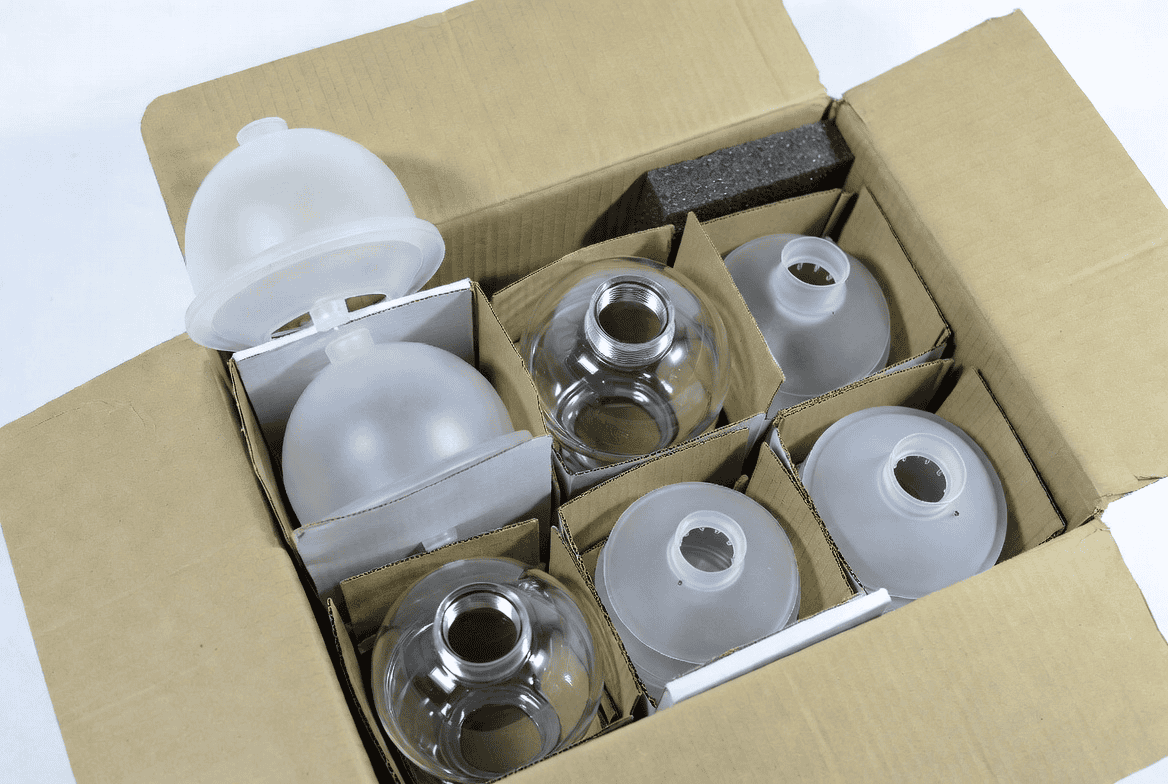
Lawn light glass shade packaging is more demanding than general glass shade packaging specifically because of the spherical globe geometry. Point contact at the globe bottom tangent, fitter collar rim vulnerability on edge drops, and rolling tendency during vibration all require a formed foam shell approach rather than flat wrap and loose fill.
The specification that delivers sub-2% breakage rates on ISTA 2A testing: formed EPE foam hemispherical shells (18–22 kg/m³), dedicated fitter collar ring (22–25 kg/m³), 50 mm foam clearance on all six faces, double-wall BC-flute inner box, 32 ECT double-wall master carton with corrugated dividers between layers.
For post-top lawn light glass globe packaging specifications, ISTA 2A test documentation, and OEM packaging program support for residential and commercial export volumes, jxlampshade.com provides complete packaging documentation as part of every custom glass shade order.