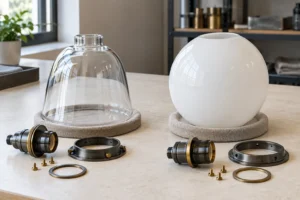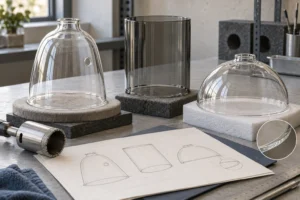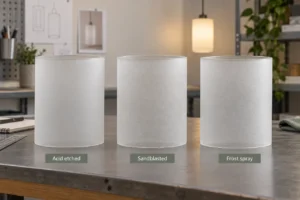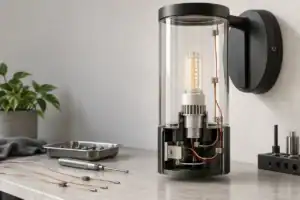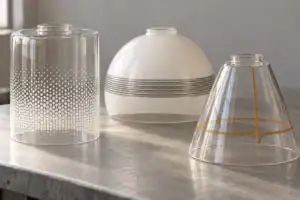
An engineering glass lamp shade is a deep dome, prismatic, or opal glass shade originally designed for factory and workshop pendant lighting — characterized by a wide-brim metal ring, heat-resistant glass, and a downward light distribution that concentrates illumination on work surfaces directly below the fixture.
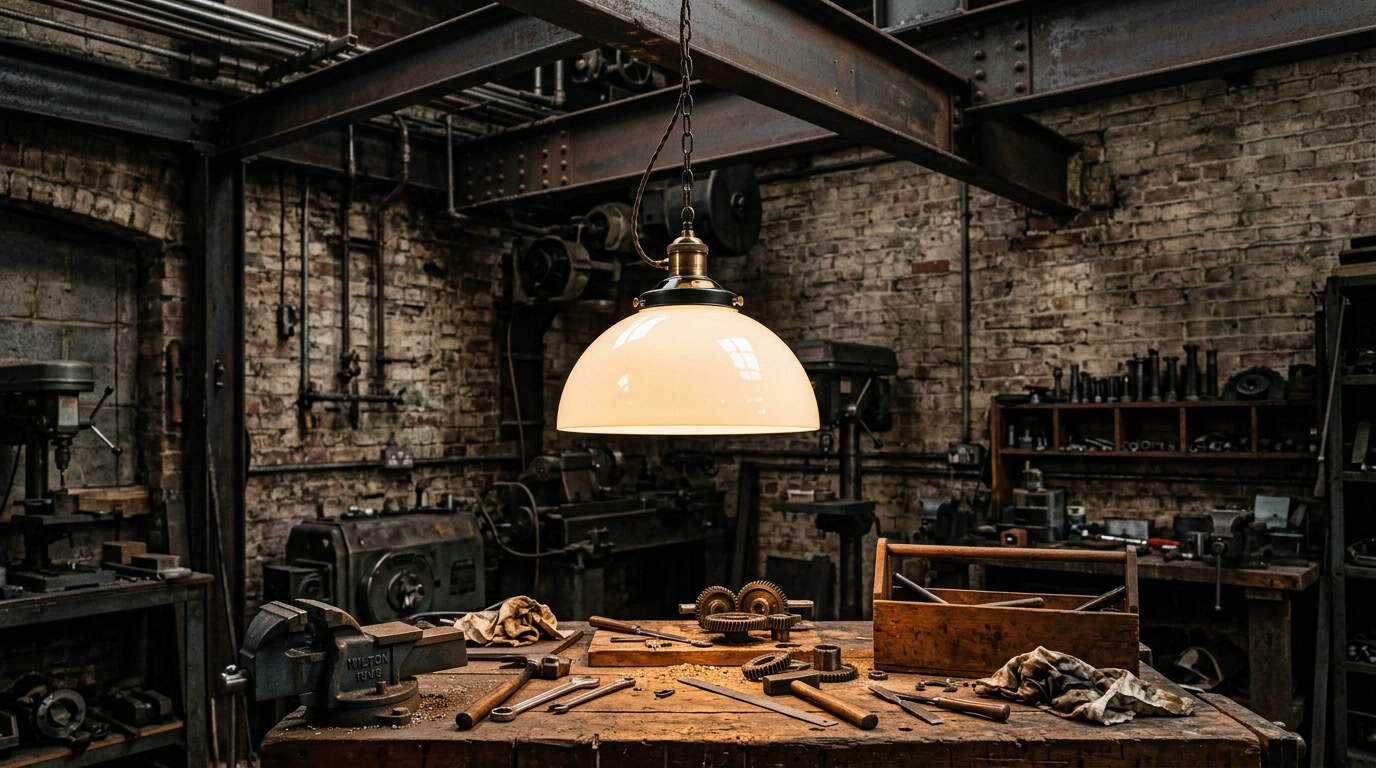
The look is immediately recognizable. A deep glass dome suspended from an adjustable metal conduit, casting a focused pool of warm light onto a workbench beneath it. You’ve seen it in Victorian-era machine shops, wartime factories, and now in every carefully styled industrial restaurant and loft apartment. The engineering glass lamp shade — also called the IES reflector shade, RLM shade, or Benjamin-style pendant — was designed not for aesthetics but for function: maximum downward light output per watt of incandescent filament, with zero upward spill wasted on ceilings.
That functional DNA is precisely why it works so well in contemporary interiors. A well-chosen engineering glass lamp shade delivers directional, glare-free task light while making a visual statement about material honesty and purposeful design. This guide covers what distinguishes engineering glass shades from decorative alternatives, the specific glass types involved, the major style variants, and the specifications you need to source or commission the correct shade.
What Is an Engineering Glass Lamp Shade?
An engineering glass lamp shade is a functional industrial luminaire component developed in the late 19th and early 20th centuries for factory, workshop, drafting room, and commercial interior applications where high-quality task lighting was essential.
The Illuminating Engineering Society (IES) — founded in 1906 — established early performance standards for industrial luminaires, and the “IES-style” reflector shade became a standardized product category defined by its optical performance: deep dome or wide-brim geometry that directs light downward and forward, minimizing upward spill that would illuminate ceilings uselessly. According to IES photometric standards for luminaire classification, the defining characteristic of an industrial task reflector is a light distribution that delivers 90%+ of output below the horizontal plane — a requirement that shaped every aspect of the glass shade geometry.
The Glass in Engineering Lamp Shades
Early engineering glass lamp shades used several glass types, each serving a specific optical or mechanical function:
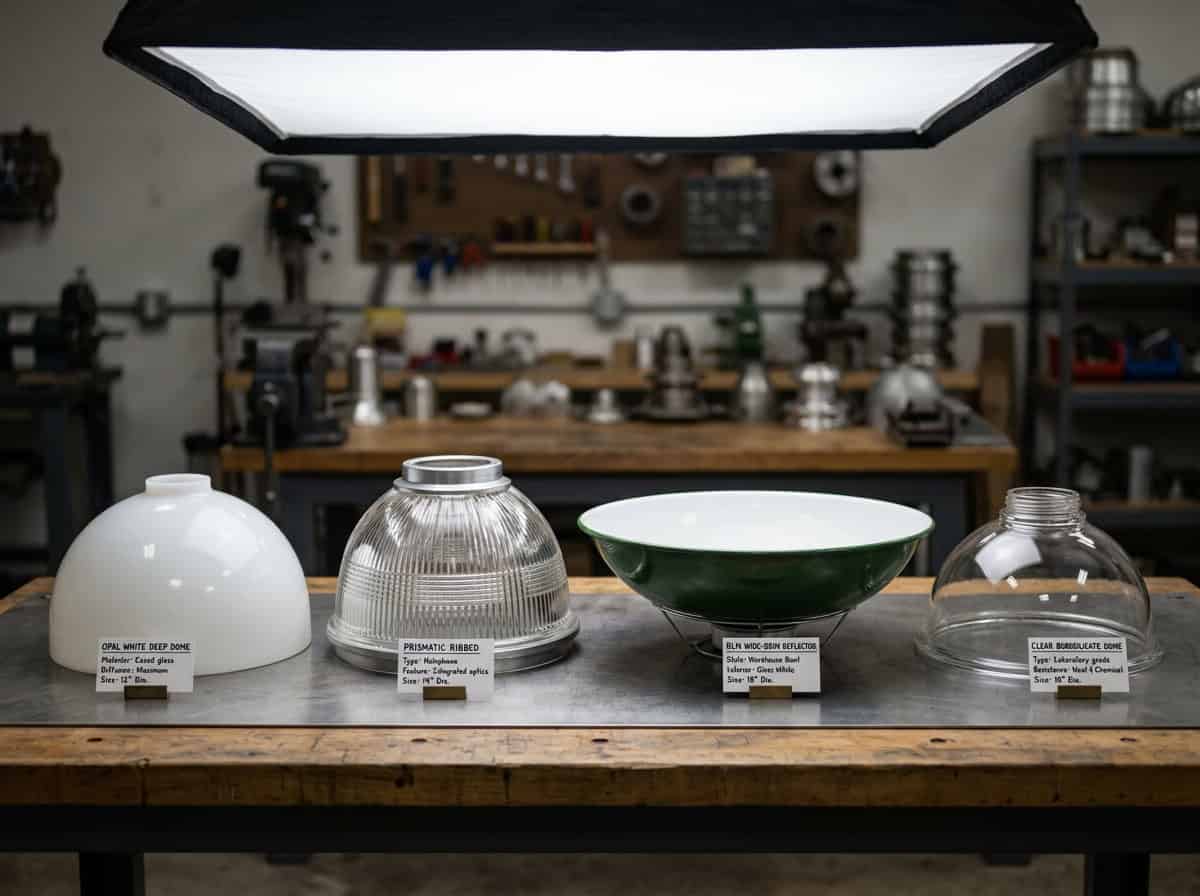
- Opal glass (white milk glass): the dominant choice for general workshop lighting. A scattering suspension of calcium or tin compounds in the glass matrix creates a uniformly white, translucent appearance that diffuses light from the bare incandescent bulb and softens the beam edge. Opal glass shades glow uniformly across the dome surface and produce soft-edged shadows below — ideal for drafting and precision assembly work where hard shadows cause eye fatigue.
- Prismatic glass (Holophane-style): glass cast with a regular pattern of pyramidal or wedge-shaped prisms on the inner and/or outer surface. The prisms refract and redirect light with geometric precision, controlling the beam spread and eliminating hot spots directly below the shade. Prismatic engineering glass shades were specified for environments requiring high uniformity at grade — factory floors, packing halls, and inspection areas. The Holophane Company, founded in 1898, pioneered prismatic glass luminaires and the name “Holophane” is still used generically to describe prismatic ribbed glass lamp shades.
- Clear glass dome: used where maximum light output per watt mattered more than diffusion. The bare filament is visible through clear glass, but the dome geometry still directs most output downward. Common in utility and storage applications.
- Heat-resistant borosilicate glass: specified for shades used near high-wattage filament lamps that generate significant radiant heat. The lower thermal expansion coefficient of borosilicate glass prevented the thermal shock fractures that plagued soda-lime glass shades in prolonged high-temperature use.
Why the Term “Engineering” Lamp Shade
The term “engineering” in this context has two sources. First, it references the intended environment — the engineering workshop, machine shop, or factory floor where these shades were deployed. Second, it references the engineered optical performance: unlike decorative shades designed primarily for appearance, engineering glass lamp shades were developed from photometric principles to achieve specific task illumination targets on the work surface below.
Contemporary buyers use the term loosely to describe any shade with the industrial-workshop aesthetic regardless of its photometric precision. In sourcing conversations with manufacturers, “engineering glass lamp shade” typically means: deep dome or wide-brim geometry, functional glass (opal, prismatic, or clear borosilicate), metal gallery ring, and pendant mounting compatible with standard conduit or swag systems.
Types of Engineering Glass Lamp Shades
The engineering glass lamp shade category includes several distinct style variants. Each has a different optical character and suits different installation contexts.
Opal Dome (Milk Glass) Engineering Shades
The opal dome is the most widely recognized engineering glass lamp shade form. A deep hemispherical or truncated-cone glass dome, cast in opal white glass, with a rolled or flanged upper opening that seats in a metal gallery ring.
Classic dimensions for original opal dome engineering shades:
– Dome diameter: 10–16 inches (254–406 mm) — the most common engineering sizes
– Dome depth: typically 60–70% of dome diameter (a “deep” dome provides more controlled downward distribution than a shallow bowl)
– Fitter opening: 2¼ inch, 4 inch, or 6 inch for pendant-mount shades
The opal dome produces a soft, even pool of light below the fixture with a well-defined circular boundary. The interior white glass surface acts as a secondary reflector, bouncing some light forward and outward before it exits the shade opening, which broadens the effective beam spread slightly beyond pure downward distribution.
Prismatic (Holophane-Style) Engineering Shades
Prismatic engineering glass shades have a ribbed or faceted exterior that refracts light through geometric prism faces. The prismatic pattern can be:
– Vertical ribs: create lateral light spread, useful for long benches and worktables
– Horizontal ribs: create vertical beam narrowing, useful for high-bay applications
– Diamond or pyramidal facets: produce complex multi-directional refraction with the most uniform floor illumination
Prismatic glass is significantly more difficult to manufacture than smooth opal glass. The prism geometry must be precise — tolerances of ±0.1 mm on prism angle are standard in quality production — and the glass must be consistently clear between the prism faces to allow refraction rather than scattering. According to ASTM C1048 standards for flat glass, optical-quality glass for prismatic applications requires stringent bubble and inclusion controls that exceed standard decorative glass specifications.
Prismatic engineering glass shades are typically 15–30% more expensive than equivalent opal glass shades due to the tooling complexity and higher glass quality requirements.
RLM (Reflector Large Midsection) Engineering Shades
The RLM shade is the canonical “factory pendant” form — characterized by a very wide, flat brim that flares outward from a relatively narrow upper body. The RLM geometry originated from US industrial lighting standards of the 1920s–1940s and was the dominant fixture form for factory floor pendant lighting for decades.
Authentic RLM shades have glass that forms the inner bowl of the shade, with a separate metal brim (or “saucer”) that extends the light-blocking and distribution geometry. The glass component in an RLM pendant is typically a relatively shallow opal or clear glass reflector bowl rather than a deep dome.
Contemporary “RLM-style” engineering glass lamp shades interpret this geometry in various ways, from faithful reproductions of 1930s factory pendants to modern reinterpretations with slimmer profiles.
Benjamin-Style and Industrial Pendant Shades
The Benjamin pendant — named after the Benjamin Electric Manufacturing Company, a significant producer of industrial lighting in the early 20th century — typically refers to a deep dome opal shade with a cast-iron or stamped steel mounting gallery, a cord-grip socket, and adjustable-height conduit connection. “Benjamin-style” is now used generically to describe any deep-dome industrial pendant with these mounting characteristics.
The glass shade in a Benjamin-style pendant is typically a 10–14 inch opal dome. The defining mounting detail is the gallery ring — a metal ring with three or more set screws that clamp the glass shade’s flanged upper lip and suspend the assembled unit from the pendant cord or conduit.
| Style | Glass Type | Dome Diameter Range | Typical Application |
|---|---|---|---|
| Opal dome | Opal white glass | 10–16 inch | Workshop, restaurant, loft |
| Prismatic Holophane | Prismatic/ribbed clear glass | 8–14 inch | Factory floor, high-bay |
| RLM style | Opal or clear glass bowl | 12–20 inch | High-ceiling industrial spaces |
| Benjamin pendant | Opal white glass deep dome | 10–14 inch | Task lighting, drafting rooms |
| Clear glass dome | Clear borosilicate | 8–14 inch | Utility, storage, accent |
Historical Context: Engineering Glass Shades in Industry
Understanding the original engineering context makes specification and authentication easier for contemporary buyers — whether sourcing period reproductions or commissioning custom shades.
The development of the engineering glass lamp shade accelerated between 1880 and 1930 alongside the electrification of industrial facilities. Early electric factory lighting used bare carbon and tungsten filament bulbs that produced uncomfortable glare and uneven floor illumination. The pendant glass dome shade solved both problems: it blocked direct view of the hot filament (eliminating glare), reflected additional light downward, and created a focused pool of task illumination on the work surface.
The Illuminating Engineering Society’s founding mission specifically addressed this industrial lighting challenge — developing photometric standards and measurement methods that allowed lighting designers to predict and verify floor illuminance levels from pendant fixture arrays. IES-classified shades were photometrically tested and catalogued by their distribution pattern, allowing engineers to calculate the number and spacing of pendants needed to meet a given foot-candle specification on the factory floor.
By the 1920s, major manufacturers including Benjamin Electric, Crouse-Hinds, and Holophane had developed product lines of standardized engineering glass lamp shades with documented photometric performance. These standards remain the reference for authentic reproductions today.
The mid-20th century shift to fluorescent tube lighting drove most engineering glass pendant shades out of mainstream industrial use. Fluorescent fixtures offered more lumens per watt and lower installation cost for large floor areas, even though the quality of task illumination from a well-designed pendant glass shade is arguably superior for individual workstations. The glass pendant shades survived in drafting rooms, machine shops, and fine-detail assembly areas where the directed, glare-free illumination quality justified the cost.
Contemporary Applications of Engineering Glass Lamp Shades
The engineering glass lamp shade re-entered mainstream design in the early 21st century through the industrial interior movement. Today its applications span a wide range from faithful period restoration to contemporary hospitality design.
Restaurant and Hospitality Lighting
Deep dome opal and prismatic engineering glass shades over bar tops, communal tables, and open kitchen counters are among the most common contemporary uses. The focused downward illumination creates visual hierarchy — the table surface is brightly lit, the surrounding space is darker — which enhances the sense of intimacy and occasion in dining environments.
For restaurant use, engineering glass lamp shades should be specified at the correct hanging height: 30–36 inches above the table surface for dining, 18–24 inches above a bar counter. At these heights, a 12–14 inch dome produces a table coverage circle of approximately 24–30 inches in diameter with a 100-lumen-per-watt LED source — sufficient for comfortable dining illumination without creating dark perimeter areas between pendants.
Residential Loft and Industrial Interior Conversion
Warehouse and factory building conversions into residential loft spaces are the natural habitat for engineering glass lamp shades. Original period shades recovered from the building during conversion, or reproduction shades specified for their aesthetic authenticity, reinforce the industrial heritage of the space.
In residential applications, opal glass dome shades are preferred over prismatic shades — the prismatic optical precision that made Holophane shades valuable in factory floors is unnecessary for residential ambient lighting, and opal glass produces warmer, more comfortable light quality in living environments.
Workshop and Studio Lighting
Returning the engineering glass lamp shade to its original purpose — task lighting over a workbench, maker’s bench, or art studio table — remains a highly effective contemporary application. The focused, glare-free illumination from a well-positioned pendant is significantly superior to ceiling-mounted downlights or strip lights for close detail work.
Per the U.S. Department of Energy’s guidance on task lighting efficiency, pendant task lighting positioned 24–36 inches above a work surface delivers illuminance levels 3–4 times higher than equivalent overhead ceiling fixtures at the same wattage, because the reduced throw distance dramatically concentrates the available lumens. An engineering glass lamp shade at 30 inches above a workbench, with a 15-watt LED bulb, can produce 500 footcandles at bench level — equivalent to a much higher-wattage overhead system.
Heritage and Period Restoration
Period restorations of Victorian, Edwardian, and mid-century industrial and commercial buildings frequently specify authentic engineering glass lamp shades as part of the lighting design. Authentic period shades can be sourced from specialist dealers, but quality and availability are inconsistent. Commissioned reproductions from specialist glass manufacturers offer better supply reliability with documented glass specifications.
How to Specify and Source an Engineering Glass Lamp Shade
The specification challenge for engineering glass lamp shades is more complex than standard replacement shade sourcing because the category spans many style variants, glass types, and mounting configurations.
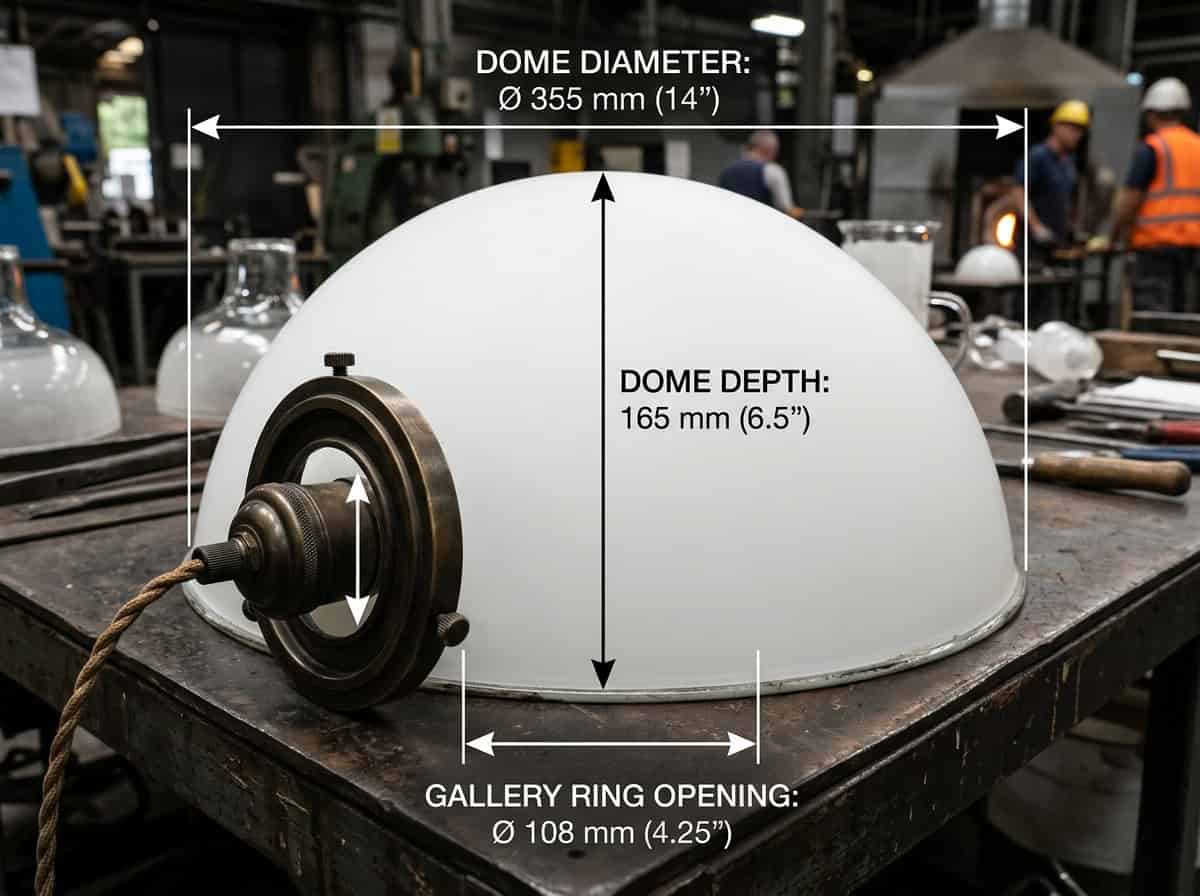
Key Dimensions
Dome diameter: The maximum outer diameter of the glass shade body. Standard engineering shades range from 8 to 20 inches; the most common sizes for residential and restaurant use are 10, 12, and 14 inch.
Dome depth: Measured from the gallery ring seating surface to the lowest point of the dome interior. A “deep” dome has a depth:diameter ratio of 0.6–0.7; a “shallow” or saucer-form shade has a ratio of 0.3–0.4. Depth significantly affects beam control — deeper domes are more directional.
Fitter or gallery opening: The inner diameter of the glass shade’s upper opening that seats in the gallery ring. Standard sizes are 2¼ inch, 3¼ inch, 4 inch, and 6 inch for various pendant systems. Unlike standard replacement shades, many engineering pendant shades use a full gallery ring (a complete metal ring with set screws) rather than a simple fitter collar.
Gallery ring diameter and design: The mounting hardware varies significantly between styles. Specify whether the installation requires:
– Standard fitter-style mounting (glass collar seats in a ring with set screws)
– Gallery ring mounting (glass flange captured inside a flanged metal ring)
– Porcelain or cast iron gallery (for period-authentic reproduction fixtures)
Glass Type Specification
For contemporary production engineering glass lamp shades, specify the glass type explicitly:
- Opal glass, borosilicate base: the premium specification — consistent opal appearance, thermal shock resistance for high-wattage LED sources and any residual high-wattage incandescent retrofit. Recommended for all applications.
- Opal glass, soda-lime base: standard production specification. Adequate for LED sources that run cool. Not appropriate for halogen or high-wattage incandescent.
- Prismatic (Holophane-style), clear borosilicate: for authentic photometric performance in workshop and industrial applications.
Per the NEMA standards for industrial luminaire enclosures, engineering pendant shades used in industrial environments should meet minimum thermal ratings documented by the manufacturer — relevant for facilities using high-wattage sources or operating in elevated ambient temperature environments.
Authentic vs. Reproduction: What to Look For
For period restoration and high-end hospitality design, buyers often need to distinguish between authentic vintage engineering glass lamp shades and contemporary reproductions. Key differentiators:
Authentic vintage indicators:
– Mold seam lines (two-piece press molds leave a visible seam on the glass surface)
– Slight dimensional variation (hand-finishing creates 1–3 mm variation between production units)
– Original opal glass appearance: slightly warm cream tone rather than pure white (early opal glass formulations used calcium phosphate opacifier which produces a warmer tone than modern tin oxide or synthetic opal formulations)
– Period-appropriate fitter sizes (original US engineering shades often use 3¼ inch fitter — less common in contemporary production)
Quality reproduction indicators:
– Documented borosilicate glass construction (authentic vintage shades were not all borosilicate — many were soda-lime; good reproductions use borosilicate for longevity)
– Consistent opal density (well-manufactured reproductions have more uniform light transmission across the dome surface than vintage shades, which may have opal density variation from batch-to-batch production)
– Documented fitter dimensions (reputable reproduction suppliers provide caliper-verified fitter measurements)
Trends in Engineering Glass Lamp Shades for 2026 and Beyond
Three converging trends are shaping the engineering glass lamp shade market in 2026:
LED retrofit compatibility. Original engineering glass lamp shades were designed for incandescent filament sources. Contemporary filament-style LED lamps — Edison bulbs with visible LED filament arrays — have revived interest in these shades because the visible filament aesthetic in a clear or opal dome reproduces the classic look. However, filament LED lamps distribute light differently from true incandescent filaments, and opal glass provides better diffusion of LED hot spots than clear glass.
Dark-sky compliant downlighting. Engineering glass pendant shades are inherently excellent dark-sky luminaires — their deep dome geometry directs virtually all output below the horizontal plane, which is exactly what the International Dark-Sky Association’s fixture certification criteria require. This has driven adoption of engineering-style pendant shades in outdoor covered spaces (covered porches, verandas, pergolas) where dark-sky compliance is required or desired.
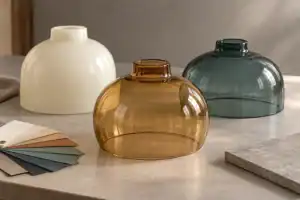
Custom color and finish expansion. The traditional opal white and clear glass dominance in engineering glass lamp shades is giving way to a broader color palette — smoked glass domes, jade green (referencing the vintage pharmacy lamp aesthetic), and cobalt blue in smaller accent sizes. These are not traditional engineering specifications but reflect consumer demand for the industrial form factor with contemporary color expression.
| Trend | Market Response | 2026 Adoption |
|---|---|---|
| LED filament retrofit compatibility | Opal glass preferred over clear for LED diffusion | ~65% of new pendant installs |
| Dark-sky outdoor covered spaces | Deep dome engineering shades as outdoor pendants | ~20% of covered outdoor projects |
| Custom color glass | Smoked, green, cobalt dome shades | ~12% of design-led projects |
| Borosilicate as standard spec | Documented glass type required by specifiers | ~40% of commercial projects |
Frequently Asked Questions
What is an engineering glass lamp shade?
An engineering glass lamp shade is a deep dome, prismatic, or opal glass shade originally designed for factory and workshop pendant lighting in the late 19th and early 20th centuries. Characterized by a gallery ring mounting system, heat-resistant glass (opal, prismatic, or borosilicate), and a geometry that directs light downward for task illumination. Today it is widely used in industrial interior design, restaurant lighting, and workshop applications.
What is the difference between a Holophane shade and an engineering glass shade?
Holophane is a specific brand and style of prismatic glass shade — the glass has a regular pattern of prisms on the surface that refracts light with geometric precision for high-uniformity floor illumination. It is one type within the broader engineering glass shade category. Other engineering glass shades include opal dome, clear glass deep dome, and RLM-style. All Holophane shades are engineering glass shades; not all engineering glass shades are Holophane.
What size engineering glass lamp shade do I need?
For dining table pendant use, a 12–14 inch dome hanging 30–36 inches above the table surface is the standard specification. For bar counters, a 10–12 inch dome at 18–24 inches above the counter works well. For workshop task lighting, a 12–16 inch dome at 24–36 inches above the work surface provides excellent task illumination. Multiple pendants in a row work well for long workbench or table applications — space them 3–4 feet apart.
Can engineering glass lamp shades be used outdoors?
Yes, in covered outdoor spaces — covered porches, pergolas, verandas, and outdoor kitchen areas. The glass shade must be rated for damp location use (the pendant housing and socket, not just the shade). Borosilicate glass construction is recommended for outdoor use due to temperature cycling exposure. The deep dome geometry makes engineering glass pendants inherently excellent dark-sky luminaires, as virtually all light is directed downward with no upward spill.
How do I identify the fitter size for an engineering glass lamp shade?
Engineering glass lamp shades use gallery-style mounting rather than a simple fitter collar in many cases. The standard gallery diameters are 4 inch (102 mm) for most residential and restaurant pendants, and 6 inch (152 mm) for larger industrial dome shades. To identify the correct size, measure the inner diameter of the gallery ring on the pendant fixture — this measurement matches the outer diameter of the glass shade’s upper flange. Some styles use a 3¼ inch (82 mm) fitter — particularly authentic vintage shades.
What glass type is used in original engineering glass lamp shades?
Original engineering glass lamp shades from the 1900s–1950s were produced in several glass types depending on application: opal white glass (calcium or tin phosphate opacifier) for general workshop use, prismatic clear glass for Holophane-type precision optics, and heat-resistant borosilicate for high-wattage incandescent applications. Most vintage shades are soda-lime opal glass, not borosilicate. Quality contemporary reproductions typically use borosilicate opal glass for improved thermal shock resistance.
How do I clean an engineering glass lamp shade?
Remove the shade from the gallery ring by loosening the set screws. For opal glass shades, wash in warm water with a small amount of dish soap — soaking for 10–15 minutes dissolves most smoke and dust accumulation. For prismatic glass shades, use a soft brush to clean between the prism ribs where dust accumulates. Avoid abrasive pads on either type — they scratch the glass surface and reduce optical performance. Dry thoroughly before reinstalling. Opal glass shades in restaurant environments near kitchen exhaust should be cleaned every 2–3 months; workshop shades every 6 months.

Conclusion
The engineering glass lamp shade is one of the few lighting products that functions exactly as well today as when it was designed a century ago — and looks better for it. The deep dome geometry, opal or prismatic glass, and gallery ring mounting that made these shades the workhorses of industrial task lighting now make them the defining element of industrial interior design and a genuinely excellent task light for contemporary workshops, kitchens, and restaurant spaces.
Specifying an engineering glass lamp shade correctly requires identifying the style variant (opal dome, prismatic, RLM, or Benjamin-style), confirming the gallery ring diameter and mounting system, and specifying the glass type — borosilicate for thermal resilience, opal for soft diffused light, prismatic for maximum optical precision. For contemporary use with LED sources, opal glass provides better diffusion of LED hot spots than clear glass.
For engineering glass lamp shade manufacturing in opal, prismatic, and borosilicate construction — in standard and custom dome diameters — our glass lampshade product line at jxlampshade.com covers both reproduction specifications and custom design programs for commercial and residential projects.