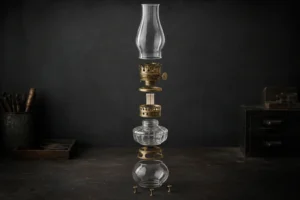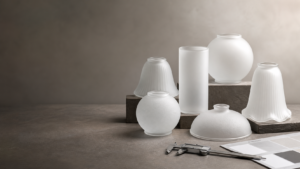
Direct answer: Cut glass table lamp shades are decorative glass covers with geometric faceted patterns — diamond, hobstar, fluted, or step-cut — that refract light into prismatic effects. They attach via uno, gallery, or spider fitters and range from Victorian American Brilliant period originals to current-production pressed geometric reproductions.
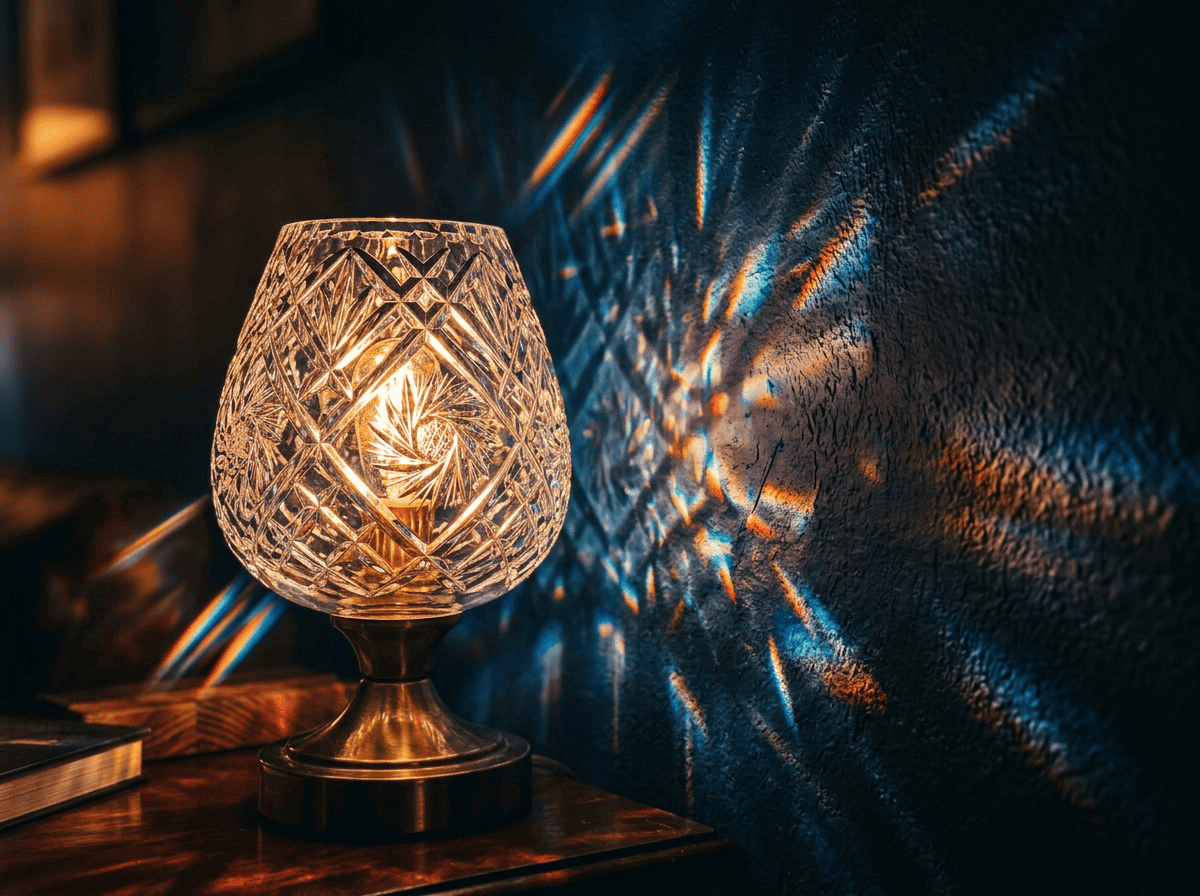
The defining characteristic of a cut glass table lamp shade is its relationship with light. Unlike frosted or opal glass, which absorbs and diffuses, cut glass interacts — the faceted surfaces refract light into prismatic patterns that animate the surrounding walls, ceiling, and table surfaces. A cut glass shade is not just a way to cover a bulb; it’s an active participant in the room’s visual character.
This guide covers the full cut glass table lamp shade market: pattern types, period styles, how to select the right shade, and how to distinguish quality from inferior production.
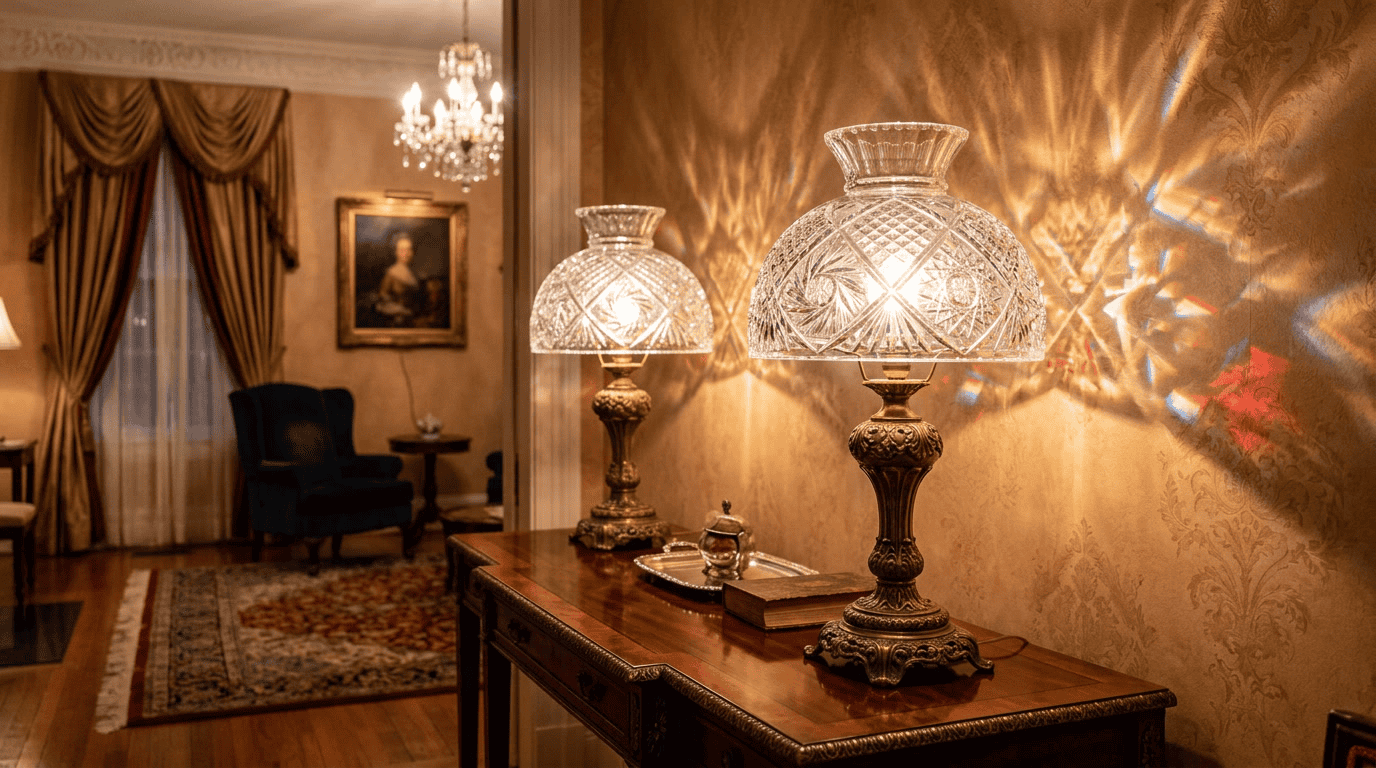
The Cut Glass Pattern Family for Table Lamp Shades
Six patterns dominate the cut glass table lamp shade market:
Diamond crosshatch: The most common and most versatile. Regular diamond grid across the entire shade surface. Works with virtually any lamp base style and period. The geometric regularity means any slight asymmetry in the cut is visible — quality control matters more for diamond crosshatch than for complex patterns.
Hobstar / strawberry diamond: Diamond crosshatch with an additional radiating star cut at each diamond intersection. The hobstar adds significant brilliance because the additional polished surfaces multiply the light refractions. More visually complex than plain diamond; more period-specific (strong association with American Brilliant, 1880–1915).
Fluted / vertical cuts: Straight parallel vertical cuts running the full height of the shade. Simple, architectural, produces clean vertical light columns on surrounding surfaces. More appropriate for streamlined modern or Art Deco-adjacent lamp bases than for ornate Victorian forms.
Fan or shell cut: Repeated fan shapes arranged in bands. Graceful, less angular than diamond patterns. Common on Victorian and Edwardian quality shades. Less available as reproductions than diamond patterns.
Step / block cut: Horizontal bands of flat-cut rectangular faces. Clean, geometric, appropriate for Art Deco and Streamline Moderne lamps.
Bohemian / naturalistic: Floral, leaf, and figurative motifs cut in relief. European (Czech/Bohemian) production tradition. The most labor-intensive; the most visually distinctive; the hardest to source as replacements.
Period Styles and Their Pattern Preferences
| Era | Preferred cut glass patterns | Lamp base material | Fitter type |
| American Brilliant (1880–1915) | Hobstar, strawberry diamond, fan cut | Silver, silver plate, brass | 2¼” gallery or ring support |
| Edwardian (1900–1920) | Fan cut, fluted, hobstar | Silver, brass, ornate cast metal | 2¼” gallery |
| Art Deco (1920–1940) | Step cut, fluted, geometric pressed | Brass, chrome, bakelite | 2¼” to 3¼” gallery |
| Hollywood Regency (1955–1980) | Diamond crosshatch, pressed crystal | Heavy brass, chrome | Spider/harp, gallery |
| Contemporary reproduction | Diamond crosshatch, fluted | Any | Uno, spider, gallery |
How to Buy Cut Glass Table Lamp Shades
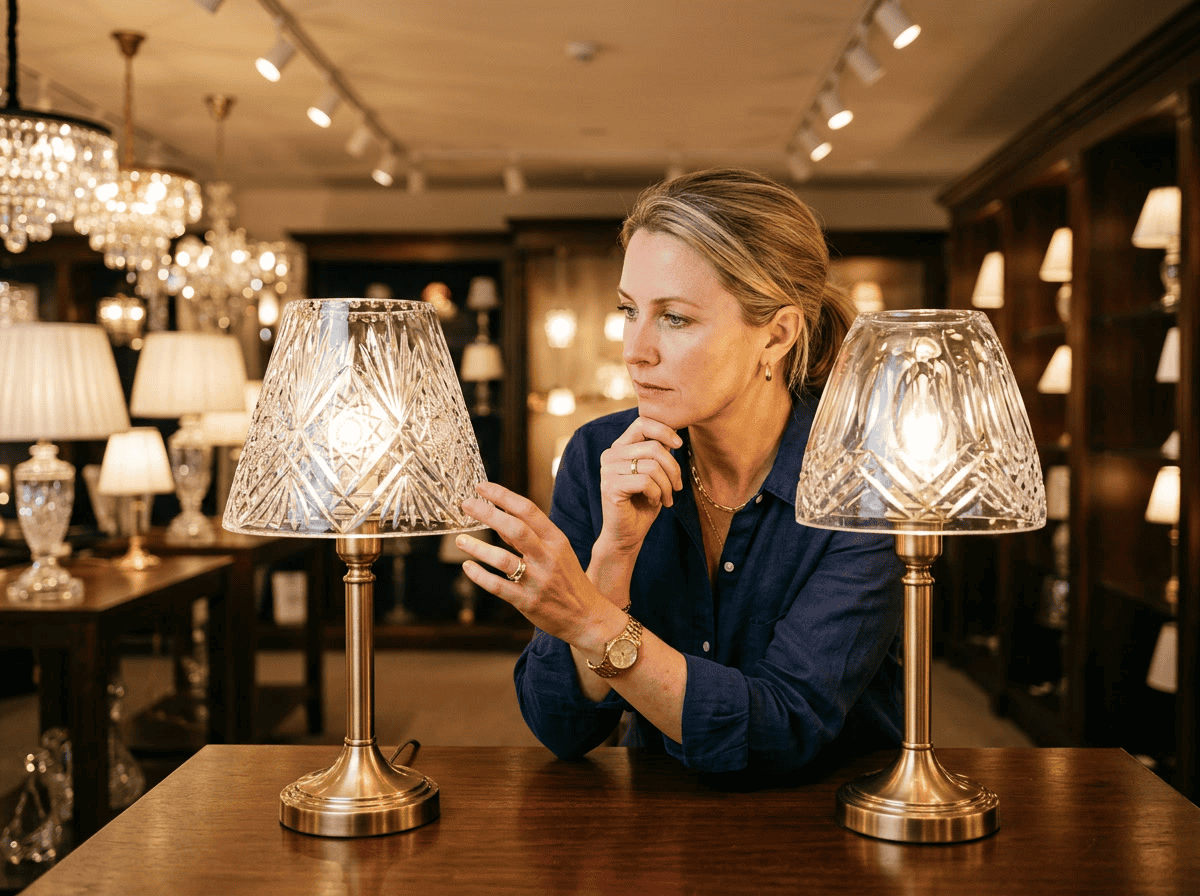
Three quality indicators that separate good cut glass shades from poor:
1. Facet sharpness: Run your fingernail along the cut pattern edges. Sharp, polished edges indicate true cut glass (or high-quality pressed with post-process polishing). Soft, rounded edges indicate basic pressed glass.
2. Polishing quality: True cut glass facets are individually polished to optical clarity. Look at a reflective surface nearby in the facet — you should see a clear, undistorted reflection. Matte or frosted-looking facets indicate unpolished pressed surfaces.
3. Glass clarity: Hold the shade up to a light and look through the clear glass areas (not the pattern) for any cloudiness, bubbles, or inclusions. Quality glass is water-clear between the cuts.
The lit test: Ask for a lit demonstration or request a lit photo from any online supplier. Cut glass quality is most apparent when the shade is lit from inside — the prismatic patterns on surrounding surfaces are the direct result of facet quality. Poor-quality pressed glass produces a dull, uniform sparkle; quality cut glass produces brilliant, distinct prismatic dispersal.
For current production cut glass style pressed shades, our cut glass lamp shades collection shows available patterns and fitter specifications.
Sizing Cut Glass Shades for Table Lamps
The proportion rule: shade outer diameter ≈ lamp base height. A 14″ tall brass base wants approximately a 14″ outer diameter shade.
| Base height | Cut glass shade outer diameter | Most appropriate pattern |
| 8–10″ | 8–12″ | Simple diamond or fluted |
| 10–14″ | 12–14″ | Diamond crosshatch or hobstar |
| 14–18″ | 14–18″ | Any pattern; hobstar for maximum drama |
| 18″+ | 16–20″ | Diamond or fluted for legibility at scale |
Note that complex patterns like hobstar become visually busy when the shade diameter is small — on shades under 10″ outer diameter, simple diamond or fluted patterns read more clearly.
Cut Glass Shades With Modern LED Bulbs
Cut glass shades work optimally with decorative filament LED bulbs. The visible filament within the clear glass acts as a distributed light source — the cut facets refract light from the filament’s shape into the prismatic patterns. An omnidirectional A19 LED produces reasonable results but the light source is a single point rather than a shaped filament, reducing the pattern complexity.
Recommended pairings:
- Diamond crosshatch / fluted: Decorative filament LED 400–600 lm, 2700K
- Hobstar / complex patterns: Decorative filament LED 600–800 lm, 2700K for more facet activation
- Any cut glass shade: Dimmer switch strongly recommended — dimming creates variable light character that plain-on operation doesn’t provide
According to the U.S. Department of Energy’s LED efficiency page, decorative filament LEDs are available in many shapes (globe, Edison, tubular) at standard base sizes — the filament shape directly affects the cut glass shade’s prismatic patterns, making bulb selection part of the shade’s overall visual design.
Interior Contexts for Cut Glass Table Lamp Shades
Traditional and formal interiors: Cut glass table lamp shades are native to formal traditional rooms — the brilliance and prismatic effects reinforce the material richness of dark wood furniture, polished brass, and richly patterned textiles.
Hollywood Regency: Heavy diamond-cut globe shades on brass urn bases, placed symmetrically on console tables or flanking a sofa. The combination of cut glass brilliance with heavy brass creates maximum glamour.
Contemporary with period accent: A single cut glass shade on a streamlined contemporary base reads as a deliberate material statement in a minimalist room. The cut pattern’s complexity contrasts with the surrounding simplicity.
What to avoid: Cut glass beside other visually complex materials (highly patterned wallpaper, busy textiles). The prismatic patterns need visual breathing room to read as designed rather than chaotic.
Caring for Cut Glass Table Lamp Shades
Pattern recesses collect dust quickly. Monthly cleaning is practical.
Dry phase first: Use a soft natural-bristle brush (watercolor brush or similar) to remove dust from pattern recesses before any wet cleaning. If you skip this step, wet cleaning pushes the dust into the cuts.
Wet phase: Damp microfiber cloth with warm water and a drop of dish soap. Wipe the exterior surface following the pattern geometry — along the cut lines, not across them, to avoid stressing the cut edges.
Rinse phase: Clean damp cloth (water only), wipe to remove soap residue.
Dry: Air dry fully before reinstalling. Moisture in the pattern recesses near the fitter hardware can cause rust on the metal parts over time.
Frequently Asked Questions
Is all “cut glass” lamp shades actually cut?
No. Most residential “cut glass” shades are pressed glass — the pattern is formed in a mold rather than ground in with a cutting wheel. True cut glass is individually cut and polished after forming. The difference is visible in edge sharpness (cut glass = sharp; pressed = rounded) and facet polish quality (cut = reflective; pressed = slightly matte).
What fitter is most common on cut glass table lamp shades?
For vintage originals: 2¼” gallery fitter (inner diameter 2.25″) is most common for pre-1940 shades. For post-war and contemporary: uno fitter (7/8″ threaded) or spider/harp fitter. Always measure your lamp’s hardware rather than assuming.
Do cut glass shades work with contemporary interiors?
Yes. A single cut glass shade in a contemporary room works as a deliberate material contrast. Avoid using multiple cut glass shades throughout a modern room — the visual complexity overwhelms clean contemporary architecture.
How much does a quality cut glass table lamp shade cost?
True cut glass: $80–300+ depending on pattern complexity, diameter, and whether it’s a period original or quality reproduction. Quality pressed geometric: $25–80 depending on size and quality level. Low-quality pressed imports: under $25, but typically visible in the matte, unsharp facets.
Can I put a cut glass shade on a mid-century modern lamp base?
Visually possible but stylistically incongruous for purist MCM interiors. MCM lamp design favored opal white glass, not cut faceted patterns. If you like the combination, consider a fluted (simple vertical cuts) shade rather than complex hobstar patterns, which are more period-neutral.
What’s the best bulb for cut glass lamp shades?
Decorative filament LED, 400–600 lumens, 2700K warm white, dimmable. The visible filament creates optimal prismatic patterns through the cut facets. Omnidirectional A19 LED is acceptable; single-point LED spots are less effective for cut glass activation.
Are cut glass lamp shades safe to use?
Yes. Glass lamp shades have no electrical components and are safe for normal residential use. Handle at the fitter rim rather than the shade body; the facets, while not razor-sharp, have sharper edges than smooth glass.
Related Articles in This Series
Conclusion
Cut glass table lamp shades are among the most visually active decorative elements available in residential lighting — the prismatic effects at night are genuinely dynamic in a way smooth glass cannot replicate. The decision framework is straightforward: start with fitter dimension (measurement), set proportional diameter and height, then choose pattern complexity appropriate to the lamp base style and interior context.
For quality replacements and new specifications, distinguish clearly between true cut glass and pressed geometric — both are valid, the right choice depends on budget, visual priority, and whether the lamp will be the room’s focal point.