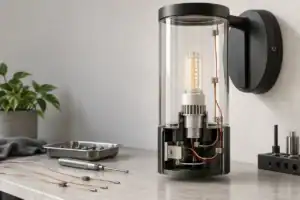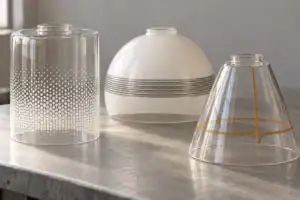
Choose glass shades for technical lighting by matching application type first (task, industrial, hazardous, or ambient), then specifying IP rating (IP54 minimum for indoor industrial), glass material (borosilicate for high-heat or thermal-cycling applications), and photometric distribution (clear for maximum lux, opal for diffused uniformity, prismatic for beam control).
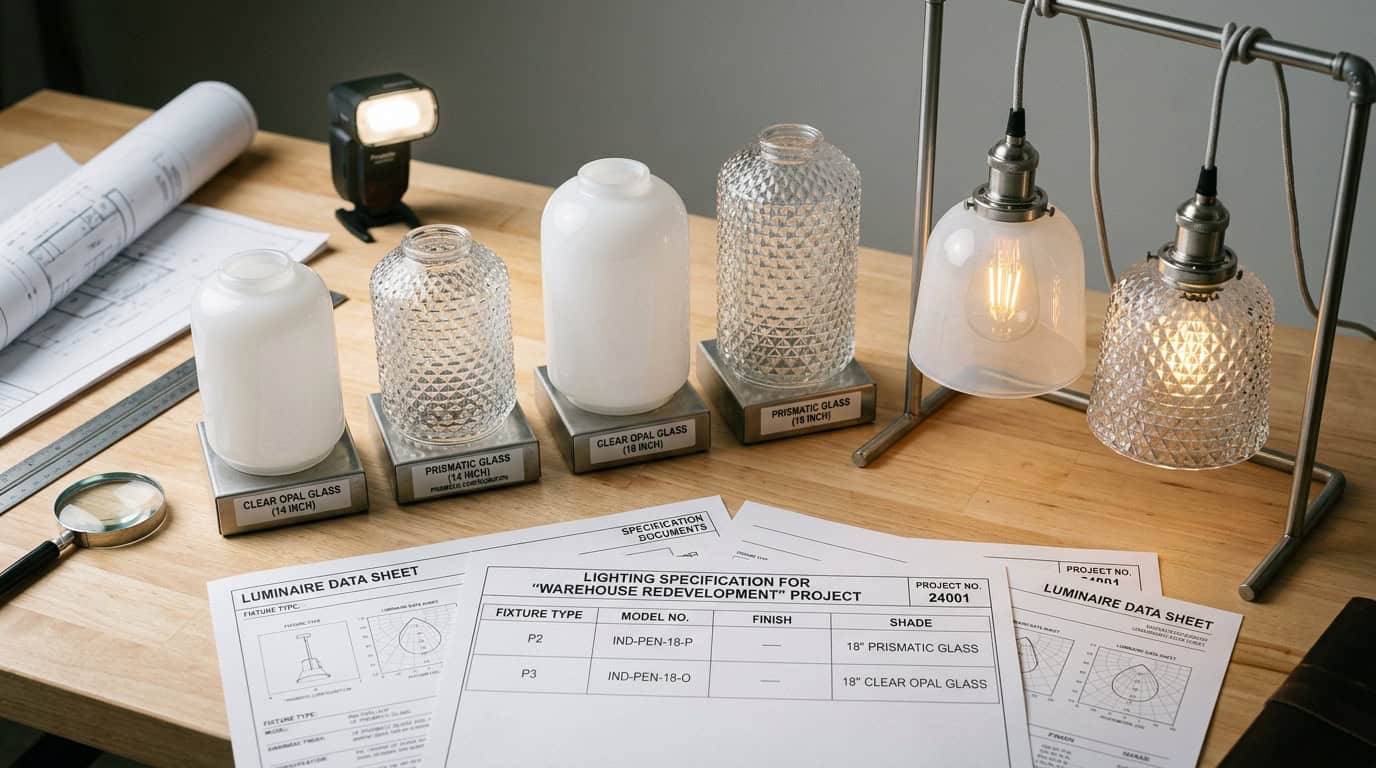
Technical lighting specification is not the same as residential or decorative lighting selection. When a facilities engineer or lighting specifier chooses glass shades for a machine shop, laboratory, food production facility, or industrial pendant installation, the stakes are different: wrong glass type means thermal shock failures, wrong IP rating means moisture ingress into the socket, and wrong photometric distribution means task illumination that misses the spec target by 30%.
This guide provides the specifier’s decision framework for selecting glass shades for technical lighting applications — in the correct order, with the specific parameters that drive each decision.
Step 1: Define the Application Category
The application category determines the mandatory constraints before any other decision is made.
Task lighting (workbench, drafting, assembly): The primary requirement is photometric — adequate footcandles at the work surface, uniform distribution, and minimal glare at eye level. Glass shade selection centers on achieving the photometric target at the correct mounting height. Prismatic or opal glass is preferred over clear to control glare.
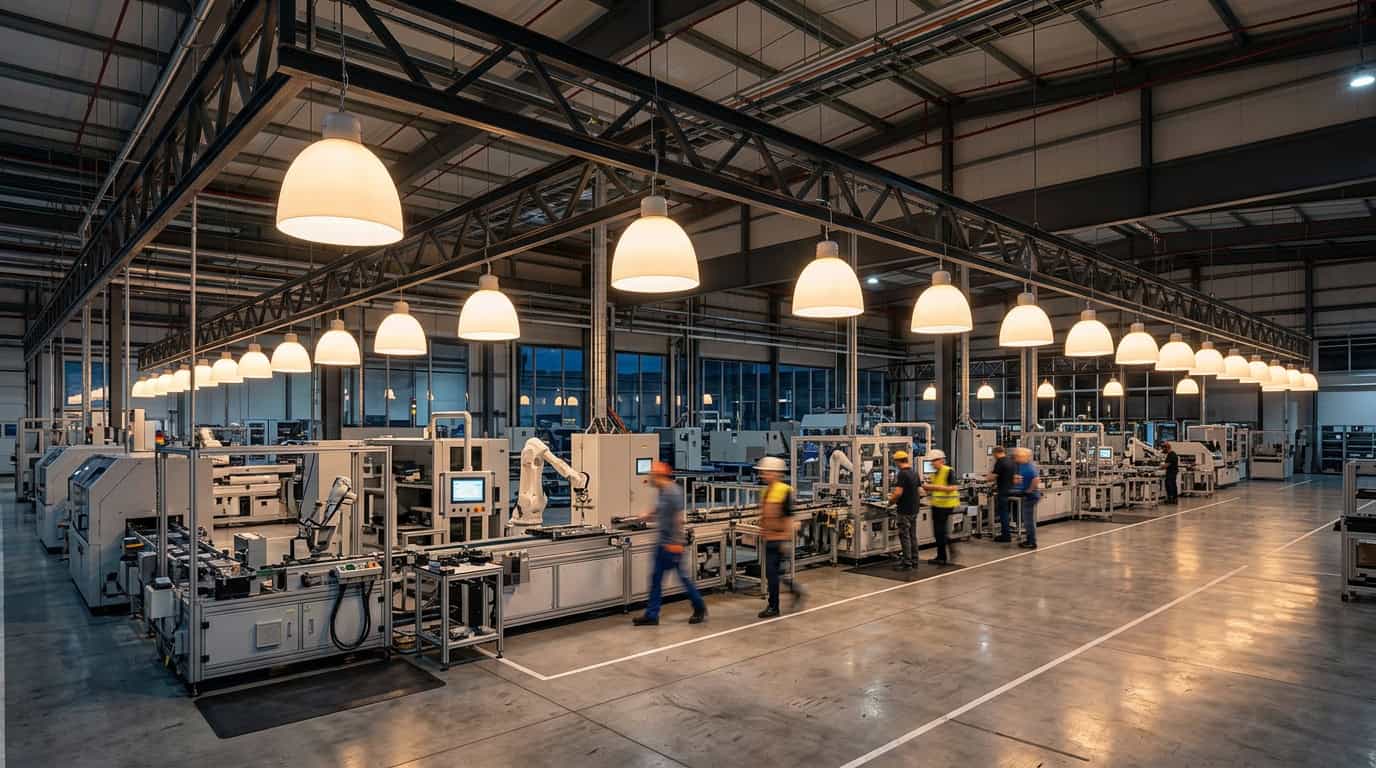
General industrial (warehouse, high-bay, machine shop): IP54 rating is the minimum for most indoor industrial environments where the fixture may be exposed to dust and occasional moisture. Tempered or borosilicate glass is required for high-bay applications where ambient temperature variation and proximity to heat-generating machinery create thermal cycling.
Hazardous location (ATEX/NEC Zone 1-2, Class I/II): Explosion-proof rated luminaire enclosures require glass rated to withstand 5J+ impact without fragmentation. Tempered glass is mandatory; borosilicate tempered is preferred for combined impact and thermal resistance. Glass must be certified as part of the explosion-proof assembly — specifying glass separately from the certified fixture breaks the classification.
Food processing and clean environments: IP65 or higher is required. Glass must be resistant to cleaning chemicals (alkaline washdown solutions at concentrations up to 2-3% NaOH are common). Borosilicate glass is chemically more resistant than soda-lime; check the manufacturer’s chemical resistance table against the specific cleaning agents used.
Outdoor covered technical (covered loading docks, outdoor process areas): Damp location or wet location rated, minimum IP65, borosilicate glass for freeze-thaw cycling.
| Application | Minimum IP | Glass Type | Photometric |
|---|---|---|---|
| Workbench task | IP44 | Borosilicate opal | Prismatic or opal |
| General industrial | IP54 | Heat-tempered | Clear or opal |
| Hazardous location | IP65 + ATEX/NEC cert | Tempered, 5J+ rated | Per fixture cert |
| Food processing | IP65 | Borosilicate | Opal or frosted |
| Outdoor covered | IP65 | Borosilicate | Opal |
Step 2: IP Rating — What It Means for Glass Shades
The Ingress Protection rating, defined by IEC standard 60529, applies to the assembled luminaire, not to the glass shade in isolation. However, the glass shade design directly affects whether the assembled fixture can achieve and maintain its rated IP protection.
Two glass shade characteristics affect IP rating maintenance:
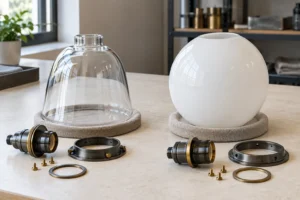
Fitter seal geometry. The glass shade must maintain a continuous seal at the fitter or gallery ring junction. A glass shade with a warped or irregular collar seating surface — a common defect in low-quality production — creates a gap in the seal that drops the effective IP rating of the assembled fixture. Specify glass shades with a verified collar flatness tolerance (±0.2 mm is adequate for IP54; ±0.1 mm for IP65).
Glass integrity under thermal cycling. A glass shade that develops micro-cracks from thermal shock does not automatically lose its weather seal — but crack propagation that reaches the collar contact area will eventually compromise the gasket seal. This is why borosilicate glass is the correct choice for technical lighting applications where thermal cycling is present: it prevents the crack-propagation failure mode that compromises IP ratings over time.
Per NEMA standards for outdoor luminaire enclosures, the gasket between the glass shade collar and the fixture ring must be inspected as part of scheduled maintenance — typically annually for IP54-rated fixtures in normal industrial environments, more frequently in washdown or chemical exposure environments.
Step 3: Glass Material Selection for Technical Applications
The glass material decision for technical lighting is not about aesthetics — it is about thermal performance, chemical resistance, and impact rating.
Borosilicate Glass
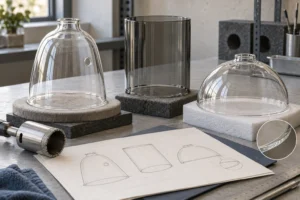
Borosilicate glass (12–15% B₂O₃ content) has a thermal expansion coefficient of approximately 3.3 × 10⁻⁶/°C — roughly one-third that of soda-lime glass. This allows it to absorb rapid temperature changes of 120°C or more without fracturing. Per ASTM C556 for borosilicate glass composition standards, documented borosilicate construction requires a boron trioxide content and corresponding thermal shock tolerance value stated in the material certificate.
For technical lighting, borosilicate is the correct specification when:
– Ambient temperature cycling exceeds ±30°C seasonally
– The fixture operates in close proximity to heat-generating process equipment
– The installation is within range of washdown or cleaning operations (thermal shock from cold water on hot glass)
– Chemical resistance to alkaline or acid cleaning agents is required
Heat-Tempered Soda-Lime Glass
Heat-tempered glass (fully tempered to ASTM C1048 standards) provides approximately four times the thermal shock resistance of annealed soda-lime glass, and when it does fracture, it shatters into small fragments rather than large shards — the “safety glass” characteristic required in many industrial environments.
Tempered glass is appropriate for general industrial applications without severe thermal cycling or chemical exposure. It is lower cost than borosilicate (typically 10–20% less) and more readily available in standard sizes.
Quartz Glass
Fused quartz glass (silicon dioxide, >99.9% SiO₂) has a thermal expansion coefficient of 0.55 × 10⁻⁶/°C — approximately one-sixth that of borosilicate — and can withstand temperature changes of several hundred degrees. It is also UV-transparent, which borosilicate (which blocks UV below 300 nm) is not.
Quartz glass is the correct specification for UV-curing lamps, germicidal UV luminaires, and high-temperature process lighting. It is significantly more expensive than borosilicate (typically 5–10× the material cost) and is not appropriate as a general substitute — specify only where the application specifically requires its properties.
Polycarbonate vs. Glass for Technical Lighting
The polycarbonate-versus-glass debate in industrial lighting most often resolves to glass for long-term technical applications because:
– Glass maintains optical clarity over 10–15 years; polycarbonate develops surface micro-scratching and UV-induced yellowing within 5–8 years in industrial environments
– Glass is chemically resistant to the alkaline and solvent cleaning agents common in industrial washdown; polycarbonate is not
– Glass is non-flammable; polycarbonate can char and off-gas in fire conditions
Polycarbonate retains a legitimate advantage in impact-resistance applications where breakage from physical contact is the primary risk.
Step 4: Photometric Selection — Distribution and Transmittance
The glass shade’s optical properties directly determine whether the fixture achieves its illuminance target on the work surface.
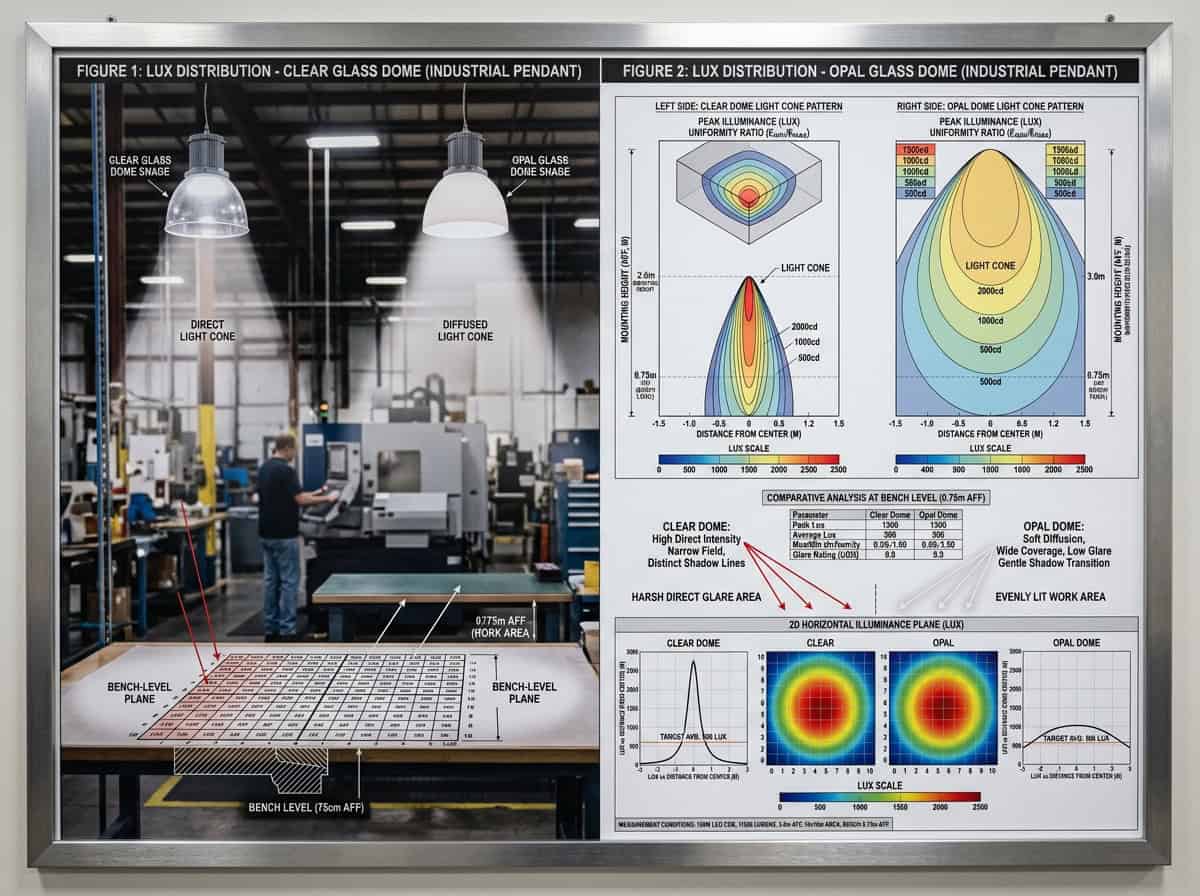
According to the Illuminating Engineering Society’s technical recommendations for industrial lighting, task lighting for precision assembly work should deliver 500–1,000 footcandles at bench level; general assembly and inspection 200–500 footcandles; general industrial warehouse 30–75 footcandles. The glass shade transmittance directly affects which LED wattage is needed to hit these targets.
Clear glass: 88–92% transmittance. Maximum lux delivery. The bulb is visible, creating some glare potential at eye level. Appropriate for high-bay applications where the luminaire is above typical eye level, or where maximum lux per watt is the primary design constraint.
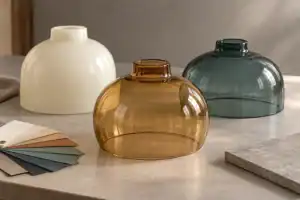
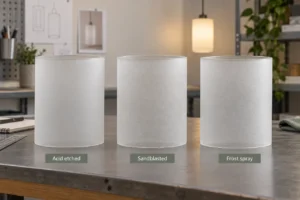
Opal glass: 75–82% transmittance. Uniform, glare-free illumination. The lux reduction (typically 8–15% versus clear at the same wattage) is small enough that a single step up in LED wattage compensates. Correct choice for task lighting, laboratory, and most indoor industrial pendant applications.
Prismatic glass (Holophane-type): 65–78% transmittance with beam shaping. The prism geometry redirects light to improve floor uniformity for a given luminaire spacing — equivalent illuminance uniformity with a wider luminaire spacing than flat glass alternatives. Correct choice for high-bay pendant arrays where uniformity ratio (minimum/average footcandles) is specified.
Step 5: Sizing and Fitter Specification
Technical lighting glass shades use the same fitter sizing principles as decorative shades, but the size range extends further and the tolerance requirements are tighter.
Standard fitter sizes for technical and industrial pendant glass shades:
– 2¼ inch (57 mm) — small pendant task fixtures, desk-mount inspection lights
– 3¼ inch (83 mm) — mid-size industrial pendants, common in older installations
– 4 inch (102 mm) — standard residential and light industrial pendant
– 6 inch (152 mm) — large industrial dome shade pendant
– 8 inch (203 mm) — heavy commercial and high-bay dome shade pendant
For IP65 applications, the fitter collar seating surface flatness matters: specify ±0.1 mm flatness tolerance for the glass collar seating face on all IP65 assemblies. This is not a specification that generic catalog shades carry — it requires a documented manufacturing specification from the glass supplier.
Common Specification Errors for Technical Lighting Glass Shades
Error 1: Specifying glass type without thermal rating. Ordering “borosilicate glass shade” without specifying thermal shock tolerance allows suppliers to ship low-boron glass that markets as borosilicate but does not meet the thermal performance that motivates the specification. Require the material certificate showing thermal expansion coefficient ≤3.3 × 10⁻⁶/°C.
Error 2: Applying residential fitter tolerances to IP65 assemblies. Residential replacement glass shades are manufactured to ±0.5–1 mm fitter diameter tolerance. For IP65 assembly, this tolerance is insufficient — the collar seating gap that results from a +1 mm oversize shade compromises the gasket seal.
Error 3: Ordering replacement glass separately from the certified explosion-proof fixture. In ATEX/NEC classified locations, the glass shade is a certified component of the classified fixture assembly. Replacing it with non-certified glass breaks the explosion-proof classification. Always source replacement glass through the fixture OEM for classified location installations.
Error 4: Selecting transmittance without checking the lux target. A designer who specifies opal glass in a high-bay application without recalculating the lux target at grade may specify a fixture that delivers only 70% of the required footcandles. Confirm the photometric target is achievable with the selected glass transmittance before specifying.
Trends in Technical Lighting Glass Shade Specification for 2026
LED source integration changes shade selection. LED chip arrays produce a fundamentally different spatial light distribution than incandescent or fluorescent sources. Opal glass increasingly outperforms clear glass in LED technical lighting applications because it diffuses LED hot spots that clear glass transmits directly to the work surface, creating uncomfortable luminance patterns.
Chemical resistance documentation required. Environmental and food-safety regulations are increasingly requiring documented chemical resistance data for all fixture components in food processing and pharmaceutical environments. Glass shade suppliers who provide chemical resistance tables against specific cleaning agents are gaining specification preference.
Dark-sky compliance for outdoor technical areas. Loading docks, outdoor process areas, and covered industrial spaces increasingly fall under local dark-sky or light-trespass ordinances. Per the International Dark-Sky Association’s regulatory framework, technical lighting in these spaces must meet full-cutoff distribution requirements — which deep dome and prismatic glass shades naturally satisfy.
| Specification Trend | Driver | 2026 Impact |
|---|---|---|
| Opal glass over clear for LED sources | LED hot-spot diffusion | ~60% of technical pendants |
| Chemical resistance documentation | Food-safety regulations | ~25% of processing/pharma installs |
| Dark-sky compliant distribution | Municipal codes | ~18% of outdoor technical areas |
| Borosilicate as default specification | Documented durability demand | ~40% of commercial specs |
Frequently Asked Questions
What glass is used in technical lighting applications?
Technical lighting applications use three primary glass types: borosilicate glass for high-heat and thermal-cycling applications, heat-tempered soda-lime glass for general industrial use with impact safety requirements, and quartz glass for UV-transmissive or ultra-high-temperature applications. Opal glass (borosilicate or soda-lime base) is the most common glass shade type for indoor industrial pendant lighting due to its uniform light diffusion and glare reduction.
What IP rating do industrial glass lamp shades need?
IP54 is the minimum for most indoor industrial environments — it provides dust protection and splash resistance adequate for general machine shop and warehouse use. IP65 is required for outdoor installations, washdown areas, food processing, and any application where the fixture may be directly sprayed with water or cleaning solution. IP66 or higher is specified for heavy washdown and chemical exposure environments.
What is the difference between opal and prismatic glass for technical lighting?
Opal glass diffuses light uniformly by scattering within the glass body (transmittance 75–82%), producing soft, glare-free illumination ideal for task and laboratory use. Prismatic glass uses geometric prism faces to refract and redirect light with precision (transmittance 65–78%), producing controlled beam patterns that improve illuminance uniformity across a floor area. Prismatic glass is specified when floor uniformity ratio is a design criterion; opal is specified when glare reduction and task comfort are priorities.
How do I specify borosilicate glass for a technical lighting project?
In the specification, require: (1) boron trioxide content ≥12% by weight, (2) thermal expansion coefficient ≤3.3 × 10⁻⁶/°C, (3) thermal shock tolerance ≥120°C differential without fracture, and (4) manufacturer’s material certificate confirming these values for the production lot. Without the material certificate, “borosilicate” in a product description is not a verified specification.
Can I replace the glass shade on an explosion-proof luminaire with any borosilicate globe?
No. In ATEX/NEC classified locations, the glass shade is a certified component of the explosion-proof fixture assembly. Replacing it with non-certified glass — even glass that meets superior mechanical specifications — breaks the explosion-proof classification. Source replacement glass exclusively through the fixture OEM for classified location installations.
What mounting dimensions should I verify for industrial glass shade replacement?
Verify: fitter inner diameter (the critical fit dimension — must match the holder ring inner span to ±0.5 mm for IP54, ±0.2 mm for IP65), collar seating face flatness (±0.1 mm for IP65), glass shade height (for enclosed fixture housings), and globe outer diameter (for clearance within the fixture housing). Request dimensional drawings from the glass shade supplier before ordering for IP65 and classified location applications.
How often should glass shades be replaced in industrial lighting installations?
Borosilicate glass shades in normal industrial environments (no chemical exposure, LED sources) should last 10–15 years before any optical degradation. Heat-tempered soda-lime glass in moderate thermal cycling environments typically lasts 5–8 years before micro-fractures at the collar compromise the IP seal. Scheduled maintenance should include visual inspection of all glass shades for crazing, collar micro-cracks, and gasket condition annually, with replacement triggered by any visible glass damage.
Conclusion
Choosing glass shades for technical lighting follows a mandatory sequence: application category → IP rating → glass material → photometric distribution → fitter specification. Reversing the sequence — selecting a glass shade by appearance and then checking whether it can meet the application requirements — leads to specification errors that surface during installation, commissioning, or the first facility inspection.
The specification errors that recur most in technical lighting projects are underspecifying IP rating for washdown environments, ordering borosilicate without requiring the material certificate, and failing to recalculate the photometric target after switching glass transmittance levels.
For technical glass shade manufacturing in borosilicate, opal, prismatic, and heat-tempered construction with documented material specifications and IP-rated collar geometry, our glass lampshade product line at jxlampshade.com supports specification-grade commercial and industrial projects.