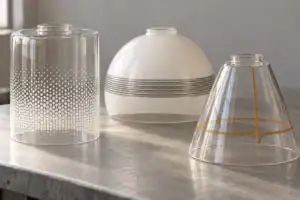
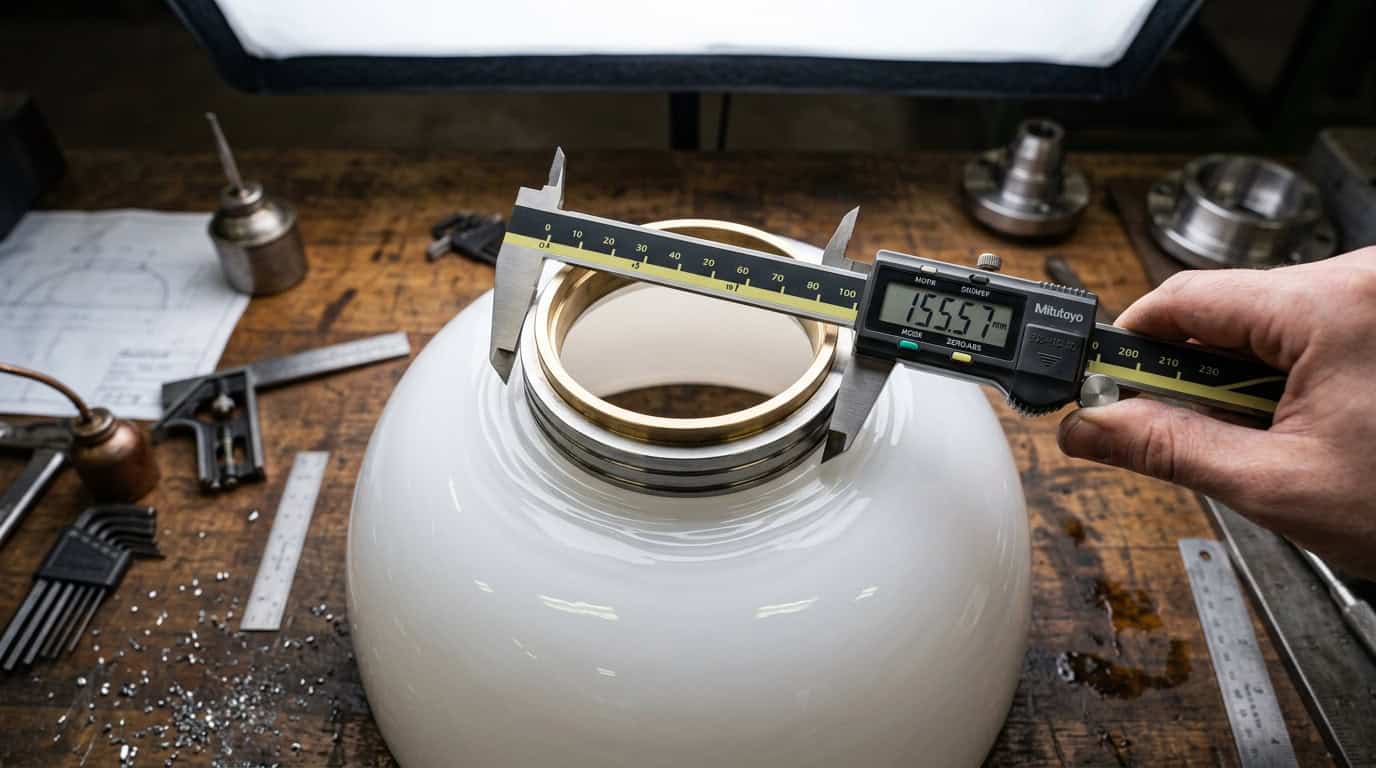
To measure a protective glass shade for an industrial or technical fixture, take four dimensions with digital calipers: fitter or gallery ring inner diameter (controls fit), globe or dome outer diameter, shade height, and — for IP-rated assemblies — the collar seating face depth, which determines gasket seal engagement and IP rating maintenance.
Measuring a decorative lamp shade for a home fixture allows some imprecision — if the globe is 3 mm undersized, it might rattle slightly but it still looks fine. Measuring a protective glass shade for an industrial or technical fixture does not allow that margin. An undersized fitter collar on an IP65-rated fixture breaks the water-tight seal. An oversized dome on a fixed-housing pendant fixture prevents assembly. A collar depth mismatch on a gasketed gallery ring leaves a gap that allows moisture, dust, and process chemicals directly to the socket.
This guide covers the complete measurement procedure for protective glass shades used in industrial pendants, machine tool lights, process area fixtures, and any technical luminaire where fit precision affects function, safety, or IP rating.
What Is a Protective Glass Shade?
A protective glass shade is a glass enclosure for a lamp source that serves a functional protection purpose beyond decoration: protecting the lamp from physical contact, containing glass fragments if the lamp breaks, providing weather or moisture sealing, or creating a specific photometric distribution for task or process illumination.
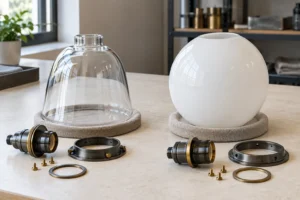
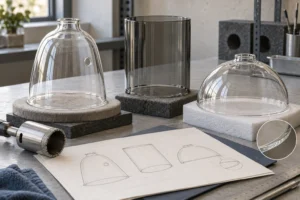
Protective glass shades appear in several fixture configurations:
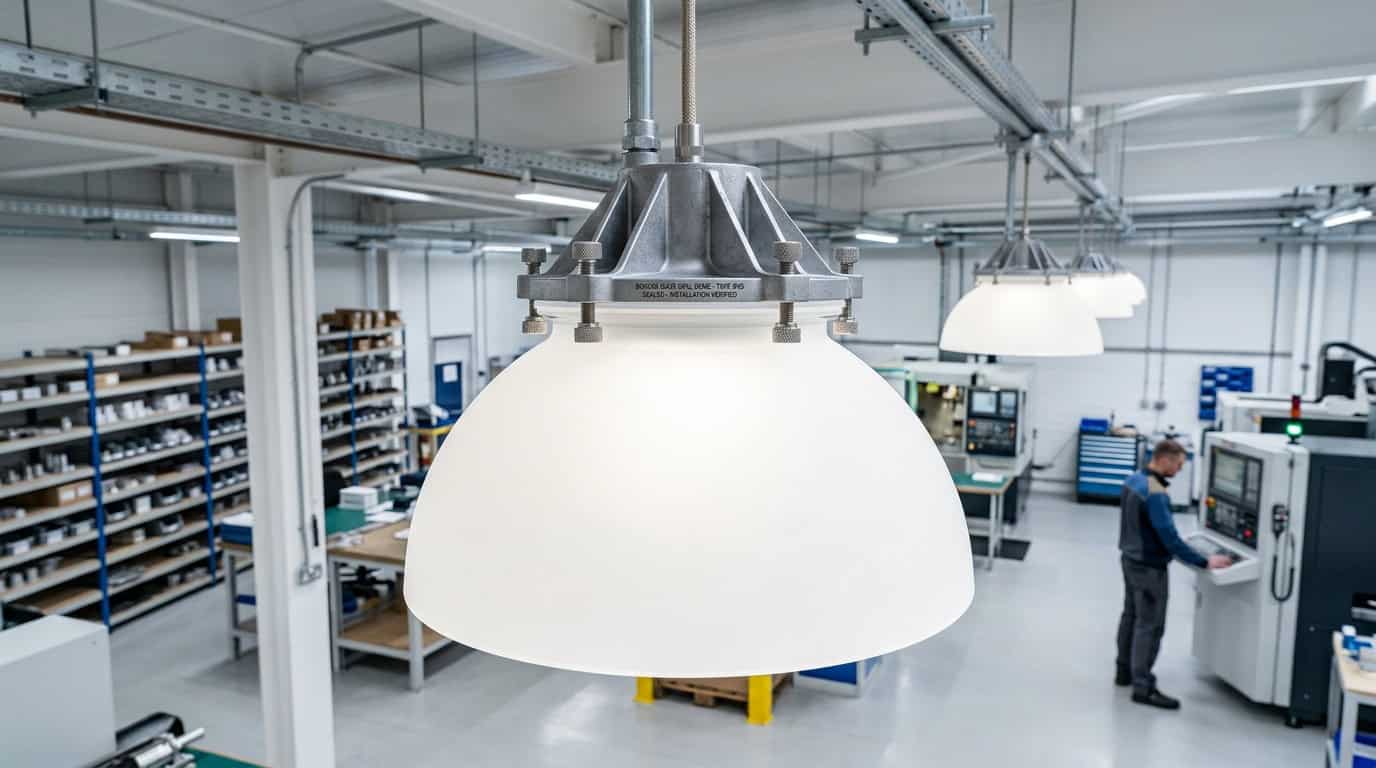
- Industrial dome pendants — deep opal or prismatic glass dome suspended from a gallery ring on a pendant cord or conduit, protecting the lamp from ambient dust, moisture, and occasional physical contact in machine shop or warehouse environments
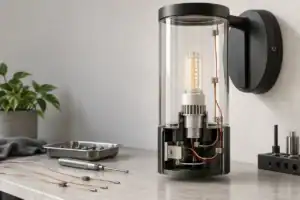
- Machine tool lights — compact dome or cylinder glass shades integrated into flexible-arm work lights for lathe, milling machine, or inspection applications; must fit within the fixture arm’s glass collar precisely
- Tube guards — cylindrical borosilicate glass sleeves around fluorescent or LED tubes in food processing or pharmaceutical facilities; protect the tube from breakage and contain glass fragments
- Explosion-proof globe covers — heavy-duty glass globes with thick walls, designed to withstand 5J+ impact as part of a certified explosion-proof fixture assembly
- Process area covers — glass domes or cylinders protecting lamps from chemical vapors, high humidity, and splash in industrial process areas
The measurement requirements for each type differ. This guide covers the full range.
The Four Critical Measurements for Protective Glass Shades
Measurement 1: Fitter or Gallery Ring Inner Diameter
This is the fit-controlling measurement — the only dimension that determines whether the protective glass shade physically seats in the fixture.
For fitter-style mounting (glass collar slides into a holder ring with set screws): measure the inner diameter of the glass shade’s collar opening. Standard fitter sizes:
– 2¼ inch (57 mm) — small task lights
– 3¼ inch (83 mm) — medium industrial pendants
– 4 inch (102 mm) — standard large pendants
– 6 inch (152 mm) — heavy industrial dome shades
For gallery ring mounting (glass flange captured inside a flanged metal ring): measure the outer diameter of the glass shade’s flange — the part that sits inside the gallery ring. The gallery ring inner diameter must match the glass flange outer diameter.
Use digital calipers for both measurements. For IP65 applications, the fitter inner diameter (fitter-style) or flange outer diameter (gallery-style) must match the fixture to within ±0.2 mm to maintain the gasket seal geometry.
Critical distinction: For fitter-style shades, the measurement is inside the glass collar opening (fitter inner diameter). For gallery ring shades, the measurement is outside the glass flange (flange outer diameter). Confusing these gives an incorrect ordering specification.
Measurement 2: Globe or Dome Outer Diameter
The maximum outer diameter of the glass shade body — measured at the widest point, not at the collar.
For enclosed fixture housings (where the dome sits inside a housing shell), this measurement determines clearance. A dome 5 mm too wide will not seat inside the housing; a dome 10 mm too narrow will rattle.
For open-frame fixtures (where the dome hangs freely from the gallery ring), diameter affects visual proportion and the photometric distribution pattern — a wider dome spreads light over a larger area.
Measure across the outside of the glass at the maximum width. For spherical globes, this is at the equator. For truncated dome profiles (flat-bottom domes common in some explosion-proof covers), measure at the widest horizontal section.
Measurement 3: Shade Height
Measured from the collar or flange seating surface (the point of contact with the holder ring or gallery ring) to the lowest point of the shade.
For enclosed fixtures, this is a clearance dimension — the shade must fit within the fixture’s internal height without contacting the lamp socket.
For open-frame pendants, height affects the depth of the effective light cone below the pendant. A deeper dome produces a more directional, higher-intensity pool; a shallower dome spreads light more broadly.
Measurement 4: Collar or Flange Seating Face Depth
This measurement is specific to IP-rated protective glass shade applications and is frequently overlooked by buyers accustomed to measuring decorative shades.
The collar seating face depth is the length of the glass collar section that extends into or contacts the holder ring — the depth of engagement between the glass and the metal mounting system. This dimension determines how much gasket material is compressed between the glass collar face and the metal ring seat.
For IP54 applications, a seating face depth of 6–8 mm is typically adequate. For IP65, 10–12 mm is required to ensure sufficient gasket compression across the full contact circumference. A protective glass shade with a collar seating face depth of only 4 mm installed in an IP65 fixture creates an incomplete gasket engagement that is the most common cause of IP65 rating failure in assembled fixtures.
Measure the collar seating face depth with digital calipers: the depth from the outer face of the collar flange (or the top of the collar opening) to the end of the seating surface.
Measurement Tools and Precision Requirements
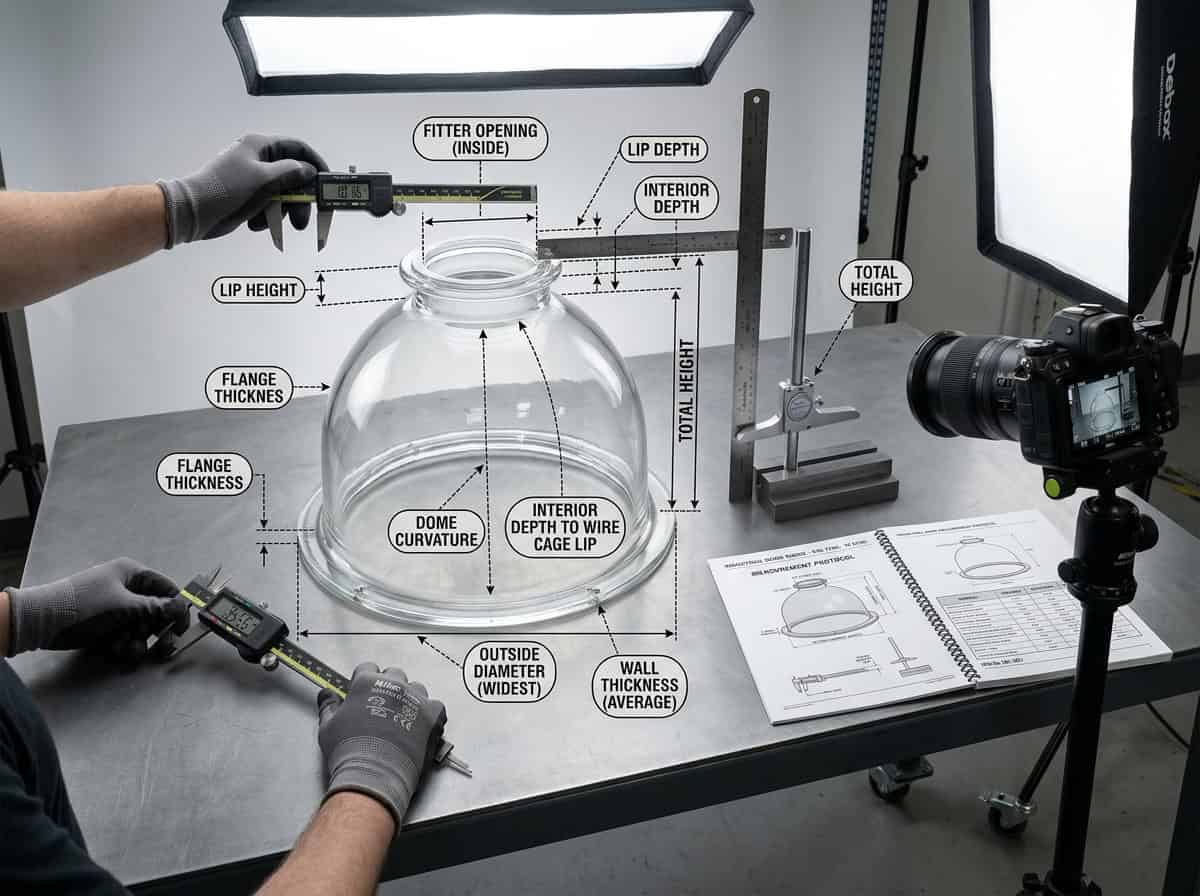
Digital calipers: Essential for all four measurements. Accuracy of ±0.02 mm is standard for inexpensive digital calipers — more than adequate for glass shade measurement. The key advantage over flexible tape measures and steel rules is that calipers measure inside diameters, outside diameters, and depths without the chord measurement error that curves introduce.
Depth gauge (micrometer-style): For the collar seating face depth measurement, a depth gauge provides a more reliable reading than an improvised caliper measurement. This matters for IP65 applications where the tolerance on seating face depth is ±0.5 mm.
Steel rule: Adequate for globe outer diameter and dome height measurements where ±0.5 mm accuracy is sufficient.
Per NEMA standards for outdoor luminaire hardware tolerances, fitter diameter tolerances for IP54-rated outdoor fixtures are ±0.5 mm; for IP65-rated fixtures, ±0.2 mm is the required tolerance. These tolerance standards apply both to the fixture holder ring and to the glass shade fitter collar.
Step-by-Step Measuring Procedure for Industrial Pendant Glass Shades
A complete measurement set for a protective glass dome shade for an industrial pendant:
Required tools: Digital calipers (6-inch capacity), depth gauge, steel rule, notepad.
Step 1: Identify the mounting type
Examine the holder ring on the fixture: does it accept a glass collar (fitter-style) or a glass flange (gallery ring-style)? This determines which shade measurement is the fitter control dimension.
Step 2: Measure the fitter or gallery ring on the fixture
For fitter-style: measure the inner diameter of the fixture holder ring using digital calipers. This equals the required glass shade fitter inner diameter.
For gallery ring-style: measure the inner diameter of the gallery ring at the glass seating surface. This equals the required glass shade flange outer diameter.
Step 3: Measure the existing shade (if available)
– Fitter inner diameter (fitter-style) or flange outer diameter (gallery-style) — the control dimension
– Globe or dome maximum outer diameter
– Shade height (collar seat to lowest point)
– Collar seating face depth (IP-rated fixtures only)
Step 4: Record and cross-check
Compare the fixture ring measurement (Step 2) with the shade fitter measurement (Step 3). They should match within ±0.2 mm for IP65, ±0.5 mm for IP54. Any discrepancy beyond these tolerances warrants investigation — the original shade may not have been the correct replacement, or the fixture holder ring may have worn.
Step 5: Document for ordering
Record all four measurements with units (mm preferred for technical specifications). Include the glass type and IP rating requirement in the ordering specification — “4-inch fitter, borosilicate opal, IP65 collar geometry” is an unambiguous specification.
Measuring Tube Guards for Linear Lamp Protection
Borosilicate glass tube guards for fluorescent or LED tube lamps require different measurements from dome-style protective shades.
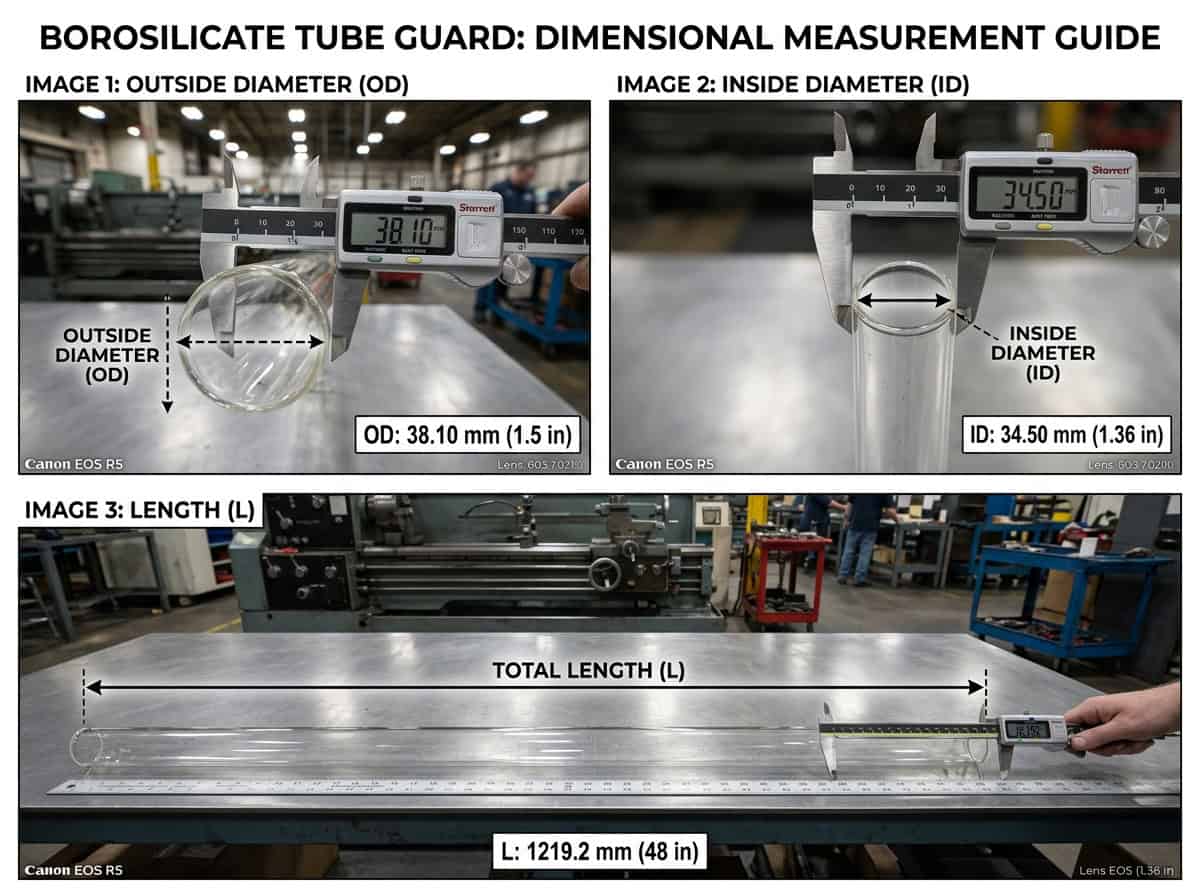
Tube guard measurements:
1. Inner diameter — must clear the lamp tube outer diameter with 2–3 mm annular clearance for thermal expansion
2. Outer diameter — determines clearance in the fixture housing
3. Length — must span the full active length of the lamp plus 10–20 mm overhang at each end
4. End cap compatibility — tube guards use push-in end caps or compression-fit caps; specify the cap type and inner diameter of the tube guard that the cap must seal
Standard T8 lamp (26 mm outer diameter) requires a tube guard inner diameter of at least 29 mm — typically 30–32 mm is specified for reliable installation. T5 lamps (16 mm outer diameter) require 18–20 mm inner diameter tube guards.
According to ASTM C1048 for heat-treated glass, borosilicate tube guards for food and pharmaceutical applications should be specified as heat-strengthened or fully tempered, with the heat treatment classification on the material certificate. Tempered borosilicate tube guards provide both the thermal resistance of borosilicate and the safe fragmentation mode of tempered glass — the appropriate combination for food processing environments where glass fragmentation is a safety audit criterion.
Common Measurement Errors for Protective Glass Shades
Error 1: Measuring flange outer diameter as fitter inner diameter
For gallery ring shades, the flange outer diameter controls fit (not the inner diameter of the shade opening). Measuring the opening gives a number 8–14 mm smaller than the correct control dimension, resulting in ordering a shade that is undersized for the gallery ring.
Error 2: Ignoring collar seating face depth for IP-rated applications
A shade with adequate fitter diameter but insufficient collar seating face depth will not maintain the IP65 gasket seal even though it appears to fit correctly. This error is invisible at installation but results in moisture ingress failures within the first wet season.
Error 3: Using the dome outer diameter as the fitter size
These are independent measurements. A 14-inch globe diameter shade may have a 4-inch, 6-inch, or 8-inch fitter depending on the fixture design. Never infer fitter size from globe size.
Error 4: Neglecting height for enclosed fixtures
In machine tool lights and fixed-housing work lights, the shade must fit within the fixture housing with sufficient clearance for the lamp socket. A shade 5 mm too tall prevents housing closure. Always measure the fixture internal height before ordering for enclosed protective shade applications.
Error 5: Measurement taken after gasket removal
The gasket between the glass collar and the holder ring compresses under installation. Measuring the shade while it is loosely seated in the holder ring without the gasket may suggest a slightly different fitter diameter than the true unloaded dimension. Remove the shade completely and measure it free-standing.
Protective Glass Shade Measurement Chart by Fixture Type
| Fixture Type | Control Measurement | Secondary | Height | Seating Depth |
|---|---|---|---|---|
| Industrial dome pendant (fitter) | Fitter inner diameter | Dome outer diameter | Shade height | IP54: 6–8 mm |
| Industrial dome pendant (gallery ring) | Flange outer diameter | Dome outer diameter | Shade height | IP65: 10–12 mm |
| Machine tool light | Collar inner diameter | Globe outer diameter | Shade height | As specified |
| T8 tube guard | Inner diameter (30–32 mm) | Outer diameter | Full lamp length +20 mm | N/A |
| Explosion-proof globe | Flange outer diameter | Globe outer diameter | Shade height | Per OEM spec |
Frequently Asked Questions
How do I measure a protective glass shade for replacement?
Take four measurements using digital calipers: (1) fitter inner diameter or flange outer diameter — the fit-controlling dimension; (2) globe maximum outer diameter; (3) shade height from collar seat to lowest point; (4) collar seating face depth for IP-rated assemblies. Compare measurements to the fixture holder ring dimensions. For IP65 applications, fitter diameter must match to ±0.2 mm.
What is the difference between a fitter-style and gallery ring mounting for protective glass shades?
Fitter-style mounting uses a cylindrical glass collar that slides inside a holder ring and is clamped with set screws — the control measurement is the glass collar inner diameter. Gallery ring mounting captures a glass flange between a two-piece flanged metal ring — the control measurement is the glass flange outer diameter. The two mounting types are not interchangeable regardless of nominal diameter.
How do I find the fitter size for a protective glass shade?
Measure the inner diameter of the fixture holder ring using digital calipers — this gives the fitter size your replacement shade must match. Standard industrial fitter sizes are 2¼, 3¼, 4, 6, and 8 inch. If your measurement falls between standard sizes, the fixture uses a proprietary fitter — contact the fixture OEM for the correct replacement shade.
Why does collar seating face depth matter for IP-rated protective glass shades?
The collar seating face depth determines how much gasket material is compressed between the glass and the metal ring during installation. Insufficient depth means the gasket is only partially compressed, leaving an effective gap in the seal that reduces the fixture’s IP rating. IP65 assemblies require 10–12 mm seating face depth to achieve adequate gasket compression over the full contact circumference.
Can I use any glass shade as a protective glass shade in a machine shop?
No. Protective glass shades for industrial environments must be specified in borosilicate or heat-tempered glass for thermal shock resistance, sized precisely to the fixture mounting system for IP rating maintenance, and rated to the appropriate IP level for the environment (IP54 minimum for general machine shop use). Decorative soda-lime glass shades are not appropriate replacements for industrial protective glass shades.
How do I measure a tube guard replacement for linear lamps?
Measure four dimensions: inner diameter (must clear the lamp tube outer diameter by at least 3 mm), outer diameter (for housing clearance), active length (from lamp holder to lamp holder, plus 20 mm), and end cap type (push-in or compression — confirm the end cap inner diameter matches the tube guard outer diameter). Standard T8 tube guards are 30–32 mm inner diameter; standard T5 are 18–20 mm.
What tolerance is required for protective glass shade measurements?
For IP54 applications, fitter diameter tolerance is ±0.5 mm. For IP65, fitter diameter tolerance is ±0.2 mm and collar seating face depth tolerance is ±0.5 mm. For explosion-proof certified assemblies, the glass must be ordered to the OEM’s drawing dimensions — independent measurements and commercially sourced glass are not acceptable substitutes for certified replacement components.
Conclusion
Measuring a protective glass shade for an industrial or technical fixture requires four dimensions — fitter or flange diameter, globe diameter, height, and collar seating face depth — taken with digital calipers rather than estimated from the old shade’s appearance. The collar seating face depth is the dimension that most replacement purchases miss, and it is the one that determines whether the IP rating of the assembled fixture is maintained.
The tolerance requirements scale with the IP rating: IP54 tolerates ±0.5 mm on fitter diameter; IP65 requires ±0.2 mm. In explosion-proof applications, glass shade dimensions are defined by the OEM fixture certification and cannot be independently specified.
For protective glass shade manufacturing in borosilicate and heat-tempered construction with dimensional documentation for IP54 and IP65 industrial applications, our glass lampshade product line at jxlampshade.com provides the technical specifications and material certificates that professional industrial lighting replacement projects require.