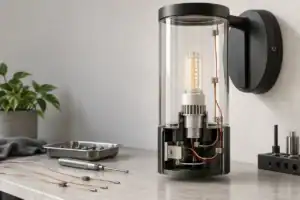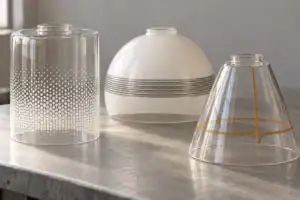
The best glass for industrial lighting is borosilicate for thermal-cycling and chemical-exposure environments, heat-tempered soda-lime for general factory and warehouse applications, and fused quartz for UV or ultra-high-temperature process lighting. The correct choice depends on operating temperature range, chemical exposure, and whether impact resistance or optical precision is the primary constraint.
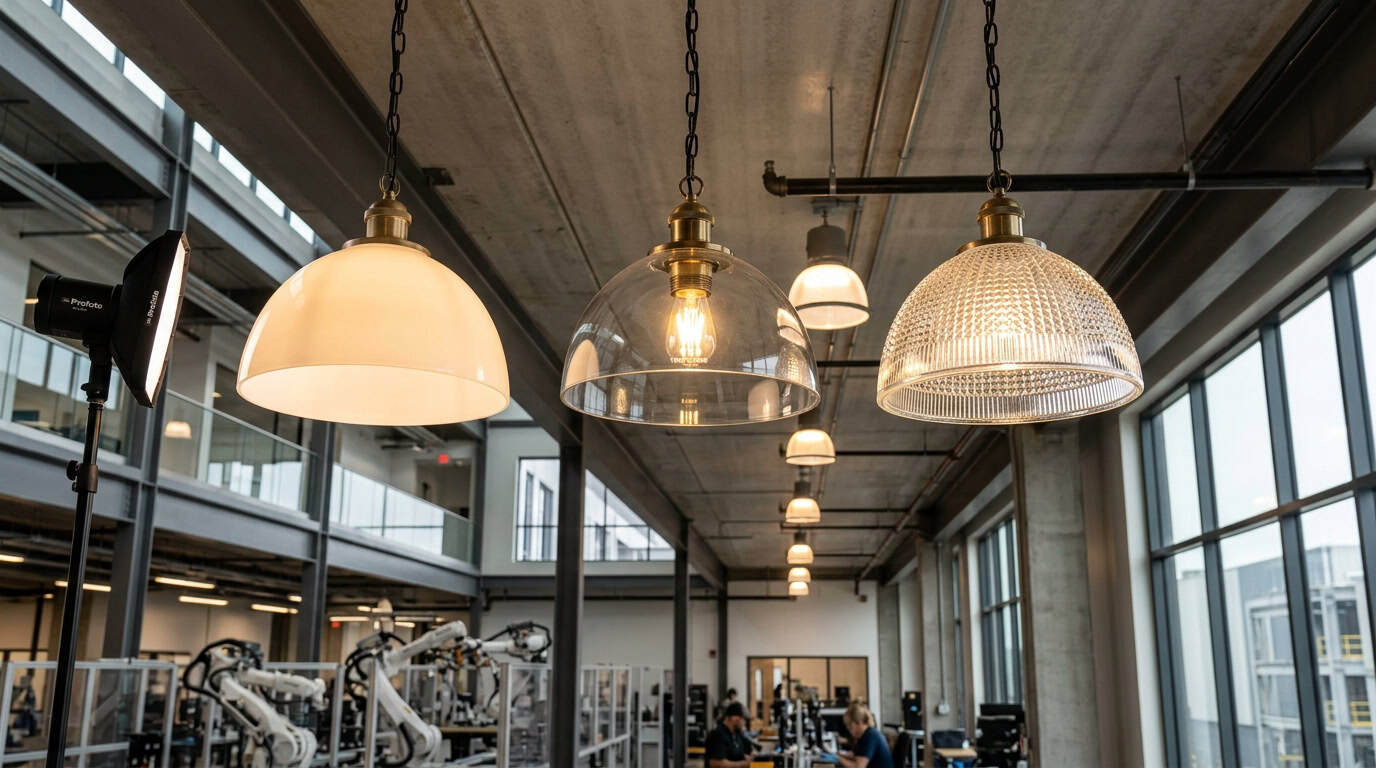
The top result for “best glass for industrial lighting” is an explosion-proof glass manufacturer talking about marine and aerospace applications. That’s useful if you’re specifying certified glass for a hazardous location rated fixture. It doesn’t help if you’re a facilities engineer choosing pendant glass shades for a food processing facility, a machine shop, or a high-bay warehouse — the contexts are completely different and the optimal glass choice differs in every one.
This guide covers the best glass for industrial lighting across the full range of common industrial applications, with the specific material properties that drive each recommendation.
Why Glass Selection Matters More in Industrial Lighting Than Residential
Industrial luminaires face operating conditions that residential fixtures never encounter:
- Sustained high ambient temperature — machine shop ambient temperatures can reach 35–45°C; foundry and furnace areas can reach 60°C or higher. Glass that is adequate at 25°C fails under sustained elevated temperature combined with the additional heat of the lamp source.
- Thermal shock events — cold water from cleaning or fire suppression hitting a hot globe. A 60°C glass globe hit by 15°C water creates an instant 45°C differential that exceeds the thermal shock tolerance of standard annealed soda-lime glass.
- Chemical exposure — alkaline cleaning agents, solvents, acids, and process chemicals contact luminaire surfaces routinely in food, pharmaceutical, and chemical processing facilities. Not all glass types are equally resistant.
- Impact risk — moving equipment, overhead crane operations, and forklift traffic create impact risks that are absent in residential contexts.
- Extended operating hours — industrial luminaires often operate 16–24 hours per day, which subjects the glass to continuous thermal loading that residential fixtures see only intermittently.
The consequence of wrong glass selection in industrial environments is not a cracked shade you replace once — it is a recurring failure mode at 12–18 month intervals that represents maintenance labor, production downtime, and a safety hazard from falling glass in work areas.
The Three Primary Glass Types for Industrial Lighting
Borosilicate Glass
Borosilicate glass contains 12–15% boron trioxide (B₂O₃) in its composition, which reduces the thermal expansion coefficient from the 9 × 10⁻⁶/°C typical of soda-lime glass to approximately 3.3 × 10⁻⁶/°C. This means borosilicate glass expands and contracts at roughly one-third the rate of standard glass for the same temperature change.
According to ASTM C556 for borosilicate glass composition, verified borosilicate construction requires documented boron trioxide content and a specified thermal shock tolerance — typically 120°C or higher for standard borosilicate, and 160°C for high-grade laboratory borosilicate formulations.
Industrial lighting applications where borosilicate is the correct choice:
– Any facility with ambient temperature variation exceeding ±30°C seasonally
– Food and beverage processing facilities using hot washdown (steam cleaning or hot water at 60–80°C on glass that may be at ambient temperature)
– Chemical processing areas where the glass contacts alkaline or acidic cleaning agents
– Outdoor or semi-outdoor industrial installations subject to freeze-thaw cycling
– High-wattage incandescent or halogen retrofit fixtures where the glass surface temperature rises significantly above ambient
The premium over standard soda-lime glass is typically 25–40% in material cost. In industrial applications where glass replacement requires a maintenance shutdown and a ladder, the total cost of replacement (labor + downtime + glass) makes the borosilicate premium recover within the first avoided replacement cycle.
Heat-Tempered Soda-Lime Glass (Toughened Glass)
Heat-tempered glass is standard soda-lime glass that has been heated to approximately 620°C and then rapidly air-cooled, creating compressive surface stress and tensile core stress. Per ASTM C1048 for heat-treated glass, fully tempered glass achieves approximately four times the thermal shock resistance of annealed glass, and when it fractures, it breaks into small rounded fragments (the “safety glass” characteristic) rather than large shards.
Industrial lighting applications where heat-tempered is the correct choice:
– General factory and warehouse pendant lighting in controlled-temperature environments
– High-bay fixtures where impact resistance from overhead crane or forklift operations is the primary risk
– Any application requiring the safety glass fracture mode (fragments rather than shards) per local health and safety regulations
– Budget-constrained specifications where borosilicate’s 25–40% cost premium is not justified by the operating conditions
The tempered glass limitation to know: Fully tempered glass cannot be cut or drilled after tempering — it shatters. Specify dimensions before tempering. This matters for custom industrial shade specifications where the glass is produced to drawing dimensions.
Fused Quartz Glass
Fused quartz glass (>99.9% silicon dioxide) has an even lower thermal expansion coefficient than borosilicate — approximately 0.55 × 10⁻⁶/°C — and a maximum continuous service temperature of approximately 1000°C. It is also UV-transparent in the 150–400 nm range, which borosilicate is not.
Industrial lighting applications where quartz is the correct choice:
– UV-curing systems for industrial printing, adhesive curing, and surface treatment
– Germicidal UV luminaires for water and air purification
– High-temperature process lighting near furnaces, kilns, or molten metal operations
– Stage and studio lighting where high-power projector lenses must withstand intense localized heat
Quartz glass costs 5–10× as much as borosilicate for equivalent size. Specify only where the application specifically requires UV transparency or >120°C operating temperature — using quartz as a general “best available” industrial glass is expensive and unnecessary.
Glass Type Comparison for Industrial Lighting Applications
The relevant performance characteristics for industrial luminaire glass shade selection:
| Property | Borosilicate | Heat-Tempered Soda-Lime | Fused Quartz |
|---|---|---|---|
| Thermal expansion | 3.3 × 10⁻⁶/°C | 9 × 10⁻⁶/°C | 0.55 × 10⁻⁶/°C |
| Thermal shock resistance | ~120°C ΔT | ~80°C ΔT (tempered) | ~300°C ΔT |
| Max continuous temp | ~450°C | ~290°C | ~1000°C |
| UV transmission | Blocked below 300 nm | Blocked | Transparent to 150 nm |
| Chemical resistance | Excellent | Good | Excellent |
| Fracture mode | Few large pieces | Small fragments (safe) | Few large pieces |
| Cost vs annealed | +25–40% | +10–20% | +500–1000% |
| Typical service life (industrial) | 10–15 years | 5–8 years | 15–20 years |
Which Type of Glass Is Commonly Used in Industrial Settings?
This is one of the most-asked questions about industrial lighting glass. The answer depends on the facility type:
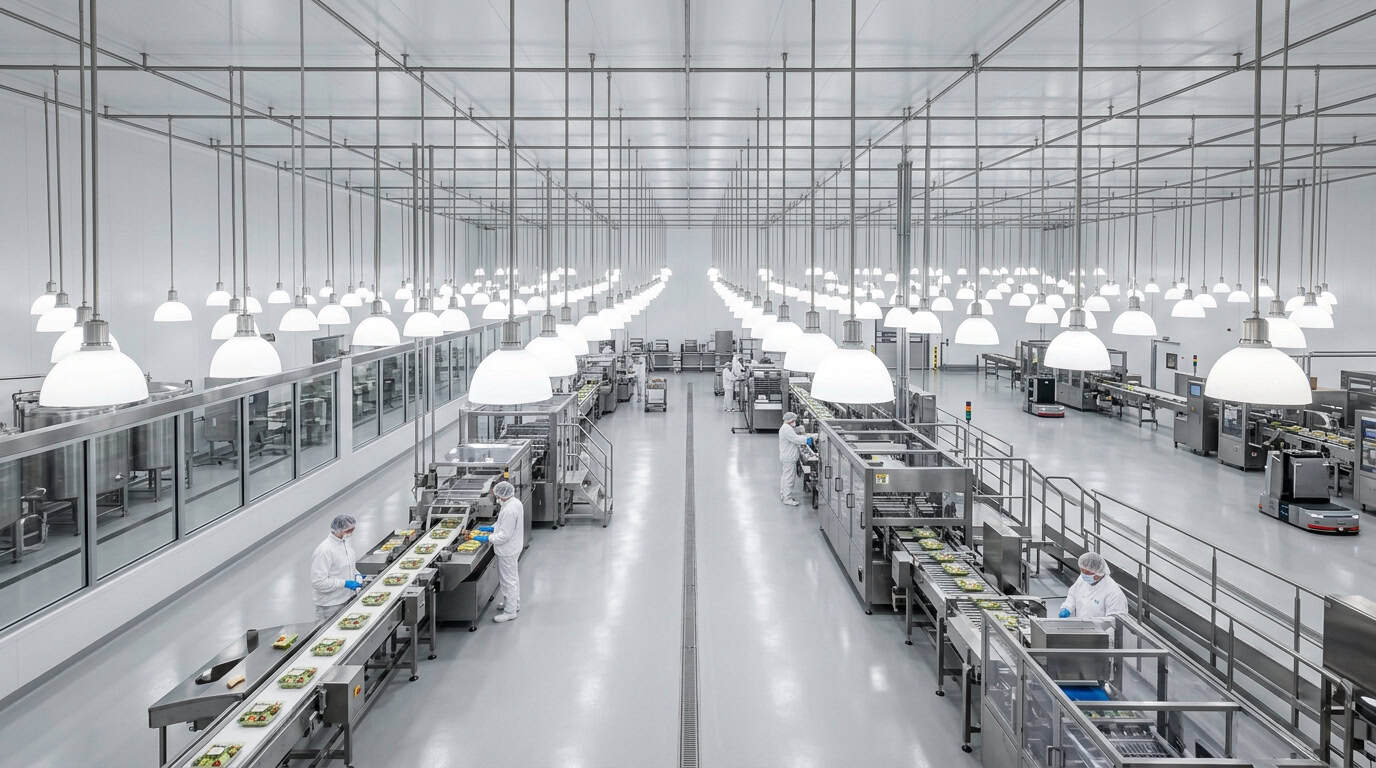
Manufacturing and machine shops: Heat-tempered soda-lime glass is the most common due to its balance of thermal performance, impact resistance (safety glass fracture mode), and cost. Borosilicate is specified for higher-temperature environments.
Food and beverage processing: Borosilicate glass is increasingly standard because food-safety regulations require shatter-resistant glass that also withstands hot washdown without thermal shock failure. The U.S. Food and Drug Administration’s Food Safety Modernization Act guidelines reference glass as a foreign material hazard in food production — facilities are required to document glass management programs, making glass quality and failure mode an audit item.
Chemical and pharmaceutical: Borosilicate glass, documented with material certificates confirming chemical resistance to the specific reagents in use. Glass in contact with the production environment may need USP/EP purity certification in pharmaceutical contexts.
Hazardous locations (ATEX/NEC): Tempered glass rated to 5J+ impact, certified as part of the explosion-proof fixture assembly. Borosilicate tempered for combined thermal and impact performance.
High-bay warehouse: Heat-tempered soda-lime glass is the dominant specification — ambient temperature is controlled, thermal shock risk is low, and impact safety is the primary concern.
What Is the Strongest Commercial Glass for Industrial Lighting?
Another frequently-asked question: which glass is “strongest” for industrial use?
Strength in glass is more nuanced than it is in metals. Glass fails in tension — it does not yield plastically the way metals do. The relevant strength metrics for industrial lighting glass are:
Impact resistance: Tempered glass achieves approximately 4–5× the impact resistance of annealed glass. For a 4-inch globe, tempered glass typically passes a 5J center-point impact test that annealed glass fails at 1.5–2J. Quartz glass has similar inherent strength to annealed glass but significantly better thermal performance.
Thermal shock resistance: Fused quartz > borosilicate > heat-tempered > annealed. For most industrial applications, borosilicate provides adequate thermal shock performance without the cost of quartz.
Chemical resistance: Borosilicate ≈ quartz > soda-lime glass. Standard soda-lime glass is vulnerable to alkaline solutions above pH 12 — common in industrial cleaning formulations.
Per NEMA’s standards for industrial luminaire enclosure ratings, glass components for industrial luminaires should be tested to the relevant NEMA Type designation for the installation environment. NEMA 4 (splash-proof, washdown) requires the glass to maintain integrity through a directed water stream test; NEMA 4X adds corrosion resistance.
Applications of Industrial Lighting Glass by Sector
Machine Shop and Manufacturing
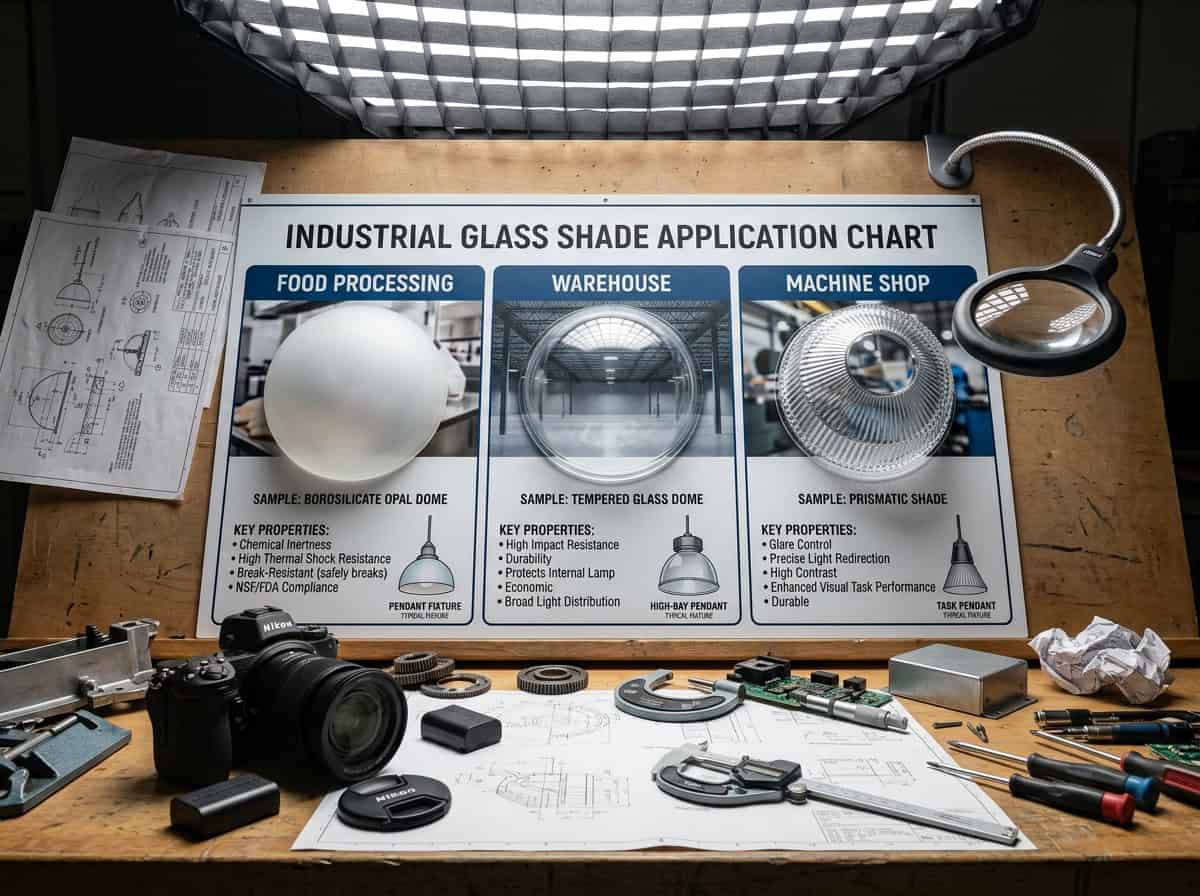
Pendant-mounted borosilicate opal dome shades or heat-tempered clear dome shades at 14–20 inch diameter, depending on mounting height and required footcandle levels. Borosilicate is preferred near grinding, welding, and cutting operations where the glass surface is intermittently exposed to localized heat and cooling from coolant spray.
Food and Beverage Processing
IP65 or IP66 sealed fixtures with borosilicate opal glass shades rated for hot washdown. The opal glass diffuses the light source uniformly — no visible hotspot means no visible shadow variation on inspection surfaces. Stainless steel gallery rings replace standard steel to resist corrosion from cleaning agents.
Chemical and Pharmaceutical
Borosilicate glass with documented chemical resistance to specific reagents. Pharmaceutical cleanroom lighting typically uses sealed flush-mount luminaires rather than pendant shades, but adjacent production and corridor areas may use pendant fixtures where borosilicate glass with USP-grade material documentation is required.
Hazardous Locations
Certified tempered glass as part of a fully-rated explosion-proof fixture assembly. The glass is not selected independently — it is sourced as a certified replacement component for the specific fixture model.
High-Bay Warehouse and Logistics
Heat-tempered clear or opal glass in 16–20 inch dome shades for high-bay pendant applications. At mounting heights of 15–25 feet, the light output advantage of clear glass (88–92% transmittance) versus opal (75–82%) translates directly to fewer fixtures needed for a given footcandle specification — a meaningful cost difference in large facilities.
How to Verify Glass Specification in Industrial Procurement
The glass specification problem in industrial procurement is that “borosilicate glass” in a product listing is not a verified claim without supporting documentation.
Steps to verify:
- Request the material certificate — should state boron trioxide content (≥12% for standard borosilicate), thermal expansion coefficient (≤3.3 × 10⁻⁶/°C), and thermal shock tolerance (≥120°C).
- Verify heat treatment — for tempered glass, the certificate should reference the ASTM C1048 tempering classification (heat-strengthened vs. fully tempered — specify fully tempered for industrial impact resistance).
- Chemical resistance data — for food and chemical processing applications, request the chemical resistance table against pH range and specific cleaning agents. Reputable manufacturers provide this.
- Third-party test reports — for ATEX/NEC classified applications, the glass must carry a certified test report from the fixture OEM. Do not accept independent glass certificates as substitutes for the fixture certification.
Trends in Industrial Lighting Glass for 2026
Borosilicate documentation becoming mandatory. Procurement specifications for food and pharmaceutical industrial lighting increasingly require the material certificate as a contract deliverable, not just a “borosilicate” label on the product listing. Suppliers who cannot provide documentation are being excluded from specification lists.
Anti-microbial glass coatings. Ag-ion (silver ion) antimicrobial coatings are being applied to borosilicate glass shades for food and pharmaceutical facilities, providing continuous surface antimicrobial action between cleaning cycles. Per the IES’s 2026 guidance on cleanroom and food processing lighting, luminaire surface hygiene is a growing specification criterion.
Recycled content glass. Industrial glass shade manufacturers are increasing cullet (recycled glass) content in production, with post-consumer recycled cullet reaching 15–20% of batch composition without compromising borosilicate or tempered glass specifications. Sustainability documentation is becoming a procurement criterion in facilities with ESG reporting requirements.
| Trend | Industrial Impact | 2026 Adoption |
|---|---|---|
| Material certificate requirement | Borosilicate documentation mandatory | ~40% of commercial specs |
| Anti-microbial coatings | Food/pharma glass shades | ~15% of new food facility specs |
| Recycled cullet in production | Sustainability documentation | ~20% of procurement specs |
| LED-optimized opal geometry | Opal over clear for LED pendants | ~65% of new industrial installs |
Frequently Asked Questions
Which type of glass is commonly used in industrial settings?
Heat-tempered soda-lime glass is the most common across general manufacturing and warehouse settings due to its balance of impact resistance, thermal performance, and cost. Borosilicate glass is the correct specification for food processing, chemical exposure, and high-temperature environments. Fused quartz is used for UV-curing and ultra-high-temperature process lighting applications.
What is the strongest commercial glass for industrial lighting?
In impact resistance, fully tempered glass achieves approximately 5× the strength of annealed glass. For thermal shock resistance, fused quartz is strongest, followed by borosilicate, then heat-tempered. For chemical resistance, borosilicate and quartz are roughly equivalent and both significantly better than soda-lime glass. For most industrial applications, borosilicate tempered glass (combining both treatments) provides the best practical strength profile.
What kind of glass can’t break in industrial lighting?
No glass is truly unbreakable, but fused quartz glass is the most resistant to thermal shock failure, and fully tempered glass provides the highest mechanical impact resistance with a safe fracture mode. In practice, laminated safety glass (two glass plies bonded with an interlayer film) is used in applications where the consequence of glass fragmentation is severe — it holds fragments in place if the outer ply fractures.
Is borosilicate glass required for food processing facilities?
Borosilicate glass is not universally mandated by regulation, but it is increasingly specified by food safety auditors and facility managers due to its thermal shock resistance (which prevents glass fragmentation from hot washdown) and chemical resistance (which prevents degradation from alkaline cleaning agents). FDA’s FSMA guidelines treat glass as a foreign material hazard — using glass types that minimize fragmentation risk is part of good glass management practice.
Can tempered glass be used outdoors for industrial lighting?
Heat-tempered glass can be used outdoors in mild climates with fewer than 30 freeze-thaw cycles per year. In climates with more severe thermal cycling, borosilicate is the correct specification. Tempered glass’s safety fragmentation characteristic (small pieces) is also relevant outdoors — large shard fracture from annealed glass creates a greater ground-level hazard in work areas.
How do I specify industrial glass shades for a washdown application?
Specify: IP65 or IP66 sealed fixture assembly, borosilicate glass shade with collar seating flatness ±0.1 mm, EPDM or silicone gasket rated for the cleaning chemical concentration and temperature, and stainless steel gallery ring and hardware. Request chemical resistance data for the glass against the specific cleaning agents used in the facility. Annual gasket inspection is required to maintain the IP rating.
What is the lifespan of borosilicate glass in industrial lighting?
A borosilicate glass shade in a typical industrial environment (LED source, IP54 enclosure, no chemical exposure) should last 10–15 years before replacement is needed. In washdown or chemical exposure environments with appropriate IP65 sealing and annual gasket maintenance, the same lifespan is achievable. Heat-tempered soda-lime glass in high-temperature-cycling environments typically lasts 5–8 years. Standard annealed glass is not appropriate for industrial use.
Conclusion
The best glass for industrial lighting is not a single answer — it is a three-way specification decision based on operating temperature, chemical exposure, and impact requirements. Borosilicate glass for thermal-cycling and chemical-exposure environments. Heat-tempered soda-lime for general industrial use with impact safety requirements. Fused quartz for UV and ultra-high-temperature process applications.
The documentation requirement is as important as the glass type itself. A product labeled “borosilicate” without a material certificate stating the B₂O₃ content and thermal expansion coefficient is an unverified claim. Require the documentation in the procurement specification and accept only suppliers who can provide it.
For industrial glass shade manufacturing in documented borosilicate, heat-tempered, and opal glass construction with material certificates and IP-rated collar geometry, our glass lampshade product line at jxlampshade.com supports industrial and commercial lighting specifications.