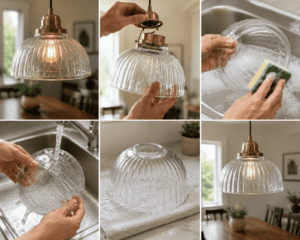
Borosilicate glass for lighting is distinguished from standard soda-lime glass by its boron trioxide content (12–15%), which lowers its thermal expansion coefficient to 3.3 × 10⁻⁶/°C — allowing lamp shades and luminaire enclosures to absorb rapid temperature changes of 120°C or more without fracturing. It is the correct glass specification for outdoor, industrial, and high-heat lighting applications.
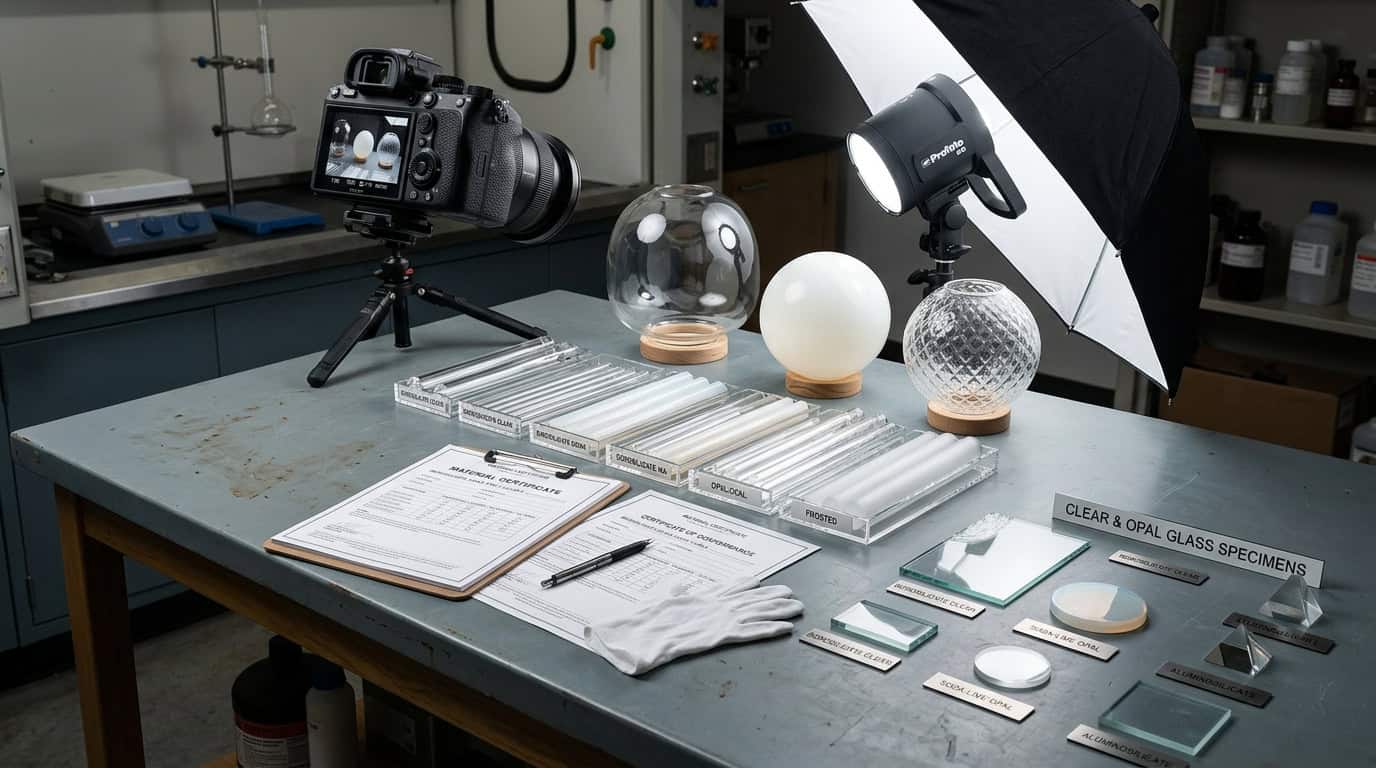
Most glass lamp shade buyers don’t think about the molecular structure of what they’re buying. They order by size, by finish, maybe by price — and when the shade cracks at the fitter collar after two winters, they order another one. The cycle repeats.
The reason most outdoor and industrial glass lamp shades crack is a mismatch between the glass’s thermal expansion behavior and the thermal demands of the environment. Borosilicate glass for lighting solves this mismatch at the molecular level. Understanding why requires a brief detour into glass chemistry — after which the reason to specify borosilicate becomes impossible to ignore.
What Is Borosilicate Glass and Why Is It Different?
All commercial glass is primarily silicon dioxide (SiO₂) — the same material as sand. The difference between glass types lies in what oxide modifiers are added to the silica matrix during melting.
Standard soda-lime glass — the glass used in windows, bottles, and most basic glassware — contains sodium oxide (Na₂O) and calcium oxide (CaO) as modifiers. These modifiers lower the melting point of the silica matrix, making production economical, but they also increase the glass’s thermal expansion coefficient to approximately 9 × 10⁻⁶/°C.
Borosilicate glass replaces some of the sodium and calcium with boron trioxide (B₂O₃), typically at 12–15% by weight. Boron oxide forms a more rigid, cross-linked glass network than sodium or calcium modifications. The result: a thermal expansion coefficient of approximately 3.3 × 10⁻⁶/°C — about one-third that of soda-lime glass.
This difference matters enormously when a lamp shade is exposed to rapid temperature changes. When two parts of the glass expand or contract at different rates — the outer surface cooling faster than the inner, or the fitter collar cooling faster than the globe body — tensile stress develops at the boundary between them. If the stress exceeds the glass’s tensile strength, it fractures. The lower the thermal expansion coefficient, the smaller the thermal stress for the same temperature differential.
Per ASTM C556 standard for borosilicate glass, standard borosilicate glass (Pyrex-type) withstands a thermal shock of approximately 160°C differential without fracture. Standard annealed soda-lime glass fractures at approximately 40°C differential — the difference between a glass globe that survives decades of use and one that cracks in its second winter.
The Chemistry of Borosilicate Glass: Key Properties for Lighting
Understanding the physical properties derived from borosilicate glass composition helps specify the right product for specific lighting applications.
Thermal Expansion Coefficient
The thermal expansion coefficient (CTE) of 3.3 × 10⁻⁶/°C means that a borosilicate glass globe at 20°C that is heated to 120°C expands by:
Δl = 3.3 × 10⁻⁶ × 100°C × l = 0.00033 × l per unit length
For a 10-inch (254 mm) globe, this is a diameter change of approximately 0.08 mm — less than the thickness of a human hair. The metal gallery ring holding the globe expands at approximately 12 × 10⁻⁶/°C (for steel), creating a differential expansion of about 8.7 × 10⁻⁶/°C between metal and borosilicate glass across the same temperature range. This differential is accommodated by the gasket and set-screw compliance in the holder ring.
With standard soda-lime glass (9 × 10⁻⁶/°C), the differential with the steel ring is only 3 × 10⁻⁶/°C — closer to the metal — but the glass itself is more vulnerable to local thermal gradients within the glass body, which is where the practical failure mode occurs.
Chemical Resistance
The boron-silicate network is chemically more resistant to attack by alkaline solutions than soda-lime glass. At pH 12–14 (typical of strong NaOH cleaning solutions), soda-lime glass loses surface layers at a measurable rate through dealkalization — the surface becomes milky or etched over repeated exposures. Borosilicate glass is resistant to these conditions at ambient temperatures; at elevated temperatures (>60°C), resistance decreases but remains superior to soda-lime.
This property makes borosilicate glass the preferred specification for food processing, pharmaceutical, and laboratory lighting where cleaning with alkaline or acid solutions is routine.
UV Transmission Characteristics
Standard borosilicate glass transmits light in the visible spectrum (380–780 nm) at 88–92% — essentially equivalent to clear soda-lime glass. However, borosilicate blocks ultraviolet radiation below approximately 300 nm. This UV-blocking behavior has two implications for lighting:
- For UV-sensitive applications: borosilicate is not appropriate for germicidal UV or UV-curing applications that require transmission in the 200–300 nm range. Fused quartz is required.
- For standard lighting: the UV-blocking behavior of borosilicate glass provides a small but real protection against UV-induced yellowing of surfaces below the lamp (shelving, countertops, artwork) — a benefit in museum, gallery, and high-end retail lighting.
Optical Clarity and Long-Term Stability
Borosilicate glass maintains its optical clarity over a significantly longer period than soda-lime glass in outdoor and industrial environments. The key mechanism: the borosilicate network is more resistant to the surface hydration and ion exchange reactions that gradually cloud soda-lime glass exposed to atmospheric moisture, UV, and temperature cycling.
In practice: a borosilicate glass lamp shade in an outdoor post-top fixture at 15 years looks optically similar to a new shade. An equivalent soda-lime glass shade may show visible surface haze from accumulated surface degradation within 5–8 years in the same conditions.
Forms of Borosilicate Glass Used in Lighting
Borosilicate glass for lighting appears in several manufactured forms, each suited to different luminaire types.
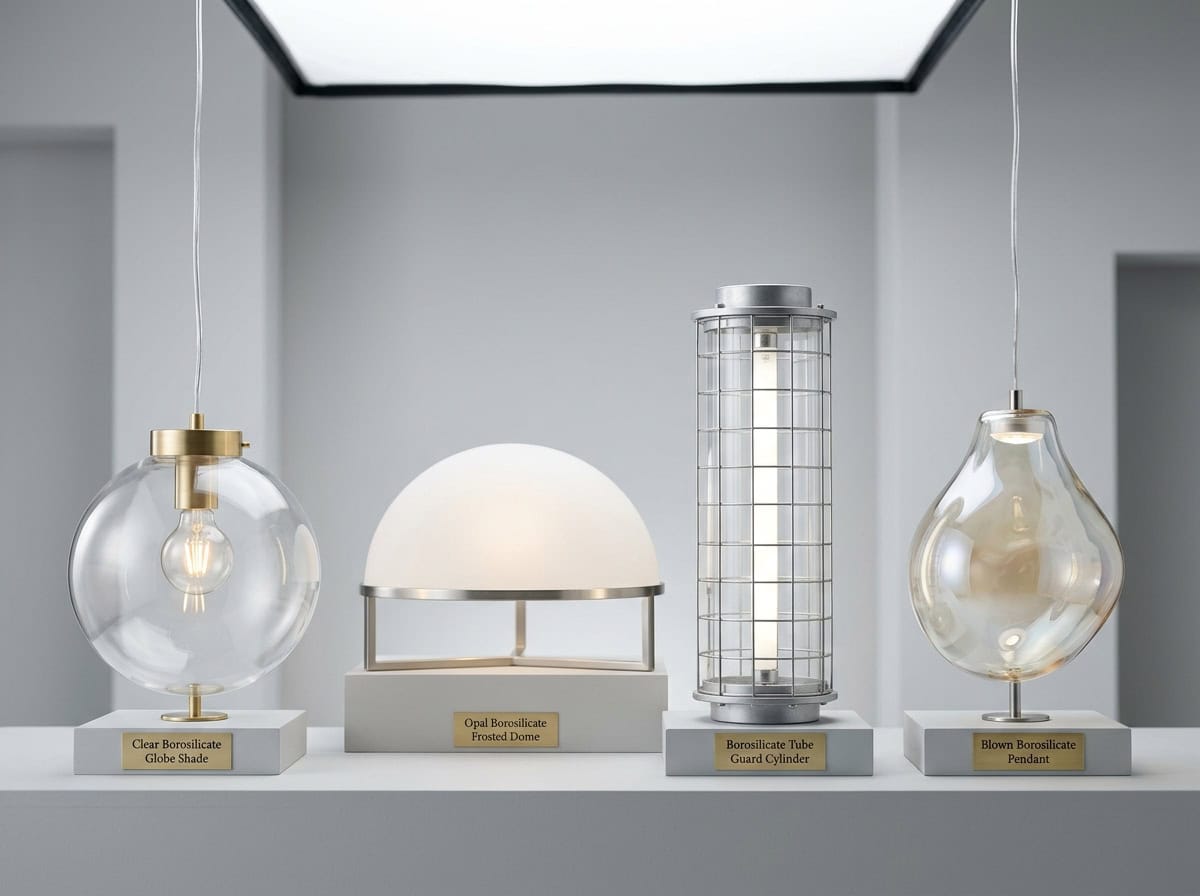
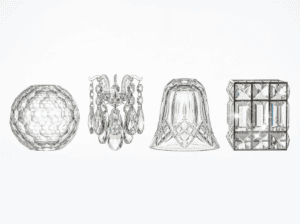
Clear Borosilicate Glass Lamp Shades
Clear borosilicate glass transmits 88–92% of visible light and makes the lamp source visible through the glass. Used where maximum light output is the priority and glare from the visible source is acceptable — high-mount fixtures, task lighting at single workstations, or decorative filament LED applications where the lamp itself is part of the visual design.
Opal Borosilicate Glass Lamp Shades
Opal borosilicate glass combines the thermal and chemical resistance of borosilicate glass chemistry with a scattering opacifier (typically tin oxide or calcium phosphate) that creates a uniformly white, diffuse glass. Transmittance is 75–82%. Opal borosilicate is the most common specification for high-quality outdoor post-top and industrial pendant glass lamp shades because it provides:
– Glare-free, uniform light output
– Thermal shock resistance for outdoor freeze-thaw cycling
– Chemical resistance for washdown applications
– 10–15 year service life in typical outdoor and industrial environments
Borosilicate Tube Guards
Borosilicate glass tube guards (also called tube shields or lamp guards) are cylindrical glass enclosures for linear fluorescent or LED tube lamps. They provide shatter-containment in food and pharmaceutical facilities where glass fragmentation is a foreign material risk. Borosilicate is specified over soda-lime for the same thermal and chemical resistance reasons.
Blown Borosilicate Glass Pendants
Artisan-blown borosilicate glass pendants are produced by lampworking — forming borosilicate glass tubes and rods with a torch into custom shapes. The result is a glass shade with the thermal performance of borosilicate and the visual character of handmade glass (slight thickness variation, possible seeded appearance from the blowing process). Used in high-end residential, hospitality, and decorative applications where borosilicate performance is specified with artisan aesthetics.
Borosilicate Glass Applications in Lighting by Context
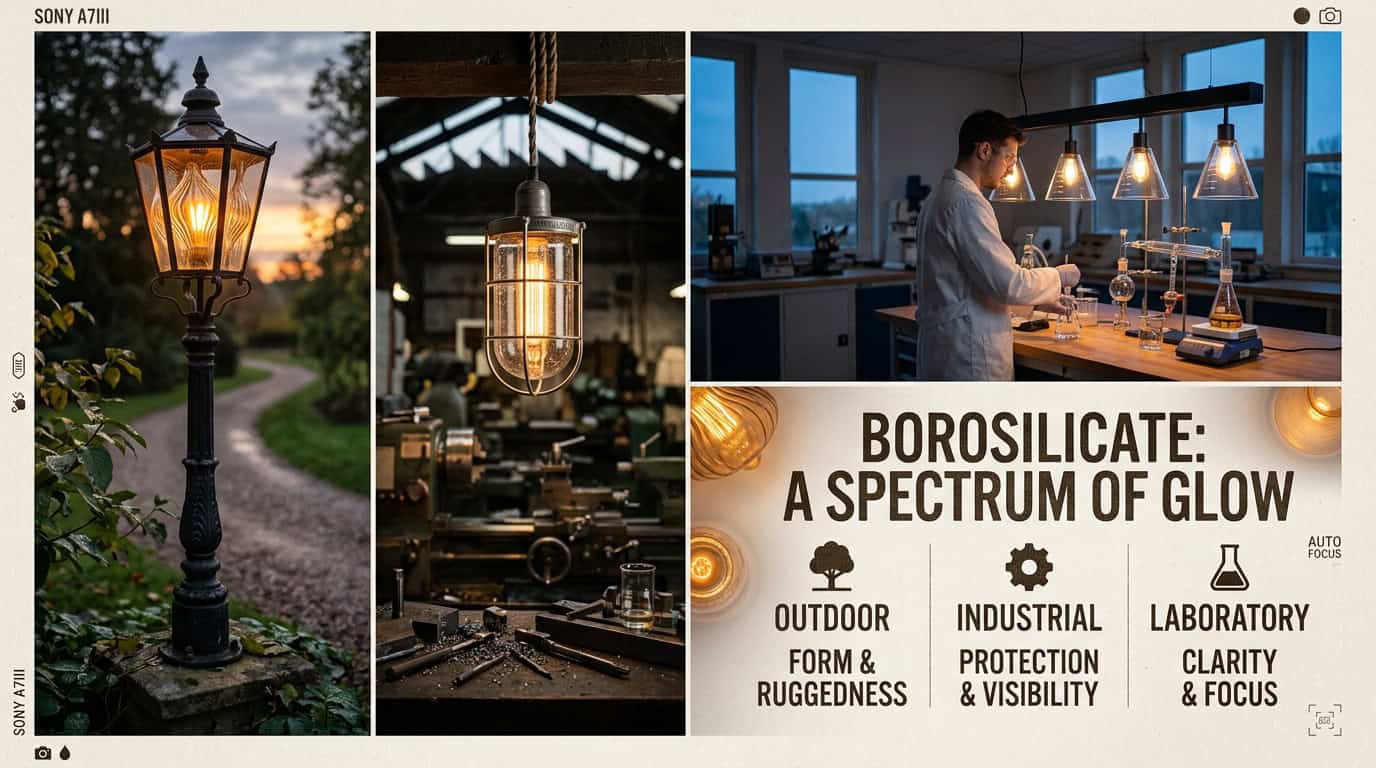
Outdoor Lamp Shades (Post-Top and Bollard)
The outdoor lamp shade application is the most common context where borosilicate glass is superior to soda-lime alternatives. Outdoor post-top and bollard fixtures experience:
– Freeze-thaw cycling (20–100+ cycles per year depending on climate)
– Temperature differentials from irrigation spray
– UV exposure
– Temperature differential between the metal holder ring and the glass collar
Per the Illuminating Engineering Society’s outdoor luminaire standards, glass enclosures for outdoor fixtures in all-season climates should be specified with a thermal shock rating appropriate for the installation location’s temperature extremes. Borosilicate glass rated to ±120°C thermal shock covers all residential outdoor applications in North American climates.
Industrial Pendant and High-Bay Lighting
Borosilicate glass for industrial pendant and high-bay applications provides the combination of thermal performance and chemical resistance that soda-lime glass cannot match in demanding environments. The gallery ring of an industrial pendant creates a metal-glass stress concentration at the fitter collar during thermal cycling — the same failure mode that breaks outdoor post-top shades, scaled up to the higher thermal loads and longer operating hours of industrial facilities.
Laboratory and Scientific Lighting
Borosilicate glass has been the standard material for laboratory glassware since the early 20th century precisely because of its thermal and chemical resistance. The same properties make it the appropriate glass for laboratory lighting — fixtures in proximity to chemical reagents, heat-generating equipment, and autoclave areas. Corning’s technical documentation on Pyrex borosilicate glass remains one of the primary references for borosilicate glass specification in laboratory contexts, as Pyrex is the defining trade name in the borosilicate glass category.
Oven, Kiln, and High-Temperature Process Lighting
Borosilicate glass is the correct specification for luminaires operating near ovens, kilns, and furnaces up to approximately 300–400°C ambient. Above this range, borosilicate approaches its softening point and quartz glass becomes the required specification.
Candle Holders and Decorative Lighting (Does Borosilicate Work for Candles?)
This is a frequently asked question. Yes — borosilicate glass is appropriate for candle holders and candle lanterns because the thermal shock resistance that protects it in outdoor lamp shades also protects it from the rapid temperature changes when a candle is lit and extinguished. Standard soda-lime glass candle holders crack more frequently when exposed to cold drafts immediately after the candle warms the glass. Borosilicate virtually eliminates this failure mode.
How to Verify Borosilicate Glass in a Lighting Product
The marketplace problem with borosilicate glass for lighting is that the term is used imprecisely. Some products labeled “borosilicate” use low-boron formulations that do not achieve the full thermal performance of standard borosilicate glass.
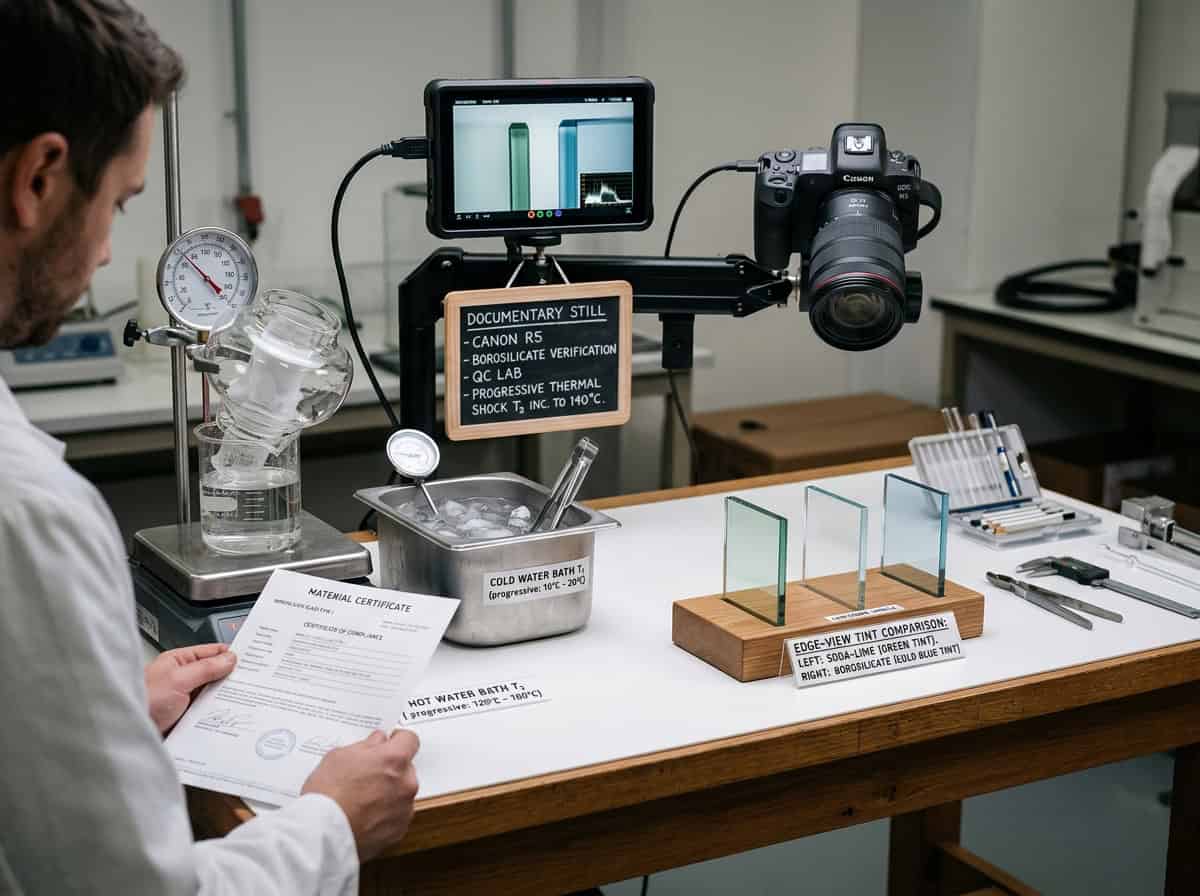
Verification method 1: Visual edge tint
Borosilicate glass viewed edge-on through several millimeters of thickness shows a faint neutral tint or very slight blue-green. Standard soda-lime glass shows a distinctly green tint due to iron oxide content. This is not a definitive test — some low-iron soda-lime glass also appears neutral — but a clear green tint at the glass edge confirms soda-lime.
Verification method 2: Material certificate
A legitimate borosilicate glass supplier provides a material certificate stating:
– Boron trioxide (B₂O₃) content: ≥12% by weight
– Thermal expansion coefficient: ≤3.3 × 10⁻⁶/°C
– Thermal shock tolerance: ≥120°C differential
If a supplier cannot provide this document, the glass has not been verified to borosilicate specification. The certificate should reference the production lot so it can be matched to delivered product.
Verification method 3: ASTM reference
Request that the material certificate reference ASTM C556 for borosilicate glass composition or ASTM C1036 for flat glass as the standard against which the glass was measured. A supplier who can cite the ASTM reference is working from a documented quality system.
Borosilicate Glass vs. Soda-Lime Glass for Lighting: The Practical Summary
| Application | Soda-Lime Adequate? | Borosilicate Recommended? |
|---|---|---|
| Indoor residential lamp shade | Yes (mild conditions) | Preferred for longevity |
| Outdoor post-top (freeze-thaw climate) | No — typical 3–5 year life | Yes — 10–15 year life |
| Outdoor coastal (salt air, temperature cycling) | No | Yes |
| Industrial pendant (controlled temperature) | Yes | Preferred |
| Industrial washdown application | No | Yes |
| Food processing facility | No | Yes (with certificate) |
| Laboratory | No | Yes |
| Near oven or kiln (< 400°C ambient) | No | Yes |
| UV-curing or germicidal UV | No (borosilicate also inadequate) | No — quartz required |
Trends in Borosilicate Glass for Lighting in 2026
Borosilicate as the residential outdoor default. Historically a premium specification, borosilicate glass for outdoor lamp shades is becoming the default in quality-tier residential products as buyers become aware of the thermal cycling failure mode and demand documented material specifications. Manufacturers who cannot verify borosilicate construction are losing market share in the quality segment.
Opal borosilicate for LED source compatibility. The combination of opal diffusion and borosilicate thermal resistance is the optimal specification for LED-source outdoor and industrial pendants — opal glass diffuses LED chip hot spots that clear glass transmits directly, while the borosilicate base provides the thermal resistance the application demands.
Documented sustainability content. Borosilicate glass production uses energy-intensive furnace operations, and post-2026 procurement criteria increasingly include carbon footprint per unit and recycled cullet content documentation. Manufacturers integrating recycled borosilicate cullet at 10–15% of batch composition while maintaining specification compliance are gaining preference in sustainability-conscious procurement.
Per IES’s updated guidance on outdoor luminaire glass specifications published in 2026, borosilicate glass is now specifically recommended for all outdoor fixed luminaires in climates with more than 15 annual freeze-thaw cycles — a significant expansion of the previous guidance, which referenced thermal performance without specifying glass type.
Frequently Asked Questions
What is borosilicate glass used for in lighting?
Borosilicate glass is used for outdoor lamp shades (post-top, bollard, wall sconces), industrial pendant and high-bay luminaires, laboratory and clean-environment lighting, food processing facility luminaires, and any lighting application requiring resistance to thermal shock from temperature cycling, high-heat lamp sources, or cold washdown. It is the preferred glass type for any lamp shade or luminaire enclosure that will experience repeated rapid temperature changes.
Can borosilicate glass be used for candles?
Yes. Borosilicate glass candle holders resist the thermal shock from sudden cooling (cold draft on a warm glass candle holder) that causes soda-lime glass to crack. The same thermal expansion coefficient that protects outdoor lamp shades protects candle holders. Borosilicate is the correct specification for quality candle lanterns and candle holders in outdoor or draft-exposed settings.
How is borosilicate glass different from regular glass?
Borosilicate glass contains 12–15% boron trioxide (B₂O₃) in place of some of the sodium and calcium oxide found in standard soda-lime glass. This lowers the thermal expansion coefficient from ~9 × 10⁻⁶/°C to ~3.3 × 10⁻⁶/°C, giving borosilicate approximately three times better resistance to thermal shock. It is also more chemically resistant to alkaline and acid solutions than soda-lime glass.
Where can I buy borosilicate glass for lighting?
Borosilicate glass lamp shades and globes are available from specialty glass shade manufacturers who document their glass construction. When purchasing, request the material certificate confirming boron trioxide content ≥12% and thermal expansion coefficient ≤3.3 × 10⁻⁶/°C. Generic lamp shade suppliers who cannot provide this documentation are most likely selling soda-lime glass regardless of the product label.
What are the disadvantages of borosilicate glass for lighting?
The primary disadvantages are cost (25–40% premium over soda-lime glass) and lower impact resistance compared to fully tempered soda-lime glass (borosilicate is harder and stiffer, but lacks the compressive surface stress that gives tempered glass its impact resistance). For applications where mechanical impact is the primary risk (high-traffic industrial areas, areas with moving equipment), tempered soda-lime glass may be a better specification. Borosilicate also cannot be cut or drilled after forming as readily as annealed glass.
Is borosilicate glass UV resistant?
Borosilicate glass blocks UV radiation below approximately 300 nm, providing UV protection to surfaces below the lamp. It does not transmit UV in the germicidal range (254 nm) or the UV-curing range (200–400 nm). For applications that require UV transmission, fused quartz glass is the correct material.
How long does borosilicate glass last in outdoor lighting?
A borosilicate glass lamp shade in outdoor use with proper gasketing, correct set-screw torque, and LED source should last 10–15 years in all-season climates including freeze-thaw cycling. The failure mode for borosilicate glass is physical impact — not thermal cycling — which is why impact protection (avoiding mechanical contact) is more important for borosilicate longevity than it is for tempered glass.
Conclusion
Borosilicate glass for lighting is not a marketing term — it is a specific glass chemistry with measurable, documentable properties that directly determine the lifespan and reliability of lamp shades and luminaire enclosures in demanding environments. The thermal expansion coefficient of 3.3 × 10⁻⁶/°C. The 120°C thermal shock tolerance. The alkaline chemical resistance. These are the properties that distinguish a glass shade that lasts 15 years from one that cracks in its second winter.
The specification is only as good as the documentation behind it. Require the material certificate. Verify the boron trioxide content and thermal expansion coefficient. And specify opal borosilicate for LED-source applications where diffusion matters as much as thermal performance.
For borosilicate glass lamp shades in opal, clear, and custom configurations with documented material specifications for outdoor, industrial, and commercial lighting applications, our glass lampshade product line at jxlampshade.com provides the material certificates and specification support that professional projects require.