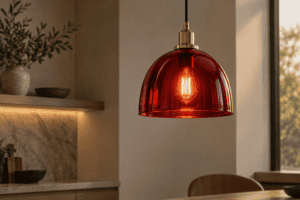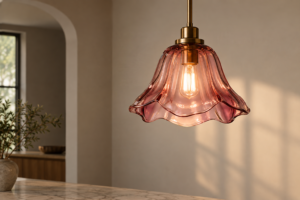
Lampshading has two unrelated meanings: in writing it means acknowledging an implausibility without resolving it; in craft and design it refers to the making, covering, and styling of lampshades. This guide covers both.
Search “lampshading” and you’ll land on a TV Tropes page about writers winking at the camera. That’s a real and well-documented use of the word. But type it into a crafts forum, a design blog, or a specialist lampshade workshop and you’ll find something entirely different — the physical practice of making, covering, and fitting lampshades. This guide covers the full picture: the term’s multiple meanings across writing, psychology, and fashion, and a thorough introduction to lampshading as a craft in its own right.
What does “lampshading” mean?
Lampshading is used in two distinct, unrelated contexts: as a storytelling technique in writing and performance, and as a noun for the craft of making and styling lampshades. The two meanings share only the word.
The writing and TV trope definition
In creative writing, film, and television, lampshading (also called lampshade hanging) is a technique where the writer acknowledges an implausibility, a plot hole, or a logic gap in the narrative — then moves on without resolving it. The acknowledgment itself is the device. By drawing attention to the problem explicitly, the writer signals to the audience that they are aware of it, which paradoxically makes audiences more willing to accept it.
The term originates from a classic joke: “Why is there a lampshade on my head?” “Because a lampshade has to go somewhere.” The logic is absurd, the question goes unanswered in any satisfying way, and that is precisely the point. A character asking a question that has no good answer functions the same way on a TV drama: the audience hears the acknowledgment, the story keeps moving, and the disbelief is suspended — not because the problem was fixed, but because someone admitted it was there.
Examples appear throughout popular fiction. A character in an action film asking “doesn’t anyone find it suspicious that we always escape at the last second?” is lampshading. A narrator who says “this is the part of the story where you’d expect me to do something sensible” before doing something clearly reckless is lampshading. The technique is most effective in comedies and meta-narratives, though dramatic writers use it too.
Lampshading in psychology and social dynamics
A second meaning has developed more recently in psychology and relationship advice contexts. Here, lampshading refers to a behavior where someone minimizes, dismisses, or deflects attention away from a valid concern — typically by acknowledging it with a joke or a quick comment, then redirecting the conversation before the issue gets examined seriously.
The psychological use of lampshading is closely related to gaslighting and deflection. Saying “I know I was late again, ha, classic me” without addressing why it keeps happening or what will change is a form of lampshading in this sense. The acknowledgment substitutes for accountability. Unlike the writing technique (where lampshading is a self-aware authorial choice), the psychological use is generally described as a manipulation pattern.
| Context | What “lampshading” means | Intent | Effect on audience/listener |
|---|---|---|---|
| Writing / storytelling | Acknowledging a plot hole or logic gap without fixing it | Self-aware, usually deliberate | Suspends disbelief; reader accepts the flaw |
| Psychology / social dynamics | Minimizing a concern with a quick acknowledgment | Often deflecting accountability | Listener’s concern is not addressed |
| Craft / design | Making, covering, or styling a lampshade | Functional and aesthetic | A finished lampshade is the result |
| Fashion | A garment cut in a flared, lampshade silhouette | Aesthetic design choice | A distinctive, structured garment shape |
The origin and history of the term
Both the writing trope and the craft word have roots in the same object, but they diverged in meaning over separate decades.
From “lampshade hanging” to “lampshading”
The storytelling trope was documented as “lampshade hanging” in television fan communities in the early 2000s, primarily through the TV Tropes wiki, which became the canonical reference for narrative devices. The site defines it as “hanging a lampshade on” a problem — that is, drawing explicit attention to something strange so it no longer reads as an oversight.
The shortening to “lampshading” followed naturally as the term crossed from fan wikis into general usage. By the mid-2010s, “lampshading” appeared in mainstream criticism, script notes, and writing workshops as the accepted shorthand. Critics began using it as a verb: “the script lampshades its own contrivances throughout Act Two.”
The psychological use came later, growing largely through social media and relationship advice content in the late 2010s and early 2020s. It borrowed the storytelling logic — acknowledge a problem without actually addressing it — and applied it to interpersonal behavior.
How the craft term developed separately
The lampshade as a designed and manufactured object has existed since the introduction of gas and then electric indoor lighting in the 19th century. Early lampshades were made by hand from fabric, paper, and later glass. The people who made them were craftspeople working with wire frames, textiles, and adhesives — and the word “lampshading” as a craft description appears in trade catalogues and upholstery manuals well before the TV Tropes definition was coined.
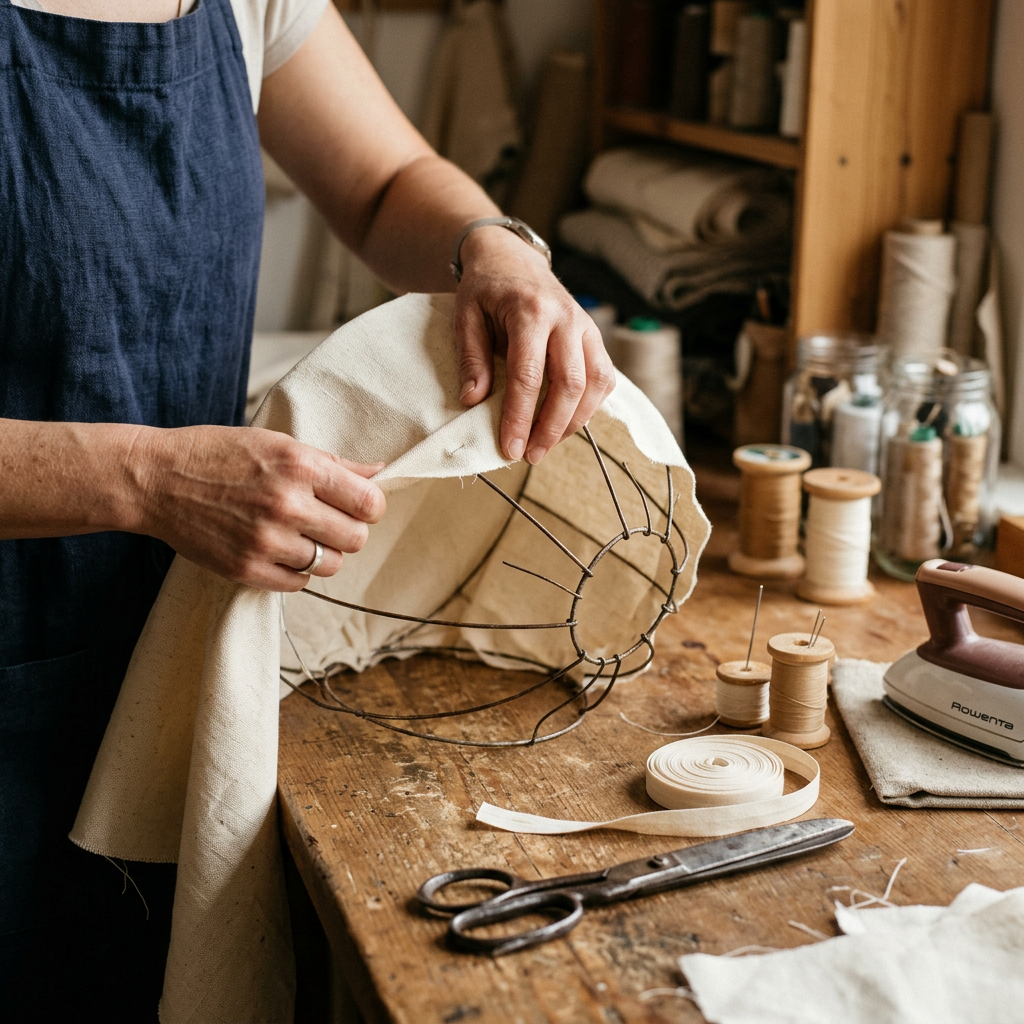
In craft contexts, lampshading refers to the full range of activities involved in making a lampshade: stretching or pleating fabric over a frame, cutting and fitting glass panels, constructing wire armatures, binding edges, and fitting the shade to a lamp. It is a distinct skill set with its own tools, techniques, and material knowledge.
The two streams of meaning now coexist. For most general searches, the writing trope dominates results. For craft, design, and lighting industry searches, the making-and-styling meaning is the operative one.
| Period | Development |
|---|---|
| 19th century | Lampshades manufactured commercially; craft terminology develops |
| Early 1900s | Glass lampshading established as specialty craft (Tiffany, Handel, Pairpoint studios) |
| Early 2000s | “Lampshade hanging” documented as TV trope on fan wikis |
| Mid 2010s | Shortens to “lampshading” in mainstream writing criticism |
| Late 2010s | Psychological use of the term grows through social media |
| 2026 | Both meanings in active use; craft meaning has no dominant reference page |
Lampshading in fashion
In fashion and textile design, lampshading refers to a specific silhouette: a garment — usually a skirt, dress, or tunic — cut with a wide, flared hem that tapers inward at the top, mimicking the shape of a lampshade. The silhouette is structured, with the fullness held outward by internal boning, a stiff underlining, or a rigid interfacing rather than by petticoats.
The lampshade silhouette in clothing design
The lampshade shape in clothing is most closely associated with Cristóbal Balenciaga, whose work in the 1950s produced structured garments with that distinctive flared volume. The lampshade coat and lampshade tunic were formal pieces that prioritized silhouette over body-conforming fit — an architectural approach to dressing that separated Balenciaga’s work from the corseted hourglass shapes dominating fashion at the same time.
The silhouette has cycled back into collections repeatedly since then. It appeared in structured cocktail dresses in the 1980s, was revived in avant-garde collections in the 2000s, and continues to appear in contemporary ready-to-wear as a design note for occasion wear and formal garments. The lampshade shape in fashion is always about the interplay between structure and volume: the garment holds a specific shape independently of the wearer’s body.
How interior lampshading influenced textile and garment construction
The connection between the physical lampshade and the fashion silhouette is not metaphorical. The techniques used in fabric lampshading — stretching silk or structured fabric over a rigid frame, creating precise folds and tucks that hold shape under tension — directly parallel the techniques used in couture garment construction. Both disciplines work with the same problem: getting fabric to hold a three-dimensional shape without collapsing.
Fabricators who make pleated lampshades and couture houses that construct structured garments use related pattern-making logic. In both cases, the folds have to be calculated before cutting. Pleat spacing must divide evenly into the circumference; the fold depth determines how much volume the finished piece holds. A miscalculation by even a centimeter produces a visible irregularity.
Lampshading as a craft: how lampshades are made
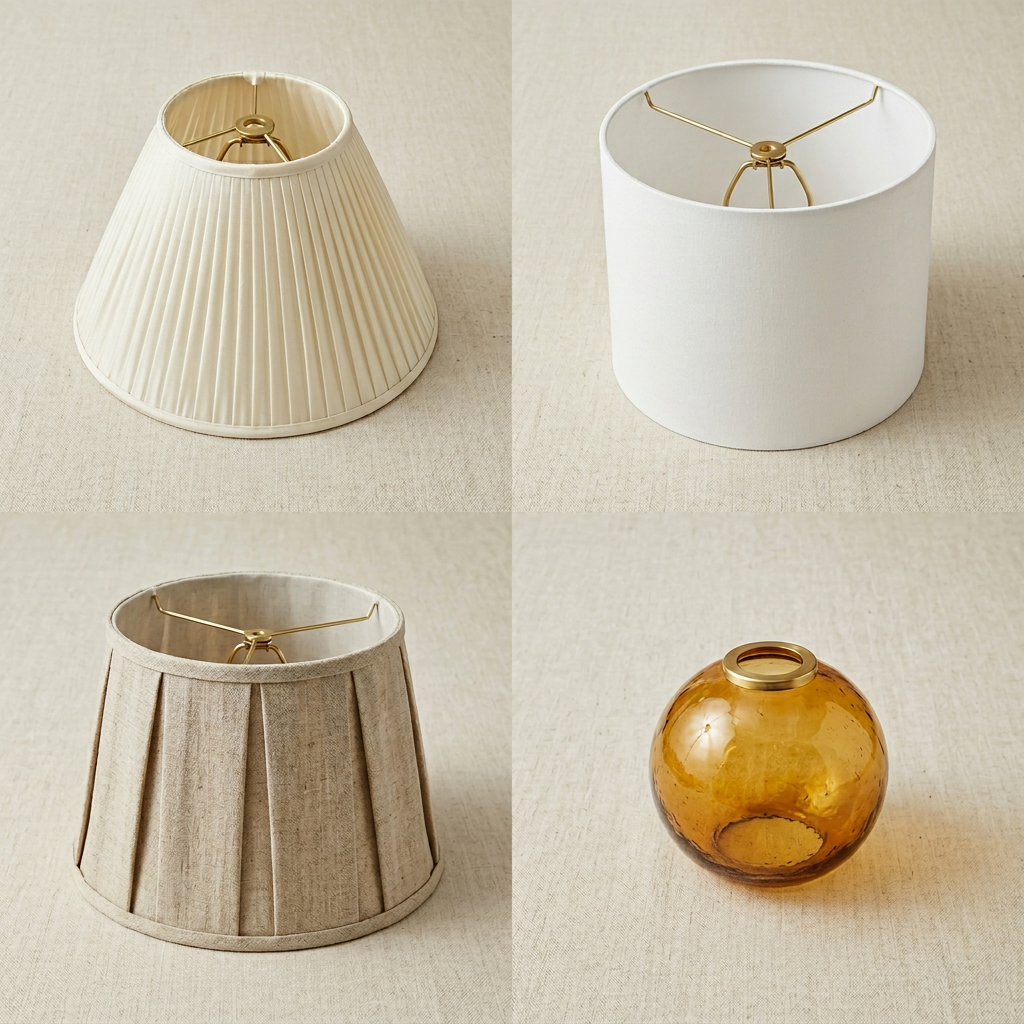
In the craft sense, lampshading covers the full range of construction methods used to produce a finished lampshade, from basic fabric-over-frame work to specialist glass lampshading. The method varies significantly by material.
Wire frames and the foundation of every lampshade
Every fabric lampshade starts with a wire frame. The frame defines the shade’s shape — drum, empire, bell, coolie, hexagonal — and its top and bottom diameters. Quality frames are made from galvanized or nickel-plated steel wire; cheaper frames use mild steel that can rust if exposed to humidity. The wire gauge determines how rigid the frame is and how well it holds shape under the tension of stretched fabric.
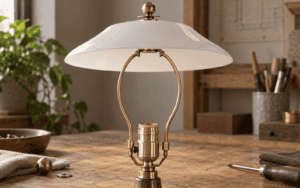
The fitter — the attachment point at the top of the frame — determines how the lampshade connects to the lamp. Spider fitters sit on a harp; uno fitters screw directly onto the socket; clip-on fitters attach directly to the bulb. In lampshading, choosing the correct fitter for the target lamp is the first decision, not an afterthought.
Fabric lampshading: wrapping, pleating, and stitching techniques
Fabric lampshading involves three main construction approaches:
Stretched (hard-back) construction: fabric is glued under tension to a styrene or paper backing laminated to the frame. The surface is smooth and the shade is rigid. This is the most common method for mass-produced shades and produces a consistent finish that holds up well to handling.
Soft-sewn construction: fabric is stitched directly to the frame rings using a whipstitch or ladder stitch. The shade has no rigid backing; the fabric is held by the stitching alone. Soft-sewn lampshading requires more skill but allows for softer, more luminous light diffusion and is standard for high-quality pleated shades. For readers interested in how different pleat styles are constructed, our pleated lampshade guide covers knife pleat, box pleat, and cartridge pleat methods in detail.
Paneled construction: panels of fabric (or other materials) are cut to shape and joined at seams. This is used for structured geometric shades, hexagonal or octagonal frames, and some specialty designs. Paneled lampshading is the bridge between fabric construction and glass lampshading, since Tiffany-style glass shades are built on the same principle: individual pieces joined at edges to cover a frame.
Glass lampshading: a specialty craft distinct from fabric work
Glass lampshading is a distinct craft that requires different tools, skills, and materials from fabric work. Where a fabric lampshader works with textile, wire, and adhesive, a glass lampshader works with raw glass, cutting tools, copper foil or leading, solder, and a flame. The two practices share the basic problem — covering a frame shape with panels that fit together precisely — but everything else differs.
The specialist craft of glass lampshading in America is closely associated with the art glass studios of the late 19th and early 20th centuries. Tiffany Studios, Handel Company, and Pairpoint Manufacturing all produced leaded and painted glass lampshades that established the technical and aesthetic standards still referenced today. The Corning Museum of Glass holds significant collections of these shades and is the primary reference source for their construction techniques.
| Material | Construction method | Light quality | Durability | Skill level |
|---|---|---|---|---|
| Silk / faux silk | Soft-sewn or hard-back | Warm, directional glow | Moderate (fades with UV) | Medium |
| Linen / cotton | Soft-sewn or hard-back | Diffused, casual | Good | Low to medium |
| Glass (pressed) | Panel fitting over frame | Clear, bright | Very high | High |
| Glass (hand-blown) | Blown to mold, fitted at fitter lip | Varies by glass type | Very high | Specialist |
| Paper / parchment | Glued hard-back | Warm, diffused | Low | Low |
| Metal / perforated | Welded or riveted | Directional, pattern-cast | Excellent | High |
Glass lampshading in detail
Glass lampshading splits into two traditions that use fundamentally different manufacturing processes, producing shades with different looks, price points, and appropriate settings.
Hand-blown vs pressed glass: two distinct making traditions
Hand-blown glass lampshades are formed by a glassblower who gathers molten glass on a blowpipe, inflates and shapes it by breath and gravity, and finishes it while still hot. Each shade is unique — slight variations in wall thickness, bubble distribution, and surface texture are inherent to the process. The Smithsonian’s Museum Conservation Institute has documented these variations as evidence of authentic hand production in historical pieces. Hand-blown shades are more expensive, more fragile at the fitter lip, and more variable in finish than pressed alternatives.
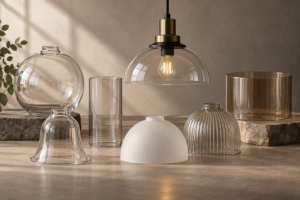
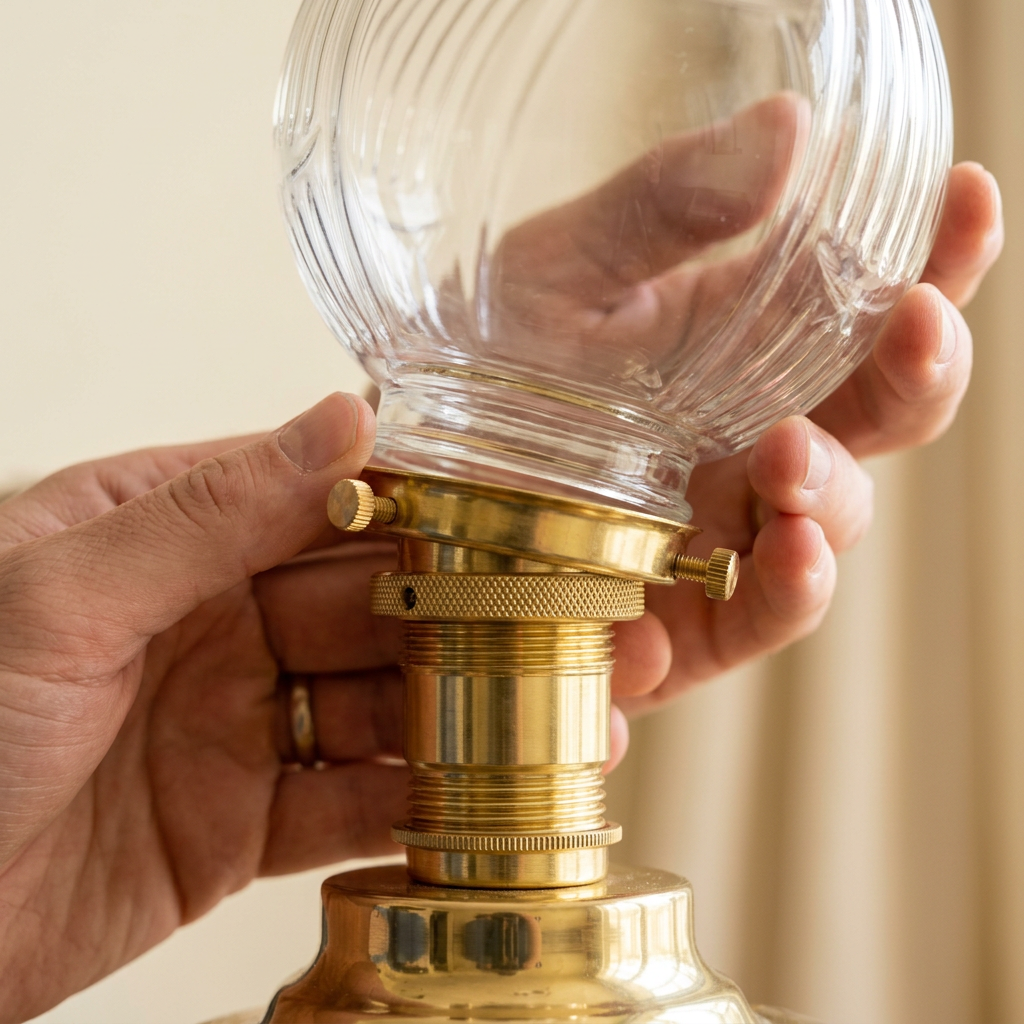
Pressed glass lampshades are made by forcing molten glass into a metal mold under mechanical pressure. The mold defines the shape precisely: every shade from the same mold is identical in form. Pressed glass is better suited to pattern-surface designs — ribs, diamond cuts, fluting, hobnails — because the mold can be engraved with the pattern and transfer it to every piece consistently. Our cut glass lamp shades collection covers the range of pressed and cut glass shade types, from plain satin opal to deeply patterned ribbed globes.
Hand-blown glass is the appropriate choice where surface variation is a feature (antique reproductions, art pieces, studio pieces). Pressed glass is the appropriate choice where consistency, pattern precision, and cost matter.
Fitter types and how glass shades attach to lamp hardware
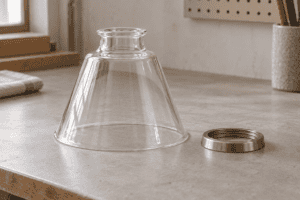
Glass lampshades connect to their lamps through the fitter — the opening at the top of the shade, sized to seat on a shade holder ring or socket collar. Fitter size is the inside diameter of this opening. Standard sizes are 2¼” (the most common for antique table lamps), 3¼”, 4″, and 6″. A shade with a 2¼” fitter will not seat correctly on a 3¼” holder without an adapter.
The fitter is the non-negotiable measurement in glass lampshading. Height and width can vary within a range and still look correct; fitter diameter must match the hardware exactly. Vintage glass lampshades follow the same standard fitter sizes as modern reproductions, which is why original hardware can often accept a new shade and vice versa. For readers replacing a broken shade, our vintage glass lamp shades guide covers fitter matching for antique lamp hardware in detail.
The LED question comes up regularly in glass lampshading. The U.S. Department of Energy confirms that LED bulbs generate far less heat than equivalent incandescent bulbs, which is a practical benefit: glass shades are not damaged by heat in the same way fabric shades are, but the solder joints and cement holding leaded glass panels can weaken under sustained high temperatures from an incandescent. LED conversion extends the life of leaded glass shades.
How to start lampshading at home: a beginner guide
Fabric lampshading is accessible to a patient beginner. Glass lampshading requires specialized tools and is not a realistic starting point for most home crafters. For those starting out, fabric-over-frame construction is the right entry point.
Tools and materials for a first fabric lampshade
A basic fabric lampshade requires:
- A quality wire frame in the shape and size you want (buy, don’t improvise — a warped frame will make every fold look crooked)
- Medium-weight fabric: cotton, linen, or faux silk in a plain weave (no stretch fabrics — they won’t hold tension)
- Bias tape or ribbon for binding the top and bottom rings
- Fabric glue (PVA-based, not hot glue — hot glue creates visible hard ridges and doesn’t bond well to bias tape)
- A metal ruler and a sharp rotary cutter
- An iron and pressing cloth
The iron is not optional. Every fold needs to be pressed crisp before being attached to the frame. Lampshading done without pressing looks hand-sewn in a bad way — uneven fold depths, soft edges, inconsistent spacing.
The most common beginner mistakes
Wrong fabric weight: using a fabric that is too sheer or too heavy for the pleat style. Lightweight chiffon collapses between knife pleats; heavy velvet bulks up at every fold seam. For a first shade, stick to a medium-weight plain cotton or linen.
Skipping the pleat calculation: cutting fabric before calculating whether the pleat count divides evenly into the frame circumference. If the math doesn’t work out to a whole number of pleats, you’ll have a visible gap or a forced wide pleat at the join. Calculate first, cut second.
Using hot glue for the binding: it’s fast, but it creates visible ridges along the tape edge and doesn’t bond well under heat from the bulb over time. PVA fabric glue or a whipstitch with waxed thread is the correct method.
Ordering the wrong fitter: measuring the outside of the shade holder ring rather than the inside diameter. Fitter size is an inside measurement. Ordering a shade by outside diameter guarantees a shade that won’t seat correctly.
Lampshading styles and their interior design applications
Lampshading as a design discipline covers a wider range of looks than most buyers realize. The style of the shade — its silhouette, fabric, and construction — reads as a design language in the room.
Traditional, transitional, and modern lampshading styles
Traditional lampshading uses pleated empire or bell shades in faux silk or silk dupioni, usually in cream or ivory, with a trim at the bottom hem. The fabric is soft-sewn on a wire frame. The light quality is warm and directional. This style suits rooms with formal furniture, antique or reproduction lamp bases, and classic interior character.
Transitional lampshading bridges formal and casual. Natural linen drum shades, pleated cotton shades in muted tones, or slightly textured shades with clean edges without trim sit comfortably in both traditional and contemporary settings. The fabric often has a natural texture rather than a silk sheen; the shape is simpler than an empire taper.
Modern lampshading favors the drum: a straight cylinder with flat-stretched fabric and minimal ornamentation. The fabric might be a textured synthetic, a fine ribbed cotton, or a technical material. Clean seams, no visible stitching, and no trim. Modern lampshading suits rooms with architectural furniture and minimal visual clutter.
Matching lampshade style to room and lamp base type
The shade should complement the base, not compete with it. A highly ornate ceramic base with hand-painted detail calls for a plain ivory silk shade — the base carries the visual weight, the shade frames the light. A simple cylindrical brass or steel base can take a more textured or colored shade because there’s nothing competing.
Scale matters as much as style. The bottom diameter of the shade should be at least 2″ wider than the widest point of the base, and the shade height should be roughly one-third of the total lamp height (base plus shade combined). A shade that’s too narrow looks pinched; one that’s too short looks undersized.
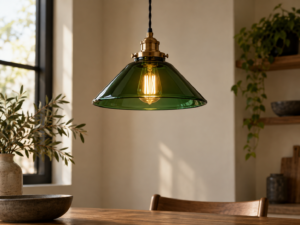
Glass lampshading serves a different design function from fabric. A glass shade reads as an object when unlit — its color, pattern, and material are visible in daylight. A fabric shade disappears until the lamp is switched on. For rooms where the lamp needs to be a visual anchor day and night, glass lampshading is the correct choice.
FAQ
What does lampshading mean in writing?
In writing and television, lampshading (also called lampshade hanging) means acknowledging a plot hole, logic gap, or implausibility explicitly rather than ignoring it, then continuing the story without fixing the problem. The acknowledgment is the device. A character who says “this is probably a terrible idea” before doing something plot-convenient is lampshading. The technique works because explicit acknowledgment reduces the audience’s resistance to accepting a contrivance. It is used most in comedy and self-aware narratives, but dramatic writers use it too.
What is lampshading in psychology?
In psychology and relationship contexts, lampshading refers to acknowledging a problem or concern with a quick comment or joke, then deflecting the conversation before the issue is examined seriously. It differs from the writing trope in intent: the psychological use is typically described as a deflection or minimization pattern. Saying “I know, I always do this, sorry” without making any change to the behavior is the classic form. The acknowledgment substitutes for accountability without providing it.
What does lampshading mean in fashion?
In fashion, lampshading describes a garment silhouette where the hem flares widely outward from a narrow top, mimicking the shape of a lampshade. The silhouette is defined by structure held in the fabric itself rather than by a petticoat or underlayer. It is most closely associated with Balenciaga’s 1950s work and has appeared repeatedly in designer collections since. The lampshade skirt, lampshade coat, and lampshade tunic are the most common garment forms using this shape.
What is lampshading as a craft?
As a craft, lampshading refers to the full range of skills and processes involved in making a lampshade: constructing wire frames, stretching or pleating fabric over frames, constructing paneled glass shades, binding edges, and fitting finished shades to lamp hardware. Fabric lampshading and glass lampshading are distinct specialties with different tools, materials, and skill requirements. Both require precise measurement and planning before any cutting or construction begins.
How hard is it to learn lampshading at home?
Fabric lampshading at a basic level — a stretched hard-back shade or a knife-pleated fabric shade on a simple frame — is achievable for a patient beginner with accurate measuring and good materials. The most common beginner failure is skipping the pleat calculation and ending up with an uneven join. Glass lampshading is a specialist craft that requires cutting tools, copper foil work, soldering equipment, and significant practice before results are usable. It is not a realistic starting point for most home crafters.
What is the difference between fabric lampshading and glass lampshading?
Fabric lampshading covers a wire frame with textile using gluing, stitching, or both. The result is a shade that diffuses light softly, is relatively light, and can be made at home with basic tools. Glass lampshading builds a shade from glass panels or a blown glass form. The shade is heavier, more durable, and transmits light more directly. Glass shades read as objects when unlit; fabric shades are largely invisible until the lamp is on. The two approaches suit different room styles, lamp types, and budgets.
Conclusion
Lampshading is a word doing double and triple duty. In a writers’ room it’s a self-aware technique for handling plot problems. In a therapist’s office it’s shorthand for deflection. On a workbench with wire, fabric, and glass, it’s a craft that has been practiced since the first electric bulbs needed something to diffuse their light.
For those interested in the craft side — whether choosing a shade, replacing a broken one, or attempting to make one — the most important things are matching the fitter size to the hardware, choosing the right fabric weight for the pleat style, and understanding that glass and fabric lampshading are separate disciplines with different rules. If you’re working with a glass lamp base or looking for a glass shade to replace a fabric one, the cut glass lamp shades collection covers the range of pressed and hand-blown glass options across standard fitter sizes.