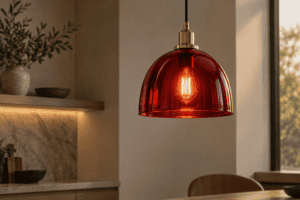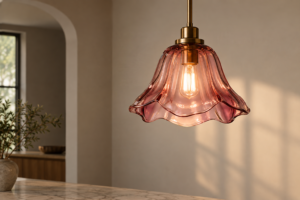
Tulip lamp shades use a flared flower profile; choose one by fitter, opening, height, petal shape, glass finish, and fixture clearance.
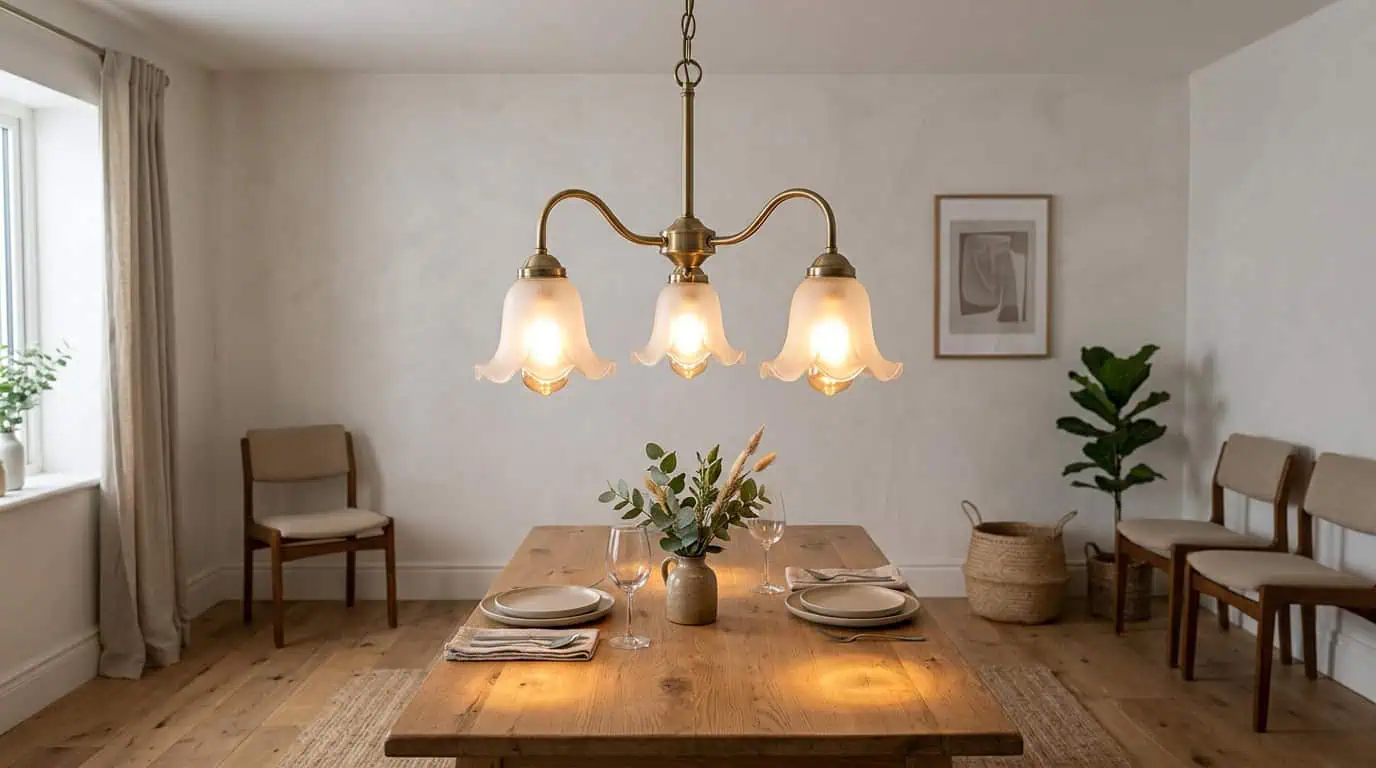
The phrase tulip lamp shades sounds specific until you start shopping. One listing may show a small frosted glass flower for a chandelier arm. Another may show a vintage colored glass shade with a ruffled edge. A third may refer to a fabric cover that slips over a ceiling light. They share a floral silhouette, but they do not share the same mounting method, dimensions, or use.
That difference matters. A shade can have the right color and still fail because its neck is two millimeters too wide, its petal flare touches the fixture, or its height exposes the socket. For a replacement, fit comes first. For a new lighting collection, the profile, glass effect, sample standard, and packing plan matter as well.
This guide treats tulip lamp shades as parts of a complete light fixture. It explains how to identify the type, record the dimensions, compare clear and diffusing glass, and prepare a replacement or custom inquiry that a supplier can review without guessing.
What tulip lamp shades are
A tulip shade is a lamp cover whose body narrows near the fitter and opens into a flower-like rim.
The word “tulip” describes the visible profile, not a universal technical standard. Some tulip lamp shades have five clear petals. Others use a continuous wavy edge that only suggests a flower. Vintage shades may be compact buds, while modern ceiling covers can be broad and shallow. Product names alone therefore do not establish compatibility.
The profile has three working zones
Read the shade from bottom to top. The first zone is the connection, which may be an open neck, screw fitter, lip, uno ring, clip, or another retaining feature. The second zone is the body, where the shade reaches its shoulder and maximum diameter. The third zone is the flower edge, where the glass or fabric flares, waves, or divides into petals.
Each zone answers a different question:
- Will the shade attach to the fixture?
- Will it clear the bulb, socket, and neighboring arms?
- Will its silhouette match the original lamp or design brief?
The connection is the pass or fail dimension. The body and flower edge determine visual match and physical clearance.
Tulip is a shape family, not one product
Retail search results mix decorative ceiling covers, glass replacements, handmade fabric forms, and vintage parts. That is why two items called tulip lamp shades may have no interchangeable dimensions. Even an exact visual match in a photo can hide a different opening or retention method.
International standards address lamp caps and holders, but they do not turn every decorative shade attachment into one size. The IEC 60061 database exists to support interchangeability and safety for lamp caps, holders, and gauges. A decorative glass neck, screw collar, or fitter still has to match the actual luminaire design.
The practical rule is simple: treat “tulip” as the starting description. Treat the opening, neck, retention detail, height, diameter, and profile as the specification.
Identify the tulip shade you need
First determine whether you need a glass replacement, a fabric ceiling cover, or a vintage flower-profile shade.
This is the most useful distinction in the entire buying process. It separates products with different mounting systems before price, color, or style distracts the search.
| Shade family | Typical construction | Common connection | Best evidence to provide | Main buying risk |
|---|---|---|---|---|
| Glass flower shade | Blown, pressed, or lampworked glass | Open neck, screw neck, lip, or set-screw fitter | Old shade, holder photos, opening and neck dimensions | Similar profile with incompatible neck |
| Fabric ceiling cover | Textile over a frame or flexible support | Hooks, clips, magnets, or fixture-specific support | Fixture photo, ceiling plate size, mounting instructions | Heat clearance and unsupported fabric |
| Vintage tulip shade | Colored, frosted, opal, or patterned glass | Period-specific fitter or gallery | Original shade, fragments, lamp model, measured profile | Visual match without dimensional match |
| Decorative flower component | Small petal or bud used in a multi-arm light | Stem, socket ring, clip, or custom metal interface | Complete arm and holder detail | Collision between adjacent shades |
Glass flower-profile shades
Glass tulip lamp shades are common on chandeliers, pendants, wall lights, table lamps, and decorative ceiling fixtures. Their openings may face up or down. Orientation changes the load path, the way dust collects, and the visible relationship between the bulb and petal edge.
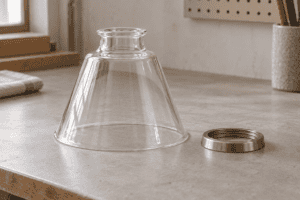
A glass shade should be checked as a rigid component. Measure the part itself and the metal holder. If set screws retain the neck, record the number of screws, the inner holder diameter, the glass neck outside diameter, and the depth available before a screw reaches a curved shoulder. A screw pressing on a slope instead of a straight neck can create a poor seat.
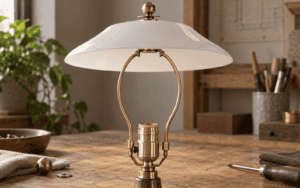
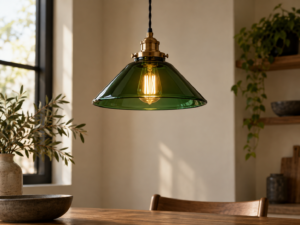
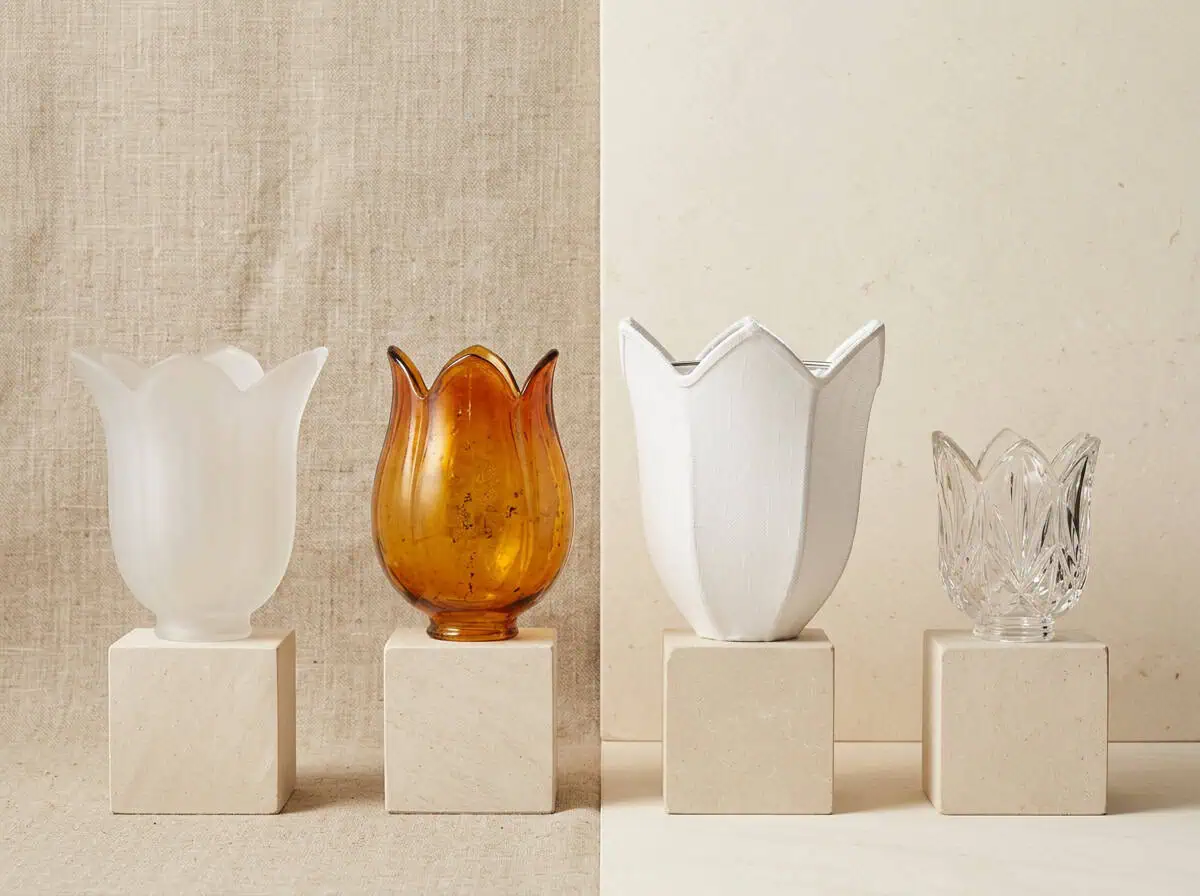
JX has a frosted flower-petal glass lampshade that shows one broad, pale tulip direction. The green tulip-bud glass shade shows a narrower vintage direction. These are useful profile references, but neither should be assumed to fit a fixture until the connection is compared.
Fabric covers sold under the same search phrase
Some top search results for tulip lamp shades are soft ceiling covers designed to change the appearance of an existing fixture. They solve a different problem. A renter may want to hide a shallow ceiling light without rewiring. A glass replacement buyer needs a rigid shade that seats in a holder.
Do not substitute fabric for glass unless the product is specifically designed and tested for that fixture. The U.S. Consumer Product Safety Commission advises consumers to keep combustibles away from bulbs and to use the correct bulb wattage for the fixture in its home fire safety guidance. A decorative cover must preserve the clearances and ventilation required by the complete luminaire.
Vintage and reproduction tulip shades
Vintage tulip lamp shades often have character that modern listings do not capture in a dropdown: a hand-shaped rim, slight wall variation, bubbles, color pooling, or a neck formed for older hardware. A replacement may need to look consistent with several surviving shades on the same chandelier.
Photograph all surviving pieces together in even daylight. Put a ruler in the frame. Record which differences are acceptable. If five old shades already vary slightly, the approval target may be a controlled range rather than one perfect silhouette. If the replacement must sit beside identical machine-made shades, the tolerance expectation will be tighter.
Flower shades for multi-arm fixtures
A shade that fits one socket can still fail on a chandelier. Adjacent tulip lamp shades may touch when the petals are too wide, or a taller body may block access to the bulb. Measure the center-to-center distance between neighboring arms and the free envelope around each shade.
The useful dimension is not only maximum diameter. Note where that maximum occurs. Two shades can both measure 120 mm wide, but one reaches 120 mm near the rim while the other reaches it at the shoulder. Their collision risk is different.
Measure a tulip lamp shade before ordering
Measure the connection first, then record the full body and petal profile in a repeatable order.
Do not begin with the widest point simply because it is easy to see. Width will not rescue an incompatible fitter. Start where the glass meets the hardware.
Prepare the shade and holder
Switch off power and let the lamp cool. Remove the shade only if the fixture instructions allow safe removal. Keep screws, rings, clips, washers, and gaskets in order. Photograph the assembled connection before separating parts. That photo often answers questions that measurements alone do not.
Use a steel rule or caliper for small openings. A flexible tape is useful for overall height and broad diameters, but it can bow across a neck and produce an uncertain reading. Record both inches and millimeters when a replacement could come from a different market.
Record the connection
For an open neck or fitter, measure:
- Opening inside diameter at the smallest controlled point.
- Neck outside diameter where it sits in the holder.
- Neck height available for retention.
- Lip thickness, groove, thread, screw area, or other retaining feature.
- Holder inside diameter and seating depth.
If the opening is not round, take at least two readings at right angles. A broken or distorted shade may appear oval even when the original drawing was round. Note the condition instead of silently averaging the values.
Record the full profile
Place the shade on a stable padded surface. Measure overall height along the centerline. Measure maximum outside diameter. Then take intermediate diameters at defined heights, such as 25%, 50%, and 75% of the total height. Those points turn a vague side photo into a usable profile check.
For a petal edge, record:
- Number of petals or waves.
- High-point and low-point height.
- Maximum diameter at the petal tips.
- Diameter between petal valleys.
- Edge condition, such as polished, fire-finished, cut, or rounded.
| Measurement | Where to measure | Why it matters | Recommended record |
|---|---|---|---|
| Opening inside diameter | Smallest usable opening | Bulb and hardware clearance | Millimeters plus a clear photo |
| Neck outside diameter | Straight retaining zone | Holder compatibility | Two readings at right angles |
| Neck height | Seating face to shoulder start | Set-screw or ring engagement | Millimeters |
| Overall height | Lowest to highest controlled point | Lamp proportion and clearance | Centerline measurement |
| Maximum diameter | Widest outside points | Adjacent part and fixture clearance | Diameter plus height location |
| Petal rise | Valley to tip | Visual profile and total height | Each repeated feature or an agreed average |
The existing lamp shade measurement guide explains base, harp, and fitter measurements for general shades. For tulip lamp shades, add the flower profile and neck detail because those control both appearance and retention.
Make photos measurable
Take a straight side view, a top view, an opening close-up, and a photo of the holder. Keep the camera far enough away to reduce wide-angle distortion. Put a rule in the same plane as the part being measured. A ruler several inches behind the shade can make the profile appear smaller than it is.
If the original is broken, do not press fragments together with bare hands. Photograph the safe fragments individually, then place them beside a drawn centerline and scale. The holder and unbroken neck fragment are usually more valuable than a pile of rim pieces.
Check the complete fixture envelope
Measure bulb length and maximum diameter, socket position, distance to nearby arms, and any ceiling or wall clearance. A tulip shade may fit the holder but leave too little room to install the bulb. An upward-facing flower may also trap more heat or dust than an open downward shade.
IEC 60598-1 covers general safety requirements and tests for luminaires, including mechanical construction, marking, and temperature-related requirements. The current IEC 60598-1 overview is a reminder that a decorative shade cannot be evaluated in isolation from the complete luminaire.

Choose the glass, finish, and light effect
Choose the finish by the desired light effect and maintenance needs, then approve it on a physical sample.
Color names are unreliable. “Opal white,” “milk white,” and “frosted” can describe visibly different products. One supplier may use opal glass with color distributed through the body. Another may use clear glass with a matte surface or coating. The shade can look similar when unlit and very different after the bulb is switched on.
Clear glass
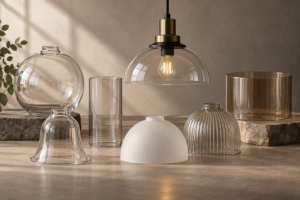
Clear tulip lamp shades expose the bulb and socket. They preserve sparkle and crisp reflections, especially on small flower shades. They also show dust, fingerprints, bubbles, tooling marks, and hardware more readily.
Use clear glass when the bulb is meant to be part of the composition. Check glare from normal viewing angles. A bright point source near eye level can be uncomfortable even when the shade looks attractive in a product photo.
Frosted and matte surfaces
Frosted glass scatters light at or near the surface. It can soften the visible bulb and make petal edges read more evenly. The exact result depends on the base glass, surface treatment, wall thickness, bulb position, and frost level.
Ask whether the finish is inside, outside, or both. An external matte surface may show handling marks differently from a smooth exterior. An internal finish can be harder to clean if the opening is narrow. This is a practical ownership issue, not a minor cosmetic note.
Opal or milk glass
Opal glass diffuses light through the glass body. It can create a fuller luminous flower with less visible bulb detail. Opacity varies. A dense opal shade may reduce perceived brightness more than a light frost, so compare samples with the intended lamp rather than judging an unlit chip.
The U.S. Department of Energy notes that luminaire efficacy depends on the source and the fixture working together, including features that may reduce source efficiency for other benefits. Its LED basics resource also recommends at least CRI 80 for interior lighting and describes CRI 90 or higher as excellent color fidelity. The shade changes distribution and appearance, while the LED source still determines much of the spectral quality.
Colored glass and coatings
Amber, green, pink, smoke, and other colors can be in the glass body, applied as a coating, or created through a layered process. State which route the sample represents. A colored body and a painted surface may differ in edge appearance, scratch behavior, cleaning, and batch consistency.
For color-critical projects, approve a physical limit sample under the specified light source. The Illuminating Engineering Society’s TM-30 method evaluates fidelity, gamut, and hue-specific shifts more fully than one CRI number. You do not need to turn a decorative shade purchase into a laboratory project, but you should control the lamp source and viewing condition when color approval matters.
Transmission and visual consistency
Light transmission can be measured, not guessed from a phone photo. NIST describes how calibrated instruments compare light intensity before and after it passes through a glass sample in its explanation of reflection and transmission measurement. For a normal replacement, a side-by-side lit sample may be enough. For a repeated commercial program, define a measurable or reference-based acceptance method.
Check the shade both lit and unlit. A color match under daylight may separate under a warm LED. A frost that looks even on a shelf may reveal thin areas when illuminated. Petal tips can appear brighter because the glass geometry changes at the edge.
Match tulip shades to the fixture and application
The right tulip shade fits the hardware, clears the bulb, and keeps the flower profile readable in its installed orientation.
Application changes the decision. A compact table lamp can tolerate a fuller flower than a six-arm chandelier with tight spacing. A downward pendant needs secure retention and a clean view from below. An upward wall light needs an opening that allows bulb access and routine cleaning.
Chandeliers and multi-arm lights
For chandeliers, measure one complete arm and the space between arms. Confirm whether every socket sits at the same angle. Small variations in old metalwork can change the visible alignment of replacement tulip lamp shades.
If only one shade is missing, compare the new sample beside the original set. Match the neck first, then height, petal rhythm, diameter, glass color, and lit appearance. A nearly correct shade can look more obvious than a deliberately coordinated but different replacement.
Pendant and ceiling fixtures
A pendant exposes the shade from several angles. Record canopy-to-shade proportion, cable or rod alignment, and the view from below. For ceiling lights, confirm vertical clearance to the ceiling plate and the method used to retain the shade.
Do not assume a fabric tulip cover can be placed over any ceiling fixture. Follow the cover manufacturer’s installation limits and preserve bulb and fixture clearances. If the product requires hooks or other supports, verify that the mounting surface and fixture arrangement match the instructions.
Wall lights
Wall sconces add a projection constraint. Measure from the wall to the outermost petal tip. Check doors, mirrors, cabinets, and circulation paths nearby. An upward flower shade should allow the bulb to be replaced without removing the fixture from the wall.
Table and floor lamps
On a table lamp, the shade should hide the socket and bulb from normal seated eye level while keeping the flower edge visually balanced with the base. On a floor lamp, the same shade may sit close to eye level and create more glare. Test the actual viewing height.
The general glass lamp shade fitter guide is the right next step if the mounting method is uncertain. Do that check before comparing decorative details.
Choose replacement, small-batch, or custom development
Use an existing item when the fitter and profile match; use a sample or drawing route when they do not.
Not every project needs a new mold or tooling. The fastest route is usually to compare the brief with an existing shade. Custom development makes sense when the connection, profile, finish, quantity, or brand requirement cannot be met from current items.
Route 1: match an existing shade
Send the connection dimensions, overall height, maximum diameter, petal detail, orientation, finish, and target quantity. Ask for a dimensioned reply, not only a product photo. If an existing tulip shade is close, decide which differences are acceptable before requesting a sample.
This route suits a replacement, a small decorative project, or early product development where the design can adapt to an available form.
Route 2: review an original sample
An intact original gives the supplier direct evidence of the neck, wall, edge, and profile. Protect it for shipping. Photograph and measure it before dispatch. Agree on whether the sample can be cut or tested. A rare vintage original may be unsuitable for destructive analysis.
If several originals exist, send one representative piece and document the variation across the set. The sample is not automatically a perfect nominal standard.
Route 3: develop from a drawing
A controlled drawing should show the centerline profile, dimensions, datums, opening and neck detail, edge condition, material or appearance target, and inspection points. A decorative sketch is useful for intent but does not replace a production drawing.
For a new collection, state the bulb, socket, fixture orientation, target market, and any required certification route for the complete luminaire. The glass supplier can review the shade, but the finished fixture owner remains responsible for complete product compliance.
| RFQ item | Minimum useful information | Better project information | Why it changes the quote |
|---|---|---|---|
| Shape | Side photo and overall size | Dimensioned centerline profile and petal geometry | Determines tooling and process route |
| Connection | Opening diameter | Neck outside diameter, height, lip, thread, screw area, and holder drawing | Controls compatibility and inspection |
| Appearance | Color name | Physical sample, finish location, lit and unlit acceptance | Controls sample approval and batch matching |
| Quantity | Approximate pieces | Sample quantity, first order, annual demand, and replenishment pattern | Affects tooling, unit cost, and packing plan |
| Quality | “Good finish” | Named visual defects, viewing distance, critical dimensions, and limit samples | Creates an inspectable acceptance standard |
| Packing | Standard export packing | Piece count per carton, label, drop-handling needs, destination, and pallet limits | Affects breakage risk and landed cost |
Sample approval should separate fit and appearance
Approve the connection and the visual effect as two decisions. A sample can fit the holder but miss the color. It can match the color but sit too high. Record both results.
Use the actual holder, bulb, and orientation for the fit review. Use the intended light source for lit color. Photograph the approved sample and retain it as a reference if repeat orders are expected.
Tulip lamp shade direction in 2026
The useful 2026 direction is replaceable floral form with controlled light, not decoration that ignores the fixture.
Organic silhouettes remain visible in residential lighting, but the practical buying questions are changing. Buyers want a flower shape that works with efficient LED sources, supports repair, and can be repeated across a collection without uncontrolled variation.
DOE projects that LED lamps and luminaires will make up 84% of lighting installations by 2035 in its solid-state lighting forecast. That does not predict one tulip style. It does explain why shade design increasingly needs to consider compact LED sources, dimming, color quality, and long service life.
Three directions are worth watching:
- Replaceable shades and accessible bulbs instead of sealed decorative assemblies.
- Softer opal and frost effects paired with warm, high-fidelity LED sources.
- Controlled color and petal profiles that can be approved as physical samples for repeat collections.
Trend content often stops at color names. Procurement cannot. A 2026 brief should still include the neck, orientation, bulb envelope, sample target, and quantity. Style determines what the buyer wants to see. The specification determines whether it can be supplied again.
Frequently asked questions
These answers cover the search questions that most often block a tulip shade purchase.
Are tulip lamp shades worth it?
They are worth considering when the floral profile suits the fixture and the connection can be verified.
n
For a simple style change, compare the cost with replacing the complete fixture. For a vintage lamp, a suitable shade can preserve the original base or metalwork. For an OEM project, the value depends on repeatability, sample approval, quantity, and packing as much as appearance. The practical bottom line is to confirm the fitter before paying for the decorative shape.
What are the lampshade trends for 2026?
Flower forms, warm diffusing glass, visible texture, and replaceable components are relevant directions in 2026.
n
Treat trend lists as design input, not a specification. A fashionable petal edge will not fix an incompatible neck. Pair the visual direction with a known LED source, controlled dimensions, and a physical finish sample. The practical bottom line is to select the fixture system first and the trend expression second.
Where are Tulip Shades located?
The capitalized name may refer to a specific retail brand, while the generic phrase describes many unrelated products.
n
Search results may point to a brand that sells ceiling-light covers. This guide uses the generic product term for glass and decorative flower-profile lamp shades. Check the seller’s company and shipping information on its own site. The practical bottom line is to distinguish a brand name from the shade shape before comparing products.
Are tulip lamp shades expensive?
Price depends on material, size, finish, connection, quantity, and whether new tooling is required.
n
An existing clear shade is usually simpler than a color-matched custom profile. A one-piece replacement and a repeated OEM order also use different pricing logic. Ask whether sampling, tooling, inspection, packing, and freight are included. The practical bottom line is to send a complete brief so quotes cover the same scope.
How do I measure a tulip glass shade?
Measure the opening, neck, retaining detail, height, maximum diameter, and petal rise.
n
Add photos of the shade and holder with a ruler in frame. For a multi-arm fixture, record clearance to the neighboring shades. Take small connection measurements with a caliper if possible. The practical bottom line is to measure the attachment before the flower rim.
Can a broken tulip shade be copied?
A broken shade can support a review when the neck, holder, fragments, photos, and profile measurements are available.
n
The feasibility depends on how much controlled geometry remains and whether an existing item already matches. Do not assume every one-piece replacement justifies custom tooling. The practical bottom line is to send the holder and the most complete safe evidence first.
Can frosted or colored tulip lamp shades be customized?
Frost and color can be reviewed with the shape, process, quantity, and sample standard.
n
Specify whether the finish is internal or external, how the approved color will be judged, and which light source will be used for review. Color on a monitor is not a production standard. The practical bottom line is to approve a physical lit sample when color matters.
Which fixtures use tulip lamp shades?
Tulip shades appear on chandeliers, pendants, ceiling lights, wall sconces, table lamps, and floor lamps.
n
The shape name does not determine compatibility. Each fixture uses its own holder, orientation, bulb envelope, and clearance. The practical bottom line is to identify the complete fixture before choosing a shade listing.
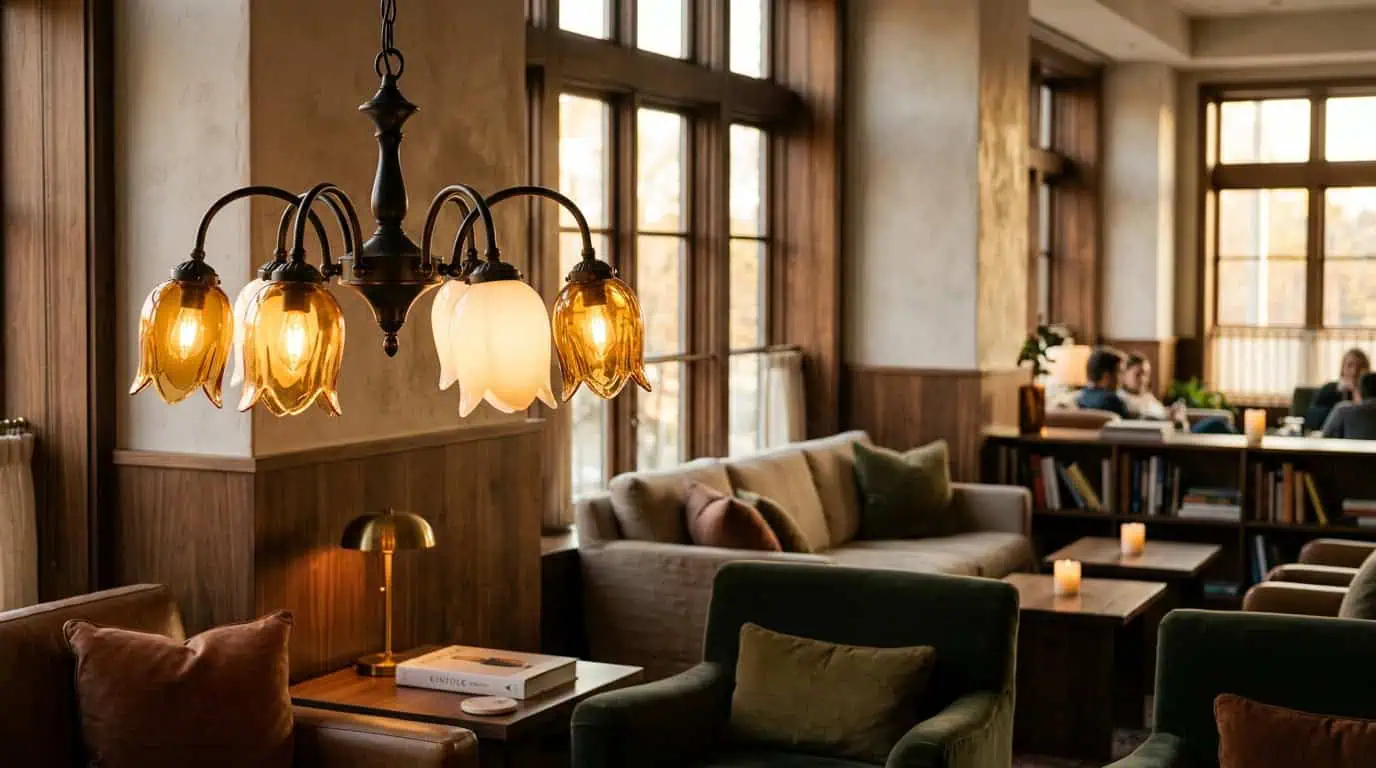
Prepare a tulip shade inquiry that can be reviewed
A reviewable inquiry combines connection data, full profile, finish reference, fixture context, and quantity.
Send a side photo, top view, opening close-up, holder photo, opening and neck dimensions, overall height, maximum diameter, petal rise, orientation, finish, bulb, quantity, destination, and required delivery window. If an old shade exists, state whether it can be sent as a sample.
For a replacement, ask the supplier to confirm the closest existing item first. For a new collection, include the drawing and sample approval plan. JX can review tulip lamp shades against existing flower-profile products or a custom development route. The next useful step is a dimensioned brief, not another unscaled photo.