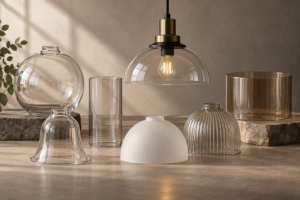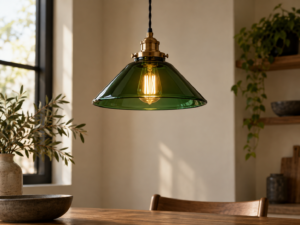
Multiply your lamp base width by 2 to get shade diameter; shade height should equal one-third of the total lamp height (base + harp + shade).
You found the perfect lamp base, but the shade is wrong. Too tall and it looks like a mushroom. Too narrow and the bulb glares straight at you. Getting lampshade proportions right is not guesswork. Lighting designers follow a set of ratios that balance aesthetics, light distribution, and structural stability. This guide walks you through the exact measurements, the tools you need, and the edge cases most online guides skip past.
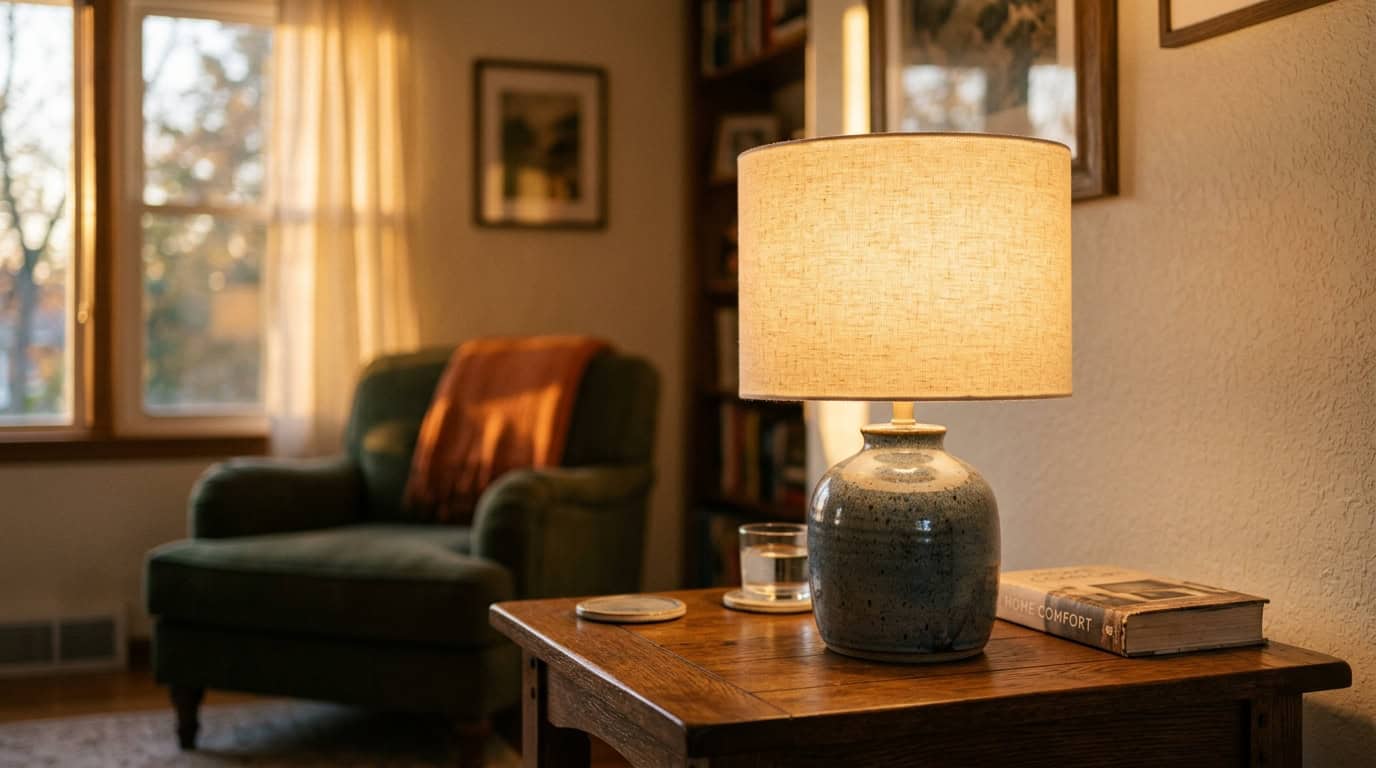
What is lampshade sizing?
Lampshade sizing is the practice of selecting shade dimensions that balance visually with the lamp base and distribute light effectively. It is not about matching any shade to any lamp. It is about understanding the relationship between base width, lamp height, and shade proportions to produce a coherent lighting fixture.
When you walk into a well-designed room, you do not consciously notice lampshade proportions. When they are wrong, though, the entire lamp feels off. A shade that is too wide overwhelms a delicate base. One that is too narrow makes the lamp look top-heavy. The right proportions create visual harmony and functional lighting.
The standard proportion formula
The classic rule for how to size a lampshade for a lamp has been used by interior designers since the mid-20th century:
Width rule: shade bottom diameter = 2 times lamp base width.
Height rule: shade slant height = one-third of total lamp height (base + harp + shade).
Those ratios work because of visual weight distribution. A shade that is twice the base width creates a stable triangular silhouette from the side. The one-third height ratio ensures the shade does not dominate the composition. You read the lamp and shade as a unified object, not a shade on a stick.
These proportions also prevent top-heaviness. Lampshades are lighter than they look, but a shade that is too tall relative to base weight can make the lamp tippy, especially on side tables where people set drinks or bump into things.
How shade dimensions are labeled
Before you can size a lampshade for a lamp, you need to understand how shades are specified. The industry uses a three-number format:
Top diameter x Bottom diameter x Slant height (example: 10″ x 18″ x 12″)
Top diameter is the width across the shade opening at the top. Bottom diameter is the width across the shade opening at the bottom. Slant height is the angled measurement from top edge to bottom edge along the side, not the vertical drop.
Bottom diameters are sold in even numbers: 10″, 12″, 14″, 16″, 18″ and so on. You will not find a 15″ or 17″ shade in standard retail. That convention dates to when shades were made on standardized wire frames.
Slant versus drop is where confusion creeps in. Slant is the length along the shade’s angled side. Drop (or depth) is the straight vertical measurement from top to bottom. For an empire shade at a 45-degree angle, slant will be about 1.4 times the drop measurement.
| Lamp type | Width priority | Height priority | Common fitter |
|---|---|---|---|
| Table lamp | High | Medium | Spider (harp) |
| Buffet lamp | High | Low (wide shade) | Spider |
| Floor lamp | Medium | High (narrow shade) | Spider / UNO |
| Desk lamp | Low (task light) | High (directs light down) | Clip-on |
Types of lamp bases and how they affect shade sizing
Different base shapes require adjusted measurements because visual width does not always match physical width. A square base measures 6 inches per side, but your eye reads it as wider because of the diagonal. Measuring wrong is the fastest way to buy a shade that looks too small.
Round vs. square bases
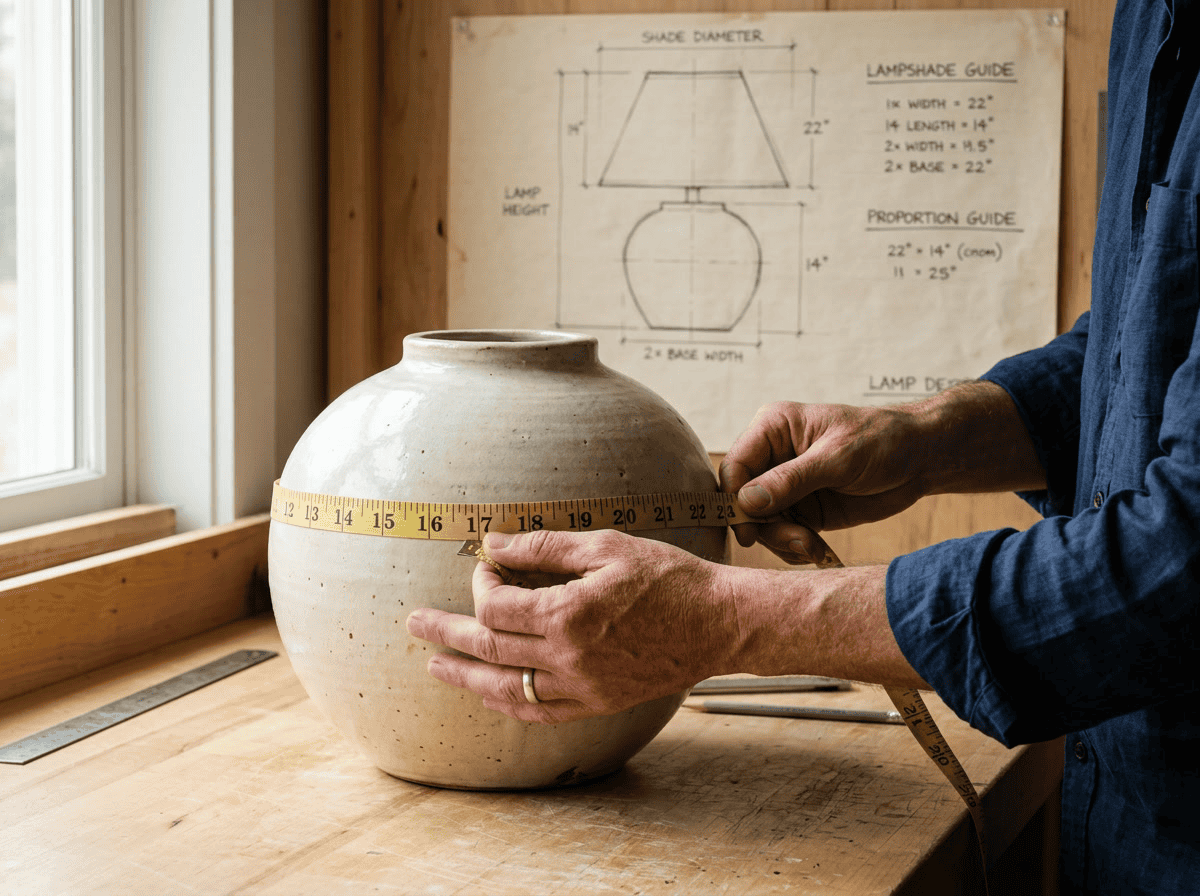
Round bases: measure straight across the widest point with a flexible tape measure. For a cylinder, that is any diameter line. For a sphere or bulbous base, find the equator.
Square bases: measure diagonal corner to corner, not side length. When you look at a square base from a typical viewing angle, you see two faces meeting at a corner. That corner-to-corner distance is the visual width. A 6-inch square base has an 8.5-inch diagonal (6 x 1.414). If you measure the 6-inch side and multiply by 2, you get a 12-inch shade, which will look too narrow because the base reads as 8.5 inches wide to your eye.
Oval bases: measure the longer axis. An oval base that is 8 inches by 5 inches should use the 8-inch measurement for sizing calculations.
Tapered and sculptural bases
Tapered bases, wider at the bottom and narrower at the top, are common in ceramic and glass table lamps. The question is which width to measure.
Measure the widest point, but verify the shade will not look absurd. If your lamp has a 10-inch wide bottom that tapers to a 4-inch neck right below where the shade sits, a 20-inch shade will look ridiculous. In that case, measure the width at the visual center of mass, usually somewhere mid-height on the base.
For sculptural or irregular bases, trust your eye more than the tape. Stand back and ask: where does my eye settle when I look at this base? That is the width to measure. If the base has multiple bulges, measure the one closest to where the shade will sit.
Lamp body height
To size a lampshade for a lamp using the height formula, you need the lamp body height, which excludes the shade, harp, and finial.
Measure: base + body + socket (the threaded part where the bulb screws in).
Do not measure: harp, any existing shade, or finial.
For adjustable harps (the U-shaped wire that supports the shade), measure with the harp set at the mid-position. Harps typically adjust 2 to 3 inches up or down by sliding the saddle, the clips that attach to the socket.
| Base shape | Measure where | Typical ratio | Notes |
|---|---|---|---|
| Cylinder | Diameter at widest | 2:1 (shade:base) | Most forgiving |
| Tapered cone | Widest point (usually bottom) | 2:1 | Avoid shades wider than base bottom |
| Sphere | Diameter | 1.8:1 | Slight reduction prevents overwhelm |
| Sculptural | Visual center of mass | 2:1 starting point, adjust by eye | Trust your eye more than the tape |
Fitter types and compatibility
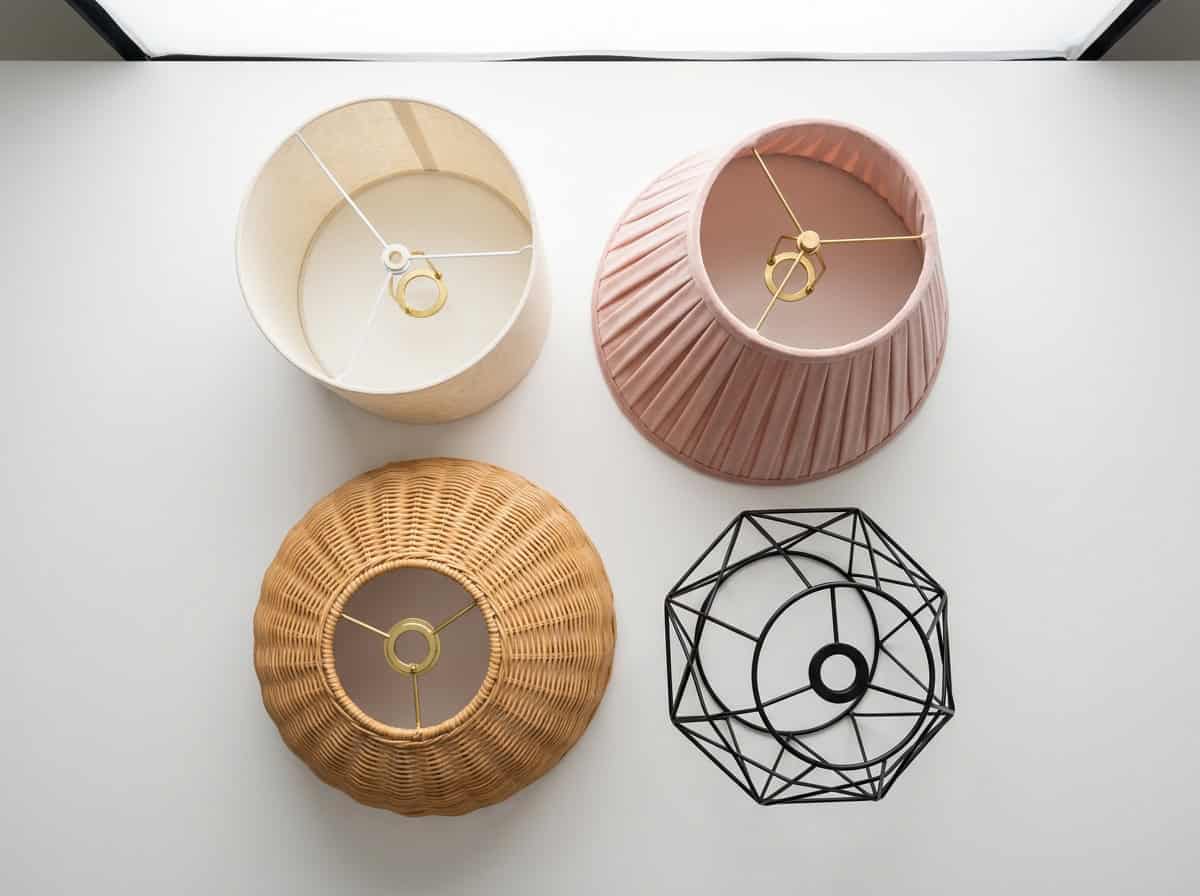
The fitter is the metal frame inside the shade that attaches to the lamp. Choose the wrong fitter type and your perfectly sized shade will not attach at all. This is the step most people skip, and the reason for most shade returns.
Before you measure anything, look at your lamp and identify which fitter type it accepts.
Spider fitter (most common)
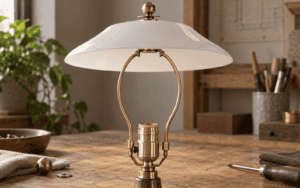
The spider fitter sits on top of a harp, the U-shaped wire bracket that arches over the bulb. The shade rests on the harp’s top loop, and you secure it with a finial that threads through both the shade’s spider and into the lamp socket.
Harps are stamped with their height: 6″, 7″, 8″, 9″, or 10″. Measure from the saddle to the top loop. If your shade sits too low (covering too much of the bulb) or too high (exposing the socket), swap the harp. They cost $3 to $8 and clip on and off without tools.
When to use: any lamp with a visible harp. About 70% of table lamps sold in the US take spider fitters.
UNO fitter
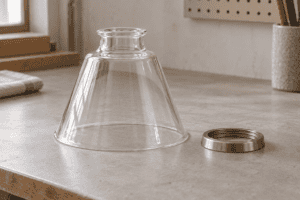
The UNO fitter attaches directly to the bulb socket threads. There is no harp. The shade has a threaded ring inside that screws onto the socket, and then the bulb screws into the ring. Tighten the bulb to lock the shade in place.
The advantage is a lower profile. The shade sits closer to the base, giving the lamp a more streamlined modern look. You also get rid of the harp, which some people find visually cluttered.
The limitation: shade height is fixed by socket position. With a spider fitter you can adjust the harp to raise or lower the shade 2 to 3 inches. With UNO, whatever height you buy is where it stays. UNO fitters are common on European-style lamps and most modern floor lamps.
Clip-on fitter
Clip-on fitters use spring clips that attach directly to the light bulb, not the socket. These are used almost exclusively on small chandelier shades, candelabra lamps, and accent lamps where the shade needs to sit very close to the light source.
Clip-on shades max out around 6 inches in bottom diameter. Larger shades generate too much heat near a bulb. Most clip-on shades are 3 to 5 inches.
Safety note: only use clip-on shades with LED or CFL bulbs rated at 60W equivalent or less. Incandescent bulbs get hot enough to scorch fabric and paper shades at that distance.
| Fitter type | Requires harp | Adjustable height | Best for | Shade size range |
|---|---|---|---|---|
| Spider | Yes | Yes (harp swap) | Table lamps, buffet lamps | 8″ to 22″ bottom |
| UNO | No | No | Floor lamps, modern table lamps | 10″ to 20″ bottom |
| Clip-on | No | No | Chandeliers, mini lamps | 3″ to 6″ bottom |
How to measure and calculate your lampshade size
Here is the exact workflow lighting professionals use to spec a replacement shade. Follow this sequence and you will get it right on the first try.
Tools you need
A flexible tape measure, fabric or soft plastic, not a rigid metal carpenter’s tape that will not curve around bases. A notepad for three measurements: base width, lamp body height, harp height. A digital caliper is optional and only necessary for custom or vintage lamps where you need precision to within 1/16″.
Measurement sequence
Measure in this order. Do not skip around.
Step 1: Base width. Place the lamp on a flat surface. Measure at the widest point. For round bases, straight across the diameter. For square bases, corner to corner. For oval, measure the long axis. For sculptural bases, measure where your eye settles, usually the visual center of mass.
Write it down. Say you get 9 inches.
Step 2: Lamp body height. Measure from the bottom of the base to the top of the socket, the threaded brass or nickel cylinder where the bulb screws in. Do not include the harp, the finial, or any existing shade. If there is a shade on the lamp now, take it off first.
Say you get 14 inches.
Step 3: Harp height. Measure from the harp saddle up to the top loop where the finial goes through. If your lamp uses a UNO fitter and has no harp, skip this and note “UNO.”
Say you get 8 inches.
Step 4: Existing shade dimensions (if replacing). If you suspect the old shade was the wrong size, measure it anyway in Top x Bottom x Slant format. This gives you a reference point. If the old shade was 10 x 16 x 11 and you calculate you need 10 x 18 x 8, you now know the old shade was too tall and too narrow.
The calculation
Shade bottom diameter = base width x 2. Example: 9″ base x 2 = 18″ bottom.
Total lamp height = body height + harp height. Example: 14″ body + 8″ harp = 22″ total.
Shade slant height = total lamp height / 3. Example: 22 / 3 = 7.3″. Round to the nearest even number: 8″ slant.
Top diameter for empire shades is usually 50 to 60% of the bottom. For an 18″ bottom, estimate a 10″ top.
Final shade spec: 10″ x 18″ x 8″.
That is the size you search for when shopping. If you cannot find that exact size, go within one increment (plus or minus 2 inches on bottom, plus or minus 1 inch on slant). A 10 x 16 x 8 or 10 x 18 x 9 will both work. The formula gives you the center of the acceptable range.
A real-world example
You inherited a ceramic table lamp with a round base and the shade is long gone.
Base width: 9-inch diameter cylinder. Body height: 14 inches from bottom to socket top. Harp: 8 inches (stamped on the harp). Fitter type: spider (harp is present).
Calculation: shade bottom target is 9 x 2 = 18 inches. Total height is 14 + 8 = 22 inches. Shade slant target is 22 / 3 = 7.3 inches, round to 8 inches.
Final spec: 10 x 18 x 8, assuming empire shape with a 10-inch top for a pleasing taper.
You search “10 18 8 empire shade spider fitter” and find half a dozen options. You pick one. It arrives, you clip it onto the harp, screw on the finial. It fits.
Shade shape selection and proportions
Empire, drum, and coolie shades can have identical Top x Bottom x Slant measurements but completely different visual weight. Shape matters as much as size when you are learning how to size a lampshade for a lamp.
Empire (tapered) shades
The empire shape is the classic tapered silhouette: smaller top, wider bottom, gentle curve or straight angled sides. If you picture a “lampshade” in your head, it is probably an empire.
Empire shades suit traditional and transitional interiors, table lamps, anywhere you want a lighter visual feel. Because of the taper, they appear lighter. The narrower top allows more light to escape upward, brightening ceilings and creating ambient glow. The wider bottom directs light downward for task lighting.
Top diameter is usually 50 to 60% of the bottom. For an 18-inch bottom, expect a 9 to 11-inch top.
The 2:1 formula was originally developed with empire shades in mind. They work at exactly twice the base width without adjustment.
Drum (straight) shades
Drum shades have the same diameter top and bottom. Bold, architectural, modern. They suit contemporary interiors, mid-century modern decor, floor lamps, anywhere you want a strong geometric statement.
Drum shades have more visual weight than empire shades at the same bottom diameter. The straight sides create a bolder silhouette. Because the top is not tapered, less light escapes upward and more gets directed down and out the sides, making drum shades better for reading lamps and task lighting.
Because drums feel heavier, you can go 10% narrower than the standard formula and still look balanced. For a 10-inch base, an empire shade would be 20 inches bottom; a drum can be 18 inches and still feel proportional.
Coolie (inverted cone) shades
Coolie shades, also called pagoda or Chinese hat shades, have a larger top than bottom. They are shaped like an inverted cone or a wide-brimmed hat.
These shades direct almost all light downward. Maybe 10% escapes out the small bottom opening; the rest reflects off the interior and beams down. They can look top-heavy on narrow bases. Use them only when the base width is at least 60% of the shade bottom.
Coolie shades work best as pendant shades (hanging from a ceiling) or on very wide, stable bases. On a typical narrow table lamp, they will look awkward.
| Shape | Light direction | Visual weight | Recommended base style |
|---|---|---|---|
| Empire | 40% up, 60% down | Light | Any |
| Drum | 20% up, 80% down | Heavy | Substantial or wide bases |
| Coolie | 10% up, 90% down | Very heavy | Only on pedestal or wide bases |
Common lampshade sizing mistakes
Even if you measure correctly and follow the formula, five errors can make a shade look wrong. Here is how to catch them before you buy.
Ignoring harp height
You calculate the perfect shade size. You order it. It arrives and sits way too low, covering half the base, or way too high, exposing the socket and wiring.
The error: your lamp has a 6-inch harp but the shade needs a 9-inch harp to sit at the right height.
Harps are not one-size-fits-all. The formula assumes you are using the correct harp height. If the shade sits wrong, do not return the shade. Swap the harp. They are $3 to $8, clip on without tools, and come in 1-inch increments from 6 to 10 inches.
Visual test: when the shade is mounted, the bottom edge should sit 1 to 2 inches above the lamp’s widest point. It should not touch the base. If it does, you need a taller harp.
Shade too tall (bulb hidden, light trapped)
The lamp looks like a mushroom. It casts dim, trapped light. You cannot see the socket even when you duck down to look.
This usually happens when you apply the one-third height formula to a lamp base that is unusually short (under 10 inches tall). On short lamps, a one-third-height shade will overwhelm the base.
Fix: reduce the shade slant to 25% of total height instead of 33%. For a 10-inch total-height lamp, that is a 2.5-inch slant instead of 3.3 inches. A subtle shift, but enough to restore proportion.
Shade bottom narrower than the base at its widest
The lamp looks top-heavy, like it might tip. You measure the lamp base at the bottom, but the base flares wider at mid-height. Or you measure a decorative element (such as a pedestal foot) instead of the actual body.
The rule: shade bottom diameter must always be equal to or wider than the lamp base’s widest point. If your base is 10 inches at its widest, a 9-inch shade will look wrong even if your calculation said 9 inches. Go up to 12 inches and check the visual balance.
Wrong fitter type
You order a beautiful shade. It arrives. You try to mount it. It does not fit.
The error: you bought a UNO fitter shade for a lamp with a harp (or vice versa). A UNO shade has a threaded ring that screws onto the socket. A spider shade has a wire frame that sits on the harp. They are not interchangeable.
Prevention: check fitter type before you measure anything else. Do you see a U-shaped wire arching over the bulb? That is a harp; you need a spider fitter. No harp, and the shade screws directly to the socket? That is UNO.
Forgetting bulb visibility
When you sit or stand at normal viewing height for that lamp, you should not see the bare bulb or socket. Light should come from the shade, not a visible bulb.
Test before buying: hold a piece of cardboard at the height where the shade’s bottom edge will sit. Sit in your chair or stand at your usual position. Can you see the socket? If yes, the shade needs to be taller or the harp needs to be shorter.
This is especially common with floor lamps viewed from a seated position. A shade that looks fine from standing height might expose the bulb when you sit on the couch.
Floor lamps, pendants, and special cases
The 2:1 width and one-third height rules were developed for table lamps. Floor lamps, pendants, and lamps without harps work differently.
Floor lamp sizing
Floor lamps are viewed from below. You are sitting on the couch; the lamp is 5 to 6 feet tall. The bottom of the shade is at or above eye level. This changes the formula.
For width: shade bottom = 1.5 to 1.75 times base width, not 2 times. A too-wide shade blocks your face and torso when you walk past the lamp. It also creates a mushroom-top effect when viewed from below. A narrower profile feels more elegant.
For height: shade slant = 40 to 50% of visible lamp body, not 33%. Floor lamps often have long narrow poles. A short shade on a 5-foot pole looks stubby. Many floor lamps use 12 to 14-inch slant heights, which would be absurdly tall on a table lamp.
Drum shades are more common than empire on floor lamps. The straight sides feel more architectural.
Pendant and chandelier shades
When a shade hangs from the ceiling, there is no base width to measure.
For width: use the fixture’s canopy diameter, or if the chandelier has multiple arms, measure the visual width of the cluster. For a shade hanging over a dining table, the shade should be 50 to 75% of the table diameter.
For fitter type: pendants use clip-on fitters exclusively. There is no harp when the fixture hangs from above.
For height: forget the formula. Pendant shade height is driven by clearance and visual proportion. The bottom of the shade should be at least 30 inches above the table surface. Keep the shade at least 2 inches away from the bulb in all directions; heat buildup is real even with LEDs.
Lamps without harps (UNO fitter lamps)
If your lamp uses a UNO fitter and has no harp, you cannot adjust shade height by swapping harps. The socket position is fixed.
Measuring: base to socket top = X. Formula: shade slant = X divided by 2.5 (slightly taller than the one-third rule for harp lamps).
Why taller? UNO shades sit lower on the lamp body (no harp height), so you need a taller shade to fill the same visual space.
| Lamp type | Width multiplier | Height formula | Notes |
|---|---|---|---|
| Standard table | 2x base | 1/3 total height | Classic rule |
| Floor lamp | 1.5 to 1.75x base | 40 to 50% of body | Viewed from below |
| Pendant (task) | 0.5x table width | Visual only | Clearance is the priority |
| Chandelier | 0.75x canopy | Visual only | Heat and proportion |
Lampshade sizing trends in 2026 and beyond
LED adoption and evolving interior design preferences are changing how people size lampshades. The formulas still work, but the aesthetics are shifting.
Oversized drum shades
Walk into a design showroom in 2026 and you will see table lamps with drum shades that are 2.5 times the base width, dramatically wider than the classic 2:1 rule. This look took off in 2024 and is now mainstream.
Why it works now: LED bulbs produce almost no heat. In the incandescent era, a massively oversized shade trapped heat and posed a fire risk. LEDs changed that. You can go as wide as you want without safety concerns. According to interior trend data from Architectural Digest’s 2026 home report, statement lighting has become the single most impactful decor change in residential spaces, outpacing furniture and wall color updates.
The caveat: this only works on substantial bases. A 6-inch skinny base with a 20-inch drum looks ridiculous. You need at least a 10-inch base with visual weight (ceramic, concrete, brass) to pull it off credibly.
Smart lamps and non-standard proportions
Smart bulbs from Philips Hue, LIFX, and others have created a new challenge: many smart lamps have no harp, no standard socket, or proprietary bases that do not accept traditional shades.
Workaround one: UNO fitter adapters. Some manufacturers sell adapters that let you mount a UNO shade on non-standard sockets.
Workaround two: skip the shade entirely. Use a decorative Edison-style LED bulb with visible filaments in a cage or open-frame lamp. The bulb becomes the design element.
By 2026, roughly 40% of table lamps sold in the US are shade-free or include a built-in shade that is not replaceable.
| Trend | 2023 adoption | 2026 forecast | Driver |
|---|---|---|---|
| Oversized drum shades | 18% | 35% | LED heat reduction, maximalist interiors |
| UNO fitter lamps | 22% | 40% | Modern and European design influence |
| Shade-free decorative bulbs | 31% | 55% | Smart home integration, vintage aesthetic |
FAQ
How big is a 20cm lampshade?
20cm equals about 7.87 inches, typically rounded to an 8-inch shade in US sizing. In the Top x Bottom x Slant format, a “20cm lampshade” usually refers to the bottom diameter. European sizing often uses centimeters while US retailers use inches, so always verify which measurement system the seller is using before ordering.
How do you know what size light shade to buy?
Measure your lamp base width and multiply by 2 to get the shade bottom diameter. Then measure total lamp height (base plus harp) and divide by 3 for shade slant height. Confirm the fitter type (spider, UNO, or clip) matches your lamp before ordering. If you are replacing an existing shade, measure it first to see if it followed the formula. Many lamps ship from the factory with incorrectly sized shades.
What size lamp shade do I need for a 36-inch lamp?
For a 36-inch total lamp height, target a 12-inch slant height shade (36 / 3). Bottom diameter depends on base width. If the base is 8 inches wide, use a 16-inch bottom diameter shade (8 x 2). If the base is 10 inches wide, go with an 18 to 20-inch bottom.
How to tell if a lampshade is too big?
A shade is too big if the bottom diameter is wider than the lamp’s widest point and the base becomes invisible from the side; if the shade nearly touches the table surface; or if the lamp feels top-heavy and looks like it might tip when you bump the table. A properly sized shade should reveal 1 to 2 inches of the lamp body below the shade’s bottom edge.
Can I use a lampshade that is slightly smaller than the formula suggests?
Yes. Going 10 to 15% smaller is fine and can look intentional, especially on lamps with very wide bases where the full 2x formula would create an oversized look. A 10-inch base could take an 18-inch shade instead of 20 inches. Going larger than the formula is riskier because it creates top-heaviness and can make the base disappear.
Do I measure lamp height with or without the shade?
Without. Measure only the lamp base plus body plus harp, excluding any existing shade and finial. The formula uses this bare lamp height to calculate what shade height to add. If you include the current shade in your measurement, you will end up with a shade that is too tall.
What if my lamp base is an irregular shape?
Measure the widest point your eye naturally focuses on, usually the visual center of mass, not necessarily the absolute bottom. For multi-tiered bases, measure the tier closest to where the shade will sit. When in doubt, go slightly narrower (1.8 times instead of 2 times) and verify proportions visually before buying.
How does shade shape (empire vs. drum) affect sizing?
Empire shades appear lighter and can follow the 2x base width rule exactly. Drum shades have more visual weight; you can reduce the bottom diameter by 10% (1.8x base width instead of 2x) to avoid a heavy look, especially on narrow bases. Coolie shades should only be used on bases where the base width is at least 60% of the shade bottom to prevent top-heavy appearance.
Getting lampshade proportions right without second-guessing every purchase
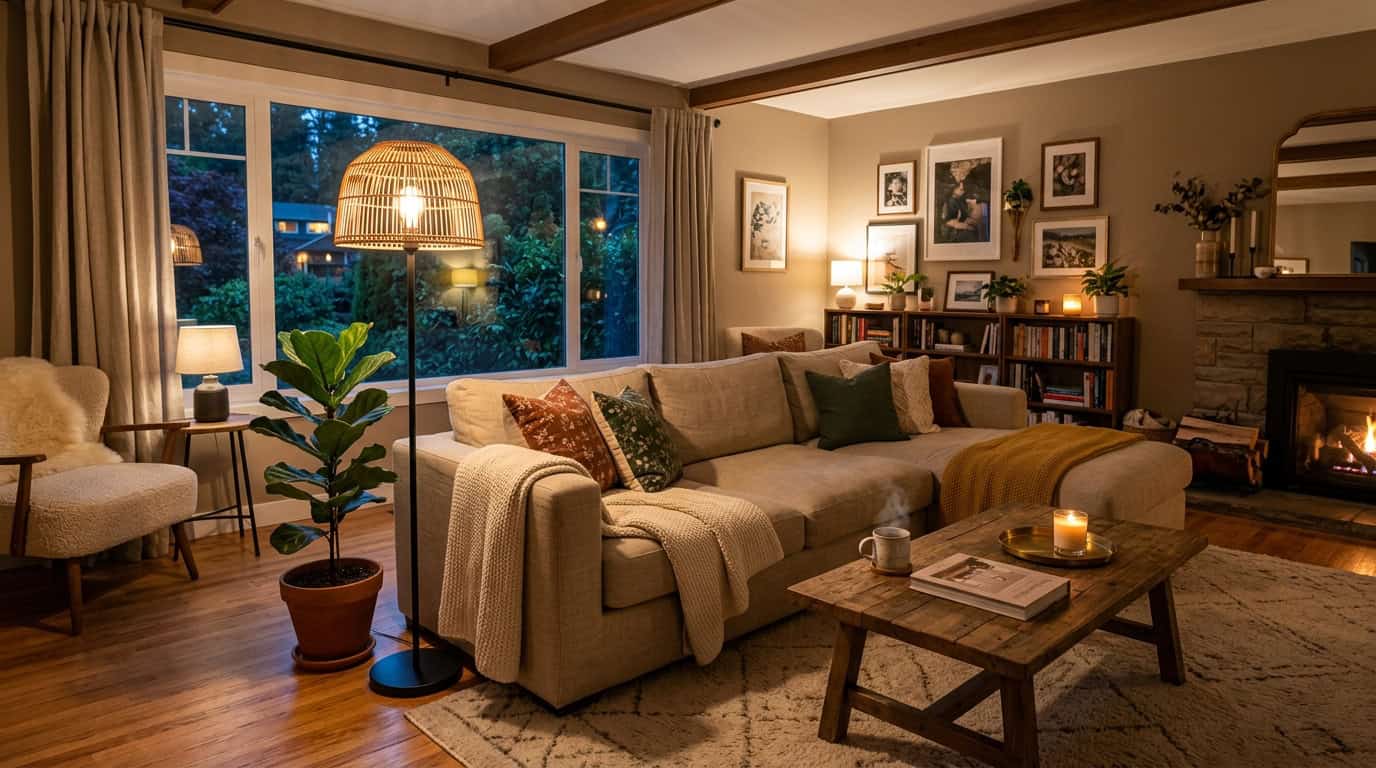
The 2:1 width ratio and one-third height formula cover about 80% of table lamps. The real skill is knowing when to adjust. Floor lamps need narrower shades to avoid blocking sightlines. Oversized bases can take bolder, wider shades if your room scale supports it. Pendants ignore the formulas entirely and size to the table or space they illuminate.
Before you buy, do the cardboard test: cut a rough shape at your calculated dimensions and hold it up to the lamp. If the bulb peeks out or the base disappears, adjust. If you are replacing a shade on a lamp that has always felt off, this is your chance to fix proportion issues the original designer missed. The measurements take three minutes. Getting the right shade on the first order saves you the return shipping.
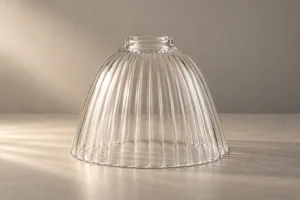
For glass and custom decorative shades, browse the glass lampshade collection at jxlampshade.com where product pages list full three-measurement specs, fitting type, and compatible lamp base styles so you can confirm fit before ordering.