
Types of Lamps & Lighting: The Complete Names List (100+ Types with Pictures)
A complete, categorised list of more than 100 types of lamps and light fixtures — by placement, by style and era, by light source, and by shade — each named, pictured and briefly explained. Use it as a quick reference whether you are specifying lighting for a project, sourcing as a buyer, or simply learning the names.
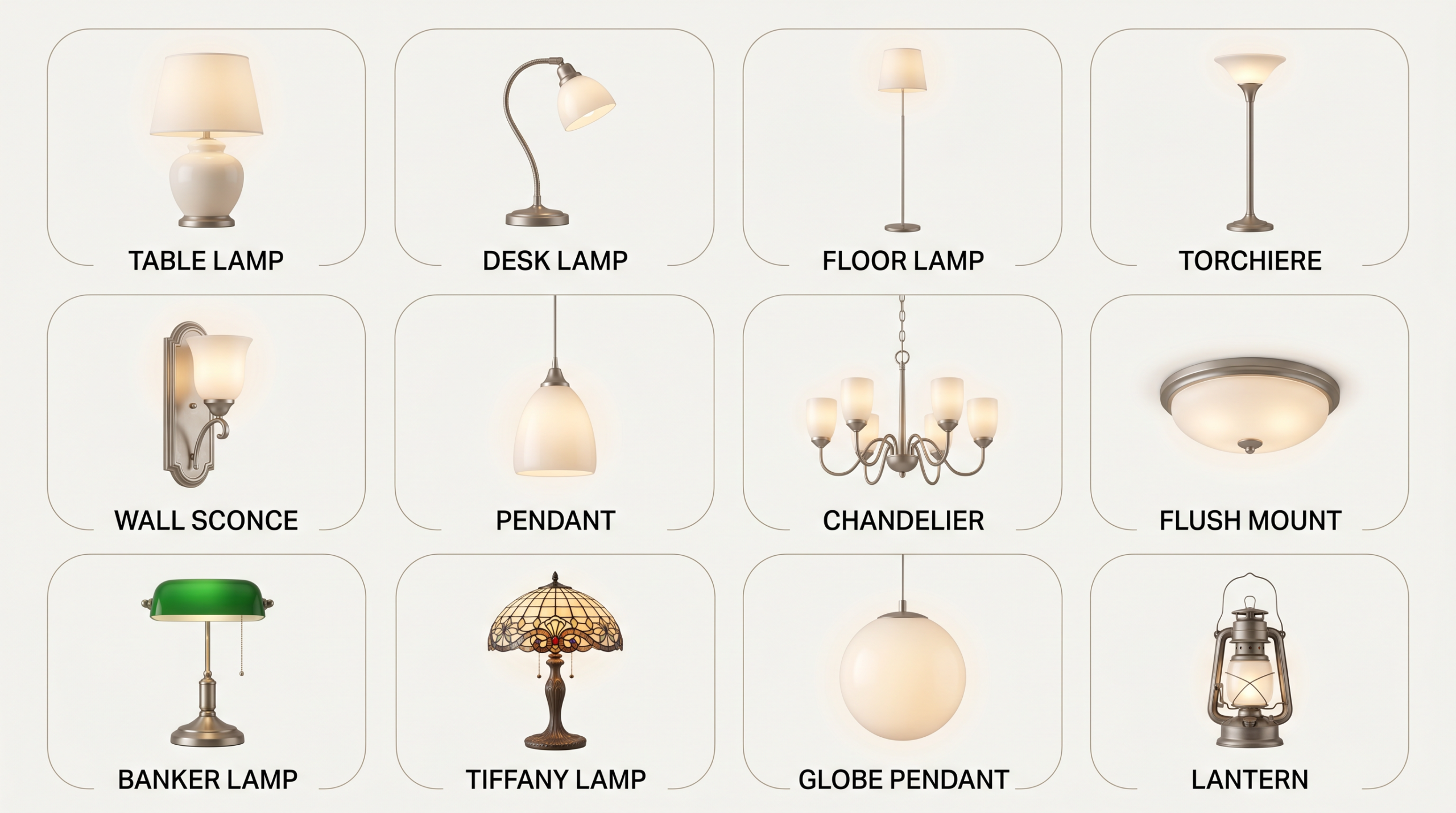
- Lamps and light fixtures are grouped four ways: by placement, style/era, light source and shade.
- The five core placements are table, desk, floor, wall (sconce) and ceiling (pendant, chandelier, flush mount).
- LED is the default light source today — 15,000–50,000 hours of life and any colour temperature (2700K warm to 4000K cool).
- A table-lamp shade should be about one-third of the lamp height; a dining pendant hangs 30–34 in (75–85 cm) above the table.
- Glass shades come in opal, clear, coloured and borosilicate, in any of the 12 standard lampshade shapes.
Types of lamps by lighting function
Before the names, it helps to know the job a lamp does. A good lighting plan layers three or four functions, and many lamp types can serve more than one.
| Function | What it does | Typical lamp types |
|---|---|---|
| Ambient (general) | Fills a room with an even base level of light. | Ceiling pendant, flush mount, chandelier, torchiere |
| Task | Focused light for reading, cooking, writing or detailed work. | Desk lamp, gooseneck, swing-arm, cone pendant |
| Accent | Highlights artwork, objects or architectural features. | Picture light, track light, spotlight, wall sconce |
| Decorative / mood | The fixture itself is the feature; the light is soft. | Tiffany lamp, salt lamp, lantern, novelty lamp |
Types of lamps by placement and type
The most common way to name a lamp is by where it lives and how it mounts. This covers table, desk, floor, wall and ceiling lighting.
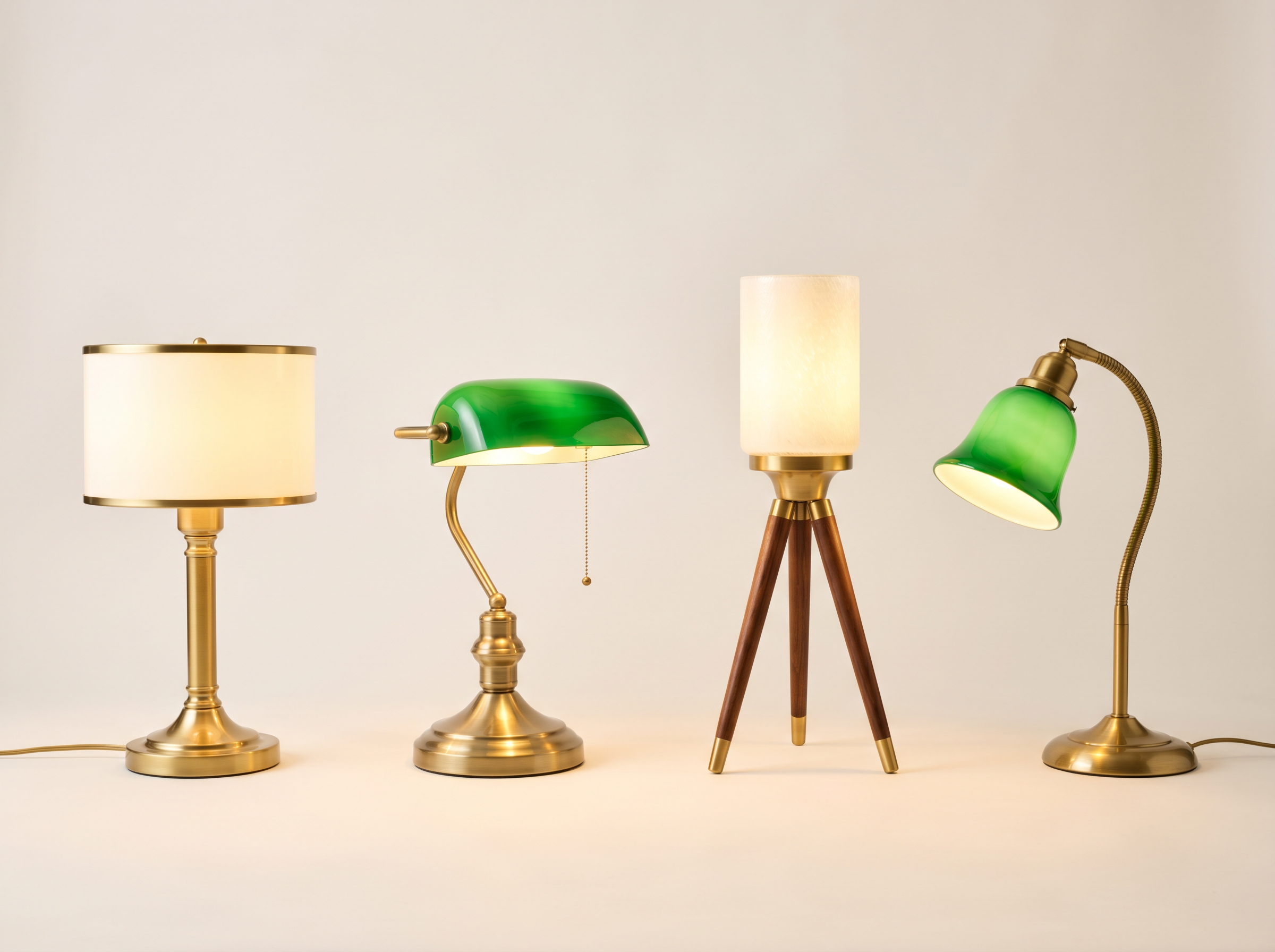
Table lamps
- Table lamp — the everyday lamp for side tables and consoles, with a base and a shade.
- Buffet lamp — tall and slim, designed for narrow surfaces like sideboards and buffets.
- Banker’s lamp — a desk classic with a brass base and a green glass shade. More on the banker’s lamp.
- Piano lamp — a low, wide-shaded lamp that throws light down onto sheet music or a desk.
- Accent lamp — a small decorative lamp used for mood rather than task light.
- Bedside / nightstand lamp — a compact lamp sized for a bedside table.
- Tripod table lamp — a lamp on three splayed legs for a modern, sculptural look.
- Arched table lamp — a curved-stem lamp that reaches light out over a surface.
- Gourd lamp — named for its rounded, double-bulge ceramic or glass base.
- Column lamp — a tall, straight-sided base resembling a column or pillar.
- Candlestick lamp — a slender candlestick-style base, often used in pairs.
- Novelty lamp — a shaped, decorative lamp valued for its form as much as its light.
Desk lamps
- Desk lamp — a task lamp sized for a work surface.
- Gooseneck lamp — a flexible neck that bends the light exactly where you need it.
- Swing-arm desk lamp — a jointed arm that extends and folds away.
- Architect lamp — a sprung, balanced-arm task lamp built for detailed work.
- Magnifying lamp — a task lamp with a built-in magnifier lens for fine work.
- Clip-on lamp — clamps to a shelf, headboard or desk edge to save space.
- LED task lamp — a slim, energy-efficient desk lamp with adjustable brightness.
- Banker’s desk lamp — the traditional green-glass-shaded version for an office desk.
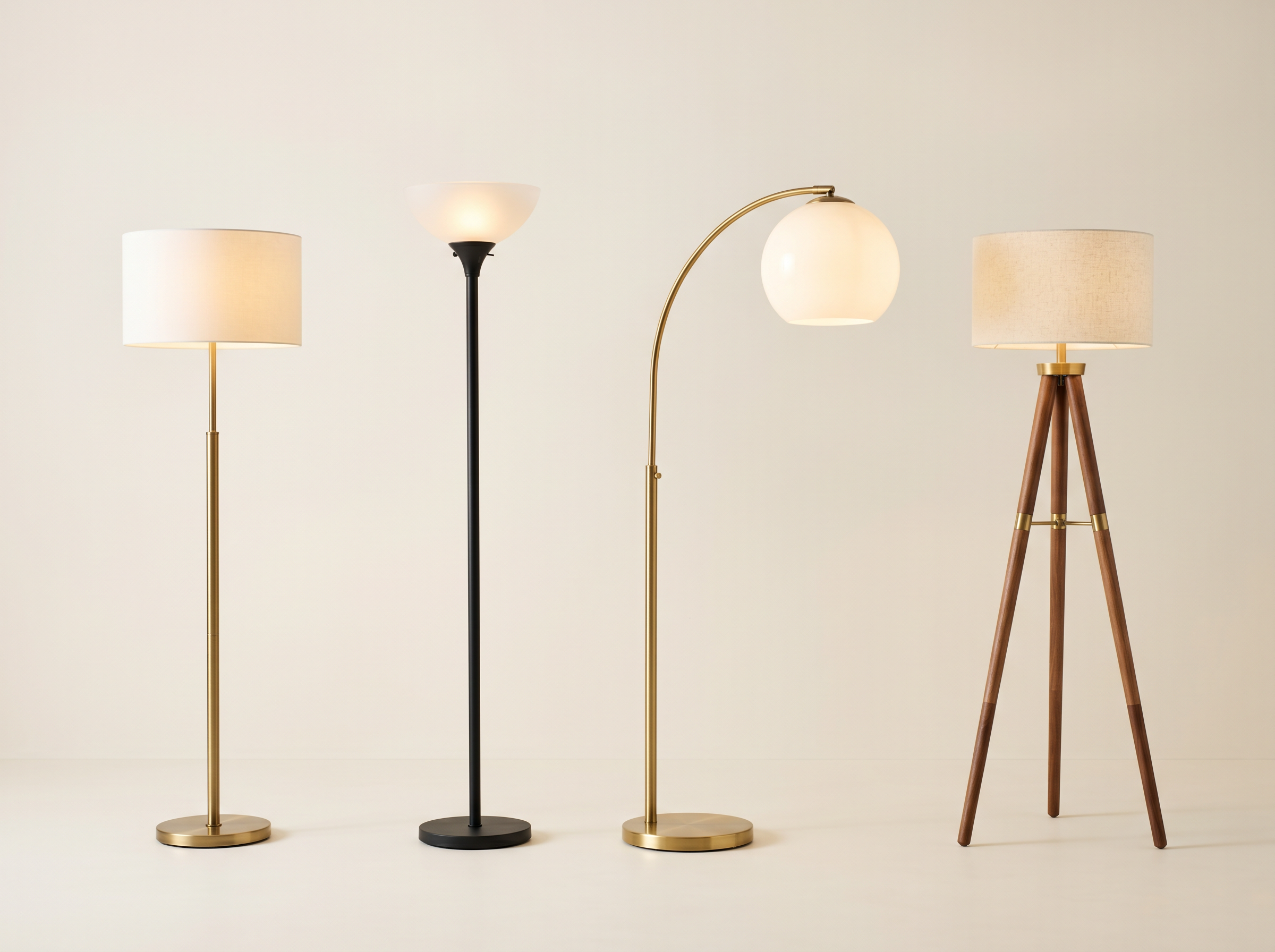
Floor lamps
- Floor lamp — a free-standing lamp on a tall pole, no surface needed.
- Torchiere — an uplighter with an upward-facing shade that washes the ceiling.
- Arc floor lamp — a long curved arm that arches light over a sofa or table.
- Tripod floor lamp — a sturdy three-legged base for a contemporary look.
- Tree / multi-head floor lamp — one base branching into several adjustable lights.
- Column floor lamp — a tall, sculptural column that glows along its length.
- Swing-arm floor lamp — an adjustable arm for reading beside a chair.
- Club / reading floor lamp — a classic straight lamp positioned for reading.
- Candelabra floor lamp — a chandelier-style cluster of lights on a floor stand.
- Down-bridge lamp — an arm that angles the light downward for tasks.
- Task floor lamp — a directional floor lamp for focused light.
- Drum-shade floor lamp — a floor lamp finished with a wide drum shade.
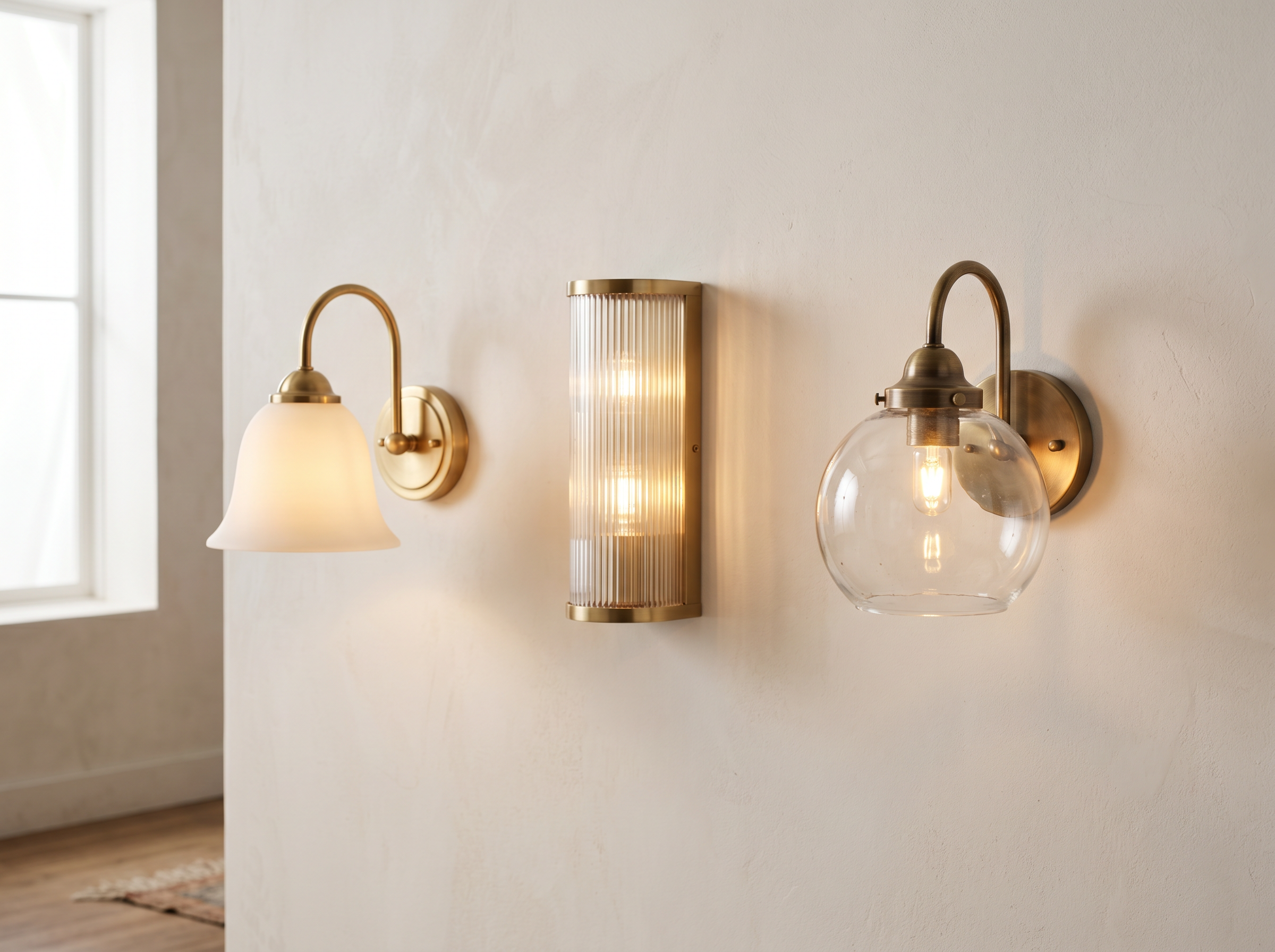
Wall lights & sconces
- Wall sconce — a wall-mounted fixture for ambient or accent light.
- Swing-arm wall lamp — an extendable wall arm, popular beside beds.
- Picture light — a slim light that illuminates artwork or photographs.
- Plug-in sconce — a wall light with a cord, no hardwiring required.
- Hardwired sconce — a permanently wired wall fixture.
- Half-moon wall light — a half-shade that casts light up and down the wall.
- Up/down wall light — a sconce that throws light in both directions.
- Vanity light — a bar of lights mounted above a bathroom mirror.
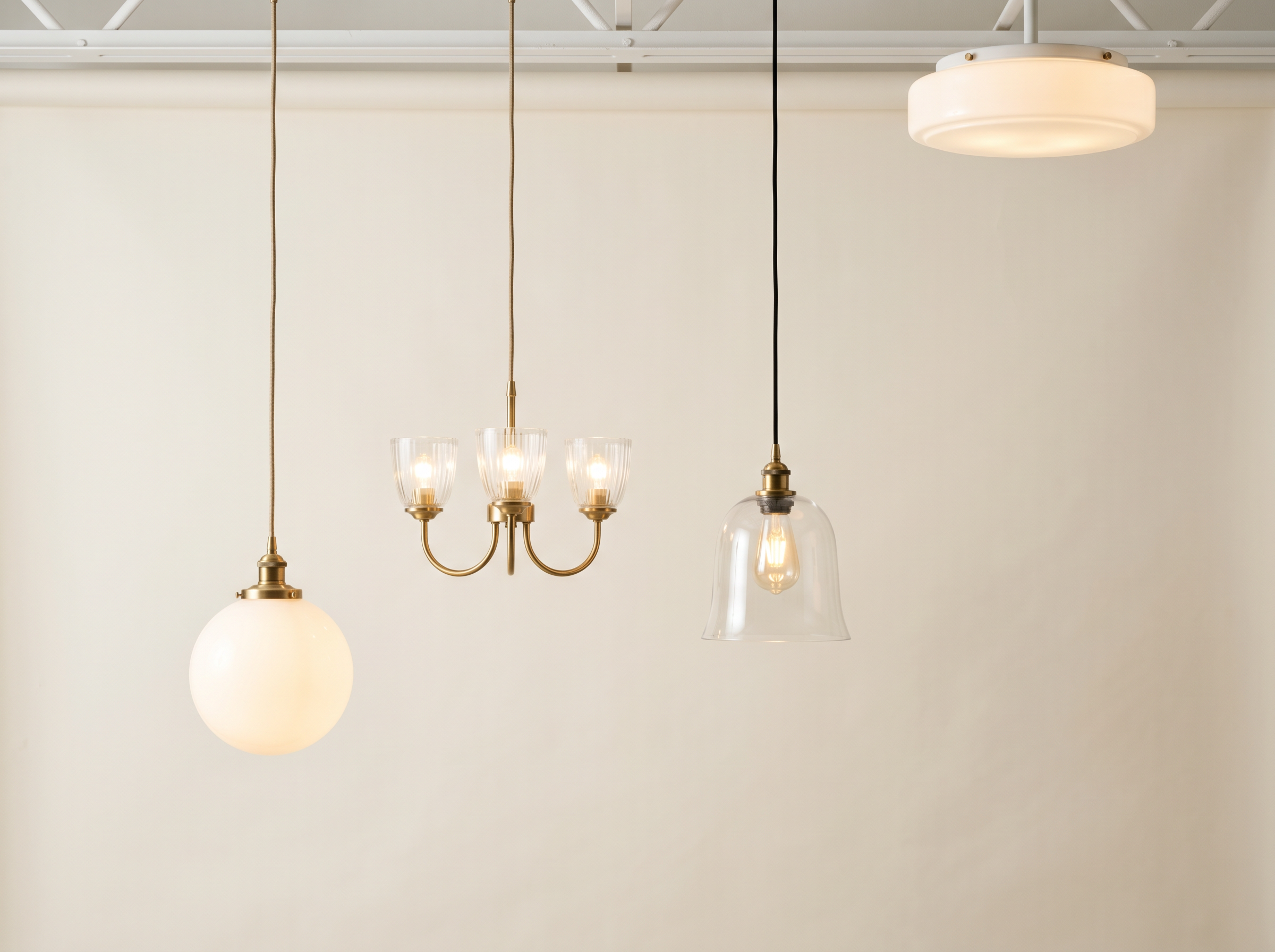
Ceiling & hanging lights
- Pendant light — a single fixture hung from the ceiling by a cord or rod. More on pendant lights.
- Mini pendant — a small pendant, often used in rows over a counter.
- Multi-light pendant — several pendants hung from one ceiling plate.
- Globe pendant — a spherical opal-glass pendant with an even glow.
- Bell pendant — a flared bell-shaped glass pendant.
- Drum pendant — a wide cylindrical shade suspended from the ceiling.
- Chandelier — a branched, decorative fixture with multiple lights. More on chandeliers.
- Candle chandelier — a chandelier styled with candle-shaped lights.
- Flush mount — a fixture fitted tight to the ceiling for low rooms.
- Semi-flush mount — hangs slightly below the ceiling on a short stem.
- Recessed light — a downlight set into the ceiling, also called a can light.
- Track light — adjustable heads mounted along a powered track.
- Linear / island light — a long suspended fixture for kitchen islands and tables.
- Lantern pendant — a framed, lantern-shaped hanging light.
- Schoolhouse pendant — a rounded opal glass shade on a fitter neck.
- Cluster pendant — many small pendants grouped at varied heights.
- Cage pendant — an exposed-bulb fixture inside a metal cage.
- Inverted dome pendant — a bowl-shaped shade facing upward or down for diffuse light.
Types of lamps by style and era
Lamps are also named for their design language. These styles carry strong visual associations and help match a fixture to an interior.
- Tiffany lamp — a stained-glass shade in the Art Nouveau tradition. More on Tiffany lamps.
- Banker’s lamp — green glass shade and brass base, the library classic.
- Art Deco lamp — bold geometry, stepped forms and frosted glass. More on Art Deco.
- Art Nouveau lamp — flowing, organic, floral forms in glass and metal.
- Industrial lamp — exposed metal, cages and clear glass shades.
- Mid-century modern lamp — clean lines, tapered shades, warm woods.
- Farmhouse lamp — rustic finishes with opal or schoolhouse glass.
- Traditional lamp — classic shapes, fabric or empire shades.
- Contemporary lamp — minimal, sculptural and current.
- Rustic lamp — natural materials and a handmade feel.
- Coastal lamp — light, airy forms with glass and rope details.
- Hollywood Regency lamp — glamorous, polished metal and crystal.
- Scandinavian lamp — pale, simple and functional.
- Vintage / antique lamp — original or reproduction period pieces.
- Oil lamp — a fuel-burning lamp with a glass chimney. More on oil lamps.
- Hurricane lamp — a candle or oil flame protected by a tall glass chimney.
- Lava lamp — a novelty lamp with rising coloured wax.
- Neon lamp — bright gas-discharge tubing bent into shapes or signs.
- Moroccan lamp — pierced metal and coloured glass casting patterns.
- Paper lantern lamp — a soft, diffused rice-paper or fabric globe.
- Edison-bulb lamp — a fixture built around a decorative filament bulb.
- Salt lamp — a carved mineral lamp giving a warm amber glow.
- Lantern lamp — a portable, framed light with a protective glass enclosure.
- Candle lamp — a small clip-shaded lamp styled like a candle.
Types of lamps by light source
“Lamp” also means the bulb itself. These are the light-source technologies you will see specified for fixtures.
- Incandescent — a heated tungsten filament gives a warm glow; low efficiency, short life. More on incandescent bulbs.
- Halogen — a brighter, longer-lasting incandescent variant with halogen gas.
- Fluorescent — gas-discharge tubes giving cool, efficient general light.
- CFL — a compact fluorescent that fits a standard socket.
- LED — efficient, long-life semiconductor lighting in any colour temperature. More on LED lamps.
- Smart LED — an app- or voice-controlled, dimmable colour LED.
- Filament / Edison LED — an LED that mimics a vintage filament bulb.
- Xenon — a bright, daylight-like arc lamp for projection and accent use.
- HID (high-intensity discharge) — powerful lamps for large or outdoor spaces.
- Neon / cold-cathode — gas tubes for signage and decorative light.
- UV / blacklight — ultraviolet lamps for effects and inspection.
- Infrared / heat lamp — emits warmth as much as light.
The table below compares the most common light sources by efficiency, lifespan and typical use.
| Light source | Efficiency | Lifespan | Light & colour | Best for |
|---|---|---|---|---|
| Incandescent | Low (~10%) | ~1,000 hrs | Warm, yellow | Decorative, dimmable warmth |
| Halogen | Low–medium | 2,000–4,000 hrs | Bright, crisp white | Accent and task light |
| Fluorescent / CFL | Medium–high | 8,000–15,000 hrs | Cool white | General & commercial |
| LED | Very high | 15,000–50,000 hrs | Any colour temperature | Almost every fixture |
| Smart LED | Very high | 15,000–50,000 hrs | Tunable / colour | Mood & home automation |
Lamp shade types (and the glass we make)
A lamp is only as good as its shade. Shades are named by material and by shape. As a glass lampshade manufacturer, we produce the glass types below in every shape — see the full lampshade shapes glossary for the silhouettes.
- Glass shade — durable, easy to clean, available clear or diffusing.
- Opal glass shade — milk-white glass that hides the bulb for an even glow.
- Clear glass shade — shows a decorative bulb and adds sparkle.
- Coloured glass shade — adds mood and accent tone.
- Borosilicate glass shade — heat- and thermal-shock-resistant for enclosed fixtures.
- Tiffany / stained-glass shade — coloured glass pieces leaded into a pattern.
- Drum shade — straight-sided, equal top and bottom.
- Empire shade — gently flared, narrow top to wide base.
- Bell shade — curved, flaring sides.
- Globe shade — a spherical glass shade.
- Fabric shade — linen, cotton or silk over a frame for soft light.
- Paper shade — light, inexpensive and highly diffusing.
- Metal shade — directs light sharply, common on industrial fixtures.
- Rattan / woven shade — natural fibres casting textured shadows.
Parts of a lamp
If you are sourcing or replacing components, it helps to know the names of each part of a lamp.
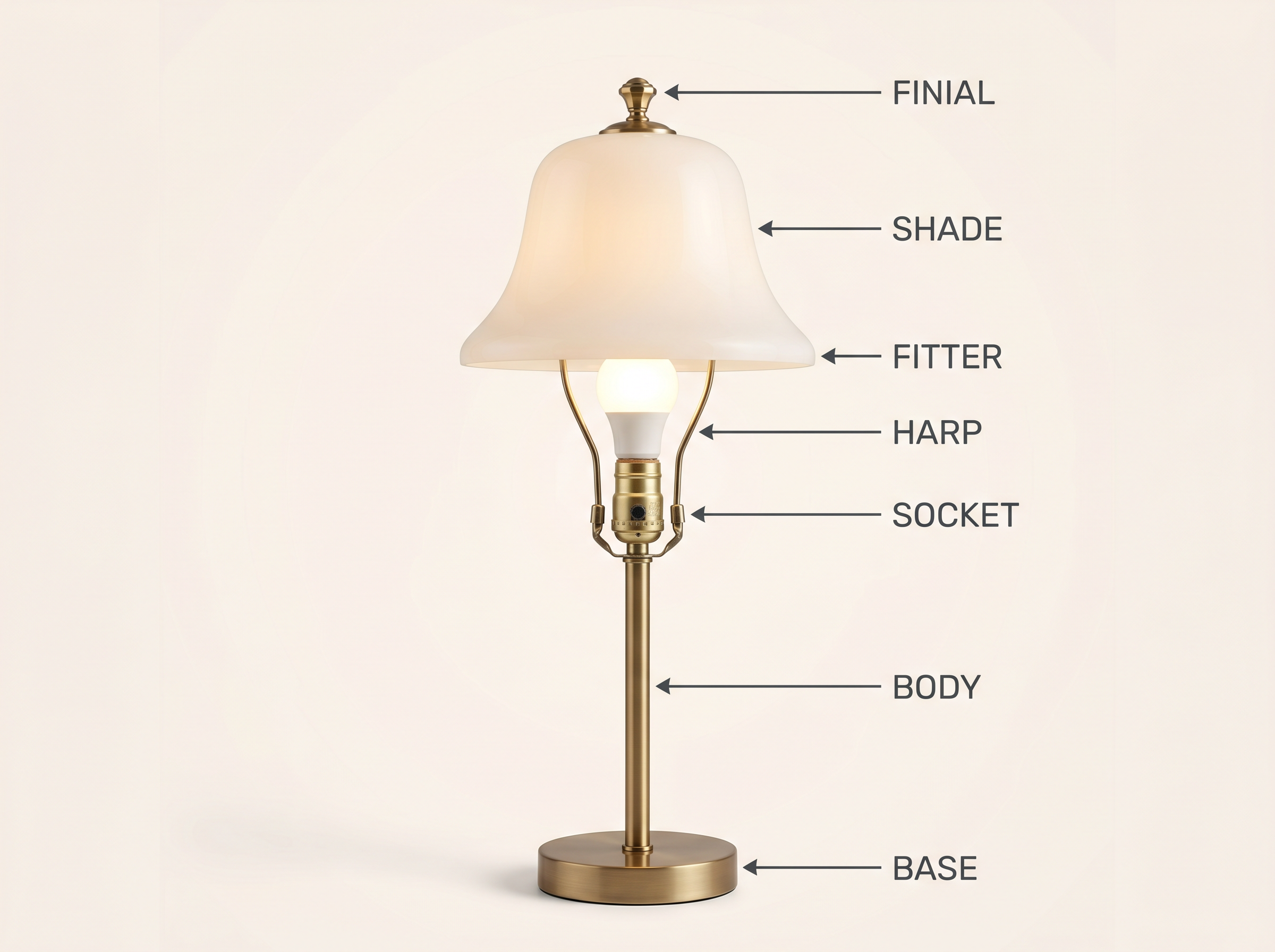
| Part | What it is |
|---|---|
| Base | The weighted foot that keeps the lamp stable. |
| Body | The main upright column or stem of the lamp. |
| Socket | Holds the bulb and connects it to the wiring. |
| Harp | The metal frame that supports a spider-fitter shade. |
| Finial | The decorative cap that secures the shade on top. |
| Fitter | The part of the shade that connects it to the fixture. See the frames & fitters guide. |
| Shade | The glass or fabric cover that diffuses and directs the light. |
Which type of lamp for each room?
The right lamp type depends on the room and the job it has to do. Use this as a starting point when planning a space.
| Room | Recommended lamp types | Why |
|---|---|---|
| Living room | Table lamps, floor lamps, arc lamp, pendant | Layer ambient and reading light; lamps add warmth and height. |
| Bedroom | Bedside table lamps, swing-arm sconces, pendant | Soft, dimmable light for rest; sconces free up the nightstand. |
| Kitchen | Mini pendants over the island, recessed, under-cabinet | Bright, even task light where you prep and cook. |
| Dining room | Chandelier or linear pendant over the table | A single focal fixture sets the centre of the room. |
| Home office | Desk lamp, architect or swing-arm task lamp | Directional, glare-free light for screens and paperwork. |
| Hallway & entry | Flush mount, semi-flush, lantern pendant, sconces | Compact fixtures that light a path without crowding the space. |
| Bathroom | Vanity light, sconces, flush mount | Even, shadow-free light at the mirror; use damp-rated fittings. |
| Outdoor | Wall lantern, post light, hanging lantern | Weather-rated fixtures for entries, patios and paths. |
How to choose a lamp: a quick checklist
Whatever the type, the same handful of decisions get you to the right lamp:
- Proportion. Size the lamp to the furniture and the room, not in isolation. A lamp that is too small or too tall looks off (see the size guide below).
- Brightness, in lumens. Judge output by lumens, not watts. Around 400–800 lumens suits a bedside or accent lamp; 800–1,600 suits a reading or task lamp.
- Colour temperature. Warm white (2700–3000K) for living rooms and bedrooms; neutral to cool white (3500–4000K) for kitchens, bathrooms and offices.
- Shade and glass. Choose an opal or frosted glass shade for soft, glare-free light, or clear glass to show a decorative bulb.
- Fitter compatibility. Make sure the shade’s fitter (spider, UNO, fitter neck or clip) matches the fixture.
- Dimmability. Dimmable LEDs let one lamp move between task and mood lighting.
- Layering. Combine ambient, task and accent fixtures rather than relying on a single light.
Lamp size and proportion guide
A few simple rules cover most situations:
- Table lamps. The shade should be about one-third of the total lamp height, and slightly wider than the widest part of the base. When seated, the bottom of the shade should sit near eye level so the bulb is hidden.
- Floor lamps. Most stand 58–64 inches (150–165 cm) tall. For reading, position the bottom of the shade around eye level when seated.
- Pendants over a kitchen island. Hang the bottom of the shade about 30–36 inches (75–90 cm) above the counter.
- Pendant or chandelier over a dining table. Hang the bottom about 30–34 inches (75–85 cm) above the table; the fixture width should be roughly one-half to two-thirds of the table width.
- Chandelier for a room. Add the room’s length and width in feet — that figure in inches is a good chandelier diameter. A 12 ft × 14 ft room suits a chandelier around 26 inches wide.
Custom glass shades for any lamp type
Every glass shade on this list can be produced to order in opal, clear, coloured or borosilicate glass, for home, hotel and restaurant lighting. We supply lighting brands and importers worldwide via OEM/ODM, with custom shapes, sizes and fitters. MOQ starts at 500 pcs.
Sourcing glass shades for a lamp range?
Send us the lamp type, shape, size, glass and fitter — we’ll quote factory-direct.
Request a quoteFrequently asked questions
What are the main types of lamps?
The main types of lamps are table lamps, desk lamps, floor lamps, wall lamps (sconces) and ceiling lights such as pendants and chandeliers. Each is named for where it sits and how it mounts.
What is the difference between a lamp and a light fixture?
In everyday use a “lamp” is a portable fixture with a base and shade, while a “light fixture” is usually a permanently installed unit such as a pendant, chandelier or flush mount. In technical terms, “lamp” can also mean the bulb itself.
What are the different types of ceiling lights?
Common ceiling lights include pendants, mini and multi-light pendants, chandeliers, flush mounts, semi-flush mounts, recessed downlights, track lights and linear island lights.
What is a torchiere lamp?
A torchiere is a floor lamp with an upward-facing shade that bounces light off the ceiling for soft, indirect ambient lighting.
What is a banker’s lamp?
A banker’s lamp is a desk lamp with a brass or metal base and a distinctive green glass shade that directs light downward, traditionally used in libraries and offices.
What types of glass are used for lamp shades?
The main glass types for lamp shades are opal (milk-white, diffusing), clear, coloured, borosilicate (heat-resistant) and stained or Tiffany glass. Each can be made in any lampshade shape.
What are the parts of a lamp called?
The main parts of a lamp are the base, body, socket, harp, finial, fitter and shade. The fitter is the part of the shade that attaches it to the lamp.
How many types of lamps are there?
There is no fixed number, but lamps and light fixtures can be grouped into well over 100 named types across placement, style, light source and shade — as listed on this page.
What kind of lamp is best for a living room?
A living room works best with layered lighting: a couple of table lamps for warmth, a floor lamp or arc lamp for reading, and an overhead pendant or chandelier for ambient light. Dimmable warm-white bulbs make the room flexible.
What is the best lamp for reading?
The best reading lamps are directional task lamps — a swing-arm or gooseneck desk lamp, an adjustable floor lamp, or a bedside lamp with an opaque shade. Aim for 800–1,600 lumens of glare-free light positioned to the side of the page.
What colour temperature should I choose for a lamp?
Choose warm white (2700–3000K) for living rooms and bedrooms where you want a cosy feel, and neutral to cool white (3500–4000K) for kitchens, bathrooms and home offices where you need clear task light.
How big should a lamp be for my table?
As a rule of thumb, a table lamp should be about one-third of the total height from the tabletop to your eye level when seated, and the shade should be slightly wider than the widest part of the base.
What is the difference between ambient, task and accent lighting?
Ambient lighting is the general light that fills a room, task lighting is focused light for an activity like reading or cooking, and accent lighting highlights a feature such as artwork. A good scheme layers all three.
References & further reading
This guide draws on established references for lamp and lighting types:
- Wikipedia — Light fixture (en.wikipedia.org/wiki/Light_fixture)
- Wikipedia — Pendant light (en.wikipedia.org/wiki/Pendant_light)
- Wikipedia — Chandelier (en.wikipedia.org/wiki/Chandelier)
- Wikipedia — Tiffany lamp (en.wikipedia.org/wiki/Tiffany_lamp)
- Wikipedia — Banker’s lamp (en.wikipedia.org/wiki/Banker%27s_lamp)
- Wikipedia — Incandescent light bulb (en.wikipedia.org/wiki/Incandescent_light_bulb)
- Wikipedia — LED lamp (en.wikipedia.org/wiki/LED_lamp)
Request a Quote for Custom Glass Lampshades