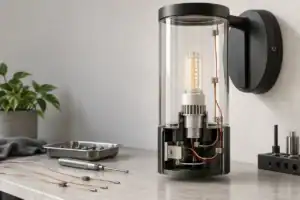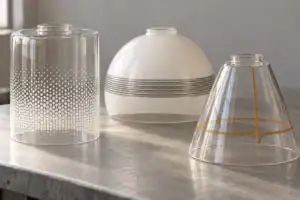
The main hotel lamp shade types divide by shape (drum, empire, bell, globe, cylinder, cone), by material (glass or fabric), and by glass finish (clear, frosted, opal, ribbed, borosilicate) — each combination suited to a specific hotel area, design style, and lighting function.
Walk a hotel corridor at check-in time and every lamp shade matches. Same silhouette, same color, same glow through the glass. That visual consistency is not an accident — it is the result of someone, at some point, making a deliberate decision about which of the main hotel lamp shade types to specify across the property, then sourcing enough of them in a single production run to guarantee they all look identical.
This guide breaks down every major type: the six standard shapes, the three material categories, the five glass finishes, how different types map to specific hotel areas, and which types are driving hospitality lighting design in 2026. If you are procuring, designing, or supplying hotel lamp shades, this is the taxonomy you need before any other decision.
The 6 Main Hotel Lamp Shade Shapes
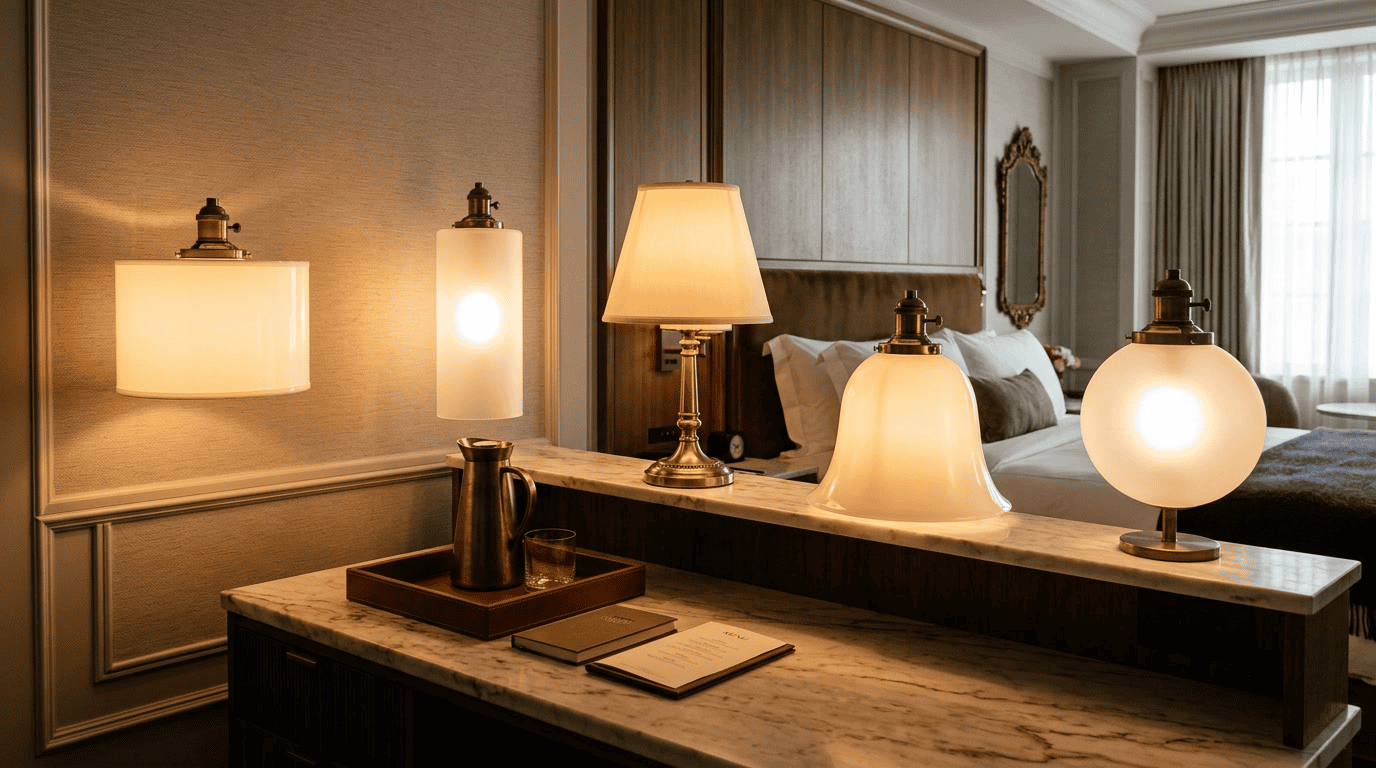
The six standard shapes used in hotel lamp shades are drum, empire, bell, globe, cylinder, and cone/coolie — each producing a distinct light distribution pattern and visual silhouette that suits different fixture types and room functions.
Shape is the first decision in specifying any hotel lamp shade. It determines how light leaves the fixture, whether the bulb is visible from seated or reclined positions, and how the lamp reads as a decorative object. As covered in the foundational literature on lampshade design, these six forms have remained the core vocabulary of shade design for over a century because each solves a specific lighting problem.
Drum and Cylinder — The Contemporary Workhorses
Drum shades are the most-specified shape in modern hotel interiors. A true drum has equal diameters at top and bottom — it is a cylinder with soft-fabric styling, or in glass, a straight-sided tube. The defining characteristic is equal light distribution upward and downward. No directional preference.
This matters in hotel corridors, where both ceiling and floor illumination are wanted, and in lobbies, where the shade is well above eye level and the even light distribution reads as a clean, modern statement. In guestrooms, drum shades on bedside lamps work well when ceilings are high enough that the shade sits above a reclined guest’s eye line — typically 80 cm or more above the mattress surface.
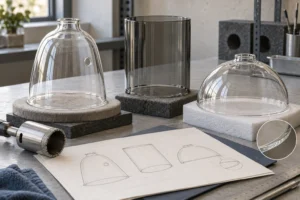
Cylinder shades are the taller, narrower relative of the drum. The proportion is more vertical — height significantly exceeds diameter. This shape appears on floor lamps, tall table lamps in contemporary hotel lobbies, and wall sconces where a vertical profile is architecturally appropriate. In glass, a frosted or clear cylinder reads as deliberately architectural rather than decorative.
Empire and Bell — The Directional Classics
Empire shades taper from a smaller opening at the top to a wider opening at the base. The taper is straight. This geometry concentrates light downward and slightly inward — exactly what a reading lamp on a hotel bedside table needs. The guest lying down does not look directly at the bulb because the shade walls block the upward sightline. Empire shades have been the default choice for hotel bedside table lamps in mid-range and upmarket properties for decades, and for good reason.
The proportions vary. A shallow empire shade (low height-to-width ratio) spreads light wide at table level. A taller, steeper empire concentrates the pool of light more tightly. Hotel guestroom desk lamps typically use a steeper empire to keep task light focused on the work surface.
Bell shades are softer. The taper is curved rather than straight, giving a more organic, residential silhouette. They produce broadly similar light distribution to empire shades — directional, downward-biased — but read as warmer and less formal. Boutique hotels and properties with an upscale residential design direction frequently choose bell shapes over empire for guestroom lamps. In opal glass, a bell shade creates a particularly premium ambient presence.
Globe, Sphere and Coolie — The Decorative Statements
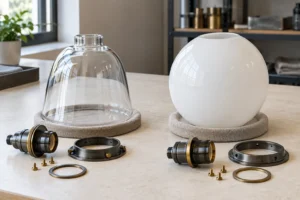
Globe shades are spherical or near-spherical. They distribute light in all directions and present a recognizable, high-visibility silhouette. Hotel applications are diverse: bathroom vanity globes (a category of hotel lamp shades so consistent it has become a visual shorthand for hotel bathrooms), bar pendant clusters, feature lamps in lobby seating areas, and wall sconces on exterior courtyard walls.
In opal glass, a globe shade glows like a soft orb at night — a visual quality that hotel designers deliberately use to create warmth in otherwise large, architectural spaces. In clear glass, the globe becomes a decorative container for the bulb, appropriate when a visible Edison-style filament is part of the design intent.
Coolie shades (also called cone shades) are wide and flat relative to their height — like an inverted flat cone. They produce a broad, low wash of downward light and are used in lounge chairs, low coffee-table lamps, and feature floor lamps where spreading light across a wide horizontal surface is the goal. Less common in standard hotel guestrooms, but a signature element in hotel lobby lounge areas and premium suites with curated furniture arrangements.
The following breakdown summarizes how the main hotel lamp shade shapes compare across the critical specification dimensions:
| Shape | Light Direction | Best Hotel Area | Visual Character | Glass Suitability |
|---|---|---|---|---|
| Drum | Up + Down equally | Corridors, lobby, sconces | Clean, modern, neutral | Excellent — all glass types |
| Cylinder | Up + Down, narrow column | Floor lamps, tall table lamps | Architectural, structured | Excellent — frosted, clear |
| Empire | Downward, directional | Bedside, desk lamps | Classic, refined | Excellent — frosted, opal |
| Bell | Downward, softer spread | Boutique guestrooms, lounges | Warm, residential | Excellent — opal, ribbed |
| Globe | Omnidirectional | Bathrooms, bars, courtyards | Decorative, luminous | Excellent — opal, clear |
| Coolie/Cone | Wide downward wash | Lounge seating, suites | Statement, low-profile | Good — frosted, opal |
Hotel Lamp Shade Materials — Glass, Fabric and Metal
The three main material categories for hotel lamp shades are glass, fabric, and metal — with glass being the professional standard for four- and five-star properties, fabric remaining viable for budget applications, and metal used selectively for industrial or outdoor-rated installations.
Material choice determines cleaning protocol, service life, batch consistency, and light transmission character. The Illuminating Engineering Society’s standards for commercial lighting environments consistently classify hospitality as a demanding use case where cleaning frequency and material durability are primary specification criteria — not secondary aesthetics.
Glass — The Professional Hospitality Standard
Glass hotel lamp shades have dominated the professional tier of hospitality procurement for one core reason: they don’t deteriorate under cleaning. A frosted glass shade wiped with a disinfectant solution every day for ten years looks the same at the end as at the beginning. Fabric shades do not.
Glass also holds its color between production batches. A hotel ordering replacement shades three years after the original installation can specify the same glass composition and get visually matching shades. Try doing that with a dyed fabric — the dye batch will be different.
The glass subcategories matter and we cover them in full in the section below. For material selection purposes, the key point is this: glass hotel lamp shades at the four- and five-star tier are not a luxury choice. They are the maintenance-practical choice. The higher unit cost pays back in reduced replacement frequency and housekeeping labor.
Fabric — Budget and Boutique Applications
Fabric hotel lamp shades occupy two distinct market positions: budget/economy properties where upfront cost is the primary variable, and high-end boutique hotels where a hand-crafted textile shade is a deliberate design statement.
At the economy end, hardback fabric shades (fabric laminated to a styrene backing) are the standard. They are cheap, lightweight, and available in a consistent color range. The trade-off is a replacement cycle of 2–4 years in daily hotel use — cleaning agents cause the backing to soften and the fabric color to drift. For a 200-room budget hotel, the replacement cost over ten years is significant.
At the boutique end, custom hand-sewn fabric shades in premium materials — silk, linen, specialty weaves — are used as decorative design elements. These cost significantly more than glass alternatives, require careful cleaning protocols, and are not suitable for high-turnover guestroom environments. They appear in penthouse suites, boutique hotel lobbies, and premium restaurant environments where the shade is intended to be a talking point.
Metal and Specialty Materials
Metal shades — typically spun or pressed aluminum, steel, or brass — appear in hotel environments where a specific design language demands it. Industrial-style hotels and urban properties with a warehouse aesthetic use pendant metal shades in bar and restaurant areas. Outdoor-rated marine-grade metal shades appear on hotel terrace and courtyard fixtures where weather exposure rules out glass.
Metal shades block light except where they are directionally open. They do not diffuse; they direct. This limits their application to task lighting, feature lighting, and design-statement contexts where controlled directionality is more important than ambient diffusion.
| Material | Service Life | Daily Cleaning | Light Transmission | Batch Color Consistency | Best Hotel Tier |
|---|---|---|---|---|---|
| Glass (frosted/opal) | 8–12 years | Wipe with any cleaner | 35–75% depending on finish | Excellent (ΔE ≤ 2.5) | 4–5 star |
| Glass (clear) | 8–12 years | Wipe with any cleaner | 88–92% | Excellent | 3–5 star + boutique |
| Hardback fabric | 2–4 years | Dry-dust only | 40–60% | Poor — dye drift between batches | Budget / 2–3 star |
| Hand-sewn fabric | 3–5 years | Specialist only | Variable | Very poor | Boutique statement only |
| Metal (aluminum) | 10+ years | Wipe any cleaner | 0% (directional only) | N/A | Industrial / outdoor |
Glass Finish Types for Hotel Lamp Shades
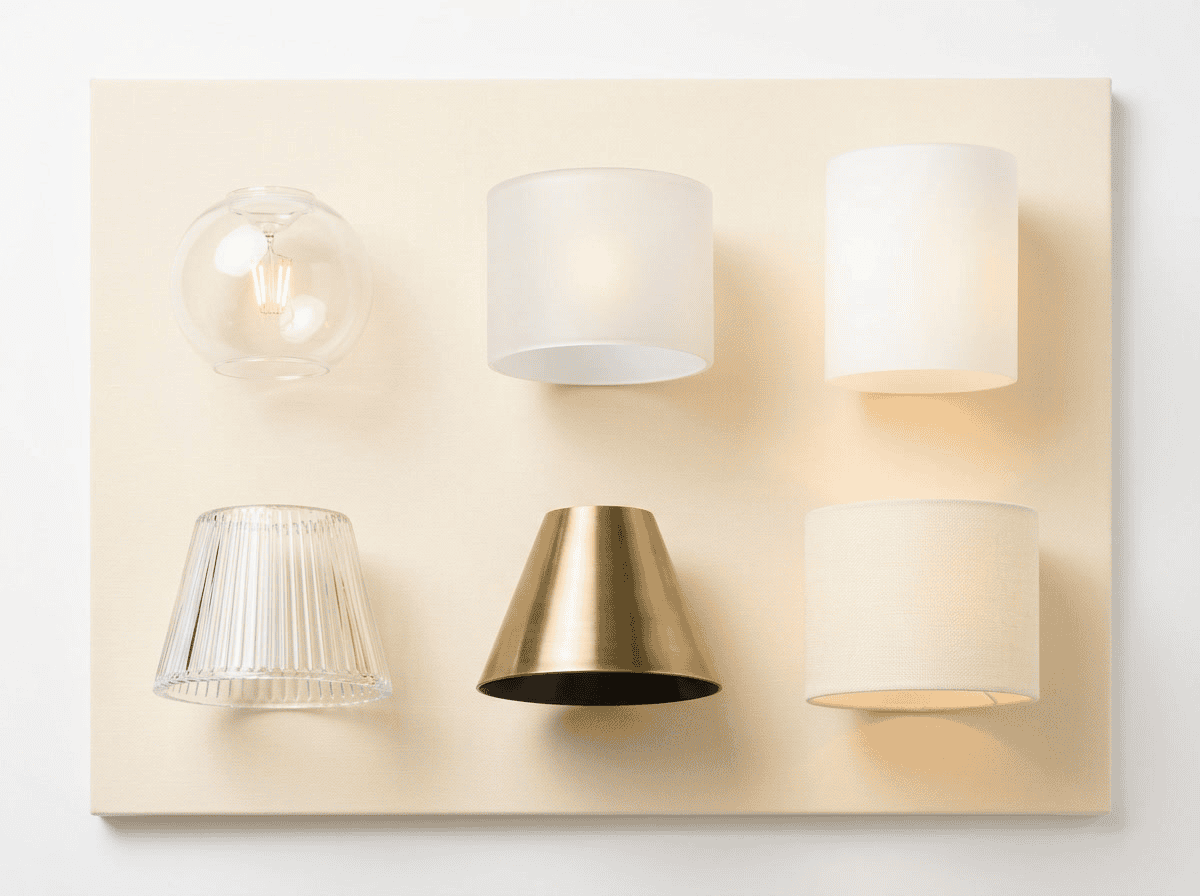
The five glass finishes used in hotel lamp shades are clear, frosted, opal, ribbed/textured, and borosilicate — each producing a distinct light effect, opacity level, and maintenance characteristic that determines which hotel area and design style it suits best.
Glass finish selection is the most technically nuanced decision in specifying glass hotel lamp shades. Two properties with identical drum-shaped glass shades can look completely different based on finish alone — one with a clear glass that shows the bulb, one with opal that glows like a paper lantern.
Clear Glass Hotel Shades
Clear glass offers the highest light transmission of any shade material — typically 88–92%. The bulb is visible. Every detail of the light source is apparent. This was historically a drawback, but in the era of decorative LED filament bulbs, it is frequently a design asset.
Hotel bars, hotel restaurants, and feature lamps in lobbies have adopted clear glass hotel lamp shades at scale as a way to display warm amber Edison-style LEDs. The visual combination — clear glass globe, warm filament spiral, reflected candlelight from polished surfaces — is one of the most replicated aesthetics in contemporary hospitality design.
Clear glass also appears in hotel bathrooms above vanity mirrors, where even illumination across the face is critical and the fixture design calls for a visually light, transparent shade.
Frosted Glass Hotel Shades
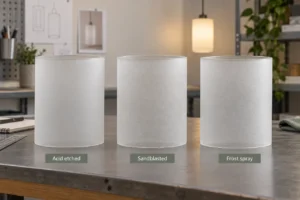
Frosted glass is acid-etched or sand-blasted on the surface, scattering light and making the bulb invisible from normal viewing angles. Transmission drops to roughly 65–75% depending on etching depth — enough reduction to eliminate glare while preserving most of the lamp’s output.
This is the single most common finish in hotel lamp shades main types. It appears in the majority of hotel guestroom bedside and desk lamps at the three-, four- and five-star level. The reasons are straightforward: it controls glare for reclining guests, it works with any bulb type without the bulb’s appearance affecting the aesthetic, it is chemically resistant and easy to clean, and it looks the same across production batches.
Frosted glass comes in grades. Light frosting (shallow etch) transmits more light but does not fully conceal the bulb. Heavy frosting conceals the bulb completely but reduces output noticeably. For guestroom applications, medium frosting — complete bulb concealment with 65–70% transmission — is the standard specification.
Opal and Milk Glass Hotel Shades
Opal glass, also called milk glass, is white throughout its body rather than surface-etched. Light passing through it scatters within the glass mass itself, not just at the surface. The result is a uniquely even, soft glow across the entire shade surface — no visible hotspot, no gradient from bright center to darker edge.
Transmission is lower than frosted: typically 35–55% depending on the opal density. The visual trade-off is accepted because the effect — a shade that appears to emit its own warm light rather than containing a light source — is particularly suited to high-end hotel applications. Hotel lobbies use opal globe shades for their presence value. Luxury hotel bathrooms have used opal vanity globes as a design standard for generations.
Opal glass is also technically superior for modern LED sources. LEDs produce a concentrated point-source output that frosted glass filters but does not fully homogenize — the bright center of the bulb can still be detected as a bright zone in the shade. According to research on LED diffusion in the lighting industry, opal glass with body diffusion (rather than surface frosting) eliminates LED hotspots more completely. For hotels transitioning to premium LED packages, opal shades produce a noticeably better result.
Ribbed, Fluted and Textured Glass Hotel Shades
Textured glass hotel lamp shades — ribbed, fluted, pressed or hand-blown with surface irregularity — occupy the decorative end of the glass type spectrum. The texture breaks light into directional patterns, partially conceals the bulb, and adds visual character that smooth glass does not.
Ribbed glass is the most structured: parallel vertical channels that create a repetitive pattern of light and shadow on nearby surfaces. Fluted glass is similar but more pronounced. Pressed glass patterns include geometric forms, natural motifs, and period-specific designs often used in traditional hotel renovations. Hand-blown glass with slight surface variations and occasional air bubbles — marketed as artisanal or seeded glass — is increasingly popular in boutique hotel properties seeking to differentiate from standardized brand properties.
Textured glass hotel lamp shades are most appropriate in boutique hotels, grand historic hotels, restaurant and bar areas, and suite-level guestrooms where the shade itself is a design feature. They are less suited to standard guestroom corridor applications where visual neutrality and cleaning simplicity are more important.
Borosilicate and Heat-Resistant Glass Hotel Shades
Borosilicate glass has a different chemical composition from standard soda-lime glass — it contains boron trioxide, which significantly reduces thermal expansion and improves resistance to temperature cycling. As documented in materials science literature, borosilicate glass can withstand thermal shock that would crack standard glass.
In hotel lamp shade applications, borosilicate is specified for:
- Fixtures near heat sources (kitchen pass-through areas, outdoor food-and-beverage stations)
- Outdoor-rated wall lamps exposed to temperature cycling between day and night
- High-wattage fixture positions where the glass shade is consistently exposed to significant heat
- Technical lighting assemblies in hotel engineering and maintenance areas
Standard hotel guestroom table lamps with LED sources operating at modest temperatures do not need borosilicate glass. The specification is appropriate where the operating environment actually creates thermal stress on the shade.
Right Type for Each Hotel Area
Matching hotel lamp shade type to hotel area requires aligning the shade shape, material, and glass finish with the room function, viewing angle, and design intent of each space.
Hotel areas differ fundamentally in how guests interact with lighting. A guestroom is an intimate, low-volume space where a single guest at arm’s-length from the lamp is the primary use case. A lobby is a high-volume, architecturally ambitious space where dozens of lamps may need to look identical at 20 meters. Getting the type wrong in either context creates either guest complaints or maintenance problems.
Guestroom Bedside and Desk Lamp Shades
The bedside lamp shade is the most scrutinized type in hotel guestroom specification. A lying guest stares at the bedside area for hours. Any shade that creates visible glare — showing the hot center of the bulb through the shade — will generate guest complaints.
Recommended type: Empire or drum shape, frosted glass. Height 20–26 cm, diameter 26–34 cm for standard hotel table lamp bases. Frosted glass at medium etch depth eliminates bulb visibility. Empire shape keeps downward light directional for reading while blocking horizontal glare.
For desk lamps, the same frosted glass applies, but the shape can be narrower empire or cylinder — the seated working position is different from the reclined reading position, and a slightly tighter light pool is acceptable.
Hotel Lobby, Corridors and Public Spaces
Scale is the challenge. A lobby may need 30 identical table lamps plus 60 matching sconces — all needing consistent appearance under variable ambient light levels throughout the day. The main hotel lamp shade types that handle this best are drum and globe shapes in opal glass.
Drum shades on corridor wall sconces need to be visually neutral enough to recede into the background while providing adequate illumination. Frosted glass drum shades are the standard. They provide even up/down light distribution in corridors, are easy for housekeeping to maintain, and remain visually consistent across multiple production batches.
For lobby statement lamps — large floor lamps flanking the reception desk, table lamps on lobby console tables — opal glass globes or large drum shades create visual presence and warmth in the architectural scale of the space.
Hotel Bathroom and Vanity Lamp Shades
Hotel bathrooms use two main shade types: vanity globe shades above mirrors, and enclosed or semi-enclosed fixture covers above the bath or in the ceiling. The vanity globe is the primary category of hotel lamp shade types in bathrooms.
Opal glass globes of 12–18 cm diameter are the standard vanity shade in mid-range to luxury hotels. The even diffusion produces flattering, shadow-free illumination at face level. Clear glass is sometimes used at the luxury tier when a decorative bulb is part of the bathroom design, but the exposed bulb creates challenging glare in the confined, reflective bathroom environment. Most designers default to opal.
Hotel Restaurant, Bar and Event Spaces
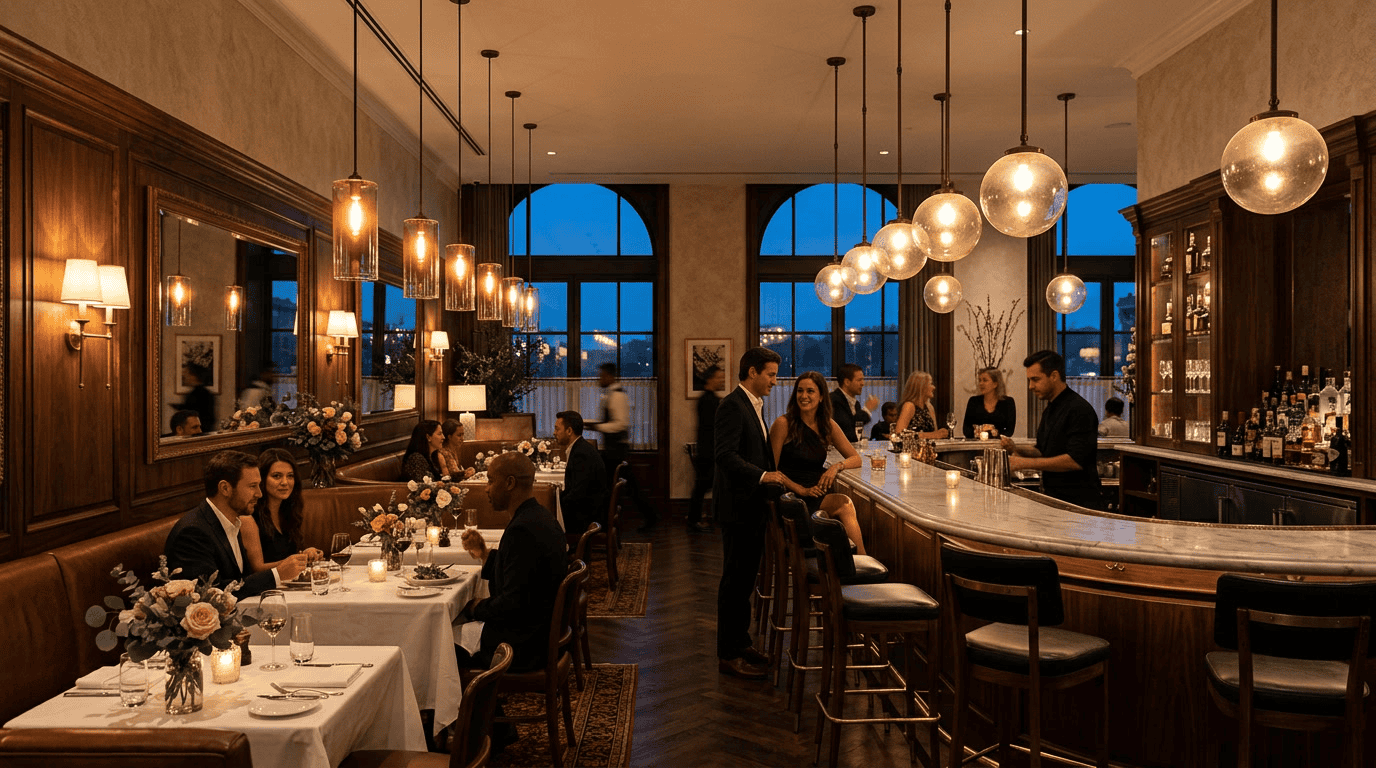
F&B spaces have the widest range of appropriate hotel lamp shade types. The trend in 2026 hospitality design has moved decisively toward visible glass — clear glass globe shades with exposed filament LEDs in bars, opal globe pendants over restaurant tables, ribbed glass cylinders in cocktail lounge areas.
The design logic is that F&B spaces benefit from the decorative quality of the shade itself being a visible element. Fabric is rare in professionally designed hotel restaurants. Metal appears in deliberately industrial concepts. Glass — in clear, opal, or textured finishes — is the standard specification for any full-service hotel food and beverage operation.
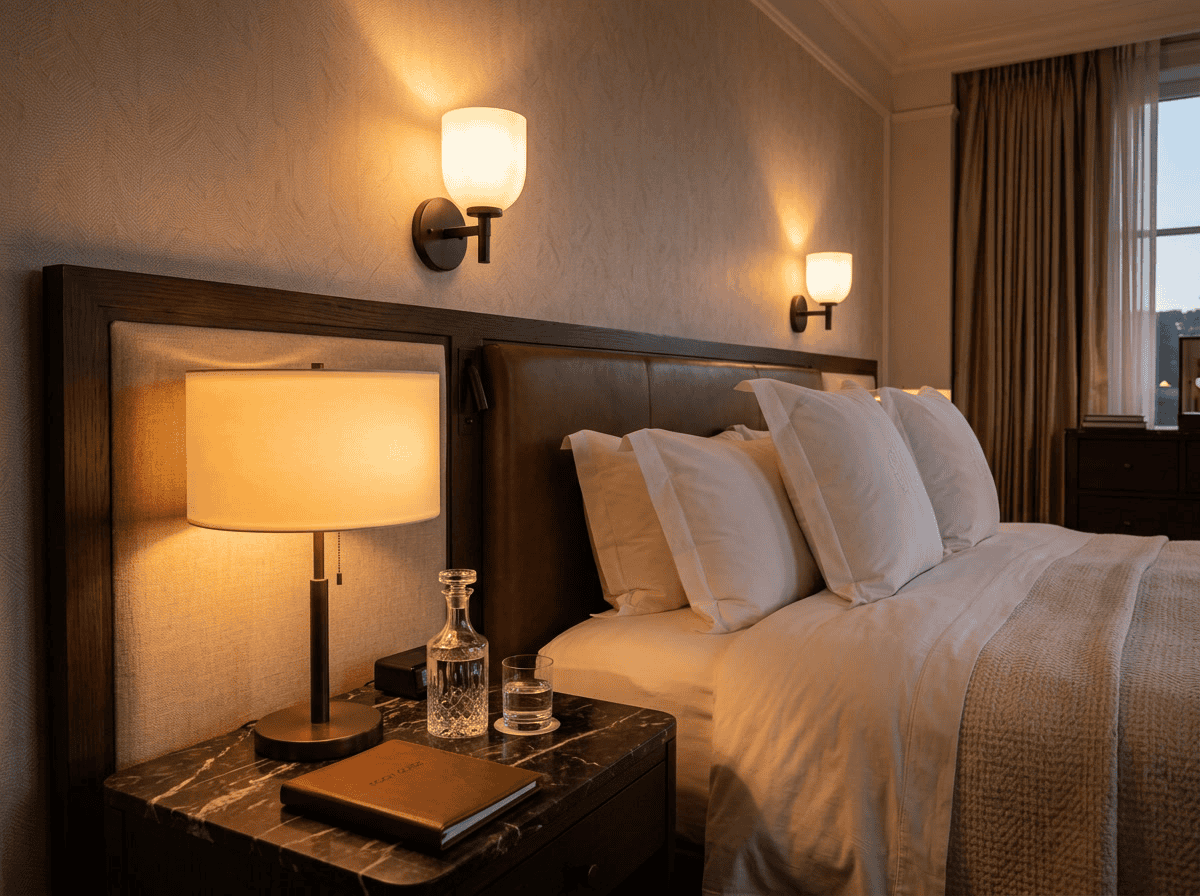
The following matrix summarizes the recommended shade type for each main hotel area:
| Hotel Area | Shape Type | Glass Finish | Light Effect | Key Requirement |
|---|---|---|---|---|
| Guestroom bedside | Empire or drum | Frosted (medium) | Directional, glare-free | No bulb visibility when reclined |
| Guestroom desk | Empire or cylinder | Frosted | Focused task light | Adequate working illumination |
| Hotel lobby — large | Globe or large drum | Opal | Warm, luminous presence | Batch consistency across all units |
| Corridors / sconces | Drum | Frosted | Even up/down | Easy daily cleaning |
| Bathroom vanity | Globe (12–18 cm) | Opal | Even, flattering facial light | No harsh shadows |
| Restaurant pendants | Globe or empire | Opal or clear | Table-level ambience | 150–200 lux at surface |
| Bar / lounge | Globe or cylinder | Clear or ribbed | Decorative, warm | Filament visibility as design feature |
| Event spaces | Drum or empire | Frosted | Flexible ambient | Adaptable to room configurations |
Hotel Lamp Shade Types by Design Style
The hotel’s design language determines which shade types are appropriate — contemporary properties favor drum and cylinder shapes in frosted or opal glass, traditional properties lean toward empire and bell shapes in opal and ribbed glass, and industrial/boutique properties use globe and cylinder shapes in clear and textured glass.
Contemporary and Minimalist Hotel Shades
Contemporary hotels — clean lines, neutral palettes, minimal ornamentation — use drum and cylinder shapes almost exclusively for hotel lamp shades. The geometry is unambiguous. No taper, no curve. The glass finish is frosted for guestrooms and opal for lobbies and feature positions.
Size discipline matters in contemporary hotel design. Shades should be proportional to the lamp base and the furniture scale — not oversized for decorative impact. A precisely sized frosted drum shade on a slender table lamp base reads as designed rather than default.
Traditional and Grand-Hotel Shades
Classic hotel properties — historic buildings, grand European hotel style, traditional Asian luxury — use empire and bell shapes in opal glass or textured (ribbed, pressed) glass. The curved profiles and softer geometric language align with traditional interior motifs: carved wood furniture, fabric upholstery, patterned carpets.
Hospitality Design’s coverage of historic hotel restoration projects consistently notes that lamp shade type selection is one of the most visible components of maintaining design authenticity in period properties. A drum shade in a grand-hotel guestroom with plasterwork ceiling moldings reads as a renovation mistake. An empire or bell shade in opal glass reads as correctly period-appropriate.
Boutique and Industrial Hotel Shades
The boutique hotel sector — independent properties, design-led chains, adaptive reuse projects in former industrial buildings — has driven the adoption of clear glass globe shades, ribbed cylinder shades, and hand-blown textured glass in hotel lamp shade specifications. These types provide the visual differentiation that boutique properties need relative to standardized brand competitors.
Industrial-aesthetic hotels use pendant metal shades and clear glass globes in bar and restaurant areas, with frosted glass drum or cylinder shades in guestrooms. The visual contrast between the deliberately rough aesthetic of the public spaces and the calm, functional quality of the guestroom creates the tonal shift that boutique hotel guests expect.
Future Trends in Hotel Lamp Shade Types 2026 and Beyond
Two technical and aesthetic trends are actively reshaping which hotel lamp shade types designers specify in 2026 — the return of textured glass in biophilic design contexts, and the technical shift toward body-diffusion opal glass driven by LED source optimization.
Textured Glass Revival and Biophilic Hotel Shades
Biophilic design — the integration of natural textures, organic forms, and material variation into interior environments — has moved from architectural theory into mainstream hotel specification over the past several years. For hotel lamp shade types, this translates into growth in seeded glass, hand-blown glass with slight irregularity, amber glass, and organic-form shade silhouettes.
Seeded glass (containing small air bubbles distributed through the body) has the appeal of natural imperfection — no two pieces are identical, and the bubble distribution creates subtle light variation that flat-surfaced glass cannot produce. Hand-blown opal glass with slight surface undulation achieves a similar effect at the premium tier.
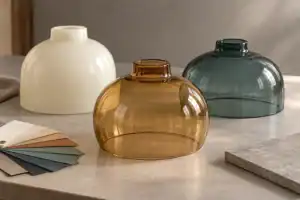
The biophilic trend extends to color. Amber glass hotel lamp shades — historically associated with traditional décor — are reappearing in contemporary boutique hotel guestrooms as a warmer alternative to the neutral frosted white that has dominated for two decades. Smoked glass and cognac glass shades are being specified in bar areas as complements to brass hardware and warm wood millwork.
LED Optimization and Opal Diffusion Technology
The technical driver for opal glass in hotel lamp shades main types is LED source characteristics. Standard LED modules produce a concentrated, directional output with visible color non-uniformity across the emitter surface. Surface-frosted glass scatters this output but does not fully homogenize it — in a frosted shade, a distinct brighter zone corresponding to the LED emitter is often detectable when the shade is examined from the right angle.
Opal glass with body diffusion eliminates this because light scatters within the glass mass itself, distributing the output uniformly before it exits the shade surface. As LED efficacy increases and premium LED packages deliver higher lumen output in smaller emitter formats, the hotspot problem intensifies — and opal glass becomes more technically justified rather than less.
This is driving an observable shift in hotel lamp shade procurement: properties upgrading from legacy incandescent sources to premium LED are disproportionately moving from frosted glass to opal glass at the same time, because the LED characteristics make the quality difference between the two finishes more visible.
| Trend | Shade Type Affected | Hotel Segment | Driver | Timeline |
|---|---|---|---|---|
| Textured glass revival | Ribbed, seeded, hand-blown | Boutique, luxury | Biophilic design demand | Active now through 2026+ |
| Amber and smoked glass | Globe, bell, empire | Boutique, bar areas | Warm-toned aesthetic reaction | Accelerating |
| Opal for LED optimization | Globe, drum, empire | 4–5 star, renovation | LED hotspot elimination | Mainstream in new builds |
| Oversized statement shades | Large globe, coolie | Luxury suites, lobbies | Feature interior design | Growing |
FAQ — Hotel Lamp Shades Main Types
What are the main types of hotel lamp shades?
The main hotel lamp shade types are defined by shape (drum, empire, bell, globe, cylinder, cone/coolie), material (glass, fabric, metal), and glass finish (clear, frosted, opal, ribbed, borosilicate). Most hotel procurement decisions start with shape — which determines light direction — then move to material, then finish. In professional hospitality, glass hotel lamp shades in frosted or opal finish dominate at the four- and five-star tier because of durability and cleaning compatibility.
What type of lamp shade is most common in hotel guestrooms?
Frosted glass empire or drum shades are the most common hotel lamp shade type in guestrooms. Empire shapes direct light downward and block horizontal glare for reclined guests. Frosted glass makes the bulb invisible and withstands daily cleaning. This combination — frosted glass, empire or drum shape, 26–34 cm diameter — appears in the majority of mid-range to luxury hotel guestrooms worldwide because it solves the guestroom lighting problem reliably and durably.
What is the difference between a drum and empire hotel lamp shade?
A drum shade has equal top and bottom diameters; an empire shade tapers from a smaller top to a wider base. The practical consequence: drum shades distribute light equally upward and downward (suitable for ambient corridor and lobby lighting); empire shades concentrate light downward (better for reading and task lighting at bedside and desk positions). In glass, both shapes work equally well — the shape choice is driven by the lighting function needed, not the material.
What type of glass is used in hotel lamp shades?
Hotel lamp shades main types of glass include clear, frosted (acid-etched or sand-blasted), opal/milk glass, ribbed or textured glass, and borosilicate glass. Frosted is the workhorse for guestrooms. Opal is preferred for applications requiring maximum visual softness and LED hotspot elimination. Clear glass is used where decorative bulbs are part of the design. Borosilicate is specified for heat-sensitive or outdoor installations. Ribbed and textured glass is used for decorative and boutique applications.
Which hotel lamp shade shape gives the most light output?
Clear glass globe shades deliver the highest light output of any hotel lamp shade type — transmission of 88–92% means almost no lumen loss through the shade. Among the frosted types, cylinder and drum shapes with thin frosting also perform well. Empire shades in frosted glass at medium etch depth lose approximately 30–35% of the lamp’s output. Opal glass loses 45–65%. The right choice depends on whether light output or visual quality (glare control, diffusion) is the priority.
What are the different types of lights in hotels?
Hotel lighting divides into ambient, task, accent, and decorative categories — with lamp shades primarily associated with table lamps, floor lamps, and wall sconces in the ambient and task categories. Hotel rooms also use recessed ceiling downlights (no shade), track lighting in retail and gallery areas, chandeliers and pendant fixtures in lobbies and restaurants (with shade types including drum pendants and globe shades), and bathroom vanity fixtures with globe shades. Table and floor lamp shades in the guestroom handle most of the ambient and bedside task lighting that directly affects guest comfort ratings.
Which hotel lamp shade type is easiest to replace at scale?
Frosted glass drum shades in standard sizes are the easiest hotel lamp shade type to replace at scale. Standard diameters (28 cm, 30 cm, 32 cm) are manufactured by multiple suppliers, making multi-source procurement possible. The straight geometry of drum shades has tight dimensional tolerances, so replacements from a different production run fit existing fixtures reliably. The same cannot be said for custom-curve empire or bell shapes, where mold-to-mold variation affects fit. For large hotel chains managing ongoing replacement programs, the drum-plus-frosted specification simplifies the entire supply chain.
What type of hotel lamp shade works best with LED bulbs?
Opal glass hotel lamp shades work best with modern LED sources because the body diffusion of opal glass fully homogenizes LED output and eliminates visible hotspots that surface-frosted glass only partially conceals. For hotels pairing premium LED packages (high-output, small-format emitters) with glass shades, opal consistently produces a better visual result. For standard LED A-shape bulbs at moderate output, frosted glass is adequate and more economical. The choice becomes opal when the LED source is a deliberate design element — high-CRI, small-emitter, point-source behavior.
Conclusion
The main hotel lamp shade types are not interchangeable. A drum is not an empire is not a globe — and clear glass, frosted glass, opal glass, and ribbed glass each create fundamentally different lighting experiences even in the same shape. Getting the type right means aligning shape, material, and finish with the specific function of each hotel area, the design language of the property, and the maintenance capabilities of the housekeeping operation.
For procurement and specification, the practical starting point is always the hotel area first: guestroom bedside (frosted empire or drum), lobby feature (opal globe or drum), bathroom vanity (opal globe), restaurant pendants (opal or clear globe), bar area (clear globe or ribbed cylinder). From that anchor, the design style and budget determine whether you move toward premium opal glass, standard frosted, or the textured glass finishes that biophilic and boutique hotel design is driving toward in 2026. OEM custom glass shade programs — for chains needing identical shades across multiple properties — follow the same type logic, then add dimensional tolerance and batch color consistency as procurement requirements on top.