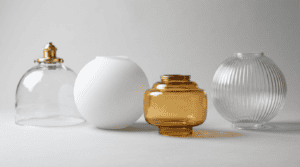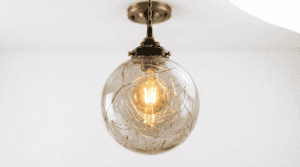
What Is Glass Made Of? Complete Material Guide for Lampshades & Glassware
Glass is made primarily of silica (silicon dioxide, SiO₂) from sand, combined with soda ash (Na₂CO₃) and limestone (CaCO₃), heated above 1700°C, then rapidly cooled into a transparent, rigid amorphous solid.
You’re holding a glass lampshade and wondering what gives it that particular clarity — why it transmits light the way it does, why it feels smooth and cool, and whether it’s fundamentally different from the glass in a window or a wine glass. The answer lies in raw materials that most people walk over every day: sand, lime, and soda. Understanding what glass is made of explains not just its physical properties but also why certain glass types are better suited for decorative lighting applications than others.
What Is Glass Made Of? The Core Raw Materials
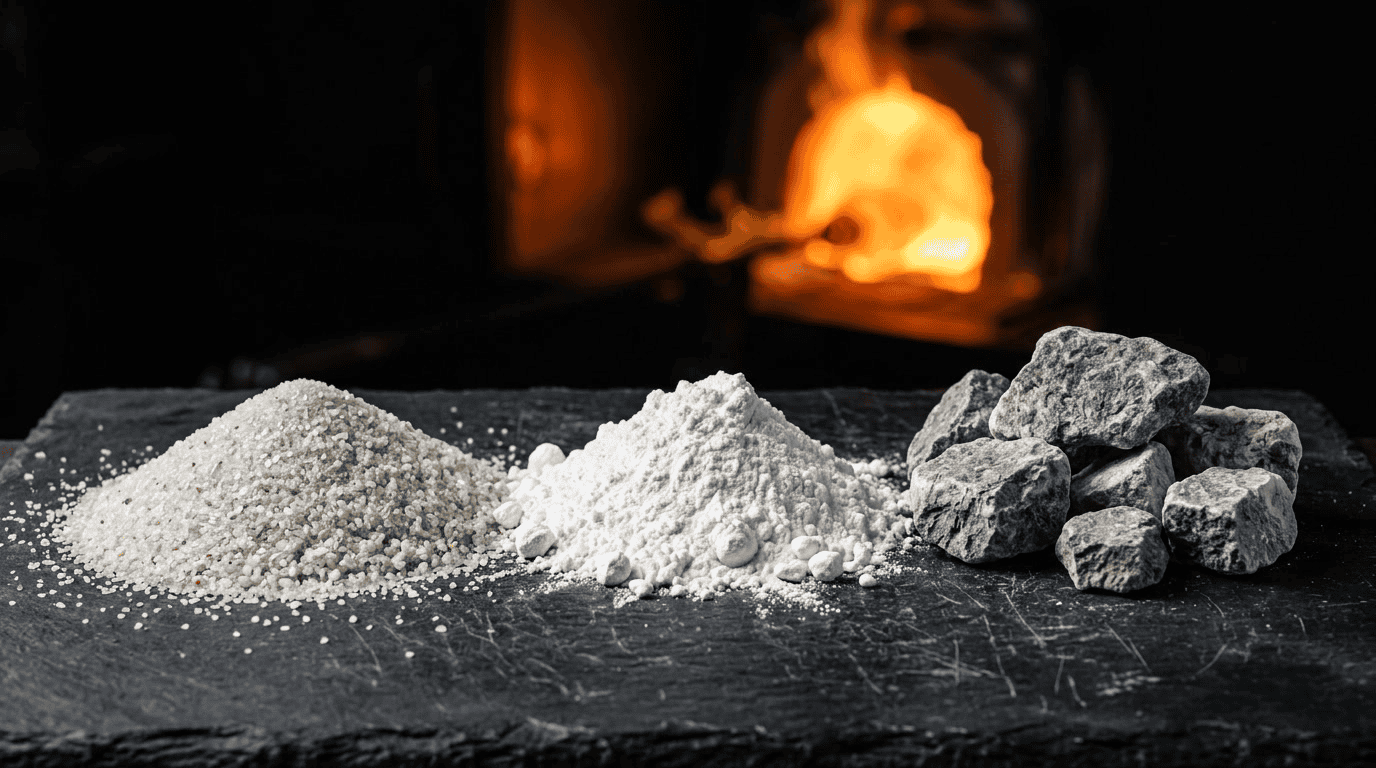
Glass is made of three primary raw materials: silica sand (70–74%), soda ash (12–16%), and limestone or dolomite (10–12%), with small additions of alumina and cullet (recycled glass) to fine-tune properties.
Most glass you encounter — windows, bottles, lampshade globes, decorative glassware — belongs to the soda-lime silicate family. It’s the workhorse of the glass world. But that composition isn’t accidental; each ingredient plays a precise chemical role.
Silica (Silicon Dioxide, SiO₂) — The Glass-Forming Backbone
Silica is the structural network former in glass. Pure silica can form glass on its own, but its melting point exceeds 1700°C — impractically high for industrial production. According to Wikipedia’s entry on glass, silicon dioxide forms the foundational tetrahedral network that gives glass its characteristic amorphous (non-crystalline) structure.
The silica used in glass manufacturing comes from high-purity quartz sand, carefully screened for iron content. Even trace amounts of iron (as low as 0.015%) can tint glass green or brown — a problem for lampshade manufacturers who need optically clear or precisely tinted output.
Key spec: silica sand for quality glassware typically has < 0.010% Fe₂O₃ (iron oxide) content.
Soda Ash (Na₂CO₃) — The Flux
Soda ash is a network modifier. Adding it to silica disrupts some Si-O bonds, dramatically lowering the melting temperature to around 700–900°C. That makes manufacturing economically viable.
The downside: sodium ions weaken the glass network. A pure soda-silica glass would dissolve in water — literally. That’s why the third ingredient is essential.
Limestone and Dolomite (CaO / MgO) — The Stabilizer
Calcium oxide, derived from limestone, restores chemical durability. It plugs the ionic “holes” left by sodium and makes the glass resistant to moisture and mild acids. Dolomite (CaMg(CO₃)₂) is often substituted for limestone in modern production because the magnesium it contributes improves thermal stability — relevant for lampshade applications where glass sits close to heat sources.
A well-balanced soda-lime glass contains roughly:
- SiO₂: 73%
- Na₂O: 14%
- CaO: 9%
- MgO: 4%
Minor Additives That Matter
| Additive | Role | Effect on glass |
|---|---|---|
| Alumina (Al₂O₃) | Network intermediate | Improves hardness and weather resistance |
| Boric oxide (B₂O₃) | Network former | Lowers thermal expansion (borosilicate) |
| Lead oxide (PbO) | Network modifier | Raises refractive index (crystal glass) |
| Colorants (CoO, CuO, Fe₂O₃) | Chromophore | Produces cobalt blue, turquoise, amber |
| Decolorants (MnO₂, Se) | Neutralize iron tint | Achieve optical clarity |
Types of Glass by Composition
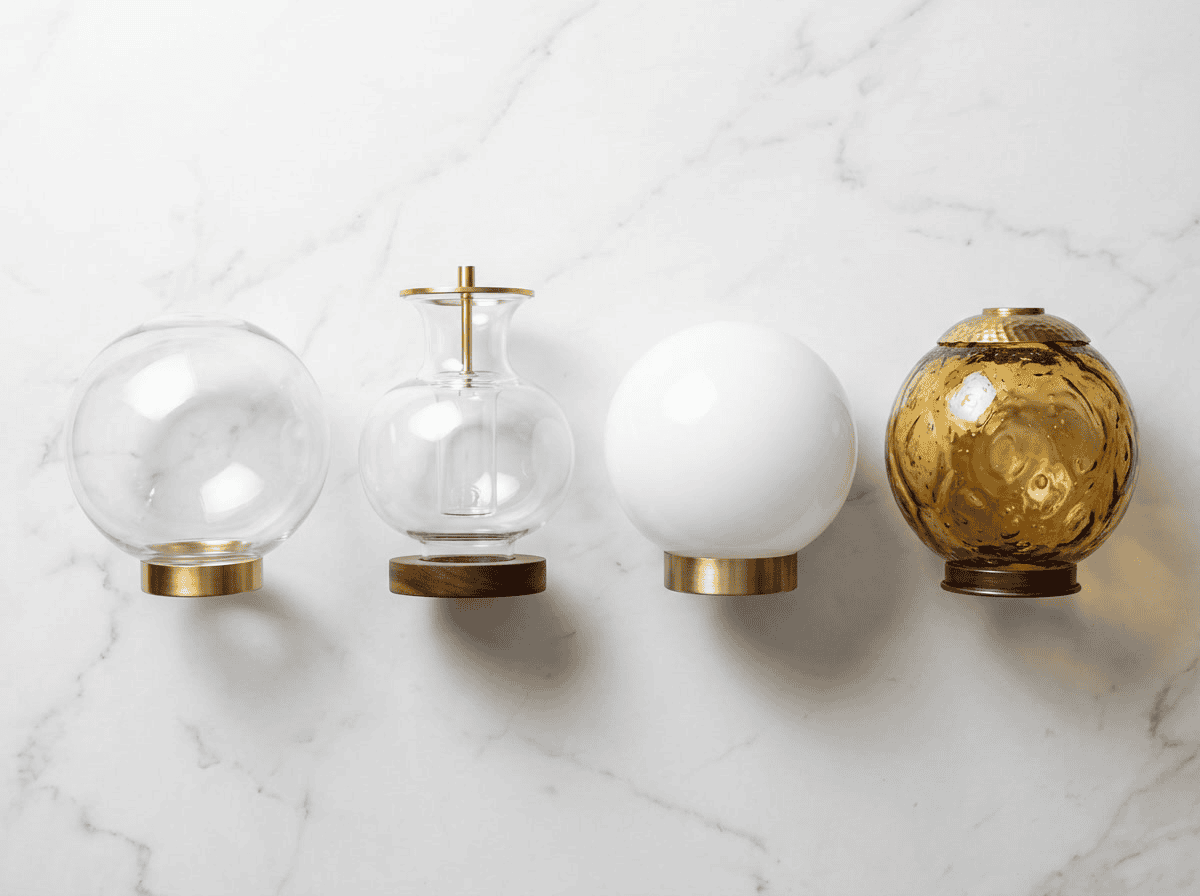
The three most common glass types are soda-lime glass (windows, bottles, standard lampshades), borosilicate glass (heat-resistant labware and pendant lights), and lead crystal (high-refractive-index decorative ware).
Understanding what glass is made of becomes more nuanced once you move beyond basic soda-lime. Different applications demand different formulations, and choosing the wrong glass type for a lampshade is a real risk.
Vidro Soda-Cal
The dominant glass type globally — roughly 90% of all glass production. Its composition (SiO₂ ~73%, Na₂O ~14%, CaO ~9%) makes it easy to melt, shape, and temper.
For lampshades: soda-lime is the default choice for blown, molded, or pressed glass globes. It’s affordable, takes colorants easily, and can be tempered to improve impact resistance. Its thermal expansion coefficient (approximately 9 × 10⁻⁶/°C) is higher than borosilicate, meaning it expands and contracts more with temperature changes — a relevant factor when pairing with high-wattage incandescent bulbs.
Vidro de Borossilicato
Replace some silica with boric oxide (B₂O₃) — typically adding 12–15% B₂O₃ — and you get borosilicate glass. The classic brand name is Pyrex, but the chemistry applies to any glass in this family.
Borosilicate has a thermal expansion coefficient of ~3.3 × 10⁻⁶/°C — roughly three times lower than soda-lime. This means it handles rapid temperature changes (thermal shock) far better, a critical property when glass is used directly around LED or halogen sources that cycle hot and cool quickly.
In practice, borosilicate lampshades can go from room temperature to 300°C without cracking under normal use. Soda-lime glass under the same conditions will stress-fracture. For pendant lights, table lamps with exposed bulbs, or any fixture where the glass sits within 5cm of a high-intensity source, borosilicate is the technically correct choice.
Lead Crystal Glass
Traditional lead crystal replaces calcium oxide with lead oxide (PbO, typically 24–35% by weight). Lead oxide dramatically increases the refractive index (RI) to approximately 1.56–1.60, compared to 1.52 for standard soda-lime. That higher RI is what creates the distinctive “sparkle” and prismatic dispersion in cut crystal lampshades.
However, lead crystal has regulatory complications. The EU’s RoHS and REACH directives have driven most manufacturers toward unleaded crystal alternatives using barium oxide (BaO) or zinc oxide (ZnO) to achieve similar RI without the heavy metal. Quality differences between lead and unleaded crystal are minimal for most decorative applications.
Quartz Glass (Fused Silica)
Pure fused silica — essentially 99.9%+ SiO₂ — sits at the high end of the performance spectrum. Its melting point exceeds 1650°C, its thermal expansion is near-zero (0.55 × 10⁻⁶/°C), and it transmits ultraviolet light, which conventional glass blocks.
Quartz glass is rarely used for decorative lampshades (cost-prohibitive) but appears in specialized UV-transmitting fixtures, scientific lamp housings, and high-intensity industrial lighting.
Glass Materials in Lampshades and Decorative Glassware
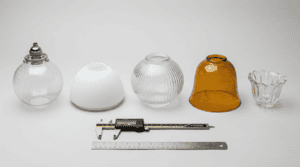
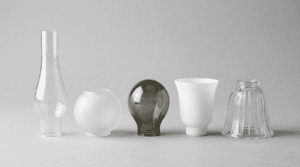
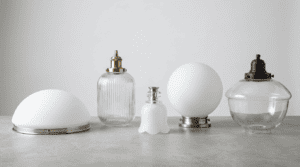
Decorative glass lampshades use soda-lime glass for standard blown globes, borosilicate for heat-intensive fittings, and occasionally specialty glasses (milk glass, opalescent, art glass) for specific diffusion or aesthetic effects.
This is where the raw material question becomes directly practical for anyone selecting or purchasing glass lampshades. The look, durability, and safety of a lampshade all trace back to its glass composition.
Milk Glass — Opal Silicates
Milk glass (also called opaline glass) is a soda-lime base modified with fluorides (sodium or calcium fluoride) or phosphates to create internal light scattering. The additive precipitates tiny calcium fluoride crystals during cooling — these microscopic particles scatter transmitted light and create the characteristic milky-white, diffuse glow.
For lampshades, milk glass is prized specifically because it softens and diffuses LED and incandescent sources, eliminating hotspots. The diffusion quality depends on the concentration of the scattering agent — too little and the glass remains translucent with a visible bulb; too much and it becomes opaque.
Colored Art Glass
Art glass lampshades (including the Tiffany and contemporary stained glass styles) use a soda-lime base with metal oxide colorants fired into the melt:
| Cor | Colorant |
|---|---|
| Cobalt blue | Cobalt oxide (CoO) |
| Amber/yellow | Iron + sulfur (FeS) |
| Green | Chromium oxide (Cr₂O₃) or copper |
| Red/ruby | Selenium or gold colloidal particles |
| Turquoise | Copper oxide (CuO) |
Gold ruby glass — using colloidal gold particles — is particularly demanding to produce; the gold must be struck (reheated after forming) to develop the red color, and gold particle size must be carefully controlled.
Etched and Frosted Glass
Frosted finishes on lampshades are not a different glass type — they’re surface treatments on standard soda-lime glass. Acid etching uses hydrofluoric acid or an ammonium bifluoride paste to microscopically roughen the surface, creating diffuse light scattering. Jateamento achieves a similar optical effect mechanically.
Both processes reduce surface gloss (from ~100 glossy to ~15–30 matte on a 60° gloss scale) without altering bulk glass composition or light transmission.
How Glass Is Manufactured — From Raw Material to Lampshade
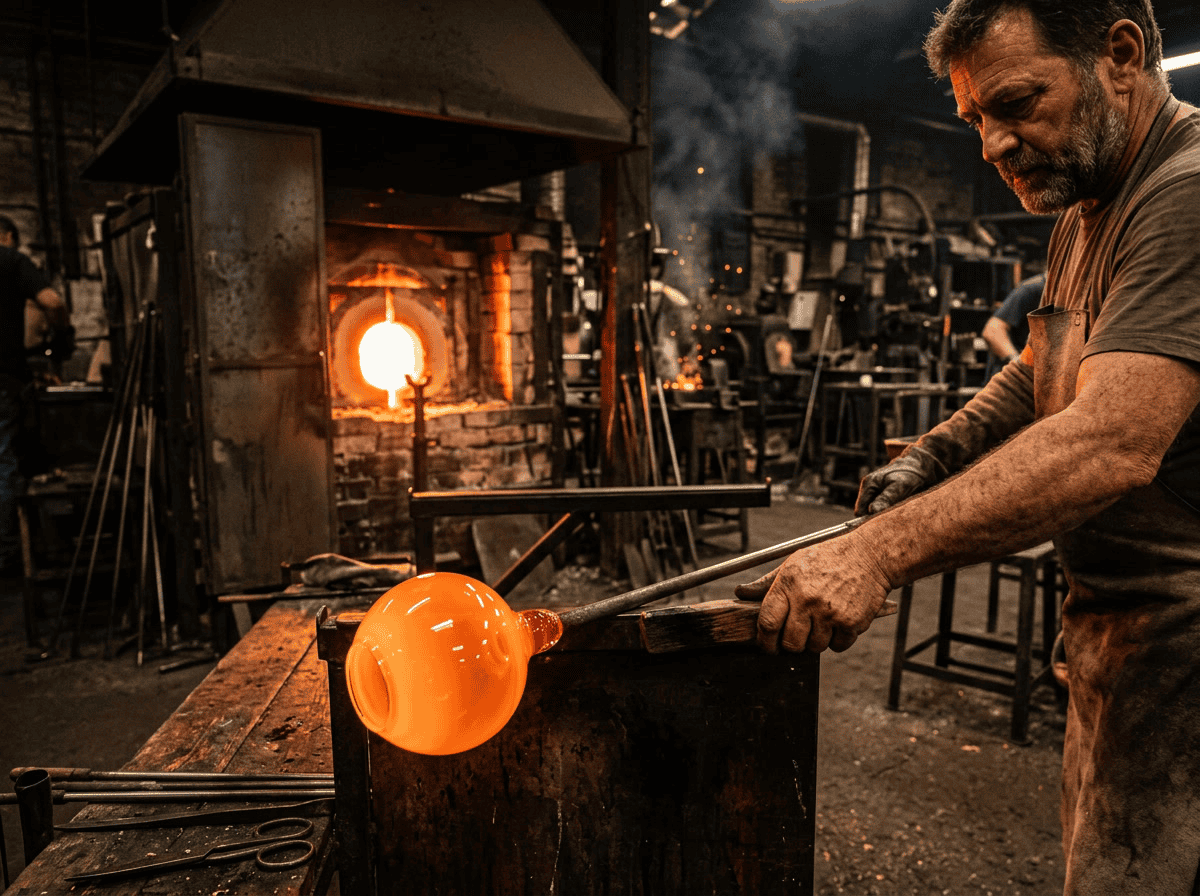
Glass is made by batching raw materials (silica, soda ash, limestone, cullet), melting them in a furnace at 1500–1600°C, forming the molten glass into shapes, then annealing (slow cooling) to relieve internal stress.
Understanding the manufacturing process clarifies why composition matters so much: small changes in raw material ratios affect viscosity, workability, and final properties.
Step 1 — Batch Preparation
Raw materials are weighed precisely and mixed with cullet (recycled glass, typically 25–40% of the batch). Cullet reduces melting energy by approximately 2.5% per 10% cullet addition — an efficiency measure with real cost implications in large-scale production.
Step 2 — Melting
The batch enters a furnace at 1500–1600°C. Modern continuous tank furnaces hold several hundred tonnes of molten glass simultaneously. Melting time varies from 24–48 hours to achieve complete homogenization.
At peak temperature, the glass melt is highly fluid (viscosity ~100 Pa·s). As it cools, viscosity increases sharply — this property window is what glassblowers and machine formers exploit.
Step 3 — Forming
For lampshades specifically:
- Mouth-blown glass: a gather of molten glass (~1200°C) is inflated by a glassblower into a mold or free-blown. The technique produces natural variations in wall thickness that give art glass lampshades their distinctive character.
- Machine pressing: molten glass is pressed into a mold under controlled force — used for uniform commercial globes.
- Centrifugal spinning: used for some cylindrical lamp covers, where a gob of glass is spun in a mold.
Step 4 — Annealing
Freshly formed glass contains significant internal stress from uneven cooling. Without annealing (controlled slow cooling in a lehr oven, typically 600°C to room temperature over 20–60 minutes), the glass would spontaneously fracture.
Tempered glass goes through a different process: it’s reheated to ~620°C and then rapidly quenched with air jets, creating compressive stress on the surface that gives it 4–5× the impact resistance of annealed glass.
Step 5 — Quality Control and Surface Treatment
Glass lampshades are inspected for seed bubbles, inclusions, strain, and dimensional tolerance. Surface treatments (frosting, coating, painting) are applied at this stage.
How to Choose the Right Glass Material for Your Lampshade
Choose borosilicate for high-heat or exposed-bulb applications; soda-lime for standard enclosed fixtures; milk glass for diffused ambient lighting; and lead-free crystal or art glass for decorative statement pieces.
Most buying decisions come down to four practical questions:
1. What Bulb Type and Wattage?
| Bulb type | Max surface temp | Recommended glass |
|---|---|---|
| LED (standard) | < 100°C | Soda-lime (adequate) |
| Halogen (25–100W) | 250–300°C | Borosilicate required |
| Incandescent (> 60W) | 150–200°C | Borosilicate preferred |
| CFL | < 120°C | Soda-lime (adequate) |
This is where most consumers go wrong. A soda-lime globe specified for an enclosed LED fixture is not the same as one that should be used with a halogen source — but they look identical on a shelf.
2. What Light Quality Do You Need?
- Clear glass: maximum lumen output, visible bulb, dramatic shadows. Best for Edison-style exposed bulbs.
- Frosted/etched: softens filament visibility, reduces glare, minor transmission loss (~10%).
- Milk glass: heavy diffusion, warm even glow, significant transmission reduction (30–50% loss).
- Colored: decorative chromatic effect, paired to bulb color temperature.
3. Where Will It Be Used?
Outdoor lampshades face UV exposure, temperature cycling, and humidity. Borosilicate with a UV-resistant coating or tempered soda-lime are preferable for exterior applications. Standard annealed soda-lime in outdoor conditions will develop surface devitrification (cloudiness) over years of UV exposure.
4. What’s the Aesthetic Priority?
- Traditional/vintage: clear soda-lime, blown texture, amber colorant
- Modern minimalist: frosted borosilicate, thin-wall, geometric form
- Statement/art: hand-blown colored art glass, Tiffany-style leaded panels
- Industrial: clear borosilicate tube or cage fitting
Pro tip from our production team: When sourcing glass lampshades for commercial projects (hotels, restaurants), always verify the glass type against the specified fixture. We consistently find that decorative distributors mix borosilicate and soda-lime globes in the same product line without clearly labeling the difference.
Future Trends in Glass Material Technology (2026 and Beyond)
The next generation of glass materials for lighting focuses on smart glass, ultra-low-iron optical glass, and bio-based additive formulations — trends already visible in premium architectural and decorative lighting.
Smart and Electrochromic Glass
Electrochromic glass — which changes transparency in response to electrical voltage — is moving from large-format architectural glazing into lamp and fixture applications. The technology layers a thin film of tungsten oxide (WO₃) onto standard glass substrate. Apply a low current, and the glass shifts from clear to a deep blue-gray opacity.
For lampshades, this means a single fixture that serves both as open ambient lighting (clear mode) and a diffused, soft-light mood fixture (tinted mode) via a simple switch or smart-home command. Commercial-scale lampshade applications are expected by 2027–2028 as film costs fall below $15/m².
Ultra-Low-Iron Glass for Maximum Clarity
Standard float glass has an iron content of 0.015–0.025% Fe₂O₃, giving it a faint green tint visible at edge. Ultra-clear (low-iron) glass — used in premium solar panels and museum display cases — reduces iron to < 0.005%, achieving transmission values above 91% vs. 84–86% for standard glass.
For high-end decorative lampshades with color-specific light requirements (art installations, hospitality lighting), low-iron glass provides dramatically better color rendering. According to the Corning glass materials science resource, advances in raw material purification are making ultra-clear glass increasingly cost-competitive for decorative applications.
Recycled Content and Circular Manufacturing
Growing environmental regulation in the EU (and incoming standards in North America) is pushing glass manufacturers toward higher cullet (recycled glass) content — targets of 60–70% cullet for container glass are already policy in several EU member states. For lampshade glass, the challenge is color consistency: recycled cullet from mixed waste streams introduces color contamination, requiring more aggressive decolorant additions.
Manufacturers investing in closed-loop cullet programs (collecting and reprocessing their own product returns) can maintain optical quality while meeting sustainability targets.
FAQ — Glass Materials Explained
What is glass made out of?
Glass is made of silica sand (silicon dioxide), soda ash, and limestone, melted together at over 1500°C and cooled rapidly. Silica forms the structural network; soda ash lowers the melting temperature; limestone provides chemical stability. Most household glass (windows, bottles, lampshades) is soda-lime glass using roughly 73% SiO₂, 14% Na₂O, and 9% CaO by weight.
What is real glass made out of, versus synthetic alternatives?
Real glass is made from inorganic mineral raw materials (silica, soda ash, limestone) fused into an amorphous solid. Acrylic and polycarbonate are often called “glass” colloquially but are fundamentally organic polymers — they’re lighter and shatter-resistant but scratch more easily, yellow under UV, and cannot match glass’s heat resistance. For lampshades, genuine glass is always preferable unless impact resistance is the absolute priority.
Is glass less toxic than stainless steel?
Glass is chemically inert and non-leaching, making it an excellent choice where food or moisture contact is a concern. It contains no reactive metals or surface coatings. Stainless steel (grade 304 or 316) is also highly safe, but can theoretically leach trace nickel or chromium under acidic conditions. For decorative glass lampshades, toxicity isn’t a practical concern either way — the comparison is most relevant for food and beverage applications.
What makes borosilicate glass better for lampshades?
Borosilicate glass has a thermal expansion coefficient of ~3.3 × 10⁻⁶/°C — three times lower than soda-lime — making it highly resistant to thermal shock. This is critical when glass undergoes rapid heating near a bulb or rapid cooling in changing ambient temperatures. Standard soda-lime glass lampshades can crack when used with halogen or high-wattage incandescent sources that were not part of the original design spec.
Why does glass look green at the edges?
The green tint at glass edges comes from iron oxide (Fe₂O₃) impurities in the silica sand raw material. Standard float glass contains approximately 0.015–0.025% iron oxide, which is nearly invisible in thin sections but becomes visually obvious at edges where light travels through more glass thickness. Ultra-clear low-iron glass reduces this to < 0.005% for applications where edge color matters.
Can glass lampshades be recycled?
Glass lampshades can be recycled but are typically not accepted in curbside container-glass recycling streams. Flat glass and borosilicate glass have different compositions and melting temperatures than container glass (bottles, jars), and mixing them contaminates container glass batches. Specialty glass recyclers and some manufacturer take-back programs accept decorative glass for reprocessing. Community discussion on glass recycling and reuse on Reddit r/askscience highlights the practical challenges consumers face.
How is glass made naturally?
Natural glass forms when silica-rich materials melt and cool rapidly — volcanic glass (obsidian) forms from cooling lava, and fulgurite forms when lightning strikes sand. Obsidian is essentially a natural soda-silica glass, and historically cultures from Mesoamerica to the Mediterranean used it for tools and ornaments before synthetic glass production began around 3500 BCE in Mesopotamia.
Conclusão
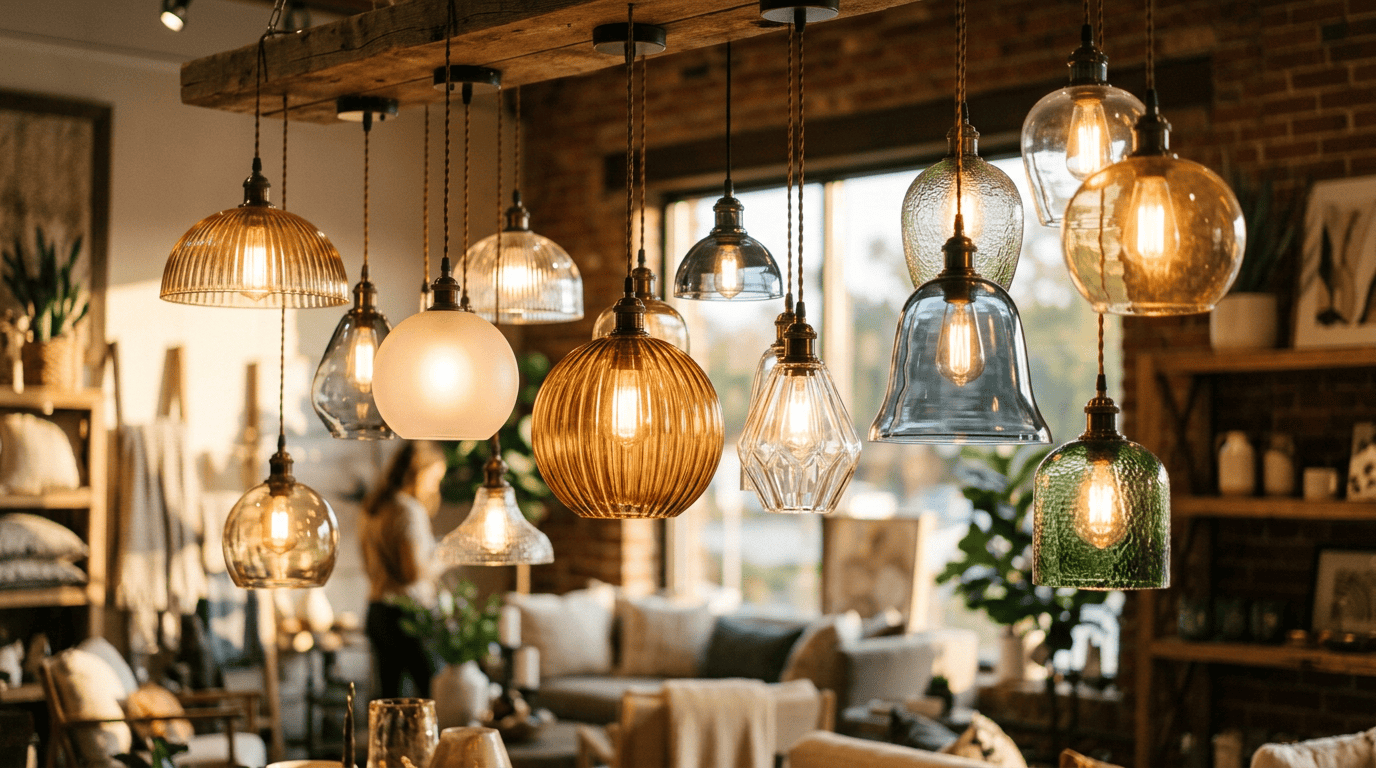
Glass is made of what material? The core answer is simple: silica sand, soda ash, and limestone — three abundant minerals transformed by heat into one of humanity’s most versatile materials. But the practical application is nuanced. Soda-lime glass, borosilicate, lead-free crystal, milk glass, and art glass each occupy a specific niche defined by their composition, and the difference between them matters for safety, optical performance, and long-term durability.
For glass lampshades specifically, the choice comes down to your heat source, your light quality requirement, and your aesthetic intent. Borosilicate where heat is involved. Milk glass where diffusion matters. Clear soda-lime or art glass where visual character is the priority. Understanding what goes into the glass you’re buying makes every specification decision more confident — and every lampshade you choose a better fit for its purpose.