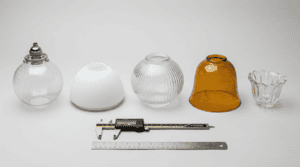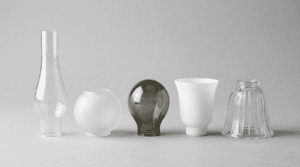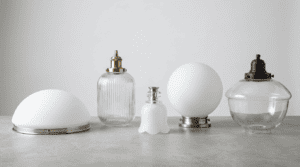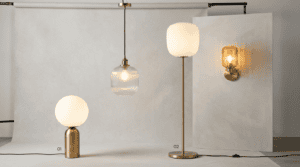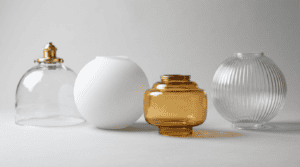
Glass lamp shade replacement requires matching four dimensions — fitter inside diameter, shade height, rim diameter, and fitter type — against the original, then sourcing a same-batch shade for matched-set fixtures like chandeliers and vanity bars. Get any one of the four wrong and the shade won’t fit, won’t look right, or won’t match the surviving shades in a multi-shade fixture.
A broken glass lamp shade on a table lamp is annoying. A broken shade on a chandelier with 5 surviving matched shades is a sourcing problem that takes most buyers two or three failed orders to solve. The category page that sold you the original 4 years ago is usually long gone, and the “universal replacement” listings on Amazon rarely tell you the fitter standard you actually need.
We’ve shipped over 40,000 glass lamp shade replacement orders since 2003, including thousands of custom matches against fragments and photographs. The questions that come up at the point of sale are almost always the same three: how do I measure, how do I match an old shade I can’t identify, and how do I avoid the color mismatch that ruins matched sets. This guide answers all three.
What Is Glass Lamp Shade Replacement?
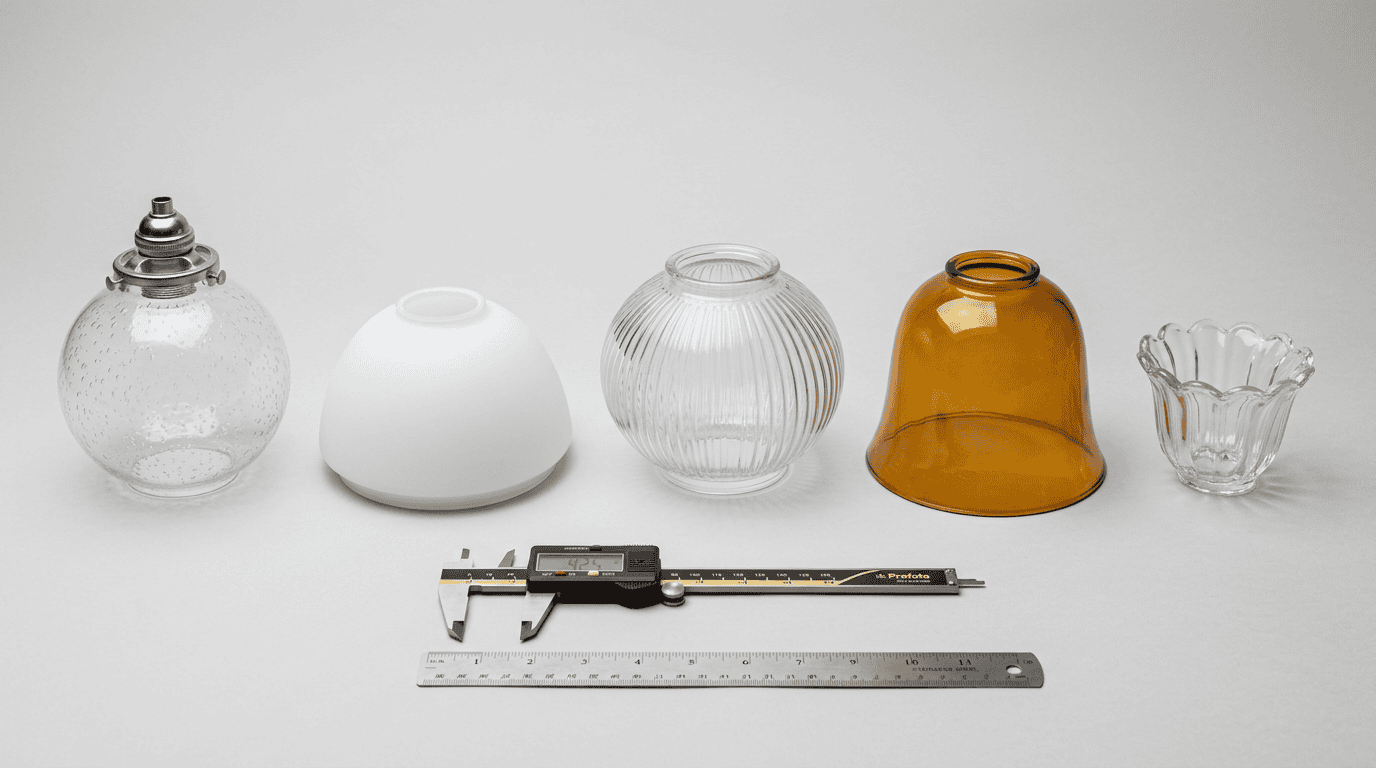
Glass lamp shade replacement is the process of identifying, sourcing, and installing a new glass shade that fits an existing lamp or fixture in place of a broken, missing, or upgraded shade. It covers three distinct scenarios: like-for-like replacement of a broken shade, style upgrade where the original is intact but unwanted, and matched-set replacement where one shade in a multi-shade fixture has failed.
Each scenario has a different success criterion. Like-for-like just needs to fit and roughly resemble the original. Style upgrade has total freedom on aesthetics as long as the fitter matches. Matched-set replacement is the hardest because the new shade must visually integrate with shades produced 2–10 years earlier in a different production batch.
The single biggest source of failed replacement orders
Measurement error. According to industry data, roughly one in four glass lamp shade replacement orders ship the wrong size because buyers measured the lamp’s harp or arm instead of the shade’s fitter, or measured the rim instead of the inside diameter. The fix is simple but unintuitive: remove the existing shade and caliper the inside diameter of the opening that mates to the lamp. That measurement, to ±0.5 mm, is the only one that determines whether the replacement seats correctly.
When replacement is the right call versus repair
Hairline cracks under 30 mm can sometimes be stabilized with UV-cured optical adhesive at a specialty restoration shop for $80–$200. Rim chips can be polished out by the same shops. Catastrophic breaks, missing pieces, or shades with structural cracks running across the body are replacement candidates only — repair makes no economic sense below $300 unless the shade is signed (Tiffany, Handel, Pairpoint, Quezal) and worth restoring for provenance.
When to Order a Glass Lamp Shade Replacement
Order a replacement immediately when the existing shade has a structural crack, missing piece, persistent rattle, or visible heat damage; defer replacement when the issue is cosmetic only. The decision matters because handling a cracked shade increases the risk of catastrophic failure during cleaning or bulb change.
Structural cracks
Any crack longer than 30 mm or any crack that crosses the rim or fitter is a hard replacement trigger. Thermal cycling will widen the crack until the shade fails — usually at the worst possible moment. Replace before the next bulb change.
Missing pieces and chips
Chips at the rim larger than 5 mm × 5 mm compromise structural integrity and create sharp edges. Missing pieces from stained-glass shades expose the leaded framework to humidity-driven corrosion. Order replacement within 2 weeks.
Heat damage and discoloration
Yellowing on clear or frosted shades indicates the bulb wattage exceeds the shade’s rating, or that incandescent bulbs were used on a shade rated for LED-only thermal loads. Discoloration is irreversible. Replace and downgrade the bulb wattage to match the new shade’s spec.
Cosmetic issues (defer)
Surface dust, fingerprints, water spots, and minor scratches on the surface are not replacement triggers. Clean first; replace only if cleaning doesn’t restore appearance.
Matched-set considerations
If one shade in a 6-arm chandelier fails, the question isn’t just “replace one shade” — it’s “replace one shade and accept color mismatch, or replace all 6 shades.” Replacing all 6 from a single new production batch ensures perfect matching but costs 6× more. Replacing just the failed one saves money but the new shade will almost certainly differ from the surviving 5 by Delta-E 1–3. Discuss the trade-off before ordering.
How to Measure for Glass Lamp Shade Replacement
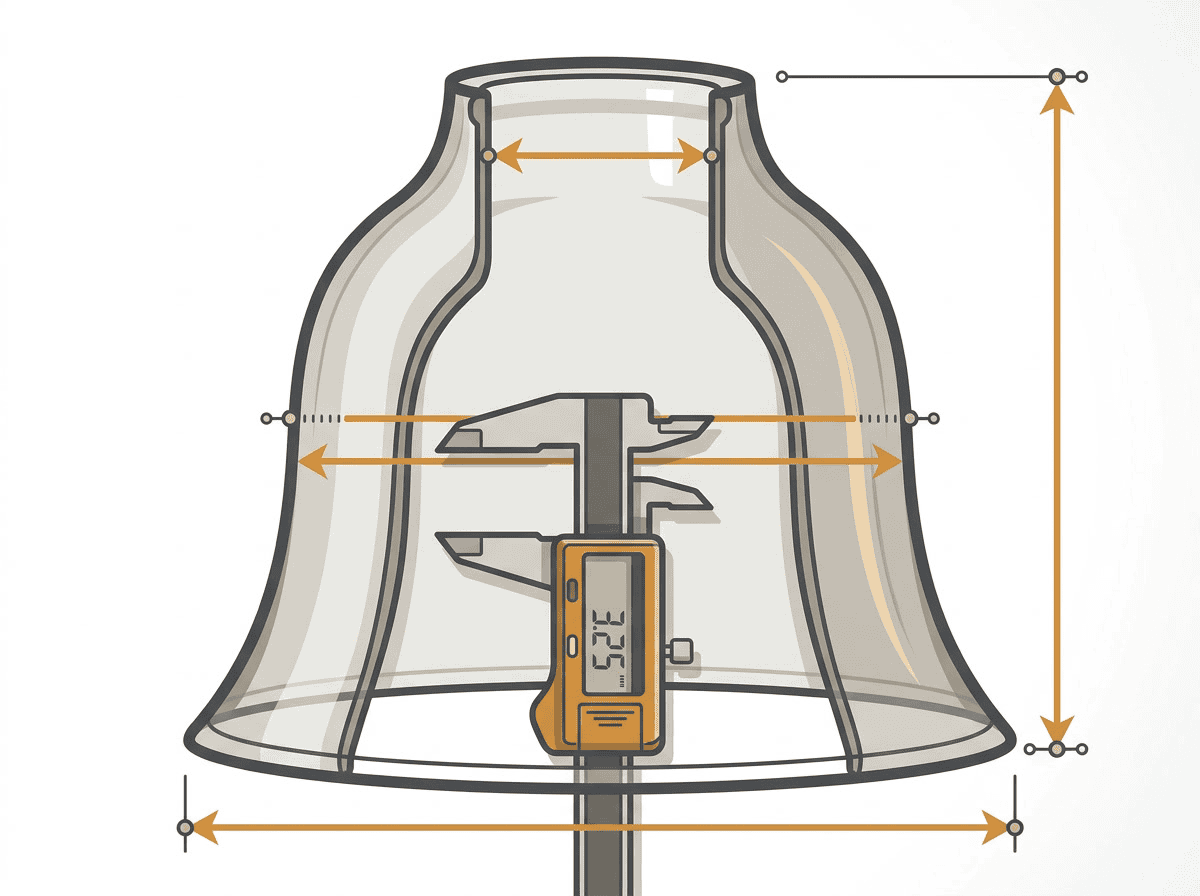
Measure four dimensions in this order: fitter inside diameter, shade overall height, maximum outside diameter, and rim outside diameter at the bottom opening. Use a digital caliper for the fitter; a tape measure works for the other three.
Dimension 1: Fitter inside diameter (the critical one)
The opening at the top (or sometimes the bottom) of the shade that mates to the lamp’s harp, socket, or threaded ring. Common fitter sizes: 1-5/8″ (41 mm), 2-1/4″ (57 mm), 3-1/4″ (82 mm), 4″ (101 mm) for imperial; 28 mm, 30 mm, 42 mm for European metric. Measure with digital calipers to ±0.5 mm — anything looser and you risk a 1/16″ mismatch that prevents the shade from seating.
Dimension 2: Overall shade height
From the rim of the fitter to the bottom rim. This determines whether the shade fits the lamp’s harp height (for harp-mounted shades) or hangs correctly from the canopy (for pendants). Tape measure to ±1 mm is sufficient.
Dimension 3: Maximum outside diameter
The widest point of the shade, which for most shapes is somewhere between the top and bottom. This is the dimension that determines whether the shade clears adjacent furniture, walls, and other shades on a chandelier. Tape measure to ±2 mm.
Dimension 4: Rim outside diameter (bottom opening)
The diameter at the bottom opening, measured outside-to-outside. This dimension is critical for matched-set replacement because rim diameter affects the visual proportions when shades sit next to each other on a vanity bar or chandelier.
Bonus: Photograph the existing shade with a ruler in frame
Place a steel ruler horizontally across the shade’s widest point and photograph from straight-on. This gives the supplier a visual reference that catches what numerical measurements miss — proportions, profile curvature, rim detailing.
The fitter-type check
Once you’ve measured, identify which of the four fitter types the shade uses:
- Uno fitter — internal threads, screws directly onto the socket
- Slip-uno fitter — internal sleeve, slides over the socket
- Spider fitter — wire frame, sits atop the harp held by a finial
- Threaded neck — male threads on top of the shade, mates to a female threaded collar
Fitter type can’t be measured numerically — it has to be identified visually. Compare against reference photos in the American Lighting Association’s guide to lamp parts if you’re not sure.
Measurement cheat sheet
| Dimension | Tool | Tolerance | Why it matters |
|---|---|---|---|
| Fitter inside diameter | Digital caliper | ±0.5 mm | Determines fit |
| Shade height | Tape measure | ±1 mm | Harp/canopy compatibility |
| Max outside diameter | Tape measure | ±2 mm | Adjacent clearance |
| Rim outside diameter | Tape measure | ±1 mm | Matched-set proportions |
| Fitter type | Visual | N/A | Mount compatibility |
Types of Glass Lamp Shade Replacement Options
Replacement options fall into four categories: identical match (same maker, same SKU), close-match generic, custom reproduction, and style upgrade. Each has different cost, lead time, and visual fidelity profiles.
Identical match
The original manufacturer still produces the exact SKU. Order direct or through a lighting distributor. Lead time 1–3 weeks. Cost 1–2× original retail. Perfect visual match. Available for roughly 30% of replacement queries, since most consumer-grade lamp SKUs are discontinued within 18–36 months.
Close-match generic
Mass retailer or restoration supplier carries a close approximation — same fitter, similar size, similar finish. Lead time 1–2 weeks. Cost 0.5–1.5× original retail. Visual match within Delta-E 2–5 for color, ±5% for proportion. Available for roughly 60% of replacement queries.
Custom reproduction
Manufacturer produces a one-off shade matched to your specs, photographs, and dimensional drawings. Lead time 4–10 weeks. Cost 3–8× standard retail. Visual match very close, but mouth-blown reproductions vary by ±1.5 mm wall thickness. Right channel for signed period shades, hospitality matched-set rescue, and any project where exact match matters more than cost.
Style upgrade
You’re not trying to match — you’re replacing the broken shade with something visually different and better. Total freedom on style; only fitter compatibility matters. Lead time depends on source (1 week from retail; 4–8 weeks from manufacturer-direct custom). Cost varies entirely on the new style chosen.
When to pick which path
| Scenario | Best path | Trade-off |
|---|---|---|
| Single shade on table lamp, original SKU known | Identical match if available, else close-match generic | None significant |
| Matched-set chandelier or vanity bar | Identical match (entire set if possible), else custom reproduction | Cost vs. visual integrity |
| Signed period shade (Tiffany, Handel) | Custom reproduction or specialist restoration | Lead time and cost |
| Old style you’ve grown tired of | Style upgrade | None; full freedom |
| One shade missing from inherited fixture | Close-match generic with batch acceptance | Color mismatch tolerated |
How to Match a Replacement When the Original Is Unknown
For fixtures with no documented manufacturer or SKU, work the identification problem in this order: search for maker’s marks, identify the era and style from physical features, send specs and photographs to specialty restoration suppliers, and accept that for mass-produced 1970–2000 fixtures, exact identification is often impossible.
Step 1: Look for maker’s marks
Check the rim, the inside of the fitter, the pontil mark on hand-blown pieces, and any visible interior surface for engraved, etched, or fired-on marks. Tiffany, Handel, Pairpoint, Quezal, Steuben, and Bradley & Hubbard all signed their work and the marks are documented online. Even partial marks (“…ANDEL”) narrow the search significantly.
Step 2: Identify the era from physical features
Pre-1920 hand-blown shades show a pontil scar (a small rough disc on the base). 1920s–1940s pressed glass shades show seam lines from two- or three-part molds. 1950s–1970s machine-blown shades show a clean smooth base with no pontil. Post-2000 imports often have rough rims that weren’t fire-polished. The Corning Museum of Glass guide to dating glass covers the era indicators in detail.
Step 3: Send to specialty restoration suppliers
Antique Lamp Supply, Paxton Hardware, BP Lamp Supply, and similar specialty restoration suppliers have catalogs going back decades. Email them dimensional measurements + photographs (with ruler in frame) + any mark photos, and they often identify the original maker and SKU within 48 hours. This service is usually free even if you don’t end up ordering from them.
Step 4: Accept identification gaps
For unmarked mass-produced fixtures made between 1970 and 2000, the original manufacturer is often a defunct importer with no surviving records. In that case, the right path is close-match generic or custom reproduction rather than continuing to hunt for an identical original.
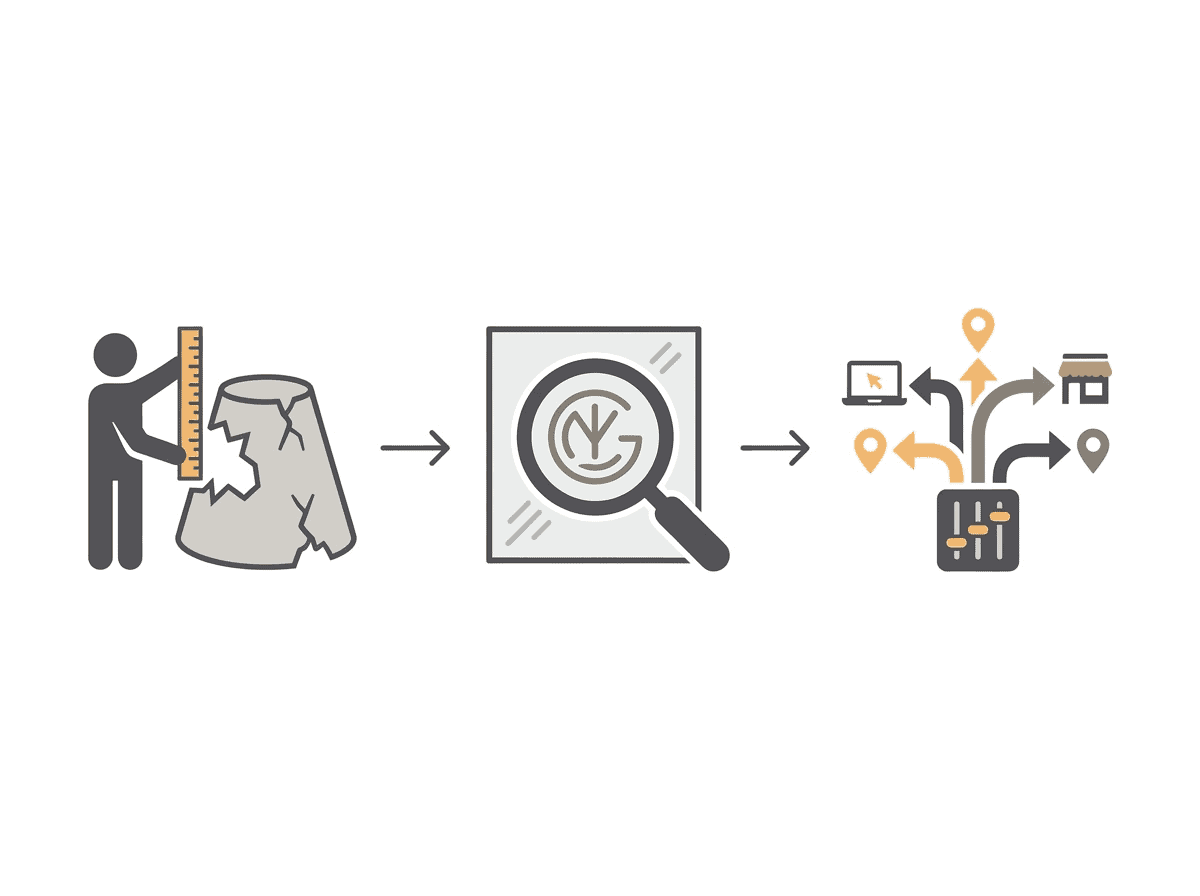
Aplicações da indústria
Glass lamp shade replacement demand splits across five sectors: residential retail (consumer single-replacement), hospitality FF&E (matched-set rescue), restoration and antiques (period-correct reproduction), commercial (vanity bars, sconces), and the niche outdoor/marine replacement segment.
Varejo residencial
The largest channel by unit volume. Standard fitter sizes dominate; consumers usually buy through Home Depot, Lamps Plus, Wayfair, or Amazon. Average order value $20–$60 for single shades, $80–$200 for vanity bar 3-packs. Returns rate runs 8–14% — higher than new lamp purchases because measurement errors are common.
Hospitalidade FF&E
The most demanding channel for glass lamp shade replacement. Hotel chains rotating FF&E need shades matching surviving fixtures across hundreds of rooms. We’ve worked on rescue projects where 280 surviving shades had to be matched by a new production batch within Delta-E 1.5 — that’s tighter than the original installation tolerance and requires test runs against actual surviving samples before final production.
Restoration and antiques
Period-correct mouth-blown reproductions for 1900–1970 fixtures. Specialty restoration suppliers dominate this channel. Average order value $80–$400 for a single shade. Lead times 4–10 weeks for custom reproductions. According to the U.S. Department of Commerce restoration industry data, period-correct restoration is a $2.4B annual market, with lighting restoration a small but stable segment.
Commercial vanity and sconce replacement
Office buildings, retail interiors, and apartment building common areas need matched-batch glass lamp shade replacement for vanity bars (3-pack, 5-pack) and sconces. Pricing channel: distributor or manufacturer-direct. Lead time 2–4 weeks for stock, 6–10 weeks for matched-batch custom.
Outdoor and marine
Borosilicate shades only. Replacement frequency is higher than residential due to UV exposure, salt spray, and impact damage. According to Statista’s outdoor lighting market data, outdoor lighting accounts for roughly 12% of total lighting industry revenue, with replacement parts a growing sub-segment as fixtures designed for serviceability replace integrated outdoor units.
Sourcing Channels for Replacement
Five channels with different MOQs, lead times, and customization profiles.
Varejo de grande porte e online. Home Depot, Lamps Plus, Wayfair, Amazon. Mass-market sizes (1-5/8″, 2-1/4″ fitters; frosted, opal, clear finishes) at $15–$60 per shade. Easy returns. Right for consumer single-replacement when the fitter and rough size are common.
Fornecedores de restauração especializados. Antique Lamp Supply, Paxton Hardware, BP Lamp Supply. Period-correct shades for 1900–1970 fixtures. Higher unit prices ($40–$300) but carry sizes and shapes mass retail doesn’t. Identification help often free.
Distribuidores de iluminação. Rejuvenation, Schoolhouse Electric, regional showrooms. Curated catalogs at retail-plus pricing, 5–30 unit ordering, 2-week typical ship. Right for designers, contractors, and small hospitality projects.
Direto do fabricante. Best for matched-set rescue (10+ shades), custom colors, branded etching, or non-standard dimensions. MOQ 50–200 for custom work. Unit pricing 40–60% below retail. Lead times 30–90 days. Right channel for hospitality FF&E and high-volume contract.
Auction and second-hand markets. eBay, Etsy, Live Auctioneers, local estate sales. The only channel for matching a truly discontinued shade by sourcing an unbroken survivor from a parted-out fixture. Quality variance is high; sample is impossible. Right when nothing else works.
Common Mistakes in Glass Lamp Shade Replacement
Ordering by approximate fitter size. Uma cúpula de 2-1/4″ não se encaixa em um encaixe de 2-1/8″. A discrepância de 1/8″ significa que a cúpula não se encaixará ou ficará muito solta para segurar. Meça para ±0,5 mm e faça o pedido com base nessa especificação.
Buying single replacements for matched sets without batch information. A replacement shade for a 6-shade chandelier or 3-shade vanity bar ordered from a different batch will subtly mismatch the surviving shades. Order from the same supplier with documented batch numbers, or replace the entire set.
Skipping the harp-shade height check. A 10″ shade on a 13″ harp leaves 3″ of exposed socket — looks wrong and lets glare escape. The harp should equal the shade height ±1/2 inch. Buy a new harp at the same time if needed.
Choosing a shade rated for higher bulb wattage than the lamp safely supports. A shade rated for 100W can be used on a 40W lamp without issue, but the opposite is dangerous. Always check both the lamp’s max wattage and the shade’s wattage rating, then use the lower of the two as your bulb cap.
Trusting “universal” listings without checking fitter compatibility. Many online listings claim “fits most lamps” without specifying fitter standard. Always verify the fitter size in the listing’s specifications before ordering. Returns are easy from major retailers but lost time and shipping costs are real.
Buying a single replacement from a different glass family than the original. Soda-lime on a fixture next to surviving borosilicate shades will have visibly different color tone, even when both are “clear.” Match the glass family as well as the dimensions.
Care and Maintenance to Avoid Future Replacement
Most glass lamp shade replacement orders trace back to preventable damage — thermal shock from wrong-wattage bulbs, impact from cleaning accidents, or stress from over-tightened fitters. Three practices extend shade life by 5–10×.
Bulb selection
Use LED bulbs whenever possible. They run roughly 60% cooler than incandescent equivalents and dramatically reduce the thermal cycling that cracks shades over years of use. Verify the bulb wattage doesn’t exceed the shade’s rating, and never use 100W+ incandescent bulbs in shades designed for LED-era thermal loads.
Rotina de limpeza
Power off the fixture and let the bulb cool completely before removing the shade. Wash in warm — not hot — water with mild dish soap. Dry with a microfiber cloth. Reinstall with the fitter snug but not over-torqued — overcompression at the fitter contact point is a known stress point that propagates cracks.
Fitter contact protection
If the shade rim contacts a metal fitter ring directly, a small rubber or felt washer between glass and metal absorbs vibration and prevents micro-cracks from forming over years of use. Replacement washers cost under $1 each and add years to shade life.
Inspect periodically
Every 6–12 months, hold each shade up to a window and look for hairline cracks radiating from the rim or fitter. These often appear before catastrophic failure and indicate either thermal stress or mechanical stress. Replace shades with visible cracks before they fail dramatically during cleaning.
Future Trends in Glass Lamp Shade Replacement
Three trends are reshaping the glass lamp shade replacement market: manufacturer parts catalogs becoming standard, AI-assisted shade identification from photos, and the rise of certified refurbishment programs.
Manufacturer parts catalogs
Right-to-repair regulations in the EU and California are pushing fixture manufacturers to publish replacement-shade SKUs with long-term supply commitments. Expect 60–80% of premium residential and commercial fixture manufacturers to maintain 10-year replacement-shade availability by 2027.
AI-assisted shade identification
Computer vision applied to shade photographs can now identify era, style, and likely original maker within seconds. Several restoration suppliers are piloting “upload photo, get match suggestions” services. The technology will mature significantly through 2027 and reduce identification time for matched-set rescue from hours to minutes.
Certified refurbishment programs
Hotels and commercial property managers rotating FF&E every 7–10 years are starting to send used glass shades back to original manufacturers for refurbishment and resale rather than landfilling. The economics work: a $40 refurbished shade beats a $100 new build with the embedded carbon footprint. Expect 3–5 major manufacturers to launch formal take-back programs by 2027.
Recycled cullet replacement shades
Soda-lime replacement shades made with 30–50% recycled cullet cut embodied carbon by 25% without affecting optical quality. LEED-eligible replacement shades are emerging as a standard spec line in commercial RFPs.
O que não vai mudar
The four standard fitter sizes (1-5/8″, 2-1/4″, 3-1/4″, 4″). The basic taxonomy of clear / frosted / opal / seeded / ribbed / stained / colored cased. The measurement protocol. Sourcing playbooks built around these durable specs outlast any one supplier or technology cycle.

Perguntas Frequentes
How do I find an exact replacement for a broken glass lamp shade?
Photograph the broken shade alongside a ruler, caliper the fitter inside diameter to ±0.5 mm, identify the fitter type (uno, slip-uno, spider, or threaded), and send all four data points to a specialty restoration supplier. They identify the original maker in roughly 60% of cases within 48 hours. For unsigned mass-produced shades, expect to settle for close-match generic or custom reproduction rather than identical match.
Can I replace a single shade on a chandelier without replacing all of them?
Yes, but accept that the replacement will color-mismatch the surviving shades by Delta-E 1–3 because glass color drifts batch-to-batch. The mismatch is visible to most people in a 6+ shade fixture. For perfect match, replace the entire set from a single new production batch — usually 5–8× the cost of single replacement but the only path to true uniformity.
Where can I buy replacement glass lamp shades?
Five channels: big-box retail (Home Depot, Lamps Plus, Wayfair, Amazon) for standard sizes, specialty restoration suppliers (Antique Lamp Supply, Paxton Hardware, BP Lamp Supply) for vintage and period-correct, lighting distributors (Rejuvenation, Schoolhouse Electric) for designer pieces, manufacturer-direct for matched-set rescue and custom work, and auction sites (eBay, Etsy) for truly discontinued shades. Match the channel to the replacement type.
How much does glass lamp shade replacement cost?
Single residential replacement runs $15–$80 for standard sizes; matched-set replacement for chandeliers and vanity bars runs $80–$500 depending on size and quantity; custom reproduction for restoration runs $80–$400 per shade; and hospitality matched-set rescue runs $4,000–$50,000+ depending on quantity and customization. The single biggest cost driver isn’t size or material — it’s whether the original SKU is still available versus requiring custom matching.
Can glass lamp shade replacement be done with a different shape or style?
Yes — as long as the fitter compatibility matches, you have total freedom on shape, color, and finish. A frosted globe can be replaced with a clear ribbed cylinder or an opal cone if all three use the same fitter standard. This is the cheapest and easiest replacement path because you’re not constrained by matching anything — only fit.
Do I need a professional for glass lamp shade replacement?
No — shade replacement is a homeowner-level task for almost all residential lamps and fixtures. Power off the fixture at the breaker, let the bulb cool, remove the old shade (loosen thumbscrews, unscrew threaded collar, or release the clip), install the new shade, restore power. Total time 3–8 minutes per shade. Call an electrician only if the fixture housing itself needs to come down or if the wiring is suspect.
What if my fixture uses a non-standard fitter size?
Pre-1970 American fixtures occasionally use legacy fitters (1-1/2″, 2-1/8″, 2-3/8″) that don’t match modern 1-5/8″, 2-1/4″, 3-1/4″, or 4″ standards. Specialty restoration suppliers carry these legacy sizes; mass retailers don’t. If no legacy match exists, two options: have a manufacturer produce a custom shade to the legacy fitter dimension (4–10 week lead time, $80–$300), or have a metalworking shop modify the existing fitter to accept a modern standard size.
Real-World Glass Lamp Shade Replacement Scenarios
Three scenarios cover roughly 80% of glass lamp shade replacement orders — each with a different sourcing approach and time commitment.
Scenario 1: Broken bedside table lamp shade
Most common case. The 2-1/4″ fitter opal globe on a bedside table lamp shattered when the lamp tipped over. Path: measure the harp, photograph the lamp base, walk into any big-box lighting retailer or order online, pick a similarly sized opal globe with matching 2-1/4″ fitter. Total time: 1 hour shopping, 5 minutes installing. Cost: $25–$45.
Scenario 2: One shade missing from a 6-arm chandelier
Harder case. The original chandelier was bought 4 years ago from a brand that’s since discontinued the SKU. Path: contact the original retailer first to check if old stock exists; if not, send dimensions + photographs to 2–3 specialty restoration suppliers; if still no match, order a custom reproduction matched to a surviving shade. Total time: 2 weeks of search + 4–8 weeks for custom production. Cost: $80–$300 for the single custom shade, or $400–$1,800 for replacing all six from one new batch.
Scenario 3: Hospitality rollout matched-set rescue
Hardest case. A hotel chain has 280 surviving glass lamp shade replacements needed across 47 rooms after a renovation knocked them off nightstands. The original manufacturer has discontinued the SKU. Path: contact the original manufacturer directly to see if archived production records and tooling survive; if so, run a one-time matched batch. If not, sample 3–5 surviving shades and send to a custom manufacturer for color-matched production at Delta-E ≤ 1.5 against the survivors. Total time: 2–4 weeks for sampling + 6–10 weeks production. Cost: $4,000–$25,000 depending on quantity and customization.
Conclusão
Glass lamp shade replacement is a four-decision problem: measure correctly to ±0.5 mm on the fitter, identify what you have if it’s part of a matched set, pick the right channel for the replacement type you need, and avoid the common mistakes that drive one-in-four returns in this category. Get those four right and the replacement arrives, fits, and looks right on the first try.
For matched-set fixtures — chandeliers, vanity bars, paired pendants — always document the original purchase batch and order spares at the time. Replacement orders 2–10 years later will subtly mismatch surviving shades by Delta-E 1–3, and that’s the single most common post-sale complaint in the glass lamp shade replacement category. We’ve shipped over 40,000 glass lamp shade replacements against measurable specs since 2003, and the projects that succeed on the first order almost always start with a one-page spec sheet that includes all four measurements plus a ruler-in-frame photograph.