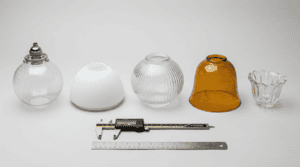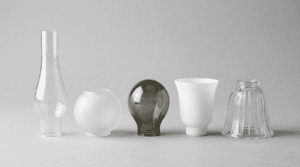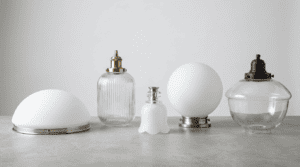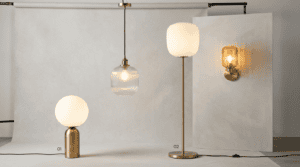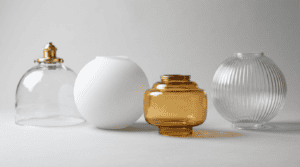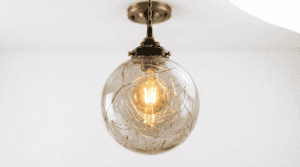
Glass is made primarily of silicon dioxide (silica sand), soda ash, and limestone — melted together above 1,700°C, then rapidly cooled into a rigid, transparent amorphous solid.
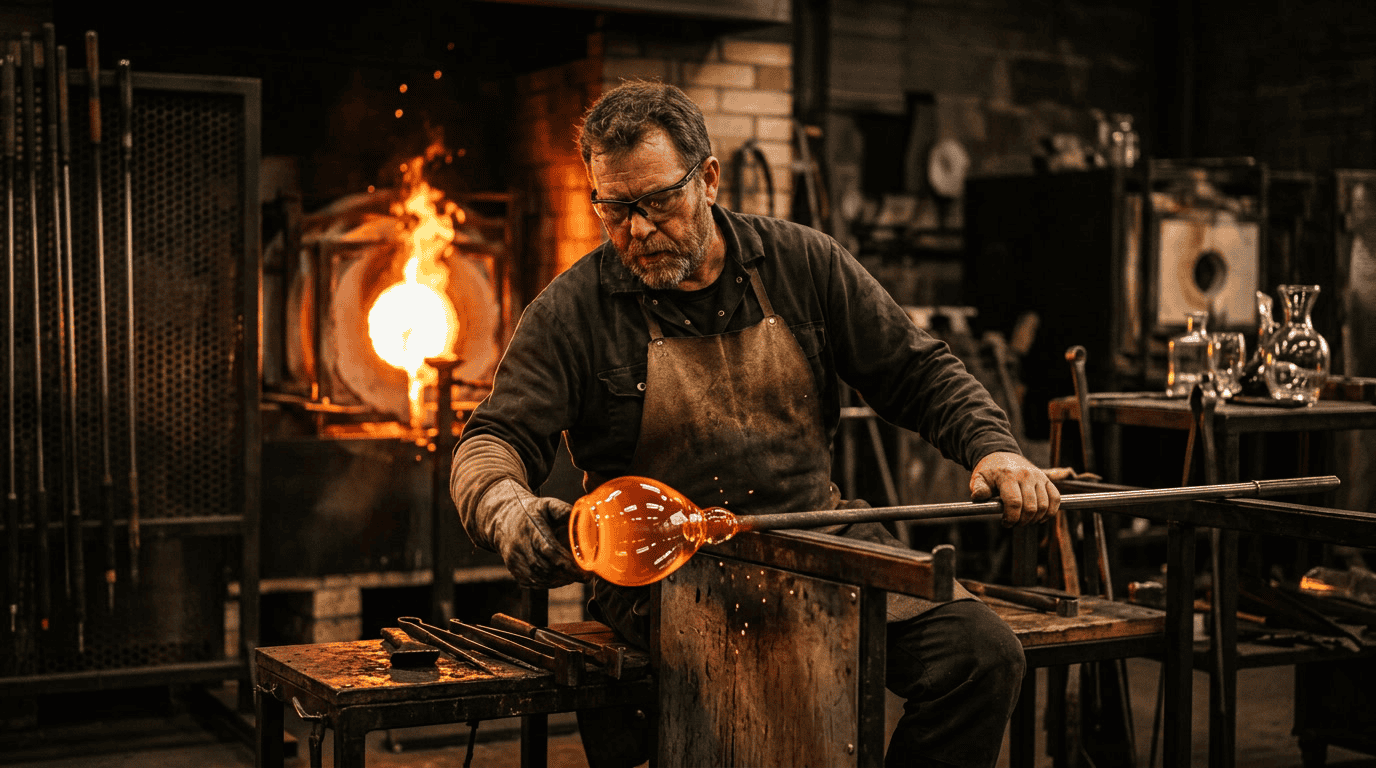
Walk into any home with a beautiful pendant lamp or an elegant table lamp, and you’re looking at one of humanity’s oldest and most versatile materials. Glass has been used for containers, windows, and decorative objects for over 3,500 years — yet most people have no idea what it’s actually made of or why it behaves so differently from metals and plastics. If you’ve ever wondered what gives a glass lampshade its clarity, its weight, or its ability to diffuse warm light evenly, the answer starts at the molecular level: the raw materials that go into the furnace.
This guide walks through exactly what glass is made of, how it’s manufactured, the different compositions used for different applications, and — critically for buyers and designers — how glass composition affects the look, durability, and light quality of lampshades and decorative glassware.
What Is Glass? A Fundamental Definition
Glass is an amorphous solid — not quite a crystal, not quite a liquid — formed when certain materials are melted and then cooled too quickly for their molecules to form an ordered crystalline structure.
That definition matters. Unlike ice (a true crystal) or water (a liquid), glass occupies a strange in-between state: its atoms are frozen in place but arranged randomly, which is why it shatters rather than bends and why it transmits light so cleanly.
The Core Chemical Formula of Glass
Standard window or container glass — called vidro de soda-lima — is roughly:
- 70–74% silicon dioxide (SiO₂) — the primary glass-forming oxide, derived from silica sand
- 12–16% sodium oxide (Na₂O) — from soda ash; lowers the melting point of pure silica
- 10–15% calcium oxide (CaO) — from limestone; improves chemical durability and workability
- 1–5% other oxides — magnesium, aluminum, potassium, iron (depending on application)
Pure silica glass (fused quartz) would work, but it melts at over 2,000°C. Soda ash and limestone are added to bring that down to a more workable ~1,400–1,700°C — a range that modern furnaces handle economically.
Glass vs. Other Materials: What Makes It Unique
Most solid materials are either crystalline (metals, salt, ice) or polymeric (plastics, rubber). Glass is neither. Its amorphous structure gives it:
- Clareza óptica — randomly arranged atoms scatter light very little
- Inércia química — resists acids, moisture, and most common chemicals
- Hardness with brittleness — harder than most plastics, but no ductility to absorb impact
- Thermal expansion — expands and contracts with temperature; composition controls how much
That last property is crucial for lampshades. A glass shade near a hot bulb undergoes thermal stress. The composition determines whether it survives or cracks — which is why borosilicate glass exists.
The Raw Materials That Make Glass
The four essential raw materials for standard glass are silica sand, soda ash, limestone, and cullet (recycled glass).
Each ingredient plays a specific chemical role. Understanding them helps explain why glass from different sources looks and performs differently — and why cheap glass lampshades sometimes yellow, cloud, or break prematurely.
Silica Sand — The Primary Ingredient
Silica sand is not the kind of sand you find on a beach. Glass manufacturers use high-purity quartz sand with a silicon dioxide content above 95%, sometimes above 99%. Beach sand contains iron, clay, and organic material that would discolor or weaken the final glass.
The SiO₂ in quartz forms the fundamental glass network. Silicon atoms bond to four oxygen atoms each, creating a three-dimensional web. When melted and cooled, this web doesn’t crystallize — it freezes into the amorphous glass structure.
De acordo com Wikipedia’s comprehensive overview of glass, natural glass formations like obsidian and fulgurite (lightning-fused sand) demonstrate that silica alone can form glass under the right conditions. Industrial production just does it more precisely, at scale, and with additives that improve workability.
Soda Ash (Sodium Carbonate)
Pure fused silica melts at about 2,300°C — impractical for commercial production. Soda ash (Na₂CO₃) is the flux: it lowers the melting point of the silica batch to ~1,400–1,500°C by disrupting the SiO₂ network.
The trade-off is that sodium makes glass slightly less chemically resistant and more soluble in water over long timeframes. This is why soda-lime glass isn’t ideal for pharmaceutical containers or high-heat environments — other glass types solve this.
Limestone and Calcium Oxide
Limestone (CaCO₃) decomposes in the furnace to calcium oxide (CaO) and CO₂. The calcium oxide stabilizes the glass network — without it, soda-lime glass would be too soluble in water and would gradually fog over time.
Calcium also improves hardness and mechanical strength. Dolomite (CaMg(CO₃)₂) is sometimes substituted to introduce magnesium oxide simultaneously.
Cullet: Recycled Glass in Production
Cullet is crushed recycled glass added back into the batch. It makes up 20–70% of a typical glass melt. Cullet melts faster and at lower temperatures than virgin raw materials, reducing energy consumption and CO₂ emissions significantly.
| Matéria-prima | Fonte | Role in Glass | Typical % by Weight |
|---|---|---|---|
| Silica sand (SiO₂) | Quartz mining | Forms the glass network structure | 70–74% |
| Soda ash (Na₂CO₃) | Synthetic (Solvay process) / natural trona | Flux — lowers melting point | 12–16% |
| Limestone (CaCO₃) | Quarried limestone / dolomite | Stabilizer — improves durability | 8–12% |
| Cullet (recycled glass) | Post-consumer / industrial scrap | Energy saver, fills bulk | 20–70% of melt |
| Minor additives | Various | Color, clarity, strength modifiers | 1–5% |
Types of Glass and Their Unique Compositions
Different glass types achieve different properties by modifying the base silica-soda-lime formula — replacing or adding oxides that change thermal expansion, refractive index, or chemical resistance.
Soda-Lime Glass (The Most Common Type)
Soda-lime glass accounts for roughly 90% of all glass produced globally. Windows, bottles, drinking glasses, and most entry-level lampshades are soda-lime glass. It’s cheap to produce, easy to blow, press, or float, and clear enough for most applications.
Its thermal expansion coefficient (~9 × 10⁻⁶/°C) means rapid temperature changes can cause thermal shock. For low-wattage LED bulbs, this is rarely an issue. For halogen or incandescent fixtures, it’s a real consideration.
Borosilicate Glass (Heat-Resistant)
Replace some sodium oxide with boron trioxide (B₂O₃) — typically 12–15% — and you get borosilicate glass. Thermal expansion drops to roughly 3–4 × 10⁻⁶/°C, less than one-third that of soda-lime glass.
Borosilicate lampshades and globes withstand thermal cycling without cracking. Laboratory glassware (Pyrex was originally borosilicate), high-end coffee makers, and quality pendant lamp shades all use borosilicate for this reason. Expect to pay 20–40% more for borosilicate decorative glass.
Lead Crystal Glass (Traditional Decorative Glass)
Lead crystal replaces calcium oxide with lead oxide (PbO), typically 24–36% by weight. This dramatically increases the refractive index from about 1.52 for soda-lime to 1.56–1.61 for crystal — delivering the brilliant prismatic sparkle prized in chandeliers and cut crystal pieces.
Lead crystal is softer and heavier, making it easier to cut and engrave. Some manufacturers have developed unleaded crystal using barium oxide or zinc oxide as substitutes for lead oxide.
Tempered and Laminated Safety Glass
Tempered glass is standard soda-lime or borosilicate glass that’s been thermally treated: heated to ~620°C and rapidly air-quenched. The result is glass 4–5× stronger than annealed glass. When broken, it shatters into small blunt fragments rather than sharp shards.
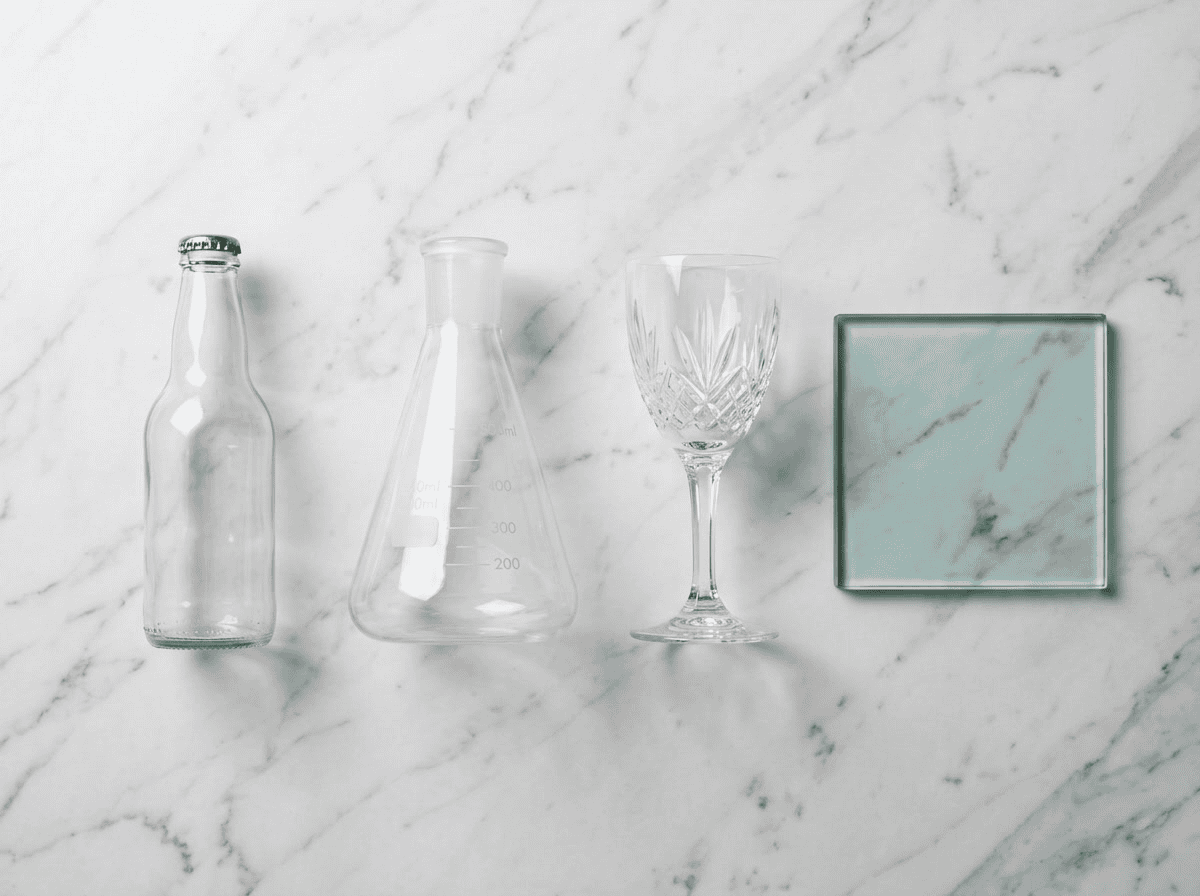
| Tipo de Vidro | Key Additive | Thermal Expansion | Melhor Para | Custo Relativo |
|---|---|---|---|---|
| Soda-cal | Na₂O + CaO | ~9 × 10⁻⁶/°C | Bottles, windows, basic lampshades | Baixa |
| Borosilicato | B₂O₃ (12–15%) | ~3–4 × 10⁻⁶/°C | Heat-resistant shades, lab ware | Medium-high |
| Cristal de chumbo | PbO (24–36%) | ~9 × 10⁻⁶/°C | Chandeliers, cut crystal decoratives | Alta |
| Tempered (safety) | None (process) | Same as base | Floor lamps, structural panels | Média |
| Fused quartz | Pure SiO₂ | ~0.5 × 10⁻⁶/°C | UV lamps, extreme heat | Very high |
How Glass Is Made: The Manufacturing Process
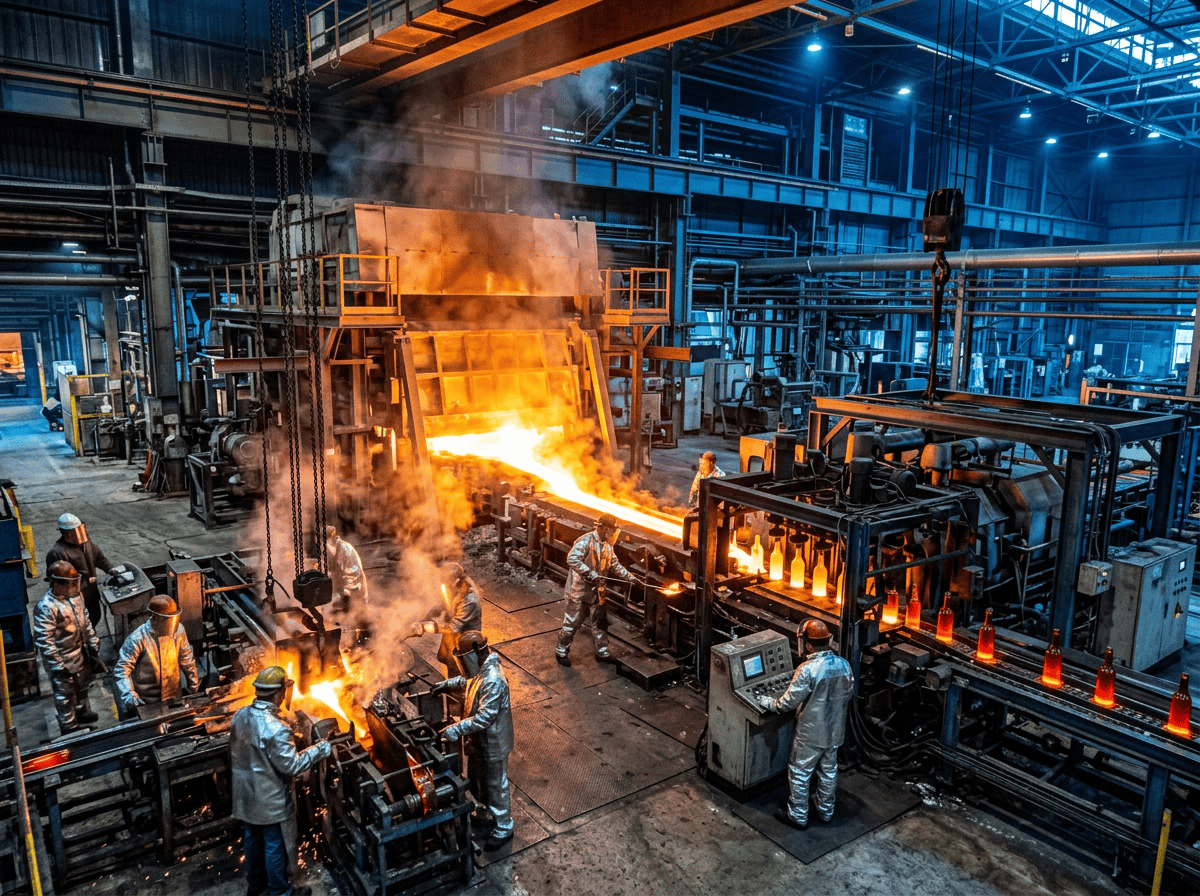
Glass manufacturing involves four stages: batching, melting, forming, and annealing — each precisely controlled to achieve consistent composition and optical quality.
Step 1 — Batching and Mixing Raw Materials
Raw materials are weighed and blended in exact proportions before entering the furnace. Modern glass plants use computer-controlled batch houses measuring each ingredient to within fractions of a percent. A 10°C reduction in furnace temperature is achievable for every 10% increase in cullet ratio.
Step 2 — Melting in the Furnace
The batch enters a regenerative furnace maintained at 1,400–1,700°C. Soda-lime melts around 1,400–1,500°C; borosilicate requires 1,550–1,700°C. Without proper fining (gas bubble removal), the finished glass would contain trapped bubbles — a visible defect in cheap glass products.
Step 3 — Forming and Shaping
The molten glass is worked at 900–1,200°C via blowing (bottles, globes, decorative vessels), pressing (thick lamp bases, textured shades), floating (flat window glass), or drawing/rolling (tubes, patterned sheets).
Step 4 — Annealing and Cooling
Freshly formed glass contains internal thermal stress. Recozimento solves this: the glass passes through a temperature-controlled oven (annealing lehr) that slowly reduces temperature from ~550°C to room temperature over 20–60 minutes. Proper annealing is the difference between glass that lasts years in a lamp fixture and glass that cracks months after installation.
Glass Composition and Quality in Lampshades and Decorative Glassware
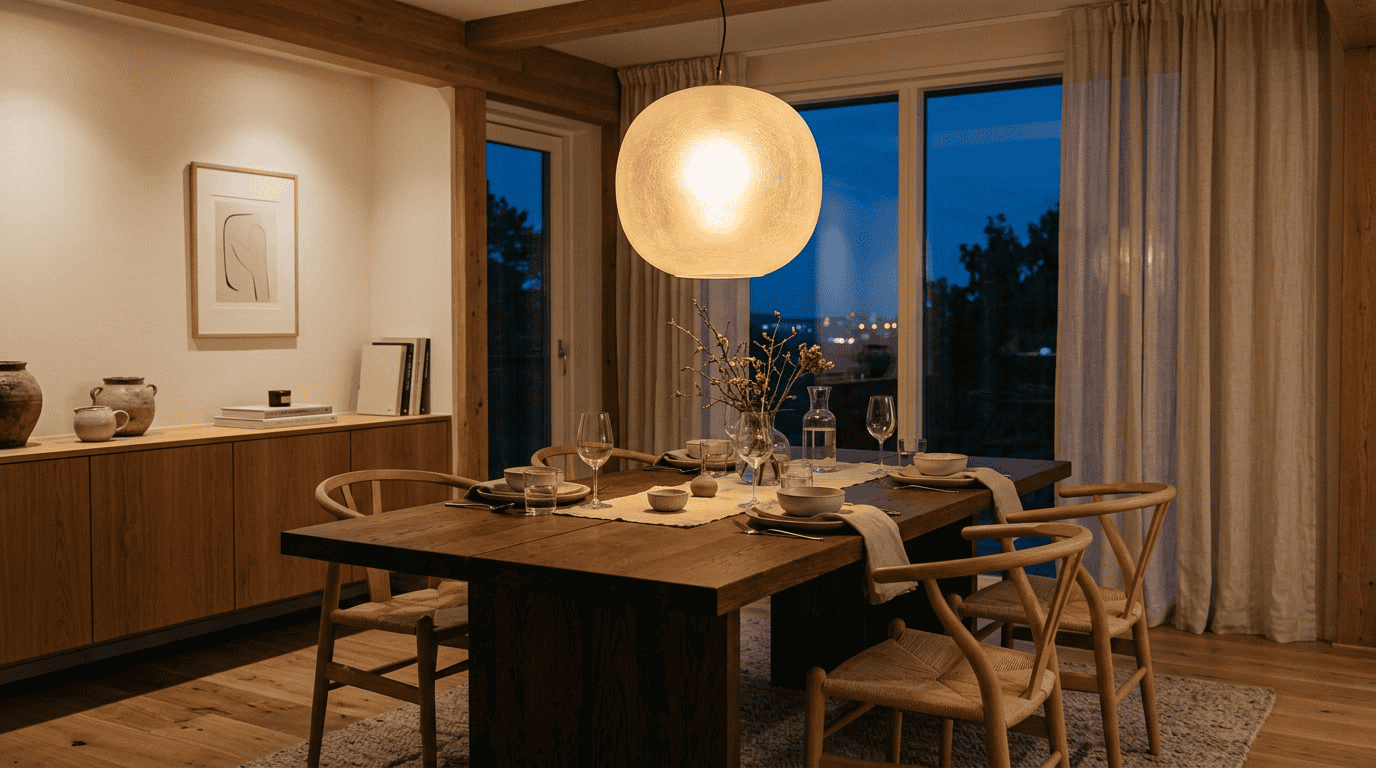
For lampshades, composition determines light transmission, heat resistance, longevity, and visual clarity — making it the single most important material specification.
Why Composition Affects Clarity and Light Transmission
Iron oxide contamination in low-purity silica gives glass a greenish tint visible against white walls at night. Seed bubbles from under-refined melt scatter light visibly in thin-walled globes. According to Encyclopaedia Britannica’s material science coverage, even trace iron levels of 0.1% can produce a distinctly green tint in thick glass sections. High-quality lampshades use silica sand with iron content below 0.02%.
Borosilicate vs. Soda-Lime for Lamp Shades
For most modern LED lighting (running at 50–80°C surface temperatures), soda-lime glass performs adequately. Borosilicate earns its premium for high-wattage halogen retrofits, outdoor pendants exposed to rain, commercial fixtures running 12+ hours per day, and kitchen pendants where steam contact is realistic.
What High-Quality Glass Lampshades Are Made From
The best decorative lampshades use one of three formulations:
- High-clarity soda-lime glass — ultra-low iron content (<0.01% Fe₂O₃), machine-blown, carefully annealed. Used in Nordic and Japanese-style minimalist pendant shades.
- Vidro borossilicato — for halogen or high-output LED filament bulbs, or outdoor use. More thermally robust, slightly less clear than the best soda-lime.
- Cristal de chumbo — for chandelier arms, prism pendants, and cut-glass decoratives. Delivers unmatched optical sparkle.
A Corning Museum of Glass, which maintains one of the world’s most comprehensive glass collections, documents how glass composition evolved across centuries because decorative and functional requirements demanded different material properties — the same trade-off buyers navigate today.
| Propriedade | High-Clarity Soda-Lime | Borosilicato | Lead Crystal |
|---|---|---|---|
| Light transmission | 91–92% | 90–92% | 89–91% |
| Refractive index | 1.52 | 1.47 | 1.56–1.61 |
| Thermal shock resistance | Moderada | Excelente | Moderada |
| Max safe temp (continuous) | ~250°C | ~500°C | ~250°C |
| Best use in lighting | LED pendants, table lamps | Halogen/outdoor fixtures | Chandeliers, decorative accents |
Future Trends in Glass Materials (2026+)
The next generation of glass materials moves beyond passive transparency toward active optical performance and sustainable production.
Smart Glass and Electrochromic Technology
Electrochromic glass — glass that changes transparency under electrical current — is moving from commercial architecture into residential lighting. These glazings use thin oxide coatings on standard soda-lime substrates. A 2024 report from the International Energy Agency cited smart glass adoption in commercial buildings growing at 18% annually, with residential applications following 3–5 years behind.
Bio-Based and Sustainable Glass Production
Traditional glass production emits ~0.5 kg CO₂ per kg of glass. Electric furnaces powered by renewable energy are already reducing per-kg emissions by 40–60% at several European manufacturers. Geopolymer glass routes using industrial waste streams (fly ash, slag) as silica sources demonstrated functional products in German and Japanese pilot facilities in 2023.
Perguntas Frequentes
What is glass actually made of?
Glass is primarily silicon dioxide (about 70–74%) combined with soda ash and limestone. The silica forms the glass network; soda ash lowers the melting point; limestone adds durability. Minor additives control color, clarity, and heat resistance.
How is glass made from sand?
Silica sand is mixed with soda ash and limestone, melted above 1,400°C into a homogeneous liquid, shaped while hot, then slowly cooled in an annealing oven. The entire process takes 24–72 hours from raw material to finished product.
What are five objects made of glass?
Windows, drinking glasses, light bulbs, mirrors, and lampshades are all made of glass — each using a specific formulation matched to its functional requirements.
Is glass natural or man-made?
Both. Natural glass (obsidian, fulgurite) forms when silica-rich material is rapidly heated and cooled by volcanic activity or lightning. As a Reddit Ask Science discussion on glass formation illustrates, both share the same fundamental amorphous structure.
What is glass in chemistry?
Chemically, glass is an amorphous solid whose atoms are arranged randomly rather than in a crystalline lattice. Silicate glasses form networks of SiO₄ tetrahedra linked at oxygen atoms, with modifier cations (Na⁺, Ca²⁺) filling interstitial positions.
How is glass made simply?
Melt sand with soda ash and limestone, shape the liquid while hot, then cool slowly. The same basic steps have applied since ancient Egypt — modern factories just do it at higher precision and volume.
What makes borosilicate glass better for heat applications?
Borosilicate contains 12–15% boron trioxide, reducing thermal expansion to about one-third that of soda-lime glass. This dramatically reduces internal stress from uneven heating — the mechanism behind most thermal shock failures in lamp shades.
Conclusão
Glass is deceptively simple — silica sand, soda ash, limestone, and heat — yet that combination produces a material with optical, mechanical, and chemical properties that no plastic or metal comes close to replicating. The specific composition determines everything from whether your lampshade survives a rainy outdoor summer to whether a chandelier pendant throws the prismatic sparkle you’re looking for.
For buyers choosing glass lampshades or decorative glassware: LED-only residential fixtures work well with quality soda-lime glass. High-heat, outdoor, or commercial applications justify the borosilicate premium. When optical brilliance matters most, lead crystal remains the standard. And regardless of type, well-annealed glass from a manufacturer with documented quality control outlasts any alternative at the same price point. Understanding what glass is made of helps you ask the right questions before buying — and recognize quality when you see it.