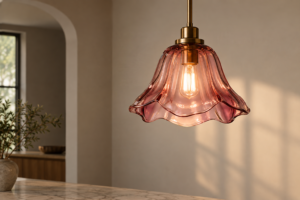
A lampshade frame is the wire skeleton that defines a shade’s shape and holds the fabric or material in place. Frames vary by silhouette (drum, empire, bell), fitter type (spider, uno, clip-on), and wire gauge. Getting the frame right determines everything downstream.
Most lampshade-making tutorials spend three paragraphs on fabric choices and one sentence on the frame. That approach is backwards. The frame determines the shade’s silhouette, how it attaches to the lamp, how the fabric behaves under tension, and whether the finished shade holds its shape for years or sags after a few months. Pick the wrong lampshade frame and the best fabric in the world won’t save the result.
This guide covers every aspect of lampshade frames in practical detail: anatomy, silhouette types, fitter types, wire materials and gauges, sizing methodology, and what to look for when buying. If you are sourcing frames for a fabric shade, replacing an old frame, or deciding whether a glass shade is a better option than a framed fabric shade for your lamp, this is the reference.
What is a lampshade frame?
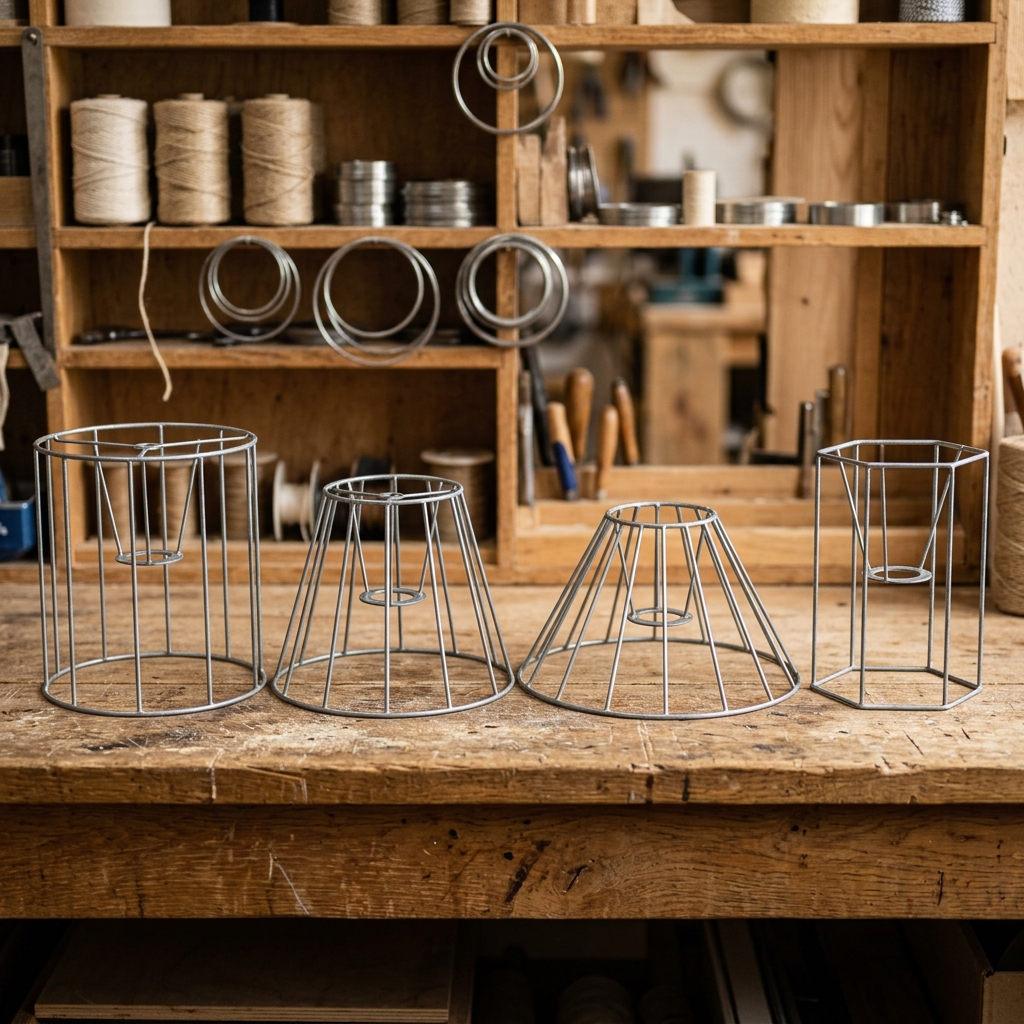
A lampshade frame is the rigid wire armature onto which fabric, paper, or other covering material is stretched, glued, or stitched to create a finished lampshade. The frame gives the shade its three-dimensional form, holds the covering material under tension, and provides the mounting hardware that connects the shade to the lamp.
The anatomy of a wire frame
Every standard lampshade frame shares the same basic structure, though the proportions and details change by style:
Top ring: the upper circumference of the frame. On a drum frame the top ring and bottom ring are the same diameter. On a tapered frame (empire, bell, coolie) the top ring is narrower than the bottom.
Bottom ring: the lower circumference. This is the measurement most relevant to visual proportion — the number that governs how the shade relates to the lamp base width and to the room.
Vertical struts: the wire ribs running from top ring to bottom ring. On a standard frame there are typically 6 to 12 struts, spaced evenly. More struts mean a rounder, more rigid frame; fewer struts mean a lighter frame with a more angular profile at each rib.
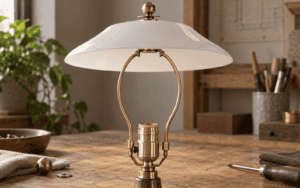
Crossbar or spider: the attachment assembly at the top of the frame. This is the critical component that connects the lampshade frame to the lamp hardware. The type of spider or fitter determines which lamps the frame will fit.
Side struts (on some styles): additional horizontal rings between the top and bottom, used on tall frames to prevent fabric from sagging inward in the middle. Common on tall empire frames and bell shapes.
A lampshade, as documented by its long manufacturing history, has always required this basic frame-and-covering system. The wire components have changed — early frames used heavier iron wire; modern frames use lighter, higher-tensile steel — but the structural logic is the same.
What the frame determines, and what it doesn’t
The frame determines:
– The shade’s silhouette and proportions (height, top width, bottom width, taper)
– The fitter type and which lamps the shade will attach to
– How the covering material behaves (fabric stretched over a drum frame behaves differently from fabric stitched onto a tapered empire frame)
– The rigidity of the finished shade (a function of wire gauge and strut count)
The frame does not determine:
– The light quality (that depends on the covering material’s opacity and color)
– The shade’s visible surface texture or color
– Whether the shade is appropriate for LED or incandescent bulbs (that depends on the covering material’s heat resistance, not the frame)
| Frame component | Primary function | What goes wrong if it’s poor quality |
|---|---|---|
| Top ring | Sets the fitter position, defines shade top diameter | Warped ring causes uneven fitter seating; shade tilts |
| Bottom ring | Defines shade silhouette, provides tension anchor for fabric | Out-of-round bottom ring creates visible waves in covering |
| Vertical struts | Maintain shape, resist inward collapse under fabric tension | Too few struts cause fabric sag; too many add unnecessary weight |
| Spider / fitter | Attaches shade to lamp hardware | Wrong fitter type makes shade incompatible with the lamp |
| Side struts | Prevent mid-section sag on tall frames | Absent on tall frames causes belly-out or sag in covering |
Lampshade frame shapes and silhouettes
The frame shape is the most immediately visible characteristic. Different silhouettes suit different lamp bases, room styles, and covering materials.
Drum and cylinder frames
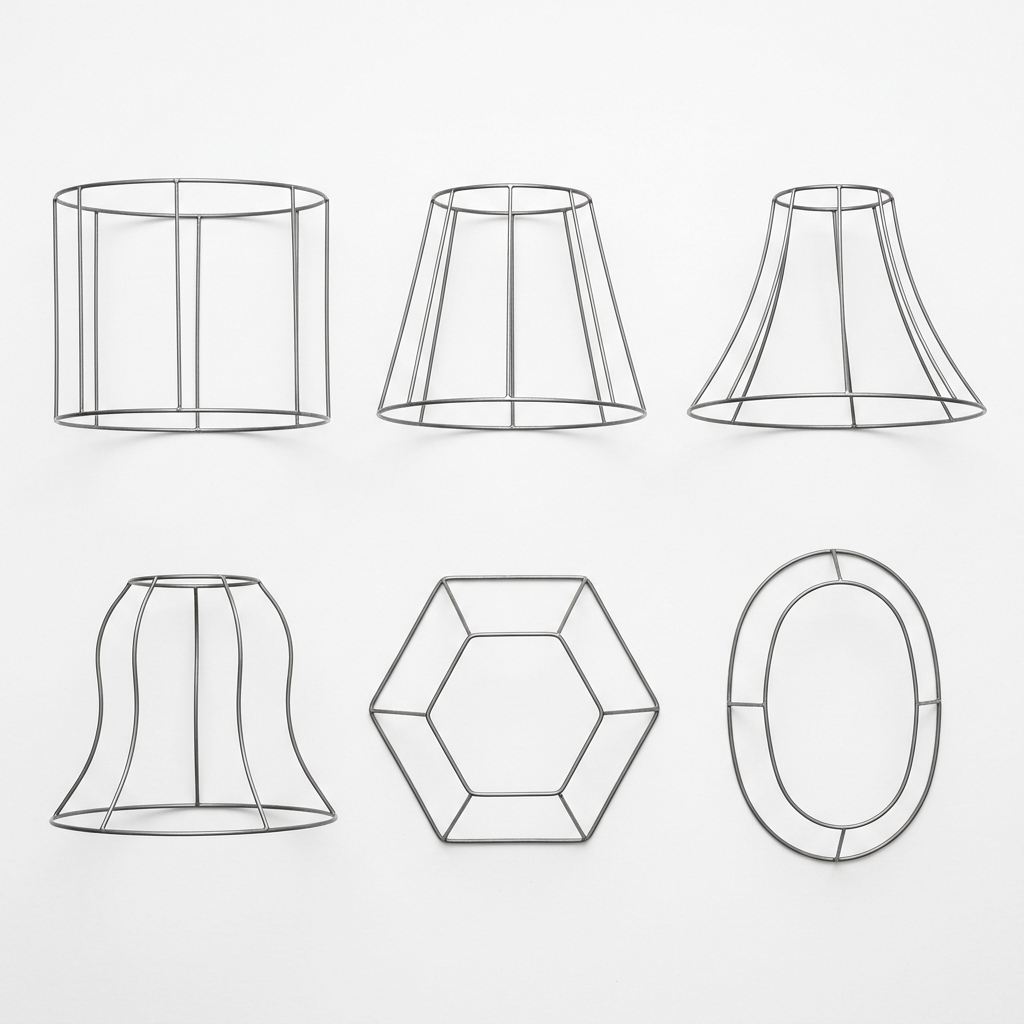
A drum lampshade frame has an equal top and bottom ring diameter, producing a straight cylinder. This is the most common frame shape in contemporary interior design. The straight profile is visually clean, and the equal-diameter rings make fabric cutting straightforward: a rectangle of fabric covers the frame without any taper adjustment.
Drum lampshade frames come in a wide range of diameters, from 4-inch boudoir sizes to 20-inch floor lamp frames. Wire gauge on drum frames typically runs from 14 to 18 gauge (higher number = lighter wire) depending on frame diameter. A 6-inch drum frame for a table lamp can use lighter wire; a 16-inch floor lamp drum frame needs heavier wire to resist the outward pressure of the covering under tension.
One practical point: because drum frames have no taper, the struts run perfectly vertical. This makes them the most beginner-friendly lampshade frame for a first fabric shade — no angled cutting required.
Empire and coolie frames (tapered)
Empire lampshade frames taper from a narrow top ring to a wider bottom ring. This is the traditional lampshade silhouette, and it accounts for a very large portion of the lampshade frames sold for both DIY and commercial use. The taper can be gradual (a shallow empire with a narrow diameter difference between top and bottom) or steep.
The coolie frame is an extreme variation of the empire: a very wide, shallow cone with a dramatically wide bottom diameter relative to its height. Coolie frames are associated with Asian-influenced and modern-eclectic interiors, and they work best with lighter covering materials — the wide, flat cone doesn’t need heavy fabric to hold its shape.
On any tapered lampshade frame, cutting the covering material requires accounting for the taper. The fabric panels must be cut as trapezoids, not rectangles, and the spacing of the struts varies slightly top to bottom because of the circumference difference. This is the primary reason tapered frames are harder for beginners than drum frames.
Bell, hexagonal, and specialty frames
Bell frames add a curve to the empire taper: the profile bows outward slightly toward the bottom before flaring or cutting straight. The curve makes them softer-looking than a plain empire. They are harder to cover because the curve prevents the fabric from lying flat along the strut line; the covering must be stretched or gathered slightly to accommodate the arc.
Hexagonal and octagonal frames replace the continuous ring with six or eight flat sides. Each flat panel is covered separately, producing a paneled shade. These frames are used for traditional, Arts and Crafts, and mission-style interiors. The straight panels actually make fabric cutting easier than a curved frame — each panel is a simple trapezoid — but the seams at each strut must be finished carefully.
Specialty frames include oval frames (common for table lamp shades on bases with an oval footprint), square frames, and asymmetric frames for architectural applications.
| Frame shape | Top:bottom ratio | Fabric cut | Visual character | Best for |
|---|---|---|---|---|
| Drum / cylinder | 1:1 (equal) | Rectangle | Clean, contemporary | Modern, minimal rooms |
| Empire (shallow) | 1:1.5 | Trapezoid | Classic, transitional | Traditional table lamps |
| Empire (steep) | 1:2 or more | Wide trapezoid | Bold, traditional | Statement table lamps |
| Coolie | 1:3+ | Wide trapezoid | Wide, architectural | Asian-influenced, modern |
| Bell | Curved taper | Curved panel | Soft, period | Victorian, antique reproduction |
| Hexagonal | Multi-panel | Flat trapezoid per panel | Mission, Arts & Crafts | Traditional, bungalow interiors |
| Oval | 1:1 (oval) | Curved rectangle | Formal, elongated | Oval lamp bases |
Fitter types: how a lampshade frame connects to a lamp
The fitter is the most practically important part of the lampshade frame. It must match the lamp’s hardware exactly or the shade won’t attach, will sit crooked, or will rock on the lamp. Fitter type is the first thing to confirm before ordering any lampshade frame.
Spider fitter (the most common type)
A spider fitter is a multi-arm metal assembly welded to the inside of the top ring of the lampshade frame. The arms extend inward from the ring and meet at a central point with a washer hole. The shade sits on a harp — a U-shaped wire stand that clips into a saddle on the lamp’s socket. The spider’s central washer drops over the harp’s top post and is held in place by a harp finial (a decorative screw-on cap).
Spider fitters are standard on the vast majority of table lamp shades. The system works because harps are themselves available in multiple heights (typically 7″ to 12″), which allows fine-tuning the shade’s position on the lamp independent of the shade frame size.
The practical implication: when ordering a spider-fitter lampshade frame, you also need to confirm the harp height. The harp positions the shade vertically; the frame’s fitter size determines the horizontal attachment. If a lamp doesn’t have a harp, a harp saddle can be added to most standard sockets without modification.
Uno fitter
An uno fitter is a single ring inside the top of the lampshade frame that threads directly onto the lamp’s socket neck. There is no harp. The shade screws onto the socket body itself.
Uno fitters are common on torchiere floor lamps, pharmacy lamps, and some swing-arm designs. They produce a very secure, low-profile attachment. The shade can’t be adjusted for height once the socket determines the position. On lamps designed for uno fitters, the socket usually has a threaded collar; standard socket bodies are not threaded for uno use.
When replacing a shade on a uno-fitter lamp, the fitter ring inside the new frame must match the socket’s thread diameter. The most common sizes are 1⅝” and 1¾” inside diameter, though some fixtures use proprietary sizes.
Clip-on and washer fitters
Clip-on fitters are spring clips inside the top ring of the shade frame that grip directly onto the bulb. They are used on small accent lamps, boudoir shades, and candelabra fixtures without harps or threaded sockets. The clip must match the bulb shape — a candelabra bulb clip will not fit snugly on an A19 bulb, and an A19 clip will fall off a candelabra bulb.
A washer fitter is a simple flat ring welded to the inside of the shade frame, which rests on a vase cap or specialized mounting plate. Common on pendant shades and some floor lamp fixtures.
| Fitter type | Attaches to | Lamp hardware needed | Adjustable height? | Typical use |
|---|---|---|---|---|
| Spider | Harp (U-shaped wire stand) | Harp + harp saddle + finial | Yes (swap harp height) | Standard table lamps |
| Uno | Socket neck (threaded) | Threaded socket collar | No | Torchiere, pharmacy lamps |
| Clip-on | Bulb directly | None (bulb only) | No | Boudoir, candelabra, accent |
| Washer | Vase cap or mounting plate | Vase cap or specialized fitting | Depends on fixture | Pendants, specialty fixtures |
Wire gauge and frame material
The wire in a lampshade frame is not all equivalent. Two frames that look identical on paper — same shape, same fitter, same size — can behave very differently depending on wire gauge and surface treatment.
Wire gauge numbers and what they mean
Wire gauge for lampshade frames uses the American Wire Gauge (AWG) standard. The system is counterintuitive: higher gauge number = thinner wire. A 12-gauge wire frame is significantly heavier and more rigid than an 18-gauge frame of the same shape.
Most commercially available lampshade frames use 14 to 18 gauge wire. Here is what the differences mean in practice:
- 14–15 gauge: heavy, rigid. Used for large floor lamp frames (14″+ diameter) where the frame must resist the outward pull of fabric under tension without distorting. Heavier to ship, harder to bend by hand.
- 16 gauge: the most common general-purpose gauge for medium table lamp frames (8″–14″ diameter). Rigid enough to hold shape; light enough to work with.
- 17–18 gauge: lighter wire, used for small boudoir and accent frames. Easier to warp during covering if fabric tension is uneven.
The practical test for whether a lampshade frame’s wire is adequate: hold the frame at the top ring and gently press the side with one finger. A properly gauged frame should have virtually no give. If the frame flexes noticeably under finger pressure, the wire is too light for the frame’s diameter.
Galvanized, nickel-plated, and bare steel frames
As noted in Wikipedia’s article on galvanization, galvanizing applies a zinc coating to iron or steel to prevent rust. For lampshade frames, the surface treatment matters because:
Galvanized steel frames: the zinc coating prevents rust in humid environments. Good choice for shades that will be used in bathrooms, coastal homes, or anywhere with elevated humidity. The zinc surface is slightly rough, which actually helps fabric adhesive bond to the wire.
Nickel-plated frames: a bright finish that resists tarnishing. The smooth, shiny surface is visible through translucent or open-weave coverings — relevant if the frame will be partially visible in the finished shade. Nickel plating offers good corrosion resistance but at higher cost than galvanized.
Bare steel / mild steel frames: uncoated wire, the least expensive option. Prone to rusting in humid conditions; should only be used in dry environments. Many budget craft frames are mild steel.
For most standard fabric lampshade applications, a galvanized steel frame is the right choice: rust-resistant, cost-effective, and the slightly rough surface bonds well with both fabric glue and stitching thread.
How to size a lampshade frame
Sizing a lampshade frame correctly requires three measurements, and the relationship between them — not any single number — is what determines whether the finished shade looks right.
The three measurements that govern every frame
Bottom diameter: the single most visually important dimension. The shade’s bottom rim is what you see from across the room, and it must relate correctly to the lamp base width. As a rule: the bottom diameter of the shade should be at least 2″ wider than the widest point of the lamp base, and not more than 4″–6″ wider. A shade narrower than the base looks pinched; one dramatically wider looks top-heavy.
Height: the shade’s vertical dimension. For a traditional lamp, the shade height should be roughly one-third of the total lamp height (base plus shade combined). On a 21-inch lamp, that’s approximately a 7-inch shade. This ratio produces a settled, balanced look. Shades shorter than the one-third proportion look squat; taller shades look column-like.
Top diameter: on a drum frame, this equals the bottom diameter. On tapered frames, this is smaller than the bottom. The top diameter matters most for the fitter: the spider or fitter assembly must fit inside the top ring, and the top ring must clear the socket body and harp with enough margin that the harp finial can be tightened without strain.
For readers replacing an existing lampshade frame, the process of measuring the fitter diameter and shade dimensions is covered step by step in our guide to measuring a cut glass lamp shade — the three-measurement method applies to any lampshade frame, not just glass.
The 1/3 rule and common sizing mistakes
The 1/3 rule (shade height = one-third of total lamp height) is a useful starting point but not a rigid formula. There are two common departures from it:
Very tall, slender lamp bases (pharmacy lamps, tall candlestick bases) often look better with a shade proportionally taller than 1/3 rule — the extra height prevents the shade from looking like a small cap on a tall base.
Wide, low table lamps (vessel shapes, short ceramic bases) often look better with a shade at or slightly below the 1/3 ratio — a deep shade on a low base produces a mushroom shape that works for casual settings.
The most common sizing mistake is ordering by the top ring diameter printed on the box rather than by the bottom diameter. On a tapered empire frame, the top ring might be 6″ while the bottom is 14″. The bottom diameter is what governs visual proportion; the top ring size is relevant only for fitter compatibility.
A second common mistake: choosing a frame size based on the covering material in stock rather than the lamp’s proportions. The frame must be sized for the lamp. The fabric must be sourced to fit the frame.

Lampshade frames for DIY vs commercial use
The lampshade frame market splits cleanly into DIY/craft supply frames and commercial-grade frames used by lampshade manufacturers. The quality gap is meaningful.
What to look for when sourcing frames for fabric lampshades
For a fabric lampshade that will hold its shape and last:
Ring roundness: the top and bottom rings must be truly round, not slightly oval. Lay the frame on a flat surface and check whether the bottom ring lies completely flat. An oval bottom ring will produce visible waviness in the finished shade, especially in stretched hard-back construction.
Weld quality: where the struts join the rings and where the spider arms join the top ring, the welds must be clean with no sharp wire ends. Sharp weld points cut through covering material from the inside over time.
Strut spacing consistency: hold the frame at arm’s length and check that the vertical struts are evenly spaced around the circumference. Uneven strut spacing telegraphs through the covering material as visible vertical lines.
Wire straightness: on each strut, the wire should run in a true straight line (for drum and empire frames) or a consistent curve (for bell frames) without kinks or bends.
For the craft market, the related searches for lampshade frames wholesale and wire lampshade frames suppliers indicate buyers looking for volume. Reputable frame suppliers will offer frames in standard incremental sizes (typically every 2″ of bottom diameter) with consistent specifications across the range.
Wholesale lampshade frame suppliers: what the market looks like
The lampshade frame supply chain has two tiers. The first tier is fabricators who make frames to order in custom sizes, custom wire gauges, and custom fitter types — serving commercial lampshade manufacturers who need frames in specific dimensions not covered by standard sizes. The second tier is distributors who stock standard-size frames in bulk, sold to craft retailers, fabric lampshade makers, and interior design workrooms.
For crafters and small-scale lampshade makers, the practical options are specialty lampshade supply retailers, fabric and notions wholesalers who carry lamp-making supplies, and direct-from-manufacturer sources. Minimum order quantities vary: some suppliers sell individual frames at retail; wholesale pricing typically kicks in at quantities of 12 to 25 frames per size.
Most frames in the Western market are made from Chinese-manufactured wire stock, as China dominates global lamp component manufacturing. Quality varies significantly by source; the inspection criteria above (ring roundness, weld quality, strut spacing) are the practical screen to apply before placing a bulk order.
Glass lamp shades vs fabric frames: a different construction entirely
For some lamps and settings, the question isn’t which lampshade frame to choose — it’s whether a wire frame and covering material is the right approach at all. Glass lamp shades use a completely different structural system.
How glass shades replace the frame-and-fabric system
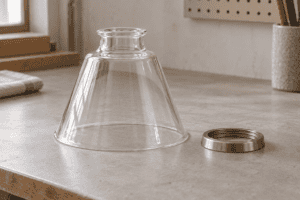
A glass lampshade doesn’t use a wire frame the way a fabric shade does. Instead of a skeleton covered with material, a glass shade is a single structural piece — blown, pressed, or assembled from glass panels — that is rigid on its own. It attaches to the lamp through a fitter (a ground or fire-polished opening at the top of the shade) that seats in a shade holder ring on the lamp socket.
The fitter opening is the glass shade’s equivalent of the lampshade frame’s spider fitter, but simpler: it’s just a circular opening of a precise inside diameter. Standard glass fitter sizes are 2¼”, 3¼”, 4″, and 6″. The shade’s fitter must match the lamp’s holder ring. There are no harp sizes, no spider arm counts, no wire gauges to worry about.
For readers considering glass shades, our cut glass lamp shades collection covers pressed and hand-blown glass shades in standard fitter sizes, with options from plain satin opal to ribbed and patterned glass.
When glass is the better choice
Glass shades are the stronger choice in three specific situations:
Antique and vintage lamps: many antique lamp fixtures were designed specifically for glass shades and have no harp, no threaded socket, and no provision for a fabric shade. Fitting them with a fabric shade requires adding hardware that changes the lamp’s profile. A glass shade with the correct fitter size drops directly into the original holder with no modification.
High-traffic and high-humidity environments: glass doesn’t fade, absorb odors, or collect dust the way fabric does. A vintage glass lamp shade in a high-use room will look the same after five years that it did on day one; a fabric shade will show its age.
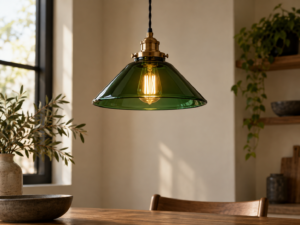
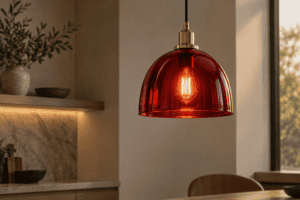
Rooms where the lamp is a visual anchor: a glass shade is an object even when the lamp is off. Its color, pattern, and material are visible in daylight. A fabric shade on a wire lampshade frame disappears until the lamp is switched on. For a lamp that needs to function as a room focal point around the clock, glass wins.
The U.S. Department of Energy notes that LED bulbs produce significantly less heat than incandescent equivalents. This matters for both fabric and glass lampshade frames: the reduced heat output from LED bulbs extends the life of covering materials and eliminates the risk of heat stress on solder joints in leaded glass panels.
FAQ
What wire gauge should a lampshade frame be?
Most general-purpose lampshade frames use 16-gauge wire, which balances rigidity and weight for medium-sized shades (8″–14″ bottom diameter). For larger frames above 14″ diameter, 14 or 15-gauge wire is more appropriate — the heavier wire resists the outward pressure of fabric under tension. For small boudoir or accent frames under 6″ diameter, 17 or 18-gauge wire is acceptable. If a frame flexes noticeably under light finger pressure, the wire is too light for that diameter.
What is the difference between a spider fitter and a uno fitter on a lampshade frame?
A spider fitter is a multi-arm assembly at the top of the frame that rests on a harp — a U-shaped wire stand on the lamp socket. The harp is held by a saddle and secured with a finial. A uno fitter is a single ring that threads directly onto the lamp’s socket neck, with no harp needed. Spider fitters are standard on most table lamps and allow height adjustment by swapping the harp. Uno fitters are common on torchiere and pharmacy lamps and produce a more secure, lower-profile attachment.
How do I know what size lampshade frame to buy?
The bottom ring diameter must be at least 2″ wider than the widest point of the lamp base. The shade height should be roughly one-third of the total lamp height (base plus shade). The fitter type must match the lamp’s hardware. The most common mistake is sizing by top ring diameter rather than bottom diameter — on a tapered frame these are very different numbers, and the bottom diameter governs visual proportion.
Can I use a lampshade frame without a harp?
Yes, if the frame has a uno fitter (which threads onto the socket without a harp) or a clip-on fitter (which grips the bulb directly). Spider-fitter frames require a harp. If you want to use a spider-fitter frame on a lamp that has no harp, you need to add a harp saddle to the socket, then fit the appropriate harp height. Harp saddles are inexpensive and clip onto most standard sockets without tools.
What is the difference between a lampshade frame and a lampshade ring?
A lampshade frame is the complete wire structure including top ring, bottom ring, struts, and fitter assembly. A lampshade ring is just the ring component — a single wire circle used as part of a frame assembly, not a complete frame on its own. Lampshade rings are sold as components for custom frame construction and for repairs, not as standalone shades. When buying a frame to cover with fabric, you need the complete frame, not just the rings.
Are lampshade frames interchangeable between fabric and glass shades?
No. Fabric lampshade frames are wire structures designed to be covered with a material. Glass lamp shades don’t use a wire frame at all — they’re self-supporting glass forms that attach to the lamp through a fitter opening ground into the glass itself. The only overlapping concept is the fitter type: a spider-fitter wire frame and a glass shade with a 2¼” fitter both attach to a lamp with a harp, but through entirely different mechanisms. You can’t put glass on a wire frame or stretch fabric over a glass form.

Conclusion
A lampshade frame is the foundation of every fabric shade, and most of the decisions that determine whether a shade looks right and lasts come down to the frame: the correct silhouette for the room, the right fitter type for the lamp hardware, adequate wire gauge for the frame’s size, and accurate sizing against the lamp base.
For fabric shades, getting those four things right before buying fabric makes everything else easier. For lamps that originally took glass shades, or rooms where durability and day-lit presence matter, a glass shade bypasses the wire frame system entirely. Our pleated lampshade guide covers the full range of fabric construction methods for those going the wire-frame route; the cut glass lamp shades collection is the starting point for readers leaning toward glass.