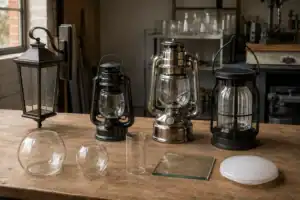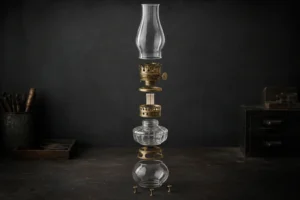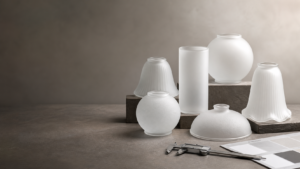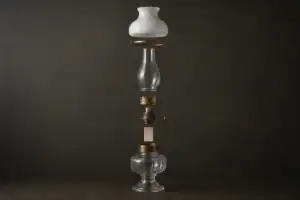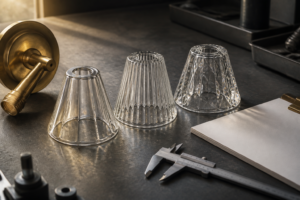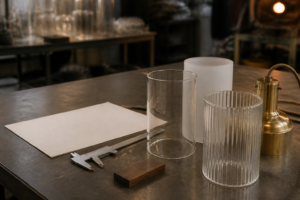
Choose outdoor glass lamp shades by first measuring your fixture’s fitter diameter, then selecting borosilicate or tempered glass rated for outdoor thermal shock, matched to the IP rating your installation requires and the light quality — frosted, seeded, or clear — your space demands.
Most people pick an outdoor glass lamp shade the wrong way: they start with aesthetics and work backward to fit. Then the shade arrives, doesn’t fit the fitter, or cracks in the first hard freeze because it’s soda-lime glass designed for indoors. This guide flips that sequence. Start with measurement, then material, then weather resistance, then style — and you’ll make the right call the first time.
Why Glass Specifically? Outdoor Glass vs. Other Shade Materials
Glass outdoor lamp shades offer superior light quality, UV-permanence, and visual clarity that polycarbonate and acrylic cannot match — but they require correct glass type selection to survive outdoor thermal and weather stress.
When you choose a polycarbonate or acrylic shade for outdoor use, you’re accepting a compromise: excellent weather resistance but light that looks slightly diffused and cooler than the bulb’s actual color temperature. Over time, even UV-stabilized polycarbonate hazes by 20–30%, cutting light output noticeably.
Glass doesn’t haze. Glass doesn’t yellow. The seeded glass shade on a well-maintained garden post lamp in 2010 still transmits light identically today. That permanence is glass’s primary advantage — but it comes with two real risks: thermal shock and impact vulnerability. Manage those two variables correctly and glass outperforms every other shade material on the market for long-term outdoor use.
| Property | Borosilicate Glass | Soda-Lime Glass | UV-Stabilized Polycarbonate |
|---|---|---|---|
| UV yellowing | None | None | Low (10–15 yr rated) |
| Thermal shock resistance | Excellent (ΔT up to 150°C) | Poor (ΔT ~40°C) | N/A — flexible material |
| Light clarity over time | Permanent | Permanent | Degrades 20–30% by year 10 |
| Impact resistance | Moderate | Low | Very high |
| Color temperature accuracy | Near-perfect | Near-perfect | Slight blue shift |
| Outdoor suitability | High with correct IP fixture | Covered/sheltered only | High |
Step 1 — Measure Your Fixture Fitter (Do This Before Anything Else)
The fitter is the ring or collar on your fixture where the shade seats. Measure it before shopping — outdoor glass shades are not adjustable and the wrong fitter size means the shade simply won’t mount.
Getting the fitter size right is the single most common mistake when choosing outdoor glass lamp shades. A shade that’s 1/8″ off on the fitter neck won’t seat securely, and a loose glass shade outdoors is a wind hazard.
Understanding Fitter Types
There are three standard fitter configurations for outdoor glass shades:
Slip fitter (most common): The shade slides over a shade holder ring. Measure the outer diameter of the holder ring — the shade’s fitter opening must match within ±1/16″. Standard residential sizes: 1⅝”, 2¼”, and 4″.
Uno fitter: The shade threads directly onto the socket. Measure the outer diameter of the socket where the shade screws on. Less common in outdoor fixtures but found on some post-mount designs.
Swag/keyless fitter: The shade snuggles into a cup-style holder. Measure the inner diameter of the cup.
How to Measure — Step by Step
- Turn off the fixture and let it cool fully (glass shades and hot sockets don’t mix during measurement)
- Use a digital caliper or a rigid ruler — cloth tape measures flex and give inaccurate readings
- For slip fitters: measure across the outer edge of the shade holder ring at its widest point
- For socket-mount (uno): measure the outer thread diameter of the socket
- Write down the measurement to the nearest 1/16″ — don’t round up or down
In practice: If your measurement falls between standard sizes (say, 2.1″), it means you have a non-standard fixture. Check the fixture manufacturer’s documentation for the OEM shade spec. Don’t guess — order a shade with the exact listed fitter or source a matching adapter ring first.
Neck Diameter vs. Fitter Diameter
One spec that confuses buyers: some glass shade listings show neck diameter (the opening at the top of the shade body) rather than fitter diameter. These are related but not the same — the neck is the opening, the fitter is the flange or rim that seats on the holder. For a standard slip-fit shade, the fitter flange is typically 1/4″–3/8″ larger than the neck opening. When in doubt, ask the supplier for both measurements.
Step 2 — Choose the Right Glass Type for Outdoor Use
For any fully or partially exposed outdoor installation, use borosilicate or tempered glass. Soda-lime glass — the default for most decorative glass shades — cracks under the thermal cycling of outdoor environments.
This is the part most buying guides skip entirely. Glass type determines whether your shade survives its first winter, and the wrong choice creates both aesthetic and safety problems.
Borosilicate Glass
Borosilicate glass (the same material as Pyrex laboratory and cookware glass) has a thermal expansion coefficient roughly three times lower than standard soda-lime glass. In practice, this means it can handle a rapid temperature swing of up to 150°C without cracking — the kind of differential that happens when a cold rain hits a shade housing a warm bulb on a summer evening.
For outdoor pendant shades, post lamp globes, and enclosed lantern panels, borosilicate is the recommended standard. According to Corning’s technical data on borosilicate composition, the key advantage is a coefficient of thermal expansion (CTE) of approximately 3.3 × 10⁻⁶/°C, versus soda-lime glass at 9 × 10⁻⁶/°C — nearly three times more stable under temperature stress.
Best for: Fully exposed outdoor shades, coastal environments, locations with freeze-thaw cycles, any application where rain-on-hot-bulb thermal shock is a realistic scenario.
Tempered (Toughened) Glass
Tempered glass is standard soda-lime glass that has been heat-treated to create compressive stress in the outer surface. It’s approximately 4× stronger than untreated soda-lime glass and, crucially, shatters into small blunt fragments rather than sharp shards when it does break — an important safety consideration for outdoor spaces with foot traffic.
The trade-off: tempering doesn’t improve thermal shock resistance. Tempered glass still cracks under rapid temperature differentials; it just cracks more safely. It’s appropriate for sheltered outdoor applications — covered porches, enclosed pergola bars — where direct rain contact with a hot shade is unlikely.
Best for: Covered or semi-sheltered outdoor locations, high-traffic areas where safety on breakage matters, applications where budget makes borosilicate impractical.
Soda-Lime Glass (When It’s Acceptable Outdoors)
Standard soda-lime glass — what most decorative glass shades are made from — is appropriate for outdoor use only in fully enclosed, sealed fixtures where the glass never contacts the weather directly and is thermally isolated from the bulb by adequate airspace. Traditional lantern-style enclosed fixtures with thick glass panels and proper airspace engineering can use soda-lime glass effectively even outdoors.
Best for: Sealed enclosed lantern fixtures with adequate thermal isolation. Not appropriate for open-bottom pendants, globe shades, or any fixture where rain can contact the exterior while the bulb is warm.
Specialty Decorative Glass Types
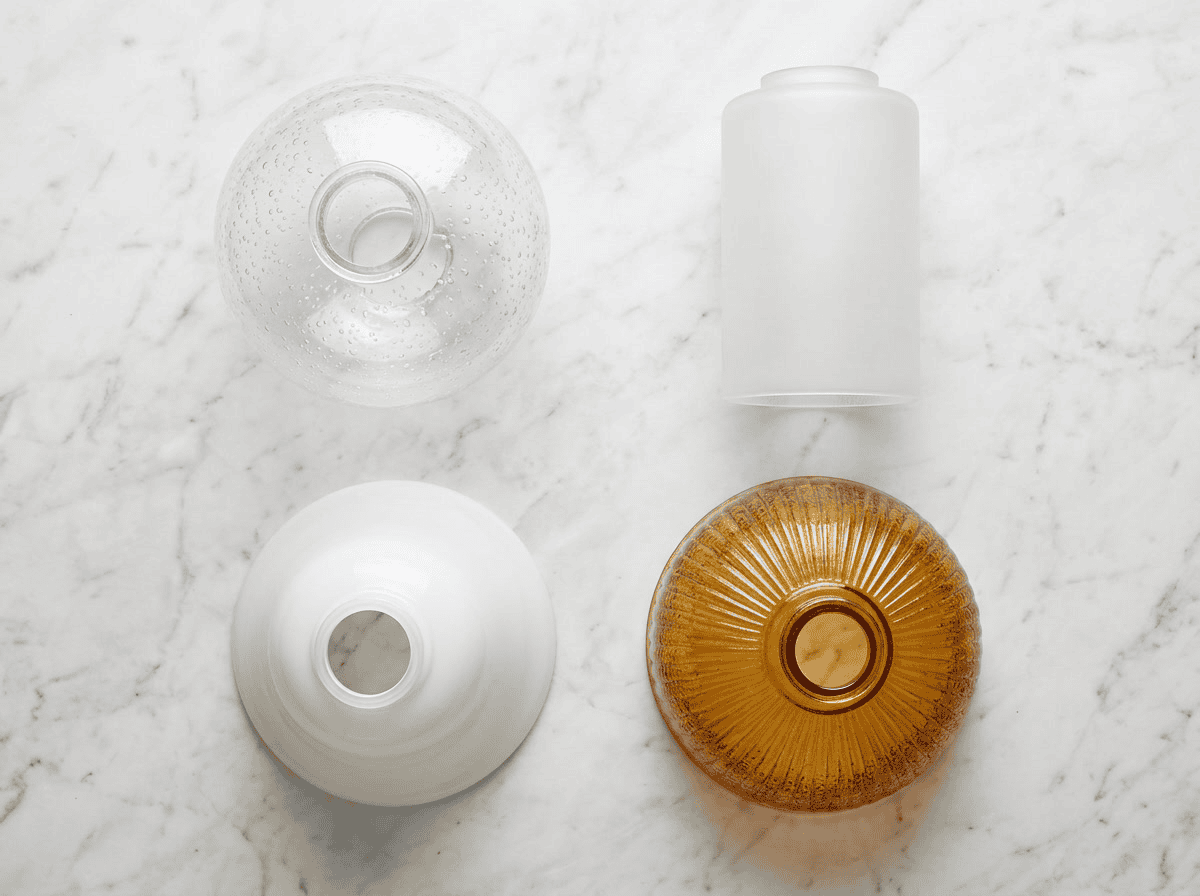
Within these three structural categories, outdoor glass shades come in several decorative surface treatments:
- Seeded glass: Small air bubbles deliberately formed in the glass during manufacture, creating a textured, antique appearance while diffusing light softly. Borosilicate seeded glass is available from specialty manufacturers.
- Frosted glass: Surface acid-etched or sandblasted to create uniform diffusion. Hides the bulb completely and produces glare-free ambient light. Available in borosilicate.
- Ribbed/pressed glass: Molded patterns (vertical ribs, diamond patterns) that scatter light directionally. Common in vintage and industrial aesthetics.
- Clear glass: Full light transmission, bulb visible. Best with decorative filament LED bulbs (Edison style) where the bulb itself is part of the aesthetic.
- Opal glass: Fully opaque white glass that diffuses light to a uniform glow. Higher light absorption than frosted, so plan for slightly lower perceived brightness.
Step 3 — Match IP Rating to Your Installation
For outdoor glass lamp shades and fixtures, require at minimum IP44 for covered locations and IP65 for fully exposed installations — the glass shade itself doesn’t carry the IP rating, but the fixture it mounts to does, and mismatching creates both safety and longevity failures.
Here’s the nuance most buyers miss: glass shades don’t carry individual IP ratings. The IP rating belongs to the complete fixture assembly — fixture body, shade, mounting hardware, and seal. When you replace a shade, you need to confirm the replacement maintains the fixture’s rated IP performance.
For open-bottom pendant styles, the open bottom means the complete assembly cannot be IP65-rated regardless of glass quality — rain driven at an angle can enter. These shades require covered or semi-sheltered installation.
For fully enclosed lantern-style fixtures, the glass panels and gasket seals together create the weather barrier. Replacing a glass panel with one that doesn’t include a matching gasket profile degrades the IP rating of the whole fixture.
The IEC 60529 standard, which defines IP ratings globally, specifies that all components of a fixture assembly must meet the rated protection level — a point worth confirming with your glass shade supplier if you’re in a high-exposure environment.
| Installation Type | Minimum IP | Glass Type Recommendation |
|---|---|---|
| Fully enclosed covered porch | IP44 | Tempered or borosilicate |
| Open covered pergola | IP44–IP55 | Borosilicate preferred |
| Fully exposed garden post | IP65 (fixture) | Borosilicate only |
| Coastal / poolside | IP65+ | Borosilicate, marine-grade fixture |
| Sealed lantern (no exposed bulb) | IP44 | Tempered acceptable |
Step 4 — Select Opacity and Light Output for Your Space
Choose frosted or opal glass to eliminate glare in social spaces; clear or lightly seeded glass to maximize light output in functional areas; and ribbed or patterned glass where decorative effect and moderate diffusion are both needed.
This is a step most buyers get backwards — they pick the look they want, then wonder why their patio feels either too dim or too glaring at night. Light quality follows directly from glass opacity, and outdoor spaces have specific needs.
Social and Ambient Zones (Patios, Decks, Garden Paths)
Frosted borosilicate is the standard choice for outdoor social spaces. It eliminates visible hot spots from the bulb, produces even ambient light without glare, and the diffusion is consistent across the entire shade surface. With a warm-white LED (2700K–3000K), frosted glass produces the candlelight-adjacent quality that makes outdoor dining and entertaining feel right.
Light transmission through frosted glass is typically 70–80% of the raw bulb output — meaningful but not a problem at typical outdoor pendant wattages (10W–25W LED equivalent).
Functional Outdoor Areas (Entry, Stairs, Workspace)
For areas where directional illumination matters — entry paths where you need to see where you’re walking, outdoor stair lighting, covered workshop or garage spaces — clear or lightly seeded glass maximizes downward light output while the shade shape handles direction.
Clear borosilicate with a dome or cone shade geometry delivers close to 90% of the bulb’s lumens. With a quality filament LED, the exposed bulb becomes an aesthetic feature rather than a glare source.
Accent and Decorative Lighting
For landscape accent lighting, garden post lamps, and fence-cap fixtures where the shade itself is a visual element, ribbed or pressed-pattern glass delivers the most visual interest. At lower illumination levels (5W–10W LED), the pattern refracts light into decorative patterns on adjacent surfaces.
In practice we’ve found: When mixing shade types across a space — say, frosted pendants over a dining area and clear globes on garden posts — keep the color temperature consistent across all bulbs (all 2700K, for instance). Mixed color temperatures across different glass opacities create an incoherent light environment that no amount of shade selection can fix.
Step 5 — Size the Shade to the Fixture and Space
Outdoor glass lamp shade diameter should be 1/3 to 1/2 the height of the fixture post for post lamps, and 12″–20″ for pendants hung 30″–36″ above outdoor surfaces — undersized shades look proportionally wrong and restrict light output.
Sizing outdoor shades is more forgiving than indoor table lamps but still follows proportional rules that matter visually.
Post Lamps
For a standard 48″ residential post lamp, the shade/globe diameter should be 10″–16″. A 6″ globe on a 48″ post reads as visually sparse; a 20″ globe looks top-heavy. The shade height should be roughly 1/3 the total lantern head height when the fixture includes a decorative body above the bulb zone.
Pendant Shades
Outdoor pendant shades — hung from pergola beams, porch ceilings, or covered terrace structures — follow the same proportional logic as indoor pendants. For a pendant over an outdoor dining table:
- Shade bottom should hang 30″–36″ above the table surface
- Shade diameter should be 12″–18″ for a 4-person table, 16″–22″ for a 6-person table
- For multiple pendants in a row, space centers at 24″–30″ with shade diameters at least 6″ smaller than the spacing (to avoid shades touching when they swing)
Wall Sconce Shades
For wall-mounted outdoor fixtures, the shade width should not exceed the fixture backplate width by more than 20% — oversized shades on wall sconces create shadows on the wall face that look unintentional.
Common Mistakes When Choosing Outdoor Glass Lamp Shades
The three most costly mistakes are buying soda-lime glass for exposed locations, ignoring fitter tolerances, and selecting opacity for aesthetics without considering the fixture’s lumen output.
We see all three regularly. Here’s how each plays out:
Mistake 1 — Soda-lime glass in a thermal-shock environment. The shade arrives, looks beautiful. Six months later, a summer thunderstorm hits a warm shade and it cracks. Soda-lime thermal shock failure is consistent and predictable — not a defect, just the wrong material for the application. The fix is always borosilicate for exposed outdoor use.
Mistake 2 — Measuring the shade opening instead of the fixture fitter. Buyers measure an existing shade’s neck opening and order a replacement with the same neck size, not realizing the fitter flange must match the holder ring, not the shade body opening. A shade with a 3″ neck but a 2¼” fitter flange mounts; a shade with a 3″ neck and a 3″ fitter flange does not fit a 2¼” holder ring.
Mistake 3 — Frosted glass on a low-lumen fixture. Frosted glass absorbs 20–30% of light output. On a 5W LED (roughly 400 lumens), that leaves ~280–320 usable lumens — inadequate for a path light covering a 10-foot zone. Either increase the bulb wattage or switch to clear or lightly seeded glass for low-lumen fixture applications.
According to the Illuminating Engineering Society’s outdoor lighting guidelines, residential outdoor pathway lighting should deliver a minimum of 0.5 foot-candles at ground level — a spec worth calculating against your shade’s light transmission before committing.
Outdoor Glass Lamp Shade Trends (2026 & Beyond)
The dominant 2026 trends in outdoor glass lamp shades are the return of mouth-blown artisan glass in high-end residential, the rise of dark-sky-compliant full-cutoff glass shade designs, and the integration of smart-bulb-optimized glass geometries.
Artisan and Handmade Glass Revival
Mass-produced pressed glass has dominated the outdoor lighting market for two decades. Starting in the mid-2020s, high-end residential and hospitality projects have shifted back toward mouth-blown and handmade glass shades — seeded glass with intentional irregularities, hand-pulled ribbed patterns, and subtle color gradients (amber, sage, and smoky grey) that pressed glass cannot replicate.
The shift is driven partly by design preference and partly by supply-chain changes that made custom handmade glass more commercially accessible. According to Statista’s home improvement market data, premium outdoor lighting spending in North America grew by double digits in the post-2023 period, with artisan fixture styles outperforming mass-market categories.
Dark-Sky Compliant Glass Shade Design
Municipalities across the US, EU, and UK are expanding light-pollution ordinances that mandate full-cutoff or partial-cutoff outdoor fixtures — meaning all light must be directed downward, with zero upward scatter. For glass shades, this means opaque tops, directional shade geometries, and specific glass opacity profiles.
The International Dark-Sky Association’s fixture approval database lists certified designs; glass shades with opaque upper sections and clear or frosted lower sections are increasingly appearing in this certification category.
Smart-Bulb-Optimized Glass
Tunable LED bulbs (adjustable from 2700K to 6500K, with dimming) are now the default for outdoor smart-home systems. Glass shade geometry is evolving to accommodate the specific optical properties of these bulbs — which have a much smaller, more intense light source than incandescent predecessors. Clear glass shades designed around filament LEDs now specify minimum bulb diameter and maximum lumen output to avoid glare at full brightness.
| Trend | 2024 Status | 2026 Direction |
|---|---|---|
| Artisan mouth-blown glass | Niche premium | Mainstream in mid-to-high residential |
| Dark-sky compliant glass shades | Regulatory requirement in some zones | Standard feature for outdoor lines |
| Smart-bulb-optimized geometries | Early product category | Broadly adopted by major manufacturers |
| Recycled glass content | Emerging | 20–30% recycled glass standard in EU market |
| Color-tinted outdoor glass | Rare | Growing: amber, sage, smoke |
FAQ
How do I choose the right size outdoor glass lamp shade?
Measure the fitter diameter first — this determines fit. Then size by proportion: for post lamps, shade diameter should be 1/3 to 1/2 the lantern head height. For outdoor pendants, 12″–20″ diameter hung 30″–36″ above the surface. Getting the fitter right matters more than shade diameter — a wrong fitter means the shade won’t mount at all.
What type of glass is best for outdoor lamp shades?
Borosilicate glass is best for any exposed outdoor location. It handles thermal shock (hot bulb + cold rain) up to 150°C differential without cracking — soda-lime glass fails at around 40°C differential. For sheltered covered-porch applications, tempered glass is acceptable and more budget-friendly. Never use standard untempered soda-lime glass for an exposed outdoor shade.
Can I use an indoor glass lamp shade outside?
Not for exposed locations. Indoor glass shades are typically soda-lime glass without any weatherproofing treatment, and the thermal shock from outdoor temperature cycling will crack them. Sealed, fully enclosed lantern fixtures with good thermal isolation are the exception — the glass in those applications functions more like a window than an exposed shade.
What does fitter size mean on a glass lamp shade?
The fitter is the rim or flange at the top of the shade that seats on the fixture’s shade holder ring. Standard outdoor residential fitter sizes are 1⅝”, 2¼”, and 4″. The fitter must match the holder ring diameter on your fixture to within 1/16″ for a secure mount. Neck diameter (the shade’s top opening) and fitter diameter are related but not the same — always confirm fitter size with the supplier.
How do I know if an outdoor glass shade is weatherproof?
The shade itself doesn’t carry an IP rating — the complete fixture assembly does. For weather resistance of the glass specifically, look for borosilicate or tempered construction with confirmed CTE (coefficient of thermal expansion) specs. For the fixture assembly, require IP44 minimum for covered locations and IP65 for fully exposed installations. Ask whether replacement shades maintain the fixture’s original IP rating, as this depends on gasket and seal compatibility.
How do I measure a replacement glass lamp shade?
Measure three dimensions: (1) fitter diameter — the holder ring outer diameter on your fixture; (2) shade diameter — the widest point of the shade body; (3) shade height — top of the fitter flange to the bottom opening. For globe-style shades, add the neck opening diameter. Bring all four measurements when shopping for replacements — suppliers need all of them to confirm a match.
Do frosted glass shades reduce light output?
Yes — frosted glass absorbs 20–30% of the bulb’s lumen output through diffusion. Opal glass absorbs up to 40%. For ambient outdoor spaces, this is usually acceptable and preferable (it eliminates glare). For task or pathway lighting where you need maximum illumination, choose clear or lightly seeded glass instead, or increase the bulb wattage to compensate for the absorption.
Conclusion
Choosing outdoor glass lamp shades correctly comes down to four decisions made in the right order: measure the fitter first, select the glass type for your climate and exposure level (borosilicate for anything exposed, tempered for sheltered applications), confirm the IP rating of the complete fixture assembly, and then — finally — select the opacity and style that fits the space.
Most buying mistakes happen because buyers start with step four and skip steps one through three. The shade that looks perfect in a product photo but arrives cracked in its first winter, or doesn’t seat on the holder ring, or leaves the patio feeling underlit — those failures are all preventable with the right sequence. Get the fundamentals right, and the aesthetics follow naturally. For custom specifications — specific glass types, fitter configurations, or bespoke decorative treatments — our outdoor glass lamp shade range covers standard and custom options for residential and commercial projects.