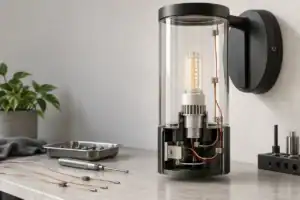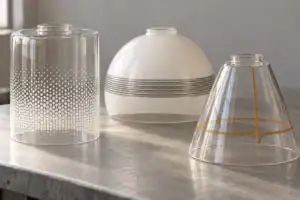
Borosilicate glass is the best glass for outdoor lamp shades — it withstands thermal shock up to a 150°C differential and resists UV yellowing for 10+ years, outperforming tempered, soda-lime, and polycarbonate alternatives in every climate.
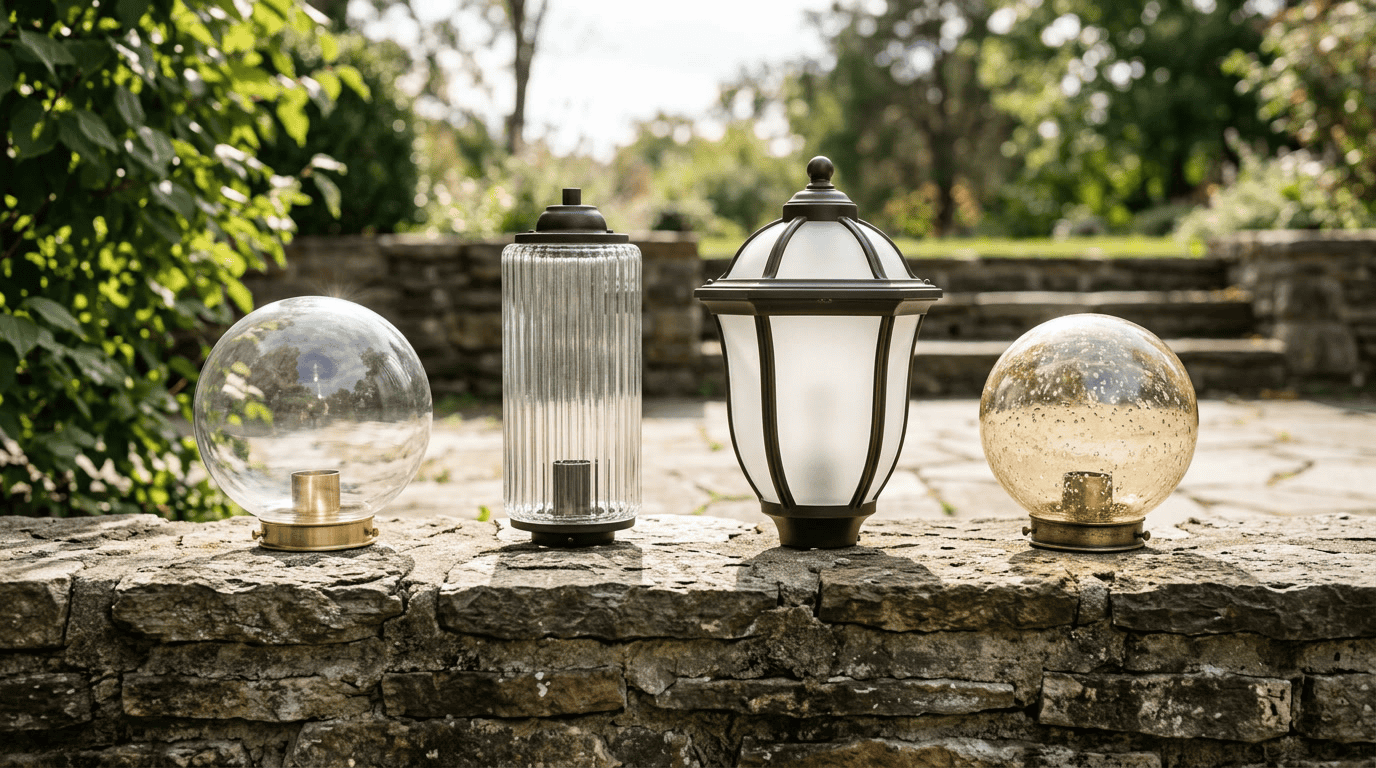
A porch lantern globe cracks its first winter. You replace it with the same-looking part. It cracks again in the same spot. The problem isn’t the fixture, the temperature, or bad luck — it’s the glass composition. Outdoor glass shades fail in predictable, preventable ways, and almost every failure traces back to one decision made before the shade was ever installed: which type of glass.
This guide covers the four glass types used in outdoor lamp shades, how each one fails, which finishes affect your light output, and how to match the glass to your climate. By the end, you’ll be able to specify the right glass — and refuse the wrong one.
Why Glass Type Matters for Outdoor Fixtures
The right glass for outdoor lamp shades isn’t determined by looks. It’s determined by physics. Outdoor glass shades face conditions that interior glass never encounters: direct sun heating the surface to 70°C while a cold rain drops it to 10°C within minutes, salt spray oxidizing surface coatings, UV radiation degrading the molecular structure over years, and repeated freeze-thaw cycles stressing any micro-crack until it propagates.
The Outdoor Glass Failure Equation
Glass fails in the field for three primary reasons:
- Thermal shock — the glass expands and contracts faster than its internal structure can accommodate, causing fracture. This is the single most common outdoor glass failure mode.
- UV degradation — prolonged ultraviolet exposure breaks the chemical bonds in certain glass formulations, causing yellowing, hazing, or surface pitting that compromises both aesthetics and structural integrity.
- Impact from thermal cycling — not a single shock event, but the cumulative fatigue of hundreds of heating-cooling cycles. Glass that survives its first winter may crack in its third.
The coefficient of thermal expansion (CTE) — measured in parts per million per degree Celsius (ppm/°C) — determines how violently a glass type reacts to temperature changes. Lower CTE means the glass expands and contracts less, making it intrinsically more resistant to thermal shock.
What “Weather-Resistant Glass” Actually Means
The phrase appears on countless product listings. It means almost nothing without specifics. There is no unified standard for “weather-resistant glass” in outdoor lighting — the term is marketing language, not a material certification. What matters is the underlying glass type, its CTE, its UV stability rating, and whether the fixture it sits in is designed to reduce the thermal gradient the glass experiences.
When a supplier says “weather-resistant,” ask: is this borosilicate, tempered, or soda-lime? That question will tell you everything the marketing label conceals.
| Glass Type | Thermal Expansion (CTE, ppm/°C) | Max Safe Temp Delta | UV Stability | Outdoor Lifespan |
|---|---|---|---|---|
| Borosilicate | 3.3 | ~150°C | Excellent (10+ yr) | 15–20 years |
| Tempered soda-lime | 9.0 | ~40–60°C | Good | 7–12 years |
| Standard soda-lime | 9.0 | ~20–30°C | Fair | 2–5 years |
| Polycarbonate | 65–70 | Not applicable | Poor without UV coat | 3–7 years |
The 4 Glass Types Used in Outdoor Lamp Shades
Borosilicate is the clear leader for fully exposed outdoor locations. But the right answer depends on your climate, your fixture type, and your budget — and in some applications, polycarbonate outperforms glass entirely.
Borosilicate Glass — The Outdoor Benchmark
Borosilicate glass contains approximately 12–15% boron trioxide, which dramatically lowers its CTE to 3.3 ppm/°C compared to ordinary glass at 9.0 ppm/°C. That difference is why a borosilicate globe survives a Minnesota ice storm while a soda-lime globe of identical appearance fractures.
As Corning’s glass science documentation explains, borosilicate’s low CTE results from the boron oxide network modifier disrupting the regular silica structure — a property that was first commercialized for laboratory glass (Pyrex) and later adopted for industrial and architectural applications.
In practice, borosilicate outdoor shades:
– Handle rapid temperature swings without stress fractures
– Maintain optical clarity without the UV-induced yellowing that affects soda-lime
– Resist surface etching from acid rain and coastal salt environments
– Typically carry a higher unit price but substantially lower lifetime cost
The tradeoff is weight and cost. Borosilicate is denser than tempered glass and typically costs 40–80% more per shade. For large-diameter lantern globes, that premium adds up. For any exposed coastal, alpine, or freeze-thaw climate, it pays back within the first replacement cycle.
Tempered Glass — The Safe Middle Ground
Tempered (toughened) glass is soda-lime glass that has been heat-treated to create internal compressive stress. When it breaks — and under sufficient thermal or impact load, it will — it shatters into small, relatively blunt granules rather than large shards. That safety profile makes it the standard specification for code-compliant outdoor fixtures in many jurisdictions.
Tempered glass’s CTE is still 9.0 ppm/°C. The tempering process improves its mechanical strength and impact resistance, not its thermal shock resistance per se. The relevant improvement is that tempered glass tolerates a larger temperature differential before fracturing — typically 40–60°C versus 20–30°C for standard soda-lime. That’s meaningful in moderate climates; it’s insufficient for freeze-thaw zones.
For covered porch applications, protected lanterns, or climates with minimal temperature swings, tempered glass is the practical choice. It costs roughly 20–40% more than standard soda-lime and is widely stocked by lighting distributors.
Soda-Lime Glass — The Budget Option That Costs More Long-Term
Standard soda-lime glass (approximately 73% silicon dioxide, 13% sodium oxide, 10% calcium oxide) is the most common glass type in the world. It’s what most windows, bottles, and inexpensive glass shades are made of. It’s also the worst choice for exposed outdoor lighting.
At a CTE of 9.0 ppm/°C with no tempering, soda-lime glass can only tolerate temperature differentials of 20–30°C before thermal stress causes cracking. On a summer afternoon, the sun-facing side of a soda-lime globe can reach 60–70°C. When an irrigation system kicks on and hits the shade with cool water, the delta can exceed 40°C in seconds. Failure is not a matter of if — it’s a matter of how many cycles.
The lure is price. Soda-lime replacement globes can cost 50–70% less than borosilicate equivalents. Over a three-year period in a climate with seasonal temperature swings, most buyers discover the total replacement cost exceeds what they would have paid for borosilicate at the outset.
Polycarbonate — When Glass Isn’t the Answer
Polycarbonate isn’t glass, but it appears in outdoor lighting applications often enough to warrant direct comparison. It’s impact-resistant, extremely lightweight, and virtually unbreakable under mechanical stress. For fixtures in high-vandalism areas, near sports courts, or in locations where falling branches are a hazard, polycarbonate can be the pragmatic choice.
The limitations are significant: polycarbonate has a CTE of 65–70 ppm/°C (twenty times that of borosilicate), which causes visible dimensional change with temperature. More critically, polycarbonate yellows and hazes under UV exposure within 3–7 years even with UV-stabilizing coatings, compared to borosilicate’s effectively indefinite UV stability. The IEC 60068-2-5 solar radiation standard sets the testing benchmark — most polycarbonate products are not tested to it.
For architectural or high-end residential applications where appearance matters long-term, borosilicate glass outperforms polycarbonate in every category except impact resistance.
Glass Finishes and Light Quality
The glass type determines durability. The finish determines how light actually behaves once it passes through the shade. These are independent decisions — you can have borosilicate in any finish, and the wrong finish for your application costs you meaningful lumen output.
Clear Glass — Maximum Output, Minimum Forgiveness
Clear glass transmits 88–92% of visible light. It’s the highest-efficiency option and the most demanding aesthetically: every blemish on the bulb, every fingerprint on the shade, every accumulation of insects inside the fixture is on display. Clear globes work best with filament-style LED bulbs, where the exposed filament architecture is part of the visual design.
Outdoors, clear glass also produces the most glare — a factor worth considering in residential settings near property lines, or anywhere the International Dark-Sky Association’s fixture seal of approval criteria for light trespass are relevant.
Frosted and Opal — Diffusion vs. Lumen Loss
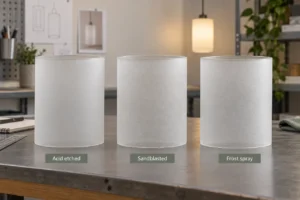
Frosted glass transmits 70–80% of light while eliminating direct visibility of the bulb and dramatically reducing glare. The frosting is either an acid-etched surface treatment or a sandblasted finish. Acid-etched frosted glass is smoother and easier to clean; sandblasted finishes have a more matte character but accumulate grime in the textured surface.
Opal glass — a semi-opaque formulation with colloidal particles suspended in the glass matrix — transmits 55–70% of light but produces an exceptionally even luminous appearance. It’s the finish most often specified for high-quality lanterns and gas-light-style fixtures. The lumen loss compared to clear glass is substantial; if you’re sizing the fixture for task lighting (pathway, security), account for the opal penalty by specifying a brighter bulb.
| Glass Finish | Light Transmission | Glare Index | Best Application |
|---|---|---|---|
| Clear | 88–92% | High | Decorative filament, low-glare settings |
| Acid-etched frosted | 70–80% | Low | General porch and pathway |
| Sandblasted frosted | 68–78% | Low | Rustic / industrial fixtures |
| Opal | 55–70% | Very low | Architectural lanterns, period style |
| Seeded/textured | 75–85% | Medium | Farmhouse, craftsman, vintage |
Seeded, Ribbed, and Textured Glass — Aesthetic Durability
Seeded glass contains small bubbles deliberately introduced during manufacturing to scatter light with a vintage character. Ribbed and fluted glass uses surface geometry to create light patterns on surrounding surfaces. These textured finishes transmit 75–85% of light (between clear and frosted), produce soft diffusion without significant glare, and tend to disguise dirt accumulation better than smooth-surface options — a practical outdoor advantage that rarely appears in product descriptions.
Textured glass also hides the cumulative micro-scratching that comes from cleaning outdoor fixtures over years, making it the lower-maintenance choice for exposed locations where cleaning is infrequent.
Climate-Zone Selection Guide
Climate is the single most important variable in choosing the best glass for outdoor lamp shades. A shade that performs perfectly in coastal California will fail in Minneapolis. Here’s how to match glass type to the conditions you actually have.
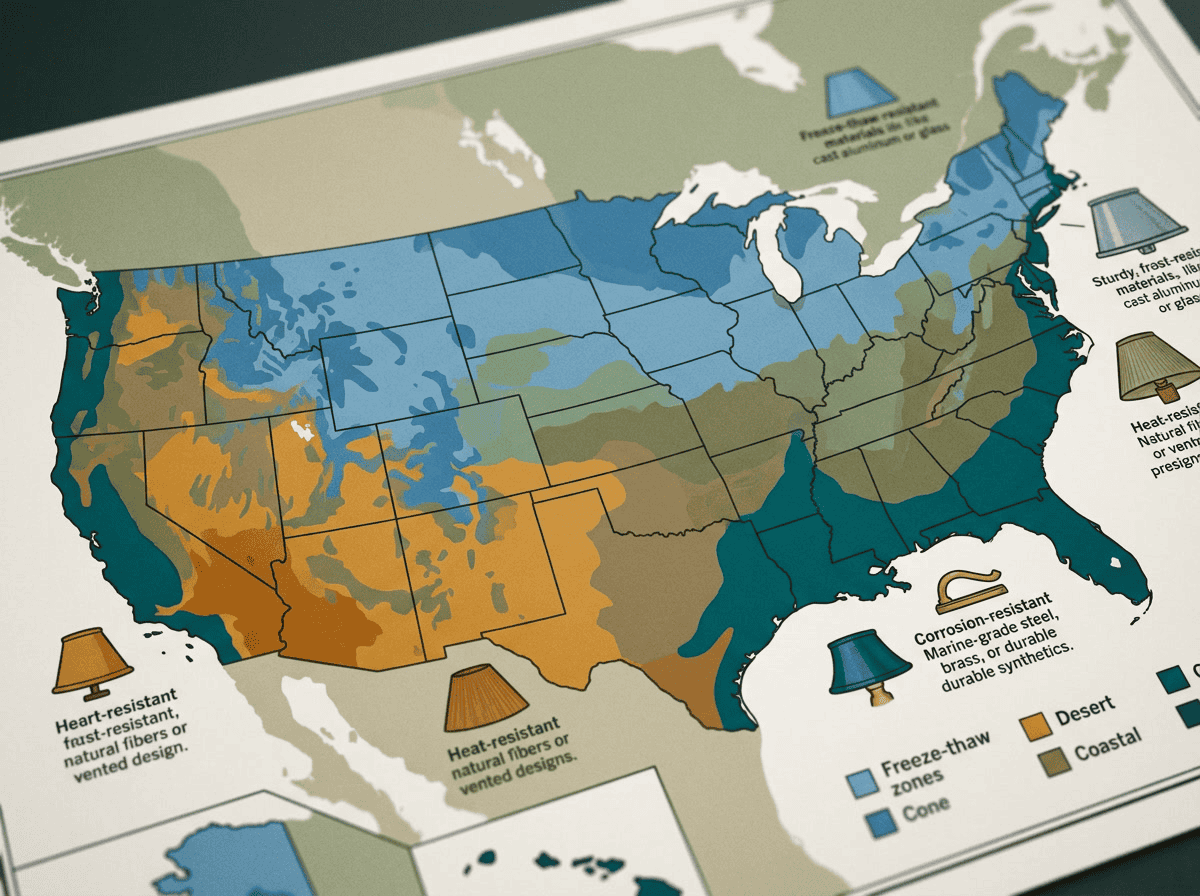
Freeze-Thaw Climates (USDA Zones 1–5)
This is the most demanding environment for outdoor glass. Temperatures swing from -30°C in winter to +40°C in summer. Rain and irrigation systems create rapid thermal shocks against sun-heated glass. Snow accumulation on the fixture top creates localized cold spots while the lamp interior warms.
Required: borosilicate glass. No other glass type handles the thermal differentials this climate routinely produces. According to ASTM C1048 heat-treated glass standards, even tempered glass is only tested to 40°C differentials — a threshold a Minnesota winter can exceed in a single rain event.
In practice: specify borosilicate explicitly when ordering. If a supplier cannot confirm the glass type, assume soda-lime and look elsewhere.
Coastal and Salt-Air Environments
The primary threat here isn’t thermal shock — it’s chemical attack. Salt aerosol reacts with the alkaline surface of soda-lime glass over time, causing progressive surface hazing (known as glass corrosion or dealkalization). Borosilicate’s lower alkali content makes it significantly more resistant to this degradation.
Secondary issue: coastal temperature swings are typically moderate, making tempered glass viable in terms of thermal performance. But the surface chemistry concern still favors borosilicate. For fixtures within 300 meters of the shoreline, borosilicate is the correct specification. Beyond 300 meters, tempered glass is acceptable with annual cleaning.
The fixture’s IP rating — the ingress protection rating defined by IEC standard 60529 — should be IP55 minimum for exposed coastal locations. The glass type and the IP rating address different failure modes; both matter independently.
Desert and High-UV Zones
Desert environments combine extreme radiant heat (glass surface temperatures of 80°C+ in direct sun are documented), high UV index, and rapid temperature drops after sunset. The UV concern eliminates polycarbonate as a viable option. The thermal concern eliminates soda-lime.
One nuance specific to desert climates: a dark-colored fixture absorbs more radiant heat than a light-colored one, driving up the glass surface temperature and increasing the thermal differential when cool night air arrives. In high-UV desert climates, borosilicate glass in a lighter-finished fixture is the optimal combination.
Humid Subtropical (Year-Round Condensation)
The gulf coast, southeast US, and similar climates present a different failure pattern: consistent high humidity drives condensation inside sealed fixtures, and the temperature swing between the lamp-heated interior and the humid exterior creates persistent moderate thermal stress. The cumulative effect is significant even when peak temperature differentials are modest.
Tempered glass performs acceptably in this climate — the differentials rarely exceed 50°C. But the moisture also degrades metal fittings, which eventually fail and allow the glass to shift or fall. In humid subtropical climates, glass longevity is often limited not by the glass itself but by the fixture hardware around it. Annual hardware inspection matters as much as glass type selection.
How to Identify the Glass Type You Already Have
Before replacing a broken outdoor shade, it’s worth identifying what you’re replacing — so you can either match it (if it lasted) or upgrade (if it didn’t).
The Tap Test and Thermal Response Check
Tap test: Strike the glass lightly with a fingernail or a small metal rod. Borosilicate produces a clear, bell-like ring. Soda-lime glass produces a duller, shorter sound. Tempered glass falls between. This test is informal but surprisingly reliable for distinguishing borosilicate from soda-lime once you’ve heard the difference on confirmed samples.
Thermal response check: In a controlled environment (a workshop, not outdoors), warm a corner of the glass to 50°C with a heat gun and apply a cool, damp cloth. Borosilicate tolerates this without stress whitening. Soda-lime typically shows a transient stress pattern visible in polarized light. This is a test for curiosity, not purchase decisions — the results are visual, not quantitative.
Reading Manufacturer Markings
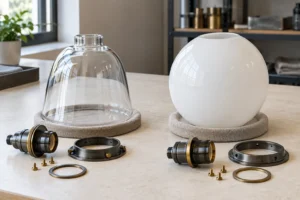
Quality borosilicate glass shades from reputable manufacturers often have a small acid-etched or engraved mark indicating the glass type. Look near the fitter rim or on the inside of the base. Marks to look for: “BOROSILICATE,” “PYREX-TYPE,” “BORO 3.3,” or a manufacturer code referencing their borosilicate product line.
The absence of any marking typically indicates soda-lime glass or an unspecified composition. Treat unmarked glass as soda-lime for specification purposes.
When Replacement Specs Matter
If the original shade lasted 10+ years, match the glass type regardless of cost. If it failed within 3 years, upgrade. One useful data point: the Statista global outdoor lighting market report tracks material preferences across premium fixtures — the shift toward borosilicate and tempered glass in residential outdoor segments has been consistent over the past decade, driven precisely by durability complaints about soda-lime replacements.
Matching Glass to Fixture Type
The best glass for outdoor lamp shades also depends on how the shade is mounted and how the fixture is oriented — factors that determine how much thermal and mechanical stress the glass actually experiences.
Post Lamps and Pier Mounts
Post-mounted fixtures sit fully exposed at the top of the installation, with 360° weather exposure and no overhead shelter. They experience the full range of thermal events — direct sun, rain, wind, snow. Borosilicate is the correct specification without exception. The globes on post lamps are also among the most frequently broken by lawn equipment and pedestrian contact, so consider a seeded or ribbed texture over clear to partially disguise minor surface abrasion.
The fitter size on post lamps is typically 3.25″ or 4″ — confirm before ordering, as these are not interchangeable, and a misfit globe transfers mechanical stress unevenly to the rim.
Wall Lanterns and Sconces
Wall-mounted fixtures have one face toward the structure (protected from direct rain and wind) and one face exposed. The thermal gradient is lower than post lamps. Tempered glass is viable in moderate climates; borosilicate remains the right call for freeze-thaw and high-UV zones. The protected side also means cleaning is more accessible, making smooth frosted finishes maintainable.
Pendant and Hanging Outdoor Fixtures
Hanging pendant fixtures for covered porches or pergolas experience the most shelter of any outdoor application. Overhead structure blocks direct rain and reduces peak sun exposure. In this protected context, tempered glass is appropriate in nearly all climates, and soda-lime glass is marginally acceptable for mild climates with no freeze-thaw cycles. The aesthetics of these fixtures often drive the finish choice more than the material composition — and that’s reasonable when the thermal environment supports it.
Future of Outdoor Lighting Glass (2026+)
Two developments are beginning to change how the best glass for outdoor lamp shades is selected and manufactured.
Smart Glass and Electrochromic Coatings
Electrochromic glass — which changes opacity in response to an electrical signal — has been used in architectural glazing for years. Scaled-down versions are beginning to appear in premium outdoor luminaires, allowing the shade to shift from transparent to frosted on a timer or sensor trigger. The glass substrate for these applications is typically borosilicate, because the electrochromic layer requires a dimensionally stable base material to prevent delamination under thermal cycling.
Widespread residential adoption is 3–5 years out. For specifiers working on projects with 10-year design horizons, electrochromic-ready borosilicate substrates are worth tracking.
Bio-Based and Recycled Glass Sourcing
Consumer and commercial pressure for lower-embodied-carbon materials is reaching the outdoor lighting sector. Recycled-content borosilicate glass — made from post-industrial laboratory glass cullet — is being offered by a small number of European manufacturers as a premium option. Optical and thermal performance is equivalent to virgin borosilicate; the supply chain is more constrained and lead times longer.
| Trend | Market Readiness (2026) | Expected Impact |
|---|---|---|
| Electrochromic smart shades | Early commercial | Niche premium segment |
| Recycled borosilicate | Available, limited supply | Sustainability-spec projects |
| Ultra-thin borosilicate (≤2mm) | Prototype stage | Weight reduction for large globes |
| Anti-microbial glass coatings | Available (hospitality) | Emerging in residential |
| Self-cleaning photocatalytic TiO₂ coating | Available | Reduces maintenance frequency |
Frequently Asked Questions
What is the best glass for outdoor lamp shades?
Borosilicate glass. Its thermal expansion coefficient (3.3 ppm/°C) is less than one-third that of standard glass, making it resistant to the rapid temperature changes outdoor fixtures routinely experience. For protected covered-porch locations, tempered glass is acceptable in mild climates.
Why do outdoor glass lamp shades crack?
Thermal shock is the leading cause — the glass surface heats and cools faster than the internal stress distribution can accommodate. This is caused by rain hitting sun-heated glass, irrigation system spray, or the daily heating-cooling cycle. Soda-lime glass is most susceptible. Borosilicate is engineered specifically to resist this failure mode.
What does IP rating have to do with glass type?
IP ratings (defined by IEC 60529) measure how well a complete fixture assembly resists water and dust ingress — they are not glass composition ratings. A fixture can carry IP65 and still contain soda-lime glass, which will crack under thermal shock regardless of the enclosure’s water resistance. The IP rating and the glass type address separate failure modes. Both matter.
How long does borosilicate glass last outdoors?
In exposed outdoor locations, well-manufactured borosilicate glass shades typically last 15–20 years before any visible degradation. UV stability, the primary limitation for other glass types, is essentially a non-issue for borosilicate. The fixture hardware around the shade typically fails first.
Can I use frosted glass outdoors?
Yes — frosted glass is an excellent outdoor choice. Acid-etched frosted borosilicate provides thermal shock resistance alongside glare reduction. The frost coating itself (if surface-applied) can gradually etch further from acid rain, but quality frosted borosilicate shades have the frost baked into the surface treatment process rather than applied as a separate coating.
What type of glass is best for coastal outdoor fixtures?
Borosilicate. Coastal salt air causes dealkalization (surface hazing) in soda-lime glass over 3–7 years. Borosilicate’s lower alkali content makes it significantly more resistant to this chemical attack. For fixtures within 300 meters of the shoreline, borosilicate is the only long-term option.
Is tempered glass good for outdoor lamp shades?
Tempered glass is a solid choice for covered porches, protected lanterns, and climates without significant freeze-thaw cycles. It tolerates temperature differentials up to 40–60°C and shatters safely if it does break. In exposed locations with harsh winters or desert heat, borosilicate outperforms it on thermal shock resistance.
Conclusion
The best glass for outdoor lamp shades is the one matched to the actual conditions the fixture faces — not the most attractive option in a catalog. For exposed locations in climates with meaningful temperature swings, borosilicate is the only glass type that consistently survives the full range of outdoor thermal events. Tempered glass fills a legitimate role for covered or protected applications in mild climates. Soda-lime glass belongs indoors.
Glass finish is a secondary decision, but not a trivial one: a frosted or opal borosilicate shade in a covered porch fixture can be aesthetically perfect and mechanically correct at the same time. Start with the glass type, then choose the finish. Get the composition right first, and the shade will still be in place long after anything else in the fixture has been serviced or replaced.