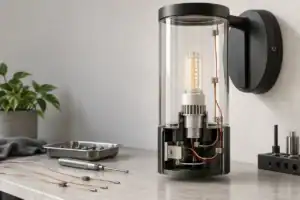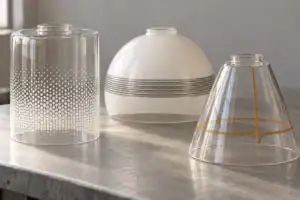
Yes — glass lamp shades can be used outdoors, but the glass type is the deciding factor. Borosilicate and tempered glass handle outdoor temperature swings, UV exposure, and moisture. Standard soda-lime glass — used in most indoor shades — will crack outdoors. The shade’s appearance tells you nothing about its suitability; the composition does.
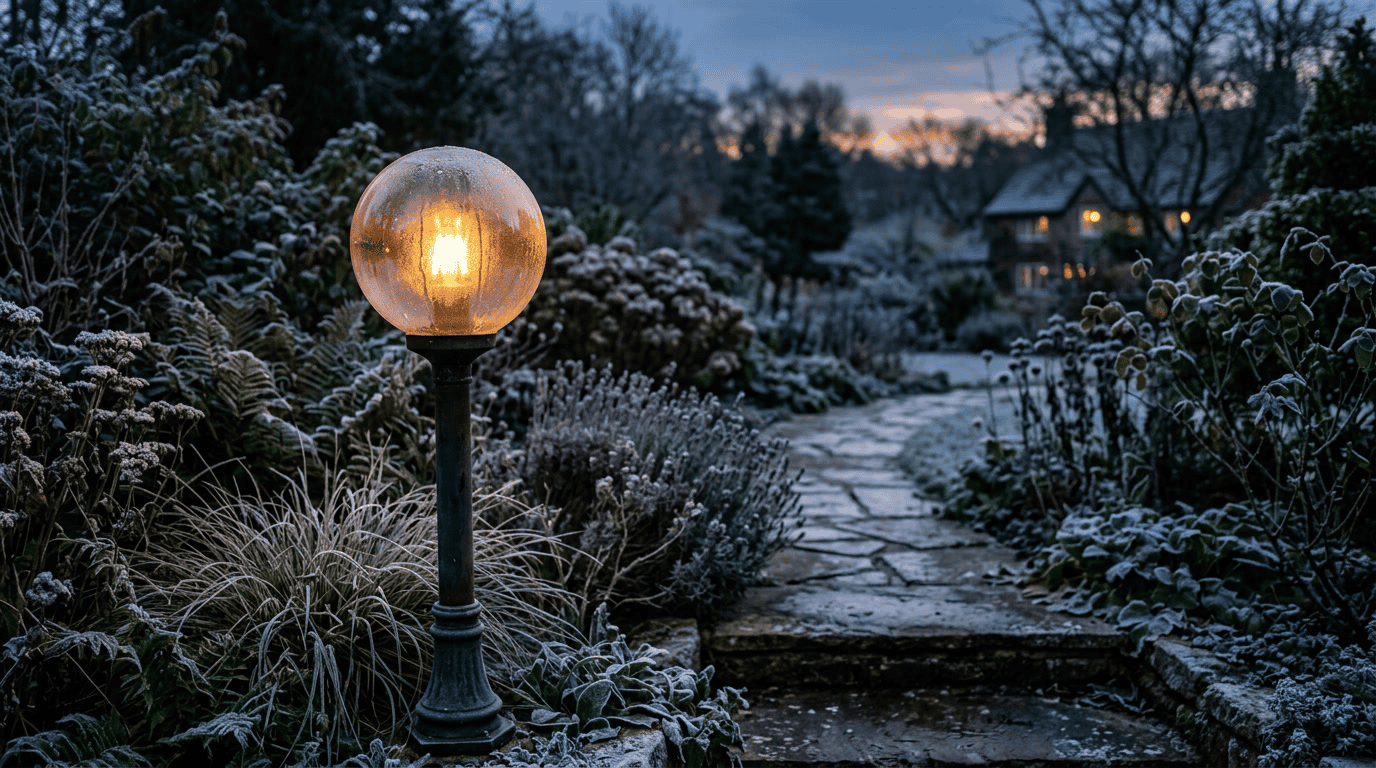
You found a beautiful vintage glass globe at an estate sale. It would be perfect in the lantern above your front door. Your neighbor tried something similar two winters ago — cracked before spring. Same climate, same style of fixture. The difference wasn’t the weather or the fixture. It was the glass.
Understanding which glass shades work outdoors and which ones don’t takes about five minutes. Getting it wrong means replacing a cracked globe in February. This guide gives you the decision framework so that doesn’t happen.
Do Glass Lamp Shades Work Outdoors?
Glass lamp shades work outdoors — reliably, and for 15–20 years — when the right glass type is used. The short answer is yes. The complete answer is: yes, with conditions that matter enormously.
The Short Answer — Yes, With Conditions
Outdoor fixtures present three challenges that indoor glass never faces:
- Thermal shock — rapid temperature changes between the heat of the lamp and the cool of rain, snow, or night air
- UV radiation — prolonged sun exposure that degrades certain glass formulations and virtually all plastic alternatives
- Moisture cycling — condensation, rain, frost, and the freeze-thaw cycle that stresses any micro-flaw in the glass until it propagates into a crack
High-quality glass shades handle all three. The operative word is specific: borosilicate glass and properly tempered glass are engineered for these stresses. Standard soda-lime glass — which accounts for the majority of decorative glass globes and shades sold for interior use — is not.
So yes, you can use glass lamp shades outdoors. But “glass” is not one material. It’s a category containing compositions with dramatically different physical properties.
Why Some Glass Shades Fail Outdoors (and Others Don’t)
The failure mechanism is almost always thermal shock. Glass expands when heated and contracts when cooled. The rate of that expansion and contraction — quantified as the coefficient of thermal expansion (CTE) — determines how well a glass type tolerates rapid temperature changes.
Borosilicate glass has a CTE of approximately 3.3 ppm/°C. Standard soda-lime glass has a CTE of 9.0 ppm/°C — nearly three times higher. When a sun-heated soda-lime globe at 65°C is hit by a cold rain that drops its surface temperature to 15°C in under a minute, the stress created by that 50°C differential exceeds the glass’s tensile strength. The result is a crack that typically radiates from the fitter rim, where the glass is mechanically constrained.
Borosilicate glass under the same thermal event experiences one-third the stress. It doesn’t crack.
| Glass Type | CTE (ppm/°C) | Max Safe Temp Delta | Outdoor Suitability | Typical Lifespan Outdoors |
|---|---|---|---|---|
| Borosilicate | 3.3 | ~150°C | Excellent — all climates | 15–20 years |
| Tempered soda-lime | 9.0 | ~40–60°C | Good — moderate climates | 8–12 years |
| Standard soda-lime | 9.0 | ~20–30°C | Poor — indoor only | 1–3 years |
| Polycarbonate | 65–70 | N/A | Acceptable but yellows | 3–7 years |
Which Glass Types Are Safe for Outdoor Use?
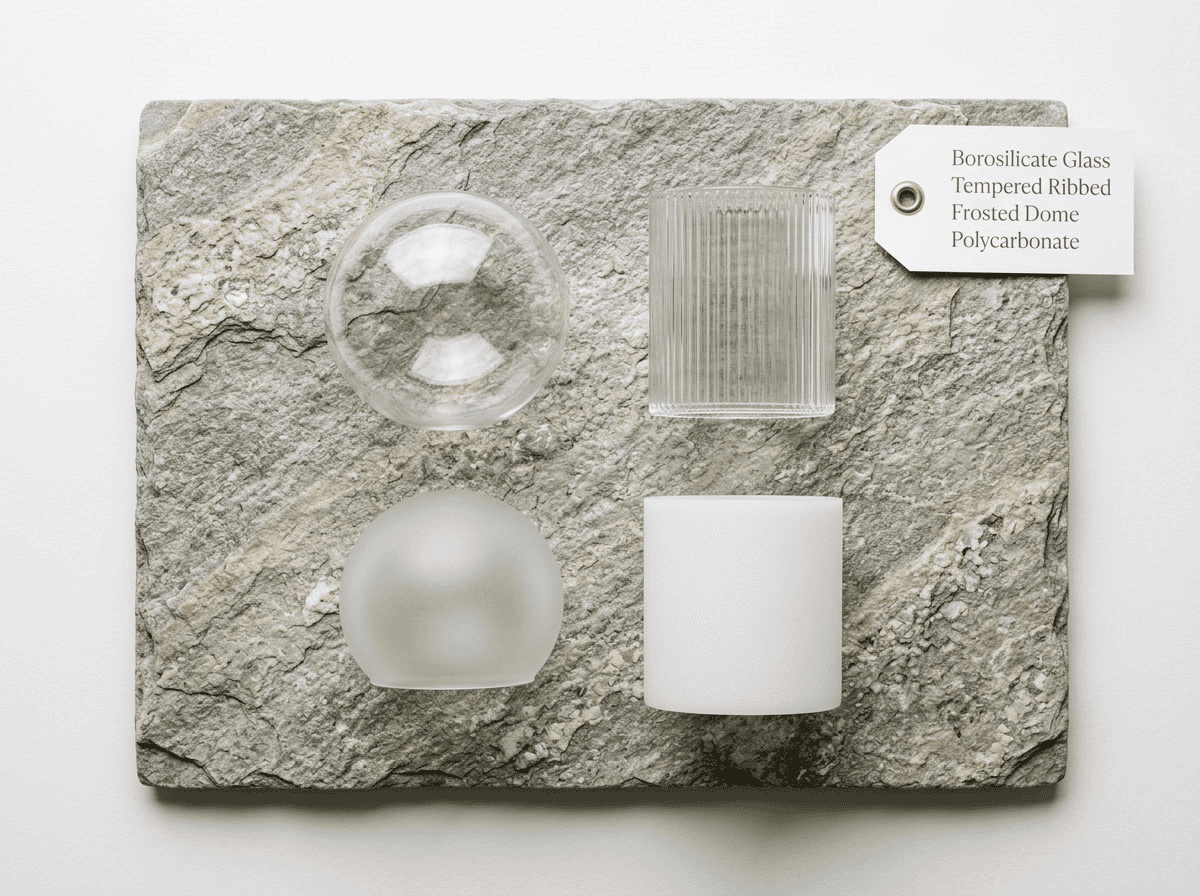
Four material categories appear in outdoor lamp shades. Two perform reliably. One fails predictably. One is technically not glass at all — but it appears frequently enough to address directly.
Borosilicate Glass — Outdoor-Safe in All Climates
Borosilicate glass is the standard for outdoor glass shades that need to last. Named for its boron trioxide content (12–15% by weight), borosilicate was originally developed for laboratory glassware precisely because it handles the thermal abuse of heating, cooling, and chemical exposure that normal glass cannot. The same properties that make it ideal for Pyrex beakers make it ideal for a lantern globe in Minnesota.
As Corning’s glass science documentation explains, the boron oxide network modifier disrupts the regular silica structure in a way that dramatically lowers thermal expansion. That structural change is permanent — it doesn’t degrade with UV exposure or temperature cycling over time.
In practice, borosilicate outdoor shades:
- Withstand thermal shocks that would crack soda-lime glass within a single rain event
- Resist UV-induced yellowing or hazing for decades
- Tolerate coastal salt air without the surface dealkalization that plagues soda-lime glass
- Typically carry a 40–80% price premium over comparable soda-lime globes — a cost that pays back within the first avoided replacement
Bottom line: If the fixture is exposed to weather in any meaningful sense, specify borosilicate. If the supplier cannot confirm the glass type, assume soda-lime.
Tempered Glass — Outdoor-Safe in Moderate Conditions
Tempered (toughened) glass is soda-lime glass that has been heat-treated to create internal compressive stress. The process improves mechanical strength and changes the failure mode — when tempered glass breaks, it shatters into small, relatively harmless granules rather than sharp shards.
Tempered glass’s CTE remains 9.0 ppm/°C. The tempering process does not reduce thermal expansion. What it does is increase the temperature differential the glass can survive before fracturing — typically 40–60°C versus 20–30°C for untreated soda-lime. That difference is meaningful in moderate climates with limited freeze-thaw exposure.
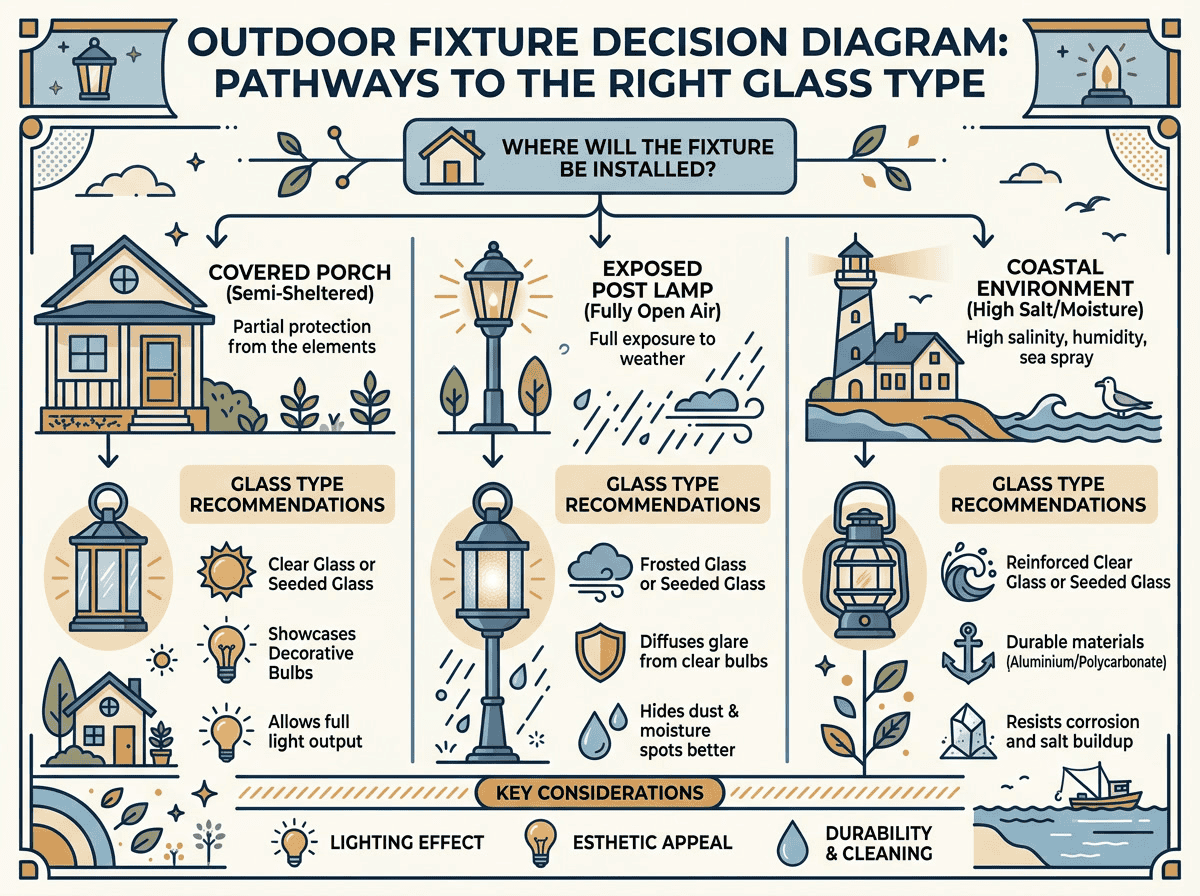
For covered porch fixtures, wall lanterns with overhead shelter, and locations with mild winters, tempered glass is a practical outdoor choice. For exposed post lamps in northern climates, mountain elevations, or coastal zones with salt spray, borosilicate is the correct specification.
Soda-Lime Glass — Indoor Only
Standard soda-lime glass accounts for roughly 90% of all glass manufactured globally, including the majority of decorative lamp shades and globes sold for residential use. It’s inexpensive, easy to mold into complex shapes, and visually identical to more durable alternatives — which makes it easy to install outdoors by mistake.
The failure pattern is consistent: a soda-lime shade installed in an exposed outdoor location typically survives its first summer. The first freeze-thaw cycle — or the first rain event that hits the shade while the lamp has been on for an hour — produces a crack. The crack may be hairline initially. It widens with each subsequent thermal event.
There is no meaningful test you can perform on a shade to determine whether it is soda-lime without a chemical analysis or an independent data sheet. If you cannot confirm borosilicate or tempered composition, treat the glass as soda-lime and keep it indoors.
Polycarbonate — The Non-Glass Alternative
Polycarbonate isn’t glass, but it fills the same shape role in outdoor lighting and appears frequently as a “safer” alternative. Its impact resistance is genuine — polycarbonate is virtually unbreakable under mechanical stress, making it appropriate for fixtures near sports courts, high-traffic pathways, or anywhere vandalism is a concern.
The limitations are real. Polycarbonate has a CTE of 65–70 ppm/°C — roughly twenty times that of borosilicate — causing visible dimensional change in temperature extremes. More significantly, polycarbonate yellows and hazes under UV exposure within 3–7 years even with UV-stabilizing coatings. According to IEC 60068-2-5 solar radiation testing standards, the accelerated UV exposure equivalent of 5–7 outdoor years produces measurable optical degradation in standard polycarbonate.
For architectural applications where long-term appearance matters, borosilicate glass outperforms polycarbonate in every category except impact resistance.
What Makes a Glass Shade “Outdoor Rated”?
The phrase “outdoor rated” appears on fixture specifications, but rarely on the glass shade itself. Here’s what it actually means — and what it doesn’t.
IP Ratings and What They Actually Test
The IP (Ingress Protection) rating — defined by IEC standard 60529 — describes how well a complete fixture assembly resists water and dust penetration. An IP44 rating means the fixture is protected against splashing water from any direction. IP65 means the fixture is dust-tight and resists water jets.
Here’s the critical nuance: the IP rating applies to the fixture assembly, not to the glass shade in isolation. A fixture can carry an IP65 rating and still contain standard soda-lime glass. The IP rating tells you the enclosure is watertight; it says nothing about the glass’s thermal shock resistance. These are independent specifications addressing independent failure modes.
When you see “IP65” on a lantern, that tells you water won’t get inside the fixture to damage the electrical components. It does not tell you whether the glass globe will survive a summer rainstorm after the lamp has been running for two hours.
Glass Composition vs. Fixture Rating — Two Separate Things
The practical consequence: you need to evaluate both the fixture rating and the glass composition separately. A fixture rated IP65 with soda-lime glass will keep its wiring dry but crack its globe. A borosilicate shade in a poorly sealed IP20 fixture will survive thermal shock but may allow moisture infiltration that damages the socket.
For exposed outdoor locations:
– Fixture: IP44 minimum for covered locations; IP65 for fully exposed
– Glass: borosilicate for exposed; tempered acceptable for covered moderate climates
– Do not substitute one specification for the other
How to Read a Product Spec Sheet for Outdoor Suitability
When evaluating whether a glass shade can be used outdoors, look for these specific fields in the product specification:
- Glass type — borosilicate, tempered, or soda-lime. If not listed, ask the supplier directly. If they cannot confirm, assume soda-lime.
- Maximum operating temperature — relevant for enclosed fixtures where heat builds up
- UL/ETL wet or damp rating — US safety certifications that indicate the fixture has been tested for outdoor use (wet location = fully exposed; damp location = sheltered/covered)
- IP rating — international standard for water and dust ingress resistance
- UV stability rating — relevant for polycarbonate and coated glass; less important for pure borosilicate
The absence of any glass-type specification in a product listing is itself a signal. Quality outdoor glass shades from reputable manufacturers list their glass composition because it’s a selling point. When the spec sheet is silent on glass type, the glass is almost certainly standard soda-lime.
Can I Use an Indoor Glass Shade Outside?
This is the question most people actually have when they search “can glass lamp shades be used outdoors.” You have a shade that currently lives inside. You want to move it — or you found one at a thrift store and you’re wondering if it’s safe to install in an outdoor fixture.
The Three Conditions Where It Might Work
An indoor glass shade can function outdoors under these specific conditions:
- Fully covered, sheltered location — under a solid roof, away from direct rain, with no direct sun exposure. A recessed ceiling fixture on a deep covered porch is the clearest example. The shade sees temperature changes, but they’re gradual. Thermal shock events (rain hitting heated glass) don’t occur.
- Mild climate with no freeze-thaw cycle — coastal California, Florida (outside freeze zones), similar environments. Temperature differentials stay within the 20–30°C range that even soda-lime glass tolerates. This is more margin than most people assume — a January night in Los Angeles that drops to 7°C after a 22°C afternoon is only a 15°C swing for a shade that has already cooled for several hours.
- Enclosed fixture that limits thermal gradient — a fully enclosed lantern with a small glass panel (not a globe or open shade) limits how fast the glass surface temperature changes, reducing thermal shock risk even with lower-quality glass.
None of these conditions guarantee longevity for soda-lime glass outdoors. They reduce the failure probability. For anything that matters aesthetically — an antique globe, a hand-blown shade, something irreplaceable — use borosilicate regardless of the location.
The Three Conditions Where It Will Definitely Fail
An indoor glass shade will fail outdoors under these conditions:
- Exposed post lamp, pier mount, or wall sconce with no overhead shelter — direct sun, direct rain, direct temperature swings. This is the standard failure scenario. The shade may survive its first summer. It will crack within 1–3 winters.
- Any climate with meaningful freeze-thaw cycling — USDA zones 1–6, mountain elevations above 1,500m, and any location with more than a few freeze-thaw events per year. The cumulative stress of repeated cycling propagates micro-flaws that weren’t visible on installation.
- High-wattage bulbs in enclosed fixtures — a 60W incandescent (or equivalent heat-generating lamp) in a sealed fixture drives glass surface temperatures above 70°C. A brief rain or morning dew then creates a 50°C+ thermal differential. Soda-lime glass fails within this range routinely.
How to Tell If Your Existing Shade Is Soda-Lime
There is no definitive field test, but two indicators help:
- Sound test: Tap the glass lightly with a fingernail or small metal object. Borosilicate produces a clear, bell-like ring that sustains for a moment. Soda-lime produces a duller, shorter sound. This test is informal and requires a confirmed borosilicate reference to compare against, but it’s reliable once you’ve heard the difference.
- Source and price: Vintage globes from estate sales, thrift stores, and most home goods retailers are almost universally soda-lime. Borosilicate outdoor shades are sold through lighting specialty suppliers, marine chandleries, and commercial lighting distributors. If you paid $15 for a glass globe at a flea market, it is soda-lime.
Installing Glass Shades on Outdoor Fixtures
Choosing the right glass is necessary but not sufficient. Installation errors are the second leading cause of outdoor glass shade failures, after wrong glass type selection.
Matching Fitter Size to the Fixture
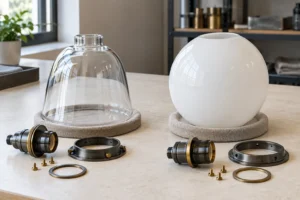
The fitter is the rim or collar at the top of the shade that seats on the fixture’s shade holder ring. Fitter sizes for outdoor fixtures are standardized in most markets:
- 1⅝ inch (41mm) — common on smaller wall sconces and accent fixtures
- 2¼ inch (57mm) — the most common residential outdoor fitter size
- 3¼ inch (83mm) — used on medium post lamps and larger lanterns
- 4 inch (102mm) — large post lamps, pier mounts, commercial fixtures
A mismatched fitter creates mechanical stress points at the contact ring. Even a 3mm mismatch — invisible to the eye — creates localized loading that concentrates thermal stress precisely where it’s least tolerable. The fitter rim is already a vulnerable point because it’s the most constrained part of the shade; adding mechanical stress to thermal stress dramatically increases fracture probability.
Always measure the fixture’s shade holder ring before ordering a replacement shade. Don’t rely on the old shade’s nominal size — measure both the old fitter and the holder ring directly.
Sealing and Positioning for Weather Protection
Even with the correct glass type and fitter, installation position affects longevity. Two practices reduce failure risk:
- Orient the fitter gap away from prevailing weather — if the fixture has a directional opening or the shade sits slightly off-center, positioning the glass so rain approaches the solid side rather than the fitter gap reduces moisture infiltration and localized thermal events at the rim
- Avoid thermal bridging — metal fitter rings and holders conduct heat and cold rapidly to the glass at the contact point; a thin rubber or silicone gasket at the fitter interface both seals the gap and reduces the rate of temperature transfer to the glass, buying the shade more time during rapid ambient temperature changes
The Illuminating Engineering Society’s residential outdoor lighting guidelines recommend annual inspection of glass shade fitter seating on outdoor fixtures — a check that takes 30 seconds and catches shifting that leads to uneven mechanical loading before it causes a fracture.
Maintenance to Extend Outdoor Glass Life
Glass shades on outdoor fixtures collect organic matter (mold, pollen, insect residue) that holds moisture against the surface and, over years, can contribute to surface etching in soda-lime glass. Cleaning guidance:
- Clean with mild soap and warm water, never abrasive cleaners or sudden temperature changes during cleaning (don’t clean a hot shade with cold water)
- Inspect the fitter gasket annually and replace if it has hardened, cracked, or compressed to less than half its original thickness
- Check for hairline cracks annually, especially at the fitter rim — a crack detected early can mean a managed replacement rather than an unexpected one
Future of Outdoor Glass Shades (2026+)
Two material developments are beginning to change what “can glass lamp shades be used outdoors” means as a question.
Self-Cleaning and Anti-UV Coatings
Photocatalytic titanium dioxide (TiO₂) coatings applied to borosilicate glass surfaces use UV light to break down organic contaminants, reducing cleaning frequency significantly. The coating is already available on architectural glazing and is beginning to appear on premium outdoor luminaires. It has no effect on thermal shock resistance — the borosilicate substrate handles that — but it meaningfully reduces maintenance in humid climates where biological growth on glass is a persistent issue.
Anti-UV hard coatings primarily benefit polycarbonate and coated glass, extending UV stability from 3–5 years to 7–10 years in tested conditions. According to ASTM standards for coated glass performance, next-generation UV-stable formulations are being evaluated for residential outdoor lighting at accelerated exposure rates equivalent to 10+ outdoor years.
Electrochromic Smart Glass for Outdoor Use
Electrochromic glass — which transitions from transparent to frosted in response to an electrical signal — is scaling down from commercial glazing to lighting applications. Several manufacturers are prototyping outdoor pendant fixtures with electrochromic borosilicate globes that can shift opacity via a phone app or automatic daylight sensor.
The practical benefit: the same fixture can function as a task light (clear glass, maximum output) in the evening and a glare-free ambient light (frosted) when neighbors or guests are nearby. The borosilicate substrate handles the outdoor thermal requirements; the electrochromic layer handles the optical switching.
| Technology | Market Readiness (2026) | Primary Benefit | Glass Type Required |
|---|---|---|---|
| TiO₂ self-cleaning coating | Available, residential | Reduced cleaning | Borosilicate preferred |
| Anti-UV hard coat | Available, improving | Extended polycarbonate life | Polycarbonate, coated glass |
| Electrochromic switching | Early commercial | Variable opacity | Borosilicate substrate |
| Recycled borosilicate | Limited supply | Lower embodied carbon | Borosilicate |
| Anti-microbial coating | Available (hospitality) | Hygiene-sensitive locations | Any glass substrate |
The Statista global smart outdoor lighting market outlook projects sustained annual growth driven partly by premium fixture categories that use borosilicate glass as the substrate for these coating and switching technologies — a market signal that borosilicate’s role in outdoor lighting is expanding, not stabilizing.
Frequently Asked Questions
Can glass lamp shades be used outdoors?
Yes — but only specific glass types. Borosilicate glass is suitable for exposed outdoor locations in any climate. Tempered glass works in moderate climates and covered locations. Standard soda-lime glass (the most common type in decorative shades) is indoor only and will crack from thermal shock outdoors.
How can I tell if a glass shade is safe for outdoor use?
Ask the supplier to confirm the glass type. “Borosilicate” or “tempered” means outdoor-capable. If the supplier cannot confirm the glass type, or if the shade came from a thrift store or estate sale, treat it as soda-lime and keep it indoors or in a fully protected covered location.
What happens if you use an indoor glass shade outside?
Soda-lime glass — the standard indoor glass composition — typically survives its first outdoor summer. The first freeze-thaw cycle, or the first time cold rain hits the shade while the lamp is warm, creates a thermal shock that cracks the glass. The crack usually radiates from the fitter rim. It may be hairline at first, then widens.
Does the IP rating on a fixture tell me the glass is outdoor-safe?
No. The IP (Ingress Protection) rating describes how well the complete fixture assembly resists water and dust ingress. It does not describe the glass composition or its thermal shock resistance. A fixture rated IP65 can still contain soda-lime glass that will crack outdoors. Evaluate the IP rating and glass type as separate specifications.
Can I use vintage glass globes outdoors?
With caution. Most vintage glass globes from estate sales, thrift stores, and antique sellers are soda-lime glass. Exceptions exist — some older borosilicate laboratory glass shades and period reproduction pieces use quality compositions — but they cannot be reliably identified without testing or documentation. For irreplaceable vintage pieces, keep them indoors or in a fully sheltered location.
Is frosted glass safe for outdoor use?
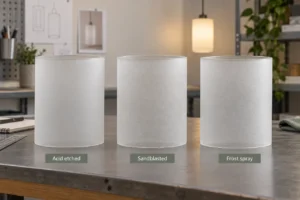
Frosted glass’s outdoor suitability depends on the base glass type, not the frosting. Frosted borosilicate is outdoor-safe. Frosted soda-lime is not. The frosted finish is a surface treatment (acid-etched or sandblasted) applied after the glass is formed — it has no effect on the glass’s thermal expansion characteristics or outdoor durability.
What is the best alternative if I can’t get borosilicate glass?
For exposed outdoor locations where borosilicate is unavailable or too costly: tempered glass in moderate climates, or polycarbonate if impact resistance is the primary concern. Polycarbonate will yellow under UV exposure within 3–7 years; tempered glass won’t. Neither matches borosilicate’s combination of UV stability and thermal shock resistance.
Conclusion
Glass lamp shades can absolutely be used outdoors — the question was never really about glass versus something else. It was about which glass. Borosilicate handles any outdoor condition reliably. Tempered glass works in sheltered or mild-climate locations. Standard soda-lime glass belongs indoors, regardless of how tempting the price or how beautiful the piece.
The decision tree is straightforward: exposed location in a freeze-thaw climate → specify borosilicate explicitly. Covered porch in a mild climate → tempered glass is fine, and even quality soda-lime in a fully protected spot. Can’t confirm the glass type → treat it as soda-lime and plan accordingly. That framework prevents the February replacement call that nobody wants to make.