Direct answer: To identify stained glass lamp shades, examine three things: construction method (copper foil solder lines are 3D; lead came has wider visible leading; printed patterns are flat), glass type (true stained glass colors run through the glass; painted-surface colors are surface-only), and any maker’s marks on the fitter ring or solder points.
The stained glass lamp shade market contains genuine antiques worth thousands of dollars, quality artisan reproductions worth hundreds, mass-market resin reproductions worth tens of dollars, and everything in between — all potentially described with the same terms. Identifying what you actually have is essential for buying, selling, insuring, or restoring stained glass lamp shades.
This guide provides a systematic identification method based on physical examination, without requiring chemical analysis or expert appraisal for most pieces.
For an overview of the broader stained glass lamp shade category, see our stained glass lamp shades hub.
The Three-Tier Identification Framework
Identifying a stained glass lamp shade requires answering three questions in sequence:
1. Is it genuine multi-piece glass construction (or not)?
2. If genuine, what technique was used (copper foil or lead came)?
3. What period and/or manufacturer produced it?
Each question has specific physical tests. Starting with question 1 is essential — misidentifying a resin reproduction as a genuine piece is the most expensive identification error.
Step 1: Is It Genuine Multi-Piece Glass?
| Construction | Pattern Lines | Weight | Back of Shade |
| Copper foil (Tiffany) | 3D, metallic, slight width variation | Heavy (glass) | Visible cut glass edges and solder reverse |
| Lead came | Wider, flatter metal lines | Heavy (glass) | H-profile lead visible between pieces |
| Resin/polymer | Flat or barely raised, perfectly even | Light | Molded, uniform resin sheen |
| Printed/applied pattern | Flat paint or film | Light to medium (single-piece glass) | No thickness variation, all one piece |
Test: Examine the pattern lines under a strong light at a low angle.
Genuine copper foil construction:
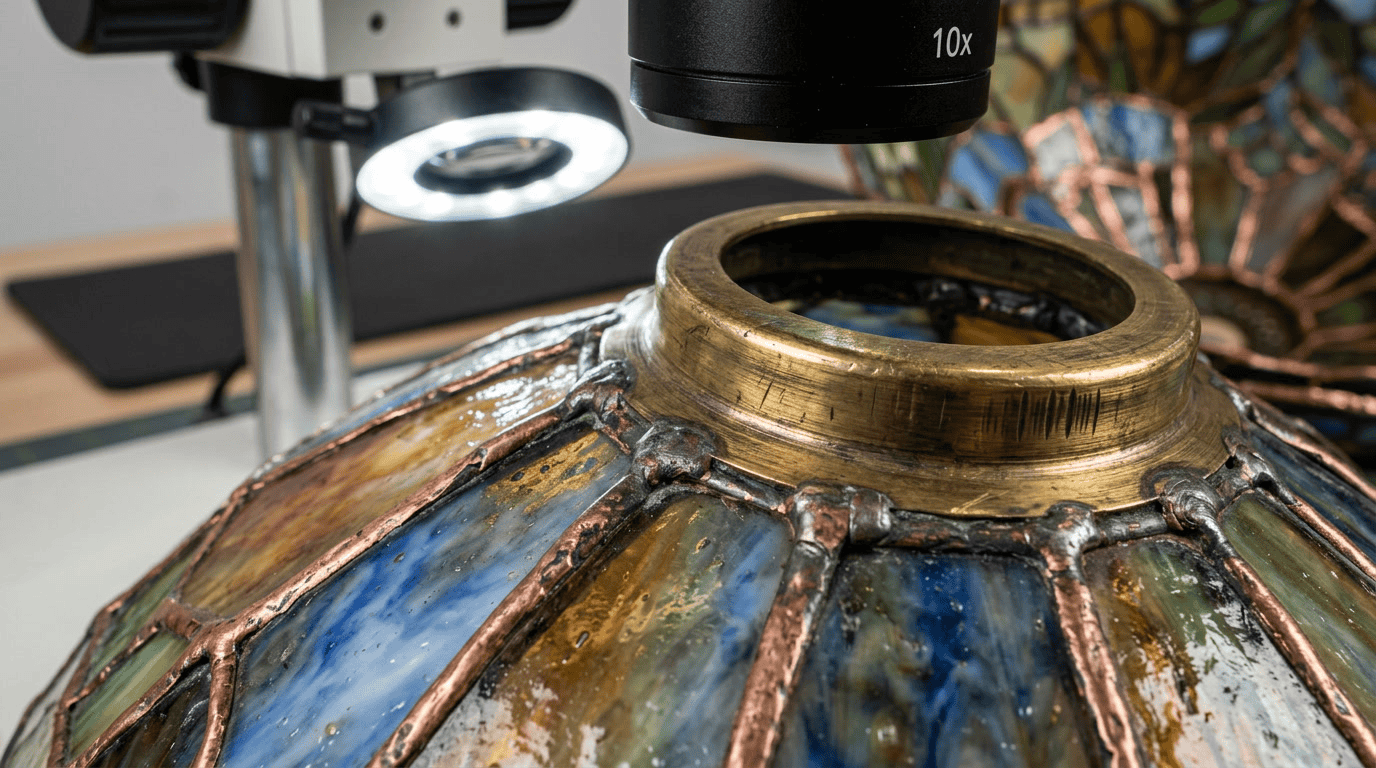
- Solder lines are three-dimensional — visibly raised above the glass surface level
- Solder has a metallic color: natural (bright silver), copper patina (warm brown), or black patina (dark)
- The lines have slight variation in width — they were applied by hand
- Turn the shade inside out and examine the back: you should see the inside of each solder line and the cut edges of individual glass pieces
Genuine lead came construction:
- Wider, flatter metal lines than copper foil
- H-profile lead strips visible (or evidence of them) between glass pieces
- Slightly different visual character than copper foil — less precise, more hand-worked
Resin or polymer reproduction:
- Pattern lines are flat or only very slightly raised — molded into the surface, not soldered
- Entire surface has a consistent resin sheen
- Weight is lighter than glass of the same size
- Pattern lines are perfectly even width throughout — no hand variation
Printed/applied pattern on single-piece glass:
- Pattern lines are flat paint or applied film
- Hold the shade to strong light — a single-piece shade with applied pattern shows no glass thickness variation between the “leading” and the “glass panels” — it’s all one piece of glass
This first test is definitive. If the pattern lines are three-dimensional and metallic, you have genuine multi-piece construction. If they’re flat, you don’t. The stained glass lampshade construction walkthrough shows what hand-soldered copper foil joints look like up close, for comparison.
Step 2: Examine the Glass Itself
For genuine multi-piece stained glass:
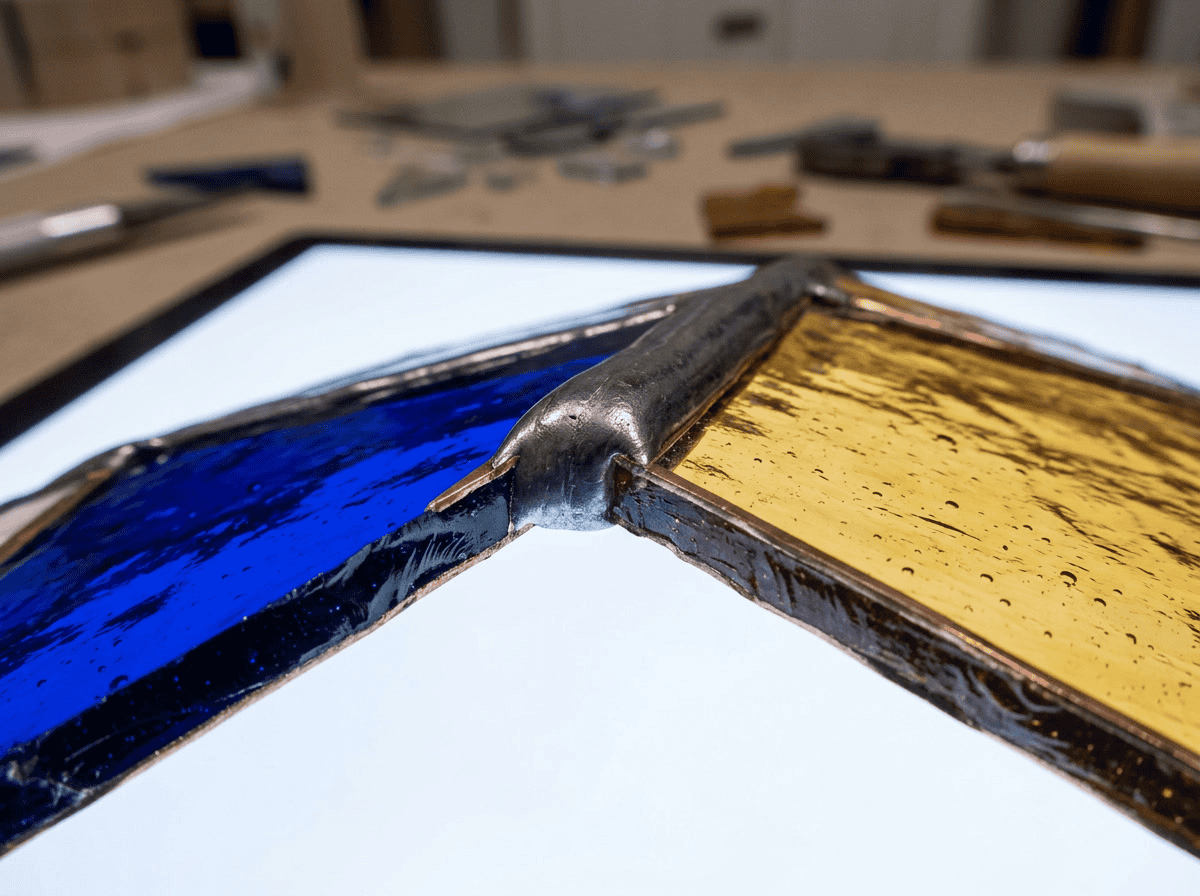
For background on how cathedral and opalescent glass is produced, the V&A introduction to stained glass is a useful primer. Hold each glass panel to a strong single light source. Genuine cathedral glass (the standard glass for stained glass work) transmits light through the full glass body and shows the color running through the entire wall thickness. The color comes from metal oxides added during the melting process.
Look for:
- Color consistency through the glass thickness — the glass looks the same color whether you’re viewing from 30cm or from across the room
- Slight variation between individual glass pieces (hand-selected, each slightly different tone)
- Any glass that is patterned within the piece itself (ripple, seedy, hammered textures) — these are characteristic of handmade art glass used in quality stained glass work
Red flags that suggest lower quality glass or misidentification:
- Color that appears only on the surface and goes clear when held to bright light
- Completely uniform, plastic-like color consistency across every panel — suggests synthetic material
- No variation at all between adjacent same-color panels
Glass types used in quality stained glass:
- Cathedral glass: transparent colored, used for background areas
- Opalescent glass: semi-opaque, light-diffusing (much of what Tiffany Studios used)
- Textured art glass: ripple, hammered, seedy, granite
- Iridescent glass: rainbow surface quality, occasional accent use
Tiffany Studios specifically used opalescent glass extensively — giving their shades a distinctive cloudy, glowing quality rather than the transparent quality of European cathedral stained glass. This is a diagnostic indicator for Tiffany-style vs. non-Tiffany stained glass.
Step 3: Check for Maker’s Marks
Where to look:
- Fitter ring: Examine the underside and inner edge of the fitter ring. Genuine Tiffany Studios pieces often have “TIFFANY STUDIOS NEW YORK” stamped with a number. This is the most common location for marks.
- Solder points near the fitter: Some studios used a small signature or number stamped into a solder area near the fitter opening.
- Paper or metal tag: Some high-quality reproduction studios attached paper or metal identification tags. These are unreliable for authentication (easily fabricated or removed) but provide information.
What marks mean:
| Mark | What it indicates |
| “TIFFANY STUDIOS NEW YORK” with number | Genuine Tiffany Studios (extremely valuable, requires expert appraisal) |
| “HANDEL” stamp | Handel Company (1885–1936), major Tiffany-contemporary, significant collectible value |
| “PAIRPOINT” | Pairpoint Manufacturing, major collectible |
| Studio name + city (e.g., “CHICAGO MOSAIC”) | Secondary American producer, moderate collectible value |
| No mark | Common for most production — absence of mark does not indicate value direction |
According to Wikipedia’s article on Tiffany Studios, the “TIFFANY STUDIOS NEW YORK” mark with a catalog number was used from approximately 1902–1933. Pre-1902 Tiffany pieces used earlier marks. The mark is widely forged — expert appraisal is required to authenticate any piece claimed to be genuine Tiffany.
Step 4: Assess Age Through Patina and Construction
If the shade is genuinely multi-piece but has no maker’s marks, physical characteristics indicate approximate age:
Signs of genuine age (pre-1960):
- Solder showing true lead patina — grey-white bloom (lead carbonate), not simply dark paint
- Glass that shows slight variation in thickness within individual pieces (hand-blown glass)
- Fitter ring with mild corrosion on the inner surface
- Minor asymmetry in the overall shade form — pre-1960 handwork versus mechanically consistent modern reproduction
Signs of quality modern production (1970s–present):
- Even, consistent solder lines throughout
- Glass pieces very consistent in thickness
- Fitter ring shows no corrosion
- Color accuracy consistent with color references — modern glass colorants are more precisely controlled than period formulas
Signs of low-quality reproduction (any period):
- Solder lines with obviously poor workmanship — blobs, gaps, uneven application
- Glass pieces that don’t fit cleanly — gaps visible in pattern junctions
- Fitter ring attachment appears structural rather than aesthetic
| Indicator | Pre-1960 | 1970s-Present |
| Solder appearance | Grey-white lead patina (true oxidation) | Even, consistent, often unoxidized |
| Glass thickness | Slight variation within pieces (hand-blown) | Very consistent thickness |
| Fitter ring | Mild corrosion on inner surface | No corrosion |
| Overall form | Minor asymmetry from handwork | Mechanically consistent |
Frequently Asked Questions
How do I tell a genuine Tiffany shade from a reproduction?
Three simultaneous tests: (1) solder lines — genuine Tiffany has hand-applied copper foil solder with slight variations; high-quality reproductions can be very similar; (2) glass type — genuine Tiffany primarily used opalescent glass with characteristic cloudy glow; (3) fitter ring mark — “TIFFANY STUDIOS NEW YORK” with number is diagnostic, but marks are forged. For any piece with claimed Tiffany provenance and significant value, professional appraisal by a recognized expert is mandatory.
Is a stained glass lamp shade without marks worthless?
No. Many genuine Tiffany-era and quality studio shades were produced without marks. Value is determined by construction quality, glass quality, pattern rarity, condition, and provenance documentation — not marks alone.
Can I tell if a “stained glass” lamp shade is actually resin just by looking at it?
Yes, in most cases. Examine the pattern lines at a low angle: resin pattern lines are flat or minimally raised; genuine solder lines are clearly three-dimensional. Also check weight — resin is substantially lighter than glass of the same size.
What is the difference between copper foil and lead came construction?
Copper foil (Tiffany technique): each glass piece wrapped in a thin copper tape, pieces assembled, solder applied along all tape joints. Results in thin, precise lines and allows complex organic shapes. Lead came: H-profile metal strips installed between glass pieces, bent to fit the pattern shape. Results in wider lines and is more appropriate for larger, flatter panels (architectural stained glass windows).
How do I tell if stained glass is genuinely colored through or just painted?
Hold the shade to a strong light source and look through a colored panel. Genuine colored glass (cathedral or opalescent) transmits color evenly through the full glass thickness — the color appears the same from both faces. Painted or foil-backed glass shows the color only when lit from behind and may appear clear or translucent from the painted face.
Can UV light help identify vintage stained glass?
Rarely. UV fluorescence is useful for identifying some glass types (uranium glass fluoresces bright yellow-green) but most colored glass used in stained glass work does not have distinctive UV fluorescence. UV is more useful for identifying vintage Depression glass and some Victorian pressed glass than for stained glass identification.
Is it worth having a stained glass lamp shade professionally appraised?
Yes, if: the shade has a claimed maker’s mark from a collectible studio (Tiffany, Handel, Pairpoint), or if the construction quality suggests it may be a significant piece, or if you’re considering purchase or sale above approximately $300. Professional appraisal by a certified appraiser in American decorative arts typically costs $150–400 and is worthwhile for any piece that might significantly exceed this in value.
Related Reading
- Stained Glass Lamp Shades: Full Buying Guide
- Stained Glass Table Lamp Shades: Tiffany Style, Custom & Decorative Options
- Tiffany Style Lamp Shade Replacement Guide
- Custom Stained Glass Lamp Shades: OEM Production Guide
Conclusion
Identifying stained glass lamp shades is a physical examination exercise starting with the fundamental question: is it genuine multi-piece glass construction? The 3D solder line test answers this clearly. For genuine pieces, glass type examination and maker’s mark research provide further detail on period, studio, and potential value. For anything with claimed Tiffany or major studio provenance, professional appraisal is non-negotiable before any transaction.
For practical buying purposes: quality current-production copper foil stained glass shades from skilled artisans are excellent decorative pieces worth $200–800+ regardless of age or maker. They light up a room with the same quality as period pieces. The identification process matters for collection value; for living with and enjoying the shade, construction quality is the relevant measure.
If your identification reveals a damaged shade worth restoring rather than replacing outright, our Tiffany-style replacement guide covers matching options. For new pieces in the styles discussed here, see our stained glass table lamp shades guide, and for bespoke reproductions our custom stained glass OEM production guide covers what a quality custom order looks like.