Direct answer: Replacing a Tiffany-style lamp shade requires measuring the fitter ring diameter (typically 2¼” to 3¼”), the shade outer diameter, and the height, then choosing between a copper foil handmade replacement, a quality cast resin replacement, or a single-piece colored glass alternative. Most Tiffany-style bases use a 2¼” or 3¼” spider/ring fitter.
A Tiffany-style lamp loses most of its purpose without the shade. The base — whether genuine antique bronze, quality reproduction cast metal, or mass-market modern reproduction — exists to support and position the shade. When the shade breaks, the lamp becomes a sculpture rather than a lamp.
Replacement is the obvious solution, but the range of replacement quality and construction is enormous, and the fit requirements are specific. This guide covers what you need to know to find the right replacement.
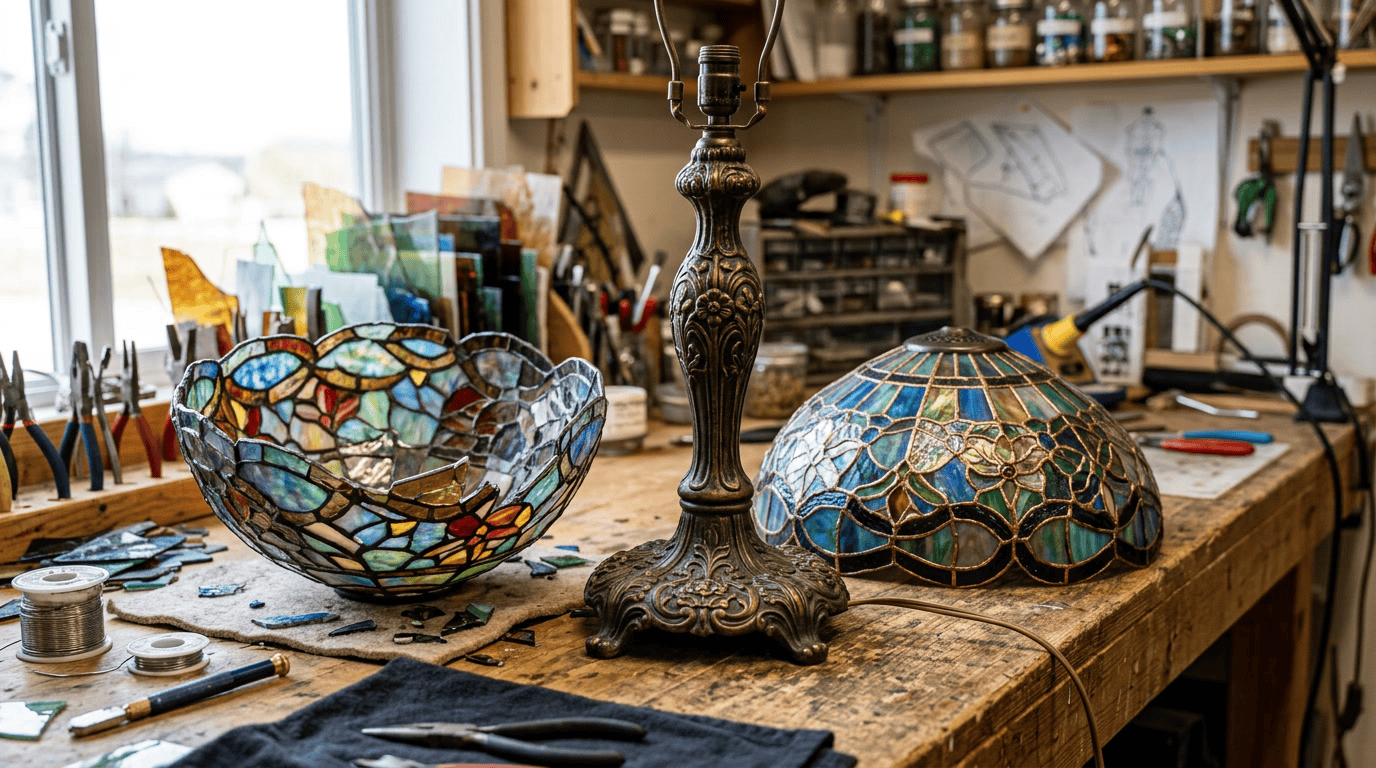
Understanding Tiffany-Style Lamp Construction
Before measuring for a replacement, understand how Tiffany glass lamps are constructed, because the fitter type is often more complex than a standard table lamp.
Most Tiffany-style lamp shades attach to their bases via one of three methods:
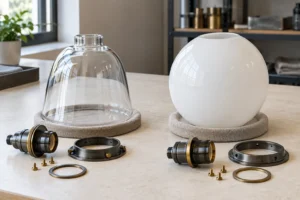
3¼” vase cap / ring: The most common method for genuine Tiffany Studios pieces and quality reproductions. A metal ring (often called a “vase cap” because the base often has a vase-form font) sits on the base opening; the shade rests in this ring. The standard ring inner diameter is 3¼” for most full-size Tiffany-style shades (12–24″ outer diameter range).
2¼” gallery ring: Used on smaller Tiffany-style shades (8–12″ outer diameter). The shade’s fitter rim outer diameter rests in a 2¼” gallery ring attached to the lamp base.
Spider/harp fitter: Some Tiffany-style bases use a standard harp and spider fitter rather than a vase cap ring. This is more common on lower-quality reproductions where the base was designed for standard shades.
Custom base fitter: High-quality antique Tiffany Studios bases often have proprietary-dimension fitter rings that don’t match any standard dimension. For these, custom reproduction shades or custom ring adapters are required.
Step 1: Identify Your Fitter Type and Measure
If you are not yet sure your shade is true stained glass at all, our guide to identifying stained glass lamp shades covers construction and age clues before you commit to a replacement.
If you have the broken shade: Measure the outer diameter of the fitter rim (the opening). This tells you the maximum inner diameter your replacement fitter ring can have (the ring must be smaller than the shade opening’s outer dimension). Also measure shade outer diameter and height from fragments if possible.
If you only have the base: Measure the inner diameter of the vase cap ring or gallery ring where the shade would rest. This is the inner diameter your replacement shade’s fitter rim must clear (slightly larger than the ring inner diameter).
Standard measurements:
| Shade outer diameter | Standard ring inner diameter | Vase cap type |
| 8–12″ | 2¼” | Small gallery ring |
| 12–18″ | 3¼” | Standard vase cap ring |
| 18–24″ | 3¼” to 4″ | Large vase cap ring |
| Custom antique | May not match standard | Measure precisely |
Step 2: Choose Replacement Type and Quality Level
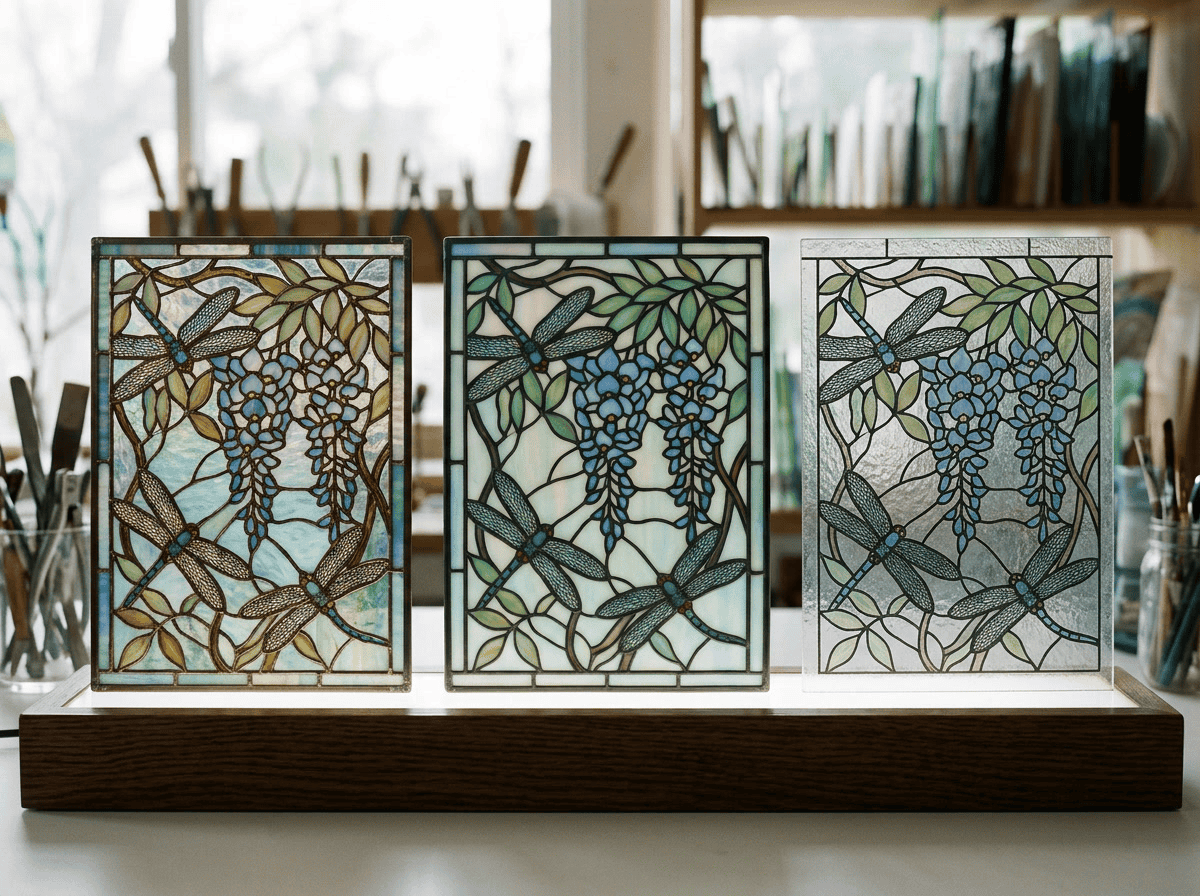
| Replacement Type | Visual Match | Price Range | Lead Time |
| Genuine copper foil | Closest to original | $200-800+ | 4-10 weeks |
| Quality cast resin | Indistinguishable from 2-3m | $80-200 | Immediate (stock) |
| Single-piece colored glass | Different aesthetic, colored warmth only | $40-120 | Immediate |
Option 1: Genuine copper foil replacement (highest quality)
A replacement shade made using the authentic copper foil technique — each glass piece wrapped in foil, assembled in the original pattern, soldered. Visual result closest to the original. Price range: $200–800+ depending on pattern complexity and artisan. Lead time: 4–10 weeks.
Best for: Replacing the shade on a quality base where the lamp is a significant decorative investment. For a sense of how this technique looks in practice, see this step-by-step copper foil panel demonstration.
Option 2: Quality cast resin with color accuracy
Better-quality Tiffany-style shade reproductions are made from resin poured into molds that replicate the appearance of multi-piece stained glass. The pattern is formed in the mold, not assembled from individual pieces. From a normal viewing distance (2–3m), indistinguishable from copper foil. Price range: $80–200. Lead time: immediate from stock.
Best for: Replacing a shade on a mid-range base where budget is a consideration and the lamp is decorative rather than a collector’s piece.
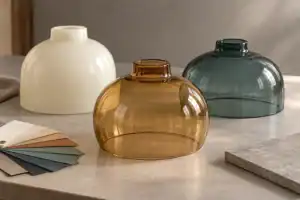
Option 3: Single-piece colored glass
A hand-blown or pressed colored glass shade in a complementary color palette. Does not replicate the multi-piece stained glass appearance but provides colored glass warmth and quality. Price range: $40–120. Immediately available.
Best for: Situations where color warmth is the priority and exact pattern matching isn’t required. Our vintage glass lamp shades collection shows available options.
Step 3: Match the Pattern Style (If Applicable)
Tiffany Studios created approximately 5,000 documented shade designs. The most commonly reproduced patterns:
Dragonfly: Blue-green dragonflies against amber-green background. One of the most recognized patterns.
Wisteria: Cascading purple wisteria flowers against blue sky. Complex, highly valued.
Peony: Large red-pink peonies against green leaves.
Geometric (Greek key, geometric mosaic): Angular patterns in repeating units. Simpler to produce; less expensive.
Poppy, lily, rose: Various floral patterns.
| Pattern Style | Color Palette | Complexity / Cost |
| Dragonfly | Blue-green on amber-green | High |
| Wisteria | Purple cascading on blue | Very high |
| Peony / Poppy / Lily / Rose | Reds, pinks, greens | Medium-high |
| Geometric / Greek key | Repeating warm or jewel tones | Lower |
For replacement matching, you don’t need to match the exact original pattern (unless doing a collector restoration). Choose a pattern in the same general style (floral, geometric) and color palette (warm earth tones, jewel tones, blue-green) that harmonizes with your base.
Measuring a Replacement When the Original Shade Is Broken
From broken fragments: photograph the full shade if intact enough, or document the largest surviving fragment. Measure the fragment’s curve radius, glass colors present, and any visible pattern elements. A skilled copper foil artisan can work from photographs and measurements to produce a close match.
From the base only: measure the vase cap ring inner diameter for the fitter requirement. For outer diameter, use the base proportional rule: most Tiffany-style shades have an outer diameter approximately equal to the base height (from base foot to socket) or 1.5× the base’s widest diameter.
Full measurement guidance: how to measure a replacement glass lamp shade.
Installing the Replacement Shade
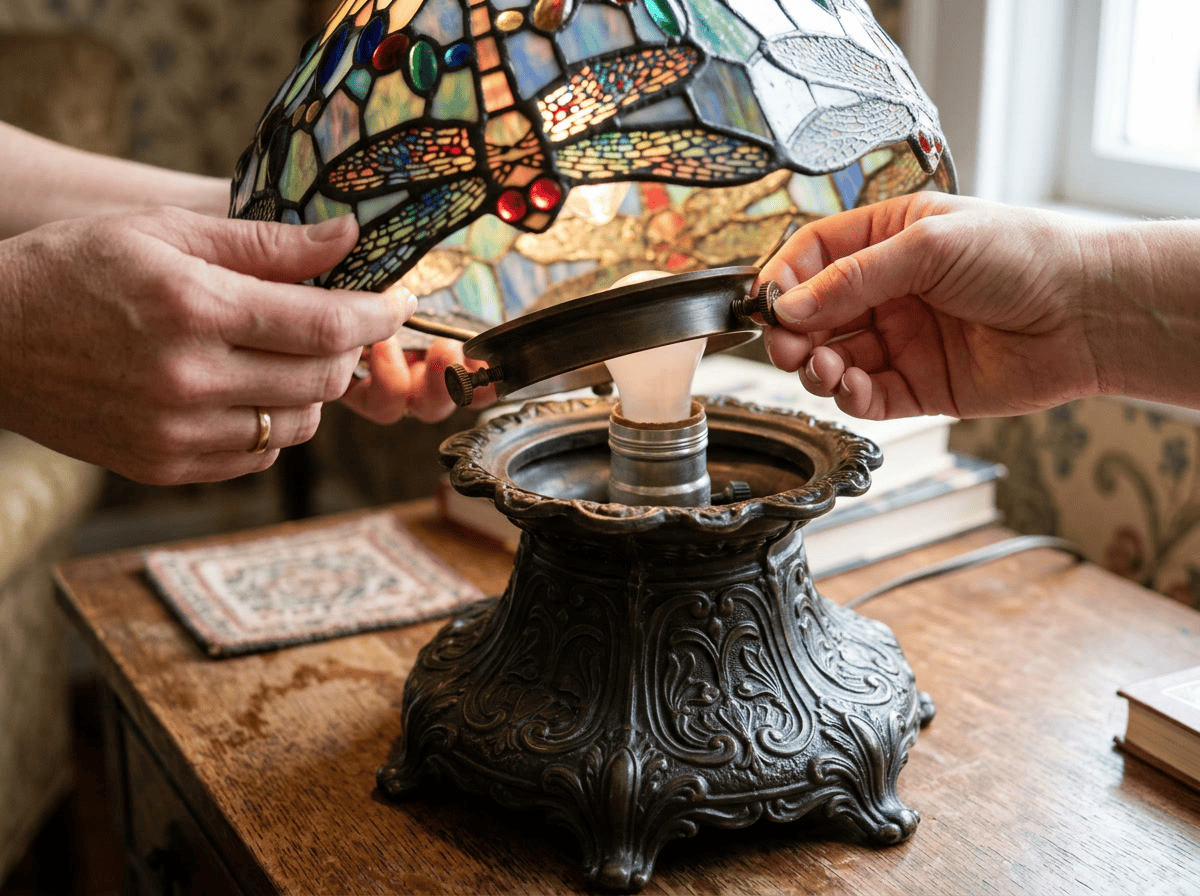
For background on how these leaded-glass forms were originally produced, the V&A introduction to stained glass is a useful primer before you handle a fragile shade.
For vase cap ring installation:
- Ensure the base is stable and positioned on a firm surface
- Lift the shade by the fitter rim (not the glass body)
- Lower gently into the vase cap ring — the fitter rim outer edge should rest evenly in the ring
- Confirm the shade is level before releasing
- Test stability by gently pushing the shade side to side — the ring should hold it securely
For gallery ring installation: The shade’s fitter rim inner diameter slips over the ring; gravity holds it in place (or a small retaining clip if provided).
For harp/spider fitter: Thread the finial through the shade’s fitter opening, screw onto the harp tip. Confirm the shade sits level on the harp.
Frequently Asked Questions
What ring size do most Tiffany-style lamp bases use?
3¼” vase cap ring (inner diameter 3.25″) for full-size shades (12–24″ outer diameter). 2¼” gallery ring for smaller shades (8–12″). Always measure your specific base before ordering — some vintage and antique bases have non-standard dimensions.
Can I replace a Tiffany-style shade with a different pattern?
Yes, if the fitter dimensions match. The shade and base are independent components. A dragonfly shade can be replaced with a geometric shade if the fitter ring diameter matches. The visual style change may or may not suit the lamp’s character — consider the base design when choosing a replacement pattern.
How do I know if a “Tiffany-style” replacement is genuine copper foil or resin?
Examine solder lines: genuine copper foil construction has raised, three-dimensional solder seams. Resin reproductions have flat or very slightly raised molded lines. Turn the shade to examine the inside surface — genuine copper foil shows the back of each glass piece and the inside of the solder pattern.
How much does a genuine copper foil Tiffany-style replacement shade cost?
$200–800+ for simple to medium complexity patterns from established artisans. Complex floral patterns (wisteria, peony, dragonfly) from skilled artisans: $400–1500+. Custom one-off commissions or museum-quality reproductions: $1000–5000+.
My Tiffany-style shade has a chip at the fitter rim. Can it be repaired?
Minor chips at the edge of a fitter rim can sometimes be patched with clear glass epoxy. For copper foil construction, a local stained glass artist can replace individual cracked or chipped pieces. For structural damage to the fitter area, replacement is usually the more reliable choice.
Are replacement Tiffany-style shades from online retailers good quality?
Quality varies enormously. Request: (1) a close-up photo of the fitter rim (should show smooth, even solder lines or glass rim), (2) a lit photo showing color transmission, (3) confirmation of construction method (copper foil, resin, or other). Avoid any listing that doesn’t disclose construction method.
Can I use a Tiffany-style shade on a modern lamp base?
Yes, if the fitter dimensions are compatible. Modern bases with standard 3¼” ring adapters (available from lighting hardware suppliers) can accept most standard Tiffany-style shade diameters.
Related Reading
- Stained Glass Lamp Shades: Full Buying Guide
- How to Identify Stained Glass Lamp Shades
- Stained Glass Table Lamp Shades: Tiffany Style, Custom & Decorative Options
- Custom Stained Glass Lamp Shades: OEM Production Guide
Conclusion
Replacing a Tiffany-style lamp shade starts with one measurement — the fitter ring inner diameter. Get that right, and the rest is quality preference and budget. Genuine copper foil construction produces the closest visual match at the highest cost. Quality resin is visually close from normal viewing distances at significantly lower cost. Single-piece colored glass is an honest alternative that provides colored glass warmth without attempting to replicate multi-piece construction.
For any lamp that represents a meaningful design investment, the replacement shade quality should match the base quality. A beautiful bronze base deserves a quality copper foil shade; a mass-market base works fine with a quality resin replacement.