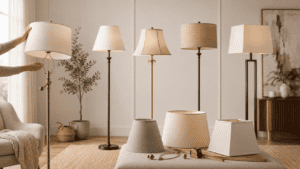
A pleated lampshade has fabric folded into regular parallel folds around a wire frame, creating structured vertical texture. Pleat style (knife, box, or cartridge) determines the silhouette; fabric and lining determine light quality and durability.
You’ve narrowed your search to a pleated shade. Then the options multiply: knife pleat or box pleat? Silk or linen? Hard-back or soft-sewn? Most product pages list the style name and show a photo but skip the part where they explain what any of it actually means on a real lamp in a real room. This guide covers the full range — pleat construction, fabric selection, sizing formulas, styling by room type, DIY basics, and care — so you can pick the right pleated lampshade on the first attempt.
What is a pleated lampshade?
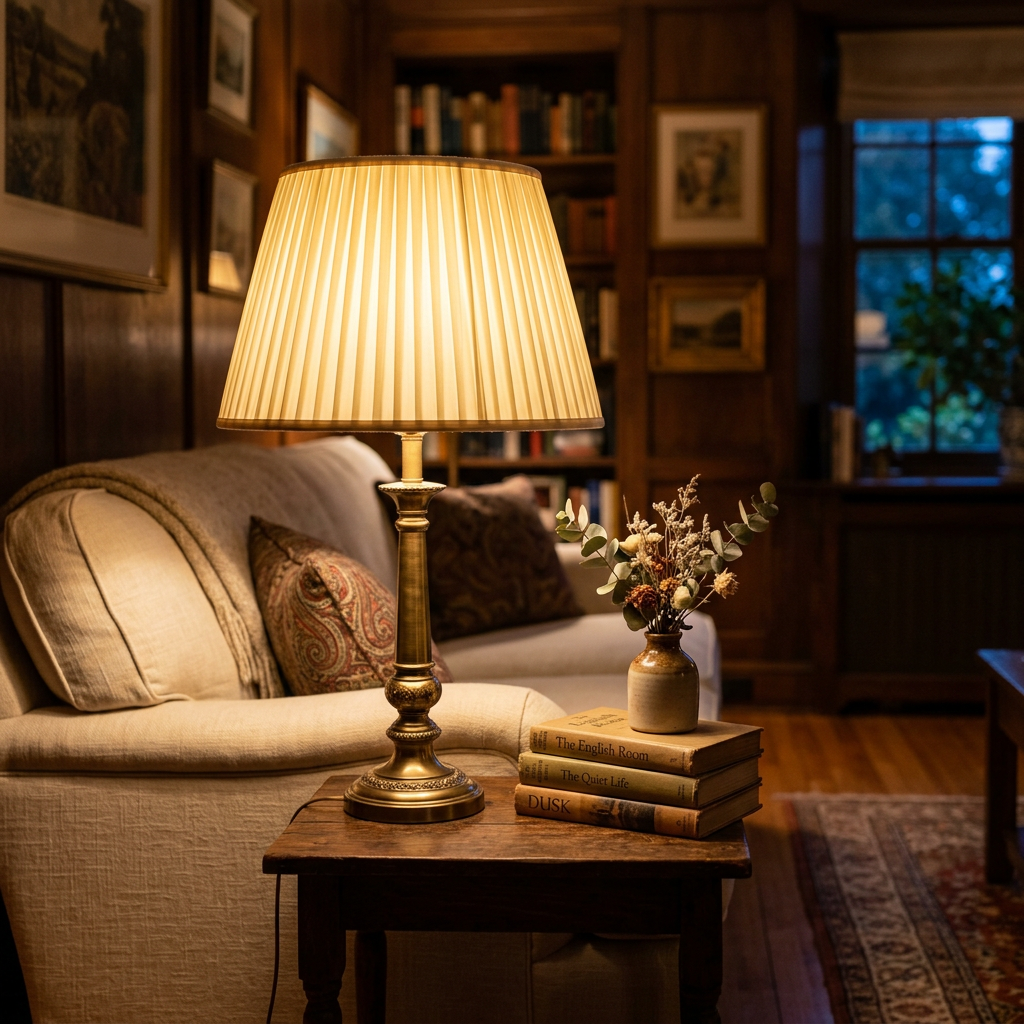
A pleated lampshade is a shade where the outer fabric is folded into regular, repeated vertical folds before being attached to the frame. The folds produce structured vertical texture around the circumference that distinguishes it from flat-fabric drum, coolie, or plain empire shades.
How pleats differ from drum and empire shades
A drum shade stretches fabric flat against a cylinder frame. A coolie is a wide-brimmed cone, also flat-stretched. A plain empire is a tapered cone with smooth fabric. None of them have folds.
What makes a pleated lampshade distinct is that the fabric itself does something: it folds, stacks, and in doing so catches and redirects light differently depending on how tight the folds are and how opaque the fabric is. A drum shade reads as clean and contemporary. A pleated shade reads as structured, tailored, and more traditional. Neither is better — they’re different tools for different rooms.
Per Wikipedia’s documentation on lampshades, pleated fabric shades became standard in Western interiors during the early 20th century, when fabricators developed consistent pleat-spacing jigs for volume production. Before that, pleated shades were made one at a time with visible variation in fold width.
The frame underneath: what gives a pleated shade its shape
Every pleated lampshade sits on a wire frame. The frame determines the overall silhouette (drum, empire, bell, coolie) while pleating is a surface treatment applied to that shape. This matters for two reasons.
First, silhouette and pleat style interact. Knife pleats on a tapered empire frame look different from knife pleats on a straight drum frame because the taper spreads pleat spacing unevenly top to bottom. Most manufacturers correct this by adjusting pleat width slightly as the fabric is set. Second, the frame determines fitter type and the dimensions you need for sizing. The pleating itself adds nothing you need to measure; the frame geometry is all that matters for fit.
| Shade style | Fabric treatment | Silhouette | Typical setting |
|---|---|---|---|
| Pleated drum | Pleated fabric on cylinder frame | Straight cylinder | Contemporary, transitional |
| Pleated empire | Pleated fabric on tapered cone | Narrow top, wider bottom | Traditional, classic |
| Pleated bell | Pleated fabric on curved-taper frame | Bell-shaped flare | Victorian, antique |
| Drum (flat) | Fabric stretched flat on cylinder | Straight cylinder | Modern, minimal |
| Coolie | Flat fabric on wide-brimmed cone | Wide, flat cone | Asian-influenced, modern |
Types of pleats: knife, box, cartridge, and more
The pleat type determines how the fabric folds and what the surface texture looks like when lit and unlit. Different pleat styles suit different fabrics, lamp sizes, and rooms.
Knife pleat
The pleat in its simplest lampshade form: all folds turn the same direction, like overlapping pages in a book. Knife pleats are tight, regular, and directional. From the side, you see overlapping fabric panels. From the front, the surface reads as clean vertical lines.
Knife pleats work best with medium-weight fabrics: silk dupioni, cotton, synthetic blends. Very lightweight fabrics — chiffon, organza — tend to collapse between folds. Very heavy fabrics — velvet, thick wool — bulk up at the fold seam. Most commercially sold pleated lampshades use knife pleats because the construction is efficient and the result is versatile across interior styles.
Fold width on a knife-pleated shade typically runs from 1″ to 2″. Narrower folds (half-inch to 1″) are called “pin pleats” and appear on small boudoir shades; wider folds (2″+) show up on large floor lamp shades.
Box pleat
In a box pleat, alternating folds face outward on each side, creating a raised rectangular panel between each set of inward folds. The result is more three-dimensional than a knife pleat. You see a series of soft rectangular panels around the circumference, with fold edges hidden underneath each panel.
Box pleats use roughly 3x the flat fabric width per inch of circumference, compared to 2x for knife pleats. That makes them heavier and more expensive to produce. They’re also more forgiving of stiffer fabrics: the extra structure at each pleat holds up better in heavy linen, silk taffeta, or treated cotton.
A box-pleated shade looks more architectural and deliberate than a knife-pleated one. It suits large table lamps and floor lamps where the shade is a design statement, and it works in traditional, formal, and eclectic interiors.
Cartridge pleat
A cartridge pleat (sometimes called a “rolled pleat”) is a soft, rounded pleat where the fabric is gathered into a tube and stitched rather than folded flat. The result is a row of small, evenly spaced soft cylinders around the shade.
Cartridge pleats are softer and more casual than knife or box pleats. They suit lightweight fabrics particularly well: thin cotton, voile, linen. The style is associated with English country-house interiors. Construction is more labor-intensive than knife pleats, so cartridge-pleated shades tend to cost more at a similar size.
Empire pleated shade
This isn’t a pleat type but a frame shape worth separating because it comes up so often in searches. An empire pleated shade combines a tapered empire frame with knife or box pleats on the outer fabric. The taper means the bottom circumference is noticeably larger than the top, which creates a classic Victorian-to-mid-century silhouette. The pleating adds texture to what would otherwise be a plain cone.
Most “traditional” pleated lampshades on the market are empire pleated shades with knife pleats in silk or faux silk.
| Pleat type | Fabric ratio | Best fabric weight | Formality | Relative cost |
|---|---|---|---|---|
| Knife pleat | 2x fabric | Light to medium | Classic to contemporary | Low to medium |
| Box pleat | 3x fabric | Medium to heavy | Formal, architectural | Medium to high |
| Cartridge pleat | 2.5x fabric | Light to medium | Casual, country | High |
| Empire knife pleat | 2x fabric | Light to medium | Traditional | Low to medium |
| Pin pleat | 1.5x fabric | Light | Delicate, boudoir | Medium |
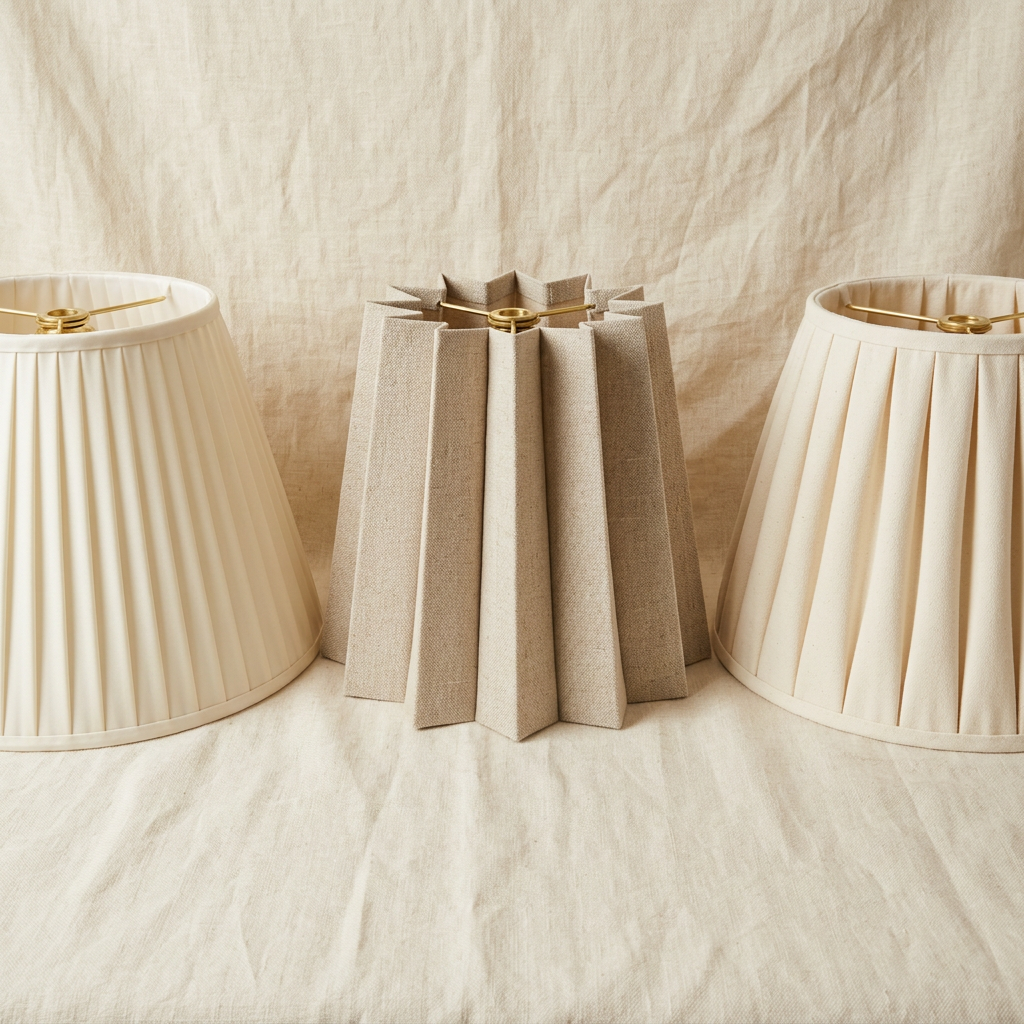
Fabric guide: what a pleated lampshade is made from
Fabric choice affects three things: how the shade looks when unlit, how it glows when the light is on, and how long it holds up before fading or deteriorating.
Silk and faux silk
Silk is the traditional choice for pleated lampshades because of its sheen and the warmth of the light it transmits. True silk dupioni (which has a natural slub from the double-cocoon fiber) diffuses light into a warm golden glow without washing out the fabric color. It pleats cleanly with either knife or box construction.
The practical drawbacks: genuine silk fades in direct sunlight within 2–3 years, and it costs significantly more than synthetic alternatives. Faux silk (polyester with a silk-weave finish) is visually indistinguishable from real silk at conversational distance and doesn’t fade. The light quality is slightly cooler through polyester, but at modern LED color temperatures of 2700K to 3000K, the difference is negligible in most rooms.
If a vendor doesn’t specify whether their “silk” shade is genuine or synthetic, it’s almost always faux silk at any price under $150.
Linen and cotton
Linen is the workhorse fabric for casual and transitional pleated shades. It pleats less crisply than silk because of its natural texture and heavier weight, which suits cartridge and wide box pleats better than tight knife pleats. The light through a natural linen shade is warmer and more diffused than through silk — more of a filtered afternoon light versus silk’s directional glow.
Cotton behaves similarly to linen, with a slightly softer hand and better color retention. Printed cotton lampshades (stripes, small florals, geometric patterns) are almost always box-pleated so the pattern reads flat across the panel face of each pleat.
Both fabrics tolerate light moisture better than silk, which matters if you ever need to spot-clean.
Polyester and synthetic blends
Budget pleated lampshades use polyester or poly-cotton blends. Advantages: low cost, resistance to fading, and consistent colorways. The weakness is that cheap polyester can look flat and plasticky when lit, especially in lighter colors. A “hot spot” directly above the bulb rather than a diffused glow is the tell. If you’re buying online, ask for a lit photo rather than a product shot against white.
Polyester shades with a linen-texture surface print are common at mid-range price points and perform reasonably well. They’re a sensible choice for shades in secondary rooms or children’s spaces where durability matters more than light quality.
Backing and lining: why the inner layer matters
Most pleated lampshades have two layers: the outer decorative fabric and an inner lining, usually white or cream. The lining determines light quality more than the outer fabric does. A hard plastic (styrene) backing glued to the outer fabric produces a crisper pleat but a harsher, more directional light. A soft-sewn lining in cotton or silk produces a gentler diffused glow but requires more precise construction to prevent light leaks at seams.
For a pleated shade in a living room at eye level, a soft-sewn lining in white or ivory is the better choice. For a utilitarian lamp — a reading lamp, a desk lamp — a hard-back styrene construction is fine and more durable.
How to size a pleated lampshade for your lamp
The same three-measurement approach that governs any lampshade also applies to a pleated shade. Getting proportions right matters at least as much as getting the fitter size right.
The 1/3 rule and height proportions
The shade height should be approximately 1/3 of the total lamp height (base plus shade combined). For a 30″ floor lamp, that’s a 10″ shade. For an 18″ table lamp, a 6″ shade. This isn’t an absolute rule, but it’s the proportion that looks settled in a room rather than top-heavy or undersized.
The bottom diameter of the shade should be at least 2″ wider than the widest point of the lamp base, and generally not more than 4″–6″ wider. A shade narrower than the base looks pinched; one much wider looks top-heavy or ungainly.
| Lamp type | Typical base height | Recommended shade height | Recommended bottom diameter |
|---|---|---|---|
| Small table lamp | 10″–14″ | 6″–8″ | Base width + 2″–4″ |
| Standard table lamp | 15″–20″ | 7″–10″ | Base width + 3″–5″ |
| Large table lamp | 21″–28″ | 9″–12″ | Base width + 4″–6″ |
| Floor lamp | 48″–66″ | 10″–14″ | 14″–18″ typical |
| Buffet/torchiere lamp | 28″–36″ | 10″–13″ | 14″–18″ typical |
For measuring the specific fitter diameter and the three dimensions any shade requires, our guide to measuring a cut glass lamp shade walks through the approach in detail — the method applies to any lampshade frame, not just glass.
Fitter types on pleated shades
Pleated lampshades use the same fitter standards as all other shade types.
A spider fitter (the most common type) is a metal cross or multi-arm assembly at the top of the shade that rests on a harp. Harp saddles are standard on most table lamp sockets. Spider fitter size must match the harp width.
A uno fitter is a ring that screws directly onto the bulb socket. Used on some torchiere and floor lamps without harps.
A clip-on fitter is a spring that clips directly onto the bulb. Used on small boudoir lamps and candelabra fixtures.
When ordering a replacement pleated lampshade, confirm the fitter type before anything else. A shade with the right diameter and height but the wrong fitter type won’t attach to the lamp.
Common sizing mistakes
Ordering by shade top width rather than bottom width is the most common error. On a tapered empire pleated shade, the top might be 6″ and the bottom 14″. The 14″ is the number that determines visual proportion; the top width is largely irrelevant to how the shade looks in the room.
The second common mistake is ordering a shade without checking the harp size. Spider-fitter shades require a harp, and harps come in 7″ to 12″ heights. If the lamp doesn’t have a harp or saddle, you either need to add one or choose an uno-fitter shade instead.
Styling pleated lampshades by room and interior style
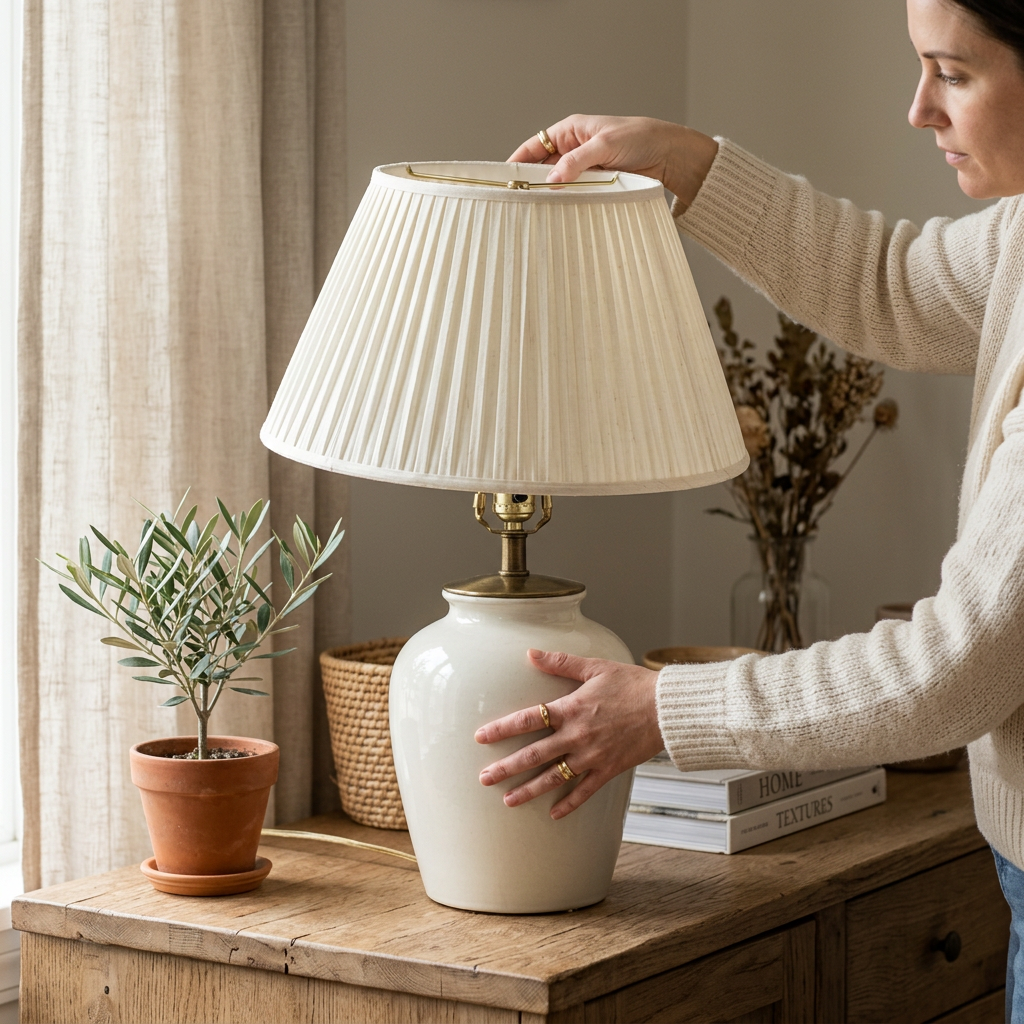
The pleat type and fabric you choose should match the room’s existing character. There are patterns that consistently work, and it’s worth knowing which combinations tend to look off.
Traditional and classic interiors
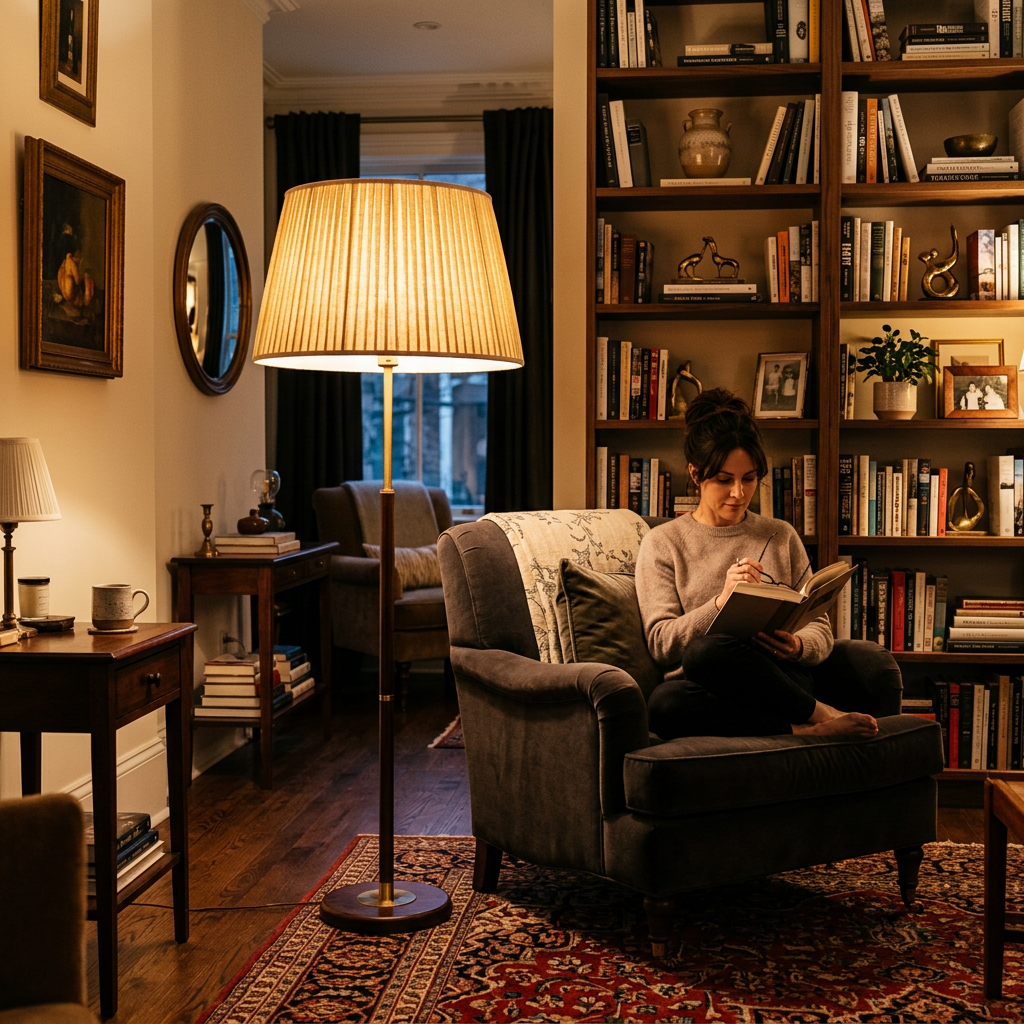
Knife-pleated or box-pleated empire shades in faux silk are the workhorses of traditional interiors. Cream, ivory, and warm white are the safe choices. Deep red, hunter green, and navy in silk add a library or study feel. A narrow trim at the bottom — cord, ribbon, or tassel — is common in this style and fits the vocabulary.
Traditional rooms often have ornate ceramic, brass, or crystal lamp bases. The pleated shade reinforces that formal character. For rooms that already have vintage glass lamp shades on other fixtures, a pleated fabric shade can work as contrast: the two textures (glass and pleated fabric) read as distinct without competing.
Modern and transitional spaces
Most modern spaces lean toward drum shades, but a box-pleated shade in natural linen can hold its own in a transitional room. Keep the fabric in undyed natural tones — ecru, stone, warm gray — rather than the ivory and cream associated with formal traditional interiors. Skip the trim. A clean-cut bottom edge or very narrow self-welt is the right finish.
Very tight knife pleats in a stiff white faux silk can also work in a contemporary setting, particularly if the lamp base is sculptural and the shade is used as a counterpoint. It’s not the obvious choice, but it’s not wrong either.
Color and pattern selection guide
Neutral pleated lampshades (white, cream, linen, gray) work in virtually any room. They transmit light efficiently and read as background rather than feature. If the base is decorative, a neutral shade lets the base carry the weight.
Colored shades (green, pink, navy, rust) shift the lamp from background to focal point. This is a deliberate design move, not a mistake. It works when the lamp has enough prominence in the room to earn that attention. A colored pleated shade on a table lamp tucked in a corner tends to look like an afterthought.
Patterned pleated shades (stripes, small prints) are typically box-pleated so the pattern faces outward flat across each panel face. They work in eclectic, English country, and casual traditional rooms.
DIY pleated lampshade basics
Making a pleated lampshade at home is achievable for a patient beginner. The difficulty varies by pleat type, and most online tutorials underestimate the precision required for even spacing.
What you actually need (and what most tutorials skip)
Materials for a basic knife-pleated shade: fabric, a wire lampshade frame, bias tape or ribbon for trim at top and bottom, fabric glue or a sewing machine, a metal ruler, and an iron. What most tutorials skip:
The frame matters more than the fabric. A warped or uneven wire frame will make every pleat look crooked no matter how carefully you cut and fold. Buy a quality frame or straighten the wire yourself before starting. Checking the frame for level before you begin is two minutes well spent.
Pleat spacing must be calculated before you cut fabric. Measure the full circumference of the frame at the top and bottom, divide by your planned pleat width plus fold depth, and verify the result is a whole number of pleats. If it doesn’t divide evenly, adjust the pleat width slightly. A visible wide pleat or a narrow gap at the seam where the fabric joins ruins the finished shade — it’s the detail people notice first.
Knife pleat vs. box pleat for beginners
Knife pleats are simpler: fold, pin, and glue or stitch. Box pleats require marking the outward-facing center of each pleat and two fold lines on each side, which multiplies the number of marks and pins considerably.
For a no-sew version: iron-on adhesive tape (Heat’n Bond or equivalent) pressed and bonded at each pleat before attaching to the frame works acceptably for knife pleats in medium-weight fabric. For cartridge or box pleats in heavier fabric, machine stitching at the pleat base gives a cleaner result. The no-sew tutorials that use hot glue directly produce inconsistent results — the glue doesn’t bond cleanly to bias tape and tends to show through thin fabrics as hard ridges.
Cleaning and care
Fabric pleated lampshades need occasional cleaning. The approach depends on the fabric type and how the shade is constructed.
For knife-pleated or box-pleated shades with a styrene hard backing: dust with a soft dry brush or low-suction vacuum with a brush attachment. Work pleat by pleat, top to bottom. Don’t use water on styrene-backed shades — moisture can separate the fabric from the backing and leave water stains.
For soft-sewn silk or faux-silk shades: dry brushing first, then spot-clean with a barely damp cloth and mild detergent if needed. Blot rather than rub. The fabric is stitched rather than glued, so it tolerates light moisture better, but soaking will distort the pleats.
For linen or cotton shades where the fabric is attached to removable rings: check whether the cover detaches from the frame. If it does, hand washing in cool water with reshaping while damp is possible. More commonly, the fabric is stitched directly to the frame wire and full washing is not practical.
Never put a pleated lampshade in a washing machine. The wire frame rusts, the adhesive or stitching loosens, and the shape won’t recover.
Rotate the shade a half turn every few months to even out light exposure. This matters most on silk and faux-silk shades near windows, where UV fading is uneven on the sun-facing side.
FAQ
What is the difference between a knife pleat and a box pleat lampshade?
Knife pleats fold all in one direction, like overlapping pages. Box pleats fold outward on both sides of a center panel, creating flat rectangular surfaces around the shade with hidden fold edges underneath. Knife pleats read as directional vertical texture. Box pleats read as a series of flat panels with a more architectural, three-dimensional structure. Box pleats use roughly 50% more fabric per shade and cost more to produce. For most table lamp settings, knife pleats are the practical choice. Box pleats suit larger, more prominent lamps where the shade itself is a design feature.
Are pleated lampshades out of style?
Tight knife-pleated empire shades in ivory silk are a period choice and should be treated as one — they suit traditional, classic, and historically-influenced interiors deliberately. Pleated shades in natural linen or box pleat in a muted modern color work in transitional and contemporary rooms. The answer depends on the specific pleat style, fabric, and room, not the category as a whole. The mistake isn’t choosing a pleated shade; it’s dropping one into a room whose character it doesn’t match.
What fabric is best for a pleated lampshade?
For traditional interiors: faux silk in cream or ivory. Good light quality, durable, and holds knife pleats cleanly. For casual or transitional rooms: natural linen — better diffusion, more texture, and it ages well. For high-use or practical settings: a polyester blend, which fades less than silk and tolerates more handling. For showpiece lamps in low-UV settings: genuine silk dupioni, which has a warmth of light that synthetic fabrics can’t fully replicate.
Can I use an LED bulb with a pleated lampshade?
Yes. The U.S. Department of Energy confirms that LED bulbs produce significantly less heat than equivalent incandescent or halogen bulbs. This is a practical benefit for fabric shades: the fabric and lining no longer face the heat stress that shortened the life of shades under incandescent bulbs. The main consideration is color temperature. Choose a warm white LED (2700K to 3000K) to maintain the warm glow expected from a pleated shade. Daylight LEDs at 5000K or higher will make the fabric look flat and cool.
How do I clean a pleated fabric lampshade?
For hard-back (styrene) shades: dry brush or low-suction vacuum only — water damages the adhesive bond. For soft-sewn shades: dry brushing first, then spot-clean with a barely damp cloth if needed. Never immerse, never machine wash. Rotate the shade regularly to even out UV fading on sun-facing sides.
Where can I buy a good pleated lampshade?
Standard sizes are widely available from home goods retailers and online marketplaces. For non-standard fitters, unusual dimensions, or a specific fabric combination, specialist lampshade manufacturers offer custom sizing. If you’re working with a lamp base that currently holds a glass shade rather than a fabric one, our cut glass lamp shade collection covers hand-blown and pressed glass shades across standard fitter sizes as an alternative.
Conclusion
A pleated lampshade isn’t a single product — it’s a category with real variation in construction, fabric, and appropriate setting. Knife pleats in faux silk belong in a traditional room. Box pleats in linen suit a transitional one. Getting the wrong combination looks off in a way that’s hard to articulate but obvious once you’ve seen the right combination.
The three questions to answer before buying: what pleat style fits the room, what fabric gives you the light quality you want, and what dimensions match the lamp. Most people only think about the third one, which is why so many replacement shades look slightly wrong even when they technically fit. If the lamp currently uses a glass shade and you’re considering a fabric alternative, or vice versa, our vintage glass lamp shades guide covers glass construction and fitter sizing across the same standard dimensions.