Direct answer: Art Deco glass lamp shades (1920–1940) are geometric, symmetrical glass covers in pressed or hand-blown glass featuring stepped panels, sunburst patterns, angular ribbing, or stylized fan forms. Common materials are frosted amber, green, clear, or milk white pressed glass with 2¼” to 3¼” gallery fitters. Both period originals and quality reproductions are available.
Art Deco was a design movement that translated industrial-age optimism into geometric ornament — applied to both machine-pressed and traditional hand-blown glass forms. Where the Victorian era expressed craft through organic floral forms, Art Deco expressed modernity through symmetry, angularity, and the machine aesthetic. In glass lamp shades, this produced a distinctive vocabulary of stepped panels, sunburst ribs, fan forms, and geometric cutwork that is immediately recognizable and still visually compelling.
Art Deco glass shades (1920–1940) are among the most actively collected vintage lamp shades. They’re also the most widely reproduced, because their geometric logic translates well to contemporary manufacturing. This guide covers the authentic Art Deco shade vocabulary, how to identify period originals, and how to use Art Deco glass effectively in 2026 interiors.
The Art Deco Glass Design Vocabulary
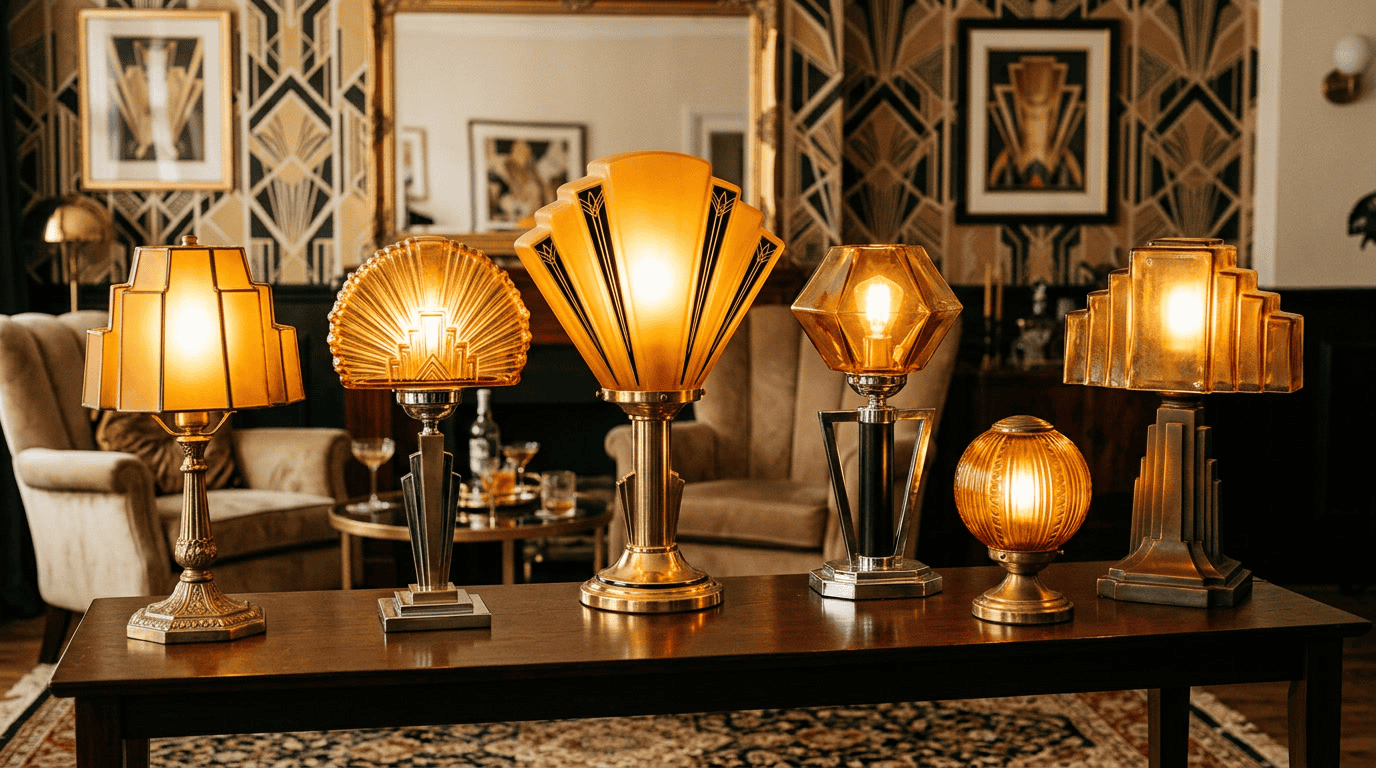
Art Deco applied to glass lamp shades is not a single style — it’s a vocabulary of approximately six recurring geometric motifs:
Stepped or tiered panels: The shade’s body is divided into horizontal bands that step outward from top to bottom, referencing the ziggurat form. Often executed in frosted or clear glass with a polished band at each step edge.
Sunburst/fan ribbing: Radiating ribs from the fitter opening downward, like the rays of a rising sun. The ribs alternate between raised and recessed, creating a strong light/shadow pattern when lit. This is the most iconic Art Deco glass motif.
Geometric pressed panels: Diamond, hexagonal, or rectangular panels pressed into the glass surface. High contrast between polished raised surfaces and frosted recessed areas.
Stepped/angular profile: The shade itself is not a smooth bell or cone but a stepped angular form — wider at the bottom in a series of flat planes rather than a continuous curve. Common in architectural lighting of the 1920s–1930s (lobby pendants, wall sconces in public buildings).
Stylized floral/natural motifs within geometric frames: Late Art Deco (sometimes called Art Moderne) incorporated stylized leaves, birds, or natural forms — but always within a geometric structure. Flowers as fans, birds as V-shapes.
Colored glass panels within metal framework: The leaded glass approach applied to Art Deco geometry: geometric colored glass panels in amber, green, and clear within metal came. Rare in mass-market production but found in high-end fixtures of the period.
Five Classic Art Deco Shade Forms
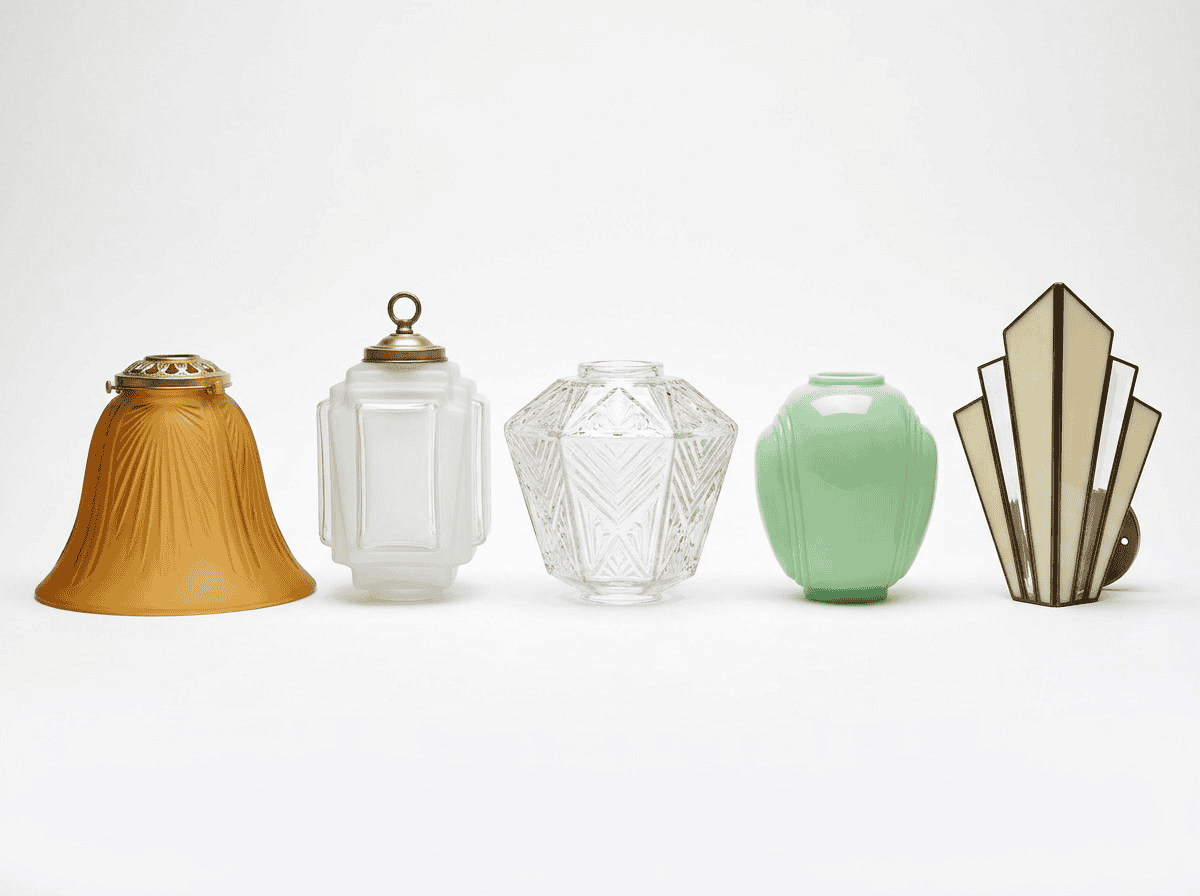
Frosted amber sunburst ribbed bell (most common): The quintessential Art Deco table lamp shade. Pressed amber or frosted glass with radiating ribs, bell silhouette, 2¼” or 3¼” gallery fitter. This form was mass-produced in enormous quantities alongside Depression glass tableware from the 1920s through the early 1940s. Available widely as period originals and reproductions.
Stepped panel pendant shade: Geometric pressed glass in a cylinder or slightly tapered form with stepped horizontal panels. Used extensively in public buildings — hotel lobbies, theater foyers, bank interiors. Now available as replacement shades for vintage fixtures in converted commercial spaces.
Clear with frosted geometric insets: Some Art Deco shades combined clear glass panels with frosted or acid-etched geometric inserts — the frosted areas scatter light while the clear panels transmit it directionally. More sophisticated optically than simple pressed patterns.
Green slag or jadite pressed shade: Some Art Deco shades used slag glass (marbled green/white) — a cousin of the iridescent carnival glass popular in the same era — or jadite-style opaque green pressed glass. Strongly period-associated and less widely reproduced than amber forms.
Geometric sconce shade: Shallow, angular glass panel designed for a wall sconce. Often trapezoidal or semi-circular with geometric surface pattern. Used in pairs flanking mirrors, doors, or fireplaces.
How to Identify Genuine Art Deco Glass Shades
For a broader framework covering all vintage glass shade types, not just Art Deco, see our guide to identifying vintage glass lamp shades.
Art Deco glass shades have been heavily reproduced since the 1950s. Identifying period originals requires reading the glass and the fitter:
Glass quality indicators for period (1920–1940) originals:
- Machine-pressed glass with visible mold seams — but mold seam finish is less clean than modern production
- Amber glass with a specific warm honey tone — many reproductions use a slightly redder or more orange amber
- Wall thickness is relatively thin at 2–3mm — feels lighter than quality modern reproductions
- Any acid-etched frosting is done post-pressing — you can often feel the slight texture difference between pressed and etched surfaces
- Fitter rim diameter may be slightly non-standard (within 1–3mm of the nominal size)
Production era clues:
- 2¼” gallery fitter is more common in pre-1940 production
- Spider/harp fitters became more common post-1945
- Pressed geometric patterns with clear undercuts (the ribs cut quite deep) suggest period production — shallow ribs suggest cheaper modern production
According to Wikipedia’s article on Art Deco, the movement’s primary commercial period ran 1920–1940, with the 1925 Paris Exposition Internationale serving as the defining moment of the style’s international recognition. Shades produced before this date are more Art Nouveau influenced; those after 1940 are generally considered Art Moderne or Streamline Moderne rather than classic Art Deco.
Using Art Deco Glass in 2026 Interiors
Art Deco glass lamp shades are currently experiencing strong design interest because of two converging trends: the return of geometric pattern and bold material statement in interior design, and the broader vintage/maximalist movement that’s reaching its maturity in 2026.
Direct period rooms: For interiors with documented or curated Art Deco furniture, textiles, and hardware, period-authentic glass shades are the obvious specification. Frosted amber sunburst ribbed shades on brass bases, geometric pendant shades in commercial or dining spaces.
Contemporary with period accent: One or two Art Deco glass shades in an otherwise contemporary room creates a deliberate material tension. A geometric amber glass shade on a streamlined brass column in a minimalist space reads as intentional — the contrast is the point.
Hospitality and commercial: Art Deco geometry translates exceptionally well to hospitality environments. Hotel lobbies, cocktail bars, restaurant dining rooms, and high-end retail spaces have specified Art Deco glass shades consistently since the style’s 1980s revival and continue to do so.
What to avoid: Mixing too many periods. An Art Deco ribbed shade with an Arts & Crafts lamp base creates confusion rather than contrast. The Art Deco vocabulary is confident enough to pair with contemporary hardware (brushed brass, matte black, polished chrome) but reads badly against Victorian ornate forms.
Sourcing Art Deco Glass Lamp Shades
If your Art Deco lamp is a floor lamp rather than a table lamp, our vintage floor lamp glass shades guide covers the larger fitter sizes typical of those fixtures.
Original period pieces: Available at antique dealers, specialist lighting restoration firms, and online vintage marketplaces. The Corning Museum of Glass maintains reference collections useful for comparing pattern and form against documented period pieces. Prices range from $25 (common mass-produced ribbed bell) to several hundred dollars (unusual forms, documented provenance, signed pieces from known studios). Confirm fitter dimensions before purchasing online.
Quality reproductions: The sunburst ribbed amber bell is one of the most reproduced glass shade forms in the market. Quality varies enormously. Indicators of quality reproduction:
- Glass weight appropriate to diameter and form (2–3mm is correct for pressed Art Deco; thinner feels cheap)
- Amber color that reads warm honey, not orange or red
- Pressed pattern depth that creates actual shadow relief — shallow patterns look flat when lit
- Fitter rim that is polished or fire-finished, not rough-cut
Custom reproduction: For unusual forms, oversized shades (15″+), or specific fitter dimensions, a glass manufacturer can produce custom Art Deco-style shades. Five specifications needed: fitter type and inner diameter, outer diameter, height, glass type (frosted amber, clear, green), and pattern description or reference photo.
Our vintage glass lamp shades collection includes Art Deco-style ribbed and geometric forms in current production with standard and custom fitter options. For table lamp applications specifically, see our vintage glass lamp shades for table lamps guide, and for the stepped panel pendant form, our vintage glass pendant light shades guide covers sizing and fitter types.
Bulb Pairing for Art Deco Glass
Art Deco glass was designed around incandescent bulbs, but performs well with modern LEDs — in some ways better, because lower heat from LEDs means no heat stress on the glass and no thermal yellowing of amber glass over time.
| Art Deco shade type | Recommended LED | Why |
| Frosted amber ribbed bell | 800 lm, 2700K, A19 | Amber absorbs ~45%; 800 lm delivers adequate ambient |
| Clear pressed geometric | 600 lm, 2700K, decorative filament | Clear glass shows the bulb — make it attractive |
| Stepped panel pendant | 1000 lm, 2700K, omnidirectional | Pendant needs consistent output in all directions |
| Green slag or jadite | 800 lm, 2700K | Green absorbs; warm white complements the green tone |
Art Deco shades and 2700K LEDs are specifically well-matched because the warm light reinforces the period aesthetic. Using cooler LEDs (3000K or above) behind Art Deco glass produces a correct but less atmospheric result. The U.S. Department of Energy’s LED guidance documents the full range of LED color temperature options available in standard residential base sizes.
How to Style Art Deco Glass Lamp Shades
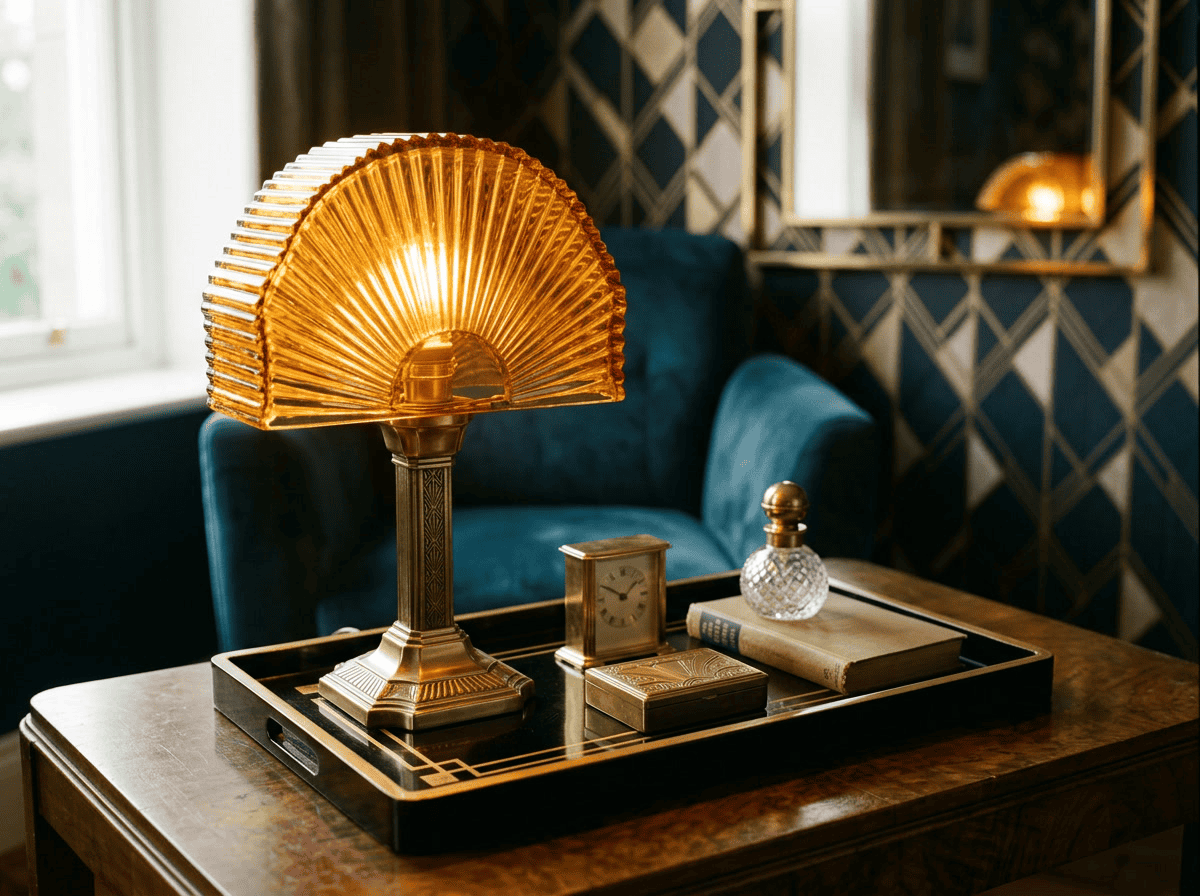
The complete Art Deco lamp: Brushed or polished brass column base (octagonal or stepped column form is most period-accurate), frosted amber sunburst ribbed shade, 800–1000 lm 2700K LED bulb. Place on a lacquered or polished surface — a mirrored tray or lacquered side table — to ground the period feel.
Contemporary integration: Art Deco glass on a contemporary matte-brass simple column base. Keep the surrounding decor restrained — the shade is the statement piece.
Pairs and multiples: Art Deco shades work particularly well in symmetrical pairs — flanking a fireplace or mirror, or as matching bedside lamps. The geometric precision of the period reads confidently in bilateral symmetry.
What not to pair with Art Deco glass shades:
- Industrial Edison bulb fixtures — the exposed filament aesthetic conflicts with Art Deco’s polished geometry
- Fabric drum shades — don’t mix on adjacent lamps in the same room
- Heavy Victorian ornate bases — the period clash reads as unresolved
Frequently Asked Questions
How do I know if an Art Deco glass shade is a period original or a reproduction?
Examine glass weight (period originals feel appropriately heavy for their diameter, not thin), amber color tone (warm honey, not orange), mold seam character (period mold seams are present but slightly irregular; modern reproductions may have cleaner or more obvious seams), and fitter rim finish (period rims are often polished but slightly imperfect). UV testing can help: amber Depression-era glass occasionally contains manganese that fluoresces; reproductions generally do not.
What is the most common Art Deco glass lamp shade for a table lamp?
The frosted amber sunburst ribbed bell shade in approximately 10–14″ outer diameter with a 2¼” gallery fitter. This form was mass-produced across dozens of American and European glasshouses from the early 1920s through the early 1940s. It’s the most recognizable Art Deco shade form and the most available in both original and reproduction.
Can Art Deco glass shades be used in modern minimalist interiors?
Yes, as deliberate accent pieces. One Art Deco ribbed amber shade on a streamlined brass table lamp in an otherwise minimalist room reads as a confident material choice. Using multiple Art Deco shades in a minimalist interior begins to feel thematic; one or two works as punctuation.
What fitter sizes are standard for Art Deco glass shades?
2¼” gallery fitter (inner diameter) is the most common for 1920s–1940s production. 3¼” gallery is used for larger forms and some pendant shades. Spider/harp fitter became more prevalent in post-1940 Art Moderne production. If your lamp has a spider fitter, many Art Deco-style shades are now also available with spider fitters as a concession to standard hardware.
Are Art Deco glass shades appropriate for kitchen or dining room pendants?
Yes. The stepped panel pendant form was extensively used in commercial and public building lighting during the Art Deco period. For a period kitchen or dining room with Art Deco hardware, period or reproduction Art Deco pressed glass pendants are the historically appropriate specification.
What color glass was most common in Art Deco lamp shades?
Amber/honey was the most common single color. Frosted clear (acid-etched) was the second most common. Jadite or sage green was less common but more collectible. Black or dark smoked glass was used in high-end fixtures. Pure white milk glass appeared in Art Deco form but more commonly in the later MCM period.
Where can I find custom Art Deco glass shade reproductions for large commercial projects?
Glass shade manufacturers who accept custom orders can produce Art Deco geometric forms in specified diameters, fitter types, and glass finishes. Minimum order quantities typically start at 10–25 units depending on the complexity of the form. Provide a reference photo of the original form, the required fitter dimension, shade outer diameter and height, and glass type. Contact JX Lampshade’s custom glass team for Art Deco project specifications.
Related Reading
- Vintage Glass Lamp Shades: Full Buying Guide
- Vintage Glass Lamp Shades for Table Lamps
- Vintage Floor Lamp Glass Shades: Styles, Sizes & Replacement Guide
- How to Identify Vintage Glass Lamp Shades
Conclusion
Art Deco glass lamp shades represent one of the 20th century’s most successful intersections of industrial production and intentional design. The sunburst ribbed amber bell, the stepped panel pendant, the geometric pressed cylinder — these forms were produced in enormous quantities because they worked visually in the homes and public spaces of their era. They continue to work in contemporary interiors because the geometry is confident enough to hold its own against any surrounding style.
For period rooms, period originals or quality reproductions are equally valid. For contemporary integration, one well-chosen Art Deco glass shade makes a stronger statement than a room full of them. Start with the fitter dimension, choose the form for the lamp and room context, and let the geometry do the work.