A paper lampshade is a light diffuser made from rice paper, washi, kraft, or papier mache stretched over a wire or cardboard frame to soften and scatter bulb light, creating warm, ambient illumination at lower cost than fabric or glass shades.
Walk into any home goods store and you will find paper lampshades sharing shelf space with fabric, plastic, and glass options — yet almost no label explains what makes one type of paper better than another, or why some catch fire near incandescent bulbs while others hang safely for decades. This guide answers all of it: what paper lampshades are made of, which styles work in which rooms, how to make one yourself, and how paper stacks up against fabric and glass when you need serious longevity.
What is a paper lampshade?
A paper lampshade is any lamp covering where the diffusing surface is made primarily from paper — rice paper, washi, kraft, papier mache, or synthetic paper derivatives — rather than fabric, glass, or plastic.
Paper has been used to filter light for more than a thousand years. The Japanese chochin lantern, documented in use as early as the 9th century CE, stretched washi paper over a collapsible bamboo frame. That same core principle — translucent paper over a rigid structure — describes nearly every paper lampshade sold today.
How paper diffuses light differently from fabric or glass
Paper scatters light by transmission: photons pass through the fibres rather than bouncing off a reflective inner surface the way they do in opal glass. The result is a soft, even glow with minimal glare. Washi and rice paper, which have irregular long-fibre structures, scatter light particularly warmly because the fibres are not perfectly uniform — they create micro-variations in density that break up harsh light patterns.
Fabric shades typically include a liner that adds a second diffusing layer, making them brighter in the downward direction and slightly less warm overall. Glass shades produce harder, more directional light depending on their finish. Paper sits between the two: warmer and more ambient than most glass, slightly less controlled than lined fabric.
Why paper became a lampshade material
Paper lampshades entered Western interiors in the early 20th century as imports from Japan and China introduced washi and rice paper to European and American households. The Bauhaus movement of the 1920s formalised the paper pendant as a design object. Isamu Noguchi’s Akari light sculptures, first produced in 1951, gave paper shades lasting status in modernist interior design. Today the material spans everything from a $3 flat-pack pendant to a $400 hand-dyed washi statement piece.
| Paper type | Light quality | Durability | Cost range | Best use |
|---|---|---|---|---|
| Rice paper | Warm, soft glow | Low | $ | Pendant, accent lamp |
| Washi (kozo) | Warm, textured | Medium | $$ | Pendant, floor lamp |
| Kraft paper | Neutral, amber | Medium | $ | DIY, industrial |
| Papier mache | Varies with thickness | Medium-high | $-$$ | Ceiling, sculptural |
| Synthetic paper | Clean, even | High | $$-$$$ | Commercial, outdoor-adjacent |
Types of paper lampshades
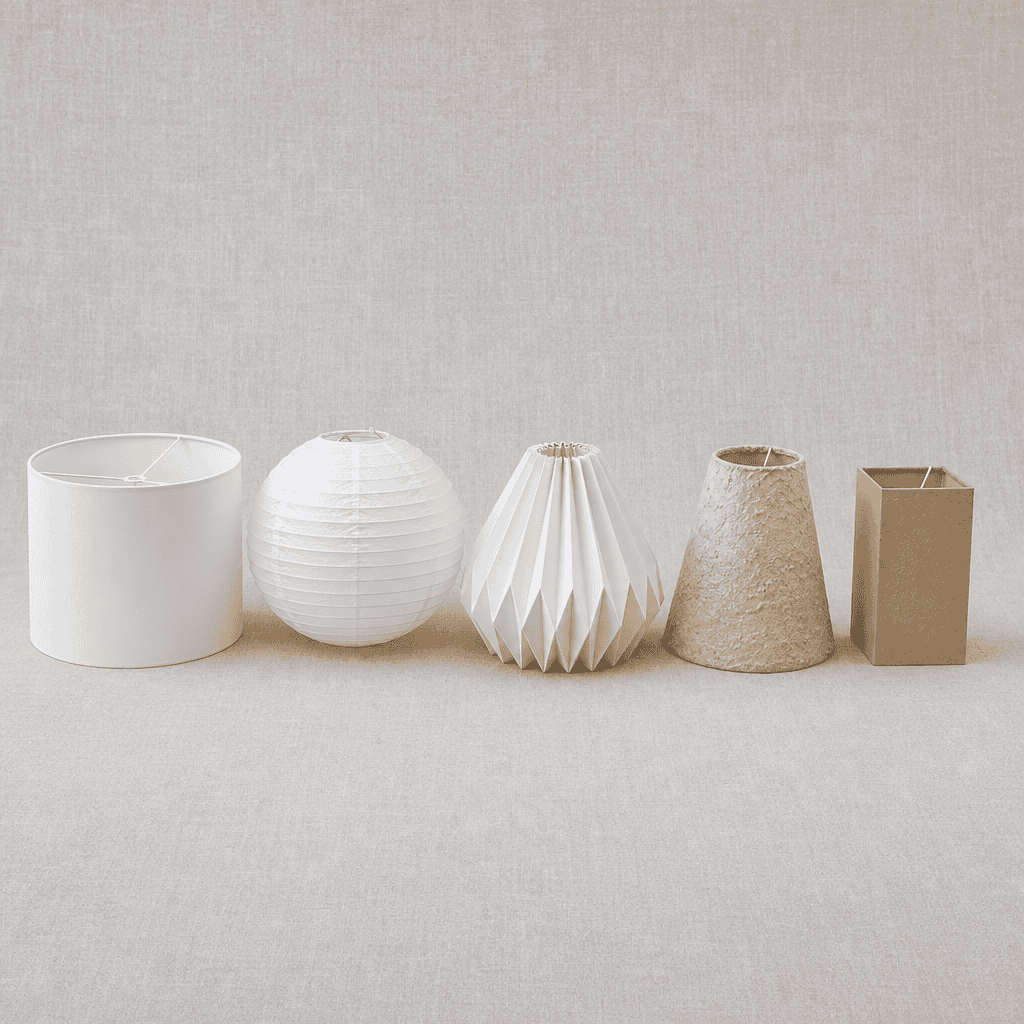
The main types of paper lampshades are drum, Japanese paper lantern (washi or rice paper), accordion/origami, papier mache, and rectangular — each suited to different bulb types, room styles, and mounting hardware.
Drum paper lampshade
The drum is the most common paper lampshade shape in Western retail: equal-diameter top and bottom rings with straight sides, typically 8 to 18 inches wide. Paper drums use a single sheet of paper (or a printed sheet) wrapped and glued around two wire rings. They fit standard harp-and-finial floor and table lamp assemblies and produce a cylindrical glow that is even on all sides.
Drum paper shades suit contemporary, Scandinavian, and industrial interiors. Because the top and bottom are both open, they cast light upward and downward as well as through the sides — useful for ambient and reading environments alike. The main drawback is that the open top accumulates dust and the paper surface does not clean easily.
Japanese paper lantern shade (washi and rice paper)
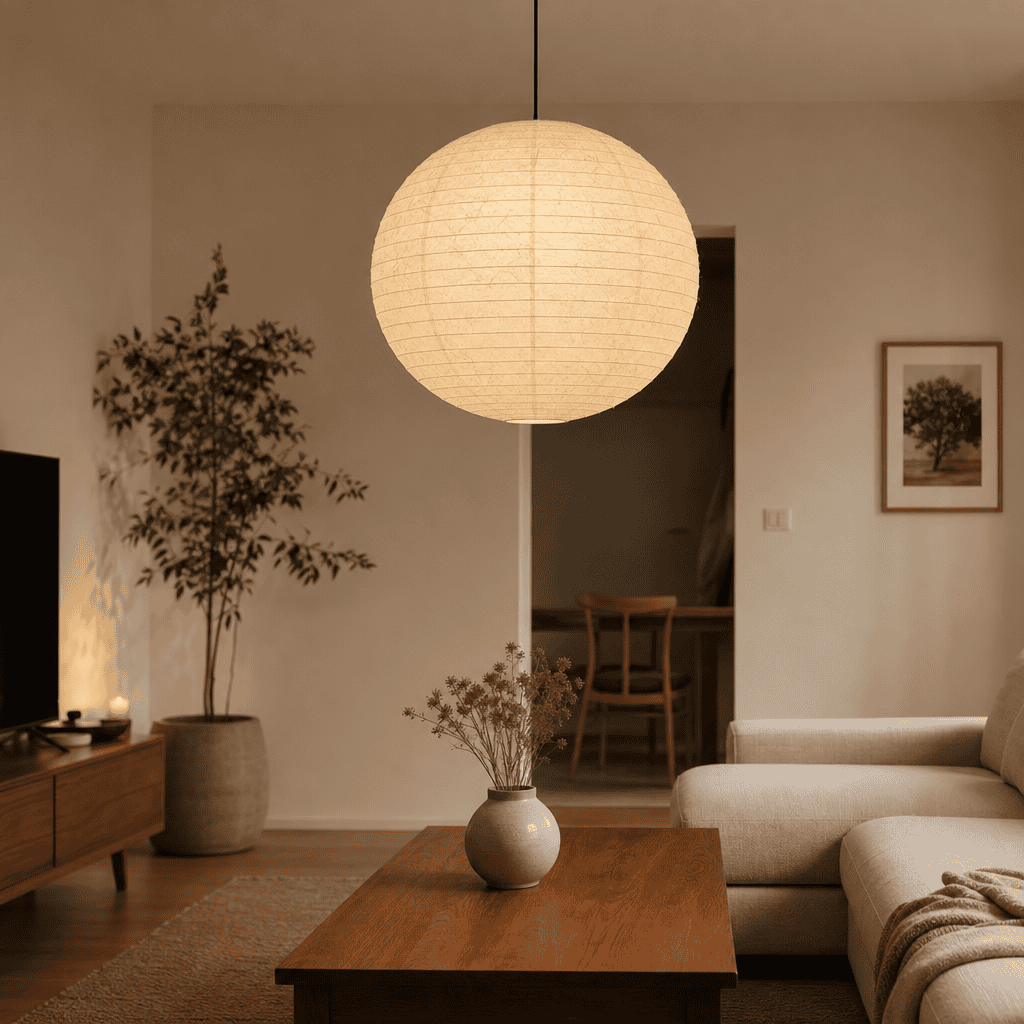
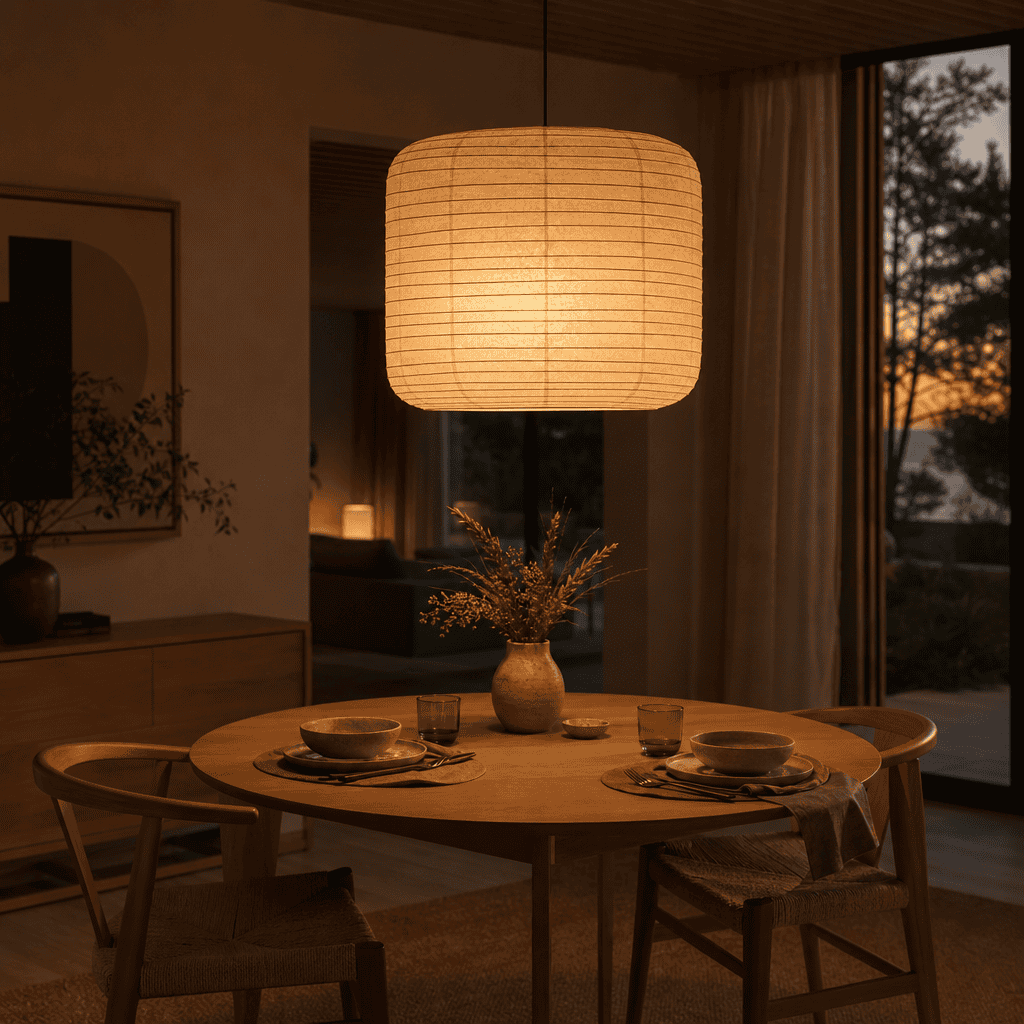
The Japanese paper lantern shade is a pendant-only form: a collapsible ribbed structure covered in washi or rice paper that hangs from a ceiling cord. These are the shades most people picture when they hear “paper lamp” — lightweight, inexpensive, and immediately recognisable by their rounded globe or elongated barrel form.
Quality varies enormously in this category. Entry-level versions use machine-processed rice paper over thin wire ribs. Higher-end versions use kozo-fibre washi (sourced from paper mulberry), which Wikipedia notes has exceptional tensile strength for its weight, achieved through long interlocking fibres that standard wood-pulp paper cannot replicate. Japanese lantern shades work best with low-heat LED bulbs. Always verify that the shade’s aperture matches your pendant cord canopy hardware before ordering.
Accordion and origami paper lamp
Accordion shades fold paper into regular pleats or origami geometric panels before mounting over a frame. The folding creates a three-dimensional texture that produces rippled or faceted light patterns on walls and ceilings — far more dynamic than a flat-paper drum.
These shades are inherently structural: the folds stiffen the paper, so they often need no inner frame at all. They appear commonly in Japandi, wabi-sabi, and contemporary Scandinavian interiors. Most accordion shades are sized for ceiling pendants (30–50 cm diameter), though table lamp versions exist for E14 candelabra sockets.
Papier mache lampshade
Papier mache shades are built up from layers of torn paper strips soaked in paste and applied over a mould. The resulting surface can be sanded, painted, or left with a deliberately rough texture. Papier mache shades are the most structurally robust paper option — a well-built shade can last 10 years or more — but they are heavier than washi alternatives and require UV-resistant sealant near windows.
DIY papier mache shades are a popular craft project (covered in the step-by-step section below). Commercially, they appear most often in artisan or bohemian home decor lines, sometimes combined with embedded leaves, fabric scraps, or natural pigments.
Rectangular paper lampshade
Rectangular shades use a four-panel flat-paper construction over a rectangular wire frame. They produce a soft rectangular bloom of light on the surface beneath them and suit task-lighting positions more than ambient lighting. You will find them most often in reading lamps, banker’s lamps, and certain floor lamp styles.
| Style | Shape | Best room | Price range |
|---|---|---|---|
| Drum | Cylinder | Living room, bedroom | $-$$ |
| Japanese lantern | Globe or barrel | Dining, bedroom, hallway | $-$$ |
| Accordion/origami | Geometric | Living room, studio | $$-$$$ |
| Papier mache | Custom, sculptural | Feature lighting | $$-$$$ |
| Rectangular | Box | Office, reading nook | $-$$ |
Paper lampshade materials — what actually matters
The most important material property in a paper lampshade is fibre length: long-fibre papers (washi, kozo) resist tearing and handle heat better than short-fibre machine papers (standard rice paper, kraft) while diffusing light more evenly.
Rice paper and washi — the gold standard
“Rice paper” is a marketing term that covers a wide range of materials. Most commercial “rice paper” lampshades are actually made from kozo (paper mulberry), gampi (a shrub), or mitsumata fibres — the same raw materials as washi. The distinction matters: genuine long-fibre kozo washi has tensile strength comparable to thin fabric and can outlast cotton muslin lampshade covers by several years.
To identify quality washi in a shade, hold it up to a light and look for irregular, slightly cloudy patches of denser fibre. Machine-processed papers have a uniform, almost plastic-looking translucency. Hand-made or semi-hand-made washi looks organic, and that organic variation is exactly what creates its characteristic warm light scatter.
Kraft and recycled paper
Kraft paper is widely used in DIY lampshades and some commercial rustic or industrial designs. It is inexpensive, easy to source, and stronger than rice paper for its thickness. The colour is naturally brown-amber, which warms the light noticeably. Kraft is not bleached, so it yellows further over time when exposed to heat and UV light.
Recycled-content paper shades vary widely in quality depending on the recycled fibre blend. Post-consumer paper fibres are shorter and weaker than virgin-fibre papers, so recycled kraft shades may need to be thicker (and therefore less translucent) to achieve adequate durability.
Papier mache (layered paper)
Papier mache lampshades combine multiple layers of paper, each soaked in an adhesive (typically white glue or wallpaper paste), applied over a form and left to cure. The layering dramatically increases structural strength — a 6-layer papier mache shade can support its own weight without an inner wire frame. The finished surface is often sealed with a clear coat to prevent moisture absorption.
Synthetic paper-look materials
A growing segment of “paper lampshades” uses synthetic materials — non-woven polypropylene, Tyvek, or synthetic vellum — that look and feel like paper but are moisture-resistant, washable, and significantly more durable. If you see a “paper” lampshade rated for damp locations or with a washable claim, it is almost certainly a synthetic paper substitute, not natural fibre. Worth knowing if longevity matters more than authenticity.
How to make a DIY paper lampshade — step by step
Yes — you can make a paper lampshade by wrapping kraft or washi paper around a purchased wire ring frame, or by building up papier mache layers over a balloon mold. The ring-wrap method takes about 2 hours and costs $8–15 in materials.
Making a paper lampshade is achievable in an afternoon using the ring-wrap method, which produces a drum shade — the fastest and most beginner-friendly result. The instructions below cover that approach.
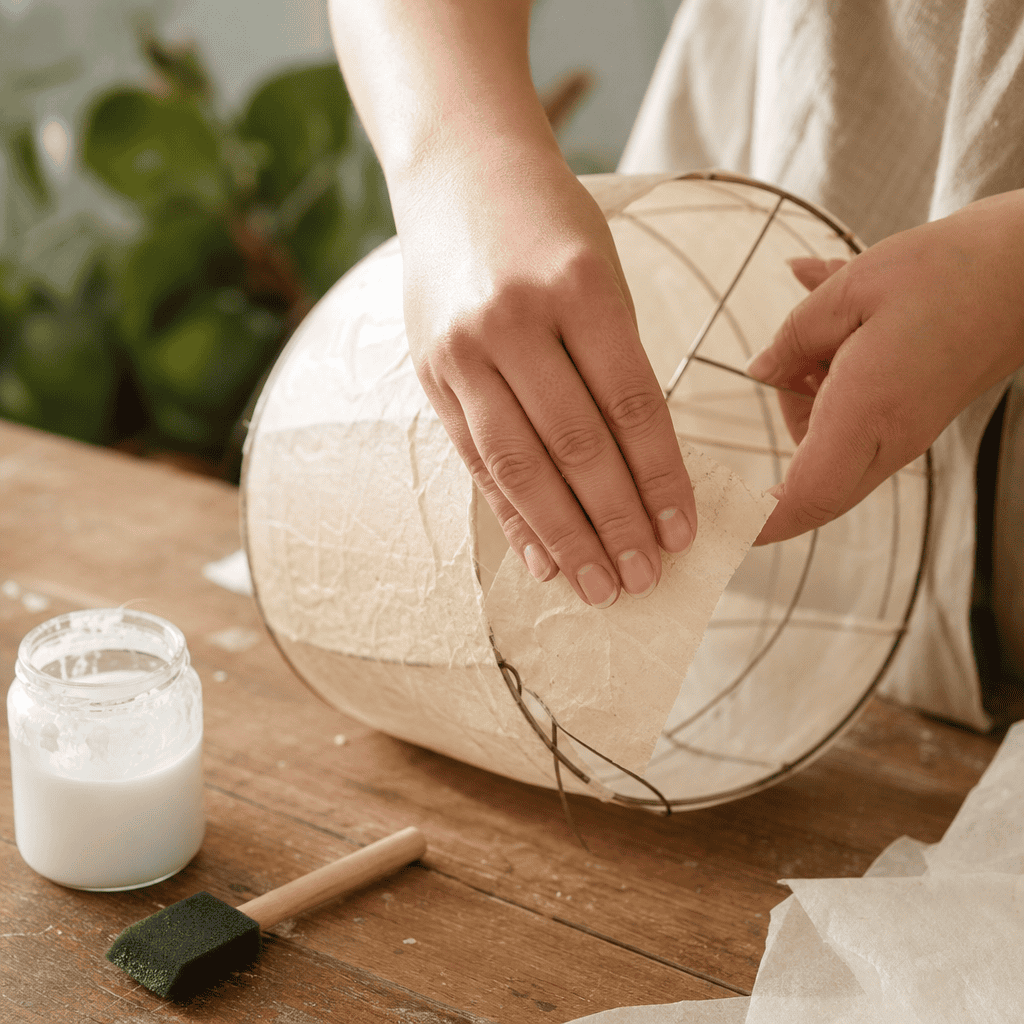
Tools and materials
- 2 wire lampshade rings (top and bottom, same diameter for a drum; different diameters for a tapered shade)
- Washi, kraft, or rice paper — enough to wrap the ring circumference plus 2 inches overlap
- White craft glue or PVA, diluted 50/50 with water
- A foam brush or wide paintbrush
- Binder clips or clothespins to hold seams while drying
- Scissors and a bone folder (optional, for clean folds)
- A pendant cord kit or harp-and-finial hardware to match your ring size
7-step method
Step 1: Measure the circumference of one ring with a flexible tape. Add 2 inches for overlap. Cut your paper to this length and to the height you want the shade (distance from top ring to bottom ring, plus 1 inch for folding over each edge).
Step 2: Lay the paper face-down on a clean surface. Brush a thin, even layer of diluted PVA along both long edges (top and bottom), about 1 inch wide.
Step 3: Position the top ring along the top edge of the paper. Roll the paper around the ring, pressing the glued edge over the wire. Use binder clips every 3 inches to hold the fold while the glue tacks — about 10 minutes.
Step 4: Repeat for the bottom ring. You should now have a cylinder of paper with both rings embedded in the folded edges. Let this dry fully, at least 30 minutes.
Step 5: At the vertical seam where the paper meets itself, apply a thin strip of PVA and press firmly. Wipe any excess glue with a barely damp cloth immediately.
Step 6: Once dry, brush a thin wash of diluted PVA over the entire outer surface as a sealer. This stiffens the paper and reduces moisture sensitivity. Let dry another 30 minutes.
Step 7: Attach your pendant cord kit or harp hardware through the top ring. Test with a low-wattage LED bulb — see the safety section below for wattage guidance.
Total time: roughly 2 hours including drying. Total material cost: $8–15 for wire rings and paper.
How to choose the right paper lampshade for your room
Choose a paper lampshade based on four factors: bulb type and wattage (LED only for safety), shade diameter relative to the lamp base, the room’s light needs (ambient vs. task), and the interior style (Japandi, bohemian, industrial, or traditional).
Bulb type and wattage — fire safety first
Paper lampshades should only be used with LED bulbs. Incandescent bulbs at a standard 60W rating generate enough heat to scorch paper when the bulb is within 6 inches of the shade surface. The National Fire Protection Association reports that lamps and light fixtures are among the leading sources of home structure fires, and close contact between shades and bulbs is a common ignition pathway. LED bulbs of equivalent brightness (800 lumens = 60W equivalent) produce roughly 80% less heat than the incandescent they replace.
Practical rule: maintain at least 3 inches between the bulb surface and the paper on all sides. If your shade is narrower than this at the top, use a lower-lumen LED or a smaller-diameter bulb (candelabra E14 instead of medium E26).
Do not use paper shades on dimmer switches unless the LED bulb is specifically rated for dimming. Non-dimmable LEDs on dimmer circuits can flicker at low settings, causing brief thermal spikes that accelerate paper ageing.
Size and proportion guide
The lampshade diameter should be roughly equal to or slightly smaller than the lamp base height for table and floor lamps. A base 18 inches tall works well with a 14–16 inch diameter shade. For pendant installations, the shade diameter should be roughly one-third to one-half the width of the surface it illuminates — a dining table that is 36 inches wide suits a pendant shade of 12–18 inches.
Height matters too: a drum shade at 10 inches height creates a different proportion than the same diameter at 6 inches. For task lighting, taller shades direct more light downward; for ambient lighting, shorter shades with open tops spread light wider. See our lampshade shapes guide for complete sizing tables by room and lamp type.
Style matching — Japandi, bohemian, industrial, traditional
Japandi and wabi-sabi: Washi and rice paper shades are native to this aesthetic. Look for natural kozo washi in undyed cream or light beige, accordion folds or Noguchi-inspired globe forms, and matte black or natural wood hardware.
Bohemian and eclectic: Papier mache shades with embedded botanicals, printed paper drums with global textile patterns, or layered hand-dyed washi all work here. Scale up — oversize pendants 20 inches and larger read as intentional statement pieces.
Scandinavian and contemporary: Clean drum shades in white or off-white paper, minimal origami pendants, or simple ribbed globe shades fit this look. Geometric precision and restraint over texture.
Industrial: Kraft paper drums in raw or lightly waxed finishes pair naturally with Edison-style LED filament bulbs, exposed pipe conduit, and reclaimed wood. The brown-amber colour of kraft paper adds warmth to an otherwise cool palette.
Traditional: Paper does not typically appear in traditional interiors, where pleated or gathered fabric shades dominate. If you want a paper shade in a traditional room, choose an off-white drum with clean edges and no visible texture — it reads as neutral enough to coexist with ornate bases.
Paper vs. fabric vs. glass lampshades
Paper shades cost less and create warmer ambient light than fabric or glass, but they are the least durable and most moisture-sensitive of the three materials. Use paper for dry, low-traffic accent lighting and fabric or glass where longevity matters.
Where paper wins
Paper shades are unmatched for warm, diffused ambient light at low cost. A quality washi pendant can cost less than a comparable cotton fabric shade while producing a richer, more organic glow. Paper also weighs almost nothing, making it practical for ceiling fittings with load restrictions and for renters who want to swap shades easily.
Paper shades are also the easiest to personalise: you can cut, paint, stamp, or layer paper in ways that are impractical with fabric and impossible with glass.
Where paper loses
Durability is the obvious weakness. A paper shade in a high-traffic hallway will show dents, moisture damage, and yellowing within a year or two. Paper is also sensitive to kitchen humidity — steam from cooking can warp and mildew a paper shade hung over an island.
Glass lampshades are indefinitely durable, easy to wipe clean, and immune to moisture. For kitchens, bathrooms, or any high-humidity space, glass is the correct material. Our glass lampshade collection covers the full range of shapes, finishes, and fitter sizes — the same warmth you want from a paper shade, built to last decades rather than years.
| Feature | Paper | Fabric | Glass |
|---|---|---|---|
| Light quality | Warm, diffused | Warm, directional | Varies by finish |
| Durability | Low | Medium | High |
| Moisture resistance | Very low | Low-medium | High |
| Cost | Low | Medium | Medium-high |
| Weight | Very light | Light | Heavy |
| Cleanability | Very limited | Limited | Easy |
| Best environment | Dry, low-traffic | Dry-medium | Any |
Paper lampshade care, safety, and replacement
Clean paper lampshades with a soft, dry brush only — never a damp cloth or water. Replace when the paper shows heat discolouration (brown patches), structural tears, or a persistent musty smell that does not resolve after airing.
Fire safety checks
The single most important maintenance action with paper lampshades is verifying bulb clearance annually. As bulbs are replaced, people sometimes install a higher-wattage LED than the original, assuming all LEDs run cool — but a 1500-lumen LED still runs hotter than a 600-lumen model and can create dangerous conditions in a tight shade. Check the inside clearance with a ruler each time you change a bulb.
If you see any browning or discolouration on the interior surface of your paper shade, replace it immediately. Discolouration means the paper has already been exposed to temperatures above its safe threshold — continued use is a fire risk.
Cleaning and dust care
Dust is paper’s main long-term enemy alongside heat. Use a soft natural-bristle brush (a wide watercolour brush or a clean shaving brush works well) to sweep dust from the outer surface in gentle downward strokes. Never use compressed air at close range — the pressure can dent or tear the paper.
For a surface smudge on kraft or papier mache, try a white art eraser applied very lightly. Test on an inconspicuous area first. Oil-based smudges (fingerprints) will not fully remove from most paper grades — treat the shade as permanent-marked in that area.
When to replace
Replace a paper lampshade immediately if you see:
- Brown or darkening patches on the interior (heat scorch — active fire risk)
- Structural creases or tears that affect the shade’s shape
- Mildew spots (small dark flecks with a musty smell)
- Significant uneven yellowing or patchy discolouration
Cosmetic yellowing that is even across the entire shade surface is normal ageing from UV and heat exposure — largely aesthetic and not a safety concern. It can be slowed by keeping paper shades out of direct daylight.
Paper lampshade trends in 2026
Paper lampshade demand in 2026 is driven by Japandi and wabi-sabi interior trends, with washi and rice paper pendants growing faster than drum styles, and sustainable recycled-paper options entering mainstream retail.
Japandi and wabi-sabi driving washi demand
Japandi — the fusion of Japanese minimalism with Scandinavian warmth — became one of the most searched interior aesthetics of 2024 and 2025 and continues to grow. Washi paper shades are a natural expression of this aesthetic: organic, handcrafted, and imperfect in exactly the right ways. Retailers from IKEA to premium Japanese import specialists are expanding their washi pendant ranges in response.
The wabi-sabi component of this trend specifically favours handmade papier mache shades with visible texture, slight irregularity, and natural pigments — the exact opposite of machine-perfect plastic. Expect to see more artisan papier mache shades in muted earth tones (clay, raw umber, warm white) through 2026 and beyond.
Sustainable and recycled-paper shades entering mainstream
Sustainability pressure from European markets is pushing manufacturers to introduce recycled-fibre paper shades. Several Japanese manufacturers now produce washi-look shades from a blend of 30–50% post-consumer paper and virgin kozo fibre — lower embodied carbon without significant loss of light quality.
In the US, the trend is slower but visible: several DTC home brands introduced recycled-content paper shades in their 2025 collections, with a price premium of roughly 15–25% above conventional paper shades and clear recycled-content labelling.
| Trend | Driver | Style influence | 2026 outlook |
|---|---|---|---|
| Japandi washi | Interior aesthetic shift | Globe and barrel pendants | Strong growth |
| Oversized statement shades | Social media design content | 24–36 inch pendants | Growing |
| Recycled paper shades | Sustainability demand | All styles | Entering mainstream |
| Dyed and printed washi | Artisan and craft market | Accent and bedroom | Niche, steady |
| Synthetic paper substitutes | Durability demand | Commercial and hospitality | Growing |
FAQ — 7 questions on paper lampshades
The most common questions about paper lampshades cover fire safety, bulb compatibility, DIY feasibility, material differences, and maintenance — all answered below.
Can I use paper to make a lampshade?
Yes. The fastest method is wrapping washi or kraft paper around two purchased wire lampshade rings (top and bottom) and securing the edges with diluted PVA glue. A full ring-wrap shade takes about 2 hours and costs $8–15 in materials. For a sculptural result, use the papier mache balloon method: inflate a round balloon to the desired size, apply 6–8 layers of PVA-soaked paper strips, let cure completely, pop the balloon, and cut a top aperture for your pendant cord kit.
Are paper lampshades a fire hazard?
Paper lampshades are safe when used correctly with LED bulbs and adequate clearance (at least 3 inches from bulb surface to paper on all sides). They become a hazard when used with incandescent or halogen bulbs, which run hot enough to scorch paper over time. Always check the shade’s maximum wattage rating and never exceed it.
What is the difference between a rice paper and washi lampshade?
Both terms describe lampshades made from similar plant-fibre papers. Washi is the more precise term — it refers specifically to traditional Japanese paper made from long plant fibres (kozo, gampi, or mitsumata). Most retail “rice paper” lampshades use the same or similar fibres but are machine-processed rather than hand-made. Washi-labelled products from Japanese manufacturers are generally higher quality and longer lasting than generic rice-paper imports.
How long does a paper lampshade last?
In a dry indoor environment with LED bulbs: 3–7 years for standard drum and lantern shades, 7–12 years for thick papier mache shades sealed with a protective coat, and 10 or more years for premium washi shades in low-traffic rooms. Humidity, UV exposure, and bulb heat are the three main factors that shorten lifespan.
Can I use an LED bulb in a paper lampshade?
Yes — LED bulbs are the recommended choice for paper lampshades. Use an LED producing no more than 800 lumens (60W equivalent) for shades under 14 inches in diameter and maintain at least 3 inches of clearance between the bulb and the paper surface on all sides. Dimmable LEDs are fine as long as your dimmer switch is rated for LED loads.
How do I clean a paper lampshade?
Use a dry, soft-bristle brush to sweep dust from the surface in gentle downward strokes. Do not use water, a damp cloth, or cleaning sprays — moisture distorts and weakens paper fibres. For light surface smudges on kraft or papier mache, a white art eraser applied very lightly may help. Washi and rice paper shades should be treated as permanent — the fibre structure absorbs oils and pigments deeply and does not release them.
What rooms suit a paper lampshade best?
Paper lampshades work best in dry rooms with ambient or accent lighting needs: bedrooms, living rooms, dining rooms, studios, and home offices. Avoid paper shades in kitchens (steam damage), bathrooms (humidity), and outdoor or covered-porch settings. For rooms where you want the warm, ambient look of paper but need durability, consider glass lampshades with a frosted or opal finish — they produce similar light quality with indefinite longevity.
Choosing your paper lampshade — what matters most
Paper lampshades work because they do one thing exceptionally well: they turn harsh bulb light into something soft, warm, and livable at a fraction of the cost of fabric or glass alternatives. The trade is durability — accept that a paper shade is a 3–7 year investment rather than a permanent fixture, and you will be satisfied with the result.
For the best outcome, match the paper type to the use case: washi for warm statement pendants, kraft for DIY projects and industrial rooms, papier mache when you want longevity with character. Use LED bulbs only, maintain clearance, and replace the shade at the first sign of heat discolouration rather than waiting for a fire risk to develop.
If durability is the priority alongside warm, diffused light, glass lampshades offer the same ambient quality in a material that will still look good in 20 years. The choice between paper and glass is ultimately a choice between warmth-with-impermanence and warmth-with-permanence.