
Lamp shade fitting guide + interactive checker
Lamp Shade Fitter Compatibility Checker & Fitter Types
Identify whether a glass lamp shade uses an UNO, spider, clip-on or neckless fitter, compare the critical opening dimensions, and screen a replacement shade before ordering.
For reliable matching, confirm the mounting system first, then measure the glass neck or fitter ring. Shade style and outside diameter alone do not determine compatibility.
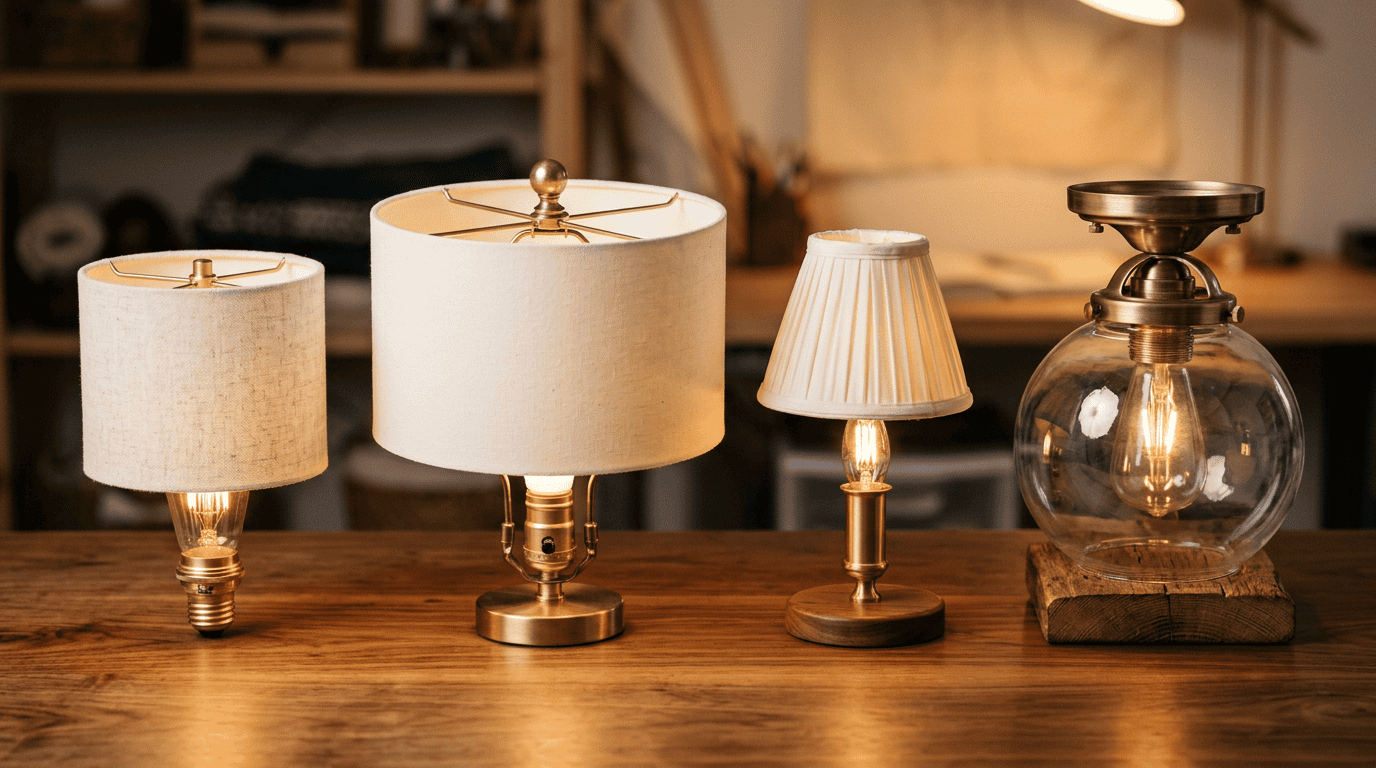
STEP 1
Identify the mounting system
Look for a threaded socket ring, harp and finial, bulb clip, or screw-held gallery.
STEP 2
Measure the critical opening
Measure the glass neck or fitter ring and the fixture holder in the same unit.
STEP 3
Confirm hardware and clearance
Check screws, rings, harp height, bulb clearance and the load of the glass shade.
Interactive fitter tool
Lamp shade fitter compatibility checker
Use this checker before ordering a replacement glass shade. It compares the mounting system, fitter diameter and holding hardware, then gives a practical compatibility result and a specification line you can send for review.
- Whether the shade and fixture use the same mounting system.
- Whether ring, neck or holder diameter is close enough for direct fitting.
- Whether an adapter, reducer ring or custom fitter should be checked before production.
The four primary mounting systems
Glass Lamp Shade Fitter Types Explained
The fitter is the mechanical interface between the shade and the fixture. Two shades can look identical but require different hardware, so identify the fitter type before comparing shape, color or outside diameter.
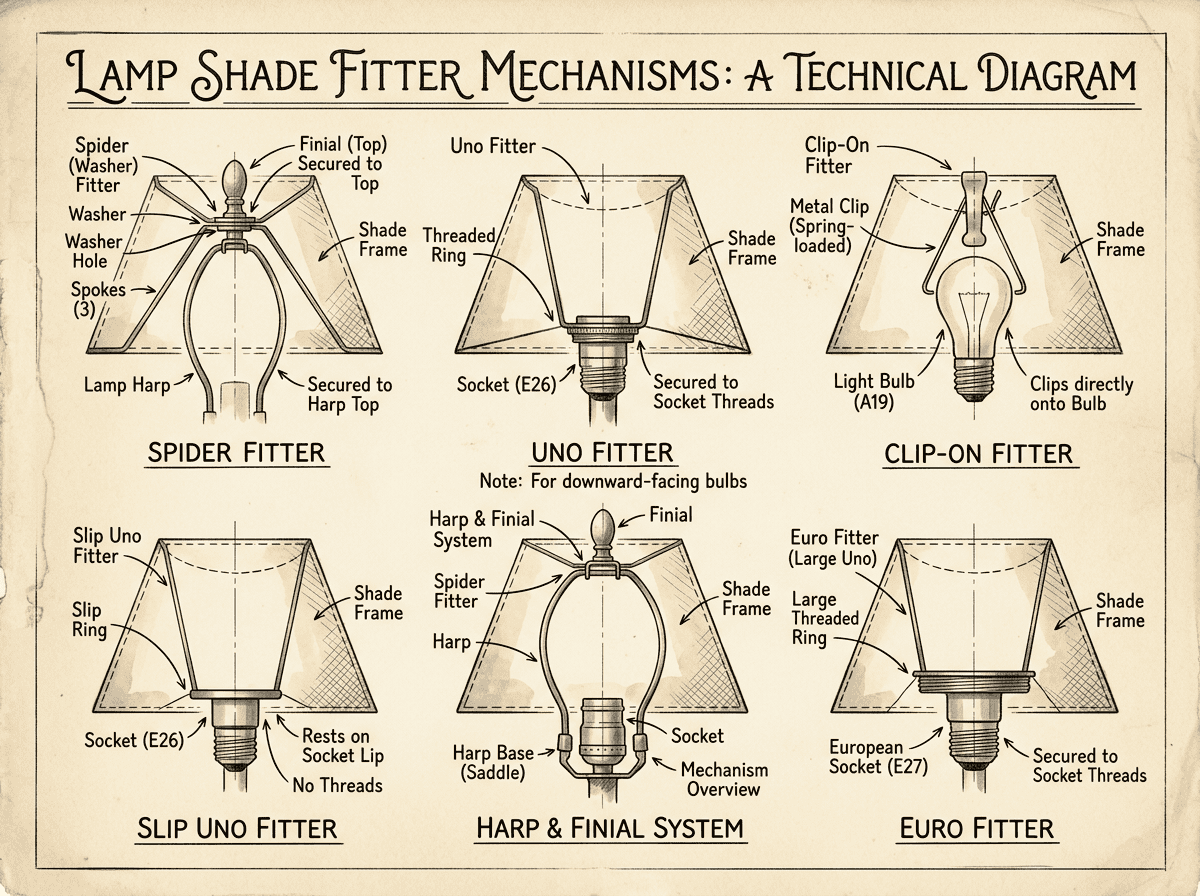
UNO lamp shade fitter · threaded socket ring
UNO Fitter
An UNO fitter sits around the lamp socket and is secured by a threaded retaining ring. It is common on table lamps, wall lights and some pendants.
Check: socket-ring system, opening diameter, thread clearance and shade weight.
Spider lamp shade fitter · harp and finial
Spider Fitter
A spider fitter has support arms meeting at a center washer. The shade sits on a harp and is held by a finial above the bulb.
Check: harp height, washer opening, finial thread and bulb-to-shade clearance.
Clip-on lamp shade fitter · bulb-mounted
Clip-On Fitter
A clip-on fitter grips the bulb directly. It is normally used with smaller, lighter shades on chandeliers, sconces and accent lamps.
Check: bulb shape, clip size, heat clearance and whether the shade is light enough for the mount.
Neckless glass shade fitter · gallery or holder
Neckless Fitter
A neckless glass shade has a smooth opening or short fitter lip held by set screws or a fixture ring. It is common on pendants, ceiling lights and wall fixtures.
Check: outside glass neck, inside holder diameter, lip profile and screw contact.
Lamp shade fitter ring sizes
Common Glass Lamp Shade Fitter Sizes
Common nominal sizes include 1-5/8, 2-1/4, 3-1/4 and 4 inches, but the label alone is not enough. Manufacturers and retailers may describe the glass opening, the outside neck, the holder opening or the retaining ring. Measure the real shade and fixture in the same place before treating a nominal size as compatible.
1-5/8 in
41 mm nominal
Seen on some smaller glass fitter openings and socket-ring systems. Confirm whether the catalog dimension refers to the glass opening, holder or ring.
2-1/4 in
57 mm nominal
A common glass shade fitter size for pendants, vanity lights and small fixture holders. Measure the outside glass neck.
3-1/4 in
83 mm nominal
Common on replacement glass shades for ceiling fans, wall lights and multi-light fixtures using screw-held galleries.
4 in
102 mm nominal
Used on larger neckless glass globes and fixture holders. Check the seating lip and screw position as well as diameter.
Measurement rule
For a screw-held glass shade, measure the outside diameter of the glass neck and the inside diameter of the receiving holder. Also photograph the fitter lip and hardware. Do not measure only the widest part of the shade.
How to identify a lamp shade fitter
Measure the Shade and Fixture in Five Steps
- Remove the shade safely. Switch off power, let the bulb cool and support the glass while loosening the hardware.
- Photograph the fixture mount. Capture the socket ring, harp, bulb clip or screw-held gallery.
- Measure the shade fitter. Record the glass neck, fitter opening or washer opening at the mounting point.
- Measure the fixture holder. Use the same unit and note screws, rings, gaskets, finial threads and harp height.
- Send a complete fit specification. Include fitter type, both diameters, overall shade dimensions, weight estimate and three clear photos.
Avoid replacement shade returns
Why Lamp Shade Fitters Mismatch
Compatibility requires the same mounting concept, a correctly matched dimension and suitable hardware. Forcing a near-match can chip the glass rim, create an unstable shade or reduce bulb clearance.
Different mounting systems
An UNO shade does not directly attach to a harp-and-finial fixture, and a spider shade does not become socket-ring compatible because the diameters look similar.
Diameter mismatch
A small difference can prevent the glass from seating or cause point pressure from set screws. Large differences require a correct reducer, adapter or custom fitter.
Wrong hardware
Missing retaining rings, gaskets, finials or set screws can make a nominally matching shade unsafe or unstable.
Clearance and load problems
The bulb, socket and glass need adequate clearance. A mount suitable for a light fabric shade may not be suitable for heavy glass.
Can an adapter solve the mismatch?
Sometimes. A purpose-made retaining ring, reducer or harp conversion may work, but the adapter must match the actual socket, holder, glass lip and load. Treat a conversion as a hardware review, not a diameter-only shortcut.
For replacement programs and OEM projects
What to Send for a Custom Glass Shade Fitter Review
For distributors, lighting brands, hospitality projects and replacement programs, send enough information to review both the glass and the mounting hardware:
- Fixture type and intended application
- Fitter type and nominal size
- Millimeter dimensions of the glass opening, neck and seating lip
- Holder, socket ring, harp, finial or set-screw details
- Overall shade height, width and approximate glass weight
- Photos of the existing shade, fixture mount and a measurement reference
- Required quantity, finish, packaging and project timing
The result of the online checker is a screening step. Final production feasibility should be confirmed from drawings, samples or dimensioned photos.
Lamp shade fitter FAQ
Frequently Asked Questions
How do I identify an UNO vs spider lamp shade fitter?
An UNO fitter is held at the socket by a threaded retaining ring. A spider fitter has arms meeting at a center washer and normally rests on a harp, secured with a finial. Photograph the lamp without the shade if the hardware is unclear.
What size lamp shade fitter do I need?
Measure the real mounting point, not the widest part of the shade. For glass held by a gallery, record the outside glass neck and inside holder. Common nominal sizes include 1-5/8, 2-1/4, 3-1/4 and 4 inches, but labels may refer to different parts of the assembly.
Can I use a 2-1/4 inch glass shade in a 2-1/4 inch holder?
It is a likely candidate, not an automatic fit. Confirm where both dimensions were taken, then check the glass lip profile, holder depth, screw position, gaskets and clearance around the bulb and socket.
Can a lamp shade fitter adapter convert one type to another?
Some conversions are possible with a properly selected retaining ring, reducer, harp or custom adapter. The hardware must be reviewed for the actual fixture and glass shade; matching one diameter does not make two mounting systems equivalent.
What should I send when requesting a replacement glass lamp shade?
Send three clear photos, fitter type, opening and holder dimensions in millimeters, overall shade size, fixture application, quantity and any hardware details. A physical sample or drawing is best for a non-standard fitter.
Is the compatibility checker a final safety approval?
No. It screens the mounting system, diameter and hardware. Final installation must also consider glass thickness, load, screw pressure, heat clearance, electrical requirements and local fixture standards.
Related measurement tools and guides
Continue Your Lamp Shade Fit Check
Replacement Glass Lamp Shades
Match shape, fitter and key measurements before selecting a replacement shade.
Lamp Shade Size Calculator
Estimate shade height and bottom diameter, then combine the result with the correct fitter type.
Glass Shade Fitting Standards
Review deeper terminology, measurement points and specification details for glass shade fittings.
Need a Non-Standard Glass Shade Fitter?
Send the fixture photos, glass opening, holder dimensions and required quantity. We can review whether the project needs a standard fitter, an adapter or a custom glass shade opening.