Victorian lampshade frames are wire armatures in bell, empire, or pagoda shapes, built to hold fabric or silk coverings in the style of 1837-1901 British interior design.
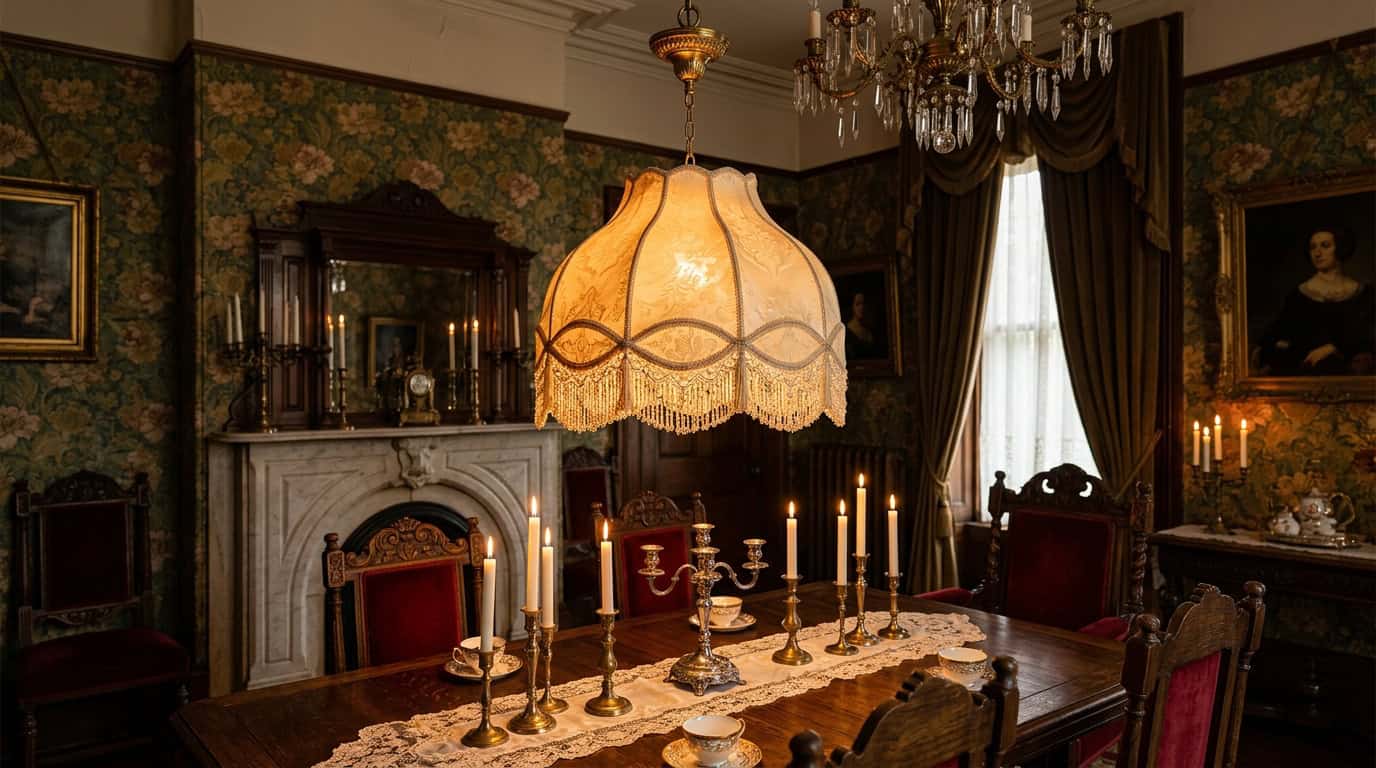
You’ve got the lamp base. Maybe it’s a brass column floor lamp from an estate sale, or a ceramic pedestal that needs the right crown. The shade matters, and for a Victorian-style lamp, the wire frame underneath the fabric is where the project actually begins.
Victorian lampshade frames determine the silhouette, the drape, and whether the finished shade holds its shape for five years or fifty. Most guides skip straight to the fabric. This one doesn’t.
What Are Victorian Lampshade Frames?
Victorian lampshade frames are the internal wire or metal armatures that give a period-style lampshade its shape, structural support, and stability. Strip away the silk, velvet, or pleated fabric and what remains is a skeleton of steel wire ribs, horizontal rings, and a central fitting: the frame itself.
The term covers two genuinely different things. First, original Victorian-era frames from the 1837-1901 period (hand-bent, often tin-plated or lacquered steel). Second, modern reproductions made to the same silhouettes for restoration and decor projects. Both serve the same structural function, but they’re not the same object.
The Anatomy of a Victorian Lampshade Frame
Every Victorian lampshade frame, regardless of shape, size, or era, shares a common architecture:
- Top ring: The small upper ring that forms the crown of the shade. Typically 2-4 inches in diameter. Sits above the bulb and fitter.
- Bottom ring: The widest horizontal ring at the base of the shade. Its diameter is the number suppliers use to “size” a frame.
- Ribs: The vertical or angled wire spokes connecting top ring to bottom ring. The rib count (typically 6 to 12) determines how smoothly the shade’s surface flows between rings.
- Intermediate rings: Secondary horizontal rings on taller or more elaborate shapes. A bell frame might have one or two intermediate rings that hold the ribs in their curved position between crown and base.
- Fitter/spider: The central fitting at the top of the frame, where the shade connects to the lamp’s hardware. This component, more than anything else, determines whether a frame will actually work with your specific lamp.
- Braces and stays: Short cross-wire supports added to frames larger than 16 inches to prevent lateral flex when fabric is stretched over the ribs.
According to Wikipedia’s overview of Victorian decorative arts, the gas lamp shades of the early and mid-Victorian period (1837-1870s) were predominantly glass: hand-blown globes rather than fabric-covered wire frames. Wire-frame fabric shades became widespread in the late Victorian period as incandescent electric lighting spread through urban British and American homes in the 1880s and 1890s. The silhouettes we recognize today as “Victorian” largely belong to that final two decades of the era.
Victorian Originals vs. Modern Reproductions
Most Victorian lampshade frames on the market are reproductions. That’s the right call for almost every project. Original frames from the 1880s-1900s are rare, often corroded or warped, and were not designed for modern bulb sockets. A reproduction in the correct period shape is easier to source, safer to use, and more dimensionally consistent than anything pulled from an estate sale.
The differences worth knowing:
| Feature | Original Victorian Frame (1880s-1901) | Modern Reproduction |
|---|---|---|
| Wire material | Tin-plated iron, lacquered steel, occasional brass | Epoxy-coated steel, bare steel, zinc alloy |
| Construction | Hand-bent and silver-soldered at joints | Machine-bent, MIG-welded or crimped |
| Wire gauge | Variable (craftsman-dependent) | Standardized: typically 14-18 AWG |
| Finish | Black lacquer or japanned coating | White epoxy (most common) or bare metal |
| Fitter compatibility | Often non-standard; adapters may be needed | Standardized for modern harp and duplex hardware |
| Price range | $40-$200+ depending on condition and rarity | $8-$60 depending on size and complexity |
For restoration work, a reproduction frame in the correct period shape almost always beats an original. Frames that survived 120+ years tend to carry oxidized joints, inconsistent rib spacing, and rust that telegraphs through light fabrics.
Victorian Frame Shapes: The 6 Core Silhouettes
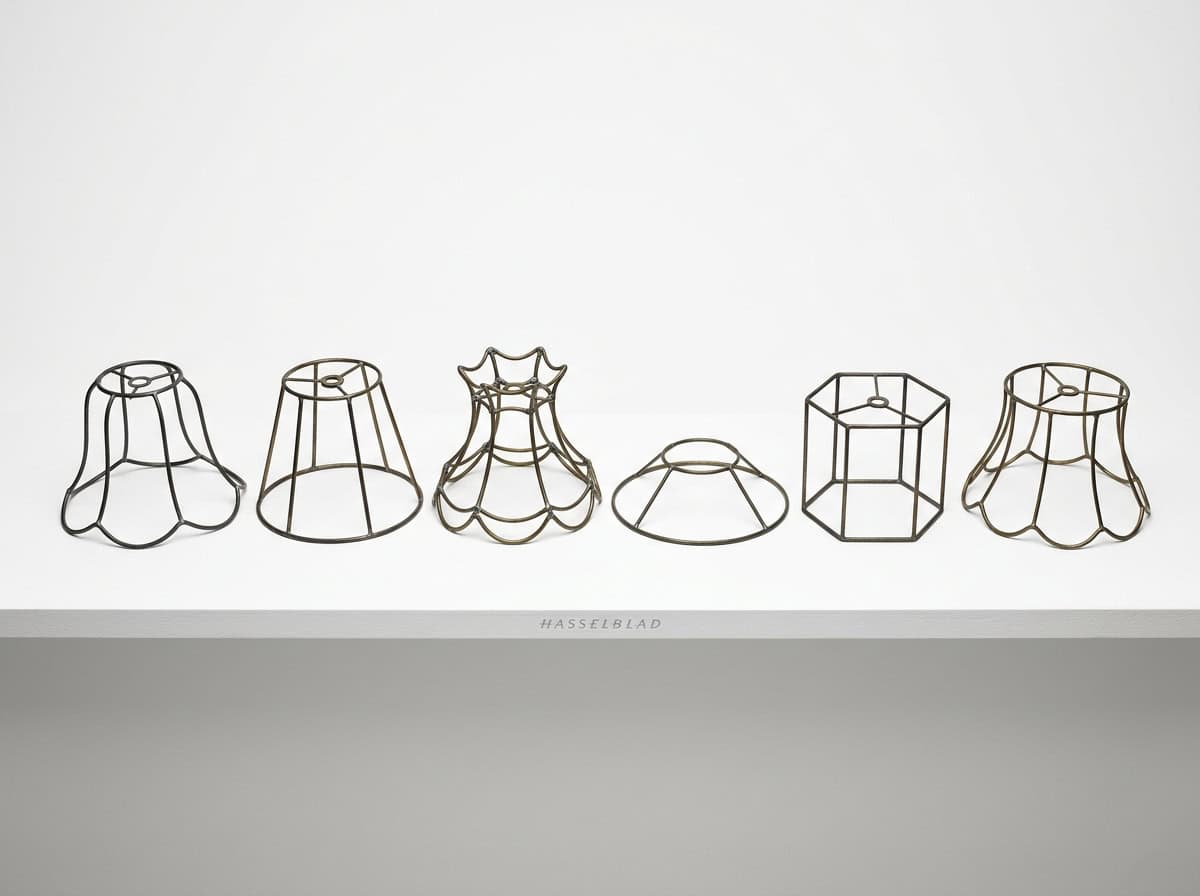
Victorian lampshade frames come in at least six distinct silhouettes, each associated with different rooms, lamp heights, and fabric treatments. Getting the shape right matters as much as getting the size right.
A Victorian lampshade frame’s shape is defined by the relationship between its top ring diameter, bottom ring diameter, overall height, and how the ribs travel between them: curved, straight, angled, or geometric.
Bell and Empire Frames: The Most Common Silhouettes
The bell frame is the shape most people picture when they think “Victorian lampshade.” Its ribs curve gently outward from a narrow top ring, reach maximum diameter somewhere in the lower half of the frame, then curve slightly back inward toward the bottom ring. This double curve creates the characteristic flared bell profile that drapes silk and velvet so naturally.
The empire frame simplifies that geometry. Its ribs run straight or at a very slight angle from a narrow top to a wider bottom, with no inward return curve at the base. Empire frames look cleaner and work particularly well with Art Nouveau-adjacent hardware from the 1890s. They’re also easier to cover because the fabric maintains a consistent downward angle rather than following a compound curve.
Bell and empire Victorian lampshade frames make up the bulk of what reproduction suppliers stock. Most specialist suppliers carry both shapes in sizes from 6 inches to 20 inches across the bottom ring. If you’re sourcing from a single supplier, these two shapes offer the most size variation.
Pagoda, Coolie, and Hexagonal Frames
The pagoda frame reflects the East Asian design influences that ran through British interior aesthetics during the Aesthetic Movement (1860s-1880s). Its profile is angular rather than curved: straight-sided panels with a pronounced flare at the bottom, sometimes incorporating one or two intermediate tiered rings. The pagoda’s flat panel sections make it well-suited to stretched-panel fabric techniques where the fabric is fitted between ribs rather than draped over them.
The coolie frame (sometimes called a coolie hat frame) is a wide, shallow cone. A very gradual taper runs from a small top ring to a notably wide bottom ring, producing a low-profile shade with significant horizontal reach. Victorian coolie frames typically had 12-16 ribs and were frequently covered in pleated silk or velvet with fringe trim running the entire bottom circumference. These frames look dramatic on buffet lamps, candelabra-style fittings, and accent tables.
Hexagonal frames break from the round template entirely. Six flat panels meet at six vertical ribs, creating a faceted lantern-like silhouette. Victorian hexagonal lampshades appeared frequently in libraries and dining rooms, used on gas-lamp conversion fittings and early electric table lamps. The flat panels suit stained glass insets, rigid fabric panels, or embroidered silk; treatments that don’t work on curved rib frames.
Scalloped and Fluted Frames
Scalloped frames separate genuinely Victorian-looking lampshades from modern approximations that merely gesture at the style. A scalloped bottom ring isn’t a plain circle; it’s a wire bent into a continuous series of arcs that form a wavy, ruffled bottom edge. Each arc becomes a natural drape point for fabric, ribbon, or fringe trim. The scalloped bottom ring is almost exclusive to Victorian-era design. Almost no other period uses it as a standard feature.
Fluted frames carry textured vertical channels between their ribs. The ribs alternate outward and inward, creating ridged surfaces that produce a column-like effect when covered in tightly fitted fabric. Fluted Victorian lampshade frames were most common on parlor table lamps from the 1880s through the turn of the century.
Both scalloped and fluted styles are harder to find as stock reproduction frames. Custom frame makers (specialist suppliers and artisan metalworkers) are the primary source for these shapes.
| Shape | Typical Rib Count | Era Peak | Best Cover Material | Common Applications |
|---|---|---|---|---|
| Bell | 8-10 | 1870s-1901 | Silk, velvet, dupioni | Table lamps, floor lamps |
| Empire | 6-8 | 1880s-1901 | Fabric, linen, faille | Bedside, side table lamps |
| Pagoda | 8-12 | 1860s-1885 | Panel silk, stiff fabric | Buffet lamps, gas conversions |
| Coolie | 8-12 | 1875-1901 | Pleated silk, velvet | Candelabra, feature lamps |
| Hexagonal | 6 (fixed) | 1860s-1890s | Stained glass, rigid panels | Library lamps, pendant lanterns |
| Scalloped | 10-14 | 1880s-1901 | Silk, charmeuse, organza | Parlor lamps, boudoir accent lamps |
Fitter Types Explained
A Victorian lampshade frame’s fitter is the hardware component at the top center that connects the shade to the lamp. It’s the detail most how-to guides skip, and it’s where the majority of frame-purchase mistakes happen.
The fitter type has nothing to do with aesthetic preference. It’s determined entirely by your lamp’s existing hardware. Buying the wrong fitter means the shade won’t mount, or will mount insecurely. Get this right before you look at shape or size.
Spider (Gimbal) Fitters
The spider fitter (also called a gimbal fitter or cross-bar fitter) is a star-shaped or cross-shaped bracket mounted at the center top of the frame. Its arms extend outward and connect to the top ring, while its center point drops down to rest on a lamp harp saddle.
A harp is the U-shaped metal bracket that wraps around the base of a bulb socket on most US and UK table lamps. The harp rises above the socket and ends in a curved saddle. The spider fitter rests in this saddle, and a harp finial threads down through the spider’s center hole to clamp the entire assembly in place.
Spider fitters are the most common fitter type for Victorian lampshade frames used on freestanding table lamps and floor lamps. One measurement matters above all others: the saddle width. Most American and British harps use the same standardized saddle width, but frames imported from other markets sometimes use a narrower center hole that won’t accept a standard finial. Check before ordering.
Washer (Duplex) Fitters
The washer fitter (commonly called a duplex fitter in the UK) is a flat metal ring mounted at the top of the frame, with an inner diameter sized to sit directly over a specific bulb socket type. There’s no harp involved. The shade simply drops over the bulb socket and rests on the socket’s collar ring.
Duplex fitters were standard on pendant lamp fittings and Victorian gas-to-electric conversion hardware. Duplex sizing refers to the inner ring diameter: duplex 45mm and duplex 55mm are the two most common sizes in Victorian-style reproduction fittings. If you’re working with a pendant lamp or a converted gas fitting, measure the socket collar diameter before ordering any Victorian lampshade frame.
Using a duplex-fitted frame on a spider/harp lamp requires an adapter. The reverse (a spider frame on a duplex pendant) also requires one. Neither is expensive or hard to find. But buying a frame with the wrong fitter type and discovering it on delivery is a preventable problem, fixed by one measurement taken upfront.
How to Match Fitter to Your Lamp Base
Three identification steps:
- Look for a harp: If your lamp has a U-shaped wire bracket rising above the bulb socket, you need a spider (gimbal) fitter.
- Look for a socket collar ring: If there’s a circular platform directly above the bulb socket with no harp, you need a washer/duplex fitter; measure the inner diameter of the ring (typically 45mm or 55mm).
- Look for a small socket neck: Some Victorian-style candelabra and accent lamps have a narrow socket neck with no harp or ring platform. These take a clip-on (euro) fitter that clamps directly onto the bulb.
For a detailed breakdown of fitter types across different lamp socket configurations, the lampshade frames guide covers US and UK hardware differences with diagrams.
How to Choose the Right Victorian Lampshade Frame
Choosing a Victorian lampshade frame involves four decisions in sequence: fitter type (just covered), shade size, wire gauge, and whether to buy pre-made or commission custom. Most buyers start with size and backtrack into fitter problems later. Starting with fitter eliminates that.
With fitter sorted, the remaining decisions become significantly simpler.
Sizing Victorian Lampshade Frames for Lamp Proportion
The classic proportion rule for Victorian table and floor lamps: the shade’s bottom diameter should be approximately equal to the height of the lamp base, measured from the base’s lowest point to the top of the socket. A lamp base standing 12 inches tall calls for a shade with a 12-inch bottom ring.
Shade height (the distance from top ring to bottom ring) typically runs 60-70% of the bottom diameter for bell and empire shapes. A 12-inch bottom ring pairs with a shade 7-9 inches tall. That ratio produces the proportions we recognize as characteristically Victorian: substantial without being top-heavy.
Floor lamps break from this formula because strict adherence produces impractically tall shades. For floor lamps, aim for bottom diameter at roughly three-quarters of lamp base height, with shade height capped at 10-14 inches regardless of diameter. Victorian floor lamp shades in the 16-20 inch range follow this adjusted proportion.
For more specific sizing scenarios, the complete lampshade sizing guide walks through table and floor lamp calculations with specific examples.
Wire Gauge and Frame Material
Wire gauge is the specification no product listing makes prominent enough. Victorian lampshade frames are typically constructed from one of three wire weights:
- 14-16 AWG (heavy): Structural frames for large shades (anything over 14 inches in bottom diameter). Heavy gauge wire doesn’t flex when you stretch velvet or dupioni silk across it under tension. Worth the added weight for any shade needing a hard-stretched fabric covering.
- 17-18 AWG (medium): The most practical wire weight for 8-14 inch reproduction frames. Balances rigidity with workability. Holds well for most period-authentic fabric treatments including pleated silk, faille, and linen.
- 19-20 AWG (light): Small decorative frames and candelabra clip shades. Fine for lightweight silk and organza. Will flex under tight fabric tension on anything larger than an 8-inch shade.
Frame finish matters less than gauge but still affects the final look. White epoxy is invisible under opaque fabrics and is the right default for most Victorian lampshade projects. Bare steel is appropriate if you plan to paint the frame before covering, a technique used in traditional lampshade-making when the cover fabric is translucent enough to show the ribs. Black frames work when the frame is meant to be visible, as in hexagonal lantern styles where the ribs show between fabric or glass panels.
DIY Lampshade Frames vs. Pre-Made
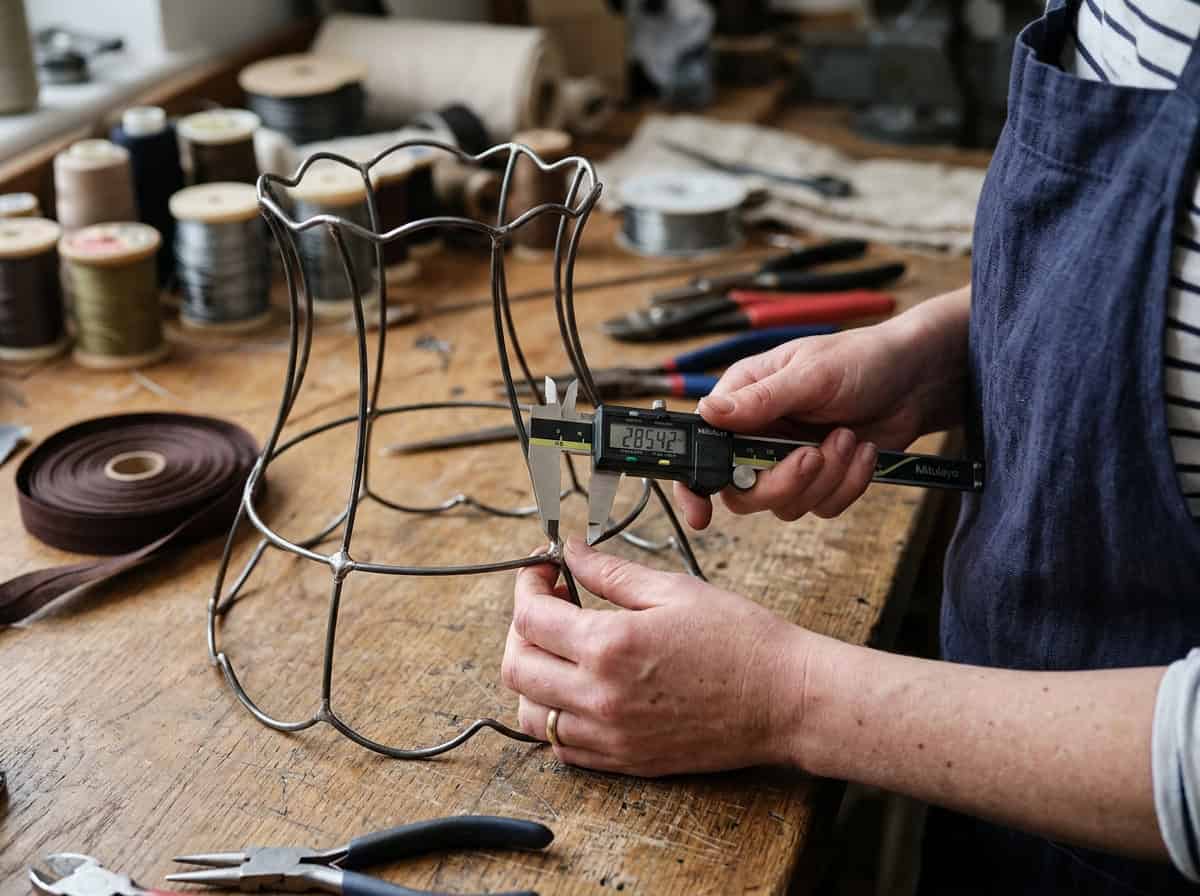
Victorian lampshade frames are achievable as a DIY metalworking project. The required tools are accessible: round-nose pliers, flat-nose pliers, wire cutters, a ring mandrel or round form, and silver solder with a soldering iron. Standard bell and empire shapes are within reach for anyone comfortable with basic craft metalwork.
That said, a decent reproduction bell or empire frame in a common size costs $12-$30 from a specialist supplier. The time to hand-bend, align, and solder a clean frame from scratch (particularly getting the top and bottom rings truly round) rarely pays off when a ready-made frame is available in the size you need.
DIY frame-making makes practical sense in two situations: you need a scalloped or non-stock bottom ring that no supplier carries in your diameter, or you’re working with a frame larger than 20 inches where shipping costs from specialist suppliers become significant. For anything in a standard bell or empire shape between 8 and 16 inches, a bought reproduction frame will have better dimensional consistency than all but the most practiced hand-bent frame.
The DIY lampshade guide covers frame construction as one of its methods, including wire supplier recommendations and mandrel alternatives.
Where to Buy Victorian Lampshade Frames
The Victorian lampshade frame supply chain is thin. There are no dominant retail brands. The market runs through specialist suppliers, custom frame makers, and a scattered group of artisan craftspeople. That scarcity is useful to understand: custom orders are normal and expected here, not exceptional. Most specialist suppliers are accustomed to building to spec.
Specialty Lampshade Suppliers
Specialty frame suppliers split into two types: catalog stock suppliers and custom frame makers.
Stock suppliers carry bell and empire frames in the most common sizes, typically 8″, 10″, 12″, 14″, and 16″ bottom diameters. Scalloped, pagoda, and coolie shapes appear in catalog lines but with fewer size options. Pricing runs $8-$30 per frame for standard sizes, $20-$50 for more complex shapes.
Custom frame makers build to specific measurements. Lampshade-making specialty suppliers (including Etsy workshop sellers with established track records) are the main source for scalloped bottom rings, pagoda shapes in non-standard sizes, and unusual fitter configurations. Custom orders typically require a minimum of 3-5 frames and 2-6 week lead times. Cost: $25-$80+ per frame depending on complexity.
The Victoria and Albert Museum’s documentation on Victorian interior design provides useful reference for period-accurate proportions if you’re commissioning a custom Victorian lampshade frame, specifically the lamp shade sizes and silhouettes documented in their late-Victorian domestic interiors collection.
Custom Frame Makers
Custom Victorian lampshade frames come from three reliable source categories.
UK craft suppliers have a historically strong track record with Victorian lampshade frames. The British lampshade-making tradition is more continuous than the American one, and UK suppliers often carry shape options and specialist knowledge that are harder to find elsewhere. Shipping times to North America run 7-14 days for most suppliers.
Etsy artisan metalworkers are a second strong option. Filter for sellers specializing in “Victorian wire frame lampshade” with 50+ completed orders and detailed product photography. Artisan pricing runs higher than catalog suppliers, but the ability to specify exact dimensions, rib counts, and fitter types makes it worthwhile for non-standard projects.
Direct manufacturer sourcing from lampshade hardware factories is viable for larger quantities, typically 10+ frames of the same specification. Lampshade hardware manufacturers who supply major importers will accept technical drawings for custom shapes at minimum quantities accessible to small interior design businesses or boutique hotel outfitters. Lead time: 4-6 weeks including shipping.
When commissioning any custom Victorian lampshade frame, give the maker six measurements: bottom ring diameter, top ring diameter, finished height from top ring to bottom ring, fitter type and dimensions, rib count, and whether intermediate rings are required.
Quality Markers and Red Flags
Not every Victorian lampshade frame listing delivers what it shows. Specific things to check:
- Missing wire gauge specification: If a listing doesn’t state AWG or wire diameter in millimeters, assume the cheapest light gauge and plan your fabric selection accordingly.
- Crimp-only joints on large frames: Crimped joints are adequate on frames under 12 inches. On bell and pagoda frames 14 inches and larger, unsupported crimp joints shift under fabric tension over time. Welded or soldered joints hold better.
- “Victorian-style” without specific shape names: The term gets used loosely. A photo might show a bell frame labeled “Victorian” when the proportions are actually mid-century modern, flat top, wide straight sides. Check the top-ring-to-bottom-ring ratio and how the ribs run.
- No return policy on custom orders: Standard practice, and acceptable. But double-check your measurements. A custom Victorian lampshade frame with the wrong fitter type or an inch off in diameter is a $40-$60 mistake.
| Quality Indicator | Better | Watch Out |
|---|---|---|
| Wire joints | Welded or silver-soldered | Crimped-only on 14″+ frames |
| Wire gauge | Stated in AWG or mm | No gauge listed |
| Finish | Even white epoxy coating | Patchy or flaking rust-inhibitor |
| Dimensional tolerance | +/-1mm stated or implied | No tolerance mentioned |
| Fitter type | Clearly labeled (spider/duplex/clip) | Listed only as “standard” |
| Shape name | Specific (bell, empire, coolie) | Generic “Victorian style” |
Victorian Lampshade Frames in 2026: What’s Driving the Revival
Victorian lampshade frames are seeing meaningfully increased demand in 2026, and not just from restoration specialists. Several converging design trends have pushed period-authentic lamp silhouettes back into general interior design practice, and the supply chain is slowly catching up.
The core driver is a broad reaction against the bare-bulb minimalism that dominated the 2010s. Victorian lampshade frames offer exactly what industrial pendants and exposed filaments don’t: weight, texture, and handcraft.
Cottagecore, Maximalism, and the Victorian Aesthetic Resurgence
The cottagecore design movement, anchored in soft textiles, domestic craft, and nostalgic visual comfort, has been a consistent presence in interior design since 2021. By 2026, it has moved from a social media subculture into mainstream retail. High-street furniture brands carry cottagecore-adjacent pieces, and the lampshade’s role in that aesthetic is significant. A bell-shaped shade in pleated silk or patterned velvet does more to establish the visual register of a cottagecore interior than almost any other single object.
Maximalism has done equivalent work from a different direction. Where minimalism favored bare Edison bulbs and industrial-style pendants, maximalist interior design needs the kind of decorative weight that a Victorian lampshade frame (covered and fringed) provides. The combination of layered pattern, rich texture, and visible craft that defines maximalism maps directly onto the Victorian lampshade aesthetic.
According to Pinterest Predicts, searches for “Victorian interior design” and “fabric lampshade DIY” have seen significant growth year-over-year through 2025-2026, driven by home decorators looking for alternatives to contemporary minimalist lighting.
Sustainable Sourcing and the Restoration Economy
A second driver is practical: re-covering or re-framing an existing lamp base, rather than replacing the entire lamp, generates less waste and often produces a better-looking result than buying a mass-market Victorian-style lamp from a furniture retailer. This has directly increased demand for replacement Victorian lampshade frames, since an existing brass or ceramic lamp base can be transformed with a new frame and fresh silk.
Small metalworking shops have expanded their offerings to include lampshade frame-making as a result. According to English Heritage’s guidance on period-appropriate domestic interiors, authentic Victorian interior restorations prioritize hand-crafted lampshades over modern reproductions, creating a sustained professional market for accurate Victorian lampshade frames alongside the broader consumer market.
| Trend | 2024 Position | 2026 Position | Effect on Frame Demand |
|---|---|---|---|
| Cottagecore interiors | Social media peak | Mainstream retail | High (bell and scalloped frames) |
| Maximalist design | Emerging trend | Core design movement | High (elaborate shapes, fringe trim) |
| Restoration economy | Craft enthusiast niche | Growing mainstream | High (all frame types) |
| DIY lampshade making | Specialist craft | Wider hobbyist market | Medium (small frames, common shapes) |
| Boutique hospitality Victorian theme | Specialist use | Growing adoption | Medium-high (custom bulk orders) |
FAQ
What sizes do Victorian lampshade frames come in?
Victorian lampshade frames are sized by bottom ring diameter, running from 6 inches (small accent lamps) to 22 inches (large floor lamps). Standard reproduction frames run in 8″, 10″, 12″, 14″, and 16″ diameters: those are what most suppliers stock without a wait. Frames under 8″ or over 18″ are almost always custom orders. Always specify the bottom ring diameter when ordering; it’s the number suppliers use to price and catalog Victorian lampshade frames.
Can I make my own Victorian lampshade frame?
Yes. Bell and empire frames are achievable with round-nose pliers, flat-nose pliers, wire cutters, a ring mandrel, and silver solder. The practical challenge is bending a truly round top and bottom ring without a mandrel (a cylindrical form slightly smaller than your target diameter). With a mandrel, the rings come out clean; without one, they’re rarely round enough for a professional finish. Ribs are cut to length and soldered to the rings at evenly spaced intervals. DIY frame-making is most worthwhile for unusual sizes or scalloped bottom rings that no catalog supplier carries.
Why are Victorian lampshade frames so expensive?
Victorian lampshade frames cost significantly more than modern drum or straight-sided frames because they’re low-volume specialty products with complex geometry. A drum frame is two plain rings and a handful of straight spokes. A bell frame with 10 ribs, two intermediate rings, and a scalloped bottom ring involves dozens of bending and joining operations, many of which require hand work even in production settings. Custom frames (especially scalloped and pagoda shapes) involve even more hand labor. The price reflects that complexity, not exotic materials.
What are the traditional Victorian lampshade shapes?
The six traditional Victorian lampshade shapes are bell, empire, pagoda, coolie, hexagonal, and scalloped. Bell and empire are the most available in reproduction supply. Pagoda and hexagonal shapes trace to the Aesthetic Movement of the 1860s-1880s. Scalloped bottom rings are the most distinctly period-specific detail: almost no other design era uses a scalloped wire ring as a standard feature. Lampshade shapes in general follow a wider vocabulary, but for Victorian frames, these six cover the full historical range.
What fitter do I need for a Victorian table lamp?
Most Victorian-style table lamps use a spider (gimbal) fitter: the four-armed bracket that rests on a lamp harp’s saddle. If your lamp has a U-shaped wire harp above the socket, that’s the fitter you need. For pendant lamps and converted Victorian gas fittings, you typically need a washer/duplex fitter; measure the inner diameter of the socket ring before ordering (most common: 45mm or 55mm). Confirm your lamp’s hardware type before choosing any Victorian lampshade frame.
What fabric should I use to cover a Victorian lampshade frame?
Victorian lampshade makers used dupioni silk, silk faille, velvet, charmeuse, and sheer silk organza, often layered. For modern reproductions, these same fabrics work well and are available from specialist fabric suppliers. Velvet and dupioni silk produce the richest period-authentic texture but require careful stretching over ribs. For scalloped and coolie frames where fabric drapes rather than stretches, charmeuse and lightweight silk move more naturally. Avoid synthetic fabrics near incandescent or halogen bulbs; they discolor or melt.
How many ribs should a Victorian lampshade frame have?
Victorian lampshade frames typically carry 6-12 ribs. Small frames under 10 inches work well with 6-8 ribs. Frames 14 inches and larger should have 10-12 ribs to maintain dimensional stability and prevent the bottom ring from pulling out of round under fabric tension. More ribs also produce a smoother visual surface, particularly visible on bell and scalloped shapes where each panel between ribs shows as a subtle facet. Hexagonal frames are fixed at exactly 6 ribs by definition.
Where can I find vintage Victorian lampshade frames?
Actual period Victorian lampshade frames (1880s-1901) turn up at estate sales, antique dealers who specialize in Victorian furniture and decorative arts, and occasionally on eBay or Etsy from estate clearouts. Condition is variable; expect rust at joints, warped rings, and non-standard fitter configurations. Most original frames need rust removal, joint re-soldering, and sometimes adapter hardware before use. For a practical guide to assessing and restoring period frames, the vintage lampshade frames guide covers sourcing and condition evaluation in detail.
Picking the Right Victorian Lampshade Frame for Your Project
Victorian lampshade frames reward specificity. Nearly every frame-purchase mistake traces back to one of three skipped steps: confirming the fitter type before ordering, checking wire gauge against the planned cover fabric, or getting the exact shape name rather than shopping by photo alone.
The shape you need is determined by room aesthetic and lamp silhouette: a design decision. The fitter is determined by the lamp’s existing hardware, a fact you look up rather than choose. The wire gauge follows from the fabric: light fabric over light gauge, heavy fabric over heavy gauge. Get those three things right and the Victorian lampshade frame will hold up for decades.
For most table lamp projects: a bell or empire frame, spider fitter, 17-18 AWG wire, sized to match the lamp base height. That specification covers the vast majority of Victorian-style table lamp work. Floor lamps and elaborate period-accurate pieces warrant more detailed planning, with scalloped, pagoda, or coolie frames from a custom maker and a multi-week lead time built into the project schedule.
Jxlampshade.com’s antique brass lampshade collection includes period-style shades that pair directly with Victorian lamp bases, a practical starting point for projects where the frame and cover need to be sourced together rather than built from scratch.