A lampshade scallop is a decorative curved wave pattern cut into the bottom edge of a shade, most common on empire, bell, and drum shades in silk, linen, or fabric. It signals traditional, vintage, or maximalist design intent.
The scalloped edge is one of those details that reads as “considered” the moment you see it. Even a modest lamp base looks intentional with the right scalloped shade above it. But the category is wider than most buyers realize: a single shallow arch across the bottom hem is a very different thing from a deep multi-point pleated scallop in dupioni silk. Knowing the difference before you shop prevents buying something that looks wrong in the room, or worse, returning it and buying the same wrong thing again.
This guide covers every variant of the lampshade scallop: construction types, shapes, materials, placement, and the 2026 trends driving demand for each.
What is a lampshade scallop?
A lampshade scallop is a curved, wave-shaped bottom edge on a fabric, paper, or glass shade. Rather than a straight horizontal hem, the shade finishes in a repeating series of arcs, ranging from subtle single-curve designs to dramatic multi-pointed patterns that echo Victorian millinery and historical textile traditions.
The defining characteristic is repetition. A single curved hem would be a shaped shade. A lampshade scallop repeats identical or near-identical curved units around the full circumference, which produces the wave pattern visible even when the lamp is off.
Hard scallop vs. soft scallop: construction and appearance
Construction drives most of the visual difference between one lampshade scallop and another, and the construction method is determined during manufacture rather than being something a buyer can select independently.
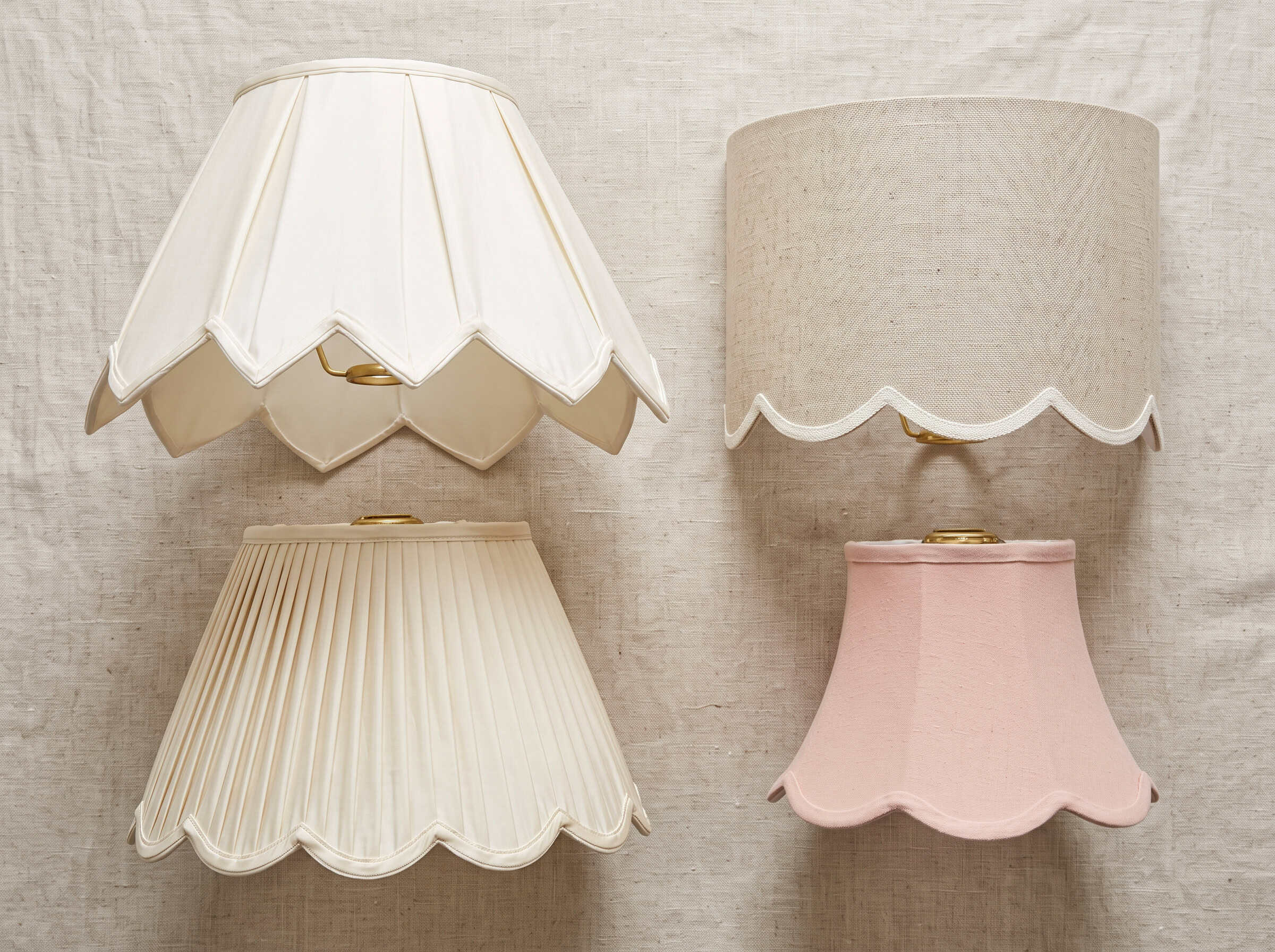
A hard scallop is cut directly from a stiffened shade panel. Because the panel has structural rigidity before shaping, the scallop holds its exact profile without additional support. The edges are finished with trim or binding, and the curve has a clean, architectural quality. Empire shades with a structured inner lining most often feature this construction.
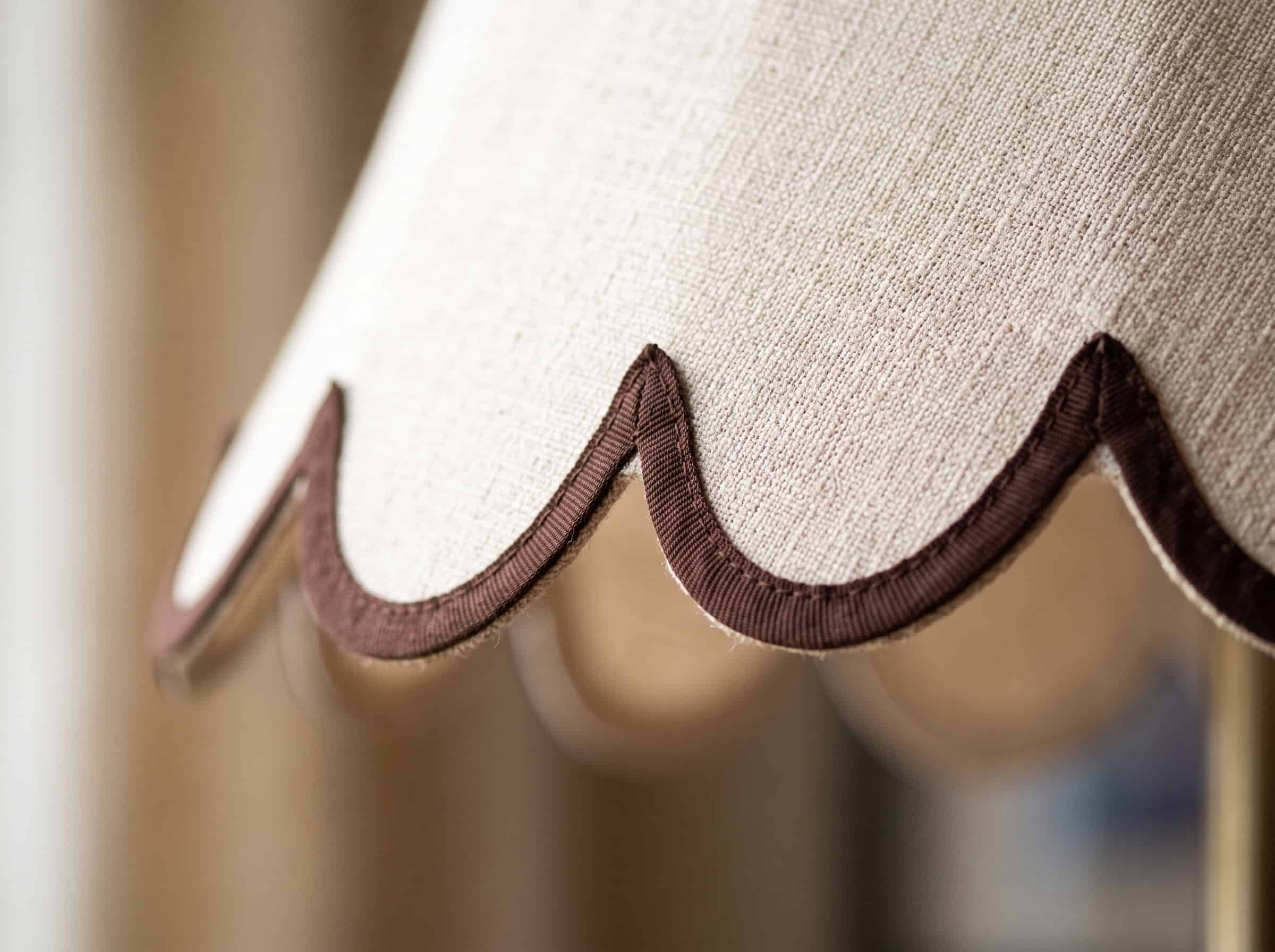
A soft scallop is sewn into a fabric shade using a shaped hem or an applied trim. The shade’s outer material drapes very slightly at the scallop points, which produces a softer, more organic curve than a hard-cut edge. Traditional silk lampshades and gathered fabric shades almost always use soft scallop construction. Up close, you can usually see the hem turn in slightly at each point, which is what gives the scallop its handmade character.
A pleated scallop combines both ideas: the shade is pleated (fabric gathered in regular vertical folds) and the bottom edge is scalloped so the pleats follow the curve downward. This creates the most complex visual pattern of the three, with vertical structure meeting a curved hem at every fold.
| Hard scallop | Soft scallop | Pleated scallop | |
|---|---|---|---|
| How it is made | Cut from a stiffened panel before shaping | Shaped hem or applied trim on fabric | Pleated fabric with curved bottom hem |
| Edge character | Clean, precise, architectural | Slightly draped, organic | Complex, three-dimensional |
| Best shade shapes | Empire, drum, coolie | Gathered silk, softback fabric | Pleated silk, structured taffeta |
| Material range | Fabric, linen, paper, hardback | Silk, dupioni, cotton | Silk, taffeta, dupioni |
| Formality level | Mid to high | High | Very high |
| Most common context | Traditional and transitional interiors | Formal sitting rooms, bedrooms | Georgian, Regency, maximalist |
Scallop depth and point count: what the measurements mean
The depth of the scallop, measured from the lowest point of the arc to the straight hemline the scallop descends below, is the most practically important measurement. A shallow scallop (1 to 1.5 inches) adds a quiet wave to the bottom edge without dominating the shade’s silhouette. A deep scallop (2.5 inches or more) becomes the shade’s defining visual feature, which is appropriate when the lampshade scallop is meant to be a room’s focal point.
Point count around the circumference is the other variable. A shade with six or eight large arcs reads very differently than a shade with 16 small, tightly spaced arcs. More points and a shallower depth produce a delicate, repeating pattern. Fewer points and a greater depth produce a bolder, more theatrical effect.
Types of scalloped lampshades
The lampshade scallop appears across several shade shapes, each with a different visual character and a different set of room applications.
Empire scallop shades: the traditional standard
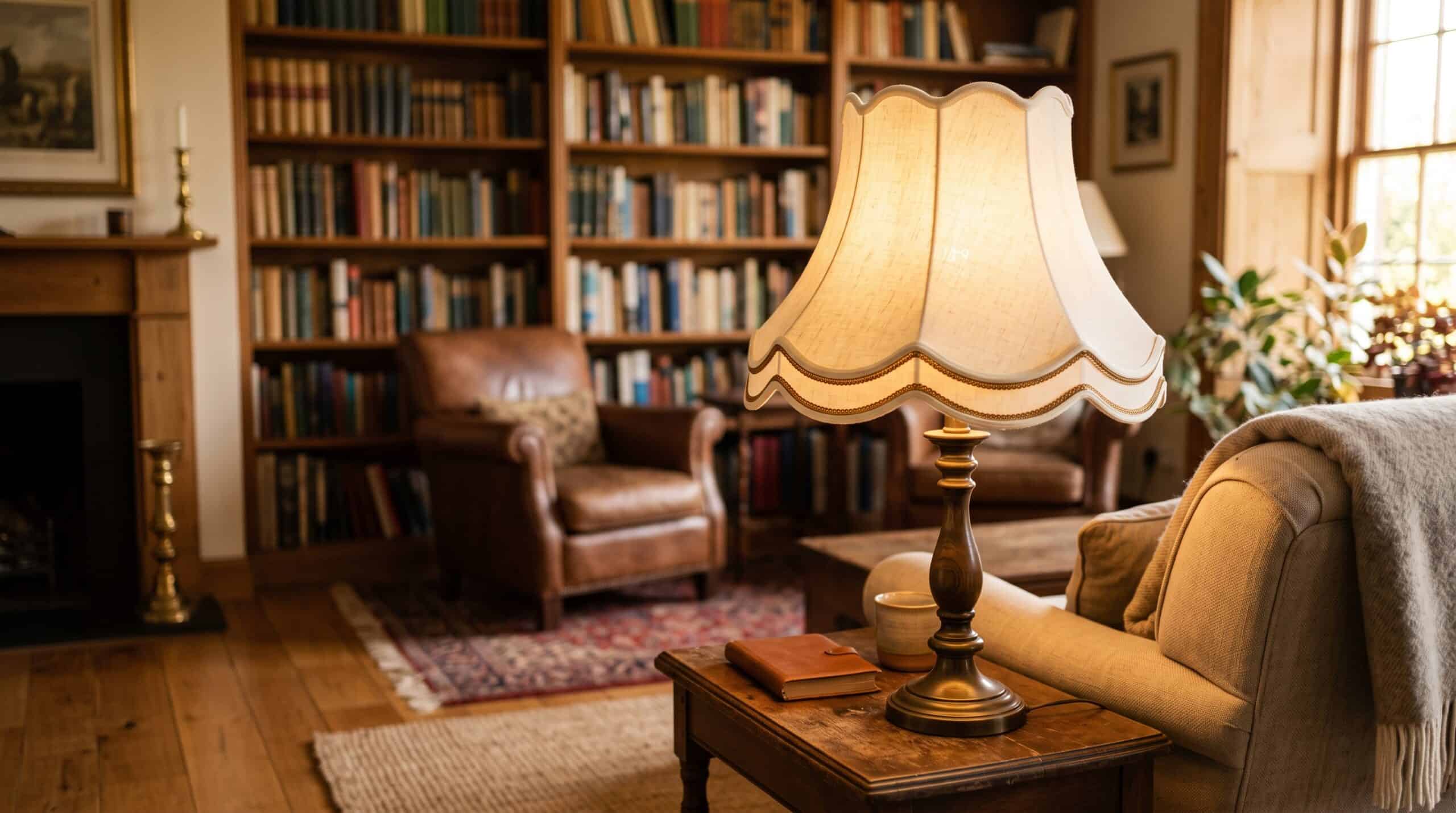
The empire shape, wider at the top and tapering toward a narrower base, is the most common host for a lampshade scallop. The reason is historical: empire shades dominated table lamp design from the late Victorian era through the mid-20th century, and scalloped edges were a standard decorative finish across much of that period.
As Wikipedia’s overview of lampshades documents, shade design in European and American homes tracked broader decorative arts movements, with ornamented edges appearing consistently in the periods that valued surface embellishment. The scalloped empire shade reflects that lineage directly.
A scalloped empire shade in 2026 is not automatically a period piece. Paired with a contemporary brass or matte black base, a single-arch scallop in natural linen reads as restrained and modern. Paired with a turned-wood or painted ceramic base in a formal sitting room, a deep multi-point silk scallop becomes an explicit historical reference. The shape is the same; the context changes what it says.
Drum and bell shapes with scalloped edges
Drum shades (equal top and bottom diameter) and bell shades (continuous taper from top to bottom) are less traditional hosts for the lampshade scallop, but both appear in the current market.
A scalloped drum shade tends toward the maximalist end of the spectrum. The even cylindrical geometry of the drum body contrasts with the irregular curved hem, creating a visual tension that works well in eclectic and statement-driven interiors. Because a drum shade with a scallop is an unusual combination, it reads as deliberate rather than default.
A scalloped bell shade follows the shade’s natural downward taper and concentrates the lampshade scallop at the widest point of the form. The result feels more contained than a drum-scallop and more expressive than a plain bell. For rooms that want some decorative edge detail without committing to a strong period reference, a bell shade with a single-arch scallop is usually the middle ground.
Pleated scalloped lampshades
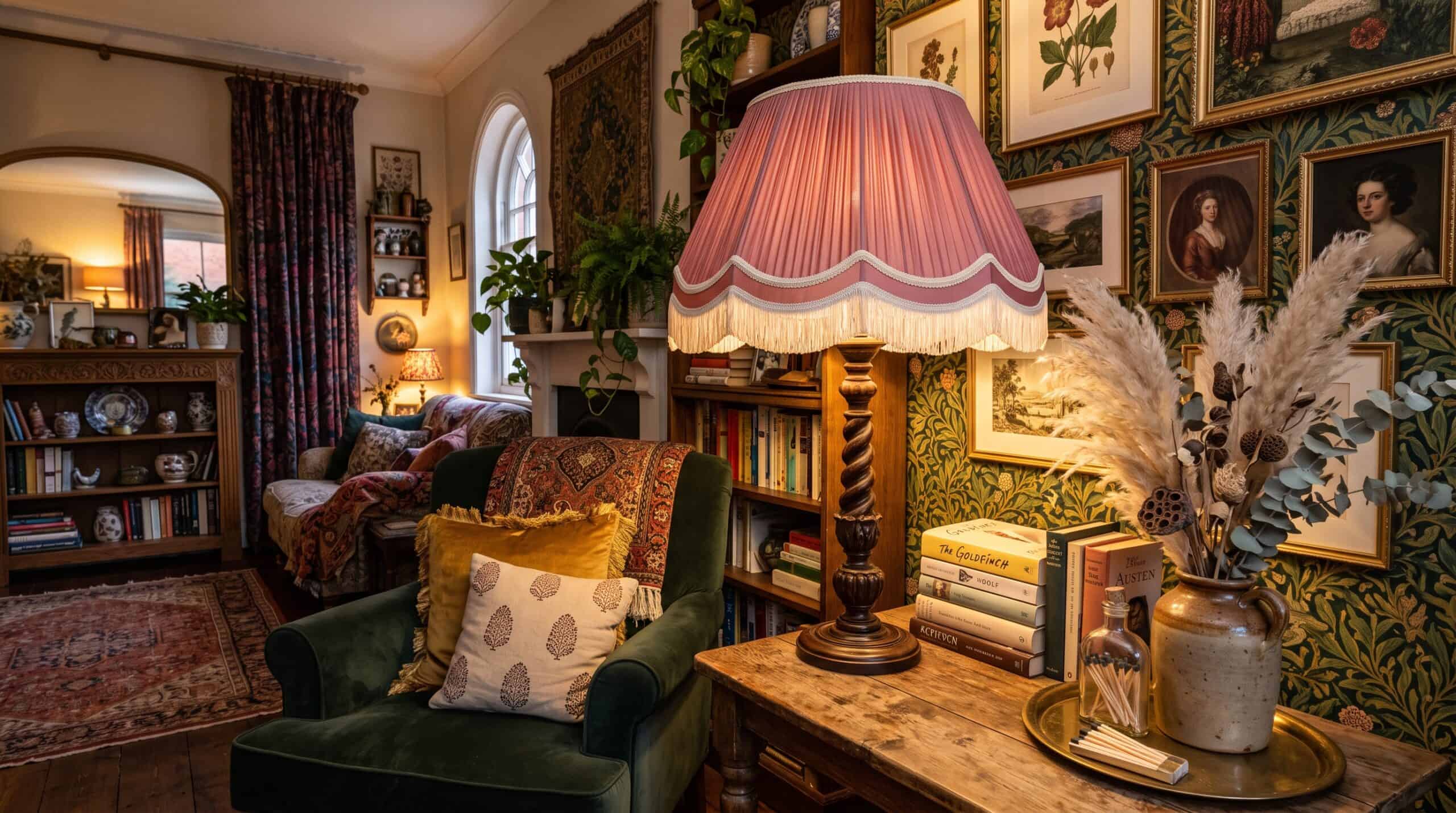
Pleated scalloped lampshades are among the most technically demanding shades to produce well. The pleats must be evenly spaced and land correctly at the scallop curves, which requires precise pattern cutting and consistent fabric tension throughout construction. When it works, a well-made pleated lampshade scallop in dupioni silk or taffeta has a three-dimensional quality that flat shades cannot approach. Light passing through the shade catches on the fold edges and scallop points, producing a subtle glow effect along the bottom hem that changes as the viewing angle changes.
These shades belong primarily in traditional and formal interiors: Georgian, Regency, English country house, or the kind of maximalist rooms where more visual complexity is a deliberate goal.
Vintage and antique scalloped glass shades
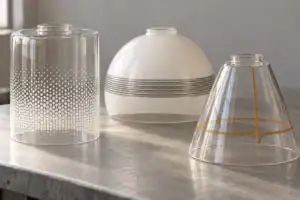
Glass lampshades carry scalloped edges too, and the tradition extends back to the late 19th century. Pressed glass shades from the Art Nouveau period often featured molded scalloped rims, as did hand-painted porcelain shades and opalescent glass pieces produced in France, England, and the northeastern United States in the early 1900s.
The Victoria and Albert Museum’s decorative arts collections hold examples of scalloped glass lamp shades from several periods, with the scallop motif appearing across different national styles and manufacturing traditions. The V&A’s holdings illustrate how persistent this particular detail has been across decorative arts generally, not just lampshade design.
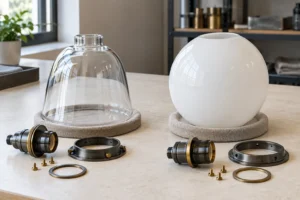
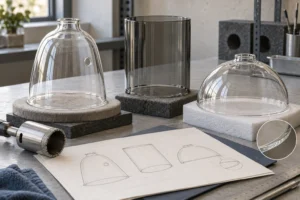
A scalloped glass shade is structurally different from a fabric one: the scallop is formed during manufacture through molding or hand-cutting rather than sewn. The result is permanent, geometrically precise, and in the case of hand-blown glass, unique to each piece. Our mouth-blown glass lamp shades include forms where the bottom rim profile can be customized for specific applications, which is the glass equivalent of choosing your scallop depth.
| Shape | Scallop style | Material | Best application |
|---|---|---|---|
| Empire | Single-arch or multi-point | Linen, silk, fabric | Traditional, transitional, vintage |
| Drum | Single-arch | Linen, cotton, velvet | Maximalist, eclectic |
| Bell | Single-arch or multi-point | Silk, fabric | Traditional, formal |
| Pleated empire | Pleated scallop hem | Silk, dupioni, taffeta | Formal, Georgian, Regency |
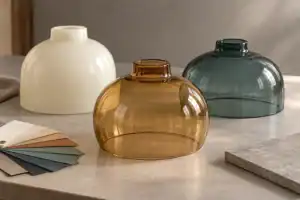
| Glass (pressed or blown) | Molded or hand-cut scallop | Clear, opal, colored glass | Vintage, Art Nouveau, traditional, eclectic |
Scalloped lampshade materials
The material of a lampshade scallop shapes its light quality, its durability, and whether the scallop edge appears crisp or softly organic in actual use.
Silk and dupioni scallop shades
Silk is the prestige material for a lampshade scallop. It transmits light with a warm, slightly golden quality that fabric and linen don’t match, and the translucency means the shade is almost as interesting when lit as when unlit. Dupioni silk, which has a natural slub texture from irregular double yarns, adds surface interest without embellishment or printing.
The limitation of silk is cost and care. A silk lampshade scallop must be kept away from moisture (water spots are nearly permanent), direct sunlight (fading occurs within months under direct UV), and heavy-handed cleaning. These are indoor, low-traffic shades for bedrooms, living rooms, and formal spaces where they will be handled rarely and viewed often.
Linen and cotton scallop shades
Linen is the practical alternative to silk for a lampshade scallop. It holds shape well, tolerates more cleaning than silk, and produces clean diffused light without the warm golden cast of silk or the flatness of a heavily lined fabric.
Natural linen in off-white or warm ivory is the most versatile option for a lampshade scallop across different interior styles. It reads as neither aggressively traditional nor obviously contemporary, which makes it the right default when the room’s direction is uncertain or when a buyer wants a lampshade scallop that can move between rooms.
Cotton shades at the lower end of the price range often use heavier or lined fabrics that reduce light transmission. The scallop edge on a cotton shade typically has less precision than silk or linen, which matters most on shades where the scallop is the primary decorative statement rather than a secondary detail.
Hardback and structured scallop shades
Hardback lampshades use a styrene or paper lining that gives structural rigidity. The scallop on a hardback is always a hard scallop by definition, cut clean and finished with a matching or contrasting trim.
The advantage of hardback construction for a lampshade scallop is precision. Because the scallop profile is cut from a flat panel before assembly, it is identical around the full circumference. There is no soft-hem drape, no variation between individual scallop points, and no risk of the curves losing their shape over time.
The trade-off: the light quality through a lined hardback shade is flatter and more uniform than through an unlined fabric shade. You lose the translucency that makes silk and linen scallop shades visually interesting when lit from inside.
Velvet, chinoiserie, and novelty materials
Beyond the standard categories, velvet scallop shades, chinoiserie-printed fabric shades with scalloped hems, and metallic-finish cloth shades all appear in the 2026 maximalist market. These are not everyday utility choices; they’re statement pieces for rooms where the lampshade scallop is meant to compete for attention with everything else in the space.
| Material | Light quality | Formality | Scallop edge precision | Care |
|---|---|---|---|---|
| Silk | Warm, golden, translucent | Very high | Soft, slightly draped | Delicate: no water, no direct sun |
| Dupioni silk | Warm, textured, translucent | High | Soft with natural slub variation | Delicate: same as silk |
| Linen | Clean, diffused, neutral | Mid to high | Clean, holds shape well | Spot clean, avoid saturation |
| Cotton (lined) | Flat, diffuse | Mid | Moderate | Spot clean |
| Hardback fabric | Flat, even | Mid to high | Very high, cut precisely | Wipe exterior only |
| Velvet | Absorbed, deep, low transmission | Very high | Soft, rich texture at edge | Brush only, never wet |
| Glass | Clear to fully diffused by type | Traditional or vintage | Permanent, set at manufacture | Wipe clean, handle carefully |
How to choose the right lampshade scallop for your space
A correctly chosen lampshade scallop amplifies the room it sits in. A mismatched one doesn’t ruin the space, but it creates a low-level visual friction that is hard to name and harder to ignore.
Matching scallop depth to shade size and lamp scale
The depth of the scallop should relate to the shade’s bottom diameter. A shallow scallop (1 to 1.5 inches) works on shades of any width. A deep scallop (2.5 inches or more) needs a bottom circumference large enough to fit at least eight to ten clean scallop units without crowding. On a 10-inch shade, a deep multi-point scallop looks cramped and irregular. On an 18-inch shade, a very shallow single-arch scallop looks like an afterthought.
Our lamp shade sizes guide covers the dimensional breakdown including bottom circumference calculations, which is the measurement you need to figure out how many scallop units will land cleanly. The rule is: circumference divided by number of desired scallop points gives the arc width. Below about 3.5 inches per point, the pattern starts looking crowded regardless of depth.
Room scale matters equally. A single table lamp with a lampshade scallop sits quietly in most rooms regardless of scallop depth. Multiple scalloped shades in a small room, or a very deep scallop on an oversized floor lamp shade, can read as busy. Treat the lampshade scallop as you would any other decorative detail: one strong statement per zone of the room.
Scalloped shades by interior style
Traditional and Georgian interiors are the natural home for a lampshade scallop. Deep multi-point scallops in silk or dupioni on empire shades, paired with turned-wood or painted ceramic bases, are a direct reference to the historical parlor lamp tradition and feel correct in rooms that share that register.
Transitional interiors suit a single-arch or two-point scallop in natural linen. The scallop provides edge detail without committing to a period reference, and linen reads as materially contemporary even when the form is traditional. According to Architectural Digest’s coverage of transitional design, this mix of traditional form and contemporary material is precisely what makes transitional spaces coherent rather than confused.
Maximalist and eclectic interiors can carry the most dramatic lampshade scallop profiles. A drum shade with a deep pleated scallop in a saturated color, or a velvet shade with a contrasting trim at the scallop points, sits in the same visual register as the room’s other layered details.
Minimalist interiors are the one context where a lampshade scallop rarely works. The scallop introduces decorative complexity that contradicts the clean-line logic of those spaces. A very shallow single-arch scallop in a tone-on-tone neutral is about the maximum a minimalist room can absorb without visual disruption.
Base pairing and trim color
The lamp base and the scallop trim are in conversation with each other. A plain linen shade with a brass trim at the scallop edge pairs naturally with a brass, gold, or warm-metal base. A white silk shade with a white trim works with almost any base material because the shade itself is neutral enough not to demand a match.
Contrasting trim at the scallop edge adds another layer of visual complexity. A dark trim on a light shade, or a ribbon trim on a plain fabric shade, signals deliberate decoration. House Beautiful’s interior design coverage consistently recommends using trim color to echo one other element in the room (a book spine, a pillow border, an accent color in the rug), which grounds the detail rather than leaving it floating.
For glass scalloped shades, the base pairing logic follows the same pattern: the rim profile should feel consistent with the base’s visual character. A sharp geometric pressed-glass scallop looks right on a straight-sided metal base. A softly rounded hand-blown rim looks right on a curved ceramic or pottery base.
| Room / style | Recommended lampshade scallop | Why it works |
|---|---|---|
| Traditional sitting room | Multi-point silk or linen empire scallop | Historical reference; matches formal seating scale |
| Transitional bedroom | Single-arch linen drum or bell scallop | Decorative without period commitment |
| Maximalist living room | Deep pleated scallop, bold color or contrasting trim | Layering visual complexity deliberately |
| Formal dining room | Soft scallop in ivory or blush empire shade | Visible at seated eye height, the right viewing angle |
| Minimalist space | Very shallow single-arch, tone-on-tone neutral | Scallop suggested rather than stated |
| Pendant (dining or hallway) | Open-bottom bowl with molded scallop rim | Scallop visible from below at normal heights |
How to style and place a scalloped lampshade
Placement matters almost as much as the shade choice itself, and a few common positioning mistakes significantly reduce the impact of a well-chosen lampshade scallop.
Table lamps vs. floor lamps vs. pendant scallop shades
A lampshade scallop is most effective on table lamps. At seated eye level, the scallop edge is in the viewer’s primary field of vision, which is exactly where the detail reads at its best.
A lampshade scallop on a floor lamp tends to sit above standing eye level, which means the scallop detail is often viewed at an upward angle or partly obscured by the shade’s body. This is not a disqualifying condition, but it does mean that deep, dramatic scallops tend to be more wasted on floor lamps than on table lamps where they can be properly seen.
For pendant shades, a lampshade scallop works best on open-bottom bowl or dome forms, where the rim faces downward and is visible from below. Empire pendants that surround the bulb tend to hide the bottom edge unless the fixture hangs at a very low position. For dining room pendants that hang 30 to 36 inches above the table surface, a scalloped glass or fabric shade with a visible bottom rim can be a strong focal point at seated eye level.
Our home lamp shades collection covers table and floor lamp applications across different shade profiles, including proportioning guidance for matching a shade to its base type. This is particularly useful for floor lamps, where the relative scale of shade to base to room ceiling height all affect the final result.
Avoiding the most common scalloped lampshade mistakes
The most frequent problem is choosing a scallop depth that doesn’t fit the shade’s bottom circumference. Too many points crowded into a small circumference produces a lumpy, uneven edge rather than a clean repeating wave. Measure before ordering, and confirm the point count against the circumference using the formula above.
The second most common issue is mismatching the scallop’s formality level to the room. A deep pleated silk scallop in a white-walled contemporary kitchen looks wrong regardless of how beautiful the shade is in isolation. Put plainly: if the room isn’t already ornamented, the lampshade scallop will look like a detail borrowed from a different house.
The third mistake is placing a scalloped floor lamp shade at ceiling height where the detail becomes invisible. This wastes the shade’s primary design feature. If you want a floor lamp with a lampshade scallop, place it to one side of a sofa or reading chair where the shade sits at or near eye level when seated.
Scalloped lampshade trends for 2026
The lampshade scallop is in a stronger market position in 2026 than at any point in the previous decade. Two distinct shifts are driving this simultaneously.
The maximalist revival and bold scallop profiles
Maximalism as a residential design direction has moved from niche to mainstream over the past three years, and the lampshade scallop is a direct beneficiary. When rooms are designed to be layered and ornamented, shade details that would read as too much in a minimal context become exactly right.
Bold scallop profiles, deep multi-point cuts, contrasting trims, and unexpected materials (velvet, chinoiserie fabric, metallic cloth) are the growth categories within the lampshade scallop market. These are not subtle choices; they are intended to be noticed.
Neutral linen and natural-material scallop shades
Parallel to maximalism, the natural-material movement continues to drive demand for linen and organic-fiber lampshades, including scalloped versions. A lampshade scallop in undyed or lightly bleached linen with a natural cotton or leather trim sits at the intersection of two strong design currents: traditional form (the scallop) in a contemporary material register (natural fiber, no chemical treatment).
The Smithsonian Institution’s Cooper Hewitt design collection documents the scallop motif recurring across different material eras in decorative arts history, consistently reappearing when the broader culture values craftsmanship and surface detail. The 2026 moment is another of those cycles, driven partly by a reaction against the smooth, textureless aesthetic of the 2010s.
Scalloped glass rim shades
The demand for antique and vintage lighting has driven renewed interest in scalloped glass shades. Pressed glass shades from the late 19th and early 20th century with molded scalloped rims are actively collected, and contemporary glass makers have responded with new production in the same forms.
Our custom glass lamp shades service handles single-piece commissions for glass shades with specific rim profiles, including scalloped and shaped edges, which is the glass equivalent of specifying the depth and point count on a fabric lampshade scallop.
| Trend | Material | Style fit | Driver |
|---|---|---|---|
| Bold multi-point scallop | Velvet, dupioni, metallic fabric | Maximalist, eclectic, grandmillennial | Maximalism mainstreaming |
| Contrasting trim scallop | Linen or cotton with dark or colored trim | Traditional, transitional | Detail-as-decoration, trend toward trim |
| Natural linen scallop | Undyed or bleached linen | Organic modern, transitional | Natural material movement meeting traditional form |
| Pleated silk scallop revival | Dupioni or taffeta | Georgian, Regency, formal | Period-reference interiors growing in design media |
| Scalloped glass rim shades | Pressed or hand-blown glass | Vintage, Art Nouveau, eclectic | Antique lighting demand; collector market |
FAQ
What is a scalloped lampshade?
A scalloped lampshade has a curved, wave-shaped bottom hem formed in a repeating arc pattern rather than a straight cut. The lampshade scallop comes in three main constructions: hard (cut from a stiffened panel for precision), soft (sewn into a fabric hem for a more organic drape), and pleated (where the shade’s vertical pleats follow a curved hem at the bottom). It appears most often on empire, bell, and drum shapes in silk, linen, or structured fabric.
Are scalloped lampshades in style in 2026?
The lampshade scallop is firmly in style in 2026. The maximalist revival and the growth of traditional and grandmillennial interior aesthetics have driven demand for ornamented shade details. Bold multi-point scallops, pleated silk scallops, and scalloped glass rim shades are among the fastest-moving categories in decorative lighting this year, and even restrained single-arch linen scallops are more widely available now than they were three years ago.
What interior styles suit a lampshade scallop best?
Traditional, Georgian, transitional, maximalist, and eclectic interiors all suit a lampshade scallop, with the depth and material of the scallop calibrated to how formal or layered the room is. The one style where a lampshade scallop almost never fits is minimalist: the scallop introduces decorative complexity that contradicts the clean-line logic of those spaces. A very shallow single-arch scallop in a tone-on-tone neutral is the most that a minimal room can absorb without visual conflict.
How deep should the scallop be on a table lamp shade?
Match scallop depth to the shade’s bottom diameter. A 10-inch shade works best with a scallop 1 to 1.5 inches deep. A 16- to 18-inch shade can carry a scallop 2 to 3 inches deep without the pattern looking crowded. The target is a minimum of eight clean scallop units around the full circumference; below that count, the pattern starts reading as an irregular hem rather than an intentional lampshade scallop. Use the bottom circumference (not diameter) divided by the desired number of points to check the arc width before ordering.
Can you use a scalloped lampshade on a pendant light?
A lampshade scallop on a pendant light works best on open-bottom bowl or dome forms, where the scalloped rim faces downward and is visible from below at a natural viewing angle. Empire-style pendants that enclose the bulb tend to hide the bottom edge unless the fixture hangs very low. For glass pendant shades with molded scalloped rims, the visibility from below is a design feature rather than an afterthought, and glass scalloped pendants over dining tables or in hallways work particularly well for this reason.
How do I clean a fabric scalloped lampshade?
Cleaning method depends on material. For linen and cotton scalloped shades, a soft lint brush removes routine dust; spot-clean marks with a lightly damp white cloth and allow to air-dry fully before using again. For silk lampshade scallop shades, avoid water entirely. A dry lint roller or low-suction vacuum with a soft brush attachment is the only safe home option. Heavy soiling on silk requires professional dry cleaning. For all fabric scalloped shades, avoid pressing or deforming the scallop edge during cleaning, since the shape of the scallop is set during manufacture and cannot be re-formed after distortion.
What is the difference between a pleated and a scalloped lampshade?
A plain scalloped lampshade has a flat or curved-panel outer surface with only the bottom hem shaped into arcs. A pleated lampshade has vertical fabric folds running around the circumference, which can combine with either a straight or a scalloped bottom edge. A pleated lampshade scallop combines both elements: the pleats run vertically and the bottom hem curves in a scallop pattern, so each individual pleat terminates at a scallop point. This is the most visually complex variant of the lampshade scallop and the most demanding to produce correctly at high quality.
What lamp base pairs best with a scalloped shade?
Traditional turned-wood, painted ceramic, ginger-jar, and decorative brass bases are the natural partners for a lampshade scallop because they share the same decorative intent. Straight-sided bases in neutral materials (white ceramic, brushed nickel, clear glass) work with single-arch linen scallops in transitional contexts because the neutral base lets the shade’s scallop be the sole decorative statement. The rule that tends to hold across styles: one of the two (base or shade) should make the decorative statement; the other should be quieter. Matching a highly ornate scalloped shade with an equally ornate base in a different style tends to produce visual noise rather than coherence.
Finding the right scalloped lampshade
A lampshade scallop, chosen and placed correctly, is the kind of detail that makes a room look designed rather than assembled. The shape, the scallop depth, the material, and the trim all inform the final effect, and the differences between them matter more than most buyers expect.
The broadest range of lampshade scallop profiles can be found among fabric shade specialists, where single-arch linen scallops, multi-point silk scallops, and pleated scallops across all depths are typically stocked. For glass scalloped shades, the options narrow considerably, since most commercial glass shade production focuses on smooth or ribbed profiles rather than scalloped rims.
For custom glass scalloped shades (whether for a specific base, a particular room proportion, or a historical reference that requires a specific rim profile), our lamp shade shapes guide covers the full range of profiles available in glass before you contact us for a custom order. The guide includes visual references for base compatibility, which is particularly useful when choosing between a rounded scallop rim and a sharp-edged one for a specific base material.