Linen lampshades are fabric shades woven from natural flax fibers that cast a warm, diffused glow, available in drum, empire, and pleated styles from 6 to 24 inches wide, in natural, off-white, and dyed tones.
You’ve found the lamp base. Maybe it’s a ceramic table lamp picked up at a weekend market, or a slender brass floor lamp you’ve been circling for months. Then you go to buy a shade and immediately lose an hour to a sea of identical beige ovals, wondering why nothing quite clicks.
The problem is almost always the shade material, not the style or the size. Cheap synthetic fabric washes everything out. Paper shades are crisp but cold. Silk is beautiful but belongs in formal rooms most people don’t actually have.
Linen lampshades sit in a different category. The natural weave scatters light rather than blocking it, producing a warm amber cast that makes a room feel lived-in rather than just lit-up. But there are real differences between a $30 linen-look polyester shade and a proper natural-linen shade, and picking the wrong one costs you both money and the effect you were after.
This guide covers the whole picture: fabric construction, which shapes work in which rooms, how to size a shade to your base, how to clean it, and how to tell quality linen from a convincing imitation.
What Are Linen Lampshades?
Linen lampshades are shades made from fabric woven from flax plant fibers (Linum usitatissimum), one of the oldest cultivated textile fibers in use. What sets linen apart from cotton or synthetic alternatives is the fiber’s natural crimp and slightly irregular weave. Those structural characteristics scatter light in multiple directions rather than transmitting it uniformly, producing the characteristic soft-edged glow that makes linen lampshades worth the extra cost over synthetic alternatives.
The fabric: flax fiber, weave, and what “true linen” means
Here’s where a lot of buyers get burned: the word “linen” on a lampshade label can mean almost anything. True linen is woven from long-staple flax fibers that are naturally stiff, slightly waxy in hand feel, and develop a subtle sheen over time. Blended “linen-look” fabrics might be 30% linen and 70% polyester, and while they can pass at the store, they behave differently under heat and sustained light exposure.
Four things worth checking before you buy:
- Fiber content label: quality linen lampshades specify “100% linen” or at minimum “85% linen / 15% cotton.” A label reading only “linen blend” could mean almost anything.
- Hand feel: true linen is slightly textured and subtly scratchy, and it softens with age. Polyester blends feel uniform with a faint plastic smoothness.
- Light test: hold the shade up to a bright lamp. Pure linen shows an irregular, mottled light pattern where you can see the weave texture. A synthetic shade glows more evenly and uniformly.
- Seam quality: on a quality linen lampshade, the vertical seam is stitched inside the frame and barely visible. Cheap shades use glued seams that separate under heat within a few years.
According to Wikipedia’s overview of linen as a textile, flax cultivation dates back over 30,000 years. The fiber’s physical properties (high tensile strength, low elasticity, natural moisture resistance) are what make it suitable for lampshades. It holds its shape under heat better than cotton or silk.
The FTC’s Textile Fiber Products Identification Act requires that fabric products sold in the US disclose fiber content percentages. If a “linen” lampshade doesn’t list a fiber percentage anywhere, that’s a red flag.
Hardback vs. softback construction
This is the construction choice most buyers overlook. It affects both the visual quality of the light and how the shade is installed.
Hardback linen lampshades have a rigid plastic or metal liner fused to the inside of the fabric. The liner reflects light back into the room, making overall illumination brighter. The outside of the shade stays relatively dark: the linen texture shows clearly, but the shade itself doesn’t glow. Hardback shades are more durable, easier to clean, and better suited to high-traffic spaces and commercial settings.
Softback linen lampshades allow light to pass through the linen itself. The entire shade glows softly when the lamp is on, and the fabric becomes luminous. This is the look most associated with linen lampshades in interior photography. Softback shades are more delicate, harder to clean, and not ideal in very bright or very humid rooms.
| Hardback linen | Softback linen | |
|---|---|---|
| Light behavior | Reflects light into room; shade stays mostly dark | Transmits light through fabric; whole shade glows |
| Visual effect | Brighter, more directed illumination | Ambient, diffused warm glow |
| Durability | Higher: rigid inner liner resists dents and moisture | Lower: fabric susceptible to dents and humidity |
| Cleaning | Wipe or dry dust | Dry dust only; avoid all moisture |
| Best for | Reading lamps, task lighting, high-use spaces | Ambient table lamps, bedroom, living room accent |
| Price range | $25 to $120+ | $35 to $200+ |
| Style fit | Traditional, transitional, contemporary | Scandinavian, coastal, organic modern |
Types of Linen Lampshades
Linen lampshades come in five main shapes. The shape determines both how light distributes and what visual weight the shade adds to a room. Pick the wrong silhouette and the proportions are off even when the size is correct.
Drum shades
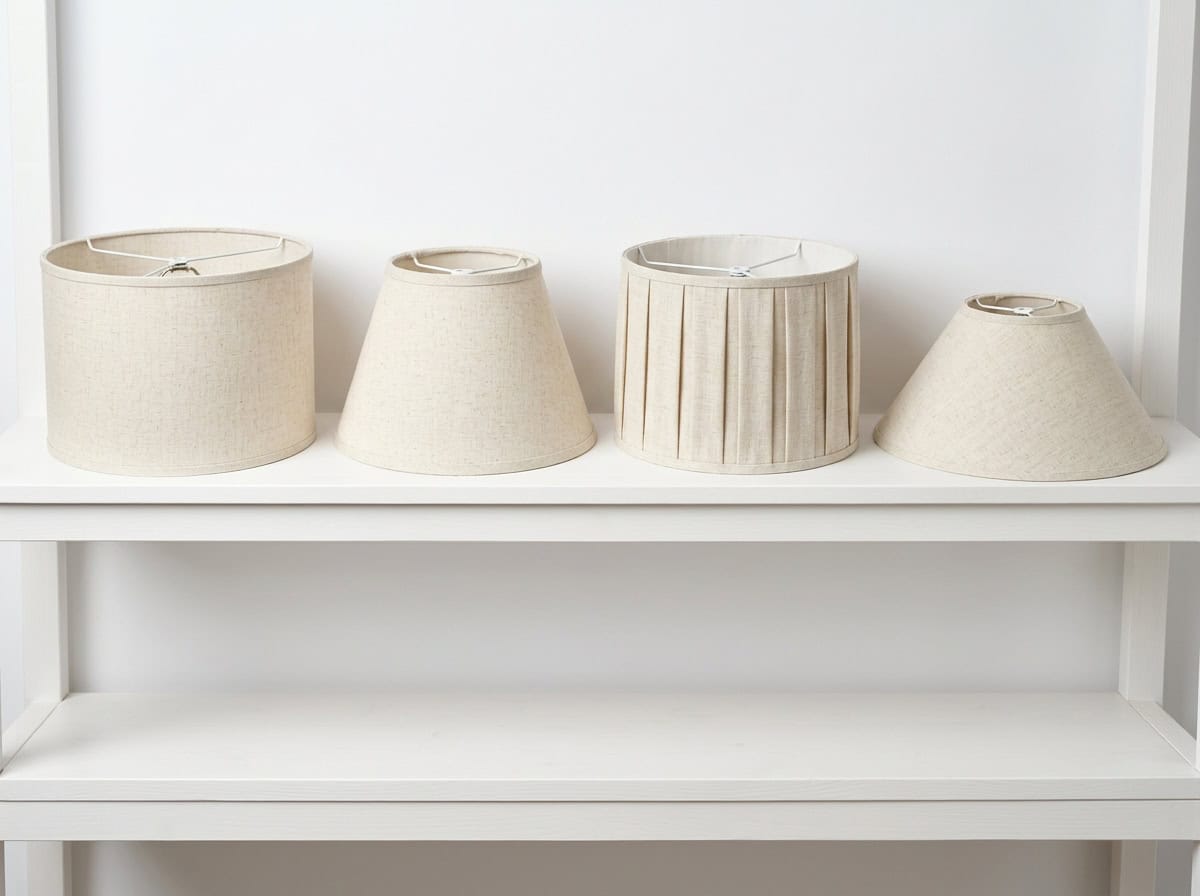
Drum linen lampshades have equal top and bottom diameters, a true cylinder. They’re the most common shape in contemporary and Scandinavian interiors because the straight sides create clean horizontal lines that work well with modern furniture.
A 16″ drum shade on a 28″-tall table lamp reads as grounded and confident. The same shade on a 14″ base looks top-heavy. Drum shades throw light in a wide cone both up and down, making them good for ambient lighting in living rooms and bedrooms but less effective for precise task work like reading.
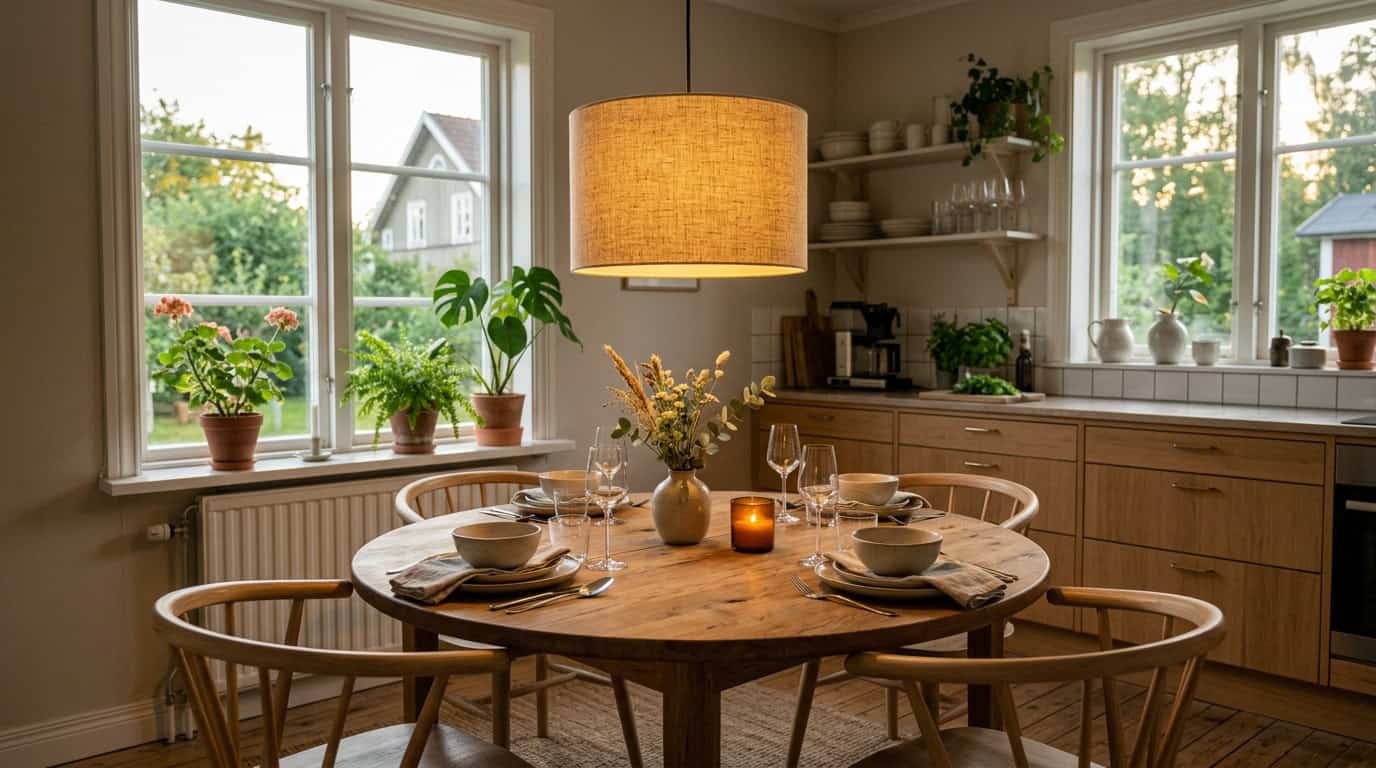
Large drum linen lampshades (20″ to 24″ diameter) are increasingly used as pendant shades over dining tables and kitchen islands. The linen diffuses the single-bulb glare effectively and adds warmth without the harshness of a bare bulb or glass shade.
Empire and tapered shades
Empire linen lampshades have a smaller top opening and a wider bottom. It’s the classic silhouette most people picture. The taper creates a focused downward light that works well for table lamps positioned beside sofas or reading chairs.
Tapered linen shades come in shallow and steep versions:
- Shallow taper (less than 60° angle): reads as modern, close to a drum but with a slight flare at the bottom.
- Classic empire (roughly 45 to 60° taper): the traditional hotel-room look; works in transitional and traditional rooms.
- Coolie/steep taper (more than 60°): wide, nearly flat shade, dramatic in bohemian or eclectic rooms, awkward in formal ones.
Pleated linen: box pleat and knife pleat
Pleated linen lampshades are built by folding the fabric in regular patterns before attaching it to the frame. This multiplies the visual texture and creates a shade that changes character as light moves across it throughout the day.
Box pleat shades have wide, flat folds that create a structured, architectural look. Common in British and American traditional interiors. The folds catch light differently at different times of day, which makes these shades more visually interesting than flat linen.
Knife pleat shades have tighter, overlapping folds all angled in the same direction, more delicate than box pleat, and often used on formal drum or empire frames.
Pleated linen shades are almost always softback, since the rigid liner doesn’t flex well with the pleating. They sit at the high end of the price range; custom pleated shades from specialty workrooms start around $150.
| Shape | Construction | Light direction | Best room use | Price range |
|---|---|---|---|---|
| Drum | Equal top/bottom diameter | Up and down, wide cone | Living room, bedroom ambient | $30 to $150 |
| Empire | Small top, large bottom | Downward focus | Reading lamps, floor lamps | $25 to $120 |
| Coolie | Very small top, wide bottom | Wide downward spread | Bohemian, accent | $35 to $130 |
| Box pleat | Fabric folded in wide pleats | Softly diffused all around | Traditional, formal | $80 to $300+ |
| Knife pleat | Tight overlapping folds | Softly diffused | Classic, transitional | $90 to $350+ |
How Linen Lampshades Transform a Room
A quality linen lampshade changes the color temperature and character of light in a way that most materials can’t match at the same price point. It’s not just a cover for the bulb.
Light quality: why linen diffuses differently
Standard LED or incandescent bulbs emit light in every direction. Without a shade, that full sphere hits walls, ceilings, and eyes at full intensity. A linen shade intercepts that sphere and scatters it through the texture of the weave.
The key word is scatter, not block. A thick paper shade blocks most light and transmits a small, concentrated amount. A white synthetic shade transmits a lot of light but uniformly: flat and bright. Natural linen scatters light through an irregular weave structure, spreading the transmitted beam in slightly different directions at varying intensities. The result is softer shadows, reduced glare, and a light color that skews warmer.
This matters in practice. In a bedroom with linen lampshades running at 2700K, the perceived warmth reads closer to 2400K, because the natural yellow-brown tone of linen fabric filters the cooler wavelengths slightly. That’s the difference between “warm” and “candlelight,” a meaningful shift in a room designed for relaxation.
Interior style pairings
Linen lampshades adapt across interiors more readily than silk or paper. They’re not a one-style material.
In Scandinavian and organic modern rooms, natural undyed linen in a drum shape is the reliable choice. Flat weave, visible texture, pairs with oak, marble, concrete, and muted palettes. The shade adds texture without competing for attention.
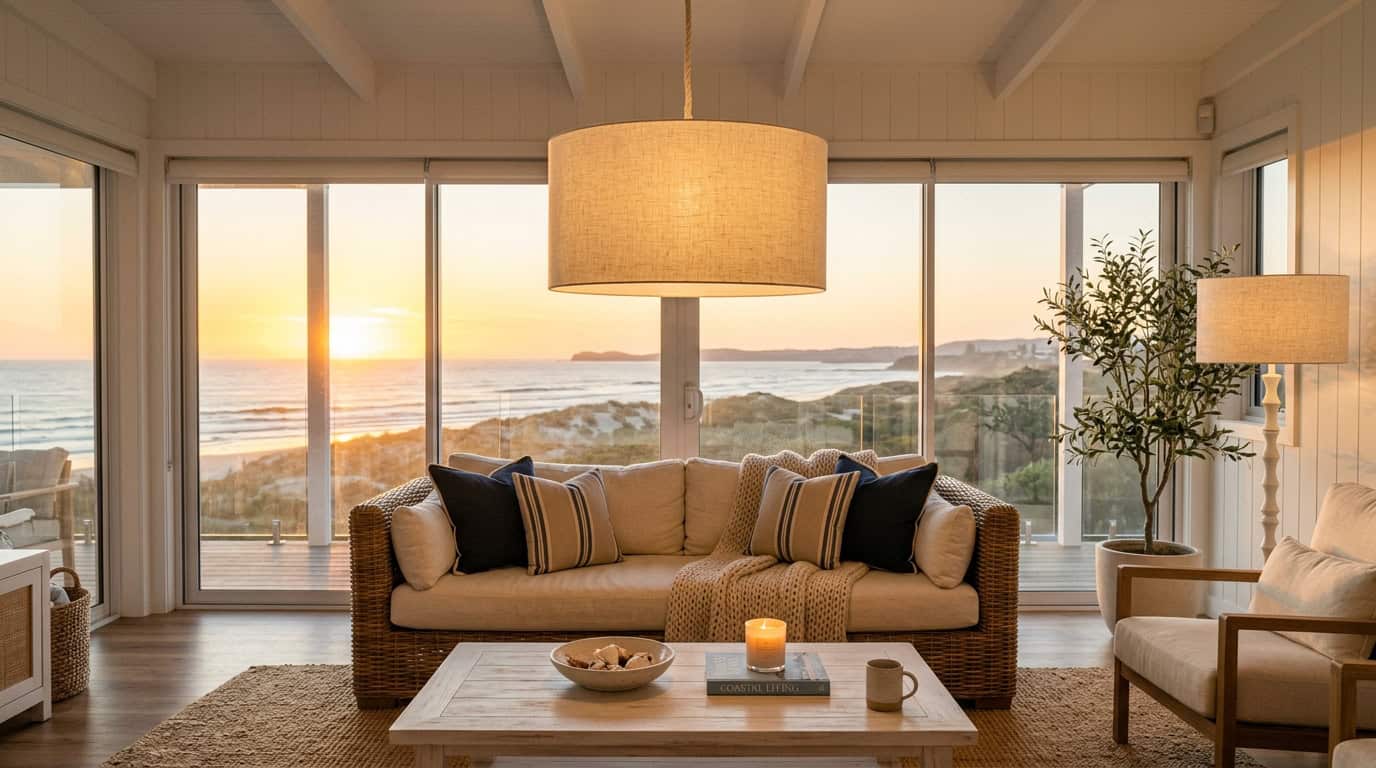
Coastal and relaxed rooms favor off-white or bleached linen with a loose weave, in a wide drum or shallow empire shape. Works with rattan, bamboo, and pale driftwood finishes.
For farmhouse and American traditional rooms, natural linen in a classic empire shape on a ceramic or turned-wood base is most reliable. This is where pleated linen shades look most at home: the structured folds echo the room’s formality without tipping into stiff.
Transitional rooms are more forgiving. Off-white or linen-with-trim shades bridge modern furniture and traditional architectural details without taking a side. The simpler the shade, the more versatile it becomes.
Tone guide
The color of the linen fabric is an underrated choice. It directly affects the color of the light the shade produces:
- Natural/greige linen: the raw color of unprocessed flax, a warm tan-gray. Casts the most amber light. Best in rooms with warm wood tones and earthy palettes.
- Off-white: slightly warmer than pure white, less intense than natural linen. The most versatile option; works in both warm and cool rooms.
- Bleached/white linen: closest to paper in its light effect. Transmits more blue-white light. Better for kitchens, offices, or spaces where brightness matters more than warmth.
- Dyed linen (navy, sage, terracotta): dramatically reduces transmitted light. A navy linen shade on a 60W equivalent LED transmits roughly 15 to 20% of the bulb’s output, creating dramatic accent lighting rather than ambient or task light.
How to Choose the Right Linen Lampshade
Getting the right linen lampshade comes down to proportions, construction quality, and whether to buy off the shelf or go custom.
Sizing: base-to-shade ratios and fitter types
The most common mistake is buying a shade that’s too narrow. A shade that’s too short or slim looks like a hat balanced on top of the base.
Width: the shade’s bottom diameter should be at least 2x the widest point of the lamp base. An 8″ wide base means starting at a 16″ shade.
Height: shade height should be 60 to 70% of the lamp base height (not the total lamp height). A 20″ base takes a 12″ to 14″ shade.
Visual check: when assembled, the bulb socket hardware should be hidden inside the shade. If you can see the socket from a seated position, the shade is too narrow or too short.
Fitter types are the attachment hardware that connects the shade to the lamp:
- Spider fitter is the most common type: a set of arms connecting the shade ring to a center pipe. Installs on the harp and works with most modern lamps.
- Clip-on fitter clips directly to the bulb. Only for small, lightweight shades (max 12″ diameter). Not recommended for linen lampshades above 8″, since the clip loosens over time from vibration.
- Uno fitter threads onto the lamp socket directly, no harp needed. Common in modern floor lamps.
- Washer fitter is similar to uno, found in specific vintage or European fixtures.
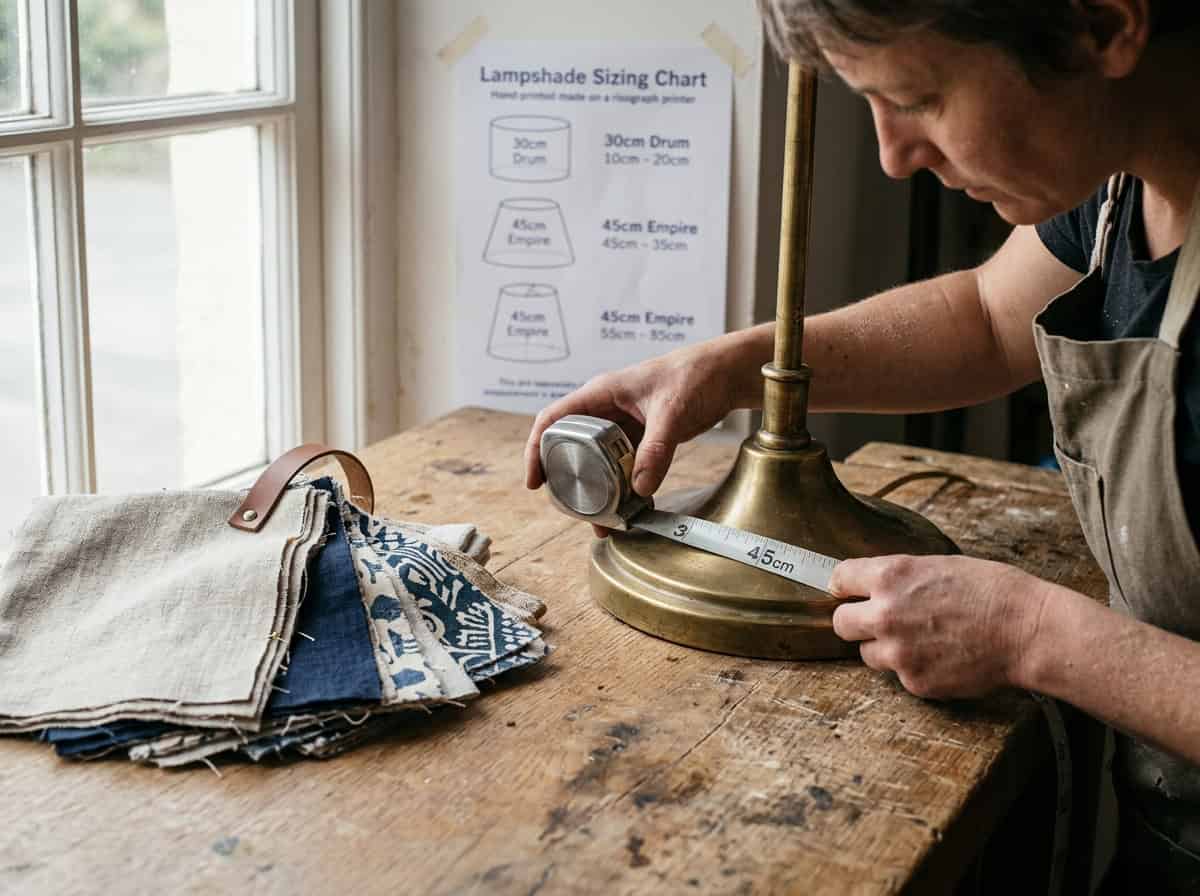
Measure your harp before ordering online. Harp height should be 1″ to 2″ shorter than shade height. Getting this wrong is the most common reason for returns.
Spotting quality linen vs. cheap blends
In 2026, “linen” is one of the most misused fabric labels in the home goods market. Here’s how to evaluate a shade without a lab:
- Ask for the fiber content percentage. Quality linen lampshades specify 100% linen or at minimum 85% linen / 15% cotton. “Linen blend” with no percentage is a warning sign.
- Check the seam quality. On a quality shade, the vertical seam is inside the frame and invisible from outside. Cheap shades have glued or exposed seams that separate within a few years.
- Inspect the trim. Quality hardback linen lampshades have heat-resistant binding tape at the top and bottom edges. Cheap versions use thin pressed fabric that curls or yellows within months.
- Test the frame by squeezing gently from the sides. A quality frame uses steel rings and resists deformation. Cheap frames use aluminum or plastic that warp under heat over time.
- Check the lining color. The inner lining of a hardback shade affects light warmth: white or cream means neutral; gold or amber means intensified warmth; a bare silver or gray lining is a cost-cutting move.
The linen lampshade collection at jxlampshade.com specifies 100% European flax linen on all natural-tone shades, worth comparing against what’s available at big-box retailers, where fiber content labeling is often vague.
Custom vs. off-the-shelf
Off-the-shelf linen lampshades cover the vast majority of standard lamp bases. Standard sizes (10″, 12″, 14″, 16″, 18″) fit most table lamps and floor lamps sold in the last two decades.
Custom linen lampshades make sense when:
- Your lamp base is unusual in scale (very tall, very wide, or asymmetrical)
- You need a height-to-width ratio that no standard shade matches
- You want a specific fabric tone or trim not available in mass production
- You’re specifying for a commercial project with exact color and size requirements
Custom shades from specialty workrooms typically take 3 to 6 weeks and start around $150 to $200 for a basic 16″ drum. Pleated or trimmed custom work runs higher. Have these measurements ready before contacting any workroom: base width, base height, desired shade bottom diameter, desired shade top diameter (if tapered), and shade height.
For B2B sourcing or bulk orders with custom specifications, the product enquiry page handles trade inquiries.
Care, Cleaning, and Longevity
With proper care, a quality linen lampshade lasts 8 to 15 years. The main causes of early failure are moisture damage, improper cleaning, and running bulbs above the rated wattage maximum.
How to clean a linen lampshade without ruining it
Dry dusting is the primary maintenance method, and it should happen more often than most people realize. Linen is a natural fiber that electrostatically attracts dust. In a dust-prone room, visible hazing builds up within weeks.
Monthly dry dusting:
- Use a clean, dry 2″ to 3″ paintbrush in gentle downward strokes. The soft-bristle type sold for interior painting works perfectly.
- A hair dryer on its coolest setting, held 12″ away, loosens dust from pleated linen lampshades before brushing.
- Do not use a cloth or microfiber towel: the fabric snags on the linen weave.
Spot cleaning as needed:
- Dampen a white cloth (not a colored one, since dye transfer is a real risk) with cool water only. No soap. Blot the spot, don’t rub.
- Allow to fully air-dry before switching the lamp back on. Moisture near a bulb socket is a fire hazard.
- For stubborn spots: a small amount of gentle upholstery cleaner applied to the cloth (never directly to the shade). Test on the inner bottom edge first.
What to avoid:
- Never submerge a linen lampshade in water. The inner liner adhesive dissolves on contact.
- Never use bleach or hydrogen peroxide on natural linen. It weakens the fiber and leaves yellow staining.
- Never machine wash or tumble dry, even if the shade is marketed as “washable.”
Yellowing, fading, and UV exposure
Do linen lampshades yellow? Yes, but the pace depends almost entirely on the bulb type above them.
Incandescent bulbs emit significant heat and UV radiation. Natural and off-white linen lampshades placed over incandescents can visibly yellow within 2 to 3 years of daily use. LED bulbs produce far less heat and emit minimal UV. The same shade over an LED equivalent can remain color-stable for 8+ years. Switching to LED extends shade life substantially and is probably the single most useful thing you can do.
Sunlight is the other culprit. A linen lampshade placed near a south-facing window where direct sun hits it daily will fade unevenly: the sun-facing panel goes first while the others hold color.
Paradoxically, bleached or white linen is more prone to yellowing than natural-tone linen. The bleaching process removes some of the natural protective compounds in the flax fiber, leaving it more vulnerable to UV and heat damage.
Fire safety: wattage limits and bulb types
According to the U.S. Consumer Product Safety Commission, lighting fixture fires are most commonly caused by bulbs running at wattages above the fixture’s rated maximum. For linen lampshades:
- Most linen lampshades are rated for 60W incandescent or 800-lumen LED equivalent maximum.
- For small or enclosed linen lampshades under 10″ diameter, drop to 40W incandescent / 450-lumen LED.
- Never use a bulb that nearly touches the shade interior. The contact point will scorch and eventually char.
- Heat from higher-wattage bulbs accelerates yellowing and can melt the adhesive in hardback liners.
The simplest rule: if the bulb hardware isn’t at least 2″ from the shade on all sides, use a lower-wattage bulb. LED bulbs are the right choice for all linen lampshade applications. They run cool and virtually eliminate both fire risk and yellowing from bulb heat.
Linen Lampshade Trends (2026 and Beyond)
Two forces are reshaping the linen lampshade market in 2026: sustainable fiber sourcing and the rise of made-to-order small-batch production.
Sustainable sourcing: European flax
European flax, grown primarily in France, Belgium, and the Netherlands, has become a meaningful market differentiator in 2026. Unlike cotton (which requires heavy irrigation) or synthetic fabric (petroleum-based), flax typically needs no irrigation and grows without pesticides. The European Flax certification, managed by CELC (the Confédération Européenne du Lin et du Chanvre), provides verified chain-of-custody from field to finished fiber.
For buyers who care about sourcing, look for linen lampshades specifying “Belgian linen,” “French flax,” or carrying the European Flax mark. These certifications add 15 to 30% to the shade cost but verify fiber content independently. Alongside this, buyers have been moving toward raw and greige tones, the natural beige-gray of unprocessed flax, rather than heavily bleached whites. It maps to the 2026 “slow home” aesthetic that’s been running through furniture and lighting for the past couple of years.
Made-to-order and digital customization
The premium linen lampshade segment is shifting toward small-batch and made-to-order production. Where custom shades once required visiting a local workroom and waiting 8 to 10 weeks, manufacturers now offer online configurators where you pick shape, size, linen tone, trim type, and fitter, then receive a finished shade in 2 to 3 weeks.
This has created a useful middle tier in the market: the $80 to $150 “semi-custom” shade, which uses standard frames but allows fabric tone and trim specification. It’s made quality customization accessible to buyers who previously settled for whatever was in stock.
| Trend | What’s driving it | What it means for buyers |
|---|---|---|
| European Flax certification | Demand for verified sustainable sourcing | Look for CELC/European Flax mark; adds about 20% cost |
| Raw/greige natural tones | “Slow home” aesthetic; pushback against over-processed whites | More natural and undyed options at mainstream retail |
| Made-to-order online | Small-batch manufacturers with digital configurators | Custom shades now accessible from $100 to $200 (was $200+) |
| Large-format drum shades | Open-plan kitchens and pendant lighting growth | 20″ to 24″ drum sizes now widely stocked |
| LED-optimized liners | LED adoption driving shade redesign | New liner colors tuned to LED’s cooler color temperature |
FAQ
What is the difference between hardback and softback linen lampshades?
Hardback shades have a rigid plastic liner fused to the inside: light reflects off it into the room, and the shade itself stays mostly dark. Softback shades let light pass through the linen, so the whole shade glows. Hardback is more durable and easier to clean; softback produces the warm ambient glow most associated with natural linen lampshades. Choose hardback for task and reading lamps; softback for ambient table and floor lamps in bedrooms and living rooms.
Are linen lampshades good for reading lamps?
Yes, with the right construction. A hardback linen lampshade on an empire or tapered shade directs light downward efficiently and works well for reading. Softback linen lampshades diffuse light too broadly for precise task use. Pair with an LED bulb in the 800 to 1100 lumen range for enough output without excess heat on the shade fabric.
How do I clean a linen lampshade without damaging it?
Dry dust monthly with a soft-bristle paintbrush using gentle downward strokes. For spot cleaning, blot with a barely damp white cloth and allow to fully dry before switching the lamp on. Never submerge in water (the inner liner adhesive dissolves) and never use bleach. If you need to remove a stain, test any cleaning product on the inner bottom edge before touching the visible surface.
Do linen lampshades yellow over time?
Yes, especially over incandescent bulbs. Incandescent heat and UV output accelerate yellowing in natural and bleached linen; visible changes can appear within 2 to 3 years of daily use. LED bulbs produce far less heat and emit minimal UV, so the same linen lampshade stays color-stable for 8+ years. Switching to LED is the most effective thing you can do to extend shade life.
What size linen lampshade do I need for my lamp?
The shade’s bottom diameter should be approximately 2x the widest point of your lamp base. Shade height should be 60 to 70% of base height. For a 10″ wide base, start at a 16″ to 20″ bottom diameter. The shade should fully conceal the bulb socket when viewed from seated eye level. Always measure your harp height before ordering: harp height should be 1″ to 2″ shorter than the shade.
Are linen lampshades fire-safe?
Yes, when used with appropriately sized bulbs. Most linen lampshades are rated for 60W incandescent or the LED equivalent (800 lumens). Exceeding the wattage rating or using a bulb that nearly contacts the shade interior is a fire risk. LED bulbs are strongly recommended: they run cool and significantly reduce both fire and yellowing risk compared to incandescent.
How do linen lampshades compare to cotton or silk?
Linen has higher tensile strength than cotton and holds its shape better under sustained heat. It produces a slightly warmer, more textured light diffusion than cotton, which glows more uniformly. Silk is more luminous and refined but significantly more expensive and fragile. It belongs in formal rooms with careful use. According to Wikipedia’s textile comparison, linen is also more moisture-resistant than cotton, which affects longevity in humid climates. For real-world use across most interior styles, linen is the more practical choice.
Can linen lampshades be used outdoors?
Not in exposed outdoor conditions. Natural linen absorbs moisture and will mold or delaminate if rained on or left in high-humidity outdoor spaces. Some outdoor-rated synthetic “linen-look” shades are designed for covered porches, but these aren’t true linen. If you need a lampshade for an uncovered or damp outdoor setting, look specifically for shades rated for outdoor use. Genuine linen lampshades are an indoor product.
Your Linen Lampshade, Narrowed Down
Linen lampshades reward care at the selection stage. The wrong shade (wrong scale, wrong construction, wrong fiber content) is immediately visible once the lamp is on. The right one disappears into the room, contributing warmth and texture without announcing itself.
The decision comes down to three things: hardback or softback (based on how the lamp is actually used), shape (drum for modern rooms, empire for traditional, pleated for textural interest), and linen quality. For quality, ask for the fiber content percentage, check seam and trim, and treat any shade labeled only as “linen blend” with appropriate skepticism.
For most table lamps, a natural-tone softback drum shade in 100% linen is the most versatile starting point. Size it to at least 2x the base width, use an LED bulb at 60W equivalent or below, and dry-dust it monthly. Done right, a quality linen lampshade is still looking good a decade from now.
For custom specifications, bulk orders, or trade sourcing, the contact page at jxlampshade.com handles those inquiries. The full lampshade collection covers standard sizes across all the shapes in this guide.